📋 What You'll Learn
- Confidently articulate the fundamental differences between cold and hot wallets.
- Accurately assess your personal security needs and risk tolerance.
- Make an informed decision on the most appropriate crypto storage solution for your specific situation.
- Equip yourself with practical security best practices to protect your assets from common threats.
⏱️ Estimated Time: 15 minutes
📊 Difficulty: Intermediate
What You'll Learn: Becoming Your Own Crypto Security Guardian
This guide will equip you with the essential knowledge and tools to navigate the complex world of crypto security. Upon completion, you will be able to:- Confidently articulate the fundamental differences between cold and hot wallets.
- Accurately assess your personal security needs and risk tolerance.
- Make an informed decision on the most appropriate crypto storage solution for your specific situation.
- Equip yourself with practical security best practices to protect your assets from common threats.
Demystifying the Crypto Wallet Landscape: Hot vs. Cold
The world of crypto storage often presents a "Security Spectrum," a gradient from high convenience with lower security to low convenience with higher security. Understanding where different wallet types fall on this spectrum is crucial for making informed decisions. A wallet serves as an application that gives you control over your account, allowing you to sign in to applications, view your balance, send transactions, and verify your identity. Wallets do not hold your crypto directly; instead, they hold the private keys that prove ownership of your assets on the blockchain. The industry uses established standards like BIP39 for mnemonic phrases and BIP44 for hierarchical deterministic wallets to ensure compatibility and recovery across different wallet solutions. The primary distinction in wallet types revolves around their connection to the internet:- Hot Wallets: These are connected to the internet, offering convenience but also exposing them to online threats. Think of a hot wallet as a "Well-Guarded House" – accessible and functional, but constantly needing vigilance against external threats.
- Cold Wallets: These remain offline, providing a robust shield against internet-based attacks. Consider a cold wallet a "Bank Vault" – highly secure, but less convenient for everyday access.
Hot Wallets: Convenience at a Cost (The Well-Guarded House)
Hot wallets are any cryptocurrency wallets that are connected to the internet. They are defined by their online accessibility, making them ideal for frequent transactions and quick access to funds. However, this connectivity also introduces a higher level of risk compared to offline storage solutions. Ethereum wallets, for instance, are applications that give you control over your account.Definition and Core Functionality
Hot wallets store your private keys on internet-connected devices or services. They allow for easy and fast access to your crypto, enabling you to send, receive, and interact with decentralized applications (dApps) instantly. Their main appeal lies in their user-friendly interfaces and immediate accessibility.Types of Hot Wallets
The "Well-Guarded House" has several rooms, each with varying levels of accessibility and inherent risk:- Exchange Wallets: The "Public Park"
- These are wallets provided by centralized cryptocurrency exchanges (CEXs) like Binance or Coinbase. When you store crypto on an exchange, you generally do not hold the private keys yourself; the exchange does. This is known as "custodial" storage.
- Risk: While convenient for trading, exchange wallets are the most vulnerable to large-scale hacks, as seen in numerous past incidents. They represent the highest risk on the spectrum because you surrender control of your private keys to a third party.
- Software Wallets (Desktop/Mobile): Your "Personal Home"
- These are applications installed directly on your computer (desktop wallets) or smartphone (mobile wallets). Examples include MetaMask, Exodus, or Trust Wallet.
- You retain control over your private keys, making them "non-custodial."
- Risk: They are connected to the internet via your device, making them susceptible to malware, viruses, and phishing attacks if your device's security is compromised.
- Web Wallets: The "Rental Property"
- These are browser-based wallets that you access through a website interface, often as a browser extension. While some, like MetaMask, are non-custodial, others might offer custodial services.
- Risk: Highly susceptible to phishing scams (where attackers create fake websites to steal your credentials) and supply-chain attacks if the website or extension itself is compromised.
Pros:
- Ease of Access: Quick and convenient for managing funds, especially for active trading or frequent transactions.
- Speed of Transactions: Instantly available to sign and broadcast transactions.
- User-Friendly: Often feature intuitive interfaces, making them suitable for beginners.
Cons:
- Higher Susceptibility to Online Attacks: Vulnerable to phishing, malware, viruses, and exploits.
- Custodial Risks: With exchange wallets, you rely entirely on the exchange's security measures and trustworthiness. If the exchange is hacked or becomes insolvent, your funds are at risk.
- Internet Dependency: Requires an active internet connection to access and manage assets.
The "Attack Vector Map" for Hot Wallets
Understanding common compromise methods can help in prevention:- Phishing Hooks for Software Wallets: Attackers send fake emails or messages, or create replica websites, to trick you into revealing your private keys or seed phrase.
- Countermeasure: Always verify URLs, enable two-factor authentication (2FA), and be skeptical of unsolicited communications.
- Malware on Devices: Viruses or spyware installed on your computer or phone can log keystrokes or steal wallet files.
- Countermeasure: Use robust antivirus software, keep your operating system updated, and only download software from trusted sources.
- Exchange Vulnerabilities: Centralized exchanges are attractive targets for hackers due to the large amount of user funds they hold.
- Countermeasure: Avoid keeping significant amounts of crypto on exchanges. Enable all available security features (2FA, withdrawal whitelisting) and utilize strong, unique passwords.
Cold Wallets: Maximum Security for Serious Storage (The Bank Vault)
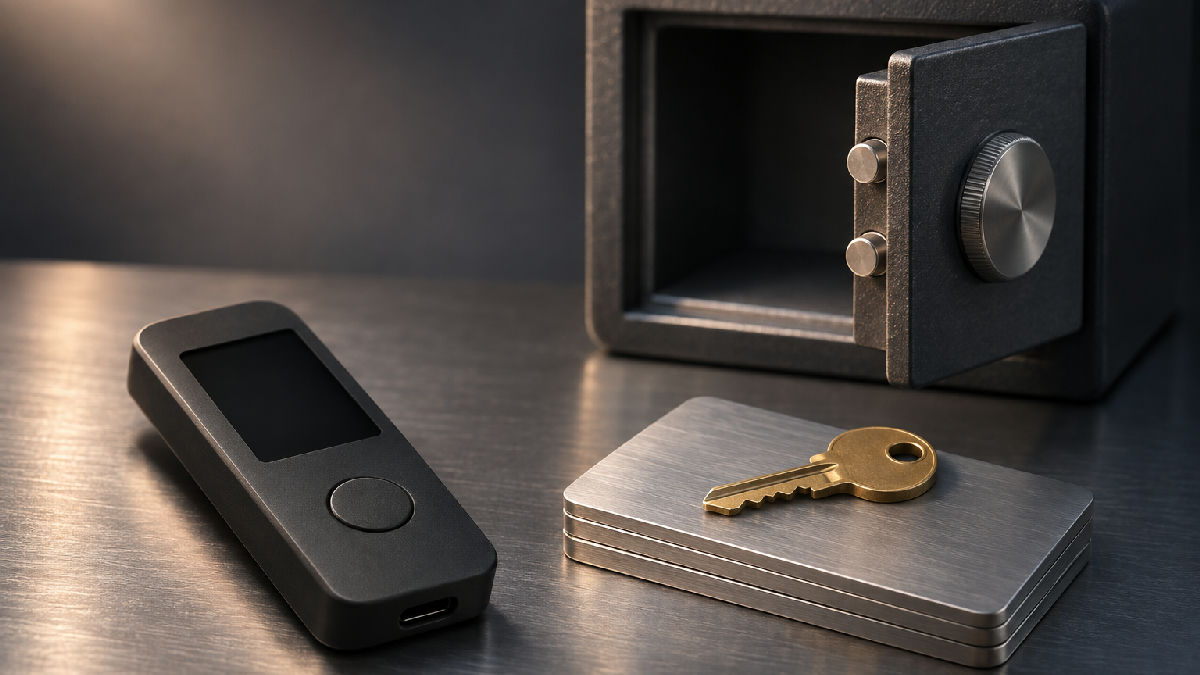
Cold wallets are physical hardware wallets or other methods that store your crypto offline. This characteristic makes them incredibly secure against online threats, essentially acting as your "Bank Vault."Definition and Core Functionality
Cold wallets keep your private keys completely disconnected from the internet. This offline nature is their defining security feature, making them impervious to online hacking attempts, malware, and phishing. While they offer superior security, they trade off some convenience for this enhanced protection.Types of Cold Wallets
Just as there are different types of bank vaults, cold storage solutions vary in their form and application:- Hardware Wallets: The "Fort Knox Device"
- These are dedicated physical devices (like USB drives) specifically designed to store private keys offline. When you want to make a transaction, the device signs it internally and then broadcasts the *signed* transaction to the network via a connected computer or phone, without ever exposing your private key to the internet.
- Examples include Ledger and Trezor.
- Security: Considered the most secure option for regular users due to their isolated environment.
- Paper Wallets: The "Hidden Treasure Map"
- A paper wallet is simply a printout of your public and private keys (often as QR codes). The keys are generated offline and then printed, with the intention that they never touch an internet-connected device again.
- Risk: While theoretically very secure if created and handled perfectly, they are prone to physical damage, loss, or degradation. They are generally not recommended for new users due to the high risk of improper handling leading to permanent loss.
- Deep Cold Storage (Brain Wallets, Multi-sig): The "Ultra-Secure Bunker"
- Brain Wallets: Involve memorizing a seed phrase or private key. While seemingly secure, human memory is fallible, and generating truly random, unguessable phrases is difficult. Not recommended.
- Multi-signature (Multi-sig) Wallets: Require multiple private keys to authorize a transaction. For example, a 2-of-3 multi-sig wallet needs two out of three designated private keys to sign a transaction. This adds significant security by distributing control and eliminating a single point of failure. These are often used for institutional holdings or shared funds.
- Security: Offers advanced security but comes with increased complexity in setup and management.
Pros:
- Offline Security: Private keys are never exposed to the internet, making them immune to online hacks.
- Immunity from Online Hacks: Malware, phishing, and remote access attacks cannot compromise an offline device.
- Full Control Over Private Keys: You maintain sole custody of your assets, aligning with the core principle of self-custody.
Cons:
- Less Convenient for Frequent Transactions: Requires physically connecting the device and entering passwords/PINs for each transaction.
- Potential for Physical Loss/Damage: The device itself can be lost, stolen, or damaged, necessitating proper backup of the seed phrase.
- Steeper Learning Curve: Setup and usage can be more complex than hot wallets, especially for multi-sig solutions.
The "Attack Vector Map" for Cold Wallets
Even bank vaults have potential weaknesses; these are typically physical:- Physical Theft for Hardware Wallets: The device itself can be stolen.
- Countermeasure: Treat your hardware wallet like cash or jewelry. Store it in a secure location (e.g., a safe) and never reveal your PIN. Crucially, your funds are protected by your seed phrase, which should be stored separately and securely.
- Improper Key Handling for Paper Wallets: Printing keys on a compromised computer, losing the paper, or having it discovered by others.
- Countermeasure: Generate keys on an air-gapped (never-internet-connected) device. Store multiple copies of the paper wallet in diverse, secure physical locations that are resistant to fire and water.
- Supply Chain Attacks: Receiving a counterfeit hardware wallet that has been tampered with.
- Countermeasure: Always purchase hardware wallets directly from the official manufacturer's website. Verify the authenticity of the device upon arrival as per the manufacturer's instructions.
The Decision-Empowerment Framework: Finding Your Perfect Fit
Choosing the right crypto storage solution is not a one-size-fits-all decision. It's a personal journey that depends on your individual needs, habits, and risk tolerance. This "Journey to Safety" requires assessing your unique situation to find the perfect balance between convenience and security.Assessing Your Needs: Questions to Ask Yourself
To guide your decision, consider these questions:- Amount of Crypto Held: Is it a small amount for experimentation, a medium investment, or a significant portion of your wealth?
- Transaction Frequency: Do you make daily trades, weekly DeFi interactions, monthly rebalances, or do you rarely touch your assets (HODL)?
- Technical Comfort Level: Are you comfortable with complex technical setups, or do you prefer simple, plug-and-play solutions?
- Risk Tolerance: How much are you willing to lose if a security incident occurs? Are you comfortable with the inherent risks of online interaction, or do you prioritize maximum offline protection?
Understanding Your Risk Tolerance: How Much Security Do You Really Need?
Your personal risk tolerance is a critical factor. If the thought of losing even a small amount of crypto due to an online vulnerability causes significant anxiety, you likely have a low-risk tolerance, pointing towards colder storage solutions. If you value immediate access and frequent interaction more, and understand the associated risks, hot wallets might suit you better for smaller amounts.The Hybrid Approach: Leveraging Both Hot and Cold Wallets
For most users, a hybrid strategy offers the best of both worlds. This involves using hot wallets for small, frequently accessed funds (like "pocket money") and cold wallets for larger, long-term holdings (like your "savings account"). This approach allows you to participate in the crypto ecosystem while maintaining a strong security posture for your primary assets. The "Crypto Flow Chart" is an interactive tool designed to guide your choice based on your input:- Amount of crypto held (small, medium, large): This influences the level of security required.
- Transaction frequency (daily, weekly, monthly, rarely): Dictates the need for convenience.
- Technical comfort level: Determines the complexity of the wallet solution you can manage.
- Risk tolerance (how much are you willing to lose?): The ultimate factor in balancing convenience and security.
- Scenario: "I have a small amount and trade often."
- Recommendation: A reputable software hot wallet (e.g., MetaMask) or an exchange wallet with strong 2FA.
- Best practices: Use unique passwords, enable all security features, and never click suspicious links.
- Scenario: "I have a significant investment and rarely trade."
- Recommendation: A hardware cold wallet is essential.
- Best practices: Purchase directly from the manufacturer, secure your seed phrase offline in multiple locations, and practice test restores.
- Scenario: "I want the best of both worlds."
- Recommendation: A hybrid strategy. Use a hot wallet for active, smaller funds and a hardware cold wallet for your main holdings.
- Best practices: Strict segregation of funds, strong security on both fronts, and careful management of your seed phrases.
Practical Security Best Practices: Your Shield Against Threats
Even with the right wallet, security is an ongoing commitment. Implementing robust security practices is your shield against the ever-evolving landscape of crypto threats.General Wallet Security:
- Strong, unique passwords and 2FA everywhere: Use complex, alphanumeric passwords for every crypto-related account (exchanges, wallets). Enable two-factor authentication (2FA) using authenticator apps (e.g., Google Authenticator, Authy) rather than SMS, which is more vulnerable to SIM swap attacks.
- Beware of phishing and social engineering: Always double-check URLs, email senders, and the legitimacy of any requests for your private information. Legitimate crypto services will never ask for your private key or seed phrase.
- Regularly update software: Keep your operating system, browser, antivirus software, and wallet applications updated. Updates often include critical security patches.
- Backup your seed phrase/private keys securely (and offline!): Your seed phrase (a series of words) is the master key to your funds. Write it down on paper and store it in multiple, secure, discreet physical locations, preferably fire- and water-proof. Never store it digitally or take photos of it.
- Never share your private keys: Your private key is your ownership proof. Sharing it means giving away your crypto.
Specific Hot Wallet Protections:
- Use reputable exchanges and software: Stick to well-established platforms and applications with a proven security record. For instance, Arbitrum One relies on Ethereum for settlement. Arbitrum One uses an EVM and WasmVM as its virtual machines.
- Enable withdrawal whitelisting: Many exchanges allow you to whitelist specific withdrawal addresses, preventing funds from being sent to unknown addresses even if your account is compromised.
- Avoid public Wi-Fi for transactions: Public networks are often unsecured and can be easily intercepted by malicious actors. Conduct transactions only on secure, private networks.
Specific Cold Wallet Protections:
- Purchase hardware wallets directly from the manufacturer: This mitigates the risk of receiving a tampered device.
- Verify device authenticity: Follow the manufacturer's instructions to ensure your new hardware wallet hasn't been compromised in transit.
- Store seed phrase in multiple secure, discreet physical locations: Redundancy is key. If one location is compromised, you have others.
- Practice "test restores" with small amounts: Before transferring significant funds, try restoring a small amount of crypto using your seed phrase on a new or wiped device. This confirms your backup is viable and you understand the process.
Real-world, anonymized hack scenarios and how to prevent them:
- The Phishing Fiasco: A user receives an email appearing to be from a crypto exchange, asking them to "verify their account" through a link. The user clicks, enters their credentials on a fake website, and their hot wallet funds are drained.
- Prevention: Always manually type website URLs, use bookmarks for frequently visited sites, and enable 2FA. Be suspicious of any unsolicited communication asking for credentials.
- The Exchange Exploit: A large centralized exchange suffers a major security breach, and funds held in its custodial wallets are stolen. Users who had left significant assets on the exchange lose their investments.
- Prevention: Practice self-custody. Use cold storage (e.g., a hardware wallet) for the majority of your assets. Only keep amounts you intend to actively trade on exchanges.
- The Lost Ledger: A hardware wallet owner loses their device in a house fire. Since they only had one copy of their seed phrase, which was stored next to the device, their funds are irretrievably lost.
- Prevention: Store your seed phrase in multiple, geographically separated, fire-resistant locations. Consider engraving it on metal or using secure recovery solutions.
⚠️ Common Mistakes to Avoid
- Storing your seed phrase digitally: This includes screenshots, photos, cloud storage, or in notes apps. If your device is compromised, your seed is exposed.
- Buying hardware wallets from third-party sellers: Always buy directly from the manufacturer to avoid tampered devices.
- Ignoring software updates: Updates often contain critical security patches that protect against newly discovered vulnerabilities.
- Using easy-to-guess PINs or passwords: Avoid sequential numbers, birthdays, or common words.
- Clicking on suspicious links: Phishing is a leading cause of crypto loss. Always verify the source and URL.
- Keeping large amounts of crypto on exchanges: Exchanges are prime targets for hackers. Move significant holdings to your own self-custodied cold storage.
- Not understanding the difference between private key and seed phrase: They are both critical; a seed phrase can generate multiple private keys.
- Reusing passwords: A breach on one site can compromise your crypto accounts if you reuse passwords.
Frequently Asked Questions
What's the absolute safest way to store crypto?
The absolute safest way involves using a hardware wallet, storing your private keys offline, and meticulously backing up your seed phrase in multiple secure, offline locations. This combination removes online attack vectors and provides redundancy against physical loss. However, this level of security trades off convenience.Can my hardware wallet be hacked?
A hardware wallet itself is designed to be highly resistant to remote hacking because it keeps your private keys offline. The device can be physically stolen, but without your PIN and seed phrase, accessing your funds is extremely difficult. The primary risks associated with hardware wallets relate to supply chain attacks (tampered devices), physical loss, or a compromised seed phrase backup.How often should I move crypto from a hot wallet to a cold wallet?
The frequency depends on your usage and the amount of crypto. A good rule of thumb is to move any funds you don't need for immediate transactions into cold storage. For active traders, moving larger profits or long-term holdings to cold storage periodically (e.g., weekly or monthly) is a smart strategy. Think of your hot wallet as a checking account and your cold wallet as a savings account.What if I lose my seed phrase?
Losing your seed phrase is equivalent to losing access to your funds if your wallet device is also lost, stolen, or damaged. Your seed phrase is the ultimate backup. Without it, your crypto may be permanently unrecoverable. This is why securing multiple, offline backups of your seed phrase is the single most critical security practice.Are exchange wallets ever safe?
Exchange wallets offer convenience for trading, but they involve custodial risk, meaning the exchange holds your private keys. While reputable exchanges invest heavily in security, they remain centralized targets for hackers. They are generally considered safe for active trading amounts but not for long-term storage of significant wealth. For true self-custody, a decentralized exchange (DEX) would be a different option, where you never give up control of your assets. DEXs allow you to trade different tokens whenever you want, with markets operating 24/7.What's the difference between a private key and a seed phrase?
A private key is a long, secret alphanumeric string that grants access to a single cryptocurrency address and its associated funds. A seed phrase (also known as a recovery phrase or mnemonic phrase), based on standards like BIP39, is a sequence of 12 or 24 words that can generate *all* the private keys and addresses for a specific wallet. If you have your seed phrase, you can restore your entire wallet and all its assets, even if you lose the physical device or software.What's Next?
Now that you've completed this guide and understand the critical differences between cold and hot wallets, you might want to:- Deepen your understanding of security principles with Essential Crypto Security Hygiene.
- Explore the nuances of different storage models by reading Difference between self custody and exchange custody crypto.
- Dive further into the specifics of hardware solutions with Hardware Wallets.
- Learn about advanced options in Cold Storage.
- Compare software and hardware more thoroughly in Digital Vaults Decoded: Understanding Security Differences between Hardware and Software Wallets.
- Continue your learning journey by exploring other wallet types and their security implications in Wallet Security Comparison.