If you’ve ever placed a trade and found yourself with a slightly different price than you expected, you’ve met slippage face-to-face. It’s that little, sometimes annoying, gap between the price you thought you were getting and the price you actually get.
Your Quick Guide to Understanding Slippage
Picture it like this: you’re trying to buy some trendy trainers online. The website shows them for £50, but by the time you've put in your card details and hit the "buy" button, the price has ticked up to £51 because so many people are trying to buy them at once. That £1 difference is a perfect, everyday example of slippage.
This happens in the tiny amount of time—often just milliseconds—between you placing an order and the exchange actually filling it. In that moment, the market can move, and your final price reflects that change.
Is Slippage Always a Bad Thing?
Not at all. While most people link slippage with losing a bit of money, it’s really just a neutral part of how markets work. It’s simply a result of price movement, and sometimes, it can even work out in your favour.
Here’s a quick look at how slippage can go, showing why it’s something to manage, not just be afraid of.
The Three Types of Trading Slippage Explained
| Type of Slippage | What It Means | Simple Example |
|---|---|---|
| Negative Slippage | Your order is filled at a worse price than you hoped for. | You try to buy a share at £10.00, but your order goes through at £10.02. You paid a little bit more. |
| Positive Slippage | Your order is filled at a better price than you hoped for. | You try to buy a share at £10.00, but your order goes through at £9.98. You paid a little bit less. |
| No Slippage | Your order is filled at the exact price you were aiming for. | You try to buy a share at £10.00, and your order goes through precisely at £10.00. |
As you can see, slippage isn't good or bad on its own; it’s just a sign of a live, moving market.
Slippage is fundamentally a measurement of price movement between order placement and execution. It's a reflection of a live, dynamic market where prices are constantly fluctuating based on supply and demand.
This happens in all kinds of financial markets, from stocks and currencies to commodities like oil. Getting a handle on these basics is a key first step for anyone looking to learn crypto trading, as the sheer speed of crypto markets can make slippage a more common thing.
Interestingly, data from the UK retail trading world shows that positive slippage happens more often than you might think. For example, a major broker called FXCM UK shares its execution numbers, which show that 25.64% of all their orders actually got positive slippage. In contrast, only 12.18% had negative slippage. That means more than twice as many orders got a better-than-expected price.
Why Does Slippage Happen? The Key Causes Explained
So, we know what slippage is. But why does it actually happen? At its heart, slippage occurs because the market price moves in the tiny window of time between when you click 'buy' or 'sell' and when your trade is actually carried out.
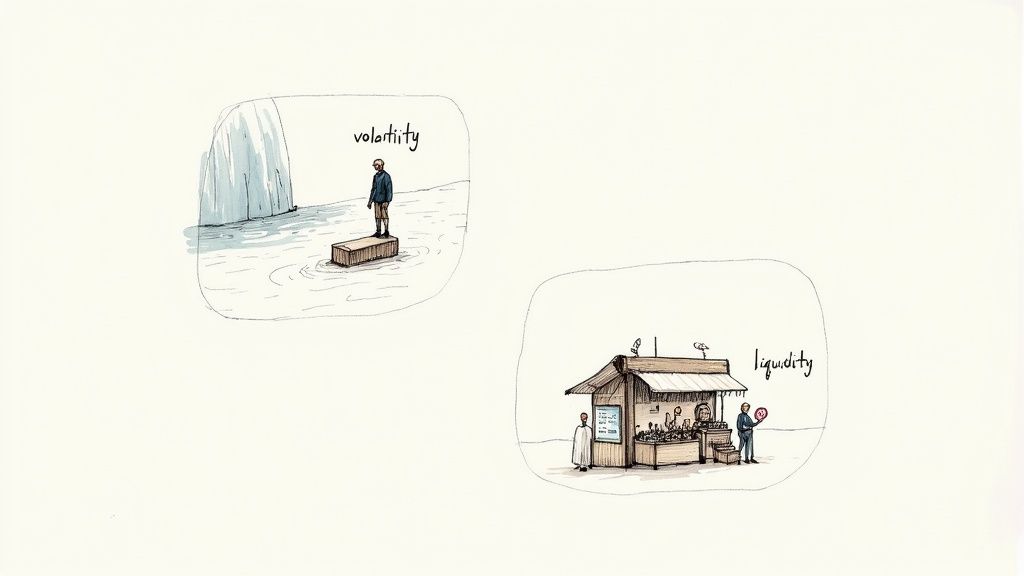
This price movement isn't random. It’s usually powered by two big market forces: volatility and liquidity.
Imagine the market is like the sea. Sometimes it’s completely calm, and other times it's a raging storm. Those two conditions directly affect whether you'll see slippage and how big it might be. Understanding these causes is the first real step towards managing how they affect your trades.
Let's break them down.
Market Volatility: The Speed of Price Changes
Volatility is just a way of measuring how fast and how much an asset's price is changing. A highly volatile market is like being on a rollercoaster; prices are shooting up and down, making it incredibly hard to lock in a precise price.
When you place an order, it isn't instant. There’s always a tiny delay—even if it's just milliseconds—as your request travels to the exchange and gets matched with someone on the other side of the trade. In a fast-moving, volatile market, a few milliseconds is more than enough time for the price to change.
Big economic news is a classic example. Imagine the Bank of England makes a surprise announcement about raising interest rates. This can send the value of the pound (GBP) soaring against other currencies in a matter of seconds.
- Let's say you try to sell the GBP/USD pair at 1.2750 the exact moment the news comes out.
- Before your order can be filled, the price might have already jumped to 1.2780. Your sell order would then be completed at this new, higher price—which is worse for you, leading to negative slippage.
In volatile conditions, the price you see on your screen is more like a snapshot in time than a guaranteed rate. The quicker the market moves, the higher the odds that the final price will be different.
This is exactly why experienced traders are often careful about placing large market orders right around major news events or during times of known uncertainty.
Market Liquidity: The Depth of Buyers and Sellers
Liquidity describes how easily you can buy or sell something without causing a big change in its price. It all comes down to how many active buyers and sellers are in the market at any given time.
Think of it like a busy city market versus a quiet village stall. The huge, bustling market has tonnes of fresh produce (high liquidity) and can easily handle a massive order without any trouble. The small, quiet stall (low liquidity) might run out of apples if you place a big order, and the owner might have to charge you more for the last few.
In financial markets, high liquidity means there are plenty of buy and sell orders ready to go, creating a "deep" order book. This depth can soak up large trades with very little effect on the price.
On the other hand, low liquidity means there are fewer people trading and a much thinner order book. Placing a big order here can quickly use up all the available orders at the current price, forcing the rest of your trade to be filled at the next available prices, which get progressively worse.
For instance, trying to buy £50,000 worth of shares in a small, little-known company is a completely different world from buying the same value in a giant company like HSBC.
- HSBC (High Liquidity): There are millions of shares being traded. Your order would likely fill almost instantly, right at the price you were quoted.
- Small AIM Stock (Low Liquidity): Your £50,000 buy order could use up all the shares being offered at the current price, then the next price up, and so on. The final average price you pay would end up being noticeably higher than the price you first saw, causing major slippage.
How to Calculate Your Trading Slippage
Slippage isn't just some vague trading idea; it's a real, measurable cost that you can and should be tracking. When you learn how to work it out, you turn what could be a nasty surprise into a genuinely useful piece of information. This simple bit of maths lifts the lid on the true cost of your trades and even gives you a way to check that your broker is being fair.
Figuring out slippage is refreshingly simple. All we're doing is comparing the price you thought you would get with the price you actually got. By doing this, we can put a solid number on its impact, both in pounds and as a percentage.
Let's walk through the basic formula and then use it in a couple of clear, real-world examples.
The Simple Formula for Slippage
To figure out your slippage, you only need three bits of info: the price you expected, the price you actually paid, and how much you traded.
It breaks down into these main steps:
- Find the Price Difference: Take away your expected price from your actual executed price. This is the slippage per share or unit.
- Calculate the Total Cost: Multiply that price difference by the number of shares or units you traded.
- Work out the Percentage (Optional): This is useful for comparing different trades. Just divide the total slippage cost by your total expected trade value and multiply by 100.
Let's see how this works in practice.
Example 1: Calculating Slippage on a UK Stock Trade
Imagine you want to buy some shares in a big FTSE 100 company, let's say HSBC. You look at the screen and see the price is £6.50 per share, so you decide to place an order for 1,000 shares.
- Your Expected Cost: 1,000 shares x £6.50 = £6,500
But it’s a busy morning on the stock market, and by the time your order goes through the system and gets filled, the average price you end up paying is £6.52 per share.
- Your Actual Cost: 1,000 shares x £6.52 = £6,520
Now we can see the slippage clear as day:
Total Slippage Cost: £6,520 (Actual Cost) - £6,500 (Expected Cost) = £20
You experienced £20 of negative slippage. That’s a real cost that has eaten directly into your potential profit. In the UK stock market, these execution costs are watched very closely. A London Stock Exchange case study actually found that, on average, trades stray from the mid-price by an amount equal to 14% of the bid-ask spread—a key sign of how well trades are executed.
Example 2: Calculating Slippage in a Forex Trade
Now, let's switch over to a currency trading example using the popular GBP/USD pair. You decide to buy £100,000 worth of pounds against the US dollar, and you're expecting to get it done at a rate of 1.2500.
- Your Expected Execution: You plan for the trade to go through at that exact price.
Suddenly, a big news announcement hits the headlines, and the market jolts. Your order gets executed, but at an average price of 1.2495.
- Price Difference per Unit: 1.2500 (Expected) - 1.2495 (Actual) = 0.0005
Wait a second. Since you were buying GBP, a lower price is actually better for you. This is positive slippage!
- Total Positive Slippage: 0.0005 x 100,000 units = $50
In this situation, the market moved in your favour between the time you clicked the button and when your trade was filled, saving you $50. Learning to calculate your trading slippage is a vital skill. It helps you understand the hidden costs—and sometimes benefits—of your trading, letting you tweak your strategy for better results.
Slippage In The World Of Crypto And DEXs
When you move into crypto trading, especially on decentralised exchanges (DEXs), the idea of slippage takes on a whole new importance. Platforms like Uniswap and PancakeSwap don't work like traditional stock exchanges with neat order books. Their unique design completely changes how you'll experience slippage.
On many of these platforms, slippage isn't just a side effect; it's a built-in feature of the system. That's because they're often powered by Automated Market Makers (AMMs). Instead of matching individual buyers and sellers, AMMs use big pools of tokens to make trades happen. This completely different way of doing things creates new challenges that every crypto trader needs to understand. For a closer look, our guide explaining how Automated Market Makers work is a great place to start.
What Is Slippage Tolerance In Crypto?
On a DEX, you’ll find a setting called slippage tolerance. This gives you direct control over the biggest price change you’re willing to put up with for your trade to go through. It’s like telling the exchange, “I want to swap my ETH for this many tokens, but if the price moves against me, I’ll accept up to 1% less to make sure it happens.”
Getting this setting right is a tricky balancing act.
- Set it too low (e.g., 0.1%): In a fast-moving market, your trade will probably fail. The price can easily move beyond your tight limit before the transaction is confirmed on the blockchain. You won't lose your money (other than the network fee), but your trade just won't happen.
- Set it too high (e.g., 5%): Your trade is almost guaranteed to go through, but you're also opening the door to a much worse price than you wanted. In extreme cases, you could see a big chunk of your trade's value just disappear.
Most DEXs suggest a default tolerance, usually between 0.5% and 1%, which is fine for most common trades. However, you'll want to change this based on how volatile the token is and how much risk you're comfortable with.
Crypto-Specific Challenges: Front-Running And MEV
The very open nature of blockchains creates some unique problems that can make slippage even worse. Because every pending transaction sits in a public waiting line (known as the mempool) before being confirmed, it creates a chance for clever bots to jump the queue.
One of the most common tricks is called front-running. Here's a quick look at how it works:
- You submit a large buy order for a token on a DEX.
- A bot scanning the mempool sees your transaction and knows it's big enough to push the price up.
- The bot instantly submits its own buy order for the same token, but with a higher network fee to make sure its trade gets processed before yours.
- The bot's trade happens first, causing a small price increase.
- Your transaction is finally processed, but at this newly inflated price. You just got hit with more slippage.
- The bot then immediately sells its tokens at the higher price it just created, making a quick, almost risk-free profit at your expense.
This is all part of a wider idea called Maximal Extractable Value (MEV), where blockchain miners or validators reorder transactions to squeeze out as much profit as possible. It’s a complicated and debated topic, but for the average trader, the end result is often more unexpected and expensive slippage.
This chart breaks down how slippage is calculated in any trade, showing the difference between what you hoped for and what you got.
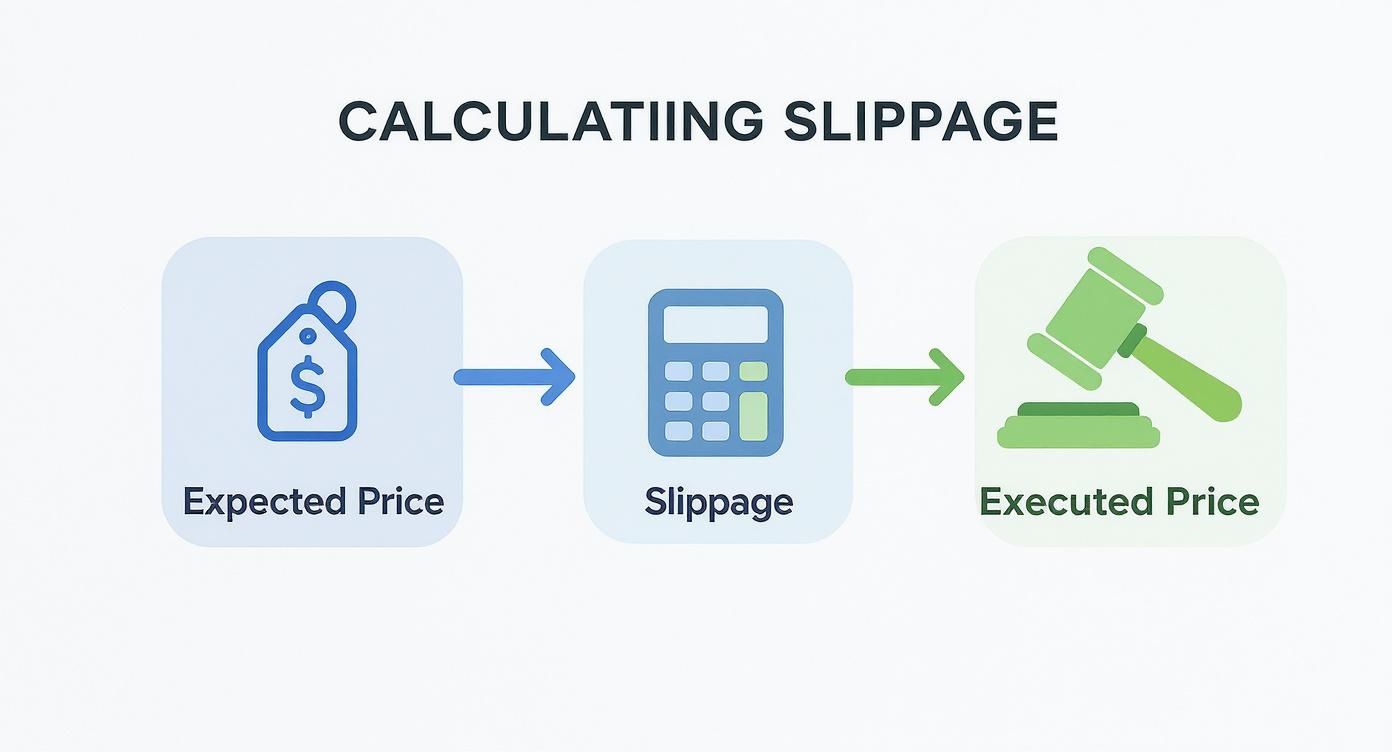
Ultimately, slippage is the gap between the price you click and the price you get. In the fast-paced, open world of crypto, understanding these unique factors is key to protecting your money and trading more effectively.
Practical Ways to Minimise Negative Slippage
You can't get rid of slippage completely—it's just a natural part of any lively market. But you absolutely can take smart steps to manage it. By being clever, you can protect your money and stop giving away profits for no reason.
Knowing what causes slippage is one thing, but actively fighting its effects is where you gain a real advantage. The following methods are practical, easy to use, and used by traders every day to keep a tight grip on their trade execution.
Choose Your Order Type Wisely
Your single most powerful tool for handling slippage is the type of order you place. Most beginners just use market orders because they’re simple, but they offer zero protection against slippage.
Market Orders: These just tell your exchange to buy or sell right now at whatever the best available price is. This guarantees your trade gets done, but you’re totally exposed to any last-second price jumps.
Limit Orders: This is your main line of defence. A limit order lets you set the exact price you're willing to accept (or a better one). For a buy order, you set the maximum price you'll pay; for a sell, you set the minimum price you'll accept. It's that simple.
For instance, if you want to buy ETH at £3,000, you set a limit order for exactly that price. This makes sure you'll never pay a penny more. The only catch? If the price zooms past your limit without ever hitting it, your order might not get filled at all. It's a trade-off between getting the price you want and making sure the trade actually happens.
To make this clearer, let's see how different order types perform against slippage.
Comparing Order Types for Slippage Management
The order you pick directly controls how much slippage risk you're willing to take on. Here’s a quick breakdown of the most common types.
| Order Type | How It Works | Slippage Risk | Best For |
|---|---|---|---|
| Market Order | Executes immediately at the current best available price. | High | When speed is more important than the exact price. |
| Limit Order | Executes only at your specified price or better. | Low / None | When getting your price is more important than speed. |
| Stop-Loss Order | Becomes a market order when a certain price is reached. | High | Limiting losses, but can slip in fast-moving markets. |
| Stop-Limit Order | Becomes a limit order when a certain price is reached. | Medium | Offers more price control than a standard stop-loss. |
Ultimately, limit orders give you the most direct control over your execution price, making them the top choice for traders focused on reducing slippage.
Avoid Trading During High Volatility
Slippage loves chaos. Big news events, like central bank announcements or major political results, can cause prices to swing wildly in seconds. Trading during these moments is like trying to catch a falling knife—it’s just not a good idea.
By simply waiting for the first few minutes after a big news release or the market open, you can avoid the most extreme periods of volatility where slippage is at its worst. Let the dust settle, then place your trade.
This is especially true in currency markets around interest rate decisions. Liquidity can dry up in an instant as prices gap up or down, creating a perfect storm for huge slippage.
Break Up Large Orders
If you need to place a big trade, especially in a less liquid market like a small-cap altcoin, dropping a single massive market order is asking for trouble. Think of it like trying to drain a swimming pool with a fire hose—you'll create huge waves and drastically change the water level.
A much better way is to break your large order into several smaller pieces. This technique, often called order splitting, gives you two key advantages:
- Reduced Market Impact: Smaller orders are soaked up more easily by the order book without pushing the price against you.
- Better Average Price: You can spread your trades out over time, potentially getting a much better average price.
This can be automated, too. For those interested in more advanced methods, you can learn more by checking out our guide on mastering crypto trading bots, which covers tools that can help carry out these kinds of clever orders.
Trade on High-Liquidity Platforms
Finally, where you trade matters a lot. Not all exchanges are the same. Slippage is far less of an issue on platforms with deep liquidity, which simply means there are loads of buyers and sellers active at any one time.
Before you put real money on the line, do your research. Stick to exchanges known for high trading volumes in the assets you're interested in. For crypto traders, this means choosing major DEXs like Uniswap for popular tokens, as their huge liquidity pools can handle big trades with minimal effect on the price.
Trading Slippage: Your Questions Answered
Even when you've got the basics down, a few questions about slippage always seem to pop up. Let's tackle some of the most common ones to really cement your understanding and help you trade with more confidence.
Is Slippage Always a Bad Thing?
Not at all. We tend to focus on the downside—what's known as negative slippage—where you get a worse price than you hoped for. But it's just as important to remember that positive slippage is also a real thing. This happens when the market actually moves in your favour in that split second between placing your order and it getting filled.
Imagine you put in a buy order for a stock at £10.00, but by the time it executes, the price has dipped, and it fills at £9.98. Any good broker will pass that better price straight on to you. You've just saved a bit of money. It's a perfectly normal, and very welcome, part of trading.
Which Markets are Most Prone to Slippage?
You'll find slippage is most common wherever high volatility and low liquidity meet. That combination is a perfect recipe for prices to jump around and for larger orders to make waves.
Generally, you'll see the highest slippage in these markets:
- Cryptocurrencies: This is especially true for smaller, less-traded altcoins or brand-new tokens launching on decentralised exchanges (DEXs).
- Small-Cap Stocks: Companies with smaller trading volumes naturally have thinner order books, which means bigger trades can easily push the price around.
- Exotic Forex Pairs: Unlike the big players like EUR/USD, more obscure currency pairs have far fewer people trading them, which means lower liquidity.
On the flip side, markets with huge trading volumes, like blue-chip stocks on the FTSE 100 or major currency pairs, tend to have much less slippage because the order books are so deep.
Is It Possible to Avoid Slippage Entirely?
In short, no. You can't completely get rid of the risk of slippage, because it's just a natural part of any live market where prices are always changing. What you can do, however, is almost completely avoid negative slippage by using the right order types.
The single best way to protect yourself from paying more than you want is to use a limit order. This type of order guarantees your trade will only execute at your specified price—or even better.
The only catch? A limit order might not get filled. If the market price zips past your limit and doesn't come back, your trade will just sit there, unexecuted. So, while it gives you total control over your price, you lose the certainty of an instant fill that you get with a market order.
Ready to turn knowledge into action? At The Coin Course, we create clear, expert-led guides to help you navigate the world of crypto with skill and confidence. From the absolute basics to advanced trading strategies, we’ve got you covered. Start your learning journey with The Coin Course today.