
If you want to learn crypto trading, it helps to start with the basics. At its core, it's the simple act of buying and selling digital currencies, like Bitcoin or Ethereum, to try and make a profit from their constantly shifting prices. You could compare it to trading stocks, but everything happens in a much newer, faster-moving digital world.
In short, you're making an educated guess on whether a digital currency's value will go up or down.
Your Starting Point to Learn Crypto Trading
Welcome to the exciting world of cryptocurrency trading. My goal here is to cut through the jargon and complexity, giving you a strong foundation without making you feel overwhelmed. We'll break down the big ideas into simple, bite-sized pieces so you feel comfortable and ready for what comes next.
The main idea is easy to grasp: you buy a cryptocurrency hoping its price will climb, allowing you to sell it later for more than you paid. Imagine you buy one Solana coin for £100. If its price shoots up to £120, you’ve made a £20 profit. Of course, if the price drops to £80, you're looking at a loss. It’s this up-and-down movement that creates both the opportunity and the risk.
Why Now Is a Great Time to Learn in the UK
The United Kingdom has quietly become a major hotspot for cryptocurrency. The scene is always changing, with more people jumping in every day, which makes it a fascinating time to dive in and start learning.
This isn't just a small trend; it's a huge shift. In fact, the UK saw the fastest growth in cryptocurrency adoption worldwide in 2025. Today, nearly 24 million Britons—that's roughly 35% of the population—own or use some form of crypto. This explosion in ownership over the last few years signals a clear move into the mainstream. You can find more details on the UK's crypto adoption on The Beer Connoisseur.
Crypto trading is less about having a crystal ball and more about managing chances. The goal isn't to be right every single time, but to have a strategy that makes money in the long run.
What You Will Learn in This Guide
I’ve designed this guide to take you from a complete beginner to feeling confident enough to take your first real steps. The information is laid out in a logical way, building your knowledge one layer at a time.
Here’s a sneak peek at what we’ll cover:
- Market Fundamentals: We'll get to grips with how the crypto market actually works, explaining key ideas like market cap and trading volume.
- Beginner Strategies: You'll discover simple, practical strategies you can use from day one, like Dollar-Cost Averaging (DCA).
- Choosing a Platform: Find out what to look for when picking a safe and reliable UK-based trading platform that fits your style.
- Risk Management: This is vital. We’ll cover the essential skills you need to protect your money and trade responsibly.
- Your First Trade: I'll walk you through placing your very first trade, step by step, so you can do it with confidence.
Ultimately, the goal is to arm you with the understanding and tools needed to navigate the crypto markets safely.
Understanding How the Crypto Market Works
Before you can trade crypto well, you need to understand the playground you’re in. At first, the crypto market can feel like total chaos, but it really runs on a few key principles. Getting your head around these is the difference between making smart choices and just gambling your money away.
Picture it as a huge, digital marketplace that never closes. It’s open 24/7, with prices bouncing around based on what people across the globe are willing to pay at any second. This constant activity is driven by everything from supply and demand to breaking news and technology updates.
The Big Three Market Metrics
When you check out any cryptocurrency, three key numbers give you an instant snapshot of its size and importance. Learning to read them is essential for making any sense of market data.
Market Capitalisation (Market Cap): This is the total value of all the coins ever created for a specific crypto. To figure it out, you just multiply the current price of one coin by the total number of coins out there. For instance, if a coin is worth £2 and there are 10 million of them, its market cap is £20 million. A gigantic market cap, like Bitcoin’s, often means more stability. A smaller one suggests higher risk but also hints at more room for growth.
Trading Volume: This number tells you how much of a cryptocurrency was bought and sold over a certain period, usually the last 24 hours. High trading volume is a good sign; it shows there’s lots of interest and good liquidity, meaning you can buy or sell easily without causing a huge price change.
Volatility: This is all about how much a crypto's price jumps around. The crypto market is famous for its high volatility. A small, lesser-known coin like Kaspa might rocket 50% in a single day, while a giant like Ethereum might only move a few percent. This is where both the big potential profits and the serious risks are found.
A simple comparison between Bitcoin and a small, new altcoin really illustrates this. Bitcoin has a massive market cap, often in the hundreds of billions of pounds, and its daily trading volume is huge. Its price is still volatile compared to traditional stocks, but it’s a much calmer sea than an altcoin with a market cap of only a few million, which could easily double or halve its value overnight.
Where Does the Trading Happen? CEX vs DEX
Your trades will happen on an exchange – a platform that acts as a marketplace, connecting buyers and sellers. Here in the UK, you have two main types to choose from, and they work in very different ways.
Centralised Exchanges (CEX)
These are the platforms most people know and start with. They're run by a company that acts as a trusted middleman, much like a regular bank or stockbroker. You sign up, deposit your pounds, and the exchange handles matching your buy and sell orders with other people.
For most people just starting to learn crypto trading, a centralised exchange is the best bet. They offer convenience, customer support, and easy-to-use features that make the whole process much less scary.
Decentralised Exchanges (DEX)
These are the wilder side of crypto. A DEX runs without any central company in charge. Instead, trades happen directly between users (peer-to-peer) using automated programs called smart contracts. You connect your own personal crypto wallet to the platform and never give up control of your funds.
Here’s a quick table to help you see the key differences at a glance:
| Feature | Centralised Exchange (CEX) | Decentralised Exchange (DEX) |
|---|---|---|
| Control of Funds | The company holds your crypto for you. | You always keep full control in your own wallet. |
| Ease of Use | Usually very beginner-friendly and simple to use. | Can be more complicated, requiring more technical skill. |
| Security | A big target for hackers, though top exchanges have strong security. | You’re responsible for your own security; less risk of one big hack. |
| Regulation | Often required to follow UK rules, like those from the FCA. | Typically less regulated and operate more freely around the world. |
For most newcomers in the UK, a CEX like Coinbase or Kraken is the most sensible place to begin. The experience feels familiar, offering a smooth entry from traditional finance into the world of digital money. Once you're comfortable, exploring a DEX might just be your next adventure.
Beginner Trading Strategies You Can Use Today
Now that we’ve covered the market basics, it’s time to get into the ‘how’ of trading. A huge part of learning to trade crypto well is picking the right strategy, and that really depends on your personal goals, how much time you can realistically spend, and your appetite for risk.
At the highest level, you can think of it as two main approaches: long-term investing versus short-term trading. It’s a bit like owning property. An investor might buy a house to live in for years, betting on its value growing slowly over the long haul. A trader, on the other hand, is more like a house-flipper—they buy a place, do it up quickly, and aim to sell it for a fast profit.
Both methods are perfectly fine, but they require totally different mindsets and levels of hands-on work.
The Long-Term Approach: HODLing
In the crypto world, long-term investing has a famous nickname: HODLing. The term started as a funny typo in an old Bitcoin forum post and now stands for "Hold On for Dear Life." It’s the simplest strategy of all. You buy a cryptocurrency you believe in for the long run and then just hold it for months or, more often, years, completely ignoring the daily price drama.
The whole point is to ride out the ups and downs, trusting that the overall value of your chosen asset will be much higher in the future. This is a very hands-off approach that doesn’t tie you to your screen watching charts all day. It's an investment in a project's future, not a bet on its price next week.
Dollar-Cost Averaging: A Smart Way to Start
One of the most popular and beginner-friendly strategies is Dollar-Cost Averaging (DCA). It's a fantastic way to build up an investment over time without trying to "time the market," something that even expert traders find almost impossible.
With DCA, you invest a set amount of money at regular times, no matter what the price is. For example, you might decide to buy £50 worth of Ethereum every Friday.
- When the price is high, your £50 gets you a little less Ethereum.
- When the price is low, that same £50 buys you a little more.
Over time, this averages out your purchase price. It removes the stress and emotion from trying to buy at the perfect bottom, which often leads to overthinking and missed chances. DCA helps you consistently build your investment and can seriously reduce the impact of volatility on your portfolio.
"Dollar-Cost Averaging is a disciplined method that takes the guesswork out of investing. It forces you to buy when others are scared and helps you avoid putting all your money in at a market high."
Active Trading: A Higher-Risk Game
If HODLing is a marathon, active trading is a series of sprints. Active traders are all about making money from short-term price movements. This requires a much bigger time commitment, a solid understanding of market analysis, and a good amount of courage to handle the risk. If you're just starting to learn crypto trading, it's wise to begin with a very small amount of money when trying these methods.
There are two main types of short-term trading:
Swing Trading
Swing traders aim to catch the "swings" in the market that happen over a few days or weeks. They aren't worried about where a coin's price will be in a year; they’re focused on its likely moves in the near future.
For example, a swing trader might see that Bitcoin has bounced off the £45,000 price level several times before. Believing it will happen again, they buy in, set a target price to sell at a few days later (say, £48,000), and place a stop-loss to limit their losses if the trade goes the wrong way. This really needs a good understanding of technical analysis. To get started, you’ll find our comprehensive guide on reading cryptocurrency charts and indicators incredibly helpful.
Day Trading
Day trading is the most intense form of active trading, without a doubt. A day trader opens and closes all of their positions within a single day, aiming to profit from tiny, quick price changes. They might make dozens of trades in just a few hours.
This strategy demands constant focus and a deep understanding of market behaviour. Because of the high number of trades and the small profit on each one, day trading is widely seen as the riskiest approach and is definitely not recommended for complete beginners.
How to Choose a UK Crypto Trading Platform
Picking a trading platform is like a chef choosing their favourite knife; it’s the main tool you'll be using every day. As the UK crypto scene grows, new platforms are appearing all the time, which can make the choice feel huge. But don't worry. By focusing on a few key areas, you can find a platform that’s safe, simple, and a perfect fit for your goals.
The right platform can make or break your early trading journey. A good one feels natural and helps you along, while a bad one can be a frustrating and costly experience. It's all about finding that sweet spot between powerful features and a beginner-friendly design.
Security First, Always
Before you even look at the fancy charts or the long list of available coins, your number one priority must be security. The crypto world has its share of scammers, so you need total confidence that your money and personal data are safe and sound.
This means looking for platforms that offer Two-Factor Authentication (2FA) as a basic feature – it adds a vital extra layer of protection to your account. It's also smart to check if the platform has ever had any major security problems. Good exchanges are usually open about their security measures. For a deeper look, our guide on how to protect your assets on an exchange is a must-read.
Financial Conduct Authority Registration
Here in the UK, it’s crucial to pick a platform that is registered with the Financial Conduct Authority (FCA) for anti-money laundering purposes. This registration isn't just a piece of paper; it shows the platform meets certain official standards, giving you a valuable layer of protection and peace of mind.
While the FCA doesn't regulate crypto trading in the same way it does stocks, this check is a strong sign of a platform's legitimacy and commitment to doing things right. You can easily check any company's status on the FCA's official register.
A platform's dedication to rules and security is a direct reflection of its dedication to its users. Never compromise on these basics for the sake of lower fees or a wider coin selection.
Key Features to Compare
Once you’ve sorted security and regulation, you can start comparing other important features. Different platforms are built for different people, from super-simple apps designed for your first Bitcoin purchase to advanced exchanges packed with complex trading tools.
When you're looking at your options, it's a good idea to have a clear checklist of what matters most to you as a beginner.
| Feature | Why It Matters for Beginners | What to Look For |
|---|---|---|
| Ease of Use | A confusing layout can lead to expensive mistakes. Simplicity is vital when you're starting out. | A clean, simple interface. Look for a straightforward dashboard and clear "buy/sell" buttons. |
| Available Coins | You need access to the assets you want to trade, but too many choices can be confusing. | A good selection of major coins like Bitcoin (BTC) and Ethereum (ETH), plus any specific altcoins you're interested in. |
| Fees | Hidden charges can quickly eat into your profits. You need total clarity. | A clear list of trading fees, deposit/withdrawal costs, and any account management charges. |
| Payment Methods | You need a handy way to get your money in and out. | Support for UK bank transfers (Faster Payments), debit cards, and possibly PayPal. |
| Customer Support | When something goes wrong, you need to know you can get help quickly. | Look for platforms offering live chat, a UK phone number, or a fast email support team. |
Ultimately, the best platform is one that matches your trading style and comfort level.
The infographic below offers a simple way to think about this. Are you leaning more towards a lower-risk, long-term hold, or a higher-risk, more active trading approach?
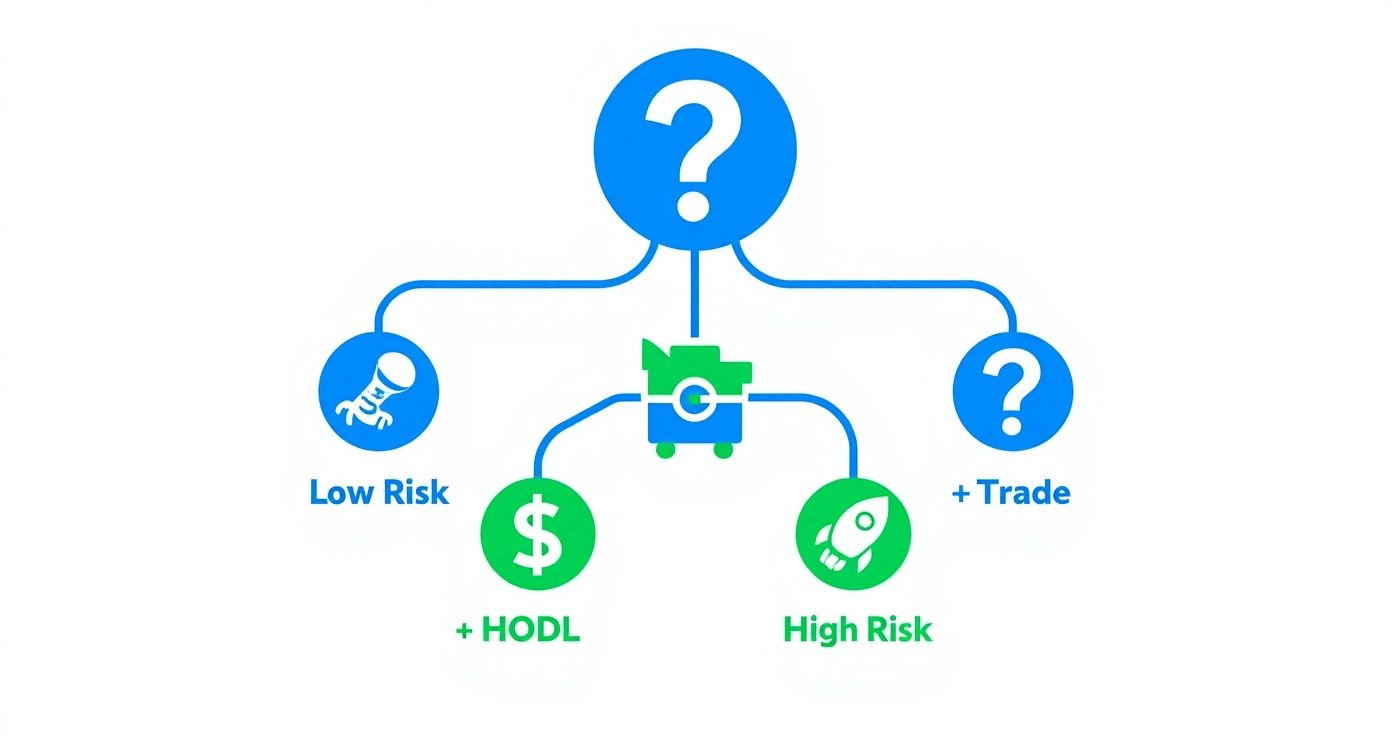
This picture helps frame the main choice many newcomers face, guiding you toward a platform that fits your personal strategy.
Taking the time to get this right is more important than ever. The UK cryptocurrency market was valued at around USD 301.2 billion in 2024 and is expected to grow to USD 550.9 billion by 2033. This impressive growth shows that doing your homework now and choosing a solid, trustworthy platform is a very smart move for the future.
Mastering Risk Management to Protect Your Money
Of all the skills you’ll learn on your crypto trading journey, nothing—and I mean nothing—is more important than learning how to manage your risk. The crypto market is known for its wild price swings. Without a solid plan to protect your money, you’re not really trading; you’re just gambling. This is the part where you move from being a hopeful beginner to a strategic trader.
The first rule is the simplest and the most vital: never invest more than you can comfortably afford to lose. Seriously. Once you put money into crypto, you should mentally be okay with it disappearing. If its value dropping to zero tomorrow would put you in a bad financial spot, you've put in too much. This one rule alone will save you from a world of emotional decisions driven by panic or greed.
Setting Up Your Safety Nets
Smart traders don’t just hope for the best; they plan for the worst. Luckily, most trading platforms give you automated tools that act as your digital safety nets, making trades for you when the price hits a certain level. Getting the hang of these is absolutely essential.
The two most important tools in your kit are stop-loss and take-profit orders.
Stop-Loss Orders: Think of this as your emergency exit. A stop-loss automatically sells your crypto if the price falls to a specific point you've already set. Let's say you buy Bitcoin at £50,000. You could place a stop-loss order at £47,500. If the market turns and the price drops to that level, your position is automatically sold, limiting your loss to 5%. It's what stops a small dip from turning into a huge financial blow.
Take-Profit Orders: This is your planned exit strategy for cashing in your gains. A take-profit order is the mirror opposite, automatically selling your crypto when it climbs to a target price. Using our Bitcoin example, you might set a take-profit at £55,000. If the price goes up, your crypto is sold, and you lock in that profit before greed kicks in and you risk losing it all.
These tools are amazing because they take emotion out of the picture. They force you to stick to the plan you made with a clear head, which is your best defence against the market's ups and downs.
The Power of Diversification
You’ve surely heard the old saying, “Don’t put all your eggs in one basket.” In the world of trading, this classic advice is called portfolio diversification, and it’s a key part of smart risk management. Instead of putting all your cash into a single cryptocurrency, you spread your investment across several different assets.
And this means more than just buying a few different coins. A well-diversified crypto portfolio might look something like this:
- Established Leaders: A good chunk of your money in major coins like Bitcoin (BTC) and Ethereum (ETH), which tend to be more stable than the rest of the market.
- Promising Altcoins: A smaller portion dedicated to altcoins from different areas, like Decentralised Finance (DeFi) or gaming, which have higher growth potential but also carry more risk.
- Stablecoins: Keeping some of your funds in stablecoins (which are pegged to a currency like the US dollar) gives you a safe place to go when the market gets very turbulent.
The real goal of diversification isn't just about chasing the biggest profits; it's about reducing your losses. If one of your investments takes a nosedive, the others can help soften the blow to your overall portfolio.
Imagine for a second that you went all-in on a new gaming token that suddenly crashed, losing 50% of its value. Your whole investment would be cut in half. Now, what if that same token only made up 10% of your portfolio? Your total loss would be a much more manageable 5%. This strategy is what helps you survive the downturns and stay in the game long enough to see the rewards of your good decisions. For a deeper dive, our complete guide on risk management in cryptocurrency trading covers more advanced strategies.
By combining the golden rule of investing, using automated safety nets like stop-loss orders, and building a smartly diversified portfolio, you create a solid foundation for your trading. These habits won't guarantee you win every trade, but they will dramatically improve your odds of protecting your money and trading for years to come.
A Step-by-Step Guide to Your First Crypto Trade
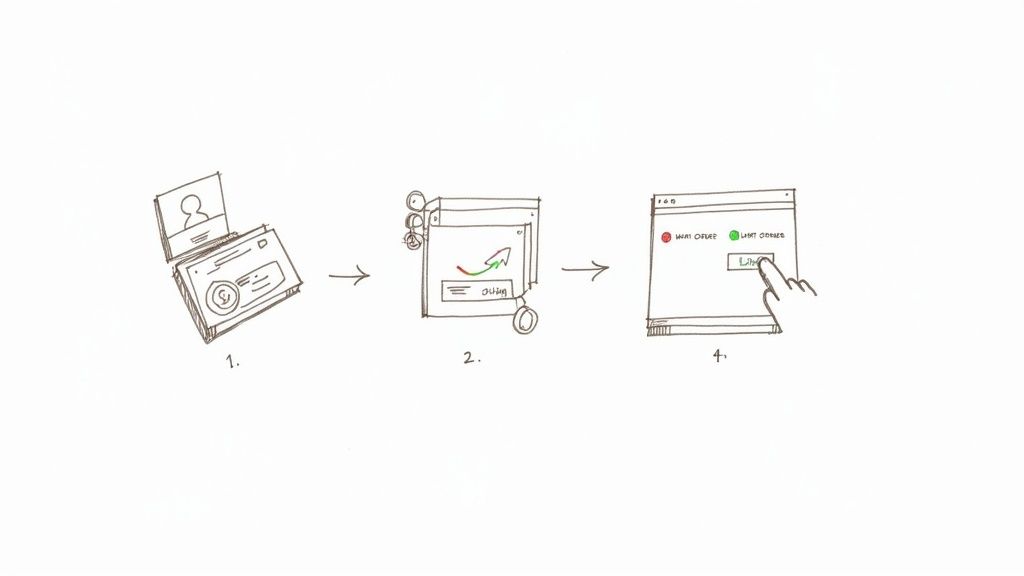
Right, you’ve got a handle on strategy and risk management. Now for the fun part – putting your knowledge into action and actually placing your first trade. It can feel like a big step, but breaking it down into a few simple stages makes it much less scary.
Let’s walk through it together, from setting up your account to hitting that final ‘buy’ button. The aim here is to get you feeling comfortable and confident.
Getting Your Account Ready
First things first, you need to get your chosen trading platform set up and ready to go. Think of it like opening a new bank account; the platform needs to check you are who you say you are.
- Sign Up and Verify: Start by creating an account with your email and a strong password. To follow UK rules, you’ll then need to complete a verification process, usually called 'Know Your Customer' (KYC). This typically means uploading a photo of your ID (a passport or driving licence is perfect) and sometimes a proof of address.
- Deposit Your Funds: Once you're verified, you can put some money into your account. For most of us in the UK, the easiest way is a simple bank transfer via Faster Payments, which is usually free and arrives almost instantly. You can deposit pounds (GBP) directly, which you'll then use to buy your chosen crypto.
Navigating the Trading Dashboard
The trading dashboard is your control centre. At first, it can look like something out of a sci-fi film, with all its flashing numbers and moving charts. Ignore the noise for now.
All you need to focus on are the key parts: the price chart, the list of different cryptocurrencies, and the all-important 'buy' and 'sell' order box. This is where you make things happen.
A quick piece of advice: your first trade doesn't need to be a big one. Starting with a small amount, say £20 or £50, is a very smart way to get a feel for the process without taking on any serious risk.
Choosing Your Order Type
When you’re ready to buy, you’ll usually have two main ways to do it. Understanding the difference between them is vital for controlling how you enter the market.
- Market Order: This is the simplest and quickest option. A market order tells the platform to buy the crypto immediately at the best price available. It’s like walking into a shop and saying, "I'll take it," paying whatever the price tag says at that moment. Your order gets filled almost instantly.
- Limit Order: This one gives you more control. With a limit order, you set the exact price you’re willing to pay. For example, if Bitcoin is trading at £50,000 but you think it might dip, you could set a limit order to buy at £49,500. Your order will only go through if and when the price hits your target.
For your very first trade, a market order is usually the most straightforward choice.
It's also interesting to see that more and more UK investors are getting involved through regulated products. In 2025, there was a record surge in money flowing into crypto Exchange-Traded Products (ETPs), with net inflows in Europe hitting around EUR 972.3 million in the third quarter alone. This trend shows how regulated options are making the market much easier to access. You can read more about the rise of UK crypto ETPs on Morningstar.
Once you’ve picked your order type, entered the amount, and given the details one last check, there’s only one thing left to do: click ‘buy’. And just like that, you’ve officially made your first crypto trade. Congratulations!
Common Questions About Crypto Trading in the UK
As you get ready to start, it’s completely normal to have a few last-minute questions. Think of this final section as a quick Q&A to clear up some of the most common things beginners in the UK ask. Getting these sorted will help you start with more confidence.
Is Crypto Trading Legal in the UK?
Yes, absolutely. In the UK, it is perfectly legal to buy, sell, and trade cryptocurrencies. However, the industry doesn't operate with no rules; there are things you need to know.
The main one is to always try and use a trading platform registered with the Financial Conduct Authority (FCA). This isn't a guarantee for the investments themselves, but it shows the platform meets certain standards for anti-money laundering and how it operates. Also, don't forget about tax. Any profits you make could be subject to Capital Gains Tax, so keeping very clear records from day one is a smart move.
How Much Money Do I Need to Start?
This is one of the best things about getting into crypto – you don't need a huge amount of cash. The entry barrier is surprisingly low. Many platforms available to UK residents will let you begin with as little as £10 or £20.
Remember that golden rule we talked about? It’s especially important here: never invest more than you can comfortably afford to lose. Treat your first few trades as a learning experience, not a winning lottery ticket.
Starting small lets you get a real feel for the process – the excitement of placing an order, the nerves of watching the market move – all without risking your rent money.
What Is the Difference Between a Coin and a Token?
This is a classic point of confusion for new people, but the difference is actually quite simple once you have the right comparison.
- A coin (like Bitcoin or Ethereum) is the main currency of its own unique blockchain. You can think of its blockchain as a country's entire road network, and the coin is the official car that can drive on it.
- A token, on the other hand, is built on top of an existing blockchain. For example, countless tokens like Shiba Inu or Chainlink run on the Ethereum network, essentially borrowing its infrastructure to function.
To put it another way, a coin owns the motorway. A token is just a car that pays to drive on somebody else’s. This difference matters more as you start looking into the specific goals and technology behind different crypto projects. Hopefully, clearing these up leaves you feeling more prepared to get started.
Ready to continue your journey from beginner to confident trader? The Coin Course offers over 50 expert articles and practical guides designed to build your skills safely and effectively. Start mastering the world of cryptocurrency today. Explore all our resources at https://thecoincourse.com.