What Is Network Effect and Why It Drives Crypto Growth
You download a new messaging app because a friend recommends it. The interface looks cleaner, the stickers are better, and the privacy settings seem thoughtful. A week later, you delete it because the people you need to contact still use the older service. The app may be well designed, but a tool that can't connect you to anyone has limited practical value.
That simple frustration explains what is network effect. A product or service becomes more useful as more people use it, because each participant adds potential connections, activity, information, liquidity, or support. In crypto, this principle helps explain why some blockchains, wallets, exchanges, and DeFi protocols keep attracting users while technically impressive alternatives struggle to survive.
Why Some Crypto Projects Win While Others Fade
The messaging app example contains the central problem. You didn't leave because the new product lacked features. You left because its network was too small. Your decision depended on other people's behaviour, not only on the app's quality.
Crypto projects face the same test. A blockchain might offer fast transactions, low fees, or elegant code, but those features won't automatically create lasting demand. Users also want wallets that support the chain, developers who build useful applications, exchanges that provide access, and other participants who make the ecosystem active. Without those connections, technical advantages remain difficult for ordinary users to experience.
Bitcoin illustrates the difference between a product and a network. A person holding Bitcoin benefits from other people recognising, securing, trading, and supporting the same monetary system. Each additional participant can strengthen familiarity and market access for existing participants. The effect doesn't mean every new holder guarantees a higher price, and it doesn't remove volatility. It means shared adoption can make the network more useful than an isolated digital asset.
The same pattern appears in DeFi. A lending protocol needs borrowers, lenders, usable collateral, reliable pricing, and enough activity for participants to transact efficiently. A new protocol may copy the features of an established rival, but copying the interface doesn't copy the existing liquidity or user habits. That installed base can make the established service more convenient, even when a competitor offers an attractive improvement.
Practical rule: A feature attracts attention, but a connected group of users gives the feature lasting value.
Network effects can therefore create a feedback loop. More participants make the service more useful, increased usefulness attracts further participants, and that activity gives builders a stronger reason to improve the product. The loop can also work in reverse. If users leave, liquidity falls, developers lose interest, and remaining users find fewer reasons to stay.
For a focused crypto explanation, this guide to how network effects shape cryptocurrency success offers a useful way to connect adoption, utility, and competitive pressure. The important lesson is simple: crypto winners usually combine useful technology with strong participation. A better feature can start growth, but the network often determines whether that growth lasts.
Understanding the Core Concept of Network Effects
Start with a simple definition: a network effect exists when a service becomes more valuable as more people use it. The new participant doesn't merely add another customer. They may create a new connection, supply more liquidity, produce useful information, or make the service easier for others to access.
A telephone network makes the idea clear. One telephone has little value on its own. Two telephones create a connection, while a larger network gives each subscriber more people to call. The benefit grows because users can reach one another through the same system.
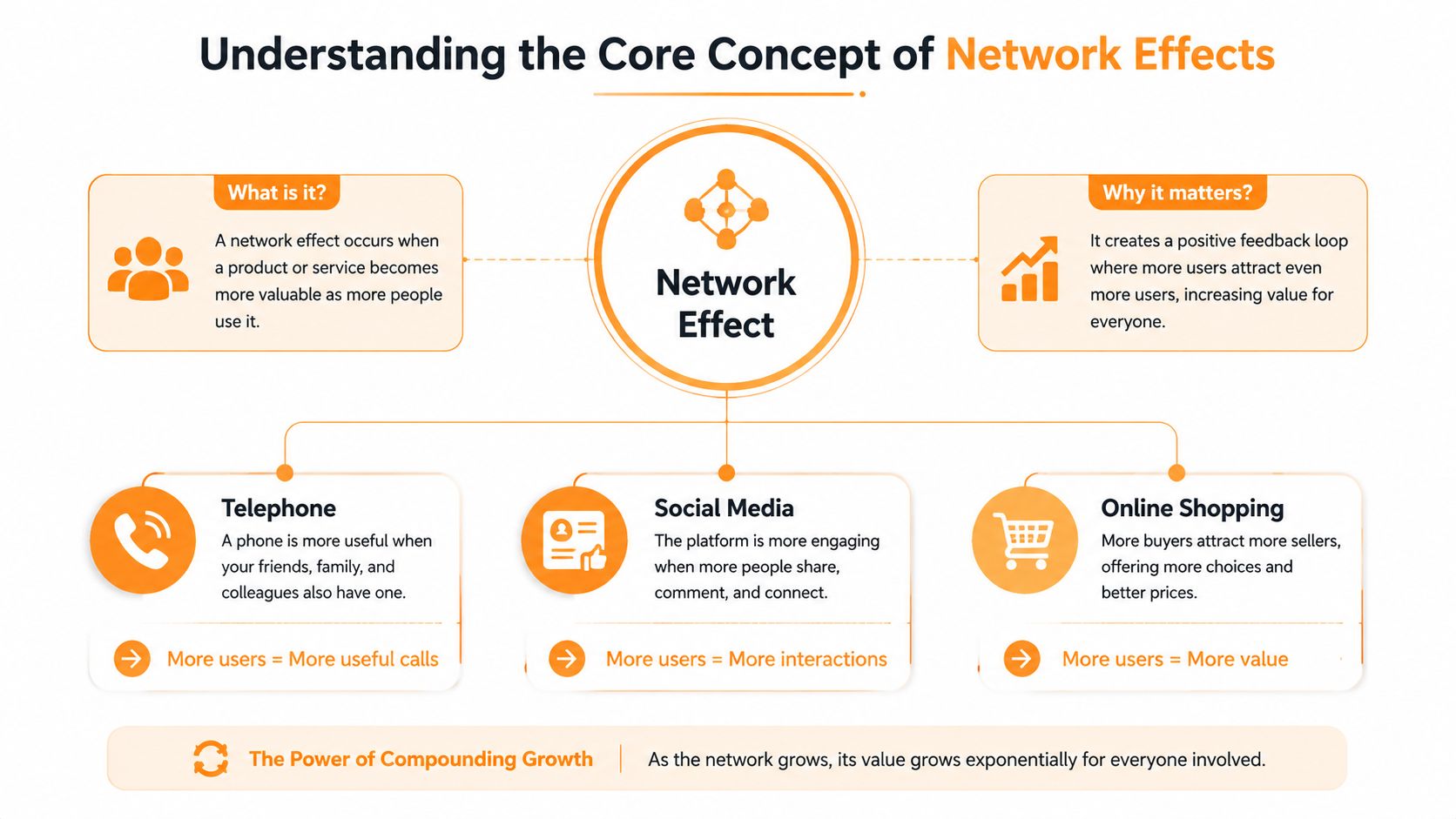
Social platforms work in a similar way. A social account becomes more useful when friends, creators, businesses, and communities are active on the same platform. A payment service also gains value when more shops accept it and more customers know how to use it. The service becomes easier to justify because participants can use it in more situations.
The feedback loop
You can understand the loop in four steps:
- An initial group joins. Early users accept that the service may feel limited while the community is small.
- Participation adds value. Users create connections, content, liquidity, transactions, or other resources.
- The improved service attracts others. New participants see more reasons to join than the first group did.
- The larger network supports further growth. Developers, businesses, and service providers find the audience more worthwhile.
Crypto networks follow this pattern. A blockchain with more users may attract more wallets, applications, educators, validators, and trading venues. Those additions can make the blockchain easier to use, which may encourage further adoption. The cycle isn't automatic, however. Poor security, confusing interfaces, high costs, or weak applications can interrupt it.
The guide to network effects from The Business Model Analyst provides a useful broader reference for comparing these feedback loops across business models. For crypto users, the practical question is always the same: does each new participant create value for other participants, or is the project merely counting sign-ups?
A wallet with many downloads but little regular use may have a weak network effect. A protocol with fewer visible users but deep, dependable liquidity may have a stronger one. Look beyond popularity signals and ask what participants contribute to one another.
The Different Types of Network Effects Explained
Network effects don't all operate through the same mechanism. Distinguishing them helps you judge whether a crypto project has a durable advantage or relies on temporary incentives.
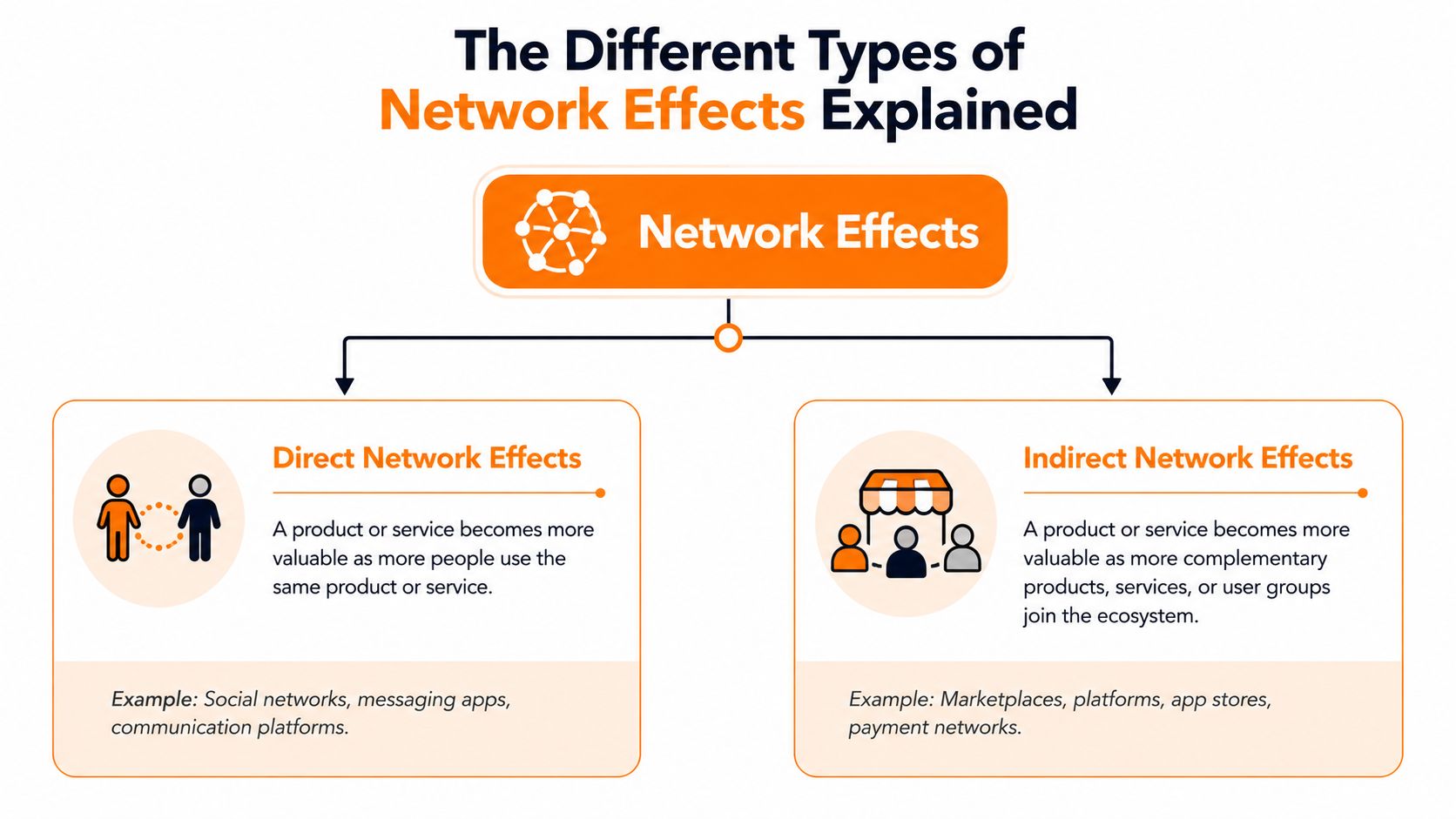
Direct network effects
A direct network effect occurs when users benefit directly from having more users on the same network. Messaging applications are the familiar example. Each additional contact can make the service more useful to existing members.
Bitcoin has a direct network element because holders, users, merchants, and service providers recognise the same asset and interact through the same network. A larger shared community can improve accessibility and familiarity. That doesn't mean Bitcoin is risk-free or that adoption guarantees a particular outcome. It means participation can reinforce the usefulness of the common system.
Indirect network effects
An indirect network effect appears when one group attracts complementary products or services, which then increase value for the original users. Ethereum provides a clear crypto example. Developers build applications, wallets and infrastructure providers support them, and users gain more ways to use the blockchain.
The relationship works in both directions. More users can make development more attractive, while more useful applications can make the network more appealing to users. The chain's value depends not only on its base technology but also on the surrounding ecosystem.
Two-sided network effects
A two-sided network connects distinct groups that need one another. A crypto exchange brings together buyers and sellers. More buyers can make the venue more useful to sellers, while more sellers and available assets can improve the experience for buyers.
Liquidity providers and traders create another version in DeFi. Traders want efficient execution, while liquidity providers want meaningful activity and a fair return for supplying capital. If one side disappears, the other side loses much of its reason to participate.
Data network effects
A data network effect develops when usage produces information that improves the service. A wallet analytics product may learn more about transaction patterns as users interact with it, allowing the product to organise activity or identify risks more effectively.
This category needs careful scrutiny. More data doesn't automatically mean better analysis. The information must be relevant, safely handled, and turned into a useful experience. A project that collects data without improving decisions may have data accumulation, not a meaningful network effect.
Watch the video below for a visual explanation of how these types differ.
Measuring Network Effects with Real Models and Metrics
Network effects are difficult to measure with a single number. Analysts usually combine a model of possible connections with evidence that users are creating useful activity.
Metcalfe's Law offers a simple starting point. It proposes that the value of a network is proportional to the square of its users, commonly written as V = n². The model captures an intuitive point: adding one participant can create potential connections with many existing participants, so network value may grow faster than user count.

Metcalfe's Law is a useful mental model, not a valuation guarantee. Users may be inactive, duplicated across platforms, controlled by automated accounts, or unable to interact with one another. A network's real value depends on the quality and usefulness of those connections.
A second lens for group formation
Reed's Law focuses on the value created when users form groups and communities. This matters for crypto because a blockchain can support many distinct communities, applications, governance groups, trading interests, or developer circles. The value isn't limited to one-to-one connections. It can also come from people organising around shared purposes.
The model still needs evidence. A large number of groups doesn't help if they are inactive, disconnected, or built around short-term speculation. Analysts should test whether communities retain participants and produce useful activity.
Metrics that reveal network strength
A practical review can combine several signals:
- Active addresses: Look for evidence that addresses are being used, while remembering that one person can control multiple addresses.
- Transaction activity: Examine whether transactions reflect useful economic activity rather than spam or incentive chasing.
- Developer participation: Check whether builders continue maintaining applications, tools, documentation, and infrastructure.
- Liquidity depth: For exchanges and DeFi, assess whether users can trade or move funds without severe execution problems.
- Cross-side participation: A marketplace needs both sides. User growth alone doesn't prove that buyers, sellers, borrowers, lenders, or developers are supporting one another.
Ofcom's UK evidence shows why installed-base measures need context. Its Mobile Matters 2021 report analysed crowdsourced data from around 280,000 Android devices across the UK, using tests collected between January and March 2021. The report examined interaction with 2G, 3G, 4G, 5G, and wi-fi, showing how real usage can reveal more than simple subscription totals.
For crypto analysis, this guide to on-chain metrics can help readers connect activity measures with network quality. Treat every metric as evidence to interpret, not as proof by itself.
Real-World Crypto Examples That Prove Network Effects Work
Bitcoin's network effect developed through shared recognition. Early participants accepted a system with limited practical reach. As more holders, businesses, developers, wallets, exchanges, and infrastructure providers supported Bitcoin, other participants gained more ways to acquire, store, transfer, and discuss the asset.
That process created several reinforcing benefits. More users gave the network broader visibility. More service providers made participation easier. More miners and infrastructure operators supported the system's operation. These effects don't make Bitcoin invulnerable, but they help explain why a technically similar project can't copy its code and inherit its position.
Ethereum shows a different pattern. Its strength rests heavily on an ecosystem of builders and applications. Developers create smart contracts, wallets, marketplaces, games, and financial tools. Users then arrive for those applications, and their activity gives developers more reason to build and maintain products.
The important point is that Ethereum's network effect isn't only a count of wallet addresses. It includes developer tools, shared standards, user habits, liquidity, documentation, and compatibility. A developer choosing a platform considers the whole environment. A user choosing a wallet considers whether it works with the applications they want. Each side influences the other.
Exchanges and DeFi marketplaces
Crypto exchanges demonstrate a two-sided effect. Buyers want a broad selection of assets and reliable execution. Sellers and liquidity providers want access to active demand. An exchange that attracts one side can become more appealing to the other, but poor service, weak security, or a loss of trust can damage both sides at once.
Uniswap applies the same logic through liquidity pools. Liquidity providers supply assets, while traders use those pools to exchange tokens. More usable liquidity can support smoother trading, and more trading activity can make supplying liquidity more attractive. The relationship remains conditional because providers also face smart-contract risk, price risk, and changing returns.
UK telecom evidence offers a useful non-crypto comparison. Mobile UK reports 111.8 million mobile subscriptions, 87 million active mobile devices, and 25 million connected things in the UK, alongside annual mobile operator investment of around £2 billion. It also reports average data use of 8 gigabytes per subscriber per month, compared with 470 megabytes in 2013. These figures show how adoption, usage, connected equipment, and infrastructure investment can reinforce one another in a mature network. The figures are available in Mobile UK's UK mobile facts.
Ofcom's Connected Nations reporting provides another useful comparison. Its Spring 2025 update says 25.9 million UK homes, 86% of the 30.2 million total, could get gigabit-capable broadband, while 22.5 million homes, 74%, could access full-fibre service as of January 2025. Ofcom also estimates that UK operators invested £7.9 billion in network infrastructure in 2022. The Spring 2025 Connected Nations update and Connected Nations 2023 UK report show the infrastructure side of the same loop. Coverage makes participation easier, participation strengthens demand, and demand can support further investment.
When Network Effects Fail and Create Anti-Network Effects
A larger network isn't always a better network. Growth can introduce congestion, fraud, poor governance, privacy problems, or confusing fragmentation. If the service becomes harder to use as participation rises, the feedback loop can reverse.
Congestion is the clearest warning. A blockchain may attract heavy demand, but users can face delayed transactions, unpredictable costs, or difficult execution when capacity doesn't meet activity. Ethereum's history of high gas fees during busy periods is often discussed in this context, but the broader lesson is more important: adoption only creates value when the network can handle participation at an acceptable user experience.
Fragmentation creates another risk. When a community divides into incompatible versions, users, developers, liquidity, and tooling may separate as well. Bitcoin and Bitcoin Cash demonstrate how a split can produce distinct networks rather than one unified environment. A fork may solve a genuine disagreement, but it can also weaken shared standards and make support more complicated.
Negative externalities can grow with the user base. DeFi platforms may attract spam tokens, fraudulent projects, automated abuse, or misleading activity. More listings and transactions can make a platform appear busy while making it harder for users to identify trustworthy opportunities. A network needs safeguards, not just scale.
When strength becomes a barrier
The UK government's platform competition review defines network effects as a demand-side feedback loop in which a service becomes more attractive as more consumers or providers join. It also warns that this dynamic can raise switching costs and entrench incumbent platforms, as described in the UK platform competition review.
That warning applies to crypto. A dominant wallet, exchange, or chain may become difficult to challenge if users can't move identity, assets, reputation, or transaction history easily. Closed systems can preserve market power even when a rival offers better features.
Look for warning signs such as falling meaningful activity, dependence on temporary rewards, worsening execution, weak developer maintenance, concentrated control, and poor interoperability. A short-term decline may be recoverable. A structural loss of trust, liquidity, or compatibility is harder to repair.
How Builders and Investors Can Leverage Network Effects
Builders should begin with the connection that creates value, not with a token. Ask who benefits when another participant joins, what that participant contributes, and how the product remains useful before the network reaches scale.
A wallet might focus on easy access to a specific application ecosystem. An exchange might solve one side of the market first, then add the other with careful liquidity support. A blockchain might prioritise developer tools and reliable infrastructure before expanding into every possible use case. The best starting point is usually narrow and useful, not broad and unfinished.
A builder's practical checklist
- Choose the mechanism: Decide whether your product relies on direct, indirect, two-sided, or data network effects.
- Reduce the empty-room problem: Give early users a useful experience even when few others have joined.
- Create compatible connections: Support portability, open standards, and integrations where possible.
- Reward lasting behaviour: Incentives should encourage useful participation rather than temporary activity.
- Protect the experience: Capacity, security, moderation, and clear information matter more as usage expands.
Community design is part of this work. Founders who want a practical resource on trust, participation, and long-term member relationships can explore community building for founders from Bazzly. A community isn't strong because it is loud. It is strong when members help one another, return for a reason, and contribute to the product's usefulness.
Investors need a different discipline. Don't treat a large user number as proof of a durable moat. Ask whether participants are active, whether different sides of the market support each other, and whether users would remain if rewards disappeared.
Questions for evaluating a crypto network
- What happens when users leave? Does the product retain value through useful infrastructure, or does activity collapse quickly?
- Who creates the value? Identify users, developers, liquidity providers, validators, merchants, or other contributors.
- Can users switch easily? Interoperability and portability can protect users from lock-in and reveal whether loyalty is earned.
- Is activity genuine? Compare transactions, liquidity, application use, and developer work rather than relying on one headline metric.
- What protects the loop? Review security, governance, costs, reliability, and the project's response to abuse.
Token design also affects participation. This guide to tokenomics and token utility can help you examine whether a token supports genuine use or merely adds speculative pressure. Builders should design for utility first, while investors should separate a functioning network from a token that is merely being promoted.
The Coin Course offers structured lessons on blockchain, wallets, cryptocurrencies, DeFi, trading, security, and advanced crypto concepts, with practical guidance for evaluating projects and protecting assets. Visit The Coin Course to build your crypto knowledge from first principles and apply network-effect thinking with greater confidence.