You've probably seen the word ripple in very different places. One day it's in a dictionary, describing tiny waves on water. The next day it's in a crypto app, a payments article, or a legal news story. That mix is where most confusion starts.
The meaning of Ripple depends on context. In everyday UK English, ripple usually means a small wave or the spread of an effect through a system. In finance, Ripple usually refers to a company and a set of payment technologies used for cross-border transfers. Add XRP into the picture, and many beginners understandably assume all three are the same thing.
They aren't. Once you separate the word, the company, the network, and the digital asset, the topic becomes much easier to follow.
Demystifying the Meaning of Ripple
If you send money to someone in another country, the process often feels oddly old-fashioned. You hand over your money quickly, but the transfer can still involve delays, multiple intermediaries, and costs that aren't obvious at first glance.
That practical problem helps explain why Ripple gets so much attention in payments. But before looking at the company, it helps to start with the ordinary meaning of the word.
The everyday meaning first
In UK English, ripple most commonly means a small wave, undulation, or light motion on a surface. It also has a figurative meaning. People talk about a ripple effect when one event spreads outward and influences other people or events, as outlined in this explanation of the ripple effect in English usage.
That everyday meaning matters because many readers search for the meaning of Ripple and land in a financial topic by mistake. The capital letter changes everything.
A lowercase ripple usually points to language and imagery. An uppercase Ripple usually points to financial technology.
Why people mix the terms up
The confusion usually comes from three names being folded into one:
- Ripple the company builds payment-focused technology for financial institutions.
- RippleNet refers to the company's payments network and related services.
- XRP is a digital asset associated with the XRP Ledger and used in some payment flows.
If you're still getting comfortable with crypto basics, it helps to read a simple primer on what blockchain technology is before going deeper into Ripple's setup.
A useful way to think about it is this. The word “ripple” in daily speech describes movement spreading across a surface. Ripple in finance tries to solve a different sort of movement problem: how value travels across borders.
Why this distinction matters
Many articles jump straight to price talk. That skips the part that makes the topic understandable.
If you're tracking the market side as you learn, tools that monitor Ripple with CoinStats can help you separate the asset's price behaviour from the wider question of what Ripple's technology is meant to do. Price is only one piece of the story.
For beginners, the key idea is simple:
- Word first. Ripple can mean a wave or spreading effect.
- Brand second. Ripple can also mean a financial technology company.
- Asset third. XRP is related, but it isn't the same thing as the company.
That clean separation makes the rest of the topic far less intimidating.
Ripple the Company vs XRP the Cryptocurrency
The distinction between Ripple and XRP is where many beginners get stuck. People hear the word “Ripple,” see XRP mentioned in the same conversation, and assume they are the same thing. They are connected, but they refer to different parts of the same broader system.
A clearer way to separate them is to ask a simple question: are you talking about the business, the payment tools, or the digital asset?
Ripple is the company
Ripple is a financial technology company. It builds products for banks, payment providers, and other institutions that need to send money across borders more efficiently.
That focus matters. Ripple is trying to improve the plumbing behind international payments. Its work is aimed at financial institutions, not at everyday card purchases in shops.
This helps explain why Ripple is often discussed in terms of settlement, foreign exchange, liquidity, and payment infrastructure. The company's goal is practical. It wants cross-border transfers to be faster, easier to track, and less dependent on money sitting in accounts around the world.
XRP is the cryptocurrency
XRP is a digital asset that operates on the XRP Ledger. It is not a share of Ripple the company, and buying XRP does not give you ownership in Ripple.
Its role in payment discussions is usually as a bridge asset. Here is the beginner-friendly version of that idea. If one institution holds one currency and needs another quickly, XRP can be used as a temporary middle step between the two. Instead of keeping piles of money parked in foreign accounts ahead of time, a payment can move through XRP and then into the destination currency.
That can reduce friction in some international payment routes. It also explains why people talk about XRP differently from a company stock or a consumer payment app.
Where RippleNet and ODL fit
Confusion grows because the company and the asset sit alongside other terms such as RippleNet and ODL.
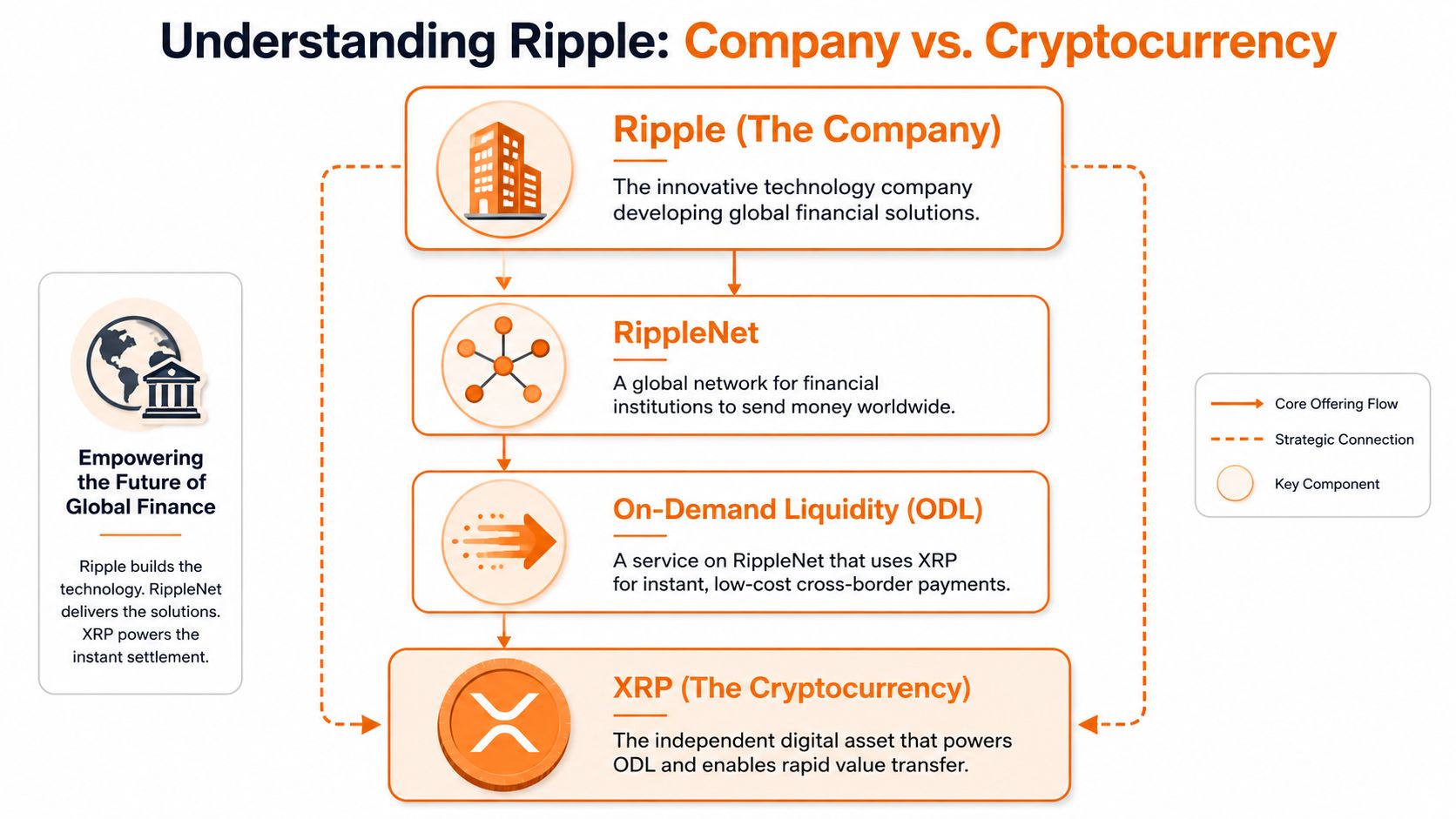
RippleNet refers to Ripple's payments network and related services used by financial institutions. ODL, short for On-Demand Liquidity, is a service that can use XRP within a payment flow when that approach makes sense for the institutions involved.
So the relationship works like this. Ripple builds the tools. RippleNet helps institutions coordinate transfers. ODL is one service inside that wider setup. XRP is the digital asset that may be used during settlement in some cases.
That layered view is much more useful than lumping every label together under “Ripple.” For example, reports about Microsoft Azure running a Ripple validator years ago relate to infrastructure around the ecosystem, not to ownership of XRP by everyday users.
A common mistake beginners make
A sentence like “I bought Ripple” usually means “I bought XRP.”
That mix-up sounds minor, but it leads to bigger misunderstandings. Someone may read news about Ripple signing up financial partners and assume the news is automatically about XRP's market price. Sometimes the two are related. Sometimes they are not. Keeping the labels separate helps you judge each development more clearly.
Why the distinction matters for real decisions
If you are evaluating Ripple, you are looking at a company and its products. Questions about customers, regulation, and payment adoption matter most.
If you are evaluating XRP, you are looking at a crypto asset. Then the key questions shift toward market behavior, custody, liquidity, and whether more institutions will use it in real payment activity.
A quick reference table makes the separation easier:
| Item | What it is | Main role |
|---|---|---|
| Ripple | A company | Builds payment solutions |
| RippleNet | A payments network | Connects institutions for transfers |
| ODL | A payment service | Uses XRP to source liquidity during transfers |
| XRP | A cryptocurrency | Moves value as a bridge asset |
Once you separate the company, the payment network, and the token, Ripple starts to make much more sense.
How Ripple's Payment Technology Works
Ripple's setup makes more sense when you break it into layers. Don't think of it as one giant machine. Think of it as a payment system with separate parts that each do a different job.
RippleNet as the communication layer
At a high level, RippleNet is about how financial institutions communicate and coordinate payments. It acts a bit like a shared system of rules and messaging for cross-border transfers.
A useful analogy is air travel. Airports, airlines, passport control, and baggage systems all need to agree on procedures before a passenger can move smoothly from one country to another. RippleNet aims to reduce the messy hand-offs that often slow international money movement.
That doesn't mean every transfer works in exactly the same way. Institutions can use different arrangements depending on their needs, currency corridors, and regulatory setup.
The XRP Ledger as the settlement layer
Separate from RippleNet is the XRP Ledger. This is the distributed ledger where XRP transactions are recorded and settled.
If RippleNet is like the system that helps participants coordinate a transfer, the XRP Ledger is like the shared record book that confirms a movement of value has happened. That distinction matters because newcomers often assume the network and ledger are the same thing.
How consensus replaces mining
Bitcoin is well known for mining. The XRP Ledger works differently.
According to the XRPL consensus protocol overview, the network uses a consensus protocol in which independent validators must agree on the order of transactions. Ripple also publishes a recommended Unique Node List, or UNL, to help the network cohere.
A plain-language analogy helps here. Think of a group of notaries checking the same stack of documents. No single notary gets to decide alone. The documents are accepted when the group reaches agreement according to shared rules.
Practical rule: Consensus is not the same as mining. Mining competes to add blocks. Consensus coordinates agreement on transaction order.
That difference is one reason Ripple-related technology is often discussed as more optimized for payment efficiency than to the open-ended design goals of some other crypto networks.
Where validators fit in
Validators don't “print money” and they don't work like bank managers approving each transfer by hand. Their role is closer to independent referees who check whether proposed transactions follow the network's rules.
If you've seen references to enterprise involvement, you may find it interesting that Microsoft Azure was running a Ripple validator years ago according to reporting on blockchain infrastructure. That detail helps newcomers see that validator participation isn't limited to one company pressing all the buttons.
Why this design appeals to payment firms
Traditional cross-border payments often involve delays caused by messaging gaps, reconciliation work, and the need to hold funds in different places before a payment even starts moving.
Ripple's model tries to tighten that process. The broad idea is straightforward:
- institutions connect through a common payment framework
- value can move through the XRP Ledger when appropriate
- validators confirm transaction order through consensus
- settlement happens quickly enough to make new liquidity models possible
The result is a system designed less for internet collectibles or app ecosystems and more for moving money from one jurisdiction to another with fewer frictions.
Comparing Ripple with Bitcoin and Ethereum
A good way to place Ripple in your mind is to start with a real question a beginner might ask: if Bitcoin, Ethereum, and XRP all live in the crypto field, are they basically versions of the same idea?
They are not built for the same job.
Bitcoin is usually treated like digital money with a strong focus on scarcity. Ethereum is a network for running programmable applications. Ripple enters the picture differently. Ripple is the company. RippleNet is the payment network built for financial institutions. XRP is the digital token that can be used on the XRP Ledger to help move value quickly between currencies.
That distinction matters here, because many side-by-side crypto discussions flatten everything into a price chart. For a bank or payment provider, the more useful question is simpler: what problem is each system trying to solve?
Different tools, different goals
Bitcoin was designed around peer-to-peer digital value and resistance to central control. Ethereum widened the idea by letting developers build applications and smart contracts on-chain. If you want a clearer picture of that app-building side, this guide to Ethereum's role in decentralised applications and smart contracts gives helpful context.
Ripple's ecosystem is narrower and more practical. Its main pitch to institutions is faster, more efficient movement of money across borders. A useful analogy is transport. Bitcoin is often discussed like digital gold, Ethereum like a programmable operating system, and Ripple-linked payment infrastructure like specialised rail lines built to move funds from one place to another with less delay.
That narrower design can confuse new readers. They expect every major crypto project to compete on the same scoreboard. In practice, they often serve different users and different needs.
Key differences at a glance
| Feature | Ripple-related ecosystem | Bitcoin | Ethereum |
|---|---|---|---|
| Main purpose | Payment infrastructure for cross-border transfers, with XRP available as a bridge asset | Digital asset with a strong store-of-value narrative | Platform for smart contracts and decentralised applications |
| Core identity | Company, payment network, and token are related but distinct | Primarily a cryptocurrency network | Primarily a programmable blockchain network |
| How the network confirms transactions | Validator-based consensus on the XRP Ledger | Proof-of-Work mining | A separate validation model focused on supporting programmable activity |
| Typical use case | Settlement between financial institutions and liquidity providers | Holding, transferring, or treating as digital scarcity | Building apps, tokens, and on-chain financial tools |
| Main lens for understanding it | Payments and settlement efficiency | Monetary policy and decentralisation | Programmable finance and software |
The table is less about ranking winners and more about matching each network to its intended use.
Where confusion usually starts
A lot of confusion comes from using the word "Ripple" as if it always means the token. Sometimes people mean the company. Sometimes they mean the payment network. Sometimes they mean XRP. Bitcoin and Ethereum do not create that exact same naming problem, so Ripple often feels harder at first.
Another common mistake is judging XRP only by the standards used for Bitcoin. That misses the point. Bitcoin's identity is closely tied to scarcity and independent digital money. XRP is often discussed in the context of settlement speed, liquidity, and cross-border transfer efficiency.
Ethereum differs in another direction. Its ecosystem became a base layer for applications, token launches, and decentralised finance. For readers exploring that side of crypto, a practical overview of earning DeFi yield safely shows how different Ethereum's financial ecosystem is from Ripple's payment-first focus.
The simplest way to separate them
If Bitcoin is trying to be a distinct form of digital money, and Ethereum is trying to be infrastructure for programmable applications, Ripple's broader ecosystem is trying to improve how institutions move money.
That does not make one automatically better than the others. It makes them different tools. And once you separate Ripple the company, RippleNet the payment technology, and XRP the token, the whole topic becomes much easier to understand.
Ripple's History and Major Legal Challenges
Ripple's story isn't just about technology. It's also about how a payment-focused crypto project collided with one of the biggest legal debates in the industry.
Early roots and the company's development
The broader idea behind Ripple-style payments goes back years, with early concepts predating today's mainstream crypto cycle. Over time, those ideas developed into a company building financial infrastructure and a ledger built around digital asset settlement.
For beginners, the important point isn't memorising every name change. It's recognising that Ripple didn't emerge as a meme token or a side experiment. It grew around a specific payments use case.
Why the SEC case mattered so much
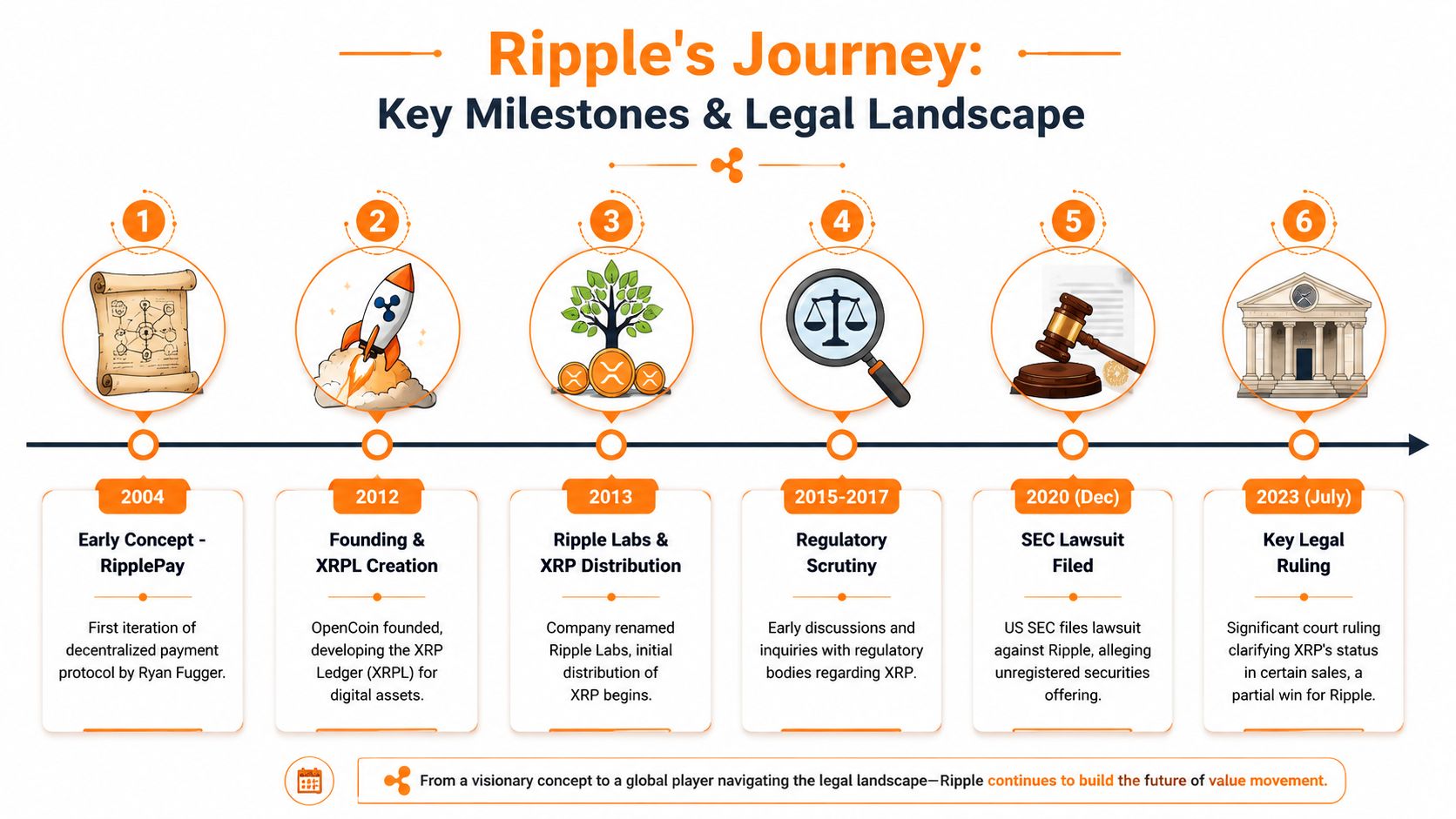
The legal challenge that shaped Ripple's public image most strongly came from the US Securities and Exchange Commission. The central dispute was whether certain XRP sales should be treated as unregistered securities offerings.
That issue mattered far beyond one company. If regulators and courts classify a digital asset one way rather than another, the consequences can affect exchanges, token issuers, and market participants across the sector.
The July 2023 ruling
In a major development reported by Reuters on the Ripple SEC ruling, a US judge ruled in July 2023 that programmatic sales of XRP on public exchanges did not constitute investment contracts. The ruling was widely seen as a significant but partial victory for Ripple.
That wording matters. It wasn't a blanket declaration that every possible XRP-related transaction was legally identical. It clarified part of the situation, but not all of it.
Why beginners should care
This legal chapter changed how many people interpret the meaning of Ripple. Before the case, some readers saw Ripple mainly as a fast-payments brand. During the case, many saw it through a courtroom lens first.
A sensible takeaway is this:
- Technology matters
- Legal classification matters
- Public understanding often lags behind both
The Ripple story shows that crypto projects don't operate in a vacuum. Courts and regulators can reshape how a network is discussed, adopted, and priced.
That's one reason legal news can matter almost as much as technical progress in this sector.
Real-World Use Cases and Partnerships
Ripple's value proposition becomes more concrete when you look at how its tools can be used in payments rather than in speculation.
What problem On-Demand Liquidity tries to solve
One of the biggest headaches in international payments is the need to keep money sitting in foreign accounts in advance. Banks and payment providers often do this so they can complete transfers in different currencies when needed.
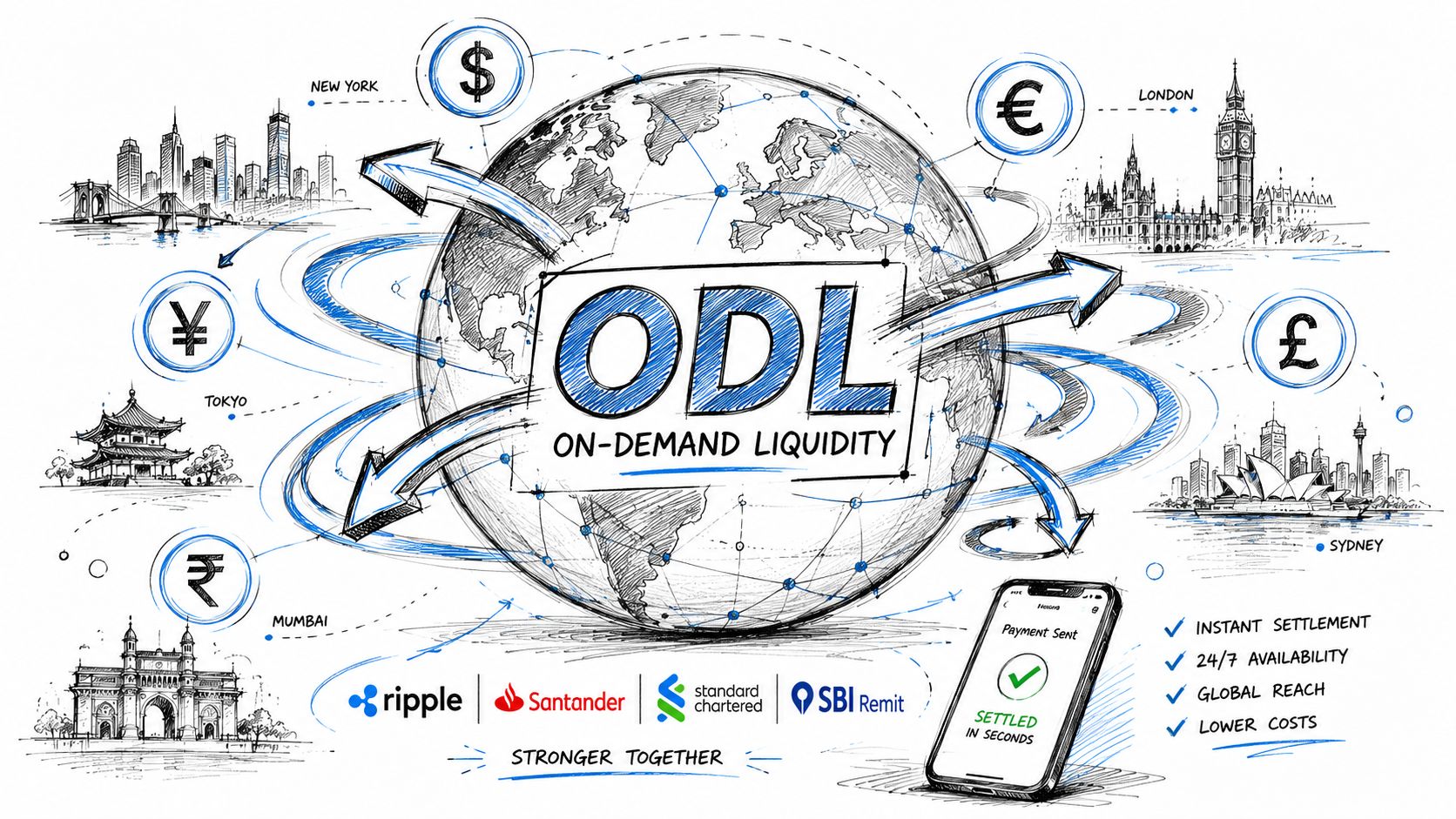
Ripple's On-Demand Liquidity, often shortened to ODL, is designed to reduce that burden by using XRP as a temporary bridge between currencies. Instead of holding the destination currency beforehand, a provider can convert into XRP, move the value, and convert out at the other end.
The appeal is not just speed. It's capital efficiency. One industry analysis published by the Financial Planning Association says technology like Ripple's could free up as much as $27 trillion in dormant liquidity tied up in pre-funded nostro and vostro arrangements if broadly adopted, as discussed in this piece on Ripple and trapped global liquidity.
A simple payment example
Take a payment provider sending funds from the UK to another country. In a traditional setup, the provider may need local currency reserves already waiting abroad.
With ODL, the path can be more direct:
- Step one. The sender starts with pounds.
- Step two. Those pounds are converted into XRP.
- Step three. XRP moves across the network.
- Step four. XRP is converted into the destination currency.
That flow aims to reduce idle capital and shorten the funding chain.
A short explainer can help if you want to see the idea in motion:
Why partnerships matter here
Payment technology only matters if institutions can use it in operational settings. That's why discussions around Ripple often focus on payment firms, remittance providers, and financial-service integrations rather than on retail hype alone.
Even when headlines spotlight XRP's market price, the more durable question is whether companies find Ripple's tools useful for real settlement problems. That's the part many beginner guides skip.
Risks Criticisms and Your Next Steps
A beginner can get confused here for a simple reason. The word "Ripple" is often used as if it means one thing, when it can refer to a company, a payment system, or a token. If you want a clear view of the risks, keep those three layers separate first. Then the criticisms make much more sense.
The main criticisms
One of the biggest concerns is centralisation. Ripple the company is highly visible, holds a large role in product development, and strongly shapes the public story around XRP. Even if the XRP Ledger uses independent validators, critics still ask whether the ecosystem feels too closely tied to one company.
Another criticism is regulatory uncertainty. Parts of the legal picture became clearer after the court rulings discussed earlier, but the rules for crypto still differ from country to country and can change quickly. That creates uncertainty for institutions considering Ripple's tools and for individuals considering XRP.
There is also market volatility. XRP can rise or fall quickly based on legal news, exchange listings, investor mood, and broader crypto market swings.
A separate point is worth keeping in view. A useful payment product does not automatically make the token a low-risk asset. RippleNet may address real cross-border payment problems, while XRP can still remain speculative in the market. Keeping that distinction clear helps you judge the topic more carefully.
How to approach it sensibly
You do not need expert-level technical knowledge to assess Ripple. You do need a simple framework.
- Separate the parts. Write down what belongs to Ripple the company, what belongs to RippleNet or related payment products, and what belongs to XRP.
- Use primary sources first. Product materials, court documents, and direct reporting are usually more reliable than short social posts or recycled summaries.
- Focus on the problem being solved. Ask whether the technology improves speed, cost, or liquidity for cross-border payments.
- Protect your holdings carefully. If you buy XRP or any other crypto, use strong security habits and consider secure storage such as a hardware wallet.
A useful test: If you cannot explain in one sentence whether you are evaluating the company, the payment technology, or the token, pause and sort that out before making any decision.
Good next steps for a beginner
A steady learning path usually works better than trying to absorb everything at once.
- Learn the basics of blockchain, settlement, and liquidity.
- Compare Ripple's payment focus with Bitcoin's and Ethereum's different roles.
- Track legal and regulatory updates in the countries that matter to you.
- Treat price excitement as background noise until you understand the underlying product and business case.
That will not remove risk. It will help you judge Ripple with a calmer, clearer framework.
If you want a structured way to keep learning, The Coin Course is a strong place to continue. It brings together beginner-friendly guides, deeper explainers, and practical safety lessons so you can build your knowledge step by step, moving beyond market noise and social media chatter.