Buying bitcoin safely in the UK really boils down to three things: using a regulated platform, securing your funds in a personal crypto wallet, and getting your head around the risks involved. Nailing this simple framework is your best defence against scams and keeps you in the driver's seat from day one.
Your Foundation for Buying Bitcoin Securely
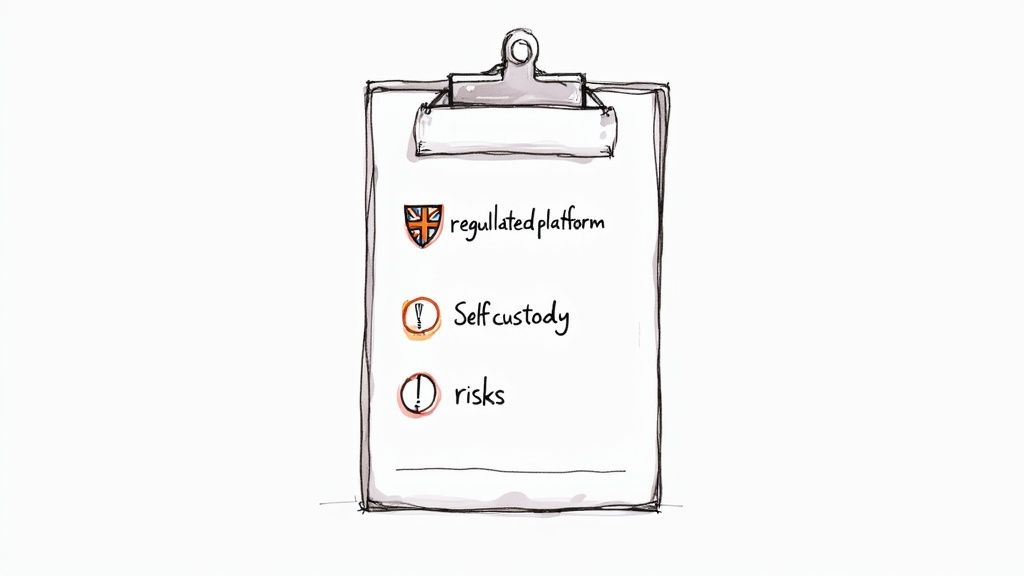
Before you even think about hitting that ‘buy’ button, you need to get your house in order. So many newcomers make the mistake of rushing in without a solid plan, and that's where things can go wrong. Picture this stage as laying the foundations for a house; if you get it wrong, the whole structure is wobbly.
The goal here isn't just to get your hands on some Bitcoin. It's about doing it in a way that protects your money and gives you peace of mind. That means starting with the right mindset—treat this like a calculated decision, not a lottery ticket. Your absolute first priority? Making sure any platform you use is legitimate.
Why UK Regulation Matters
Here in the UK, the crypto market is gradually coming under more regulatory oversight, which is great news for buyers like you. The main body to know is the Financial Conduct Authority (FCA). Your first check, always, should be to see if an exchange is registered with them. Using an FCA-registered firm, for instance, a well-known name like Coinbase, means they're on the hook for certain standards, a layer of accountability you just won't find on unregulated platforms.
This is more important than ever. Crypto ownership is on the rise, with recent data showing around 12% of UK adults now own or have owned cryptoassets. That’s a huge jump from just 4% back in 2021. But with this growth comes risk, as many people don’t realise how limited their protections are. The FCA has shut down hundreds of scam sites, but the responsibility to choose wisely still rests with you. It’s well worth reading the full research on crypto ownership trends from the FCA to see the bigger picture.
It’s a common mistake to think all crypto platforms are basically the same. The reality is, a regulated exchange has to follow much stricter rules on things like anti-money laundering and how they advertise to you, making it a fundamentally safer place to start.
Before you make a move, a quick mental checklist can make all the difference. I’ve put together a simple table to summarise the core safety pillars you should be thinking about.
Quick Safety Checklist Before Buying Bitcoin
| Safety Pillar | Why It Matters for You | Your First Action Step |
|---|---|---|
| Platform Regulation | Provides a basic layer of accountability and helps you avoid outright scams. | Always check if the exchange is on the FCA's cryptoasset register. If it's not, steer clear. |
| Personal Wallet Control | Ensures you, and only you, have access to your Bitcoin. "Not your keys, not your crypto." | Research and set up a non-custodial wallet (hardware or software) before you buy your first Bitcoin. |
| Risk Awareness | Protects you from making emotional decisions and investing more than you can lose. | Decide on a budget you're comfortable with, like £50 or £100, and stick to it. Never invest money you might need for essentials. |
Getting these basics right from the start sets a secure foundation for every transaction you make in the future. It's this prep work that separates a confident investor from someone who might fall for a costly scam.
How to Choose a Safe UK Bitcoin Exchange
Choosing where to buy your Bitcoin is the single most important security decision you'll make. It’s all too easy to just Google "buy Bitcoin UK" and click the top result, but a bit of due diligence now will save you a world of pain later. This isn't about finding the flashiest platform with the most ads; it's about finding a solid, reliable home for your first crypto purchase.
Imagine choosing a bank. You wouldn't deposit your life savings into a brand-new bank you've never heard of without first checking it's properly regulated. The exact same logic applies here. In crypto, your first line of defence is always the legitimacy and security of the exchange itself.
First Things First: Check for FCA Registration
Before you even glance at fees, features, or fancy charts, there's one question you must answer: "Is this platform registered with the Financial Conduct Authority (FCA)?"
In the UK, any firm offering crypto services is legally required to be on the FCA's cryptoasset register. This is a red line.
Being FCA-registered means the company has to meet specific anti-money laundering and counter-terrorist financing standards. While it doesn't give you the same deposit insurance you'd get at a traditional bank, it does mean the company is on the radar of UK regulators and operates within a recognised legal framework. It’s a foundational layer of protection you can't afford to skip.
You can check the register yourself in under a minute. Just head to the FCA's official website and search for the company's name. If they're not on the list, walk away.
Don’t just take a company’s word for it. Dodgy websites have been known to slap an "FCA Registered" logo on their homepage when they aren't. Always, always verify it for yourself on the official FCA register before you even think about signing up.
The UK government is also bringing in a more robust regulatory framework for cryptoassets, which is great news for consumers. These new rules will require exchanges to meet clear standards on consumer protection and operational strength, much like traditional financial firms. This helps you check if a platform is authorised, seriously reducing your risk. To get the details on these important changes, you can read more about the new cryptoasset rules on the official government site.
The Key Security Features to Demand
Once you've confirmed an exchange is properly registered, it's time to look under the bonnet at its security features. These are the digital locks, alarms, and vaults that keep your account and your crypto safe from thieves.
Here are the absolute must-haves:
- Two-Factor Authentication (2FA): This is non-negotiable. 2FA forces you to verify your identity with a second device—usually a code from an app like Google Authenticator on your phone—whenever you log in. Steer clear of SMS-based 2FA if you have the choice, as it’s far more vulnerable to "SIM-swapping" attacks.
- Proof of Reserves (PoR): This is essentially a public audit that proves an exchange actually holds enough assets to cover all of its customer deposits. In the wake of major exchange collapses, PoR has become a critical signal of transparency and financial health. Look for platforms like Kraken that conduct regular, independent PoR audits.
- Cold Storage Policies: Any exchange worth its salt will keep the vast majority of customer funds in cold storage. These are secure wallets that are kept completely offline, far away from the reach of online hackers. A trustworthy platform will be open about this, and you should be looking for a figure of over 95% of funds held in cold storage.
- Whitelisting Withdrawal Addresses: This fantastic feature lets you create a pre-approved list of crypto wallet addresses that your account can send funds to. It’s another powerful layer of security. Even if a hacker breaches your account, they can't drain your Bitcoin to their own unknown wallet without first getting it approved, which usually requires access to your email as well.
It can be helpful to see how these features work in the real world. For example, if you're looking at one of the big global players, you can learn more about the safety of Binance in our detailed guide to see a breakdown of its security measures.
Don't Get Stung by Hidden Fees
Finally, let's talk about fees. A platform might shout about its low trading fees, but then sting you with high charges for deposits or withdrawals. You need to understand the complete cost structure before you jump in.
Here’s a quick rundown of the fees you'll encounter:
| Fee Type | What It Is | What to Look For |
|---|---|---|
| Trading Fees | The commission you pay for each buy or sell order. It's usually a small percentage of the total transaction value. | Look for a clear, tiered fee structure. Many platforms offer lower fees for higher trading volumes. |
| Deposit Fees | The cost of getting your money onto the exchange. This varies hugely depending on your method. | UK bank transfers (Faster Payments) should ideally be free. Debit card deposits will always be higher, typically around 1-3%. |
| Withdrawal Fees | The charge for moving your Bitcoin off the exchange into a personal wallet you control. | This can be a flat fee (e.g., 0.0005 BTC) or a percentage. Pay close attention here, as high fees can discourage good security habits. |
Picking the right exchange is a balance. You're weighing top-notch security against reasonable fees and an interface you find easy to use. By following this simple framework—verify regulation, demand key security features, and understand the costs—you’ll be in a much better position to start your Bitcoin journey safely and confidently.
Securing Your Coins with a Bitcoin Wallet
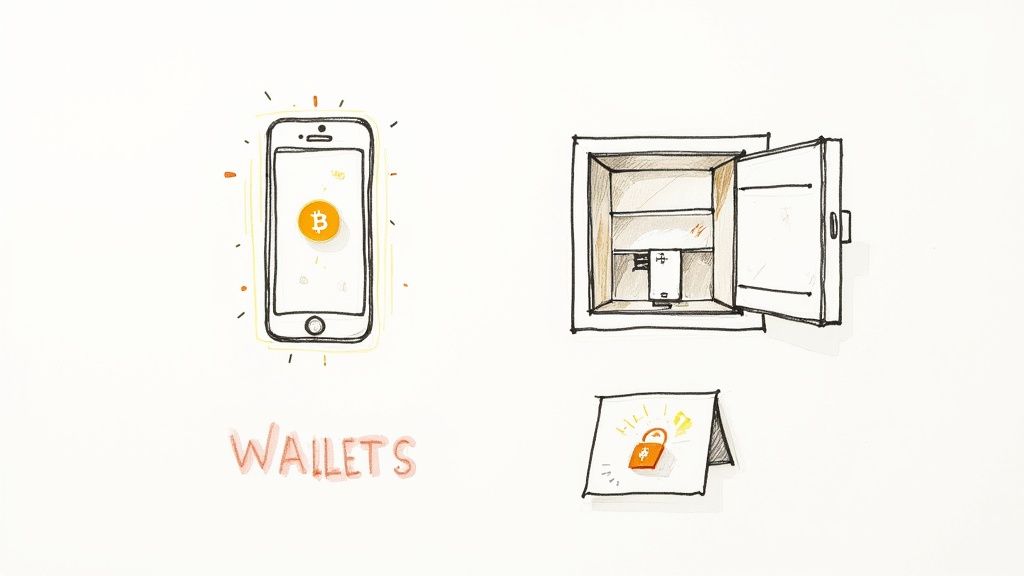
Congratulations, you've bought your Bitcoin. But that's only half the job done. Now you need to make sure it stays your Bitcoin, and that means securing it properly. This is where a crypto wallet enters the picture.
Think of a wallet less like the one in your back pocket and more like a personal, digital safe. It’s the tool that gives you absolute control over your coins, taking them out of the hands of a third party.
Leaving your Bitcoin on the exchange you used to buy it is a bit like leaving a bar of gold with the dealer after you've paid for it. While convenient for quick trades, it's a risky long-term strategy. Exchanges are big, juicy targets for hackers, and if one goes under, your funds could be frozen or lost forever. This is why you'll hear the old crypto saying time and time again: "not your keys, not your coins."
To truly own your Bitcoin, you need a wallet where you, and only you, control the private keys. These keys are like the secret combination to your safe, and holding them yourself is what we call self-custody. It’s the bedrock of responsible crypto ownership.
Hot Wallets vs Cold Wallets Explained
As you start exploring, you'll immediately run into two main categories: "hot" wallets and "cold" wallets. The names might sound a bit technical, but the idea is actually very simple and boils down to one thing: internet connectivity.
A hot wallet is a piece of software on your phone or computer. Because it's always connected to the internet, it’s incredibly convenient for sending, receiving, and managing small amounts of crypto. It’s your crypto current account – easy to access for everyday use.
A cold wallet, on the other hand, is a physical device, often looking like a fancy USB stick. It keeps your private keys completely offline, which makes it virtually impossible for an online attacker to get anywhere near them. This is your savings vault, built for the secure, long-term storage of significant holdings.
To really get to grips with how these work, our guide on understanding custodial and non-custodial crypto wallets offers a much deeper look.
Here’s a quick comparison to help you decide what's right for you:
| Feature | Hot Wallet (e.g., Mobile App) | Cold Wallet (e.g., Ledger, Trezor) |
|---|---|---|
| Connectivity | Always online | Completely offline |
| Best For | Small amounts, frequent use, convenience | Large amounts, long-term holding, maximum security |
| Security Risk | Higher risk (vulnerable to online attacks) | Extremely low risk (immune to online attacks) |
| Example | Exodus, Trust Wallet, MetaMask | Ledger Nano S Plus, Trezor Model One |
When you're just starting, a reputable software wallet on your phone is an excellent choice. It strikes a good balance between security and user-friendliness. As your portfolio grows, migrating to a cold wallet isn't just a good idea; it's a crucial step.
The Most Important Thing: Your Seed Phrase
When you set up a new wallet, it will generate something called a seed phrase (or recovery phrase). This is a list of 12 or 24 random words presented in a specific order.
Pay attention, because this is the single most important piece of information you will ever handle in crypto. It's the master key to your funds. Anyone who gets their hands on this phrase can access and steal your Bitcoin, from anywhere on the planet.
Your one and only job is to protect it. There are no do-overs here.
Here are some battle-tested, practical tips for keeping your seed phrase safe:
- Go Analogue: Write the words down with a pen and paper. Never, ever store it on a device connected to the internet. That means no screenshots, no text files, no email drafts, and definitely no cloud storage like Google Drive or iCloud. Hackers live for these mistakes.
- Create Redundancy: Make at least two physical copies. Paper is fragile—it can burn in a fire, get destroyed by water, or simply get lost.
- Store in Separate, Secure Locations: Keep one copy in a fireproof safe at home. Put the second copy somewhere else entirely, like a bank's safety deposit box or with a trusted family member (if you're absolutely sure you can rely on them).
- Consider a Metal Upgrade: For the ultimate in durability, you can engrave or stamp your seed phrase onto a purpose-built metal plate. These are designed to withstand fire, floods, and physical damage, ensuring your master key survives a disaster.
Taking these steps isn't being paranoid; it's being smart. It ensures that even if your phone gets stolen or your computer dies, you can always restore your wallet and access your Bitcoin. This is what true self-sovereignty looks like.
Buying Your First Bitcoin Securely
Alright, you've done the homework. You've picked a solid, regulated exchange and have a secure personal wallet ready to go. Now for the main event: actually buying your Bitcoin.
This isn't just about clicking a 'buy' button. It's about following a few crucial steps to make sure your first purchase is smooth, secure, and successful. We'll go through the entire process as you'd experience it on a typical UK-regulated platform, from proving you are who you say you are to finally taking custody of your new coins.
Getting Verified (The 'KYC' Bit)
The very first hurdle you'll encounter on any legitimate UK exchange is the identity verification process, often called Know Your Customer (KYC). It might seem like a bit of a faff, but honestly, it's a massive green flag. It tells you the platform is playing by the rules and complying with UK financial regulations designed to stamp out fraud.
To get through KYC, you’ll usually need to have a couple of things handy:
- Proof of Identity: A clear photo of a government-issued ID. A driving licence or passport is the standard here.
- Proof of Address: A recent utility bill or bank statement (usually from the last three months) that clearly shows your name and address.
- A quick 'selfie': Most platforms will ask you to take a live photo of yourself, sometimes holding your ID, to prove it's really you.
Think of it this way: this process protects you just as much as it protects the platform. It prevents identity theft and helps ensure you can recover your account if you ever get locked out. If an exchange doesn't ask for this, you should be asking yourself why – they’re almost certainly not regulated properly.
Linking Your Bank Account
Once you're verified, it’s time to connect a payment method. For most of us in the UK, the best way to fund an exchange account is a simple UK bank transfer via Faster Payments. It’s almost always free, and the money usually lands in your account within a few minutes.
You can often use a debit card, too, which is just as fast. The catch? It nearly always comes with higher fees, typically anywhere from 1% to 3% of your transaction. As for credit cards, most UK banks block them for crypto purchases anyway, so a bank transfer or debit card is your best bet.
Here’s a piece of advice I give everyone starting out: begin with a small amount. For your very first go, just use an amount you're completely comfortable with, maybe £20. This lets you walk through the entire process—buying on the exchange, then withdrawing to your wallet—without the pressure of a large sum hanging over you.
Placing Your First Order: Market vs. Limit
With your account funded, you're ready to make the trade. You'll generally see two main ways to buy Bitcoin. Knowing the difference can save you a bit of money and frustration.
- Market Order: This is the 'get it done now' option. It tells the exchange to buy Bitcoin for you at the best price available at that exact moment. It’s instant and simple, but the price you get might be a fraction different from what was on the screen a second before.
- Limit Order: This option gives you more control. You set the exact price you're willing to pay. For instance, if Bitcoin is trading at £50,000, you could place a limit order to buy at £49,500. Your order will only go through if the market price drops to your target.
For a first-timer, a market order is perfectly fine and by far the most straightforward way to get your foot in the door.
The Final, Critical Step: Move It to Your Wallet
This is the most important part of the entire guide. Once the purchase is confirmed, your job isn't done. You need to withdraw that Bitcoin from the exchange and send it to the personal wallet you set up earlier. Leaving it on the exchange is like leaving cash with a third party; moving it to your wallet is how you take true ownership.
Follow this checklist to get it right and avoid any heart-stopping mistakes:
- Find Your Wallet Address: Open your personal wallet and look for a 'Receive' or 'Deposit' button. This will display a long string of letters and numbers – that's your unique Bitcoin address for this transaction.
- Copy, Don't Type: Use the copy function in your wallet app. Seriously, never try to type a wallet address by hand. One tiny typo, and your Bitcoin could be lost forever.
- Start the Withdrawal: Back on the exchange, navigate to 'Withdraw', choose Bitcoin, and paste your wallet address into the destination field.
- The "Paranoid" Double-Check: Before you hit send, check the first few and last few characters of the pasted address against what's shown in your wallet. For example, check that
1A2b...Y8Z9matches exactly. Make absolutely sure they match. - Send a Test First: Still nervous? I don't blame you. Send a tiny fraction first—say, £10 worth. Wait for it to arrive safely in your wallet. Once you see it land, you can send the rest with confidence.
Once that Bitcoin arrives in your personal wallet, you've done it. You haven't just bought Bitcoin; you've bought it securely and taken full control of your asset. That's what this is all about.
How to Spot and Avoid Common Bitcoin Scams
Dipping your toes into the world of Bitcoin is an exciting step. But let's be realistic: where there's money to be made, there are always scammers looking to take advantage of newcomers. The best way to buy Bitcoin safely is to learn how to recognise the traps before you fall into them. A healthy dose of scepticism is your greatest asset.
The good news is that most scams aren't particularly creative. They tend to follow predictable patterns, often preying on urgency or promising returns that sound way too good to be true. If you can learn to stay calm and question everything, you're already halfway there.
Phishing Scams: The Impersonators
One of the most common threats you'll encounter is phishing. This is a classic con where a scammer impersonates a legitimate company to trick you into handing over sensitive information. We're talking about your exchange login details or, worse, your wallet's private keys.
You might get an email that looks like it's from "Coinbase Support", with a panic-inducing subject line like "URGENT: Your Account Has Been Compromised." The email will urge you to click a link right now to secure your funds.
- The dead giveaway: That link doesn't go to the real website. It takes you to a pixel-perfect clone. The moment you type your username and password into that fake site, the scammer has full access to your real account.
Here’s a simple rule I live by: never, ever click on links in unexpected emails or messages. Always go directly to the official website by typing the address into your browser yourself or using a bookmark you've previously saved. This single habit makes phishing attacks completely powerless.
Fake Giveaways and Social Media Traps
Social media platforms can be a minefield for crypto scams. A particularly nasty one is the "giveaway" scam, which you'll often see promoted by hacked or fake accounts of big names like Elon Musk or major crypto companies.
The pitch is dangerously simple: send 0.1 BTC to this address, and they'll instantly send you 0.2 BTC back as a thank you. It's a tempting offer designed to trigger your greed and fear of missing out. Of course, any crypto you send is gone for good.
This is a great time to think about the legitimate steps involved in buying Bitcoin. A proper transaction never involves sending your coins to a stranger with the promise of getting more in return.
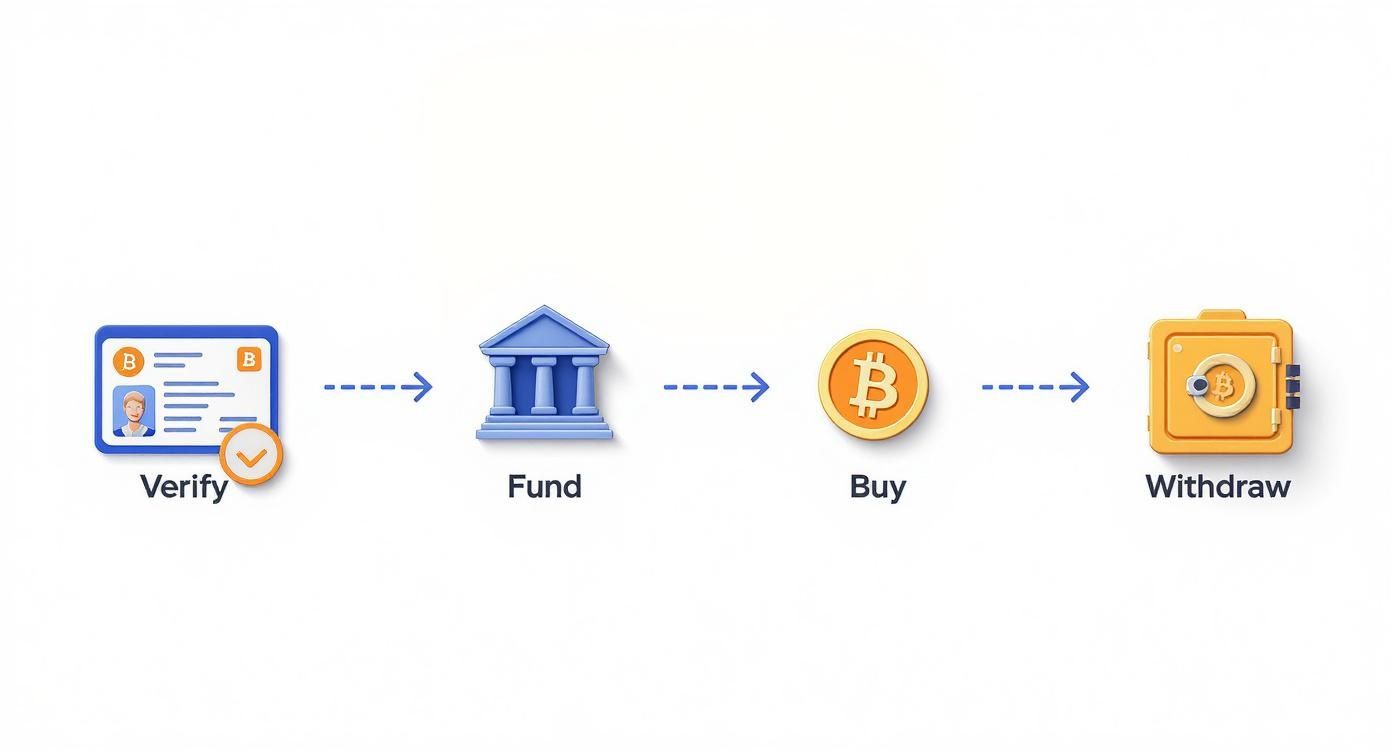
As you can see, a secure purchase always ends with you in control, withdrawing the Bitcoin to your own wallet. For a much deeper look into these kinds of threats, you should check out our guide on spotting crypto red flags.
"Pump and Dump" Schemes
Another trap to watch out for is the "pump and dump." This is where a group of insiders coordinates to artificially inflate the price of a small, obscure cryptocurrency—the "pump." They'll use platforms like Telegram and X to create a frenzy of hype, promising that a coin called "MoonRocket" is the "next Bitcoin."
As new investors pile in, the price shoots up. The original scammers then sell off all their holdings at this peak—the "dump"—which causes the price to collapse, leaving everyone else holding a bag of worthless tokens.
Thankfully, if you're buying Bitcoin in the UK, consumer protection has improved a lot. The FCA has brought in new rules that demand clearer risk warnings and have banned dodgy incentives for crypto promotions. The UK has also adopted the "Travel Rule," which forces crypto firms to share information on transactions. This transparency makes it much harder for criminals to operate anonymously. While these measures make the UK a safer place to get started, you can never let your guard down.
Common Questions About Buying Bitcoin Safely
As you start your journey into Bitcoin, a few questions are bound to pop up. It's perfectly normal. Getting a handle on how to buy bitcoins safely means looking at the whole picture—from taxes to what you do with your recovery phrase. Let’s tackle some of the most common queries we get from UK investors, so you can move forward with real confidence.
Do I Have to Pay Tax on Bitcoin in the UK?
Yes, you very likely will at some point. HMRC doesn't see Bitcoin as money; they treat it as property. You won’t get a tax bill just for buying and holding it, which is good news. But the moment you ‘dispose’ of your Bitcoin, the taxman takes notice.
Disposing of it can mean selling it for pounds, swapping it for another crypto like Ethereum, or even using it to buy a coffee. If you’ve made a profit when you do this, you could be on the hook for Capital Gains Tax. You get a tax-free allowance each year, but any profits above that figure need to be declared.
Keeping meticulous records is non-negotiable if you want to stay compliant. For every transaction, you absolutely must log:
- The date you bought your Bitcoin.
- Its value in GBP at that exact time.
- The date you sold, traded, or spent it.
- Its value in GBP at the moment of disposal.
If you're trading regularly or sitting on significant gains, getting advice from a tax professional who actually understands crypto is one of the smartest investments you can make.
What Is the Safest Way to Store My Recovery Phrase?
The only truly safe way is completely offline and physically tough. Your recovery phrase (often called a seed phrase) is the ultimate master key to your Bitcoin. Protecting it is your number one job. Never, ever store it digitally—not on your computer, not in an email draft, and definitely not on a cloud service like Google Drive.
Imagine your recovery phrase is like the deed to your house. You wouldn't leave a digital copy of it sitting on your desktop for anyone to find. Treat it with the same level of physical security.
Start by writing it down carefully on paper. Better yet, get a metal seed storage plate and stamp the words into it. That simple upgrade makes your backup resistant to fire and water damage. Make two of these physical copies.
Keep one in a secure spot at home, like inside a fireproof safe. The second copy needs to be stored somewhere completely different and equally secure—think a bank's safety deposit box or with a trusted family member. This redundancy is your lifeline; if disaster strikes one location, you won't lose everything.
Can My Bitcoin Be Stolen from a Hardware Wallet?
While the hardware wallet itself is a fortress, your Bitcoin can still be stolen if a scammer tricks you into giving up your recovery phrase. The biggest threat isn't a clever hack on the device; it's you being manipulated through social engineering.
A classic scam involves a fake support email or website that looks official. It might claim your Ledger wallet needs to be "re-validated" or "synchronised" and will direct you to a webpage with a form to enter your 24-word phrase. The second you type that phrase in and hit enter, a thief gains total control and will drain your funds instantly.
These are the golden rules for keeping your hardware wallet secure:
- Never type your recovery phrase into any website, app, or computer program.
- The only time you should enter the phrase is directly on the hardware device itself, and only when you're restoring your wallet.
- Always buy your hardware wallet straight from the manufacturer’s official website, such as Ledger.com. This prevents you from ending up with a device that has been tampered with.
Is It Safe to Use a Mobile App to Buy Bitcoin?
Yes, it is, provided you’re smart about it. Using the official mobile app from a regulated UK exchange like Coinbase or Kraken is a perfectly safe and convenient way to buy Bitcoin. Just make sure you download it by following the link from the exchange’s official website—this helps you dodge the malicious fakes that sometimes pop up in app stores.
Once it's installed, turn on every security feature the app offers. Use biometrics like Face ID or a fingerprint scanner, and set a strong, unique PIN code for the app itself.
These apps are great for buying, but remember they are "hot wallets," meaning they're connected to the internet. They’re fine for making transactions but aren't the place to store large amounts long-term. A great security habit to get into is using the mobile app to make your purchase, then promptly moving the bulk of your Bitcoin over to your secure cold wallet for proper safekeeping.
At The Coin Course, our mission is to give you the clear, reliable knowledge needed to navigate the world of cryptocurrency with confidence. From the basic principles to advanced security practices, we're here to support your journey. Explore our full range of expert articles and guides at https://thecoincourse.com.