When people ask, “Is Binance safe?”, there’s no simple yes or no answer. For anyone in the UK, it's a question with two different sides: how strong the platform's digital security is versus its tricky relationship with UK regulators.
While Binance has some seriously powerful digital defences, the truth is that it operates in the UK without a formal thumbs-up from the country's financial watchdogs.
Two Sides of the Same Coin: Binance’s Safety
Deciding whether to use an exchange like Binance means looking at more than just the technology that keeps your password safe. How the platform gets along with national regulators is just as important, as it directly affects what happens if something goes wrong.
On one hand, Binance has built what you could call a digital fortress. It gives users a solid set of security tools to lock down their accounts and protect their funds from theft. These are the absolute basics for keeping your assets safe from common online threats.
But then there’s the other side of the story: its regulatory status here in the UK.
The crucial thing to understand is that Binance does not hold official approval from the UK's main financial watchdog, the Financial Conduct Authority (FCA). So, while your crypto might be well-protected from hackers, you’re missing out on the consumer protections you'd get from a fully regulated UK financial company.
What This Actually Means for You
This lack of formal regulation puts UK users in a unique position. To help you get a clear picture of what this means in practice, here's a quick summary of Binance’s safety for UK users.
Binance UK Safety at a Glance
| Safety Factor | Binance's Standing | What This Means for You |
|---|---|---|
| Technical Security | Strong. Features like 2FA and an emergency fund (SAFU) are in place. | Your account is well-protected against common hacking attempts. |
| Regulatory Status | Not authorised by the FCA. | You have no access to the Financial Ombudsman or FSCS protection if Binance fails. |
| User Protection | You rely on Binance's own policies and insurance, not UK law. | Resolving a dispute or getting your money back depends entirely on Binance's goodwill. |
| Personal Responsibility | High. You must take extra steps to secure your assets. | Understanding personal security is something you can't skip. |
This table shows the trade-off quite clearly. Let's explore those points a bit more.
Technical Security: Binance gives you the tools you need, like two-factor authentication (2FA). It also maintains a massive emergency insurance fund called SAFU (Secure Asset Fund for Users), which is designed to cover user losses if a major hack happens. For instance, if hackers broke in and stole crypto, this fund would be used to pay users back.
Regulatory Risk: Because it isn't authorised by the FCA, you can’t go to official bodies like the Financial Ombudsman Service if you have a complaint. More importantly, you're not covered by the Financial Services Compensation Scheme (FSCS) if the company goes out of business.
Personal Responsibility: All of this puts the ball firmly in your court. It's up to you to manage your own risk. Getting to grips with the basics of exchange security and protecting your assets isn’t just a good idea—it’s essential.
Ultimately, using Binance in the UK is a balancing act. You get access to one of the world's biggest platforms with a huge range of features, but you have to give up the peace of mind that comes with local regulation.
Navigating Binance's UK Regulatory Maze
https://www.youtube.com/embed/SLv-YINflUQ
When we ask, "is Binance safe?", we can't ignore its complicated relationship with UK regulators. This is where things get a bit confusing, mainly because of the Financial Conduct Authority (FCA), the UK's top financial watchdog. You can think of the FCA as the bouncer for financial services; without its permission, a company can't legally offer certain services here.
Binance and the FCA have had a rather bumpy history, which adds a layer of risk for anyone using the platform in the UK. The main issue is that Binance isn't authorised by the FCA to carry out regulated financial activities in the country. This isn't just a bit of paperwork; it completely changes the level of protection you have as a customer.
The Impact of No FCA Authorisation
Using a platform that isn't authorised by the FCA means you're operating without some critical safety nets. It’s a bit like driving a car without insurance—everything might seem fine, but if you have an accident, you’re left to deal with the mess on your own.
The risks are very real and could hit you in the wallet. Here’s exactly what you’re missing out on by using a platform outside the FCA's protection:
- No Access to the Financial Ombudsman Service: Let's say you have a complaint with a regulated bank that you can't sort out directly. The Ombudsman is your next stop. They can make an independent, final decision. But with an unauthorised firm like Binance, they have no power. You’re on your own.
- No FSCS Protection: The Financial Services Compensation Scheme (FSCS) is a lifesaver. It can pay you back up to £85,000 if a regulated company goes bankrupt. With Binance, that protection simply isn't there. If the platform were to fail, your funds aren't covered by this key UK scheme.
This timeline really highlights the difference between Binance's powerful technology and its ongoing regulatory headaches in the UK.
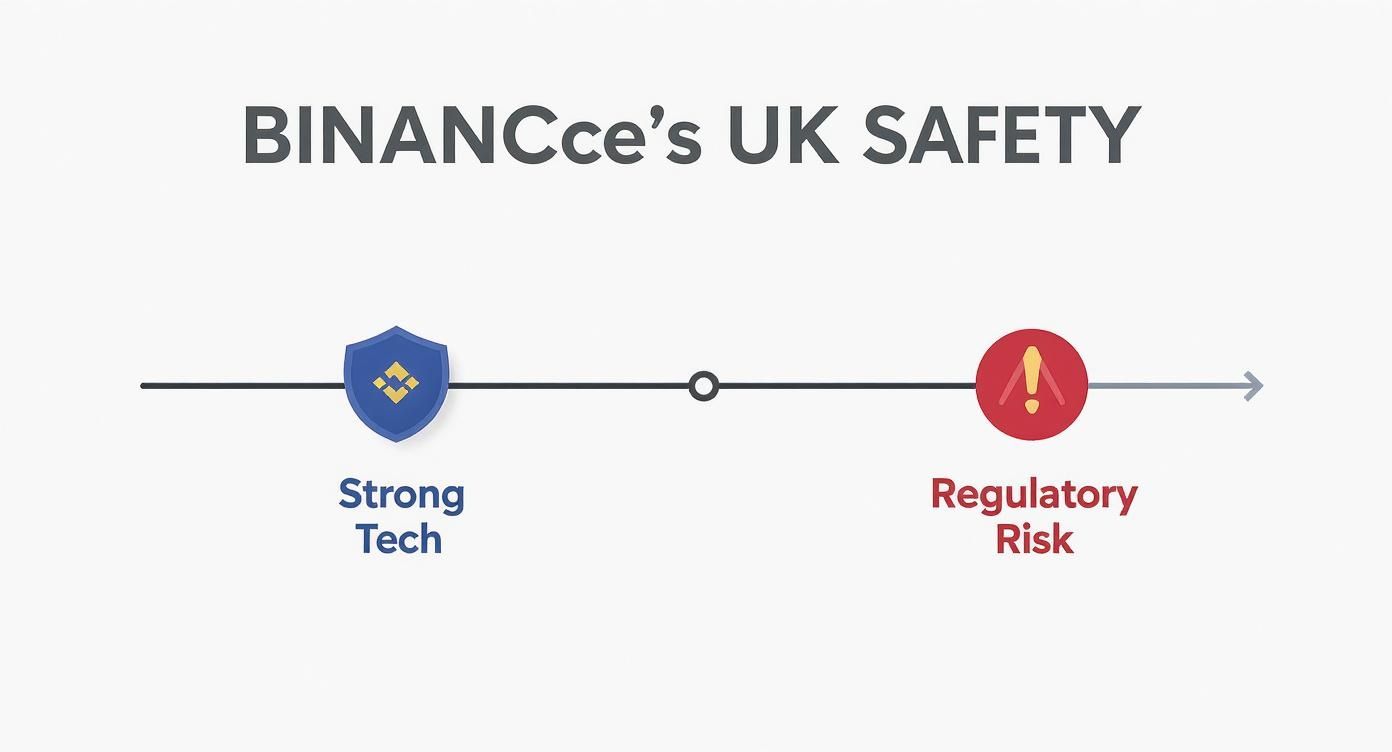
As you can see, while Binance scores high on technical security, its unresolved status with UK regulators remains a major issue for users here.
Binance's Official UK Status
The situation became much clearer in recent years. Back in June 2021, the FCA took direct action against Binance Markets Limited (BML), a UK-based part of the wider Binance Group. The FCA essentially banned BML from doing any regulated crypto activity.
While BML followed the rules, the restrictions stayed. Then, on 30 May 2023, BML cancelled its FCA permissions for good. You can still find the FCA's official warning on their website, which explains their position on Binance and its UK status.
What this means today is that no company in the Binance group has the necessary authorisations to offer regulated crypto services to UK customers. If you want to dive deeper into these rules, you might find our guide on security tokens and regulatory compliance helpful.
This lack of regulation directly affects how safe Binance is for you. While the platform itself has strong security measures, the absence of a UK regulatory licence means you're accepting a level of risk you wouldn't have with an FCA-authorised provider. It's a trade-off you have to be comfortable with.
A Look Inside the Binance Security Toolbox
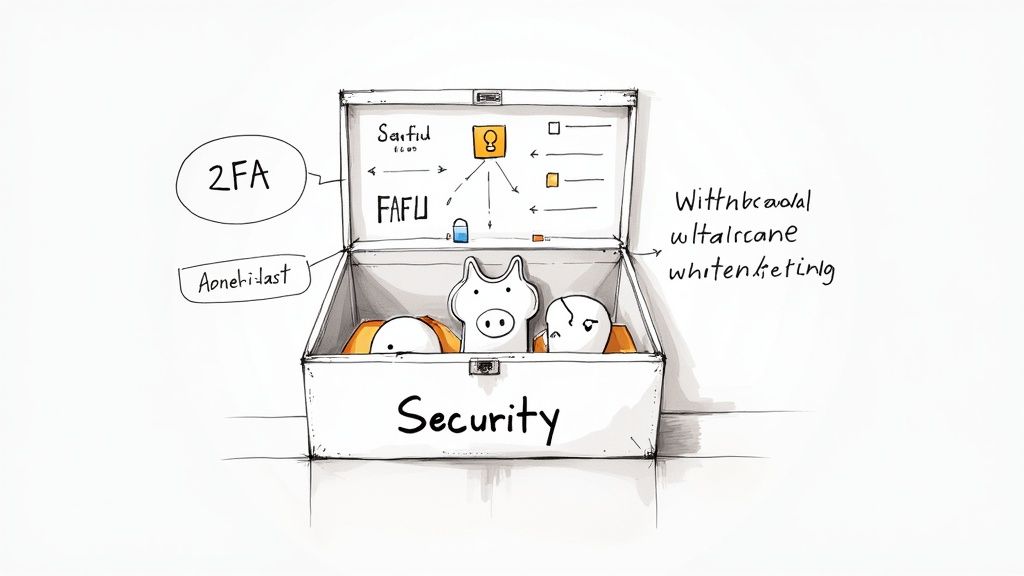
Putting the regulatory noise to one side for a moment, let's open up the digital toolbox Binance actually gives you to protect your account. While no platform is ever completely hacker-proof, the strength of its security features plays a huge part in answering the question, "is Binance safe?". Binance offers several layers of defence, but here’s the catch: it's up to you to turn them on and use them properly.
Imagine being given a state-of-the-art home security system. It’s fantastic, but it’s not going to do much good if you don't actually set the alarm. Binance provides some powerful tools to keep your crypto secure, but you have to be the one to use them.
Your First Line of Defence
The most important security measure on any crypto exchange, without a doubt, is Two-Factor Authentication (2FA). The best way to think about it is this: your password is the key to your front door. 2FA is like adding a second, high-tech deadbolt that needs a constantly changing code from your phone to unlock.
So, even if a scammer somehow steals your password, they're still stuck on the doorstep. They can't get into your account without also having your phone. This one simple step makes a criminal's job incredibly harder.
For example, whenever you try to log in or withdraw funds, Binance will ask you for a temporary, six-digit code from an app like Google Authenticator. This code refreshes every 30 seconds, creating a moving target that's nearly impossible for an attacker to guess or intercept in time.
Binance's Emergency Insurance Fund
But what happens if, despite all the best security in the world, the exchange itself gets hacked? This is exactly why the Secure Asset Fund for Users (SAFU) exists. Back in 2018, Binance set up this massive emergency insurance fund specifically to protect users if a large-scale hack ever happened.
You can think of it as the exchange’s own private insurance policy, which it funds by putting aside 10% of all trading fees. The whole point is to make users whole again if their funds are stolen because of a security problem on Binance’s end.
The SAFU fund is a huge confidence booster for traders. Valued at over $1 billion, it shows a serious commitment to covering user losses in a worst-case scenario—a promise not all exchanges are willing or able to make.
This fund was famously put to the test during the 2019 hack. Binance used it to fully reimburse every single person affected, making sure they didn't lose a penny.
More Tools to Lock Down Your Account
Beyond the basics, Binance offers a few more specialised tools that give you much more detailed control over your account's security. These features are designed to stop common attack methods and give you extra peace of mind.
Withdrawal Whitelisting: This feature lets you create a specific list of crypto addresses you’ve pre-approved for withdrawals. If an attacker ever gets into your account, they simply can't send your crypto to their own wallet because it won't be on your trusted list. It’s the digital version of telling your bank to only allow payments to people you already know.
Anti-Phishing Code: You can set a unique, secret code that will appear in every single official email you get from Binance. For example, you could set your code as "BlueBanana77". If an email lands in your inbox that looks like it's from Binance but doesn't say "BlueBanana77", you know instantly it's a fake. It's a dead giveaway for a phishing scam trying to steal your login details.
These tools make one thing clear: a big part of whether Binance is safe comes down to how proactive you are. By enabling these features, you're building multiple barriers that make your account a much, much harder target for criminals.
Has Binance Been Hacked Before?
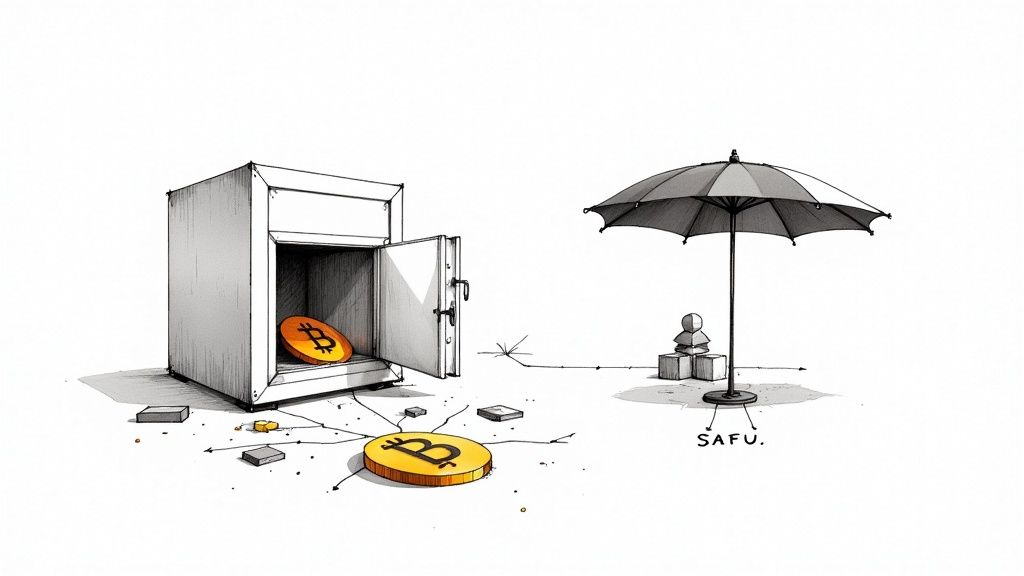
Let's be straight: no crypto exchange is an unbreakable fortress. Binance, despite its size, has faced a major security test.
Back in 2019, hackers got away with 7,000 Bitcoin. This wasn't just a technical problem; it was a defining moment that put Binance's promises to the test. The question of whether Binance is safe suddenly became very real for millions of users.
Instead of leaving its customers out of pocket, Binance immediately turned to its Secure Asset Fund for Users (SAFU). This emergency fund, built for exactly this kind of disaster, was used to cover every single stolen coin. Trust was restored almost overnight because users got their money back.
When the crisis hit in 2019, Binance drew from its $1 billion SAFU fund to make every affected user whole again, proving its commitment wasn't just talk.
This response is a world away from some of crypto's darkest days. Just think back to the infamous Mt. Gox collapse in 2014. After losing a massive 850,000 Bitcoin, the exchange simply went out of business, leaving customers with nothing but years of legal battles and a small fraction of their funds.
Binance’s approach was different. The hack led to a complete overhaul of their internal security, showing they weren't just fixing the immediate problem but preparing for the future.
- 2019 Binance Hack: 7,000 BTC stolen. The response? Full repayment from the SAFU fund.
- Mt. Gox Collapse: 850,000 BTC lost. The result? Bankruptcy and customers getting less than 20% back after nearly a decade.
- Bitfinex Breach: 120,000 BTC stolen in 2016. Their solution was to share the losses, meaning every user on the platform took a financial hit.
The lesson here is simple. When you're judging an exchange, don't just look at its defences. Look at how it handles a crisis.
What Binance Learned From the Breach
In the aftermath, Binance didn't just plug the hole; it reinforced the entire building. They tightened up risk controls, introduced stricter withdrawal checks, and improved real-time wallet monitoring to flag suspicious activity instantly. It was the digital equivalent of adding motion sensors and reinforced steel doors to the vault.
These proactive upgrades mean a similar attack today would face a much tougher challenge. For any trader weighing their options, seeing an exchange learn and adapt from its mistakes provides a powerful sense of reassurance.
| Exchange | Hack Year | Amount Stolen | Recovery Outcome |
|---|---|---|---|
| Binance | 2019 | 7,000 BTC | Full reimbursement via SAFU |
| Mt. Gox | 2014 | 850,000 BTC | Partial recovery after years |
| Bitfinex | 2016 | 120,000 BTC | Losses shared among users |
The fact that Binance made users whole says a lot about its culture and financial health. Still, it’s a strong reminder that no system is perfect, and being careful yourself is essential.
Crisis Response Shapes Reliability
How a company behaves in its darkest hour tells you everything you need to know about its integrity. For UK users wondering if Binance is truly safe, the 2019 incident is arguably one of the strongest points in its favour.
Binance also increased transparency by publishing a detailed report, explaining what went wrong and how they were fixing it. This level of openness is a rare and welcome sight in the often-secretive crypto world. It turned a potentially disastrous failure into a show of accountability.
A combination of constant watchfulness and a solid, well-funded recovery plan is what truly provides peace of mind.
Ultimately, it’s the willingness to stand by its users and cover their losses that sets an exchange apart. This history gives us a clear picture of how Binance acts when the worst happens.
Tip: Always monitor your account for unexpected activity and make sure you have alerts enabled for all logins and withdrawals. Catching something early can make all the difference.
Why Is Binance Still So Popular in the UK?
Despite some very direct warnings from UK regulators, Binance hasn’t just survived; it has thrived. So, what’s going on? Why are so many UK traders still using the platform? It really comes down to a classic trade-off: huge opportunity versus regulatory risk. For a lot of people, what Binance offers is simply too good to ignore.
Think of Binance as the world's biggest and busiest crypto supermarket. It has a massive selection of cryptocurrencies, far more than most UK-regulated exchanges can offer. If you're looking for that next breakout altcoin or just want a very diverse portfolio, that variety is a huge attraction. Add to that its enormous trading volumes, which usually mean you get better prices and can make trades instantly.
But all that global appeal doesn't just magically erase the local risks. It’s a bit like ordering from a huge, popular international website that doesn't follow UK consumer protection laws. You might find a rare item at a fantastic price, but if it arrives broken or doesn't show up at all, you have no local authority to back you up. You’re essentially on your own, relying on the company's customer service.
Popularity Versus Protection
That comparison really gets to the heart of the matter for UK users. The platform’s huge size isn't a replacement for proper, official regulatory protection in your own country. While Binance gives you access to powerful tools and a vast market, the lack of FCA oversight means you're operating without the UK’s financial safety net. That’s a key difference to understand when deciding if Binance is the right choice for you.
This situation has certainly created some confusion. Even without official FCA authorisation, Binance has seen huge spikes in interest. For instance, a rumour about ‘regulatory approval’ in 2023 led some to claim that Binance’s UK trading volume shot up by 200%. These reports were quite misleading, though. Binance Markets Limited was never actually given a licence to operate, and the FCA has been consistent with its warnings. You can learn more about the UK regulatory situation and Binance’s trading volumes to get the full story.
For many traders, the calculation is simple: the potential rewards and features offered by the world's largest exchange outweigh the risks associated with its unregulated status in the UK. This is a personal risk assessment every user must make for themselves.
At the end of the day, the platform’s stubborn popularity in the UK is fuelled by a few key attractions:
- Unmatched Coin Selection: It lists hundreds of cryptocurrencies that you just can't find on smaller, regulated exchanges.
- High Liquidity: Massive trading volumes mean you can buy or sell large amounts without causing a huge price swing.
- Advanced Trading Features: For experienced investors, access to tools like futures and options trading is a major plus.
These advantages create a powerful pull for traders who are prepared to take on more personal responsibility for their funds. The decision to use Binance in the UK isn't really about whether it's "safe" in an absolute sense, but rather about whether you fully understand—and accept—the specific risks you're taking on.
How to Protect Your Crypto on Binance
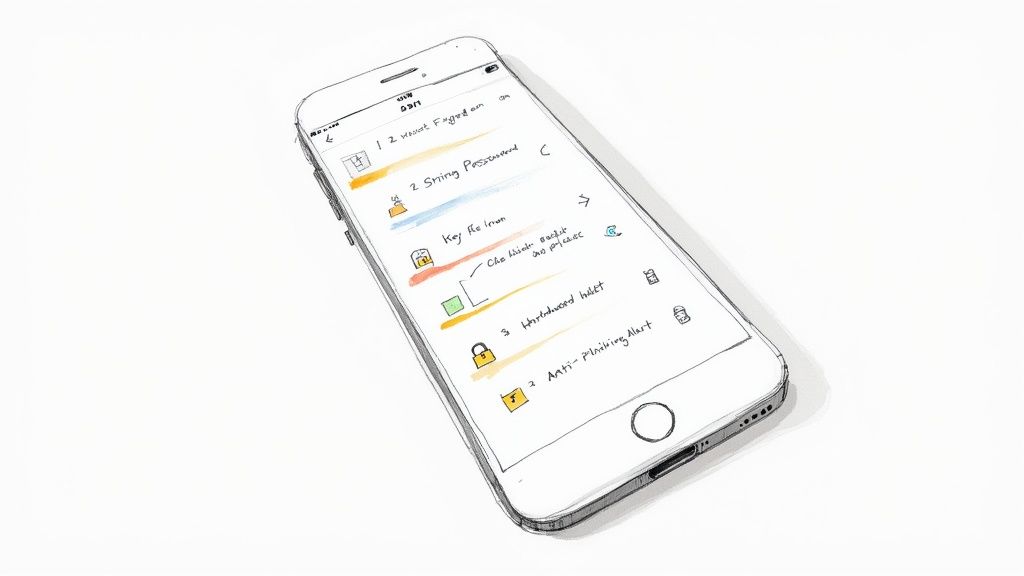
Even with all of Binance's protections, your account's security ultimately comes down to you. The platform gives you all the right tools, but they’re useless unless you actually turn them on. Think of it like this: Binance provides a high-tech vault door, but you’re the one who needs to set a strong combination and spin the lock.
By taking a few practical steps and building some smart habits, you can dramatically lower your personal risk. It’s all about making your account a much tougher target for any opportunistic hacker to crack.
Activate Essential Security Layers
First things first: set up Two-Factor Authentication (2FA). This is not optional. It adds a second, time-sensitive code to your login process, meaning a stolen password alone isn't enough for someone to get in. While SMS 2FA is better than nothing, authenticator apps like Google Authenticator are far more secure.
For ultimate peace of mind, a physical security key (like a YubiKey) is the gold standard. To get the full picture on why this is so important, have a read of our complete guide on setting up two-factor authentication for crypto accounts.
Beyond that, make sure you also:
- Create a Unique Password: Don't be tempted to reuse a password from another service. Your Binance password should be long, complex, and used absolutely nowhere else. A good password manager can handle this for you.
- Enable Anti-Phishing Code: This is a clever little feature. You set a unique code or phrase in your account that Binance will then include in every legitimate email they send you. If an email arrives without that code, you know instantly it's a scam.
Adopt Smart Security Habits
Great security is more than just settings; it’s a way of thinking. One of the biggest dangers out there is phishing, where scammers use fake emails or copycat websites to trick you into giving them your login details. Always be suspicious of urgent emails and double-check you're on the official Binance.com URL before typing anything.
It’s also worth noting that the regulatory landscape is tightening. In the UK, for instance, a significant rule change is coming. From 1 January 2026, all crypto platforms will need to collect fully verified identification from users, including name, address, and tax information. Not following these rules could lead to fines of up to £300. These new HMRC rules are designed to increase transparency and accountability, which highlights just how important it is to keep your personal data secure.
The golden rule of crypto is "not your keys, not your coins." This means that any crypto held on an exchange is ultimately in their custody, not yours.
For any large amount of crypto you plan on holding for the long term, moving it to a personal hardware wallet is the smartest move. This puts your private keys directly into your hands, taking the risk of an exchange hack or asset freeze completely off the table. While Binance has strong security, nothing beats holding your own keys.
Let's wrap things up by answering a few of the most pressing questions we hear from UK crypto enthusiasts. Getting straight to the point on these should clear up any remaining concerns about whether Binance is the right fit for you.
Can I Lose Money if Binance Isn't FCA Regulated?
Yes, absolutely. This is one of the biggest risks to understand. Because Binance isn't regulated by the Financial Conduct Authority (FCA), your money doesn't have the safety net provided by the Financial Services Compensation Scheme (FSCS).
Think of the FSCS as a last line of defence. If your high-street bank went out of business, the scheme would step in to protect your savings up to £85,000. With an unregulated platform like Binance, that protection simply isn't there. You're relying entirely on Binance's own security measures and financial health to keep your funds safe.
What Happens if the UK Blocks Binance?
This is a very real possibility and a major risk of using any platform that operates in a regulatory grey area. If UK authorities suddenly decided to block access to Binance's website, you could find yourself completely cut off from your funds.
Regulatory rules can change overnight. One day you can access your account, the next you might not. This uncertainty is precisely why it’s so important to be aware of the regulatory climate you're stepping into.
Remember, the SAFU fund is there to protect against hacks and system failures. It offers zero protection if a government decides to block the platform. Your access could vanish with little to no warning.
Does the SAFU Fund Protect UK Users?
It does. The Secure Asset Fund for Users (SAFU) is Binance’s global emergency insurance fund, and it covers all users, including those in the UK. Its purpose is to pay users back if the platform itself suffers a major security breach, like a sophisticated hack that results in lost funds.
But it’s important to know its limits. The SAFU fund won't help you if a regulator blocks your access, if you fall for a phishing scam and lose your password, or if the market simply crashes. It's designed for a very specific type of platform failure.
Here at The Coin Course, our goal is to give you the practical, no-nonsense knowledge you need to navigate the crypto world safely. If you want to build your confidence and learn to protect your assets like a pro, dive into our expert guides and resources. Find out more at https://thecoincourse.com.