You've probably seen the post already. A Telegram channel, an X account, or a Discord group flashes a message like “BTC breakout incoming” or “guaranteed long setup”. The chart looks convincing. The comments are full of rocket emojis. For a moment, it feels like you've found a shortcut.
That feeling is exactly why bitcoin trading signals are so appealing.
A signal promises to simplify a messy market into one decision. Buy here. Sell there. Put your stop here. But Bitcoin doesn't hand out easy money, and the people selling certainty are often the people you should trust least. A useful signal can help you organise your thinking. A bad one can pull you into a rushed trade on a poor platform at the worst possible time.
For UK traders, that matters even more than many global guides admit. Rules, platform quality, tax, and market timing all shape whether a signal is practical or just noise with a price tag. If you treat a signal like a tip from a mate at the pub, you'll trade emotionally. If you treat it like one input inside a careful workflow, you'll make far better decisions.
The Promise and Peril of a Bitcoin Signal
A bitcoin trading signal is attractive because it reduces effort. You don't need to stare at charts for hours. Someone else has already done the scanning and sends you an alert. In theory, that saves time. In practice, it can also outsource your judgement.
A simple example shows the difference. Say you see “Buy BTC now, target higher” posted online. One trader enters instantly because they don't want to miss the move. Another pauses, checks the chart, notices the price has already jumped, and realises the “signal” may be late. The first trader is following a message. The second is evaluating a setup.
That second habit is what keeps signals useful.
Why signals feel more important in the UK
The UK retail market changed when the FCA banned the sale, marketing, and distribution of cryptoasset derivatives and exchange-traded notes to retail consumers in January 2021, which pushed many traders more towards spot Bitcoin and made timing tools like moving averages and RSI more central to entry and exit decisions, as described in this overview of the FCA shift and signal use.
That change matters because spot trading has less room for reckless experimentation. Without the same retail access to certain products that amplify trading positions, many people now focus on simpler chart-based decisions. That sounds safer, and often it is, but it also means traders can become over-dependent on signals without learning how to judge them.
Practical rule: A signal is an idea, not an instruction.
The real risk isn't just a wrong call
New traders often think the danger is only market direction. They ask, “Will Bitcoin go up or down after this signal?” That's only part of it. The bigger risks are often boring ones. Did the signal arrive too late? Is the exchange reliable? Are spreads wide? Are you trading because the setup is strong, or because the alert made you anxious?
A decent signal points to a probability. A poor signal sells certainty. In crypto, that difference is huge.
What Are Bitcoin Trading Signals
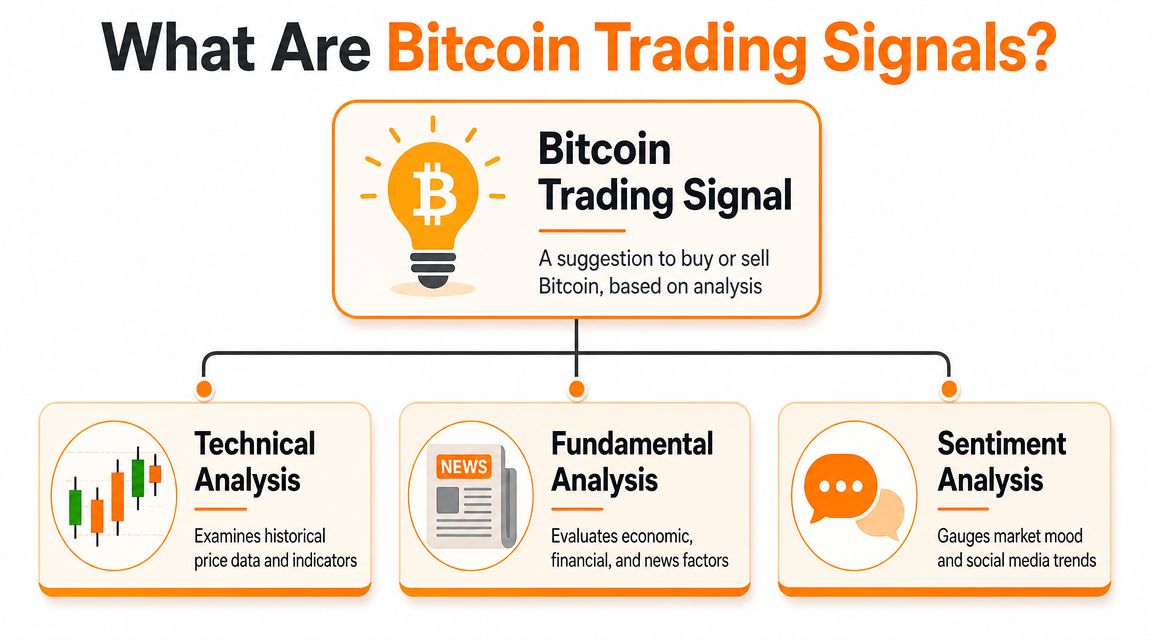
At the simplest level, bitcoin trading signals are suggestions to buy, sell, or wait, based on some kind of analysis. They can come from a person, a charting platform, a bot, or your own rules.
Think of them like driving aids. Your dashboard gives you speed and fuel. A mechanic can tell you what the engine is doing beneath the surface. Traffic around you shows how other drivers are behaving. Bitcoin signals work in a similar way. Some read the chart. Some look under the bonnet. Some measure crowd mood.
Technical signals
Technical signals come from price, volume, and indicators. These are the most common signals beginners meet first. They include moving averages, RSI, MACD, support and resistance, trendlines, and chart patterns.
A very ordinary technical signal might be a moving-average crossover. Another might be price bouncing from a support area several times. If you want to get comfortable with that style of chart reading, this guide on using moving averages for crypto trading signals is a practical starting point.
Here's how to think about technical signals:
- Dashboard reading: They tell you what price has been doing.
- Fast to use: You can spot them quickly on TradingView or exchange charts.
- Easy to misuse: Beginners often treat one indicator as proof instead of one clue.
Fundamental signals
Fundamental signals come from broader events and economic context. In Bitcoin, that might include major regulation, exchange news, large shifts in market structure, or broader macro events. These aren't always neat chart alerts, but they still influence trades.
A simple example is this. If a major regulatory update changes how retail traders can access crypto products, that affects behaviour. Price may still move according to technical levels, but the backdrop has changed. That can make a chart setup more fragile or more meaningful depending on the moment.
Fundamental signals tend to be slower and less tidy than technical ones. They don't always tell you the exact candle to buy. They help answer whether the market environment supports the trade.
Sentiment signals
Sentiment signals measure market mood. Traders use them because price doesn't move on maths alone. It also moves on fear, greed, excitement, and panic.
Examples include:
- Social mood: Is everyone euphoric or extremely negative?
- Headline tone: Are traders reacting to scary news or positive catalysts?
- Crowd behaviour: Are people chasing moves after the fact?
Sentiment is useful because extreme optimism and extreme fear can both be warning signs. But it's slippery. A loud crowd can stay loud for a long time.
When a signal matches the chart, the market context, and your own risk plan, it becomes far more useful than a single alert on its own.
The strongest approach combines them
Most weak trading decisions come from leaning on just one type of signal. A trader sees RSI oversold and buys, even though the broader trend is weak and liquidity is poor. Another trader sees bullish news and ignores a chart that's clearly losing momentum.
A better approach is to stack evidence.
| Signal type | What it helps with | Common beginner mistake |
|---|---|---|
| Technical | Timing entries and exits | Treating one indicator as enough |
| Fundamental | Understanding context | Ignoring it because it feels less precise |
| Sentiment | Reading crowd behaviour | Confusing hype with confirmation |
That's the core idea. Signals aren't magical. They're observations from different angles.
Finding and Evaluating Signal Providers
Once you know what a signal is, the next question is where it comes from. Most traders run into signals from one of three places. Public charting platforms like TradingView. Private groups on Telegram or Discord. Automated bots that scan markets and push alerts.
The source matters because a signal can be technically valid and still be useless in practice.
What to look for before trusting a provider
A good provider usually behaves more like a teacher than a hype account. They explain the reasoning behind the setup. They show the invalidation point. They accept that some trades fail. A bad provider usually does the opposite. They post only wins, avoid detail, and create urgency.
Use this checklist before paying attention to any provider:
- Method first: Do they explain why the setup exists, or only shout “buy now”?
- Clear invalidation: Do they show where the idea is wrong?
- Market timing awareness: Do their alerts make sense for your trading hours?
- Platform discipline: Do they care where the trade is executed, or just the signal headline?
- Educational tone: Do you learn from the posts, or just feel pressured by them?
The UK timing problem
For traders in Britain, timing isn't a small detail. It can decide whether a signal is actionable or stale. A key issue is reliability outside US market hours. Recent FCA consumer research found 12% of UK adults held crypto in 2024, and UK traders need to judge whether a provider accounts for latency, slippage, and liquidity conditions in European and UK sessions, because overnight alerts may already be outdated by the time you act, as discussed in this analysis of crypto signal timing for UK traders.
That point gets missed constantly. A signal posted during an active US move might look brilliant on a screenshot. If you see it later from London and enter after the move has stretched, you're not trading the same setup. You're trading leftovers.
A signal provider should fit your clock, not just your curiosity.
Paid doesn't mean better
Many newcomers assume a subscription makes signals more reliable. Sometimes a paid service is more organised. Sometimes it's just better marketing. Price tells you almost nothing by itself.
A stronger test is to ask, “Would I still value this feed if I never placed a trade from it?” If the answer is yes because the commentary sharpens your judgement, that's promising. If the answer is no because it's just alerts and adrenaline, be careful.
A decent provider helps you think. A weak one trains you to obey.
A Safe Workflow for Using Trading Signals
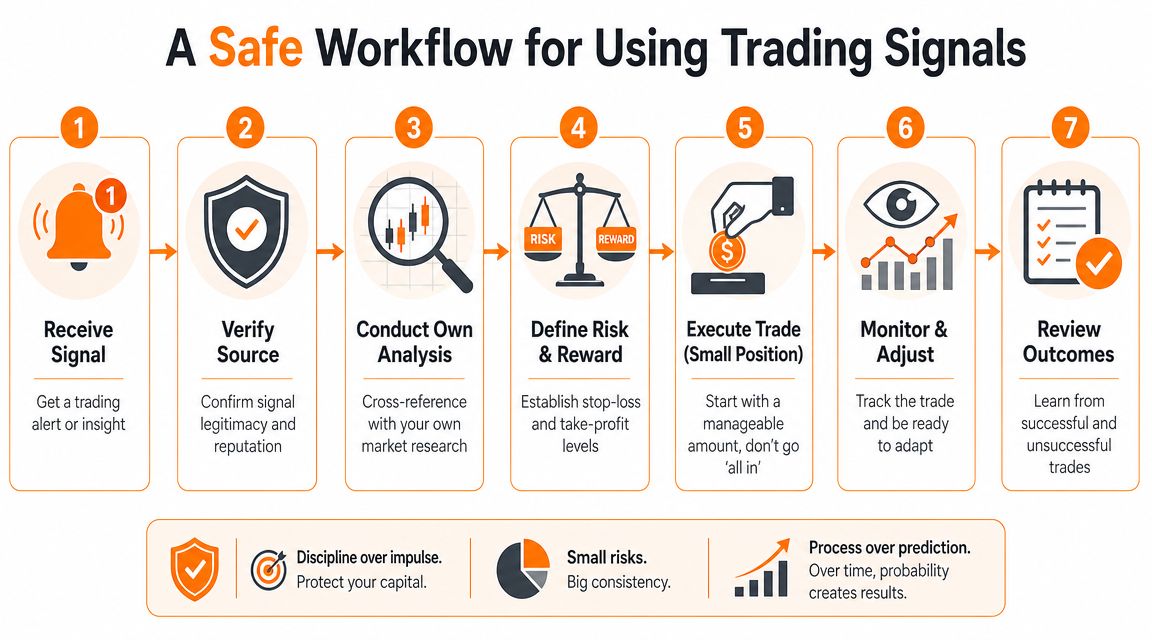
The safest way to use bitcoin trading signals is to treat them like a checklist, not a command. Most trading damage happens between receiving the signal and clicking the order button. That gap is where discipline lives.
The seven-step workflow
Receive the signal
Start with the alert, but don't assume it deserves action. A signal is only a candidate trade.Verify the source
Ask who sent it and whether they've earned your attention. If it came from a random social account or a noisy group chat, scepticism is the correct default.Check the chart yourself
Pull up BTC/USD or BTC/GBP on your charting platform. Mark the key level. Look at trend, recent price structure, and whether the move has already happened.Look for confirmation
This can be another indicator, a clean support or resistance reaction, a volume clue, or a higher-timeframe structure. Don't pile on endless indicators. You're looking for agreement, not a perfect picture.Define risk before entry
Decide where you'd exit if wrong. Decide where you'd take profit if right. Decide position size before the order goes in.Execute small and cleanly
If the setup still looks valid, enter with a manageable position. You don't need to go all in to prove a point.Review the outcome
Save the chart. Write down why you took it. Note whether the signal was early, late, clear, or messy.
Why this workflow matters more in the UK
Frequent short-term trades can become annoying long before they become profitable. For most individuals, HMRC treats crypto gains as Capital Gains, and the annual exempt amount is £3,000 for 2024/25, which means even small profitable signal-led disposals can add tax-reporting work, as noted in this discussion of UK crypto tax friction for signal traders.
That doesn't mean you shouldn't trade. It means hyperactive signal chasing has a hidden cost. Every quick in-and-out decision may create admin, not just opportunity. Beginners rarely factor that in when they join a channel sending multiple alerts a day.
A practical safety layer
Before you place any signal-based trade, your exchange account should already be locked down. Strong passwords, app-based two-factor authentication, and careful device habits matter as much as chart reading. This guide on how to secure your crypto exchange account is worth sorting before you risk any capital.
A short video can help make the workflow easier to picture in practice.
A simple pre-trade card
Keep something like this beside you:
- Setup quality: Does the chart still support the signal?
- Risk point: Where am I wrong?
- Position size: Is this small enough to think clearly?
- Admin cost: Is this trade worth the tracking and tax hassle?
- Emotional state: Am I calm, or am I reacting to urgency?
Keep this standard: If you can't explain the trade in two or three plain sentences, you probably shouldn't take it.
A Practical Example of Reading Signals
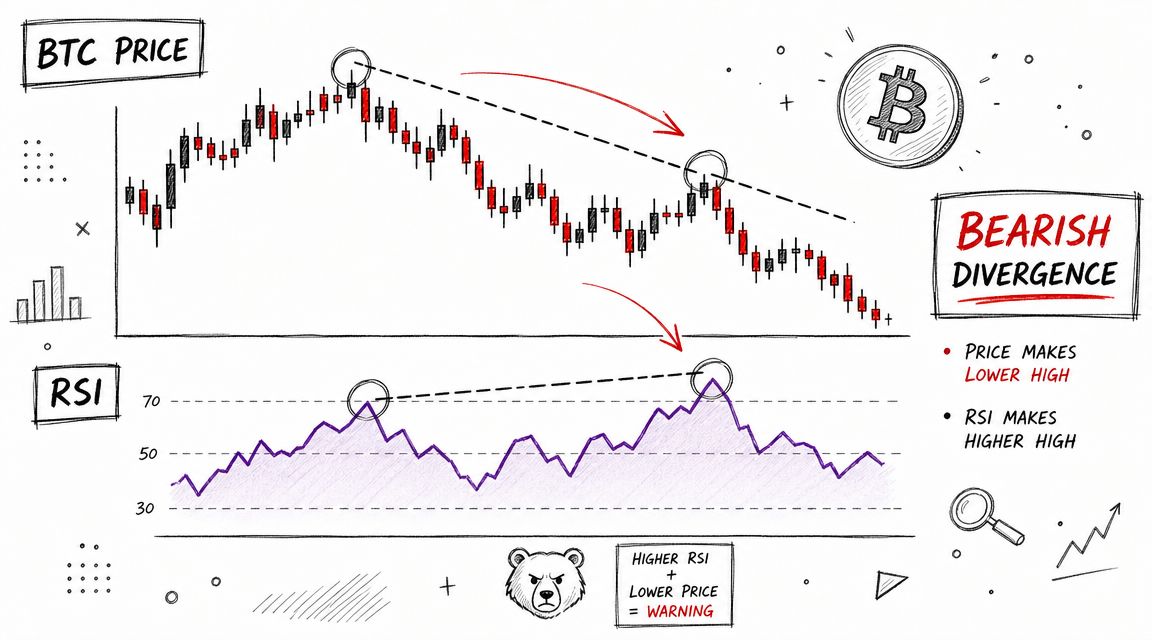
Let's make this concrete with one of the cleaner technical setups beginners can learn to recognise. Bearish divergence on the 14-period RSI happens when Bitcoin makes a higher high on price, but the RSI makes a lower high. Price is still rising, yet momentum is fading.
Reading the setup
Say Mia is watching the 4-hour Bitcoin chart during the London session. Bitcoin pushes to a fresh swing high, but the RSI doesn't match that strength. Instead, RSI forms a lower high. That's a warning sign, not a sell button.
Bearish divergence on the 14-period RSI can be especially useful for UK traders on the 4-hour or daily chart during the London session, where it can filter out some intraday noise, as outlined on Investing.com's Bitcoin technical overview.
Mia doesn't rush in. She knows divergence often appears before price turns. Sometimes it leads to a pullback. Sometimes it just marks a pause.
Adding confirmation
Mia wants one more sign. She draws a short-term trendline under the recent move and watches for a break. She also checks whether price starts slipping below a nearby moving average. Now the idea is sharper. Momentum is weakening, and price is starting to confirm it.
Her plan might look like this:
- Entry idea: Below the broken short-term structure
- Invalidation: Above the recent swing high
- Target area: A previous support zone where buyers stepped in before
Notice what she hasn't done. She hasn't assumed the divergence guarantees a drop. She hasn't increased size because the chart “looks obvious”. She's turned a signal into a plan.
Bearish divergence is a warning flare. The trade comes from the full plan, not from the flare alone.
Why this example matters
This is how bitcoin trading signals become useful in real life. Not because they predict every move, but because they help you organise evidence. The signal gives you a reason to pay attention. Confirmation and risk management decide whether the trade deserves your money.
That shift, from spotting to planning, is where traders improve.
How to Avoid Bitcoin Signal Scams
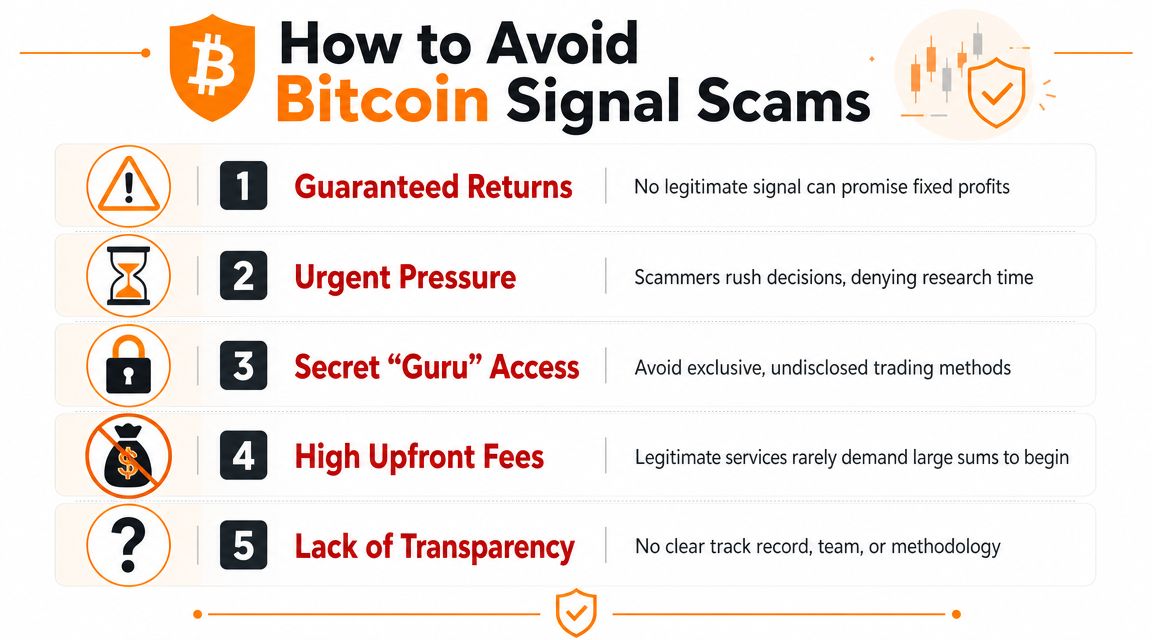
Scammy signal services usually sound better than honest ones. That's the trap. Real traders talk about uncertainty, invalidation, bad fills, and risk. Scammers talk about certainty, exclusivity, and speed.
If a signal seller makes you feel rushed, dazzled, or slightly ashamed for asking basic questions, step back.
Red flag checklist
- Guaranteed returns: No legitimate signal can promise a fixed outcome in Bitcoin.
- Forced exchange choice: Be wary if they insist you must use one obscure platform.
- Guru theatre: Anonymous experts with secret methods are selling mystique, not process.
- Pump-style chatrooms: If the group feels like a frenzy machine, it probably is.
- Dangerous account requests: Never hand over access that could put funds at risk.
The platform question is especially important in the UK. The FCA has warned that 86% of firms offering cryptoasset derivatives and related products to retail consumers in the UK were expected to fail to meet anti-money-laundering standards, which is why traders should treat any signal as a probability tool and carefully vet the execution venue, as highlighted in this discussion of crypto market signals and UK regulatory context.
What scammers exploit
Scammers don't just exploit greed. They exploit confusion.
They know beginners often can't tell the difference between a chart screenshot and a proper trading thesis. They know many people are embarrassed to ask what RSI means, or why a stop-loss sits at a certain level. They know urgency shuts down careful thinking.
A few habits lower your risk fast:
| Scam signal | Safer response |
|---|---|
| “Act now or miss it” | Wait and verify |
| “No losses, only wins” | Leave immediately |
| “Use this unknown platform” | Research the venue first |
| “Trust me, don't ask questions” | Ask more questions |
A simple rule for self-protection
If a signal service doesn't want you to understand the trade, it wants your dependence.
That's why the best defence isn't paranoia. It's competence. Learn enough to ask basic questions. Learn enough to read a chart. Learn enough to walk away when the setup, the venue, or the salesperson feels wrong.
Developing Your Signal Trading Skills
The biggest mindset shift is simple. Stop trying to become someone who chases signals. Try to become someone who can judge them.
That doesn't mean you need to build advanced models or stare at charts all day. It means building a repeatable routine. Check the higher timeframe. Mark levels. Read one or two indicators well instead of ten badly. Keep a trade journal. Review losses without inventing excuses.
A practical next step is to spend time on a charting platform such as TradingView and practise identifying one setup repeatedly. RSI divergence, support and resistance reactions, or moving-average behaviour are enough to start. You'll learn more from tracking one clear pattern carefully than from consuming a constant stream of random alerts.
It also helps to read broadly around active trading. If you want a grounded companion piece, this article on crypto day trading is useful for understanding the habits and limits that shape short-term decisions.
Signals work best inside a wider system that includes security, risk control, patience, and record-keeping. Once you see them that way, they become calmer and more useful. They stop feeling like magic and start behaving like tools.
If you want to build that kind of skill step by step, The Coin Course offers practical crypto education with a strong focus on safety, clear explanations, and real-world decision-making for beginners and experienced learners alike.