You see the word dollar everywhere in crypto, even when you're trying to avoid traditional finance. Bitcoin is priced in dollars. Most major stablecoins aim to track the dollar. Global risk sentiment often turns on what the Federal Reserve does. If you're in the UK or Europe, that can feel odd. Why should one country's money shape markets that are supposed to be global and digital?
The answer starts with world reserve currencies. They sit underneath trade, debt, commodities, banking, and now a big part of crypto. If you understand how reserve currencies work, a lot of confusing market behaviour starts to make sense. You also get a clearer view of where Bitcoin, stablecoins, and CBDCs fit into the next version of global money.
What Is a World Reserve Currency
A world reserve currency is the money countries trust enough to hold in their financial emergency kit. Think of it as a kind of global savings account. Central banks keep reserve currencies so they can pay for imports, support their own currency, and handle periods of stress.
That sounds abstract, so use a simple example. A company in Brazil buys machinery from Japan. The buyer uses one currency at home, the seller uses another, and neither side wants extra risk from constant exchange-rate swings. So they often settle trade in a currency both sides trust. In many cases, that's the US dollar.
The three jobs reserve currencies do
A reserve currency usually does three things at once:
- Store of value. Central banks want to hold assets that they believe will remain widely accepted in the future.
- Medium of exchange. It helps countries and companies settle cross-border deals without having to swap through several smaller currencies.
- Unit of account. Global goods are often priced in one familiar currency, which makes comparisons easier.
Oil is the classic example people know, but the same logic shows up across shipping, lending, commodities, and trade finance. A common pricing language reduces friction.
Practical rule: A reserve currency isn't just money people use. It's money institutions rely on when a deal is large, cross-border, and time-sensitive.
Why one currency can dominate
Reserve currencies benefit from a powerful loop. The more people use one, the more useful it becomes. Banks build systems around it. Traders quote prices in it. Governments hold it. Companies borrow in it. That makes the next user more likely to choose it too.
This is one reason crypto traders keep running into dollar exposure, even when buying decentralised assets. If you'd like a clean primer on why this spills into asset prices far beyond forex, Alpha Scala has a helpful explainer on the dollar's impact on markets.
For crypto learners, the key point is simple. Bitcoin may be decentralised, but it still trades inside a world where reserve currencies shape liquidity, pricing, and investor behaviour. Stablecoins make that link even tighter.
A Brief History of Global Money
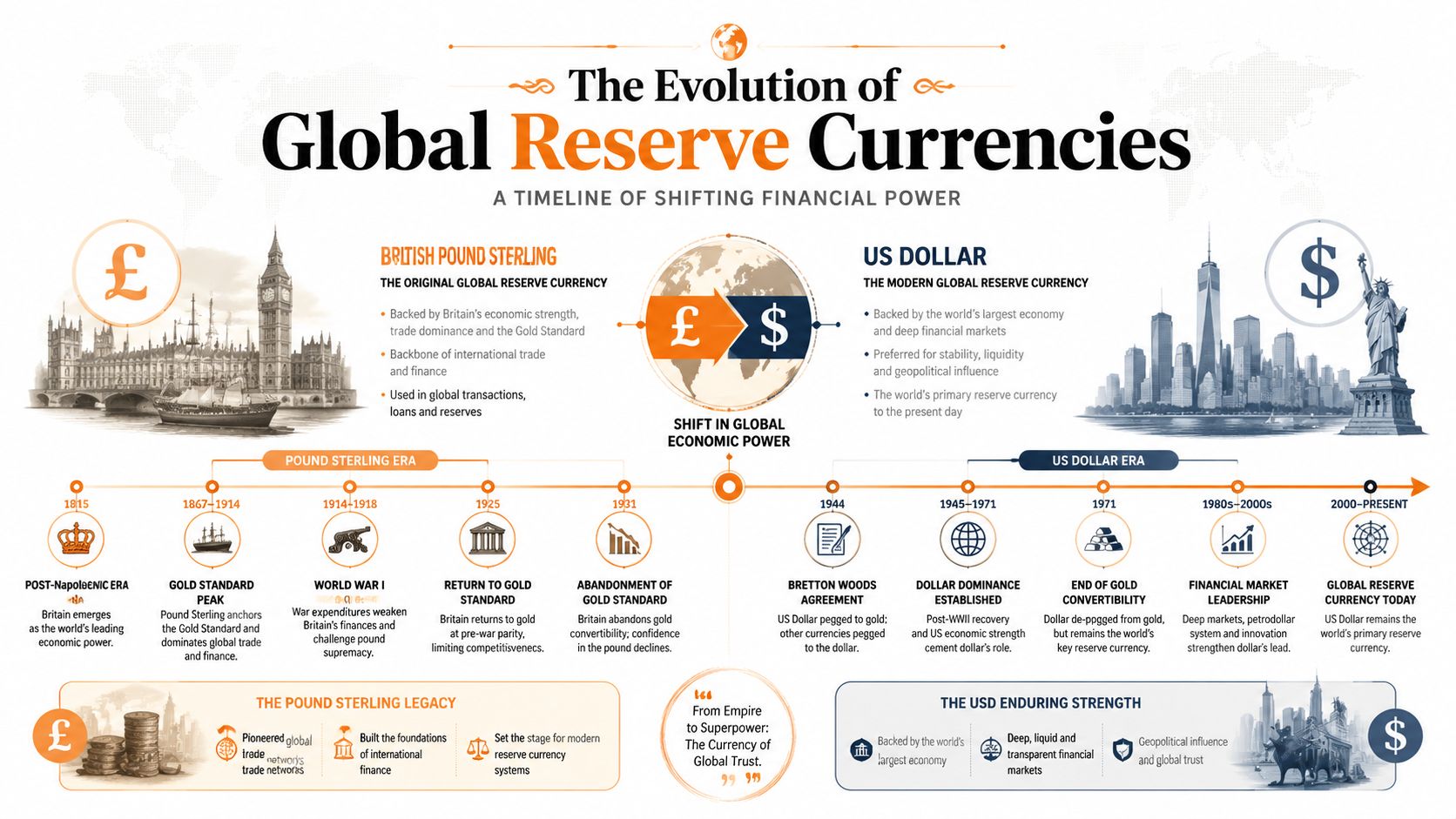
Before the dollar became the centre of gravity, the British pound sterling played a huge role in global finance. In fact, the pound was still one of the two dominant reserve currencies as late as 1929, when sterling and the US dollar together accounted for about 97% of global foreign exchange reserves, and historical estimates show the dollar first overtook sterling in the mid-1920s, not only after the Second World War, according to historical research on the rise and fall of reserve currencies.
That matters because many people imagine a sudden handover after 1944. However, the transition was gradual. Sterling's influence faded over time, while the dollar became more attractive as the United States gained economic and financial weight.
The pound era and the long handover
For a long stretch, sterling worked because Britain sat at the centre of a vast trading and financial network. If you were shipping goods, borrowing abroad, or settling international invoices, the pound was familiar and practical.
But reserve status isn't a trophy you keep forever. Countries and banks choose what works best for scale, liquidity, and trust. As the United States expanded economically and financially, the dollar became harder to ignore.
Bretton Woods locked in the modern order
The big institutional turning point came in 1944, when 44 countries agreed at Bretton Woods to the IMF and World Bank framework that helped anchor the post-war system around the dollar. That event didn't create the dollar out of thin air. It formalised and reinforced a shift already under way.
At first, the arrangement linked the dollar to gold. That gave other countries a strong reason to hold dollars and organise their exchange-rate policies around them. Later, the gold link ended, but the dollar's role didn't disappear.
The strongest reserve currency usually isn't the one with the best story. It's the one with the deepest habits, markets, and institutions built around it.
Why this history matters for crypto
Crypto investors often underestimate how sticky monetary systems are. New technology can move fast. Reserve systems usually don't.
That's why claims that Bitcoin, a CBDC, or another national currency will replace the dollar overnight should be treated carefully. History shows transitions in world reserve currencies happen through long shifts in trust, trade, finance, and political power. Crypto can influence that process. It doesn't erase it.
How a Currency Achieves Reserve Status
A currency doesn't become a reserve currency because a committee awards it a badge. It earns that role over time. Governments, central banks, commercial banks, exporters, and investors all have to decide that holding and using it is the safest practical choice.
You can think of reserve status like entry into a very exclusive club. There isn't a form to fill in. Membership comes from reputation.
The unwritten entry rules
Three features matter most in practice:
- Economic scale. The issuing country needs to matter in global trade and finance.
- Deep, open markets. Foreign institutions need to buy and sell assets in that currency easily, without worrying they'll get stuck.
- Policy credibility. People need confidence that the rules won't change suddenly.
A reserve currency also needs to be widely accepted by other major players. Network effects then kick in. If banks already clear trades in a currency, and governments already hold it, and firms already invoice in it, the next participant has a strong reason to join the same system.
Why challengers struggle
This is why replacing the leader is so difficult. A rival currency doesn't just need to be good. It needs to be good enough to persuade millions of users and institutions to move together.
The broader reserve-currency literature often points to factors such as currency convertibility, market depth, and macro policy credibility. Those are the same structural features that shape whether a currency can play a larger international role. In plain English, outsiders need to trust that they can get in, get out, and still understand the rules.
What crypto investors should notice
This same logic appears in digital assets.
Bitcoin's supporters argue that neutrality and scarcity make it attractive as a long-term reserve-like asset. Stablecoins succeed when they're liquid, easy to transfer, and accepted across many venues. A CBDC could gain traction if states push it into payment systems. Different technology, same underlying lesson. Trust and usability matter more than branding.
If you're into altcoins, this is worth remembering. Many crypto projects focus on speed or novelty. Reserve-like status, whether in fiat or crypto, comes from trust, depth, and repeat use over time.
The Current Global Reserve Landscape
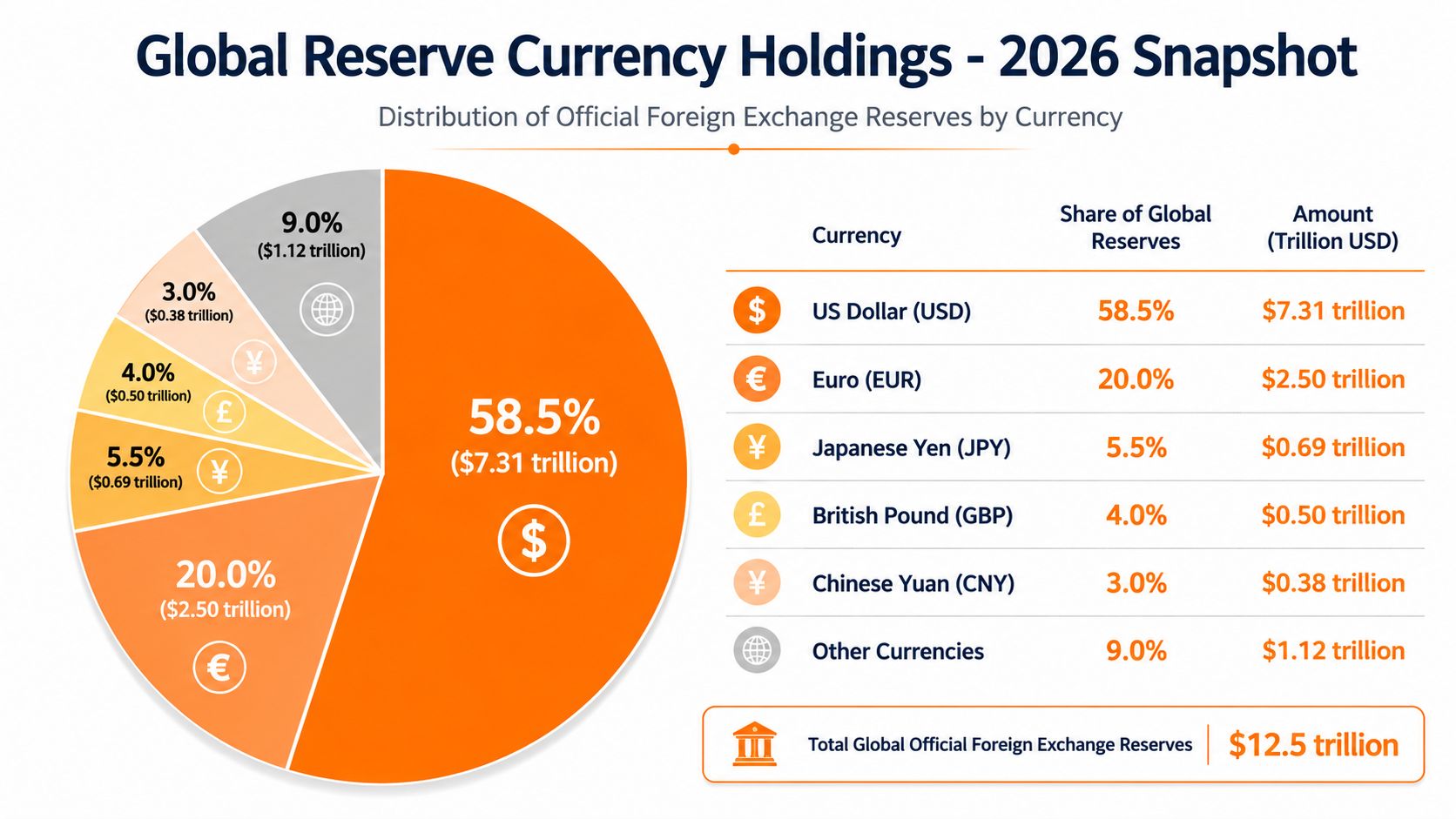
Today's reserve map still has one clear heavyweight. As of July 2025, the US dollar held about 58% of global foreign exchange reserves, compared with about 20% for the euro and about 5% for the British pound sterling, according to the Council on Foreign Relations' overview of the world's reserve currency system. That same source notes the 1944 Bretton Woods conference involved 44 countries, which helped entrench dollar centrality in the modern system.
That doesn't mean other currencies don't matter. It means the hierarchy is still very uneven.
A simple view of the pecking order
Here's the practical picture:
| Currency | Role in reserves |
|---|---|
| US dollar | The main anchor for global reserves, trade, and financial flows |
| Euro | The strongest alternative among major fiat currencies |
| British pound | Still significant, but clearly secondary |
| Others | Relevant in niche or regional ways, but far smaller in reserve influence |
For a UK reader, sterling still matters. It remains in the IMF-recognised reserve-currency basket. But it's no longer close to the top tier in the way it once was.
Where SDRs fit
A lot of readers get tripped up by SDRs, or Special Drawing Rights. They sound like a global currency. They aren't money you spend in a shop or send through a wallet.
An SDR is better thought of as a synthetic reserve asset created by the IMF. Its value is based on a basket of major currencies. That makes it useful as an accounting and reserve tool, but not as an everyday payment currency.
Why this matters for stablecoins
This hierarchy helps explain something strange in crypto. Even in a supposedly borderless market, the digital assets with the most day-to-day utility often mirror the old reserve order. Dollar-backed stablecoins dominate trading pairs, collateral use, and settlement rails.
If you want a crypto-specific bridge from fiat stability to on-chain usage, this guide on the role of stablecoins in crypto is useful. It shows how stablecoins don't replace reserve currencies so much as repackage them for the internet.
How Central Banks Use Reserve Currencies
A central bank doesn't hold reserve currencies for prestige. It holds them because real-world problems arrive fast. Imports still need paying for. Debt still matures. Currency markets can move sharply when investors panic.
If you want a quick refresher on the institution behind all this, Finzer has a plain-language guide on what is a central bank.
What reserves are for
Think of foreign exchange reserves as a country's emergency toolkit. Central banks use them in a few practical ways:
- To support their own currency. If a domestic currency is falling too fast, the central bank can use foreign reserves to buy its own currency and calm the move.
- To pay external obligations. Countries may need trusted foreign currency for imports, debt service, or trade settlement.
- To provide confidence in a crisis. Reserves tell markets the country has usable assets if funding conditions tighten.
A country doesn't need to be in full crisis to use reserves. Sometimes the goal is to smooth disorderly conditions so businesses and households aren't hit by sudden instability.
Why the mix of reserves matters
Not all reserve currencies have the same impact. The pound's reserve role is constrained by structural factors like convertibility, market depth, and policy credibility, but its international role is still materially smaller than the dollar's. In mid-2025, the dollar accounted for roughly 58% of global reserves, the euro about 20%, and the pound about 5%, meaning foreign central bank allocation decisions have a more limited direct feedback effect on sterling, as explained by the Philadelphia Fed's analysis of reserve currency dominance.
That helps explain why moves in dollar liquidity often ripple through everything, while changes in sterling reserve demand usually have a narrower global effect.
If you want to know which fiat currency still sits closest to the core plumbing of the financial system, look at what central banks reach for when they need safety and flexibility.
The crypto connection
This matters for crypto because reserve management shapes global liquidity conditions. When central banks defend currencies, adjust reserves, or react to stress, risk appetite can change quickly.
Bitcoin traders often focus on charts and narratives. Fair enough. But reserve-currency mechanics help explain why macro shocks can hit digital assets even when the crypto-specific news flow looks quiet.
Future Trends Shaping Global Money
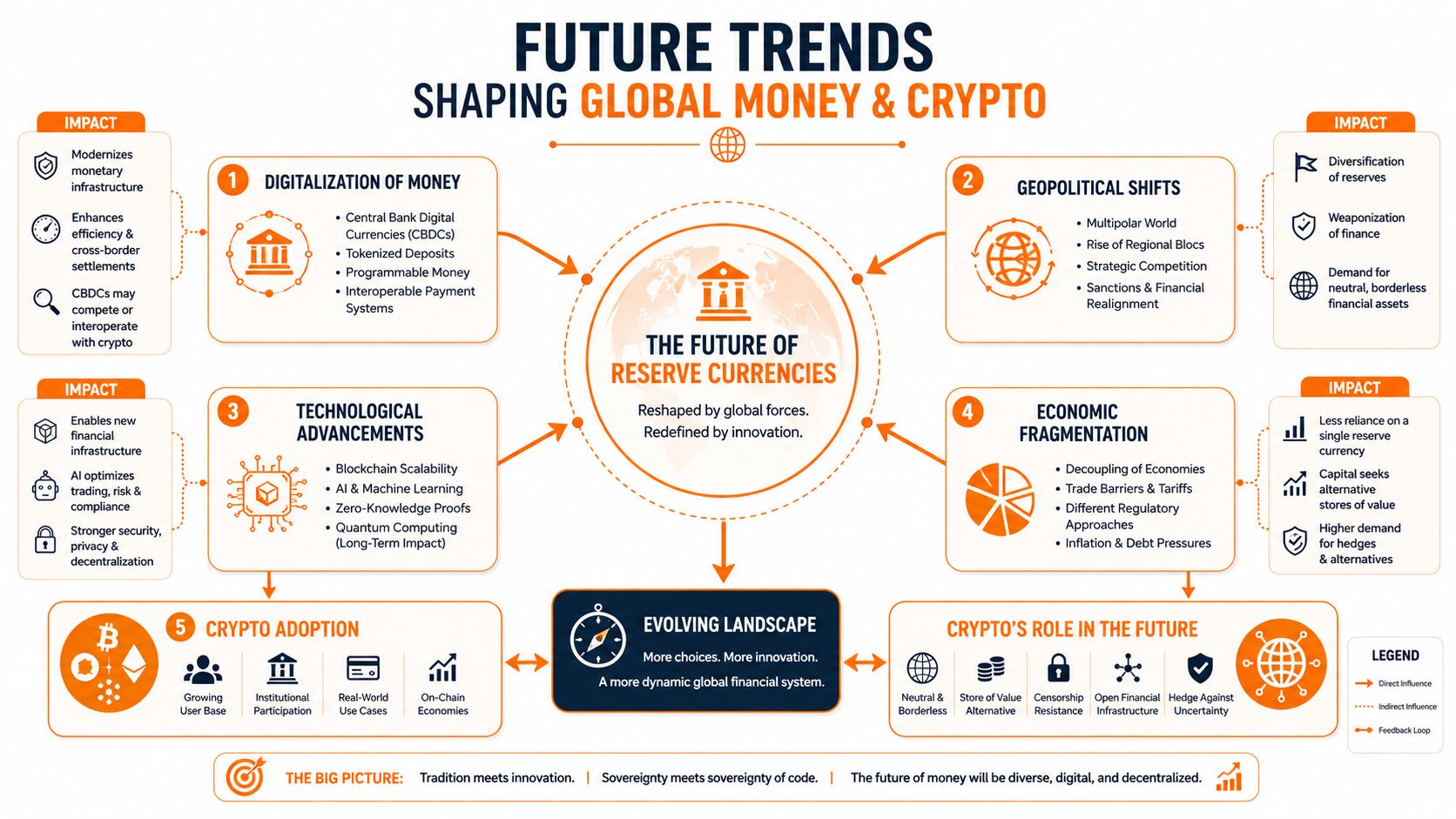
A lot of talk about the future of money gets too dramatic. "De-dollarisation" is often presented as if the system is about to flip overnight. The evidence looks more gradual.
Recent commentary notes that gold surged about 65% in dollar terms over the past year and remains the main reserve asset outside fiat currencies, while the dollar's share has only edged down from around 58% to 56% in some recent estimates, which suggests diversification is gradual rather than a collapse, according to GIS Reports on the dollar and reserve trends.
Trend one: diversification, not revolution
Some countries want less dependence on the dollar-based system. That can mean settling more trade in alternative currencies, holding more gold, or building payment rails that reduce reliance on US-centred channels.
But diversification isn't the same as displacement. A reserve system can become more mixed without losing its main anchor right away.
Trend two: CBDCs change the rails
Central Bank Digital Currencies matter because they could make state-backed money easier to move across digital networks. They don't automatically create a new reserve currency. What they can do is update how official money is issued, tracked, and used.
If you're exploring that side of the topic, this primer on central bank digital currencies CBDCs gives a good crypto-first explanation.
A CBDC world could improve payment efficiency while also giving governments more control over monetary plumbing. That's one reason crypto users are split on them. Faster settlement sounds good. More surveillance doesn't.
Here's a useful overview to pair with that idea:
Trend three: crypto both challenges and strengthens the system
Bitcoin presents a particularly distinct proposition compared to fiat reserves. It isn't issued by a state, it isn't tied to one country's debt, and many holders see it as a hedge against policy risk.
At the same time, stablecoins often reinforce the current hierarchy. A dollar-backed stablecoin gives users fast, internet-native access to a digital form of the dollar. That's not de-dollarisation. In many cases, it's digital dollarisation.
Crypto doesn't just compete with the old system. In some corners, it extends it into new markets and new user groups.
So the future may not be one winner replacing everyone else. It may be a layered system where fiat reserves, gold, CBDCs, Bitcoin, and stablecoins all play different roles.
What This Means for Crypto Investors
For crypto investors, the biggest mistake is treating reserve currencies as old-world trivia. They shape liquidity, sentiment, and the design of digital assets right now.
The practical lesson is that reserve status is about power, trust, and plumbing. Crypto sits inside that environment, whether it wants to or not.
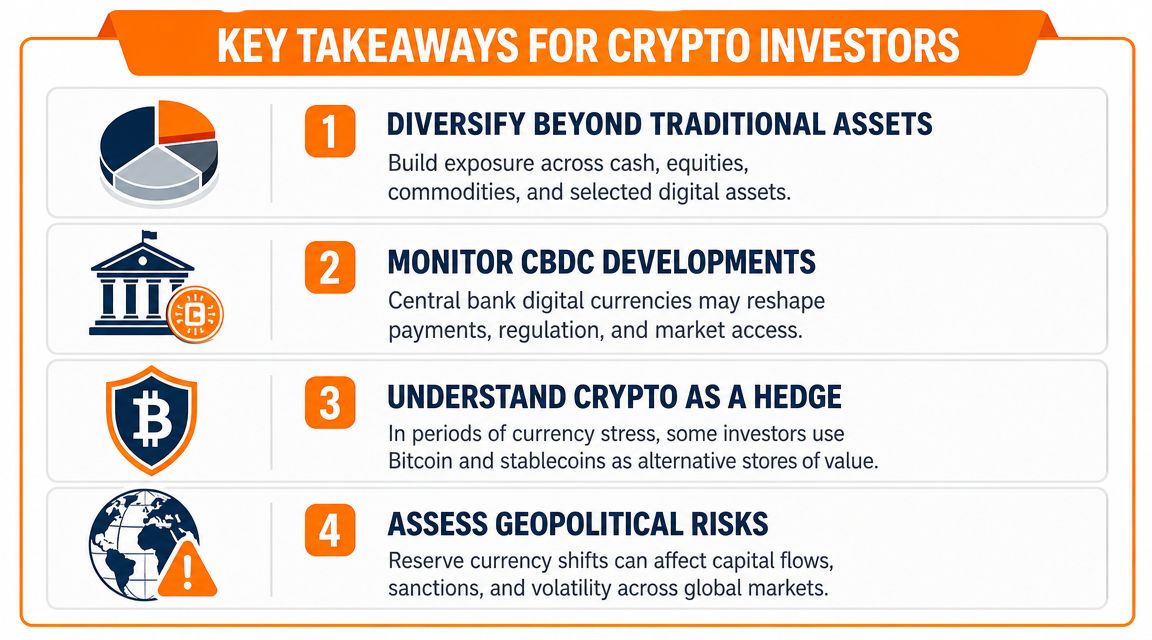
Four takeaways worth keeping
Dollar dominance is sticky, but not eternal
The current system has huge inertia. That should make you sceptical of dramatic claims about an instant monetary reset. At the same time, no reserve currency lasts forever. The more fragmented the world becomes, the more valuable neutral settlement assets may look to some investors.Stablecoins are mostly carrying the dollar online
Many people assume stablecoins weaken the fiat system. Usually they don't. They make the dollar easier to use on exchanges, in DeFi, and across borders. For now, that's closer to digital dollar expansion than dollar decline.Bitcoin's digital gold story comes from reserve-system doubts
When people worry about debt, inflation, sanctions, or political control over money, Bitcoin's pitch becomes clearer. It isn't a reserve currency in the traditional state sense, but it appeals to users who want an asset outside that framework.CBDCs could pressure private crypto in payments
If governments launch smoother digital payment systems, some everyday uses of private tokens could face tougher competition. That doesn't kill Bitcoin or open blockchains, but it could reshape where they have the strongest advantage.
A useful reality check for UK readers
Reserve-currency status can sound prestigious, but prestige isn't the same as broad economic benefit. As noted in Xponance's discussion of reserve currency status and persistent trade deficits, the pound's share is only about 5% of global foreign exchange reserves, which suggests the practical advantages for Britain today may be more limited than many people assume.
That same reality check helps in crypto. Labels can mislead. "Store of value", "global money", and "hedge" all sound impressive, but what matters is how an asset is used under pressure.
How to think about the next few years
A sensible crypto investor doesn't need to predict the death of the dollar or the victory of Bitcoin. A better approach is to track incentives.
Watch how governments digitise money. Watch whether stablecoins spread further into payments. Watch whether more investors treat Bitcoin like a reserve-adjacent asset during periods of stress. And if you want a wider look at why distributed ledgers keep attracting attention across institutions, you can learn from Global Governance Media about blockchain.
For a broader foundation on where all this may lead, this guide on the future of digital currency is a strong next read.
The smart crypto view isn't "fiat is dead". It's "global money is being rebuilt, and different assets will win different jobs".
If you keep that frame in mind, world reserve currencies stop being a dry macro topic. They become a map for understanding why crypto markets behave the way they do, and where opportunities may emerge.
If you want to build that understanding from the ground up, The Coin Course is a strong place to continue. It offers clear, practical crypto education for beginners and experienced learners alike, with guides that connect blockchain basics to real market behaviour, risk, and strategy.