Picture this: you have some savings, but instead of letting them sit in a standard bank account, you put them into a high-yield savings account where they earn interest. At its heart, crypto staking is a lot like that. You "lock up" some of your cryptocurrency to help run and secure a blockchain network.
For helping out, the network pays you a reward, usually in the form of more of that same cryptocurrency. This lets you earn a passive income from the crypto you're holding, rather than just letting it gather digital dust in your wallet.
Putting Your Crypto to Work

Think of it as putting your digital money to work. When you deposit money in a savings account, the bank uses it to offer loans and pays you a small slice of the profits as interest. Staking is a similar idea, but instead of trusting a big bank, you're directly supporting a decentralized blockchain network.
When you commit your coins, you become an active participant in the network. Your role is to help verify transactions and keep the entire system honest and secure. Your staked assets are the foundation that helps the blockchain run smoothly.
To give you a clearer picture, let's break down the essential components into a quick summary.
Crypto Staking at a Glance
This table simplifies the core ideas behind staking.
| Concept | Simple Analogy | What You Do | What You Get |
|---|---|---|---|
| Blockchain Security | Neighbourhood watch | You lock up your coins to "vouch" for good behaviour on the network. | The network becomes stronger and more resistant to attacks. |
| Transaction Validation | A digital bookkeeper | Your staked coins give you a chance to confirm transactions are legitimate. | You earn staking rewards (more coins) for your service. |
| Passive Income | Earning interest on savings | You commit your crypto for a period of time, similar to a fixed-term deposit. | A regular stream of new coins, often shown as an APY (Annual Percentage Yield). |
This process might seem complex on the surface, but it’s all built on a clever piece of technology designed to be much more efficient than old-school crypto mining.
The Role of Proof-of-Stake
The engine that makes staking possible is called Proof-of-Stake (PoS). Think of it as the rulebook that a blockchain network follows to agree on which transactions are valid, all without needing a central boss like a bank.
This is a huge step away from how early cryptocurrencies like Bitcoin operate. Instead of using tons of electricity and computing power to solve complex puzzles (a system called Proof-of-Work), PoS networks choose participants to create new blocks based on how many coins they have locked up, or "staked".
The main idea of Proof-of-Stake is that people with a financial "stake" in the network are the most motivated to act honestly and keep it secure. The more you stake, the more the network trusts you.
If you’re selected to validate a new block of transactions, you check everything is correct, add it to the blockchain, and receive a reward for your good work. This approach makes the entire system incredibly energy-efficient and secure.
Staking vs Mining: A Quick Look
It's easy to mix up staking and mining, but they are two very different ways of achieving the same goal: keeping a blockchain secure and up-to-date.
- Mining (Proof-of-Work): This is like a race. Miners use powerful, specialized computers to solve difficult mathematical problems. It’s a competition that burns a massive amount of energy, and only the first to solve the puzzle wins the prize. Imagine thousands of people guessing a password at once.
- Staking (Proof-of-Stake): This is all about participation. You simply lock up your cryptocurrency for a chance to validate transactions. There’s no need for expensive hardware, which makes it much more accessible for everyday people and kinder to the environment.
In short, staking opens up network security to more people. It allows almost anyone holding a PoS cryptocurrency to play a direct role in its operation and earn rewards, all without the high costs and technical hurdles of traditional mining.
How Proof of Stake Enables Staking
To really get your head around crypto staking, you first need to understand the engine that makes it all possible: Proof-of-Stake (PoS). This is the set of rules, or "consensus mechanism," that many modern blockchains use to confirm transactions and keep the network secure. It’s a completely different approach compared to how older cryptocurrencies like Bitcoin work.
Imagine a blockchain as a public digital logbook. Before a new page (or a "block" of transactions) can be added, someone has to check that everything is legitimate. Proof-of-Stake is simply the method for deciding who gets this crucial job.
The Great Blockchain Raffle
A great way to think about Proof-of-Stake is like a giant, continuous raffle.
To get into this raffle, you need tickets. In the crypto world, these "tickets" are the coins you decide to stake. For example, if you're staking Cardano (ADA), each ADA coin you lock up is like a raffle ticket. By locking up your coins, you’re essentially throwing your hat in the ring for a chance to be chosen.
The more coins you stake, the more "tickets" you have, which naturally boosts your odds of being picked to validate the next block. It’s a clever system where your influence is directly proportional to how much skin you have in the game.
In a Proof-of-Stake system, your staked assets act as a security deposit. This deposit shows you have a vested interest in the network's health and are incentivised to act honestly. Misbehave, and you risk losing that deposit.
This raffle-like selection is what sets staking apart from the power-hungry mining process used by Bitcoin. The selection is random but weighted by the amount staked, so you don't need a warehouse full of powerful computers to take part. For a deeper dive into these different systems, you can learn more about blockchain consensus methods in our detailed guide.
Validators: The Guardians of the Network
The participants who get picked from the raffle are called validators. Their job is absolutely critical: they check transactions, confirm they're all above board, and bundle them into a new block to add to the blockchain’s history.
When a validator successfully adds a block, they get paid for their efforts. This payment, known as a block reward, is usually a mix of newly created coins and a slice of the transaction fees from that block.
This is exactly where your staking rewards come from. If you delegate your coins to a validator, you get a cut of their earnings, proportional to your contribution. For instance, if you provide 1% of all the crypto staked with a particular Cardano validator, you’ll pocket roughly 1% of their rewards, minus a small fee for their service.
Why Proof of Stake is More Efficient
The Proof-of-Stake model was born out of a need for a more sustainable alternative to Bitcoin's Proof-of-Work (PoW) system, which is notorious for its massive electricity consumption.
- Energy Consumption: PoS networks use an incredibly small fraction of the energy that PoW networks do. Ethereum's switch from PoW to PoS, for example, slashed its energy use by an estimated 99.95%. It's a game-changer for sustainability.
- Accessibility: Just about anyone can get involved in staking, even with a small bag of crypto. There's no need to fork out for expensive, specialised hardware like you do for mining. Someone with just 1 Solana (SOL) coin can start staking.
- Security: To compromise a PoS network, an attacker would need to get their hands on at least 51% of all the coins being staked. This would be astronomically expensive and would ultimately be self-destructive, as attacking the network would torpedo the value of the very coins they hold.
So when you stake your crypto, you aren't just earning some passive income. You're playing an active role in making a blockchain network more efficient, democratic, and secure. Your staked coins are the bedrock that allows these decentralised systems to run smoothly and honestly—a real win-win for you and the network.
Exploring Different Ways to Stake Your Crypto
So, we've covered the basics of how Proof-of-Stake keeps a blockchain secure. But that doesn't mean you need to be a full-time network guardian to get involved. Thankfully, staking isn't a one-size-fits-all deal; there are a few different routes you can take, depending on your technical know-how, how much you want to invest, and just how hands-on you're prepared to be.
A good analogy is investing in property. You could buy a whole building and manage it yourself for the biggest returns, but that comes with a lot of work. Alternatively, you could pool your money into a property fund and let an expert handle the day-to-day grind. Staking offers a similar choice between direct, deep involvement and more convenient delegation.
This diagram breaks down the basic structure, showing how individual stakers support the validators who do the heavy lifting of securing the network.
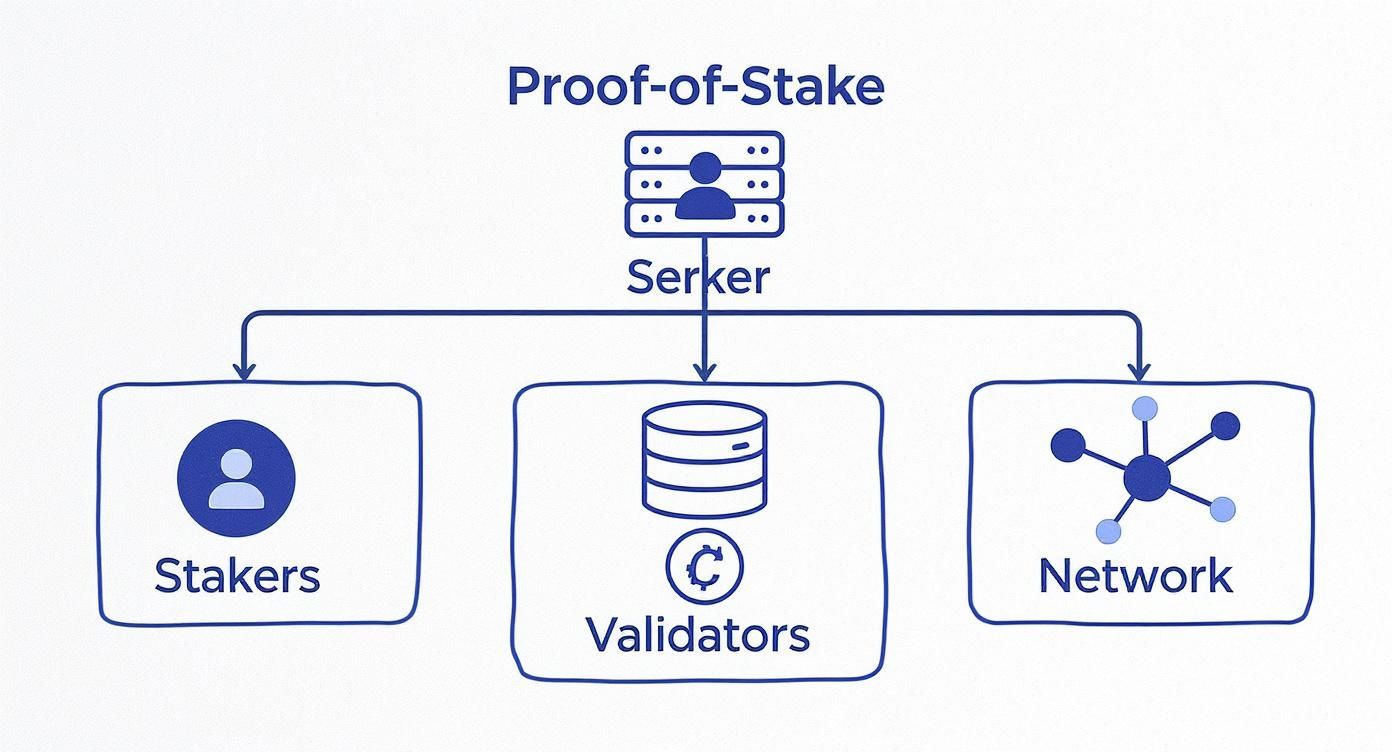
As you can see, it's the combined weight of all the stakers that gives validators the power they need to propose and confirm new blocks on the chain.
Running Your Own Validator Node
The most direct way to stake is by running your own validator node. This is the crypto equivalent of becoming a full-time security guard for the blockchain. It involves setting up a dedicated computer that’s always online, constantly processing transactions and helping the network reach an agreement.
This path definitely offers the highest potential rewards. Why? Because you keep all the block rewards for yourself, with no fees paid out to a middleman. But it's certainly not for the faint-hearted.
Here's what you're up against:
- High Technical Skill: You need to be comfortable with command-line interfaces, server maintenance, and troubleshooting. It's a proper tech job.
- Significant Investment: Many networks have a hefty minimum stake. For Ethereum, you'll need 32 ETH just to get started.
- Constant Uptime: Your node needs to be online 24/7. Any downtime doesn't just mean you stop earning; it can lead to penalties where you lose some of your staked crypto.
Running a validator is really for the serious, technically-minded people who want to maximise their earnings and play a direct role in keeping the network healthy.
Delegated Staking – The Popular Choice
For the vast majority of crypto holders, delegated staking is the perfect entry point. Instead of wrestling with a complex server setup, you simply "delegate" your staking rights to a professional validator who handles all the technical work for you.
Think of it like owning shares in a company. You have voting rights, but you might not want to attend every board meeting. So, you can give your voting proxy to a representative you trust. Delegated staking is the same principle; you're lending your staking power to an expert.
With delegated staking, you always retain full ownership and control of your crypto. The validator never touches your funds. You just assign them the "weight" of your stake, which boosts their chances of earning rewards—which they then share with you.
Take a cryptocurrency like Cardano (ADA), for example. You can use your own personal wallet to browse thousands of different "stake pools" (validators). You pick one based on their track record and fees, and with a few clicks, your ADA starts earning rewards. It's a much more accessible approach for most people. For a deeper dive into how these rewards work, check out our guide on earning with DeFi and validator incentives.
Liquid Staking – Unlocking Your Capital
One of the newest and most popular innovations in this space is liquid staking. A big drawback of traditional staking has always been that your assets are locked up, sometimes for weeks or months, completely unusable. Liquid staking solves this problem brilliantly.
When you stake your assets through a liquid staking provider, you get a special token back that acts as a receipt for your staked position. This is known as a liquid staking token, or LST.
For instance, if you stake your Ethereum (ETH) with a service like Lido, you receive a token called stETH in return. This stETH token quietly accumulates staking rewards in the background, but the real magic is that you can trade it, lend it, or use it in other decentralised finance (DeFi) apps. It's the best of both worlds: you're earning staking rewards while keeping your capital "liquid" and ready for other opportunities.
This has made staking far more appealing, particularly for investors here in the UK. Staking has moved from a niche activity to a more mainstream option, helped by growing regulatory clarity. The UK government even confirmed that certain crypto staking setups don't fall under the definition of a collective investment scheme, giving both investors and service providers more confidence.
Comparison of Staking Methods
To make things clearer, let’s quickly compare these different approaches. Each has its own set of trade-offs, and the best one for you really depends on your goals and resources.
| Staking Method | Best For | Pros | Cons |
|---|---|---|---|
| Running a Validator | Technically skilled users with significant capital who want to maximise returns and contribute directly to network security. | - Highest potential rewards (no fees paid to others) - Direct control over your operation - Actively supports network decentralisation |
- Requires a large minimum stake (e.g., 32 ETH) - High technical barrier to entry - Risk of financial penalties ("slashing") for mistakes or downtime |
| Delegated Staking | The average crypto holder looking for a simple, low-effort way to earn rewards on their assets. | - Easy to set up; beginner-friendly - No technical knowledge required - You retain full ownership of your crypto |
- Lower rewards due to validator fees - You must trust the validator's performance and security - Your assets may still be locked for a period |
| Liquid Staking | DeFi users and investors who want to earn staking rewards without sacrificing the ability to use their capital elsewhere. | - Earn rewards while keeping your capital "liquid" - Access to other DeFi opportunities - Simple to use through platforms like Lido |
- Introduces smart contract risk (bugs in the protocol) - The value of the liquid token (e.g., stETH) can drift from the underlying asset - Platform-specific risks |
Ultimately, whether you decide to become a hands-on validator, delegate to a trusted professional, or keep your options open with liquid staking, there's a path that fits your style. The key is to understand the risks and rewards of each before you jump in.
Understanding the Rewards and Risks of Staking
Putting your crypto to work through staking sounds like a fantastic way to earn some passive income. And it can be. But it’s crucial to look at both sides of the coin—the potential rewards and the very real risks involved. Getting your head around this balance is the only way to make smart decisions with your assets.
Let’s be honest, the main attraction of staking is the rewards. These are usually presented as an Annual Percentage Yield (APY), a figure that shows the potential return you could earn over a year. You can think of it as being similar to the interest rate on a savings account, but for your crypto.
How Staking Rewards Work
Staking rewards don't just appear out of thin air. They are the network’s way of saying "thank you" for helping to keep everything secure and running smoothly. When a validator successfully adds a new block of transactions to the chain, they receive a reward, and if you’ve delegated to them, a slice of that reward comes to you.
The APY for any given cryptocurrency can swing about quite a bit, and it’s shaped by a few key factors:
- Network Inflation: Many blockchains, like Cosmos (ATOM), mint new coins with each block specifically to pay validators. Your rewards are essentially your share of this newly created supply.
- Transaction Fees: A small cut of the fees users pay to send transactions on the network often gets added to the rewards pool. For a popular network like Ethereum, this can be a significant amount.
- Total Amount Staked: The more crypto being staked on a network, the more thinly the rewards are spread. This means a surge in popularity can actually drive down the APY for everyone.
Because of this, that tempting 5% APY you see today could easily be 4% next month or 6% the month after. It's not a fixed rate, so you'll want to keep an eye on it. The appeal of these returns has certainly caught on. In the UK, attractive yields have driven a lot of crypto investors towards staking. For instance, staking Ether in the UK has offered an average annual yield of around 4.6%, which comfortably outpaces the UK’s base interest rate, making it a compelling alternative to traditional savings. You can dig into more of these trends in the latest cryptocurrency staking statistics.
The Real Risks You Must Consider
Earning rewards is great, but staking isn't a risk-free game. It's vital you understand the potential downsides before you commit your funds. These risks can be managed, but ignoring them could lead to some nasty surprises.
One of the biggest risks is something called slashing. This is the network's way of penalising validators who misbehave.
Slashing is the blockchain's enforcement mechanism. If a validator you've delegated to acts maliciously (like trying to approve fraudulent transactions) or simply goes offline for too long, the network can confiscate and destroy a portion of their—and by extension, your—staked crypto as a punishment.
This is precisely why picking a reputable and reliable validator is so important. A good operator will have a proven track record and solid infrastructure, minimising the chance of any errors that could trigger a slashing event.
Lock-Up Periods and Market Volatility
Another thing you need to be aware of is lock-up periods. When you stake, many blockchains require your crypto to be locked for a set amount of time. This could be anything from a few days to several weeks, or sometimes even longer. For example, when you unstake Polkadot (DOT), there's a 28-day waiting period before you can access your funds.
During this lock-up, your assets are completely tied up—you can't sell or move them. This becomes a serious risk if the market suddenly plummets. Imagine you’ve staked your crypto for a 21-day period. If the price crashes by 30% on day two, you're stuck watching the value of your holdings fall, powerless to do anything but hope for a recovery before the lock-up ends.
Finally, there’s custodial risk. If you choose to stake through a centralised exchange or platform, you're handing over control of your assets. While it’s often more convenient, it means you don't hold your own private keys. If that platform gets hacked, goes bust, or runs into regulatory trouble, your funds could be lost for good. It's the classic trade-off between ease of use and having direct control over your own crypto.
Your Step-by-Step Guide to Staking Crypto
So, you’re ready to put your crypto to work? Fantastic. Getting started with staking is much more straightforward than most people think. We're going to walk through the two most common ways to do it, covering both the hands-on approach for maximum security and the simpler path for total convenience.
This guide will break everything down into clear, easy-to-follow steps for each method. By the end, you'll have the confidence to get your own staking journey underway.
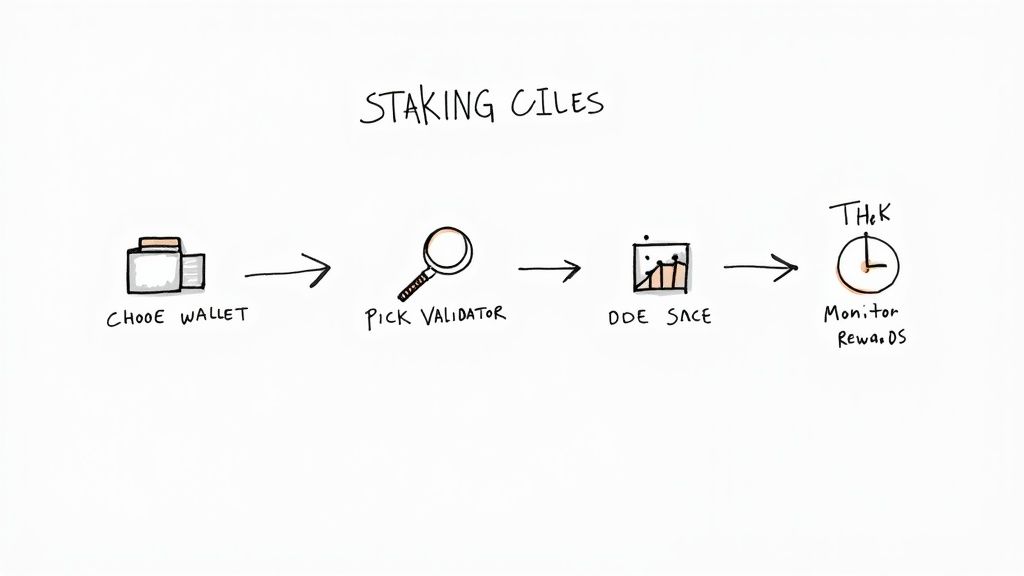
Method 1: Staking with a Personal Wallet
This is what people in the know call "self-custody" staking. It means you, and only you, are in control of the private keys to your crypto. Think of it as being your own bank. It’s the gold standard for security because your assets never leave your possession.
For this method, you might use a hardware wallet like Ledger for ultimate safety, or a dedicated software wallet like Keplr, which is brilliant for networks in the Cosmos ecosystem.
Here’s how it usually works:
- Get Your Wallet Set Up: The first thing you need is a wallet that’s compatible with the coin you want to stake. Download it, set it up, and—this is crucial—write down your seed phrase and store it somewhere safe and offline.
- Move Your Funds In: Send the crypto you plan to stake over from an exchange or wherever else you have it stored.
- Find the Staking Hub: Once inside your wallet, look for a tab labelled "Staking," "Earn," or "Delegate." This is your control panel. For a bit more detail on this part of the process, have a look at our guide on connecting your crypto wallet to DeFi platforms.
- Pick Your Validator: Now for the most important decision you'll make. Your wallet will present a list of validators. Don't just close your eyes and point. Do a little homework. Look for validators with a solid track record, high uptime (aim for over 99%), and reasonable commission fees. A higher fee isn't always a red flag if the validator is rock-solid reliable.
- Delegate Your Stake: Once you've made your choice, just type in how much crypto you want to stake and hit confirm. Your coins are still in your wallet; you’re simply giving your staking power to the validator.
And that's it! You're now staking. You can sit back and watch your rewards roll in, which you can monitor directly from your wallet interface.
Method 2: Staking on a Regulated Exchange
If you'd rather have a simpler, more hands-off experience, staking directly on a major crypto exchange is an excellent alternative. Platforms like Coinbase and Kraken are popular choices here in the UK, making it incredibly easy to start earning rewards with just a couple of clicks.
This is a custodial method, which means you're trusting the exchange to hold your private keys for you. While that does introduce some platform risk, it completely removes the technical heavy lifting from your shoulders.
Let's break down the simple steps:
- Create and Fund Your Account: If you’re not already signed up, create an account on a reputable exchange that offers staking. Then, either deposit or buy the crypto you plan to stake.
- Navigate to the Staking Area: Look for the "Staking" or "Earn" section on the exchange's website or app. They usually make it very easy to find.
- Choose Your Crypto and Stake: Pick the asset you want to stake from their list. The exchange will clearly show you the estimated annual yield (APY). Enter the amount you want to commit, and you're good to go.
The biggest selling point here is sheer simplicity. The exchange handles all the complicated stuff—like choosing validators and managing the technical side—behind the scenes. Your rewards are just automatically paid into your account.
But remember, there's always a trade-off. The exchange takes a small cut of your earnings for providing this convenience, and you are placing your trust in their security. Both methods are perfectly valid ways to get into crypto staking; the best choice for you really boils down to your own preference for control versus convenience.
Navigating Staking Taxes and Rules in the UK
Earning rewards from staking is great, but if you're in the UK, you've got to get your head around the tax side of things. It's far better to think about your tax obligations from day one than to get a nasty surprise from HMRC later. The good news is, the principles are fairly straightforward.
For the vast majority of people, HMRC views the rewards you get from staking as miscellaneous income. This simply means the value of the rewards, calculated in pounds sterling on the day you receive them, is subject to Income Tax.
You'll need to declare this income on your annual Self Assessment tax return. How much tax you pay will depend on your total income for the year and which tax bracket you're in – just like any other side hustle or freelance work.
What About Capital Gains Tax?
On top of Income Tax, you also need to have Capital Gains Tax (CGT) on your radar. This doesn't apply when you first receive your staking rewards, but it can kick in the moment you decide to "dispose" of your crypto.
What counts as a disposal? It's broader than you might think:
- Selling your crypto for pounds.
- Trading it for another type of crypto.
- Using it to pay for goods or services.
If your crypto has gone up in value between when you got it and when you get rid of it, that profit could be liable for Capital Gains Tax. Thankfully, everyone gets an annual CGT allowance, so you only pay tax on gains that push you over that threshold.
The single most important thing you can do is keep meticulous records. Every single time you get a staking reward, log the date, the type of crypto, the amount, and its value in GBP. This habit will save you a world of headaches when it's time to calculate both your income and any potential capital gains.
A Practical Example of UK Staking Tax
Let's imagine a UK-based staker named Alex. Over the tax year, Alex earns staking rewards worth a total of £2,000. This is his miscellaneous income. Assuming Alex is a basic rate taxpayer, he'll owe 20% Income Tax on that, which works out to £400.
A few months later, Alex sells the crypto he earned from those rewards. By then, its value has climbed to £2,500. This means he's made a capital gain of £500 (£2,500 sale price minus the £2,000 value when he acquired it). As long as his total capital gains for the year are under the annual allowance, he won't owe any CGT on this profit.
The regulatory picture in the UK has become much clearer recently, which has really helped investors feel more confident. The government confirming that most staking setups aren't collective investment schemes removed a major grey area and encouraged more people to get involved. This clarity, along with the FCA's broader work in the crypto space, is all about protecting investors. You can find more detail on the UK's crypto legal framework and its impact if you want to dig deeper.
Common Questions About Crypto Staking
As you get to grips with the basics, a few questions inevitably pop up. Let's tackle some of the most common ones to help round out your understanding and get you ready to stake with confidence.
Is Crypto Staking Profitable in the UK?
Absolutely, staking can be profitable. It often presents the potential for higher returns than you'd find in a typical high-street savings account. But, and it's a big but, profits are never guaranteed. The actual return you see is a moving target, influenced by the crypto's market price, the network's reward rate, and any fees your validator takes.
Remember, your rewards land in your wallet as crypto, not pounds, so their value can swing up and down daily. For UK investors, it's also crucial to factor in Income Tax on your staking earnings to stay compliant with HMRC.
Which Cryptocurrency Is Best for Staking?
There's no single "best" crypto for staking – the right choice really boils down to your own goals and how much risk you're comfortable with.
- Ethereum (ETH) is the giant in the room, the largest and most well-established choice.
- Cardano (ADA) and Solana (SOL) are also incredibly popular, largely because they offer straightforward staking and reliable reward schedules.
Before you jump in, do your homework. Look into the network's reputation, how stable its reward payments have been, and be clear on any lock-up periods that might tie up your funds.
The smartest move is to choose a network you genuinely believe in for the long haul. Staking is less about chasing quick gains and more about supporting a project's future while earning a consistent yield.
Can I Lose My Crypto When Staking?
Yes, you can, and it's vital to know the risks involved. The main threat is something called slashing. This is essentially a penalty where you can lose a chunk of your staked crypto if your chosen validator messes up badly or tries to cheat the system.
The other obvious risk is simple market volatility. The price of the crypto you're staking could drop, potentially wiping out the value of your rewards and even eating into your initial investment. You can manage these risks by sticking with well-known, reputable validators and taking the time to understand the rules of the network you're joining.
Ready to deepen your knowledge? The Coin Course offers expert articles and practical guides to help you master everything from DeFi to wallet security. Start your crypto journey with confidence at https://thecoincourse.com.