
You've probably seen the word node in a few different places and felt that small jolt of confusion. One person says you need Node.js to build a website. Another says Bitcoin runs on nodes. Then someone else calls a laptop on a network a node too. Same word, different conversations, and it all starts to blur together.
That confusion is normal. Tech reuses words constantly, and what is a node depends on the world you're talking about. Once you separate those meanings, blockchain starts to feel much less mysterious. And if you've ever wondered whether running your own node is only for developers with a rack of servers, the answer is no.
Untangling the Term Node
A common scene goes like this. You're reading about crypto, open a beginner thread, and someone writes, “Run your own node.” Then you search for it and land on articles about Node.js, web development, server infrastructure, and networking diagrams. Instead of getting a simple answer, you get three different ones.
That overlap matters because crypto is no longer a niche topic for only technical people. In the UK, 6.2% of adults, or 4.2 million people, owned cryptocurrency as of 2021, and 70% of non-owners said lack of knowledge was their main barrier according to Triple-A's UK cryptocurrency ownership data. If people don't understand basic terms like node, the whole subject feels harder than it needs to be.
A node, at its simplest, is a point in a system that connects, stores, sends, or checks information. That broad meaning is why the word appears in so many areas of tech. It's a flexible label, not a single gadget.
Why the word keeps appearing
Think about a map. A train network has stations. A road network has junctions. A social network has people connected to other people. In tech, a node often means one unit inside a larger network.
That's why the same word can show up in blockchain, internet hardware, and software tools.
A lot of beginner confusion comes from assuming every use of “node” refers to the same thing. It doesn't. The shared idea is connection inside a system.
If you ever work with exported data, logs, or copied web content while learning these ideas, a guide on efficient HTML document conversion can help turn messy source material into clean text that's easier to study. And if blockchain itself still feels fuzzy, this beginner-friendly explanation of what a blockchain is gives the wider picture that makes nodes easier to place.
The simple promise
By the end of this guide, the word node won't feel slippery anymore. You'll know the difference between a network node, Node.js, and a blockchain node, which is commonly understood in crypto.
A Node in Three Different Worlds
The fastest way to clear up the term is to look at it in three separate worlds.
General node
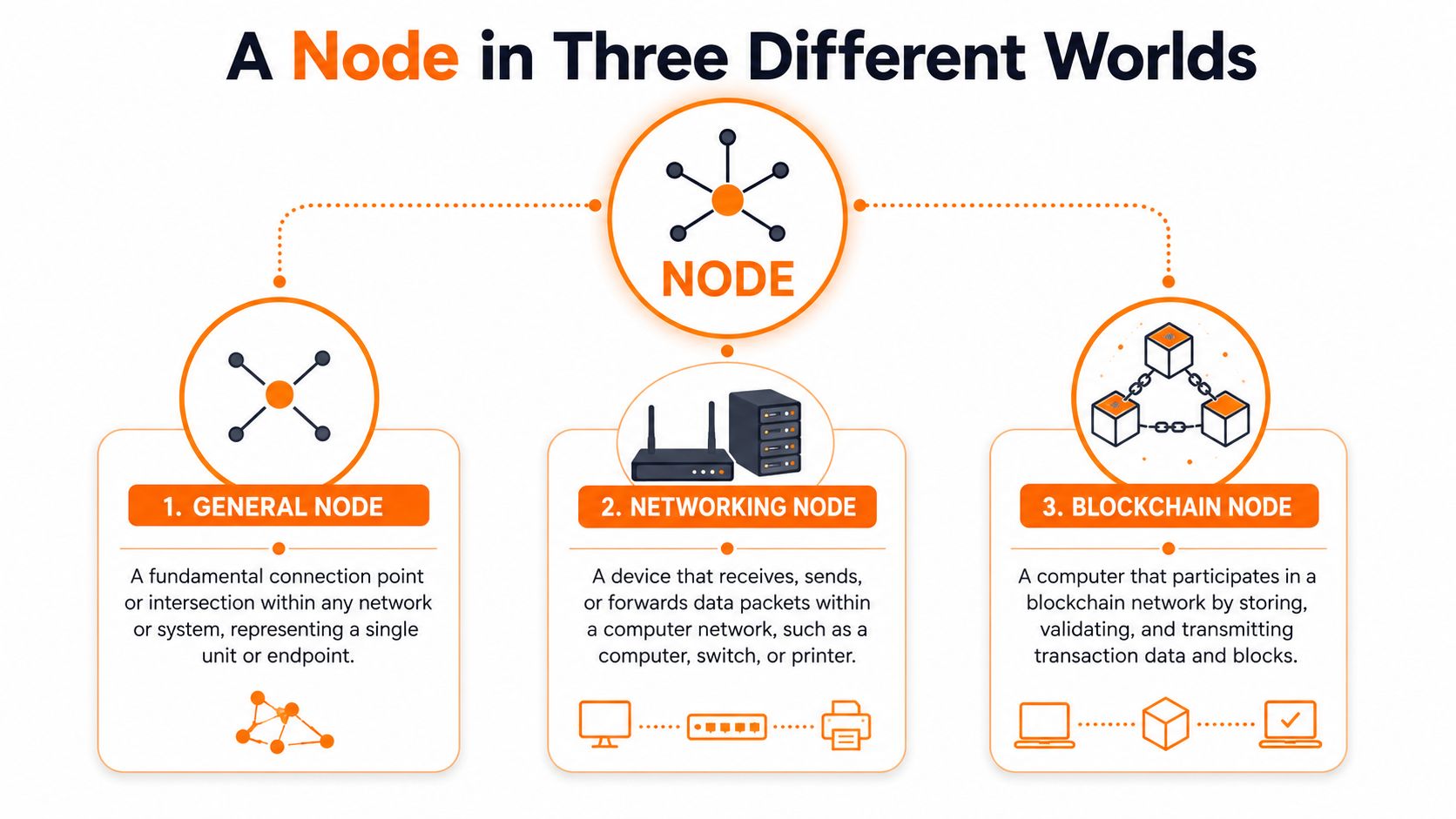
In the most basic sense, a node is just one point in a system.
A dot on a diagram can be a node. A step in a workflow can be a node. If you draw circles and lines to show how things connect, each circle is often called a node. It's the broadest and least technical meaning.
A helpful way to think about it is this:
- A single point: One part of a bigger structure.
- A connection spot: It links to other parts.
- A unit with a role: It may receive, send, store, or process something.
This broad meaning is why the word travels so easily across disciplines.
Networking node
In computer networking, a node is a device connected to a network. Your laptop on home Wi-Fi can be a node. A printer in an office can be a node. A router and a server can be nodes too.
If a device can send, receive, or forward data on a network, people often call it a node.
A short comparison helps:
| Context | What the node is | Easy example |
|---|---|---|
| General systems | A point in a structure | A dot in a diagram |
| Computer networking | A connected device | A laptop or router |
| Blockchain | A computer participating in the blockchain | A machine running Bitcoin Core or Geth |
People often meet this meaning when learning about servers, hosting, or cloud systems. If you want a plain-language overview of how rented computing resources fit together, Cloudvara's Infrastructure as a Service guide is useful background.
Node.js
Now for the confusing one. Node.js is not a physical node.
Node.js is a software runtime that lets developers run JavaScript outside a web browser. If someone says, “Install Node,” they usually mean Node.js, not a blockchain node and not a network device.
That mix-up catches people because the name sounds like hardware. It isn't. It's a development tool.
Quick test: If the conversation includes JavaScript, packages, npm, or backend apps, they almost certainly mean Node.js.
Blockchain node
A blockchain node is a computer running blockchain software that helps a blockchain network operate. It can store blockchain data, check transactions, share blocks, and help keep everyone on the same version of the ledger.
That's the meaning that matters most in this guide. And to understand why it matters, it helps to compare centralised and distributed systems first. This overview of centralised and decentralised networks gives the right mental frame.
The Role of a Blockchain Node
A blockchain node is easiest to understand if you stop thinking about coins first and think about record-keeping.
Suppose a city keeps a public record of every approved property transfer. If only one office holds the record, everyone must trust that office. If many offices each hold a matching copy and check every update against the same rules, it becomes much harder for one bad actor to cheat.
That's what blockchain nodes do. They help many computers share, verify, and preserve the same ledger.
Nodes as city infrastructure
A blockchain network works a bit like a city's infrastructure.
- Roads: Transactions travel across the network from one node to another.
- Traffic wardens: Nodes check whether those transactions follow the rules.
- Public archives: Many nodes keep a copy of the chain's history.
If someone tries to send funds they don't have, a properly running node won't just shrug and pass it on. It checks the rules and rejects invalid data.
What validation really means
Validation sounds technical, but the idea is simple. A node receives new information and asks, “Does this follow the network's rules?”
For a transaction, that can mean checking things like whether the format is correct, whether the transaction is properly signed, and whether it conflicts with the ledger the node already knows.
For a block, validation means checking that the block itself follows the chain's rules before accepting it.
Practical rule: A blockchain node doesn't trust first and verify later. It verifies before accepting data as valid.
This is the foundation of blockchain's “don't trust, verify” culture.
What consensus means in plain English
Consensus means agreement. In blockchain, it means the network's participants agree on the valid state of the ledger according to shared rules.
That doesn't mean every computer chats with every other computer at once and votes like a class show of hands. It means nodes independently apply the same rulebook. Over time, the valid chain emerges because honest nodes keep accepting and sharing data that fits those rules.
It is akin to many exam markers using the same mark scheme. They don't need to stand in one room discussing every answer. If the rules are clear and they apply them properly, they reach the same result.
If you want a closer look at the mechanics behind that process, this explainer on how blockchain transactions are verified is worth reading.
Why nodes matter so much
Without nodes, a blockchain isn't much of a network. It becomes a claim without independent checks.
Nodes make decentralisation real because they spread trust across many participants instead of placing it in one company, one server, or one database admin.
The Different Types of Blockchain Nodes
Not all blockchain nodes do the same job. They belong to the same family, but they have different responsibilities and different resource needs.
The easiest analogy is a library.
Full node
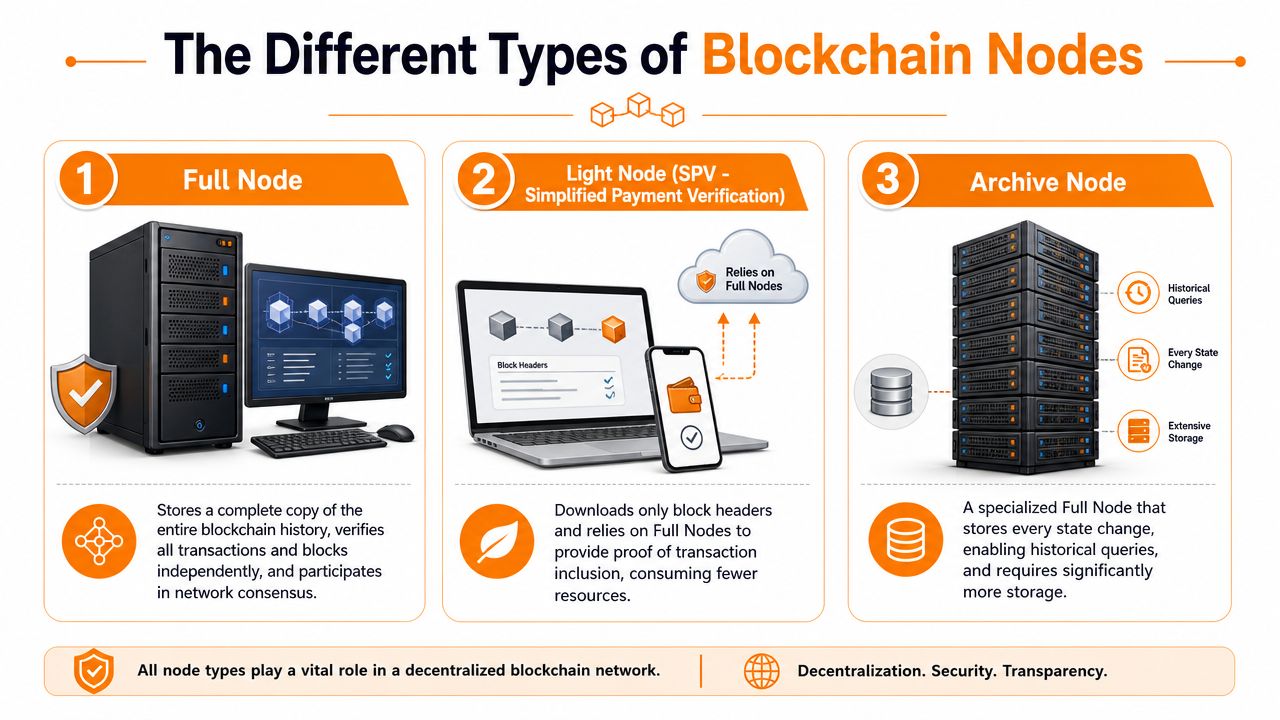
A full node is like owning a complete reference library at home. It stores the blockchain history needed to verify the chain independently and checks the rules for itself.
That independence is the key point. A full node doesn't need to ask a third party, “Is this transaction real?” It can inspect the chain with its own software.
People run full nodes because they want stronger verification, more control, and a direct connection to the network.
Light node
A light node is more like carrying a library card and using the main library when needed. It stores much less data and relies on full nodes for some information.
That trade-off makes light nodes far easier to run on limited devices. Wallet apps often use this lighter approach because phones and simple devices don't have the storage or processing room for full-chain verification.
The upside is convenience. The downside is more dependence on other infrastructure.
Archive node
An archive node is the obsessive historian.
It stores far more historical state data than a typical full node and is especially useful when developers, analysts, or advanced services need deep historical queries. For ordinary users, this is usually more than necessary. For specialist use cases, it can be invaluable.
Validator or mining node
Some nodes do extra work beyond storing and verifying. Depending on the blockchain, these might be mining nodes or validator nodes.
They help create or propose new blocks according to the network's design. That role is separate from the basic idea of being a node. You can run a node without being the one creating blocks.
A simple comparison
| Node type | Best way to think about it | Main trade-off |
|---|---|---|
| Full node | Your own complete reference library | More storage and upkeep |
| Light node | A slim reader that checks in with a bigger library | Less independence |
| Archive node | The specialist history archive | Heavy storage demands |
| Validator or mining node | A participant with extra network duties | More complexity |
Why beginners mix them up
People often hear “run a node” and assume there's only one kind. In practice, there's a spectrum.
- If you want independence: A full node makes the most sense.
- If you want convenience: A light setup is easier.
- If you build tools or need deep history: Archive infrastructure may matter.
- If you want to help produce blocks: Validator or mining roles enter the picture.
You don't need the biggest, most complex node to understand blockchain. You need the right mental model first.
Why You Should Consider Running a Node
For many people, running a node sounds like something reserved for infrastructure teams and very online hobbyists. It isn't. If you care about privacy, self-reliance, and how blockchains stay honest, running a node is one of the clearest ways to participate.

In the UK, over 2,185 public Bitcoin nodes are operational, ranking the country sixth globally, according to BitRef's node tracker. That same source notes a UK blockchain market valued at $2,039.3 million in 2025, projected to reach $23,002.1 million by 2030, an 11-fold increase with a 62.4% CAGR. Those figures are market projections, not a promise, but they show why core infrastructure matters. Bigger ecosystems still rely on ordinary computers enforcing the rules.
You verify for yourself
The strongest reason to run a node is sovereignty.
If you use someone else's node, you depend on their view of the blockchain. Usually that works fine. But “usually” isn't the same as “independently verified.” Running your own node means your wallet or service can ask your own machine what the chain says.
That changes your role from passive user to active checker.
You reduce unnecessary trust
A good node setup can also improve privacy. Instead of broadcasting activity through someone else's infrastructure, you can rely more on your own.
That doesn't make you invisible, and it doesn't solve every privacy issue. It does reduce one important layer of dependence.
You strengthen the network
Each honest node makes the network tougher to censor and harder to centralise. Think of a public park cared for by volunteers. One person picking up litter won't transform the whole park overnight, but a lot of people doing small jobs keeps the place healthy.
That same spirit applies here.
This short video gives a helpful visual explanation before you look at the practical side:
Reasons people actually do it
- Personal control: You don't have to outsource verification.
- Better learning: Running a node teaches you how the network behaves.
- Public benefit: Your machine helps distribute the network's workload.
Running a node is less like buying a gadget and more like joining the maintenance crew for shared digital infrastructure.
Running a Node for Bitcoin and Ethereum
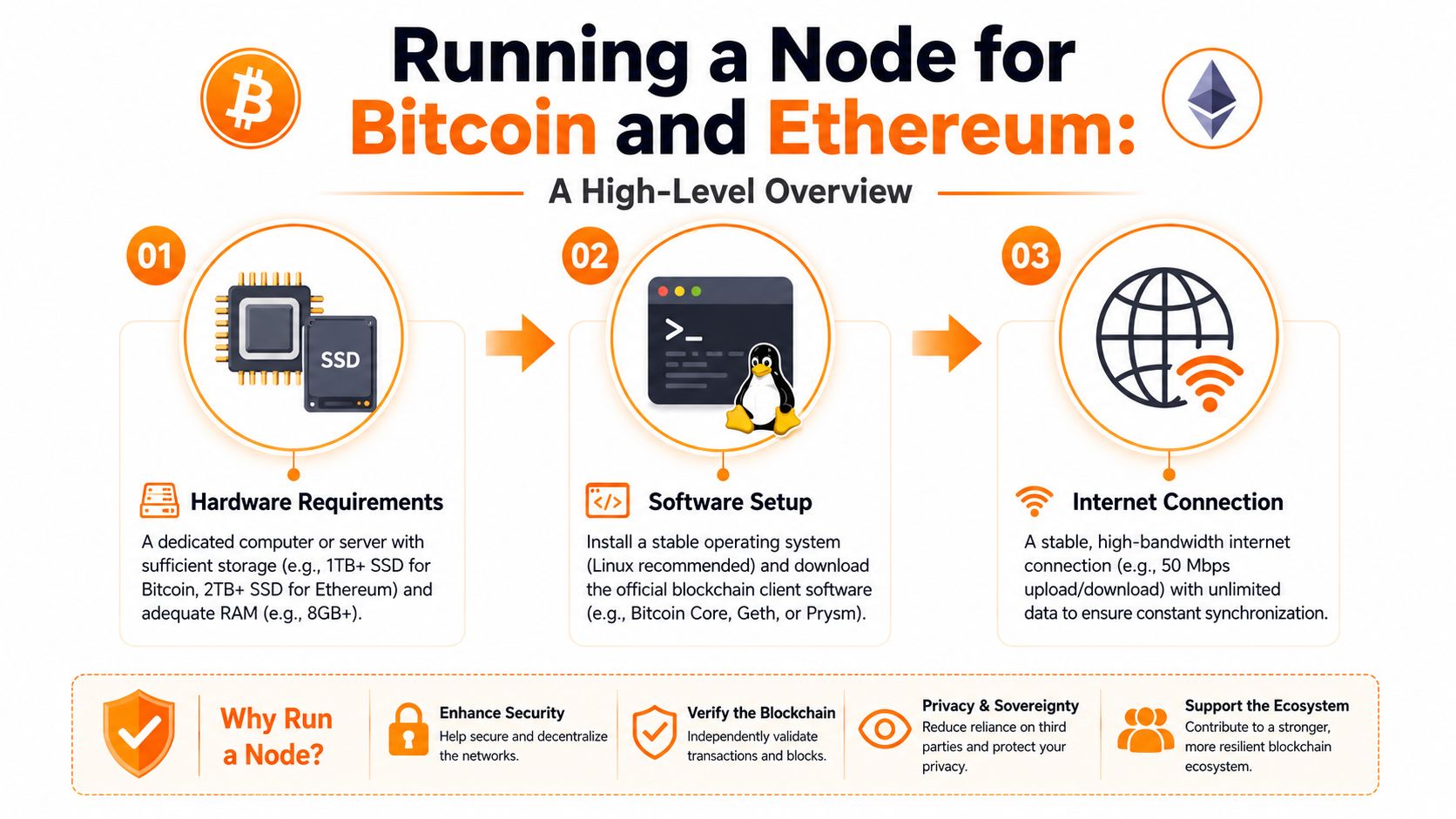
Many readers may expect this discussion to become daunting. It doesn't need to. Running a node is a technical task, but the basic decision is straightforward. You need the right hardware, suitable software, and a stable internet connection.
The practical difference between Bitcoin and Ethereum is significant.
Bitcoin is usually the simpler starting point
A Bitcoin node can often run on a 4-core CPU, 8 GB RAM, and a 1 TB SSD, while a production-grade Ethereum full node in the UK needs an 8-core CPU, 64 GB RAM, and a 4 to 8 TB NVMe SSD, according to Cherry Servers' Ethereum node requirements guide. That source also notes 128 GB RAM is recommended for heavy MEV-Boost or local block-building workloads.
That gap matters because it changes cost, power use, and complexity.
What the hardware means in practice
Here's the plain-English version:
| Network | Typical entry point for a full node | What it means for a beginner |
|---|---|---|
| Bitcoin | 4-core CPU, 8 GB RAM, 1 TB SSD | More approachable for home setups |
| Ethereum | 8-core CPU, 64 GB RAM, 4 to 8 TB NVMe SSD | Needs a more serious machine |
For Ethereum, the source adds a few practical warnings. RAM below 32 GB can lead to state sync failures, and storage speeds below 68 MB/s random write can cause transaction propagation delays. It also says a UK setup should have 300 to 500 Mbps minimum network bandwidth, with 1 Gbps preferred for RPC endpoints and faster syncs.
That doesn't mean every curious learner needs an enterprise rack. It means Ethereum node operators need to think more carefully about performance margins.
Software and setup choices
Users typically run official or widely used client software. For Bitcoin, that often means Bitcoin Core. For Ethereum, common choices include execution and consensus clients that work together.
At a high level, the setup usually looks like this:
Choose the machine
A dedicated mini-PC, spare desktop, or rented server can work. The key is stability and enough storage headroom.Install the client software
The software connects to peers, downloads chain data, and starts verifying.Let it sync
This is the patient part. The node has to catch up with the network before it becomes fully useful.Maintain it
Updates, storage checks, and uptime matter more than flashy tuning.
Common mistakes
Beginners rarely fail because the idea is too hard. They usually fail because they underestimate the boring parts.
- Storage growth: A drive that seems big enough today can become cramped later.
- Slow disks: Especially on Ethereum, fast storage isn't a luxury.
- Weak internet: Syncing and staying current takes a reliable connection.
- Using the main computer: A node can compete for resources and become annoying if you run it on the machine you need for daily work.
Start with realistic expectations. A node is infrastructure, not an app you install and forget.
A practical path that doesn't overwhelm you
If you want the gentlest path, Bitcoin is often the friendlier first project. If you specifically need Ethereum, treat it like a more demanding infrastructure commitment from the start.
Either way, the win isn't just getting the software running. The win is understanding what your machine is doing and why it matters.
Your Next Steps in the World of Nodes
At this point, the word node should feel a lot less slippery.
You've separated Node.js from network nodes and blockchain nodes. You've seen that a blockchain node is a computer that stores, checks, and shares ledger data. You've also seen that there are different kinds of nodes, and that running one can be practical if you match the project to your hardware and patience.
A sensible learning path
If you want to keep going, this order works well:
- Read blockchain basics first: Make sure blocks, transactions, and consensus feel familiar.
- Study wallets next: It helps to see how wallets interact with nodes.
- Explore Bitcoin Core or Umbrel: These are common starting points when people move from theory to practice.
- Join user communities: Forums and project docs are often where real setup questions get answered.
- Start small: A basic Bitcoin full node is often easier to manage than jumping straight into heavier infrastructure.
What matters most
You don't need to memorise every client, protocol detail, or storage option on day one. The biggest shift is understanding that blockchains aren't magical databases floating in the cloud. Real computers run them. Real people maintain them. Real trade-offs shape how decentralised they remain.
That's why learning what a node is matters. It moves blockchain from abstract buzzword to visible infrastructure you can understand, inspect, and maybe even help run.
If you want a clear next step, The Coin Course is a strong place to continue. It brings blockchain and crypto education together in one structured platform, with beginner-friendly guides, practical safety lessons, and deeper material for readers who want to go beyond the basics.