You click Confirm on a crypto swap while the price is moving quickly. The wallet keeps showing “pending”, the gas estimate rises, and twenty minutes later you still don't know whether the trade will execute, fail, or become irrelevant. That frustrating pause is usually not a mysterious blockchain fault. It's a queue forming because more people are competing for limited processing capacity.
The same idea appears in ordinary broadband. A video stream can buffer when many households use the connection during the evening, just as blockchain transactions can wait when users compete for block space. In both cases, demand has reached a shared bottleneck.
This guide answers three practical questions: what network congestion is, how to recognise it, and what you can do when it appears. The examples move from home broadband to blockchain so the technical details have a familiar starting point.
Why Your Transaction Is Stuck Right Now
A blockchain transaction doesn't go straight from your wallet to a finished result. Your wallet signs it, sends it to a node, and the node places it in a waiting area called the mempool. Validators or miners then select transactions for inclusion in a block. If demand is greater than the available block space, your transaction joins a queue.
Your fee affects where you sit in that queue. On networks with competitive fee markets, users who offer a more attractive priority fee may be selected sooner. A low fee can leave a transaction pending while newer transactions move ahead. A high fee doesn't guarantee success, however, because the transaction may still depend on contract conditions, available liquidity, or a valid nonce.
Broadband congestion follows the same logic. Ofcom describes congestion as a reason broadband speeds slow when networks are busy. In its March 2023 home broadband measurements, the average UK download speed between 8pm and 10pm was 67.7 Mbit/s, compared with an average maximum speed of 71.0 Mbit/s, so peak performance reached 95% of maximum across all connections. The daily minimum was 63.3 Mbit/s, or 89% of the average maximum, and the congestion effect was lowest on full-fibre lines. Ofcom's home broadband performance report provides the underlying measurement.
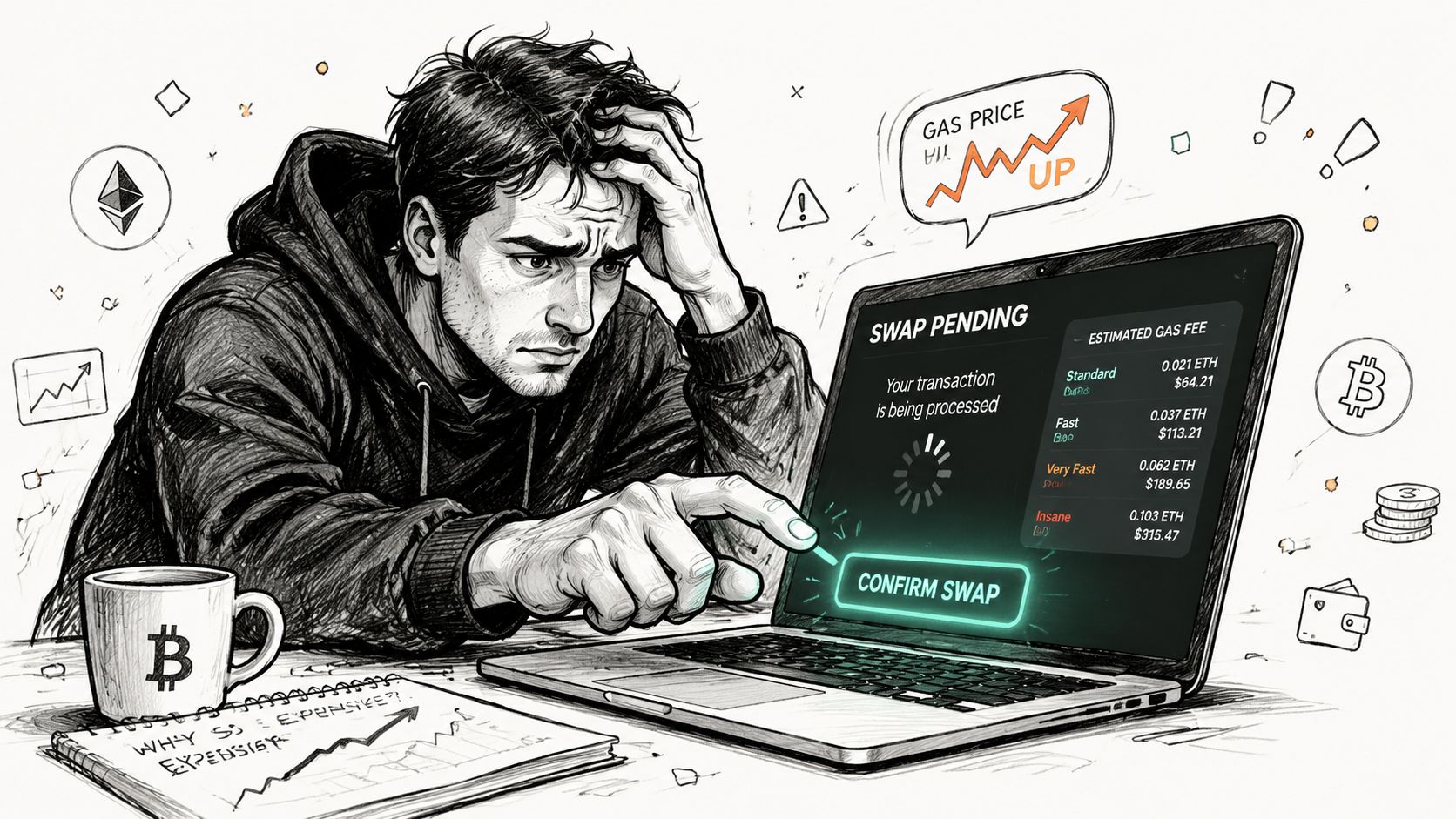
Practical rule: A pending transaction is evidence of a queue, not proof that your funds have disappeared.
Before replacing or cancelling anything, check the transaction hash in a block explorer. Confirm whether it remains pending, has failed, or has already completed. If the transaction is pending, review the current fee market and your wallet's replacement options. For a useful primer on the fee mechanism itself, read what gas fees are and how you can optimise them.
The rest of the problem becomes easier once you separate capacity, demand, and priority. The network has a limited amount of work it can process, users create demand, and fees help decide which work gets processed first.
What Network Congestion Really Means
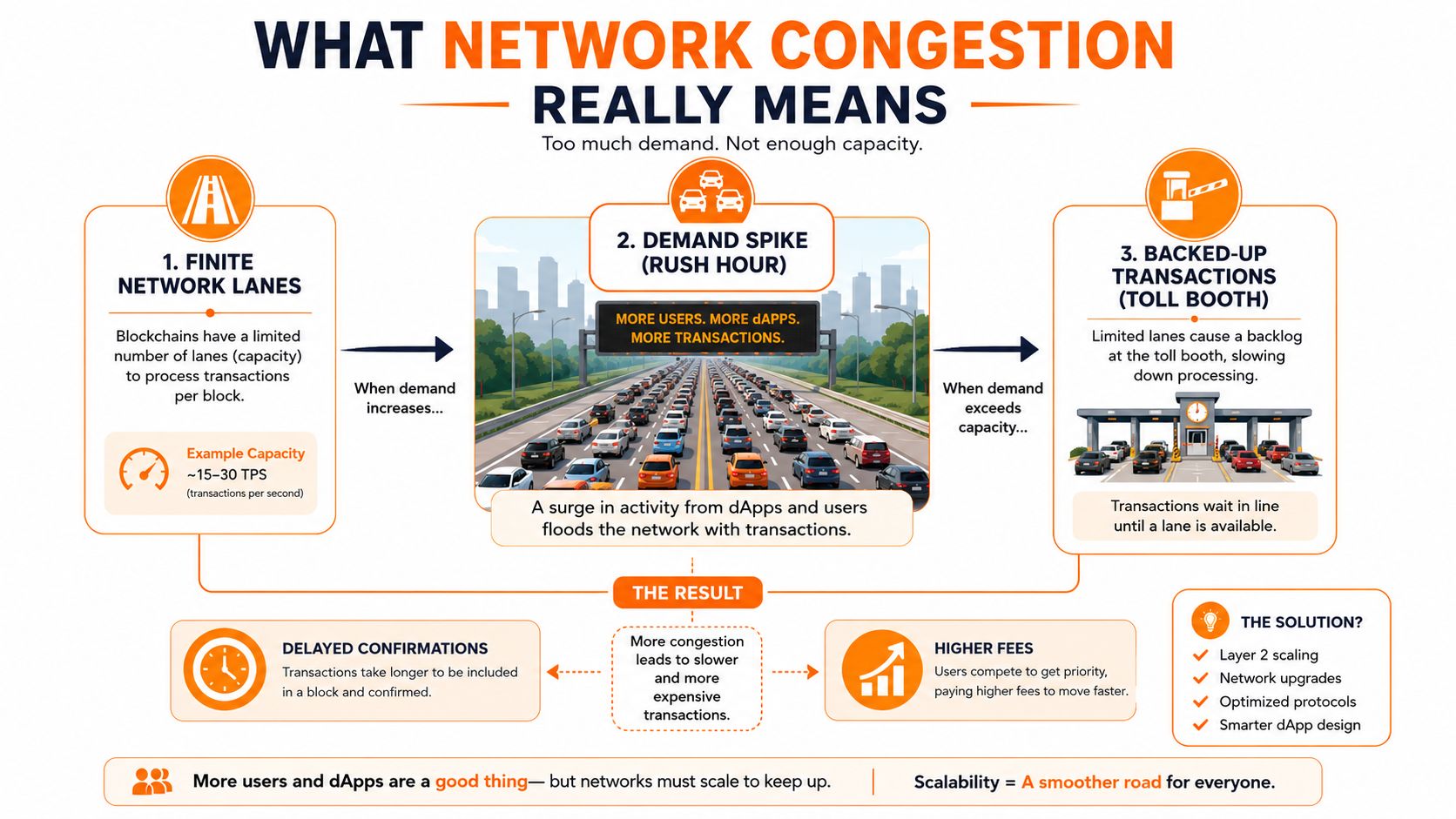
Network congestion occurs when demand for a shared network resource exceeds the capacity available at that moment. Think of a motorway with a fixed number of lanes. During a quiet period, vehicles move freely. At rush hour, more vehicles arrive than the road can carry smoothly. Queues form near narrow points, such as junctions or toll booths.
In a computer network, the lanes are links and available bandwidth. The vehicles are data packets. The toll booth is a router, server, or other shared processing point. Throughput describes how much data successfully travels through the system, while latency describes how long a packet takes to reach its destination. A congested route can have plenty of theoretical bandwidth but still deliver poor real-world throughput because packets wait, arrive unevenly, or need retransmission.
For a clear refresher on the difference between these terms, this guide to bandwidth and latency explained is a useful companion.
Blockchain congestion uses a similar pattern, but the scarce resource is usually block space and execution capacity. A block can contain only a bounded amount of transaction data or computational work. When more transactions compete for that space than validators can include, the mempool grows. Fees then become a bidding mechanism for priority.
Two bottlenecks can appear
Throughput-limited congestion happens when the network cannot process enough transactions to keep up with demand. A sudden application launch, market movement, or popular mint can fill the available queue.
Fee-market congestion appears when the network can technically process transactions, but users compete aggressively for inclusion. The result is a rising fee market, even if the physical queue isn't visibly dramatic to a casual user.
Decentralised networks can't add capacity overnight. A change to block limits, block timing, validator requirements, or execution rules affects every node and participant. Developers must consider security, hardware demands, propagation time, and decentralisation before changing the protocol.
Congestion is therefore a signal, not automatically a failure. It tells users that demand is pressing against a shared limit. The fee market redistributes processing priority towards transactions whose senders are willing to pay more or wait longer.
Signs That a Network Is Congested
Start with the symptom you can observe. On home broadband, a busy connection may show slower throughput, rising latency, jitter, or packet loss. Ofcom's 2023 measurements found that UK peak-time download performance was below the average maximum across all connections, while full-fibre lines showed the smallest congestion effect. The Ofcom performance update explains the relationship between busy-hour demand and measured speeds.
Ofcom's Connected Nations 2024 report gives a later benchmark. It found that average 8pm to 10pm download speeds ranged from 98.7% to 99.7% of the 24-hour average, depending on technology, because of congestion within the network or across the internet. The report also estimated that 1% of UK premises, around 385,000 premises in July 2024, couldn't access decent broadband, defined there as at least 10 Mbit/s download and 1 Mbit/s upload. Average UK download speeds rose from 170 Mbit/s in 2023 to 223 Mbit/s in 2024. Ofcom's Connected Nations 2024 report contains these figures.
Blockchain users look for equivalent warning signs:
| Indicator | Broadband Signal | Blockchain Signal | Where to Check |
|---|---|---|---|
| Queue pressure | Busy-hour slowdown | Rising pending transactions or mempool size | Etherscan Gas Tracker, mempool.space |
| Delay | Higher latency and jitter | Longer confirmation times | Block explorers and wallet history |
| Capacity use | Link utilisation and reduced throughput | High block space utilisation | Chain explorers |
| Delivery problems | Packet loss and retransmission | Failed or reverted transactions | Wallet and explorer records |
| Price of priority | Traffic shaping or service priority | Rising base fee and priority fee | Etherscan Gas Tracker |
| Local variation | Slow performance in one area | Congestion on one chain, rollup, or app | Solana status pages, Polygon zkEVM explorers |
Use Etherscan's Gas Tracker for Ethereum fee conditions and mempool.space for Bitcoin's unconfirmed transaction queue. For Solana, check validator and network status information. For Polygon zkEVM, use an explorer that shows transaction status and recent blocks.
Treat a gas chart like a weather forecast. A calm, stable range suggests you can submit a routine transfer without urgency. A sharply rising chart signals a demand front moving through the network. If the transaction matters immediately, set a fee limit you understand. If it can wait, don't chase a temporary spike because the wallet displays it.
Famous Crypto Congestion Moments
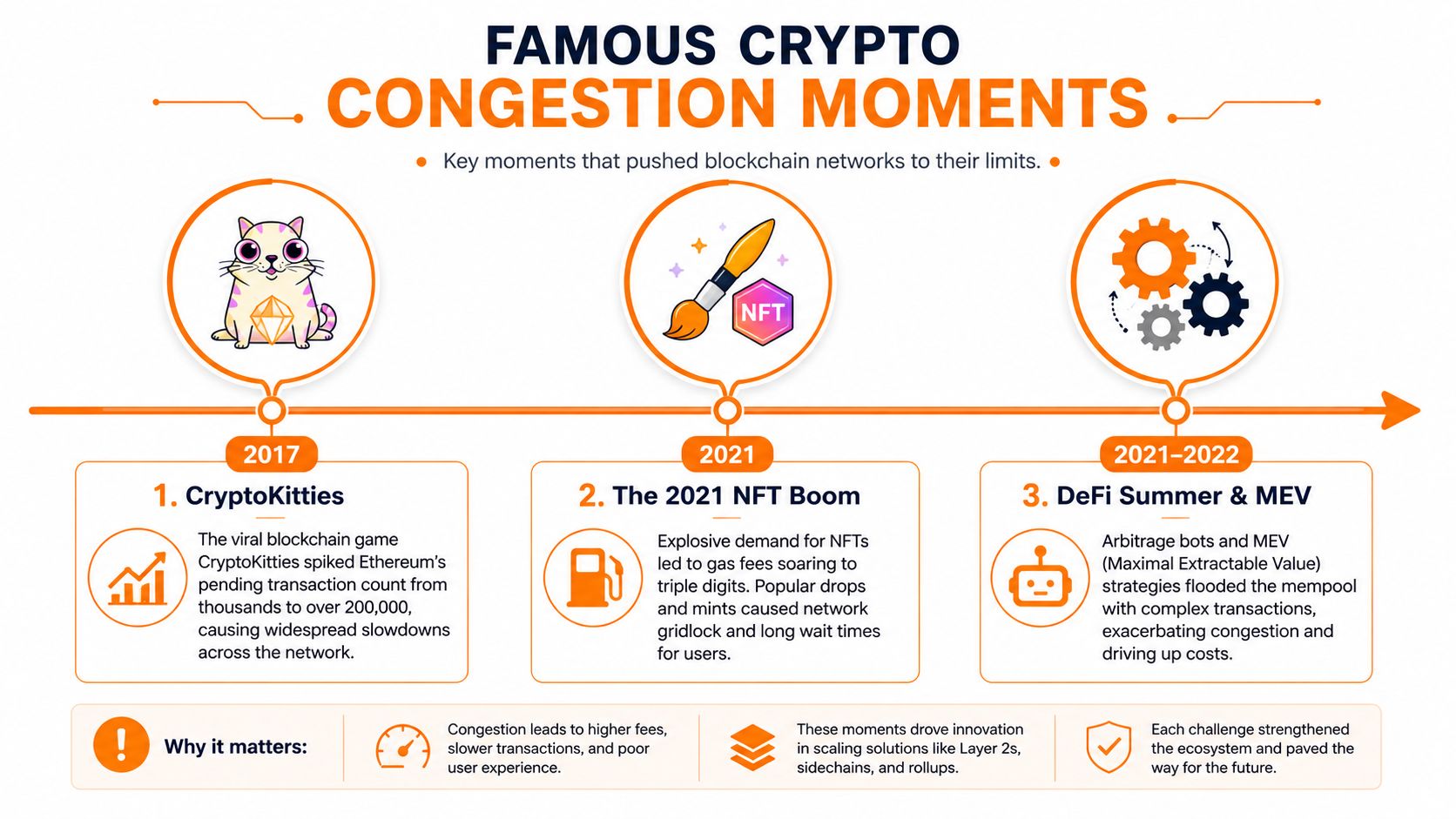
Crypto congestion becomes easier to understand through the events that made the queue visible to everyone. Each episode followed a recognisable pattern: a popular use case attracted demand, a bottleneck limited processing, and users paid through delays, failed transactions, or higher fees.
CryptoKitties and the first mass warning
In 2017, the CryptoKitties application brought a large wave of activity to Ethereum. The event became famous because a consumer-friendly smart-contract application could compete with ordinary transfers for the same block space. Pending transactions rose above 11,000, while average gas prices moved beyond 500 gwei, figures documented in contemporary coverage such as this account of the CryptoKitties congestion episode.
The technical cause was not that digital cats consumed the entire internet. Smart-contract interactions required execution and block space, and users competed to have those interactions confirmed. Secondary-market activity slowed, and traders could miss opportunities because their transaction remained in the queue.
Black Thursday and DeFi dependence
The March 2020 market shock exposed a different weakness. Rapid price movement drove users towards stablecoins, lending applications, decentralised exchanges, and collateral-management systems at the same time. MakerDAO's liquidation process depended on oracles, keeper activity, and timely transactions, while Uniswap users faced intense demand for scarce liquidity.
The episode showed how DeFi composability can amplify a backlog. One delayed transaction can affect a liquidation, which changes collateral conditions, which creates more trading and repayment activity. Users faced failed trades and missed arbitrage windows, while the system's interconnected contracts made a local queue feel like a market-wide problem.
NFT demand, Ordinals, and inscription pressure
The NFT boom demonstrated how speculative demand can turn block space into an auction. Bidders could lose a valuable opportunity when a transaction arrived too late, while ordinary users found routine transfers unexpectedly expensive. The human cost wasn't limited to professional traders. A user sending funds for rent or another essential payment could face a fee large enough to change the decision entirely.
A later inscription rush made the same point across more than one ecosystem. During the BRC-20 and Ordinals activity in 2023, reported congestion pushed Bitcoin's mempool beyond 400,000 unconfirmed transactions, while related Ethereum fee conditions rose above 30 USD in the cited reporting. CoinDesk's coverage of the Ordinals and BRC-20 congestion period provides context for that demand shock.
These moments differ in application, chain, and mechanism. The pattern remains consistent: a sudden use case meets finite processing capacity, then users compete through time and fees.
A short visual explanation can help connect those historical events to modern scaling debates:
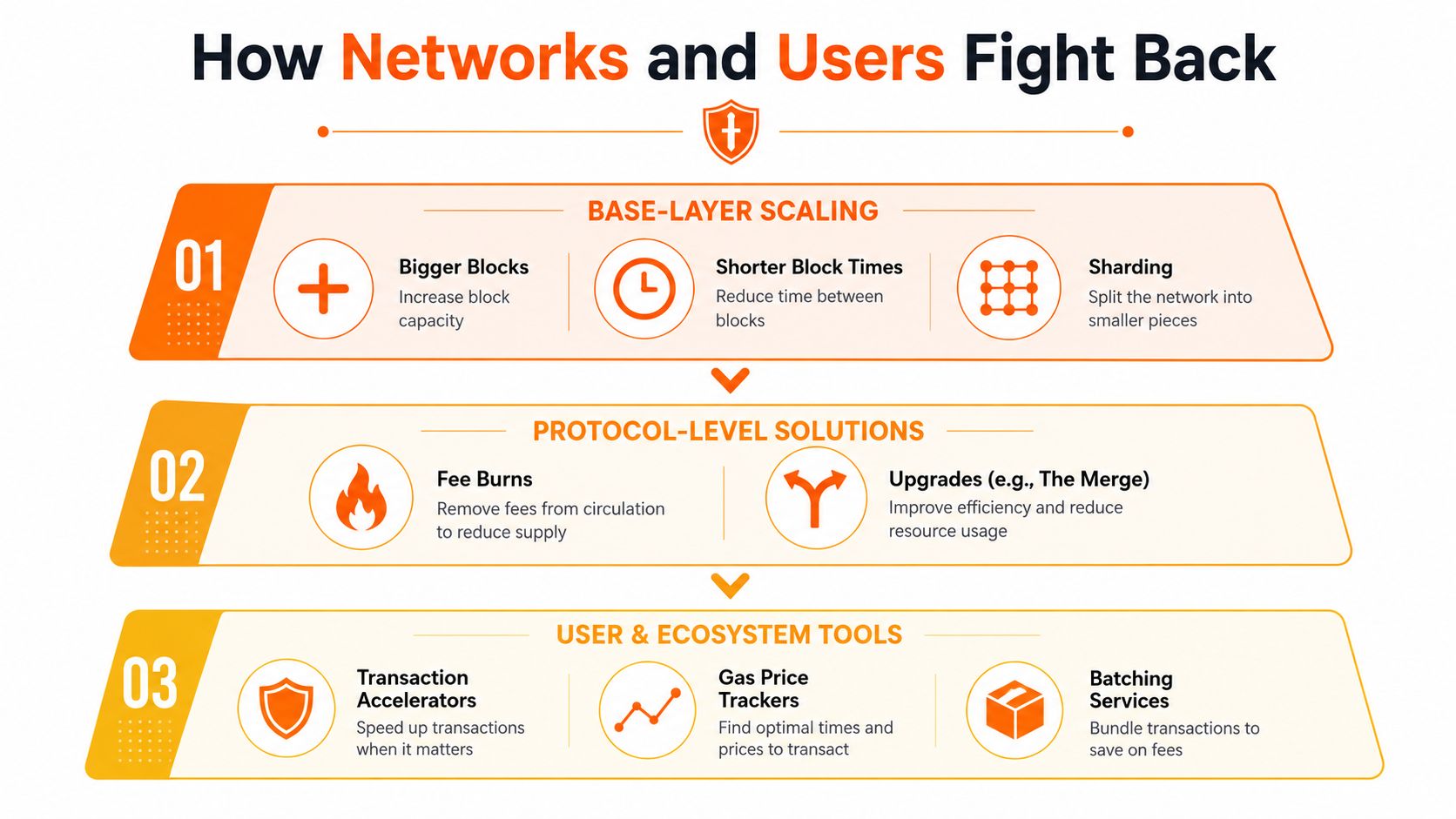
How Networks and Users Fight Back
Congestion relief works best as a layered toolkit, not a single magic upgrade. Each layer moves the bottleneck or changes how users compete for capacity. The trade-off may involve speed, cost, security, validator requirements, or decentralisation.
Base-layer changes
Protocol designers can increase capacity by allowing larger blocks, shortening block intervals, or distributing work through sharding. Each option changes the assumptions that nodes must handle. Bigger blocks may carry more activity, but they can also increase propagation and hardware demands. Shorter intervals may reduce waiting, but validators have less time to receive and verify blocks.
Ethereum's EIP-1559 introduced a base fee that adjusts with demand, alongside a priority fee chosen by the user. The base fee is burned, while the priority fee acts as a tip. This doesn't create unlimited capacity. It gives the market a clearer way to express urgency and makes fee estimation more structured.
Layer two and application design
Rollups process activity away from the base layer and publish settlement data back to it. Optimistic rollups assume transactions are valid unless challenged, while zero-knowledge rollups use cryptographic proofs. They can reduce the amount of work that every base-layer participant must execute for each individual user action.
Before choosing one, read this guide to Layer 2 networks and faster, cheaper blockchain transactions. The important question isn't just whether a rollup is cheaper. Check bridge risk, application support, withdrawal arrangements, liquidity, and whether the assets you need are available there.
Applications can also reduce pressure by batching transfers, compressing calldata, scheduling non-urgent actions outside busy periods, and avoiding unnecessary contract calls. Exchanges and wallets can group user withdrawals rather than sending every instruction separately.
Network operators have their own controls. A node may use a pruned data configuration, tune mempool limits, or connect to private transaction relays such as Flashbots. These choices can improve operational handling, but private routing changes visibility and introduces its own trust and execution considerations.
Even adjacent infrastructure teams use workflow tools to control operational bottlenecks. For example, organisations can automate ISP billing workflows so administrative traffic doesn't become another avoidable load on a network team. The principle is the same: identify the queue, prioritise important work, and remove repetitive demand where possible.
Choosing the Right Tools for Your Role
The best response depends on what you're trying to do. A trader needs rapid visibility and transaction controls. A developer needs simulation and efficient contract design. An everyday holder mainly needs safe timing, a fee reserve, and a reliable fallback.
| User Role | Primary Tool | Key Habit | Best-Fit Network |
|---|---|---|---|
| Trader | Etherscan Gas Tracker, Blocknative, Flashbots Protect RPC | Set a maximum fee and check pending activity before signing | Ethereum or a suitable supported Layer 2 |
| Developer | Tenderly, Alchemy webhooks, OpenZeppelin Defender | Simulate calls and reduce unnecessary execution and calldata | The rollup or base layer that fits the application |
| Everyday holder | Rabby or MetaMask fee estimation | Keep a gas reserve and delay routine transfers during spikes | A supported Layer 2 for routine activity |
For traders
Use the Etherscan Gas Tracker for a quick market view and Blocknative's mempool tools when you need more detailed pending-transaction information. Flashbots Protect RPC can help keep eligible transactions out of the public mempool, although you should understand its routing and execution behaviour before relying on it.
Set a maximum fee cap rather than approving an unlimited amount. Avoid submitting a non-urgent auction bid at the last possible moment. Watch broader market volatility as a practical warning sign, because rapid price movement often brings more swaps, liquidations, and arbitrage activity.
For developers
Tenderly can simulate contract calls before deployment or execution. Alchemy webhooks can provide event-driven application monitoring, while OpenZeppelin Defender supports operational controls around smart contracts. Review calldata size, batch compatible actions, and choose a rollup based on users, liquidity, tooling, proof model, and withdrawal needs rather than fee alone.
For everyday holders
Keep a small native-token reserve for fees. Let Rabby or MetaMask estimate EIP-1559 parameters, but still review the maximum before signing. For routine swaps and transfers, consider a Layer 2 if the destination, bridge, and asset support match your needs. This guide to Layer 2 wallet solutions explains why wallet choice matters.
If the trade is time-sensitive, pay the fee. If it can wait twelve hours, it almost always should.
Your Congestion Survival Checklist
Use this routine before you sign:
- Scan the queue. Check a relevant gas tracker, mempool view, or chain status page.
- Review the estimate. Look at the maximum fee, priority fee, and contract interaction. Don't approve a figure you haven't read.
- Choose the timing. Submit urgent activity when confirmation matters. Schedule routine activity for a calmer period.
- Pick the route. Confirm whether the application supports a Layer 2 or another suitable network.
- Keep a fallback. Know whether you can delay, cancel, replace, or reroute the transaction safely.
During a spike, open the explorer and inspect the transaction nonce and status. If it remains pending, your wallet may let you replace it with a higher-fee transaction using the same nonce. A cancellation transaction can also be possible, but it still needs to be confirmed and isn't guaranteed just because you submitted it.
Don't bridge impulsively during a fee surge. A bridge adds another transaction path, and moving funds between networks can introduce waiting periods, liquidity constraints, or contract risk. Check the destination before sending, and never assume a cheaper route is safer.
Looking towards the 2026 scaling roadmap, EIP-4844 blob capacity, more mature rollups, and intent-based transaction protocols may create additional ways to handle demand. These are opportunities, not guarantees. Capacity improvements can change where queues form rather than eliminate competition forever.
The one-minute test: Before signing, identify the queue, set your fee ceiling, confirm the network, and decide what you'll do if the transaction stays pending.
Congestion becomes manageable when you stop treating it as random. Observe the queue, price urgency, and keep a second route for activity that doesn't need immediate settlement.
The Coin Course offers structured, practical lessons on blockchain fundamentals, wallets, DeFi, trading, security, and advanced crypto concepts. Visit The Coin Course to build the knowledge needed to read fee markets, choose safer transaction routes, and manage congestion with more confidence.