
When you hear the term market cap in crypto, don't let it intimidate you. It's a surprisingly straightforward idea that gives you a quick snapshot of a cryptocurrency's total value. At its heart, it's calculated by taking the current price of a single coin and multiplying it by the total number of coins floating around in the market.
Picture it this way: if you wanted to know the total value of a company like Tesco on the stock market, you'd multiply the price of one share by the total number of shares out there. Crypto market cap is the exact same concept, just for digital money.
Your First Look at Crypto Market Cap
This single number is one of the first things you'll see on websites like CoinMarketCap or CoinGecko, and for a good reason. It provides a simple way to get a feel for the size and influence of a cryptocurrency.
A huge market cap usually points to a more established project with a massive network, like Bitcoin or Ethereum. A tiny market cap, on the other hand, might signal a newer, more experimental, or maybe riskier project. It’s the market’s collective gut feeling about what an asset is worth.
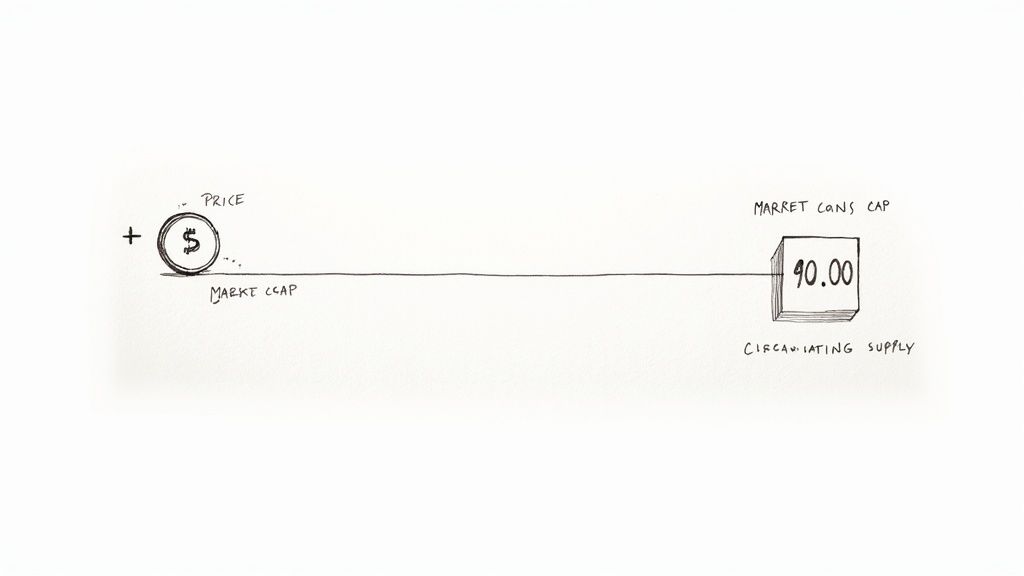
This is why looking at price alone can be a red herring. A coin priced at £1 isn't automatically "cheaper" than one priced at £100. If that £1 coin has billions in circulation, its market cap could easily make the £100 coin with only a few thousand available look small. Market cap gives you the real context.
Why This Number Matters Today
Understanding market cap is more important than ever. The UK cryptocurrency market alone ballooned to a size of roughly USD 301.2 billion in 2024.
With predictions suggesting it could climb to over USD 550.9 billion by 2033, thanks to growing interest in new ideas like decentralised finance, it’s obvious that the total value locked into these assets is enormous. This growth shows just how vital market cap is for understanding the true size of the crypto world. You can read more about the UK's crypto market expansion and what's behind it.
The formula for working out market cap is beautifully simple, which is part of its power as a quick-reference tool. Here's how it works.
The Simple Formula for Market Cap
| Component | What It Means | Simple Example |
|---|---|---|
| Current Price | The live price of one unit of the cryptocurrency. | Let's say one token of "Cardano (ADA)" is trading at £0.40. |
| Circulating Supply | The total number of coins actively available to the public. | There are 35 billion "Cardano (ADA)" tokens in circulation. |
| Market Cap | The result of multiplying the current price by the circulating supply. | £0.40 (Price) x 35,000,000,000 (Supply) = £14,000,000,000 Market Cap. |
As you can see, the calculation itself is a walk in the park. The real skill is in figuring out what the final number tells you about a project's place in the broader crypto universe.
Putting the Market Cap Formula to Work
Okay, theory is one thing, but let's walk through a real-world example to see how simple this calculation really is. It's the best way to make the idea stick.
Let's invent a UK-based crypto project called 'BritCoin'. To figure out its market cap, we only need two pieces of information: the current price of one coin and the total number of coins actually out in the wild.
Imagine there are 50 million BritCoins available for people like you and me to trade. This is its circulating supply. If the price for a single BritCoin is hovering at £2, the maths is a piece of cake.
All you do is multiply the number of coins by the price of a single coin.
50,000,000 BritCoins (Circulating Supply) x £2 (Current Price) = £100,000,000 Market Cap
And there you have it. That £100 million figure gives us a snapshot valuation of the entire BritCoin network at this very moment.
Where to Find This Data
The good news is, you'll almost never have to do this calculation yourself. Top-notch crypto data websites handle all the number-crunching for you and serve it up in a clean, easy-to-read way.
Sites like CoinGecko and CoinMarketCap are your best friends here. They are essential tools for anyone even slightly serious about crypto.
These platforms gather live data from hundreds of different exchanges all over the globe. They don't just give you the market cap; they also provide the current price, circulating supply, 24-hour trading volume, and detailed history charts for thousands of different digital assets. They are the definite starting point for almost any crypto research.
Take a look at the homepage of CoinGecko, for instance. Notice how the default view is a league table of cryptos ranked by market cap.
As you can see, giants like Bitcoin and Ethereum are sitting comfortably at the top, their massive, multi-billion pound market caps on full display. This ranking instantly shows you which projects the market values the most right now.
Learning to get around these sites is a fundamental skill. It lets you quickly get a feel for any project that catches your interest, so you can make decisions based on real data, not just someone's opinion on social media. It’s a huge first step toward becoming a more confident and informed investor.
Decoding the Different Kinds of Market Cap
When you start digging into cryptocurrency market cap, you'll quickly discover it's not a one-size-fits-all metric. To avoid some common investor traps, it’s vital to understand the three main flavours of market cap you'll encounter. Knowing the difference gives you a much clearer picture of a project's real value and its future potential.
The number you'll see plastered across most crypto sites is the Circulating Market Cap. This is the standard we've been talking about: the current price multiplied by the number of coins actually available to the public and trading on exchanges. Think of it as the project's current, real-world valuation.
But the story doesn't stop there. To get the whole picture, we need to look beyond just the coins changing hands today.
Circulating vs Total Supply Market Cap
The Total Market Cap zooms out a little. This version is calculated by multiplying the current coin price by the total supply—that's every coin that has been created so far, minus any that have been verifiably burned (which just means destroyed).
This total supply includes coins that are not yet on the open market. They might be locked up in a project's treasury or put aside for the development team, due to be released in the future. This number shows the value of all existing coins, not just the ones being actively traded.
So, why does this matter? A big gap between the circulating and total supply can be a warning sign for future inflation. If millions of locked coins are set to be released onto the market, that could create a lot of selling pressure and push the price down. This is a key idea in how digital money works, and you can learn more about how supply schedules affect value by decoding tokenomics.
A Pizza Analogy to Make It Simple
Imagine you've ordered a pizza. The circulating supply is the number of slices already on your plate. The total supply is all the slices in the box, including the ones you haven't taken yet.
This visual breaks down the simple maths behind the most common form of market cap.

It’s a powerful but straightforward formula: the number of coins available to trade, multiplied by their current price, gives you the total market value.
Looking Ahead with Fully Diluted Market Cap
Finally, we have the Fully Diluted Market Cap (FDMC). This is a forward-looking number that gives you a glimpse into the future. It calculates what the market cap would be if every single coin that will ever exist was in circulation today.
The formula is simple: current price multiplied by the project's maximum supply. For a cryptocurrency like Bitcoin, which has a strict limit of 21 million coins, the FDMC tells you its theoretical maximum value at today's price.
To finish our pizza story, the fully diluted value is the entire pizza, including any dough the pizza place could possibly make into more pizzas. It’s a guess at a project's ultimate size, but always remember it's hypothetical—it might take years, or even decades, for all those coins to be created.
A Quick Look at Market Cap Types
To make sense of these three key metrics, here’s a simple table breaking down what they measure and how you, as an investor, can put them to use.
| Metric Type | What It Really Measures | How an Investor Uses It |
|---|---|---|
| Circulating Market Cap | The current market value of all publicly available coins. | To get a sense of a project's current size and rank it against others. |
| Total Market Cap | The value of all coins already created, including locked ones. | To spot potential future price drops from unreleased tokens. |
| Fully Diluted Market Cap | The theoretical value if the maximum possible supply were circulating today. | To understand a project's long-term potential valuation and ambition. |
Each metric tells a different part of the story. Using all three together gives you a much more complete and detailed understanding of a cryptocurrency's value.
Why Market Cap Is a Key Tool for Investors
So, how does getting your head around a crypto's market cap actually help you make better choices? Think of it as your go-to ruler for measuring up the whole digital asset world. It’s the first metric we use to sort projects into different buckets, each with its own level of risk and potential for growth.
This sorting system is incredibly handy when you're trying to build a balanced portfolio. It gives you a quick snapshot of whether a project matches your appetite for risk, helping you avoid investments that are either too tame or far too wild for your taste.
Sizing Up the Market: Large, Mid, and Small-Cap Cryptos
Generally, the crypto market is split into three main groups based on market capitalisation. Getting to know these categories is a basic part of doing your homework as an investor.
Large-Cap Cryptos: These are the giants of the industry—names you probably already know, like Bitcoin and Ethereum. With market caps often in the tens or hundreds of billions of pounds, they're usually seen as more stable and less jumpy than smaller projects. They’ve been around a while and have solid, established networks.
Mid-Cap Cryptos: These are established projects that still have lots of room to grow. They might offer a nice blend of the stability of the large-caps and the explosive growth potential of the small-caps. For many people, this middle ground is an exciting place to invest.
Small-Cap Cryptos: Think of these as the startups of the crypto world. They're very speculative and come with a lot of risk, but they also offer the potential for huge, life-changing returns if the project really takes off. For example, a new gaming token with a market cap of just £5 million could, in theory, grow a hundred times over.
A larger market cap often brings another important benefit: liquidity. In simple terms, this just means lots of people are actively trading the coin, making it easier for you to buy or sell without causing a huge price swing. That ease of trading is a big plus for many investors.
A Growing Market in the UK
Understanding these categories is becoming more important as a growing number of people in the UK dip their toes into the market. A recent study from the Financial Conduct Authority (FCA) revealed that 12% of UK adults now own cryptocurrency, while awareness of digital assets has hit 93% of the population. The average amount people are holding has also increased, which shows deeper involvement. You can find the details in the FCA's report on UK crypto ownership.
This growing number of investors makes tools like market cap more vital than ever for making sense of a very crowded space. Looking at market cap is often just the first step in a much bigger research process. For a deeper dive into evaluating projects, check out our beginner's guide to fundamental analysis.
By sorting cryptocurrencies into these different groups, market cap provides a simple yet powerful framework. It helps you quickly understand a project's size, stability, and potential place within your investment strategy.
Common Market Cap Myths and How to Avoid Them
Market cap is a super useful tool, but it's also one of the most misunderstood numbers in crypto. If you don't understand its limits, it can easily lead you down the wrong path. Getting to grips with the common myths about market cap is one of the best ways to protect yourself from making simple mistakes.
One of the biggest misunderstandings is that market cap represents the total amount of money that has been invested into a project. This just isn't true. It’s not a running total of every pound ever invested; it's a snapshot, a theoretical calculation based on the very last traded price.
Think about it like this: a project has one million coins in circulation, and the last coin just sold for £10. That gives it a market cap of £10 million. But that does not mean that £10 million of real money has been put into the project. All it means is that, at this exact moment, the market values the entire circulating supply at that figure. Understanding this difference is really important.
Myth 1: Market Cap Equals Money Invested
As we've just covered, this is a dangerous assumption. A coin's market cap is a fleeting snapshot of its value, not a bank statement of money flowing in.
Key Takeaway: Market cap reflects the current theoretical value of a network. It’s calculated as Circulating Supply x Last Traded Price and is not a measure of the total money invested.
This is why you can see the total crypto market cap jump or fall by billions of pounds in a single day. It’s not necessarily new money flooding in or out; it’s the collective valuation changing as prices tick up and down.
Myth 2: A Low Price Means It's Cheap
This is another classic trap. You see one coin trading at £0.01 and another at £500 and instinctively think the first one is a bargain with more room to grow. More often than not, this is a completely useless comparison without looking at the bigger picture.
The price per coin is only one part of the equation. The other, more important part, is the supply.
- Example A: A project like yearn.finance (YFI) might have a price of £5,000 but with only 36,000 coins circulating, giving it a market cap of £180 million.
- Example B: A project like Shiba Inu (SHIB) might be priced at £0.00002 but with 589 trillion coins circulating, giving it a market cap of over £11 billion.
In this real-world case, the "cheap" Shiba Inu coin actually represents a project that's vastly larger than the "expensive" yearn.finance. When comparing the relative size of different crypto projects, always, always look at the market cap first, not the individual coin price.
Myth 3: Market cap Cannot Be Manipulated
For huge projects like Bitcoin, trying to manipulate the market cap would require a mind-boggling amount of money. It’s practically impossible. But for smaller, little-known altcoins, it’s a totally different story.
Many small-cap coins have low liquidity, meaning there aren't many active buyers and sellers. This makes them very vulnerable. A small group with enough money can make a few large purchases, artificially pumping the price. This, in turn, inflates the market cap and creates the illusion of a hot new project, tricking unsuspecting investors who get left holding the bag when the price crashes.
Always be extra careful when looking at these thinly traded assets.
Putting It All Together for Smarter Investing
So, let's tie all of this together. We've gone over what market cap is, the simple maths behind it, and both its practical uses and the potential traps you need to look out for.
Think of market cap as a crucial dial on your investor's dashboard—it's incredibly useful, but it’s not the only one you should be watching. You need a full set of instruments to get the whole story.
On a bigger scale, the total market cap of all cryptocurrencies is often seen as a health check for the entire industry. When that number is going up, it’s usually a good sign that confidence is growing and new investment is coming into the market.
Building Your Strategy
Getting a solid handle on basic ideas like what is market cap of cryptocurrency is the first real step on your journey. It gives you a way to sort different assets and manage your risk.
This is especially true as the UK crypto scene continues to grow. In 2024 alone, the UK cryptocurrency market brought in roughly USD 334.3 million in revenue, with hardware sales like mining rigs leading the way. Forecasts show that figure is set to grow, which shows just how much is happening right on our doorstep. You can dig into more stats about the UK's growing crypto economy on grandviewresearch.com.
By using market cap as one of your tools—not your only tool—you can navigate the exciting, and often chaotic, world of crypto with a lot more confidence. It's about shifting your approach from pure guesswork to making properly informed decisions.
Market cap is your starting point, not your final destination. It gives you context and helps you compare projects at a glance, but true research means digging deeper into a project's technology, team, and the way its tokens work.
At the end of the day, your goal is to build a portfolio that matches your financial goals. Combining a smart analysis of market cap with thorough, old-fashioned research is the best way to make that happen. For more on this, check out our guide on how to create a balanced and resilient crypto portfolio.
Frequently Asked Questions
After getting to grips with the basics of market cap, a few common questions tend to pop up. Let's tackle them head-on to help you put this metric to good use in the real world.
Is a Higher Market Cap Always a Better Investment?
Not at all. It really depends on what you're trying to achieve. A high market cap often signals a more established, stable project—think of it as the blue-chip stock of the crypto world. For investors who prefer to avoid big risks, that stability is a huge plus.
On the flip side, smaller projects with low market caps are where you find the potential for massive growth. Of course, that potential comes with a much bigger dose of risk. For example, a project like Bitcoin is unlikely to grow 100x from here, but a tiny project with a £1 million market cap could. There's no single "best" choice; it's all about matching the investment to your goals and how much risk you can stomach.
Your personal risk tolerance is the key. Large-cap crypto offers a sense of security, while small-cap crypto brings higher growth potential but also much greater volatility.
Can a Crypto Market Cap Fall to Zero?
Yes, and it happens more often than you might think. Remember, market cap is just the coin's price multiplied by its circulating supply. If a project fails—due to a hack, a bad idea, or a complete loss of investor trust—its price can crash to effectively zero.
When the price hits zero, the market cap does too. This is a very real danger in the crypto world, especially for smaller, unproven projects that haven't built a solid foundation or a strong community.
What’s the Difference Between Market Cap and Trading Volume?
It's really important not to mix these two up; they tell you completely different things about a cryptocurrency.
Market Cap gives you the big picture. It’s the total value of all the coins that have been created and are currently available, showing you the overall size of the project.
Trading Volume is all about right now. It measures the total value of coins traded back and forth over a set period, usually the last 24 hours. Think of it as a measure of how much buzz and activity there is around a coin today.
Put simply, market cap tells you how big a project is, while trading volume tells you how active its market is right now. High volume is a great sign of a healthy, liquid market where you can easily buy or sell.