
So, what exactly is market cap in the world of crypto? Think of it as the total price tag for an entire cryptocurrency. It’s not about how much one coin costs, but rather the combined value of all the coins currently out there. For instance, if you wanted to buy every single Bitcoin in existence, the market cap is the theoretical cost.
Understanding the True Size of a Cryptocurrency
When you’re new to crypto, it’s easy to focus on the price of a single coin. You might see a coin like Shiba Inu (SHIB) trading for a fraction of a penny and another like Solana (SOL) trading for over £100. At first glance, you might think Solana is a much larger project. But this is a classic rookie mistake, and market cap is the tool that tells the real story.
Market cap gives you a much better picture of a project's actual size and importance. It’s a bit like valuing a company on the stock market – you wouldn’t just look at its share price; you’d look at the company's total worth. To figure this out for a cryptocurrency, you just need to multiply two key things:
- Current Coin Price: How much one coin is worth on an exchange right now.
- Circulating Supply: The total number of coins that have been created and are available for the public to buy and sell.
Multiply the price by the supply, and you have the market capitalisation. This one number lets you make a fair, apples-to-apples comparison between different digital currencies. If you're curious about the mechanics behind these assets, you can learn more about how digital currencies work in our detailed guide.
Why This Metric Is So Important
In a nutshell, a cryptocurrency's market cap shows its total value. This number is crucial for tracking the growth and size of the whole crypto world. To give you some perspective, the UK's cryptocurrency market alone recently hit a size of around £245 billion, according to a report from the IMARC Group. That huge number is simply the combined market caps of all cryptos traded and held in the UK.
Market cap gives you a bird's-eye view, helping you judge a cryptocurrency's stability and influence. A higher market cap usually means a more established project with greater investor trust and a bigger community.
Think of it as your first step for any serious research. Instead of getting caught up in individual coin prices, market cap helps you see the bigger picture.
The Simple Maths Behind Market Cap
So, how do you actually calculate a cryptocurrency's market cap? The good news is you don't need a fancy calculator or a degree in economics. It all comes down to one simple multiplication.
Market Cap = Current Price × Circulating Supply
That’s all there is to it. This formula gives you a quick snapshot of the total value of all the coins or tokens currently available on the market. Let's break down what each of those parts really means.
The Two Pieces of the Puzzle
Understanding the market cap formula is all about its two main ingredients.
- Current Price: This is easy enough. It’s what one coin or token is worth at this very moment. This price is always changing, moving up and down with every trade on crypto exchanges across the globe.
- Circulating Supply: This is the grand total of coins that are actually in public hands and ready to be traded. This is a very important detail because it doesn't include coins that are locked up, saved by the project's founders, or haven't been created yet.
When you multiply the current price by the number of coins in circulation, you get a solid idea of the project's overall size and where it stands in the crypto market.
For a live look at these numbers, websites like CoinMarketCap are fantastic resources. They track this data in real-time for thousands of different cryptocurrencies.
This image gives you a perfect example, showing the top cryptocurrencies ranked by market cap. You can see Bitcoin and Ethereum sitting at the top, with their current price, circulating supply, and the final market cap figure all laid out clearly.
Putting It Into Practice: A Bitcoin Example
Let's make this real by using the formula with Bitcoin (BTC). We'll use some simple, round numbers to make it easy.
Let's say the price of one Bitcoin is £55,000.
And at that same moment, the number of Bitcoins in circulation is 19.7 million.
All we have to do is put those numbers into our formula:
Market Cap = £55,000 (Current Price) × 19,700,000 (Circulating Supply)
Do the maths, and you get a market cap of around £1.08 trillion. It's a massive number, and it shows perfectly why Bitcoin is seen as a "blue-chip" crypto asset. Its huge market presence isn't just because of a high price tag; it's the combination of that price with the massive number of coins already out in the world.
Circulating vs. Total vs. Max Supply
Now, when you're looking into crypto data, you'll often see three different "supply" numbers. It's really important to know which is which, because only one of them is used for the standard market cap calculation.
- Circulating Supply: These are the coins available to the public right now. This is the number used to calculate market cap across the industry.
- Total Supply: This is the total number of coins that exist so far, minus any that have been permanently destroyed (or "burned"). It includes the circulating supply plus any coins that are locked away or held in reserve.
- Max Supply: This is the absolute limit—the maximum number of coins that can ever be created for that specific cryptocurrency. It's written into the project's code. For Bitcoin, that famous hard cap is 21 million.
Sticking to the circulating supply gives you the most accurate and realistic picture of a project's current market value, since it only counts the coins that can actually be bought and sold today.
Using Market Cap to Understand Crypto Projects
Knowing the formula for market cap is one thing, but the real skill is knowing how to use it. This single number gives you a quick, at-a-glance way to judge a project's size, its possible stability, and where it might be going. It’s far more useful than just looking at a coin's price and is the foundation for comparing different assets in the crypto world.
The graphic below shows neatly how market cap is calculated from its two main parts.
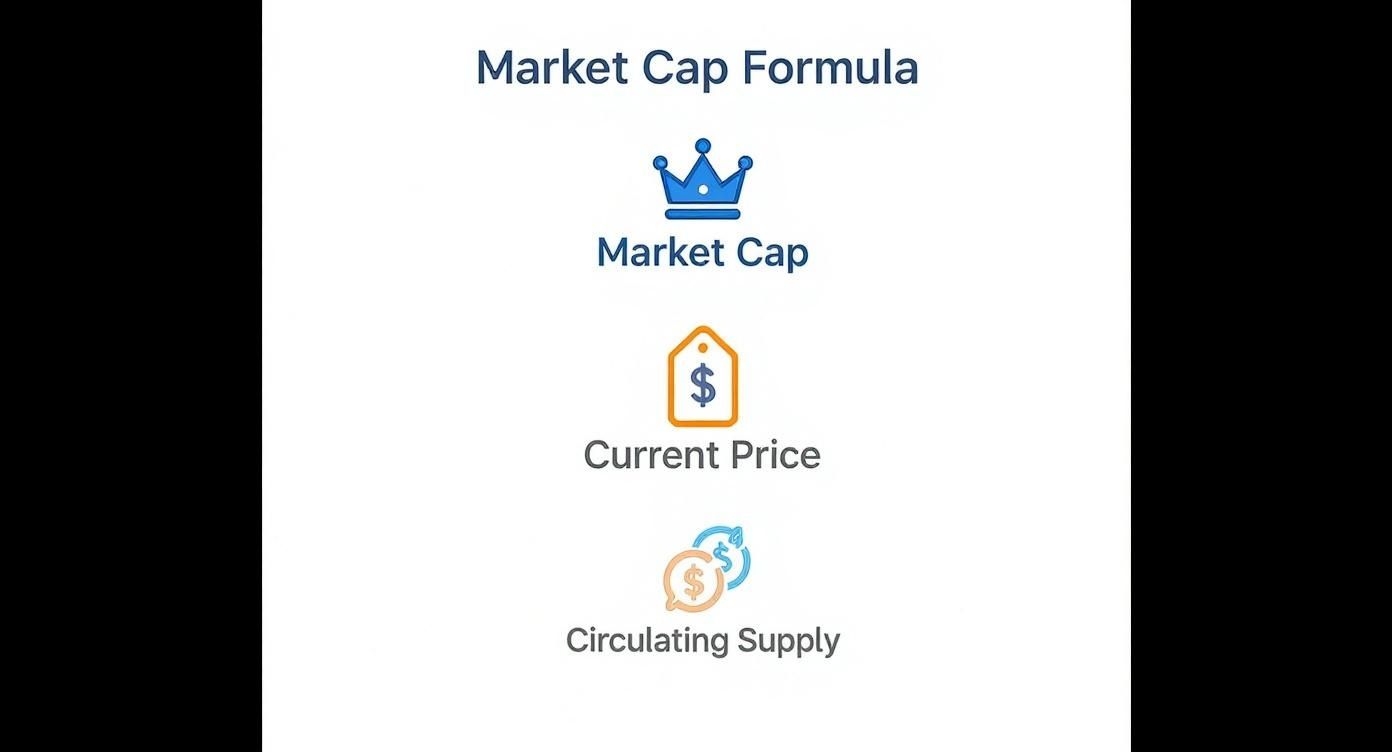
As you can see, market cap is the result of a coin's current price and its circulating supply. This direct connection is exactly why it gives you a much fuller picture of a cryptocurrency's true size compared to its price tag alone.
A Ship Analogy: Large-Cap vs Small-Cap
A really useful way to understand market cap is to picture the crypto market as a huge ocean. Each cryptocurrency is a ship, and its market cap tells you how big that ship is. This, in turn, gives you a strong clue about its stability and risk level.
Generally, we can sort these crypto 'ships' into a few main categories, which helps investors find their way.
To make this clearer, let's break down the common groups you'll hear analysts and investors talk about.
Crypto Market Cap Categories Explained
| Category | Typical Market Cap (USD) | Characteristics | Example |
|---|---|---|---|
| Large-Cap | Over $10 billion | The established giants. Less shaky, well-known, and seen as lower risk. Think of them as the market's cruise liners. | Bitcoin (BTC) |
| Mid-Cap | $1 billion to $10 billion | Solid projects that still have plenty of room to grow. They are usually more volatile than large-caps but less than small-caps. | Chainlink (LINK) |
| Small-Cap | Under $1 billion | Newer or more specialised projects. They come with higher risk and are much more jumpy, but also offer the chance for huge profits. | Fetch.ai (FET) |
This framework is key for building a strategy. An investor who prefers stability might fill their portfolio with large-cap "cruise liners," while someone who is okay with more risk might take a chance on a few small-cap "speedboats," hoping one of them has a massive growth spurt.
Of course, market cap is just one part of the story. To really get a project, you also need to look into its tokenomics—the economic rules that control the asset. For a deeper look, check out our guide on how digital assets shape blockchain economies.
By grouping projects, market cap helps you build a balanced plan. It's not just a number; it's a vital tool for weighing risk and opportunity in the vast crypto ocean.
Market Cap in a Local Context
While we often talk about worldwide numbers, it's also interesting to see how this works on a local level. Here in the UK, for instance, the crypto market has its own unique character, shaped by local rules and what investors are thinking.
The total UK cryptocurrency market revenue was around $334.3 million and is expected to climb to nearly $619 million by 2030, which shows some seriously strong local interest. It’s no surprise that Bitcoin still holds the biggest market share in the UK. You can find more details in the UK cryptocurrency market outlook on Grand View Research.
Comparing Different Cryptos with Market Cap
Alright, let's put this knowledge to use. One of the most common traps for newcomers is thinking a low coin price means a good deal. Understanding what market cap is in crypto is exactly how you avoid this expensive mistake.
Let's look at a real-world example: Cardano (ADA) and Shiba Inu (SHIB). This will show you exactly why a coin priced at a tiny fraction of a penny can be "bigger" than one worth many pence.
Why Price Alone Is Misleading
If you only looked at the prices, you might get the wrong idea. But that’s only one part of the story. Watch what happens when we bring the circulating supply into the mix. We'll use some approximate, rounded numbers for this example.
Cardano (ADA):
- Current Price: £0.35
- Circulating Supply: 35 billion coins
Shiba Inu (SHIB):
- Current Price: £0.000018
- Circulating Supply: 589 trillion coins
Now, let's do the simple maths using the formula we've covered: Price × Circulating Supply.
The results are pretty eye-opening. Cardano's market cap is around £12.25 billion (£0.35 × 35,000,000,000). In contrast, Shiba Inu's market cap comes in at approximately £10.6 billion (£0.000018 × 589,000,000,000,000).
In this case, even though Cardano's price is thousands of times higher, the two projects have surprisingly similar market caps because of Shiba Inu's absolutely enormous supply.
This simple comparison makes a key point clear: a coin's price tells you very little by itself. The market cap is the true measure of a cryptocurrency's size and total market value.
Understanding this is essential. It helps you make smarter comparisons and stops you from buying into a project just because its price looks cheap.
Market Cap and UK Investor Trends
The importance of market cap isn't just an idea; it has a real effect on investment trends right here in the UK. A project's size often determines how visible it is and how stable people think it is, which in turn attracts everyone from everyday investors to large companies.
Recent research from the FCA really shows this growing interest, revealing that around 12% of UK adults now own some form of cryptocurrency. What's more, the average amount held per person has gone up from £1,595 to £1,842 – a clear sign that people are putting more of their own money into these assets. You can dig deeper into UK crypto investment trends from Morningstar.
By using market cap as your main tool for comparison, you're basically using the same measurement that shapes the whole market. It lets you see past the hype of a low price and focus on what really matters: a project's actual substance and its place in the crypto world. Always, always check the market cap before deciding if a crypto is really a bargain.
What Market Cap Doesn't Tell You
While market cap is a fantastic starting point for checking a cryptocurrency's size, it's not the full story. Relying only on this number is a bit like judging a car's quality based only on its price tag. To truly get a feel for a project, you need to understand what market cap leaves out.
A project's market cap is just a snapshot in time. It's a calculated number, not a bank account full of billions of pounds. This means it can swing up and down with price changes, painting a picture that can be misleading if you don't look at the bigger picture.
Busting a Common Myth
First, let's clear up a huge misunderstanding: market cap is not the total amount of money invested in a project. It’s easy to think a £100 billion market cap means investors have actually put £100 billion into that cryptocurrency. That's just not how it works.
Think about it this way. If a coin’s price doubles overnight because of a few big purchases, its market cap also doubles. The actual amount of new money that came into the project could be a tiny fraction of that increase. It's a very important difference to make. See market cap for what it is: a dynamic indicator, not a fixed pot of cash.
Market cap shows the current market feeling of value. This feeling can be influenced by hype and excitement just as much as by real strength. It’s a measure of what people think it's worth, not how much money was invested.
The Vital Signs That Market Cap Overlooks
Thinking critically about what market cap doesn't show is just as important as knowing what it does. It completely misses several key health checks that are essential for any serious look at a crypto project.
A high market cap, for example, tells you nothing about a project's day-to-day activity or real-world use. For a clearer picture, you need to dig deeper and look at other things. These include:
- Trading Volume: This shows you how much of a crypto has been bought and sold over a certain period, usually 24 hours. High volume suggests real interest and a busy market. A large-cap coin with strangely low volume? That could be a warning sign.
- Liquidity: This is all about how easily you can buy or sell an asset without making the price jump or fall dramatically. A project might look impressive with a high market cap on paper, but if there aren't enough buyers and sellers, you could find it hard to sell your coins at a fair price.
- Technology and Use Case: Does the project actually do anything useful? A huge market cap is pretty meaningless if the technology behind it is flawed, old, or solves a problem nobody has.
- Team and Community: The strength of the development team and the passion of its community are often better signs of long-term success than market cap alone. An active, involved community can help a project survive the unavoidable crypto storms.
At the end of the day, market cap is an excellent tool for quick comparisons and for filtering the thousands of coins out there. But it should always be the start of your research, not the end. By combining it with these other key signs, you'll build a much more complete and reliable view of any cryptocurrency.
Your Next Steps in Crypto Research
So, now you know that a crypto’s market cap is basically its total value on paper. It's a great starting point for sizing up a project and a vital piece of the research puzzle, but it’s definitely not the only piece. Your adventure into crypto is just getting started.
What's next? Get your hands dirty. Head over to a data website like CoinMarketCap or CoinGecko. Look up a few coins you're interested in and check out their market caps. You might be surprised to see how a coin with a low price can have a massive market cap, and the other way around. There's no better way to learn than by doing it yourself.
The crypto world is always changing, and the best tool you have is your own curiosity. Think of this guide as your starting block—the real learning happens when you start exploring on your own.
As you dig deeper, always remember to keep a balanced view. Market cap gives you an idea of a project’s size and stability, but managing your risk is just as important. A great next step is to learn about spreading risk through crypto portfolio diversification in our detailed guide.
Stay curious, keep learning, and you'll be well on your way to exploring this exciting space with confidence.
Got More Questions About Market Cap?
Even after you've got the basics of market cap down, a few common questions tend to pop up. Let's tackle them directly to clear up any lasting confusion and help you use this number like a pro.
What's the Deal with Fully Diluted Market Cap?
You'll often see another term floating around: Fully Diluted Market Cap (FDMC). It’s a slightly different way of looking at a project's valuation.
While the normal market cap looks at the coins available right now, the FDMC calculates a project's value based on its maximum possible supply—every single coin that will ever be made.
- Standard Market Cap: Based on coins in circulation today.
- Fully Diluted Market Cap: Based on every coin that will ever be created.
Picture a project with 1 million coins in circulation, each worth £1. Its market cap is a simple £1 million. But if its long-term goal is to have a maximum supply of 10 million coins, its FDMC is £10 million.
FDMC is a peek into a project's possible future value, but it comes with a huge "what if": it assumes that the price will stay the same as millions of new coins enter the market. And that’s a very big guess.
Can a Crypto's Market Cap Actually Go Down?
Of course. A crypto's market cap is never still; it’s constantly moving. Because it's a simple multiplication of price and circulating supply, a change to either number will change the final result.
A market cap usually falls for two reasons:
- The Price Drops: This is the most common reason. When bad news comes out or the market mood turns sour, the coin's price falls, and the market cap goes down with it.
- The Supply Gets Smaller: It sounds strange, but sometimes projects "burn" tokens, which means they permanently remove them from circulation. If the price doesn't change, a lower supply means a lower market cap.
A falling market cap can be a warning sign, often showing that investor confidence is fading. It’s a powerful reminder that this number is a live indicator, not a fixed value set in stone.
Is a Higher Market Cap Always Better?
That's the big question, isn't it? And the answer really depends on what you’re trying to do as an investor. A higher market cap isn't automatically "better" for everyone.
It helps to think about it in terms of risk and reward.
- Large-Cap Giants (like Bitcoin): A huge market cap usually suggests stability and a lower risk of complete failure. These are the established leaders of the industry. The downside? Their massive size makes that explosive, 100x growth pretty unlikely.
- Small-Cap Upstarts: A tiny market cap is a sign of high risk and wild price swings. But this is where the chance for life-changing profits can be found. If a small project really takes off, the returns can be gigantic.
So, "better" is all about your own goals. If you’re playing it safe and want stability, a higher market cap is your friend. If you have a higher appetite for risk and are hunting for massive returns, you might find yourself looking into the world of smaller-cap projects.
At The Coin Course, our mission is to arm you with the clear, practical knowledge you need to navigate the crypto world safely. From core concepts like market cap to advanced trading strategies, we’re here to help. Start your learning journey with us today!