You're probably already used to apps that work together without much thought. You tap a payment app, your bank updates, a receipt lands in your email, and your budgeting tool notices the transaction a few seconds later. When that smooth handoff doesn't happen, it feels broken.
Blockchains often feel like that broken version.
You might hold a token on one network, want to use it in an app on another, and suddenly face wallet prompts, bridges, wrapped assets, strange fees, and a nagging fear that one wrong click could send funds into a black hole. That confusion sits at the heart of the question what is interoperability. It's really about whether separate blockchain systems can work together in a way that feels normal, safe, and useful.
Introducing Blockchain Interoperability
A simple way to think about it is this. Sending an email to a postal address doesn't work because the two systems weren't built to talk to each other. They use different formats, different delivery methods, and different rules.
Many blockchains have the same problem. Bitcoin, Ethereum, Solana, Algorand, and other networks each keep their own records, follow their own consensus rules, and speak their own technical language. Left alone, they behave like separate islands.
Blockchain interoperability is the attempt to connect those islands.
According to Chainlink's explanation of interoperability standards, blockchain interoperability is the ability of different networks to communicate and exchange data and value without friction, replacing ad-hoc bridges with secure, universal communication layers. The same source describes the long-term goal as chain abstraction, where users no longer need to manually bridge funds.
What that means in plain English
If interoperability works well, you shouldn't need to care as much about which chain an app uses behind the scenes. You would open the app, approve an action, and the system would handle the complex routing for you.
That matters because a blockchain becomes far more useful when it can interact with other blockchains. A payment network could settle with a tokenised asset platform. A game could recognise assets minted elsewhere. A lending app could accept collateral from multiple ecosystems instead of trapping users inside one.
Practical rule: If a blockchain can't easily exchange data or value with others, its users often end up doing manual work that software should have handled for them.
Why the idea matters so much
Without interoperability, every chain has to rebuild the same tools, attract the same users, and keep liquidity inside its own walls. That slows adoption and creates friction for everyone, from first-time users to developers building complex apps.
So when people ask, what is interoperability, the short answer is simple. It's the set of methods that let separate blockchain networks communicate, transfer value, and share useful information in a coordinated way.
Why Blockchains Need to Communicate
A helpful analogy is to treat blockchains like digital nations.
Each nation has its own laws, its own language, and its own currency. One chain may use a particular smart contract model. Another may finalise transactions differently. A third may not support the same data structure at all. None of that is wrong. It just means they don't naturally understand one another.
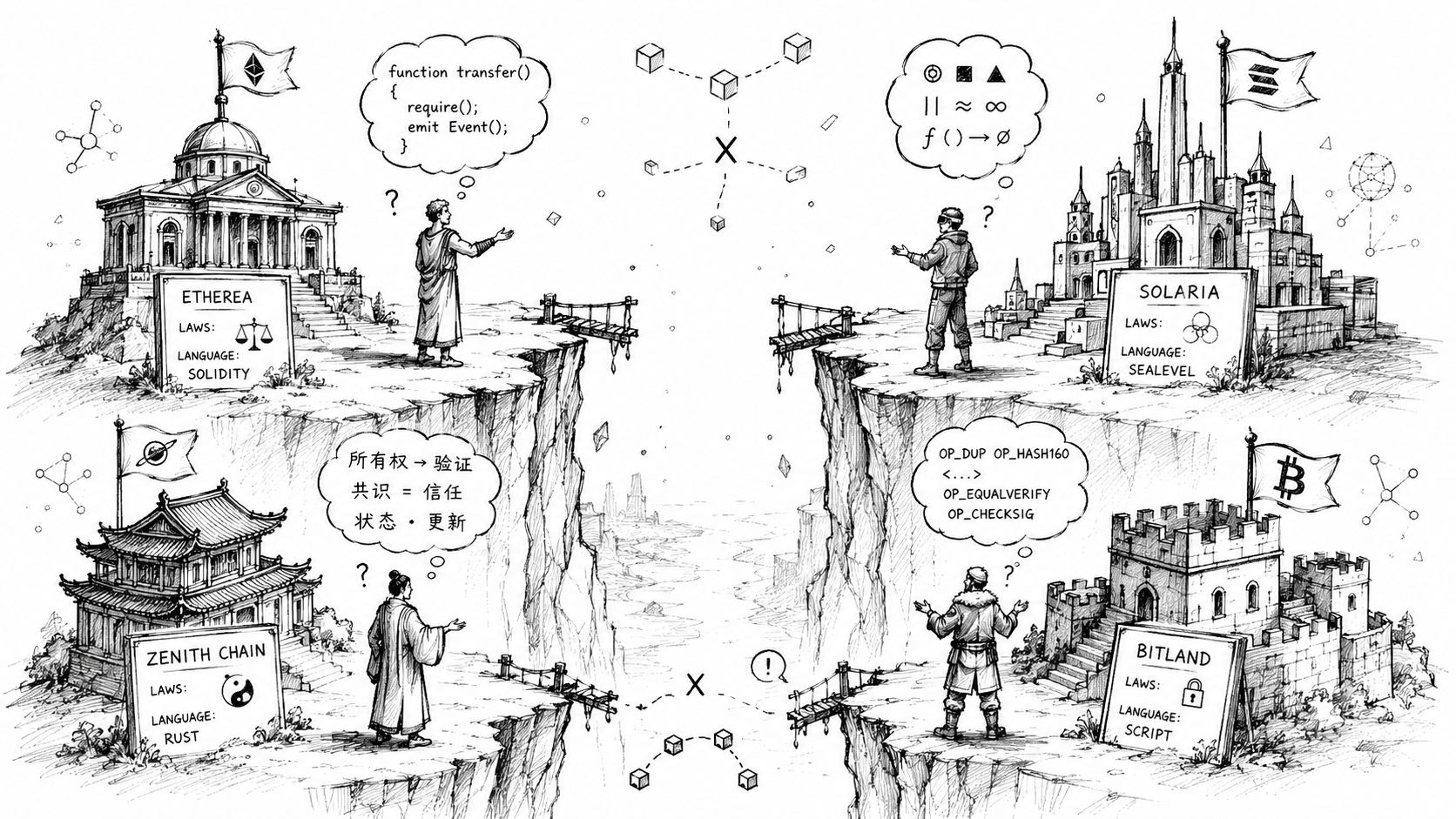
That separation creates a practical problem. If your assets live in one ecosystem but the app you want to use lives in another, you often need an extra tool in the middle. In crypto, that middle layer is commonly a bridge, a swap service, or a message-passing protocol. If you're new to that process, this guide to bridges and cross-chain DeFi helps make the journey less abstract.
Fragmentation hurts users first
Individuals don't wake up wanting to manage network compatibility. They want to send value, use an app, or move an asset.
Here's where things get messy:
- Assets get trapped: A token on one chain may have value, but not immediate usefulness on another chain.
- Apps stay siloed: A developer may build a strong product, but only for users inside one ecosystem.
- Workflows get clunky: Users end up switching wallets, signing multiple transactions, and checking whether a wrapped version of an asset is accepted.
- Trust assumptions multiply: Every extra service between chains introduces another thing that could fail.
Why institutions care too
This isn't only a retail crypto issue. Fortune Business Insights reports that Europe currently holds approximately 37% of the global blockchain interoperability market, driven by leaders like the UK and Germany. The same source says the BFSI sector holds the largest share, with financial firms using interoperability to improve security and streamline operations across private and public blockchains.
That tells you something important. Interoperability isn't a side quest for hobbyists. Banks, insurers, and financial platforms care because real business processes cross boundaries. Money moves between entities. Records need to match. Systems need to verify one another.
Separate chains can be innovative on their own. But users and institutions get the biggest benefit when those chains can cooperate without forcing everyone to learn the plumbing.
A simple example
Think of a person in London who owns an asset issued on one blockchain but wants to use it as collateral in a lending app built on another. Without interoperability, that person either can't do it or has to use a workaround that adds cost, time, and risk.
That's why blockchains need to communicate. Not because it sounds elegant, but because disconnected systems create a bad user experience and leave value sitting idle.
The Different Layers of Interoperability
People often talk about interoperability as if it were one single feature. It isn't. It has layers.
That's why two projects can both claim to be interoperable while solving very different problems. One may let data packets move between chains. Another may let apps call functions across networks. A third may still struggle because, even if messages arrive, the receiving side interprets them differently.
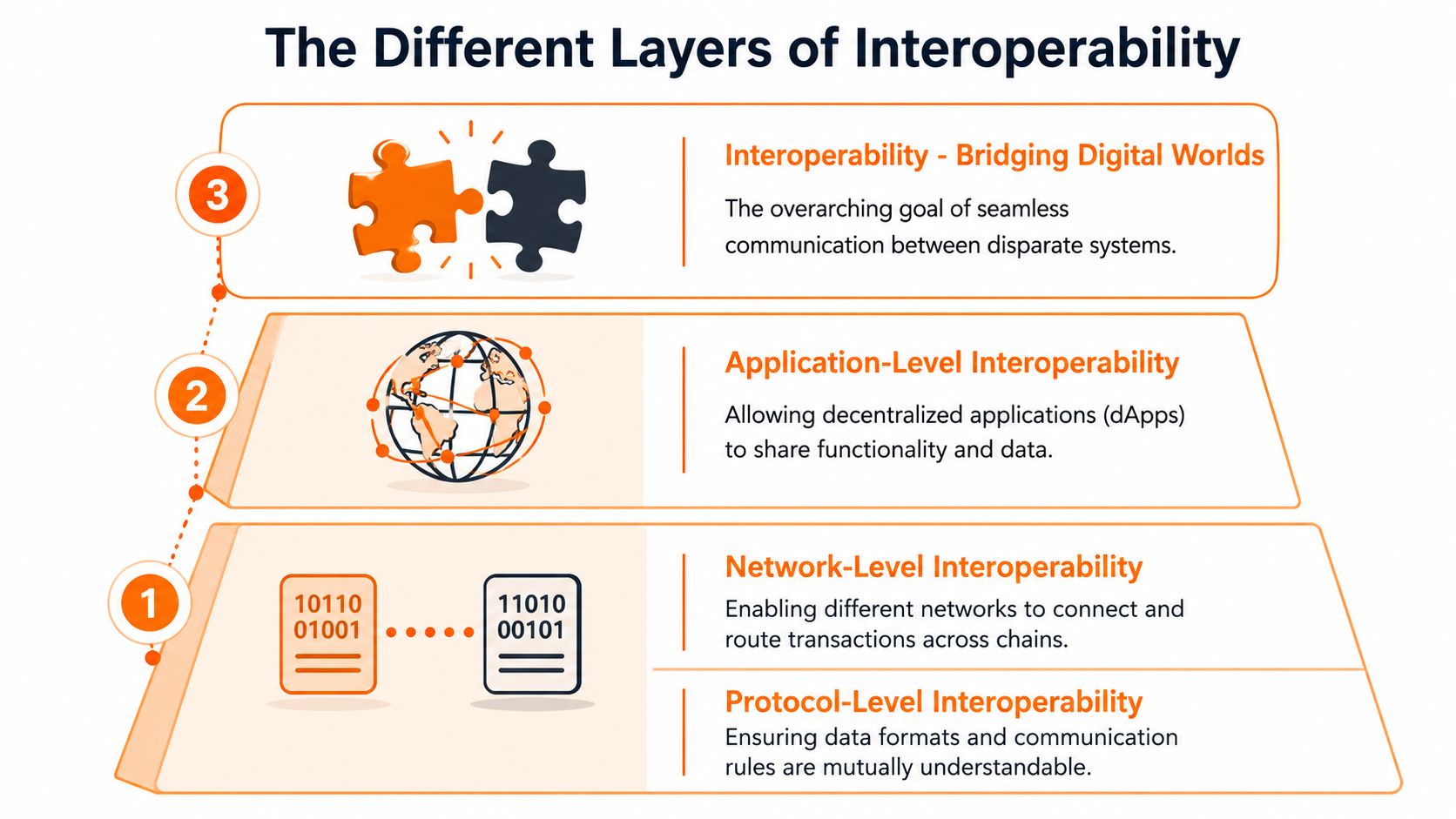
Protocol level
Start at the lowest layer. This is about the basic rules of communication.
Think of electrical plugs. A device can be perfectly well made, but it still won't work if the socket shape and voltage standard don't match. Blockchains face a similar issue. They differ in transaction formats, validation methods, and message structures.
At this level, interoperability means building ways for one network to verify or interpret information from another. If that foundation is weak, everything higher up becomes fragile.
Network level
The next layer concerns how separate chains connect and route information.
This is closer to transport. Even if two places use compatible packaging, they still need roads, ports, or routing systems to move goods between them. In blockchain terms, this layer handles the movement of messages, proofs, or assets across networks.
A lot of current interoperability tools live here. Bridges, messaging protocols, relays, and similar systems all try to answer the same question: how does one chain send something meaningful to another chain in a way the other side will accept?
Application level
This is the layer most users notice.
It's one thing for chains to exchange raw data. It's another for apps to do something useful with that data. A lending protocol might need to recognise an asset that originated elsewhere. A game might need to read ownership data from another network. A payments app might need to trigger settlement on a different chain without the user manually moving funds first.
At this level, the focus is less on pipes and more on user outcomes.
Semantic understanding matters too
There's one more source of confusion. Two systems can exchange data and still misunderstand each other.
If one chain labels an asset or event differently, the receiving application may process it incorrectly. This is similar to two people who both speak English but use the same word to mean different things in a legal contract. The message arrived, but the meaning got distorted.
According to CMS's legal overview of blockchain interoperability and standards work in the UK context, the UK still lacks a universally accepted standards framework for blockchain interoperability, and the British Standards Institution is working on this gap. The same discussion stresses that governance, compliance, and data standards matter alongside technical design.
Key insight: True interoperability isn't only about sending information. It's about making sure the other side can verify it, route it, and understand what it means.
A better way to judge interoperability claims
When a project says it supports cross-chain activity, it helps to ask three separate questions:
- Can it communicate? The protocol layer.
- Can it deliver reliably? The network layer.
- Can applications use the result correctly? The application and meaning layer.
A project that solves only one of those may still be useful. But it hasn't solved the whole puzzle.
How Crypto Interoperability Actually Works
Most interoperability today comes from a handful of technical approaches. They all try to connect separate chains, but they do it in different ways and with different trade-offs.
Cross-chain bridges
A bridge works a bit like a currency exchange booth at a border.
You bring one asset to the booth on Chain A. The system locks, holds, or otherwise accounts for that asset, then gives you a corresponding version on Chain B. That new version can be used inside the second ecosystem.
This is often the easiest idea for newcomers to grasp. It's also one of the riskiest in practice because the bridge becomes a critical point of trust, code complexity, or custody.
Atomic swaps
Atomic swaps are closer to a direct trade between two people who don't want a middleman.
One person offers Asset A on one chain. The other offers Asset B on another chain. The swap only completes if both sides satisfy the required conditions. If not, it fails cleanly.
That can reduce dependence on a central custodian. If you want a more focused walkthrough, this explainer on atomic swaps and cross-chain interoperability is worth reading.
Relays and light clients
Some systems avoid trusting a bridge operator by verifying information from another chain more directly.
A relay network can pass messages and proofs between chains. A light client can check selected information from another blockchain without downloading everything that chain has ever recorded. That makes cross-chain verification more practical, especially when full verification would be too heavy.
A real example with Algorand
Research on Algorand's interoperability design describes a concrete approach: Algorand achieves interoperability through state proofs and bridges, while using its Pure Proof of Stake (PPoS) consensus mechanism. In simple terms, that means it combines a specific way of proving state with bridging tools to communicate securely and efficiently with external blockchains.
That example matters because it shows interoperability isn't one generic switch a chain flips on. Different networks combine different methods based on their design goals.
Comparing Interoperability Methods
| Method | Analogy | Key Advantage | Main Risk |
|---|---|---|---|
| Bridge | Currency exchange booth at a border | Familiar and widely used for moving assets between ecosystems | The bridge itself can become a weak point |
| Atomic swap | Two people trading directly with locked conditions | Reduces dependence on a central intermediary | Limited by compatibility and user complexity |
| Relay network | Courier service carrying verified messages | Helps chains communicate without forcing full integration | Added infrastructure can increase design complexity |
| Light client approach | Checking an official summary instead of the full archive | Allows targeted verification from another chain | Harder to implement well |
The trade-off people often miss
The easiest method to explain isn't always the safest. The most trust-minimised design isn't always the easiest to use. And the most flexible developer tool can still create confusion if the app design is poor.
That tension exists in other software too. If you've ever seen a unified API model such as API2Cart's unified integration solution, you already know the general pattern. One layer tries to simplify communication across many separate systems, but the simplification only works if the translation layer is reliable.
The hard part isn't just connecting systems. It's connecting them in a way that users can trust and developers can maintain.
Leading Interoperability Projects in Action
It helps to move from theory to named examples. Different projects have taken sharply different routes toward the same broad goal.
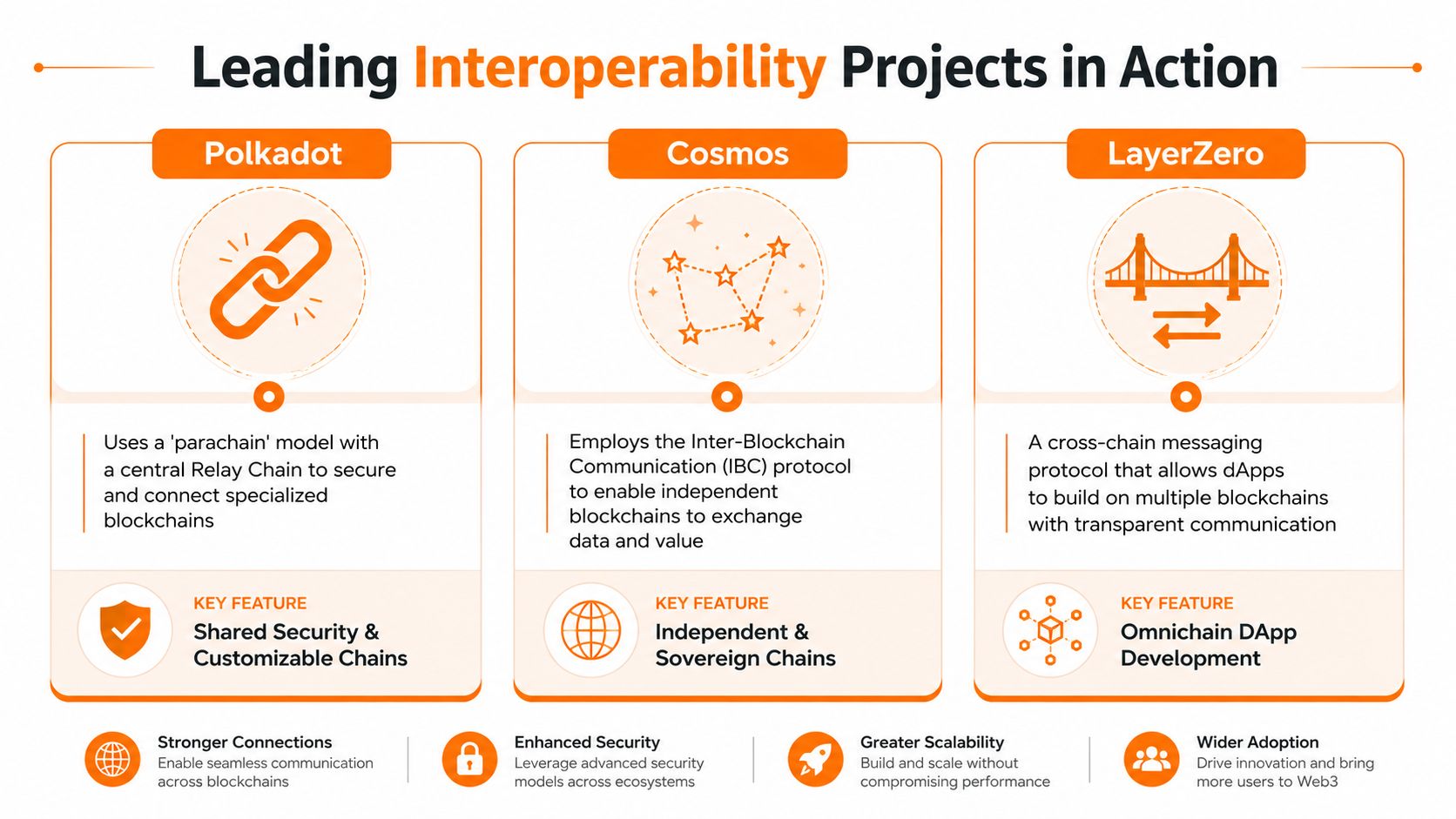
Polkadot
Polkadot is often described as a hub-and-spoke model.
The central idea is the Relay Chain, which helps provide shared security and coordination for connected blockchains called parachains. Instead of forcing every project onto one identical chain, Polkadot lets specialised chains connect through a common framework.
That design appeals to builders who want custom blockchains without giving up the benefits of being part of a wider network.
Cosmos
Cosmos takes a different view. It leans into the idea of many independent chains that can still communicate through a shared protocol.
Its best-known concept is IBC, short for Inter-Blockchain Communication. The easiest way to think about it is as a common language that compatible blockchains can learn to speak. They remain sovereign, but they gain a standard way to exchange messages and value.
This model tends to attract people who want independence first and interoperability second, rather than a tightly coordinated umbrella.
A short visual overview helps here:
LayerZero
LayerZero focuses on messaging.
Rather than framing interoperability mainly as asset transfer, it aims to give applications a way to send information across chains. You can think of it as a postal service for blockchains. The important item isn't always the package itself. Sometimes it's the verified message telling another chain what to do next.
That makes LayerZero attractive for developers building apps that live across several ecosystems at once.
Why these models feel so different
All three examples pursue interoperability, but they don't start from the same philosophy:
- Polkadot prioritises shared security with specialised connected chains.
- Cosmos prioritises independent chains linked by a common communication standard.
- LayerZero prioritises cross-chain messaging for app builders.
None of these approaches makes interoperability “solved”. They show that the industry is still testing different ways to balance openness, security, and ease of development.
For a learner, that's the useful lesson. When someone says a project is interoperable, the next question should be: interoperable in what way, for whom, and with what trust assumptions?
The Security Risks You Cannot Ignore
Interoperability sounds exciting until you look at where many failures happen.
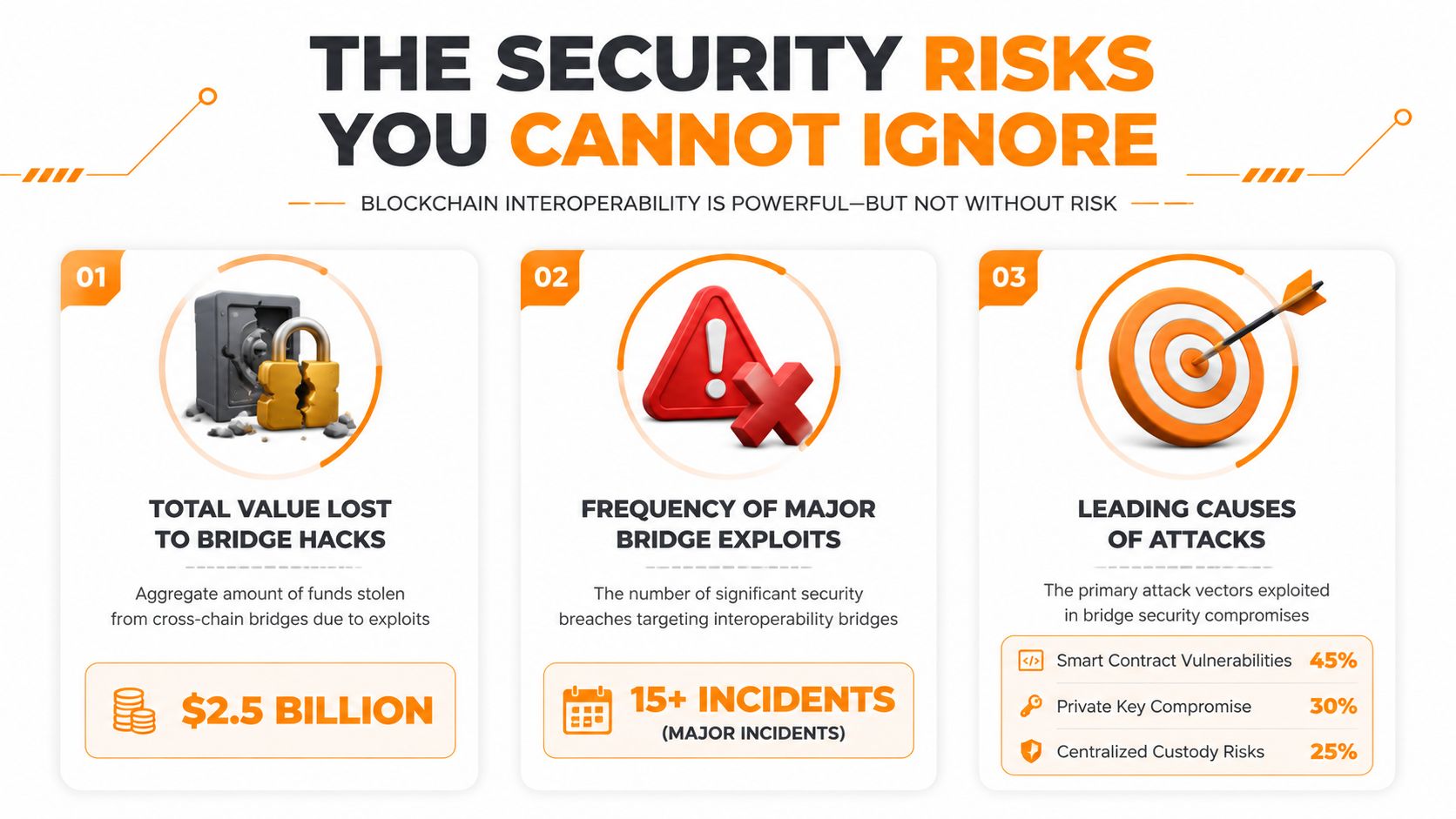
Unfortunately, some of the most convenient cross-chain tools are also the easiest places for attackers to focus. A bridge can hold value, control message flow, or rely on a small set of privileged actors. That creates a tempting target.
Why bridges are fragile
A bridge often has to answer a difficult question: how can Chain B trust that something really happened on Chain A?
Different projects answer that in different ways. Some rely more heavily on smart contracts. Others use validators, relayers, signers, or custodial structures. Every added component increases the attack surface.
If a bug exists in the contract logic, if key management is weak, or if too few parties control the verification process, attackers look for gaps.
The UK angle matters
A lot of explainers stop at general warnings. That misses a more grounded point for European readers.
According to this UK-focused discussion of blockchain interoperability challenges, the security vulnerability gap in UK-aligned cross-chain bridges remains under-documented despite the UK's $1.2B DeFi exposure in 2025, and 68% of bridge exploits targeted users lacking multi-signature verification protocols.
That's a useful reality check. The risk isn't just theoretical and it isn't only a problem somewhere else.
What users should look for
When assessing an interoperability tool, ask practical questions:
- Who verifies transfers or messages? A small trusted set is easier to understand, but can create concentration risk.
- How are keys protected? Good operational security matters as much as good code. This is why general secure credential practices, such as those outlined in PostPulse's API key management guide, are relevant even outside traditional software teams.
- Is multi-signature verification used? That won't solve every problem, but weak signer design is a known danger.
- Can you explain the trust model in one sentence? If not, you may be relying on a system you don't really understand.
For readers who want to tighten their broader habits, this guide to common DeFi security threats and defences is a sensible companion read.
Reality check: Convenience in cross-chain crypto often comes from hiding complexity. Hidden complexity doesn't disappear. It turns into security risk that someone else may or may not be managing well.
A healthy way to think about it
You don't need to avoid interoperability entirely. But you should treat it with the same caution you'd use when wiring money through a chain of unfamiliar financial intermediaries.
Ask who holds power, who can pause the system, who signs approvals, and what happens if one part fails. If the answers are fuzzy, the risk probably is not.
The Future of a Connected Blockchain World
The most promising future for blockchain doesn't look like dozens of isolated apps forcing users to become part-time network engineers. It looks more like software people already expect to use. You open an app, approve an action, and the system handles the chain-level details in the background.
That vision is closely tied to chain abstraction. Instead of manually bridging, swapping, wrapping, and selecting networks at every step, users would interact with outcomes rather than infrastructure.
Why the UK matters in that future
The UK is one of the places where this area is expected to grow quickly. Future Market Insights projects that the blockchain interoperability market in the United Kingdom is projected to expand with a 29% CAGR from 2025 through 2035. The same forecast places the global market at USD 332.8 million in 2025 and USD 1,832.3 million by 2035, while noting that cross-chain bridging accounts for approximately 41.20% of the total solution category.
That projection doesn't mean every interoperability product will succeed. It does show that the market sees this problem as central, not optional.
Three practical takeaways
- For users: Prefer tools whose trust model you can explain. Start small, verify wallet prompts carefully, and don't treat “cross-chain” as a synonym for “safe”.
- For developers: Design for failure. Assume users won't understand chain mechanics, and make security assumptions visible rather than buried in documentation.
- For investors: Look beyond hype. Ask whether a protocol solves a real communication problem, whether its model scales, and whether its security design matches its ambition.
The big idea is simple. Blockchain becomes much more useful when networks can communicate cleanly, applications can work across ecosystems, and users don't have to think about the machinery every time they move value.
If you want to build that understanding from the ground up, The Coin Course is a strong place to continue. It offers practical guides on blockchain basics, DeFi, wallets, security, and advanced crypto topics, written for people who want clear explanations without the usual jargon overload.