Impermanent loss is the difference between holding tokens in a wallet and supplying those tokens to a liquidity pool, and a 2x price move can create roughly 5.7% loss compared with just holding them. The loss comes from the pool changing your token mix as prices move, not from a separate fee charged to your account.
You may have deposited equal values of ETH and USDC, checked the projected fee income, and then watched the pool return more USDC but less ETH than you supplied. That feels like a mistake, especially when the total value appears lower than the value in a wallet. It isn't necessarily a software error. It is the result of how an automated market maker rebalances assets.
New liquidity providers often focus on fees first and price exposure second. Even experienced users can underestimate what happens when one token moves sharply against the other. The useful question isn't, “How much yield does this pool advertise?” It's, “After rebalancing, fees, market movement, and UK tax treatment, what will my wallet contain?”
What Impermanent Loss Really Means for Your Crypto
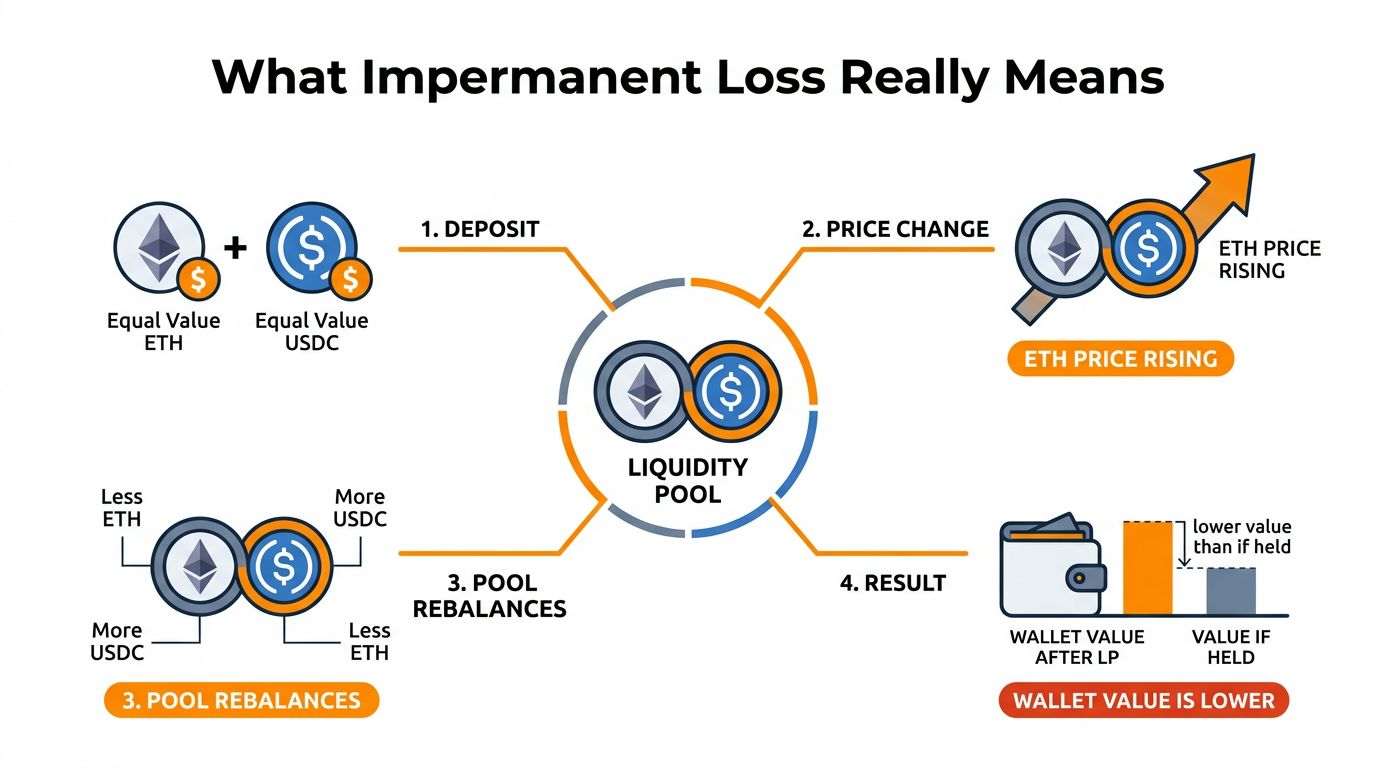
You deposit equal values of ETH and USDC into a liquidity pool. ETH then rises, traders buy ETH from the pool, and the smart contract changes the token mix. Your position contains less ETH and more USDC. It may still be worth more than your original deposit, yet less than the same ETH and USDC held untouched in your wallet.
Impermanent loss is the difference in value between holding tokens outside a liquidity pool and supplying those tokens to the pool. Compare both choices at the same later price. That isolates the effect of the pool's rebalancing from the market's general rise or fall. UK guidance describes the comparison in similar terms: value the assets remaining in the pool against the value of holding the same assets outside it, rather than treating fees alone as the benchmark.
A 2x move in one asset creates roughly 5.7% impermanent loss for a standard 50/50 pool, before trading fees or other rewards. The figure does not mean your whole deposit falls by 5.7%, nor that ETH itself lost 5.7%. It means the pool position is worth about 5.7% less than the original tokens held directly at that later price.
Practical rule: Compare the pool with the wallet alternative, not with your original deposit alone.
The percentage is only one part of the result in your wallet. Trading fees may reduce the gap, while a sharp price move, withdrawal costs, or UK tax treatment can change the amount you keep. Concentrated-liquidity pools can make the comparison less forgiving because your liquidity may leave its chosen price range and stop earning fees.
The calculation becomes clearer when you separate the AMM's trades, the changing token balance, fee income, and risk-reduction strategies. For record-keeping or broader crypto tax questions, Nanak Accountants and Associates crypto tax may help you identify the information an accountant needs.
How Automated Market Makers Create This Loss
A traditional exchange uses an order book. Buyers post bids, sellers post offers, and trades match when prices meet. An automated market maker, or AMM, uses a smart contract holding token reserves. Traders swap against those reserves, and the contract calculates a price from the pool's current balance.
A common model uses the constant-product formula:
x × y = k
Here, x and y are the quantities of the two tokens, while k is the pool's constant. The contract adjusts the amount a trader receives so the product remains consistent after the swap.
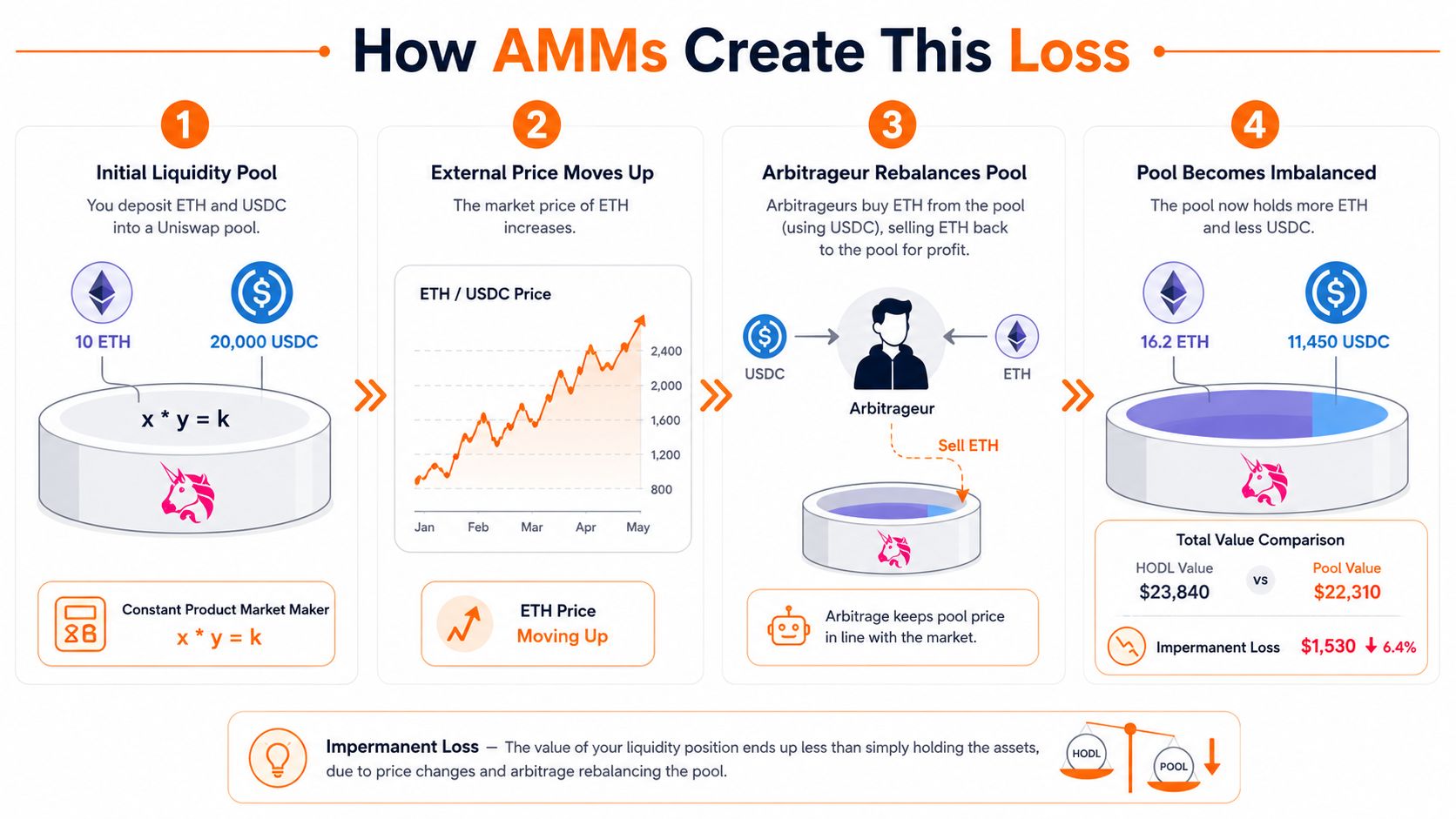
Consider a pool containing 1 ETH and 2,000 USDC as a simple starting picture. If ETH's external market price rises, the pool's old ETH price becomes too low. Arbitrage traders can buy ETH cheaply from the pool and sell it elsewhere at the higher market price. Their trades remove ETH and add USDC until the AMM price catches up.
The flow looks like this:
- Deposit: The pool contains ETH and USDC in the required ratio.
- External price change: ETH becomes more expensive elsewhere.
- Arbitrage: Traders remove underpriced ETH from the pool and pay USDC.
- New balance: The pool holds less ETH and more USDC.
That last step creates the LP's exposure. You own a share of the pool, so you also own its changed mixture. When ETH rises, the pool sells some of the winner into the market. You end up with more of the weaker asset, USDC in this example, and less of the stronger asset, ETH.
The process isn't a theft from a hidden account. Arbitrage traders perform a necessary service by aligning the pool with wider market prices, but the rebalancing changes the value mix held by liquidity providers. A beginner-to-expert guide to how automated market makers power DeFi trading provides further background on that pricing model.
Uniswap v3-style concentrated liquidity applies the same basic risk inside selected price ranges. Your capital becomes more active within the range, but a price move can take the position out of range or change its token composition quickly. As a rule, the more volatile or uncorrelated the pair, the greater the expected impermanent loss for a given price move.
A Worked Example With Real Numbers
Numbers make this easier to see. Start with a provider who deposits 1 ETH and 1,000 USDC when ETH is worth 1,000 USDC. The deposit is worth 2,000 USDC.
The wider pool contains 10 ETH and 10,000 USDC, so the provider owns a 10% pool share. Its constant product is:
10 × 10,000 = 100,000
Now ETH doubles to 2,000 USDC. Arbitrage changes the pool reserves so the new price matches the outside market. The pool holds approximately 7.071 ETH and 14,142 USDC. A 10% withdrawal therefore returns:
- 0.7071 ETH
- 1,414.2 USDC
- Total value of approximately 2,828.4 USDC
If the provider had kept the original assets in a wallet, the result would be different:
- 1 ETH, now worth 2,000 USDC
- 1,000 USDC
- Total holding value of 3,000 USDC
The difference is 171.6 USDC, which equals an impermanent loss of approximately 5.7% compared with holding. The figures and calculation are shown in Chainlink's worked explanation of impermanent loss.
| Price Change | Hold Value (USDC) | LP Value (USDC) | Impermanent Loss (%) |
|---|---|---|---|
| 1.25x | Not specified | Not specified | About 0.6% |
| 1.5x | Not specified | Not specified | About 2.0% |
| 2x | Not specified | Not specified | About 5.7% |
| 3x | Not specified | Not specified | About 13.4% |
| 4x | Not specified | Not specified | Not specified |
| 5x | Not specified | Not specified | About 25.5% |
The table shows the relative loss, not the final value of every possible deposit. Your actual pound result depends on the amount supplied, the starting ratio, the price of both assets, pool design, and fees. The loss also isn't locked while the position remains open. If the relative price returns to the original deposit ratio before withdrawal, the structural loss can disappear, although fees, rewards, gas costs, and tax effects still need separate treatment.
When Trading Fees Beat the Loss and When They Don't
An LP position has two competing outcomes. Fees and rewards add value, while price divergence creates impermanent loss relative to holding. The basic breakeven test is simple:
Fee revenue must exceed the IL dollar value for the position to beat the wallet alternative.
For a 2x ETH move, the structural loss is roughly 5.7%. On a $10,000 deposit, that equals about $570, so the position needs approximately $570 in fee revenue just to offset that loss, before other costs. This illustration uses the verified 5.7% rate and the specified deposit amount.
| Price Change | Impermanent Loss % | IL Dollar Value | Fees Needed to Break Even |
|---|---|---|---|
| 1.25x | About 0.6% | About $60 on $10,000 | About $60 |
| 1.5x | About 2.0% | About $200 on $10,000 | About $200 |
| 2x | About 5.7% | About $570 on $10,000 | About $570 |
| 3x | About 13.4% | About $1,340 on $10,000 | About $1,340 |
| 5x | About 25.5% | About $2,550 on $10,000 | About $2,550 |
A research-accessible UK explainer cites 54.7% of Uniswap v3 LPs in volatile pairs losing money after fees, because impermanent loss exceeded fee income. The explainer on impermanent loss for liquidity providers frames the result as a warning against treating headline APR as guaranteed profit.
Three variables matter most:
- Pair volatility: A volatile pair can move beyond the range that fees can realistically compensate.
- Fee tier: Higher fees may attract more income per trade, but they can also sit in pools where price movement and execution risk are greater.
- Capital efficiency: Concentrated liquidity can earn more from trades in range, yet a narrow range can stop earning when price leaves it.
High-volume, closely correlated pools can make impermanent loss a manageable cost of earning fees. A narrow position in a quiet or sharply moving pool can turn into a quiet drag. Broader debates about fee design and Uniswap upgrades can be explored through NomadCards' coverage of a Uniswap founder responding to V4 criticism, but the personal calculation still comes down to your own entry, range, fees, and exit.
Practical Strategies to Reduce Impermanent Loss
No strategy removes impermanent loss entirely. The sensible aim is to make the expected loss smaller than the fee income you can reasonably earn, while keeping the position understandable enough to monitor.
Start with pairs that move together
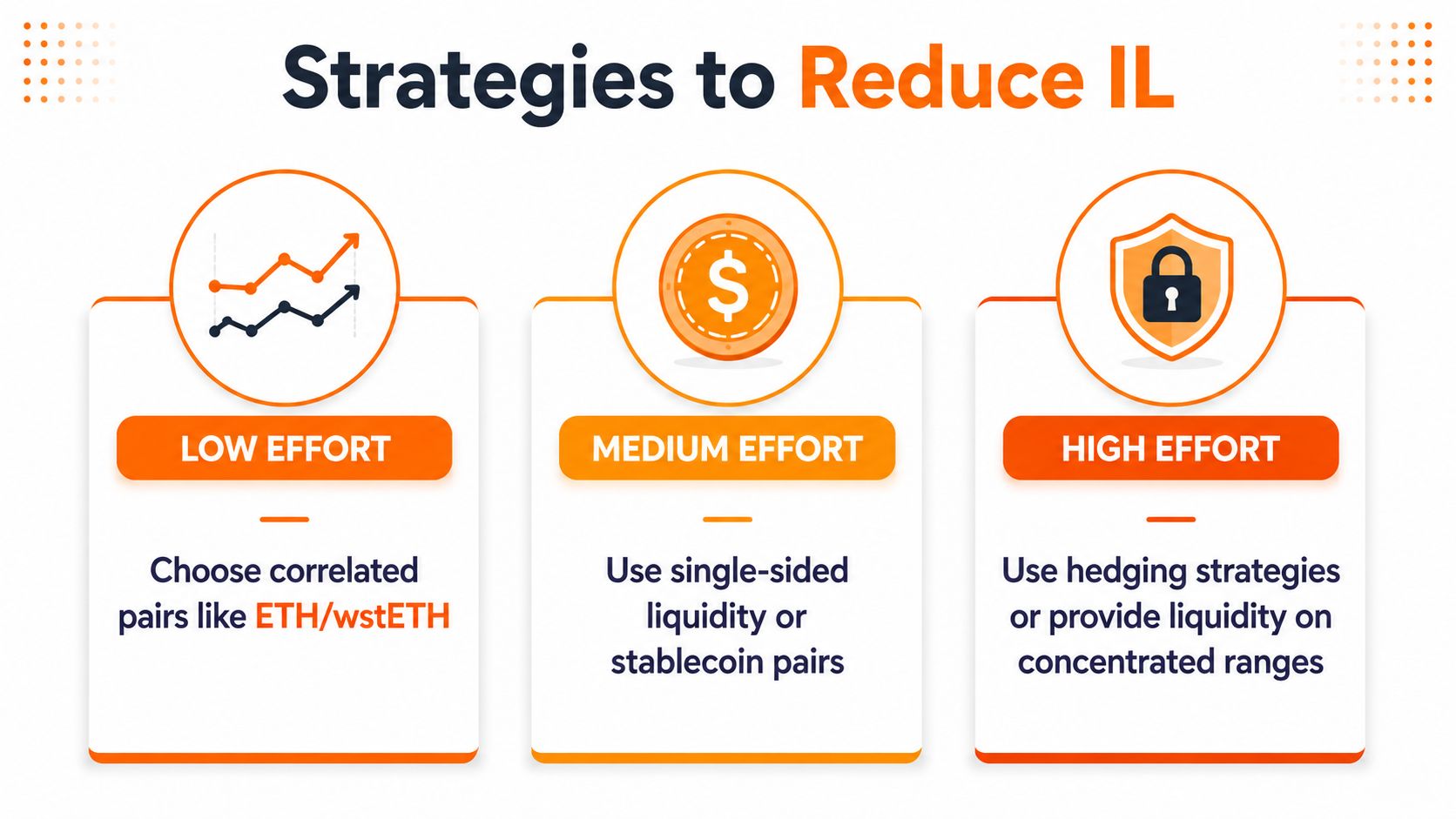
A pair such as ETH/wstETH usually has closer economic exposure than a new-token/ETH pair. Stablecoin-versus-stablecoin pools can also reduce divergence when both tokens maintain their intended relationship.
The benefit is a steadier ratio and less rebalancing pressure. The trade-off is clear: correlated assets often offer less upside from choosing the stronger token, and stable pools generally provide lower yield than riskier markets.
Use range design carefully
Concentrated liquidity lets you choose where your capital operates. A wide band or a full-range equivalent is easier to manage and less likely to become inactive after a modest market move, although it uses capital less efficiently than a narrow range.
A narrow range can produce stronger fee concentration while price stays inside it. It also demands more attention, because a move outside the selected range can leave the position earning little or no trading fee income while the market exposure remains relevant.
Add active protection only when the maths supports it
Experienced providers may use perpetual contracts or options to hedge part of the directional exposure. They may also rebalance a concentrated range as prices move or keep deposits shorter so an adverse move has less time to develop.
Hedging introduces premiums, funding costs, liquidation risk, and operational work. Those costs can exceed fee income. Shorter deposits reduce some tail exposure but may sacrifice compounding rewards and add transaction costs. Choose the simplest method that matches your ability to monitor the position.
Impermanent Loss and UK Tax Treatment
For UK liquidity providers, impermanent loss has two parts: the economic result and the tax treatment. While an LP position remains open, the change in its asset mix is not usually a separate taxable event under the disposal-based approach described by UK crypto tax guidance. Tax relevance generally arises when you remove liquidity or otherwise dispose of the position.
The sequence is straightforward:
- You supply assets to the pool.
- The pool rebalances as their relative prices change.
- Your share comes to contain a different mix of assets.
- You remove liquidity or dispose of the LP position.
- The resulting gain or loss is considered in the capital gains calculation.
The UK government's 2026 tax update on cryptoasset loans and liquidity pools says some disposals may receive “no gain, no loss” treatment, deferring Capital Gains Tax until an economic disposal. That treatment does not remove the record-keeping burden. Keep the dates, token quantities, sterling values, fees, deposits, withdrawals, and pool-token details needed to reconstruct what happened.
HMRC guidance identifies a four-year claim deadline for reporting a capital loss. Under that guidance framework, a loss arising in 2022/23 must be claimed by 5 April 2027. A recorded loss may then be carried forward indefinitely against future gains. The UK crypto loss guidance explaining the claim window explains how the claim window works.
A worthless asset can involve a separate negligible-value process. The claim must identify the asset, the amount treated as disposed of, and the disposal date, which may be £nil. HMRC sets out this mechanism in its cryptoassets manual guidance on negligible value claims.
An LP token or locked pool does not automatically remove the tax question. Start your records with the first transaction, then use this guide to navigating crypto trading taxes as a starting point for wider record-keeping issues. Tax treatment can depend on the exact transaction, so seek professional advice where the position is unclear.
Checklist Before You Add Liquidity
Run this checklist before approving a deposit. It forces you to compare the attractive part of the pool, fee income, with the exposure that produces impermanent loss.
- Confirm pair correlation: Ask whether the two assets normally move together or whether one can outrun the other.
- Simulate price moves: Use an impermanent-loss calculator for several entry-to-exit scenarios, including both upward and downward moves.
- Estimate fee income: Compare a realistic fee estimate over your planned holding period with the possible loss from price divergence.
- Choose the pool structure: Review the AMM model, fee tier, range settings, incentives, and whether your position can become inactive.
- Set the duration: Decide whether this is a short monitoring trade or a longer allocation. Don't leave the time horizon undefined.
- Choose a rebalance trigger: Write down the price or range condition that would make you review the position.
- Record the tax basis: Save transaction dates, token quantities, sterling values, fees, LP tokens, deposits, withdrawals, and reward details for HMRC records.
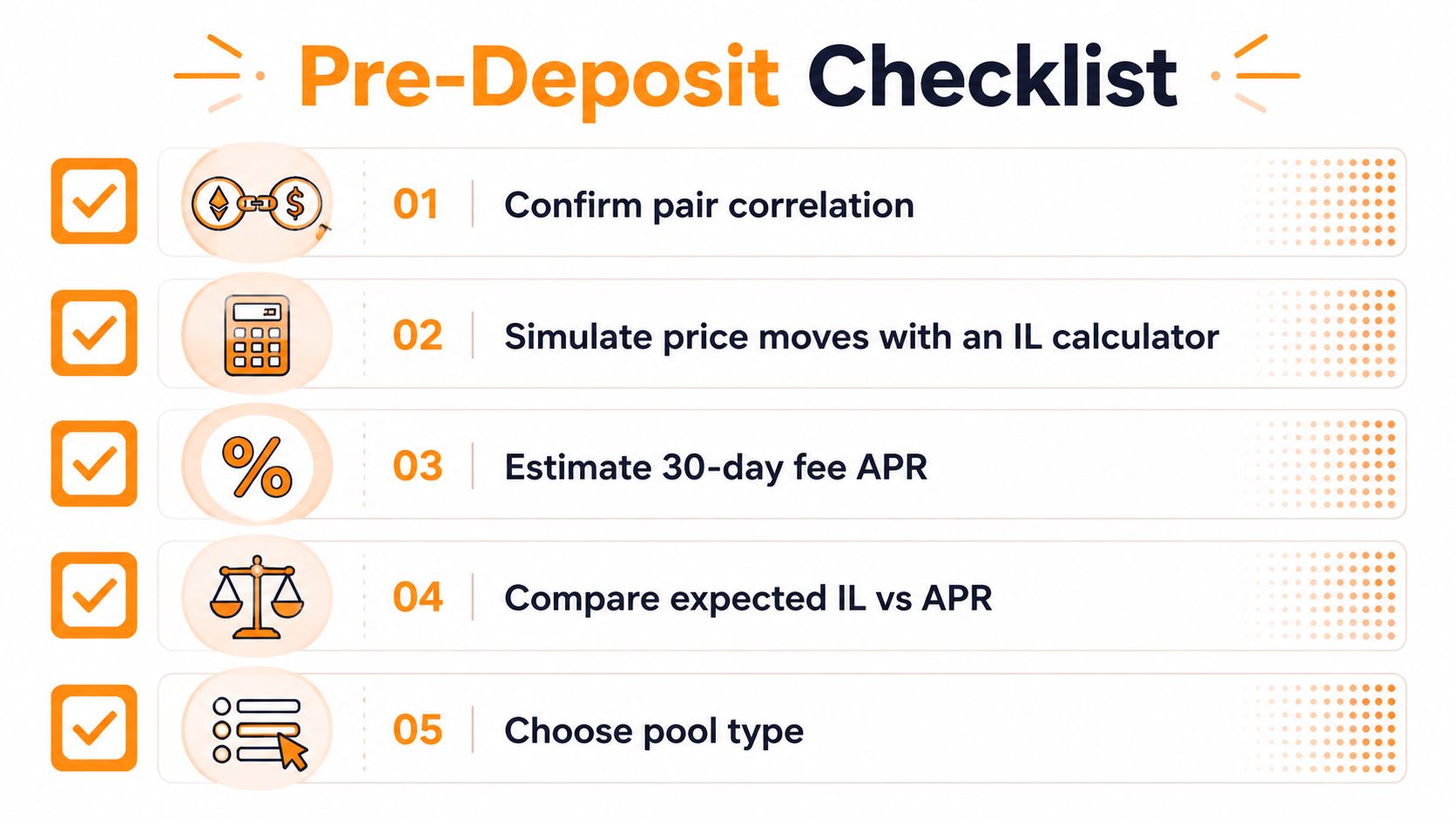
The checklist won't protect you from smart-contract failure, market volatility, depegging, or poor execution. It does stop a common mistake, entering a pool because the advertised yield looks high without calculating the wallet alternative. For a practical walkthrough of the deposit process itself, see this step-by-step guide to providing liquidity on decentralised exchanges.
Frequently Asked Questions About Impermanent Loss
Can impermanent loss become permanent?
Yes. The loss becomes permanent when you withdraw while the relative price remains different from the original deposit ratio. You receive the pool's revised token mix, locking in the difference compared with holding those assets directly. The relevant UK tax treatment then depends on the disposal calculation for the assets involved.
How do calculators work?
An IL calculator compares your starting deposit ratio with the later price ratio. Enter the deposited amounts, the initial relationship between the tokens, and a possible exit price. Then compare the result with your own estimate of trading-fee income, because the calculator shows divergence loss rather than your complete wallet outcome.
For a standard pool, a 1.25x move corresponds to about 0.6% loss, while a 2x move corresponds to about 5.7% loss, based on the established comparison figures from UK government liquidity-pool tax guidance.
Is impermanent loss the same as a token price drop?
No. A token price drop changes the value of that token. Impermanent loss measures the relative opportunity cost of supplying both assets to a pool instead of holding the same assets directly. The pool's rebalancing can sell part of your appreciating ETH, so impermanent loss can occur even while ETH rises.
Can stablecoin pools still suffer impermanent loss?
Yes. Stablecoin pools aim to limit price divergence, but they do not remove every risk. A depeg, delayed oracle update, shallow liquidity, or failure of one stablecoin to maintain its intended value can alter the pool ratio and create losses. Treat “stable” as a design goal, not a guarantee.
| Price Change | Impermanent Loss |
|---|---|
| 1.25x | About 0.6% |
| 1.5x | About 2.0% |
| 2x | About 5.7% |
| 3x | About 13.4% |
| 5x | About 25.5% |
UK crypto ownership has involved meaningful losses for retail users. FCA consumer research found that 45% of UK crypto owners reported losses in the year to April 2022, while 10% lost over half their portfolio and 21% lost 21% to 50%. The FCA cryptoasset consumer research provides the cited context. These figures reinforce the need to compare fees, price risk, and tax effects rather than relying on a yield headline.
The Coin Course offers practical education on DeFi mechanics, liquidity provision, crypto taxes, security, and risk controls. Visit The Coin Course to build your understanding before depositing funds and comparing strategies.