
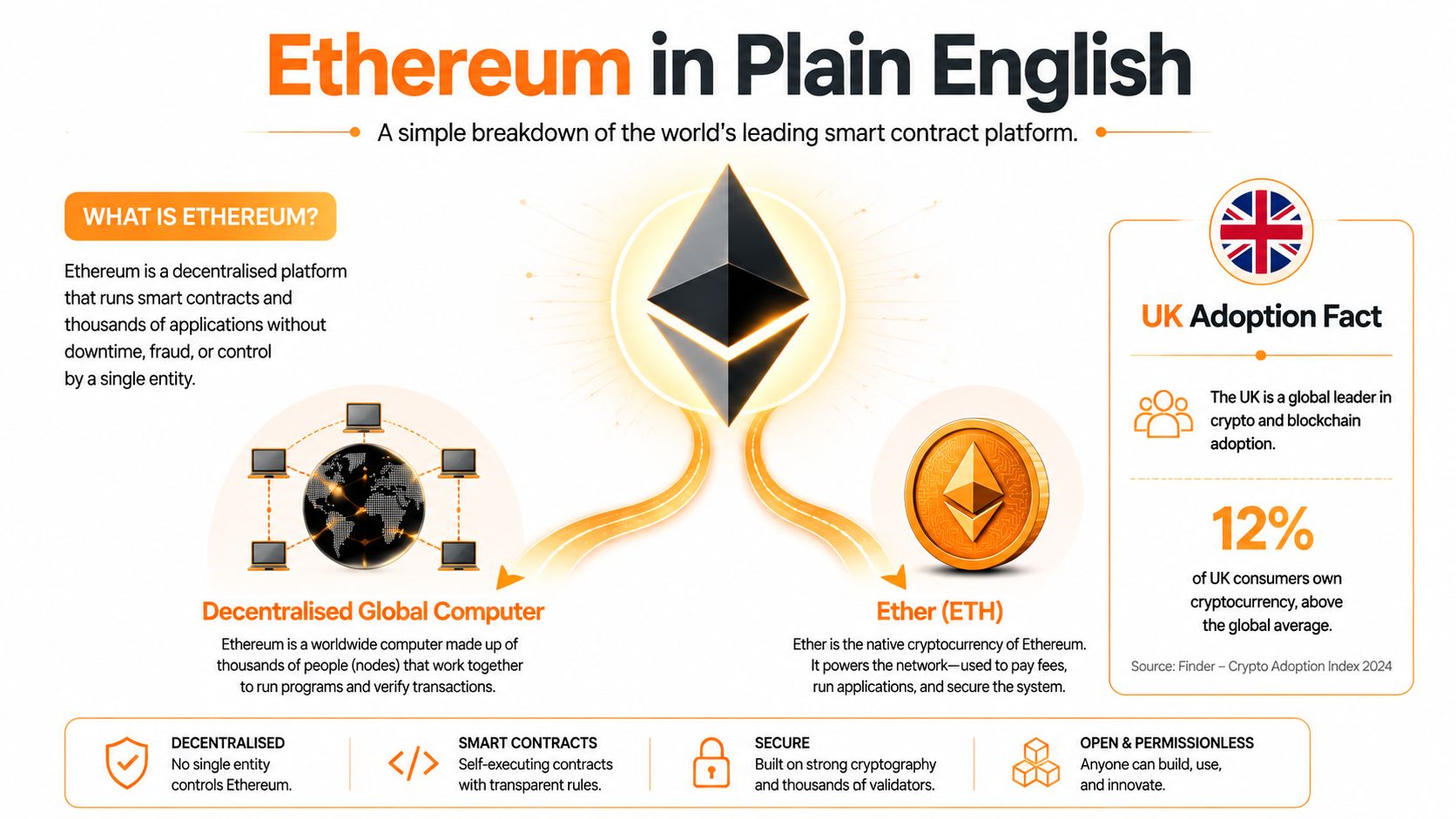
Ethereum is a decentralised global computer that runs smart contracts and powers its own currency, Ether (ETH). Around 4.5 million UK adults owned crypto in 2025, and 43% of crypto owners held Ethereum, making it a major part of Britain's digital-asset market.
That opening fact changes the usual beginner question. “What is Ethereum?” isn't only a question about software or internet money. For a UK reader in 2026, it also means understanding how the network works, what the Merge changed, what people build on it, and which parts of buying, staking, trading and custody are regulated.
This guide starts with the simple picture, then adds detail only when it becomes useful. You don't need to code, run a validator or understand cryptography to follow it.
Ethereum in Plain English
Ethereum is a decentralised global computer. Instead of one company owning the computer and deciding which programmes can run, thousands of independent computers maintain a shared network and process instructions called smart contracts.
Its native currency is Ether, or ETH. ETH has two jobs. It pays the network's transaction fees, known as gas, and it can be held or traded as a cryptoasset. You can think of gas as the small amount of ETH needed to ask the network to record an action, whether that action is sending ETH, swapping tokens or interacting with an application.
Ethereum's UK adoption gives the idea practical context. FCA research reported that around 8% of UK adults owned cryptoassets in August 2025, equivalent to about 4.5 million people, and 43% of crypto owners held Ethereum (FCA crypto market description). Ethereum is therefore not a niche experiment in Britain. It's one of the two best-known and most commonly held cryptoassets among UK users.
Ethereum compared with Bitcoin
A useful analogy is to treat Bitcoin as a sturdy pocket calculator built for one main job, holding and transferring value. Ethereum is closer to a smartphone. Other people can create apps that run on it, provided their code follows the network's rules.
Those apps can support lending, trading, collectibles, membership systems and many other activities. The network doesn't guarantee that every app is safe, just as a smartphone doesn't guarantee every downloaded app is trustworthy. It provides the platform and shared rules.
The rest of the explanation rests on three ideas:
- Smart contracts: Programmes that carry out rules automatically.
- Proof of stake: The system Ethereum uses to validate new activity.
- UK regulation: The separate question of how exchanges, custodians, staking providers and other firms are supervised.
You can understand all three without writing a line of code. Start by viewing Ethereum as shared infrastructure, ETH as the fuel and asset, and smart contracts as programmes that use the infrastructure.
How Ethereum Evolved From Whitepaper to 2026
Ethereum began with a broader aim than digital payments. In late 2013, Vitalik Buterin proposed a blockchain that could run programmes, rather than limiting its ledger to transfers. A 2014 crowdsale helped fund development, and the network's genesis block arrived in 2015.
The early network resembled a public engineering project more than a finished product. Frontier gave developers the first working environment, while Homestead brought greater maturity. The 2016 DAO crisis showed how difficult it can be to change a live financial system after a serious coding failure affects users and their funds.
Ethereum then provided shared standards for new projects. ERC-20 offered a common method for creating interchangeable tokens, and ERC-721 helped establish a standard for unique tokens. These standards supported the ICO boom and later the NFT wave, though the applications built with them differed greatly in quality and risk.
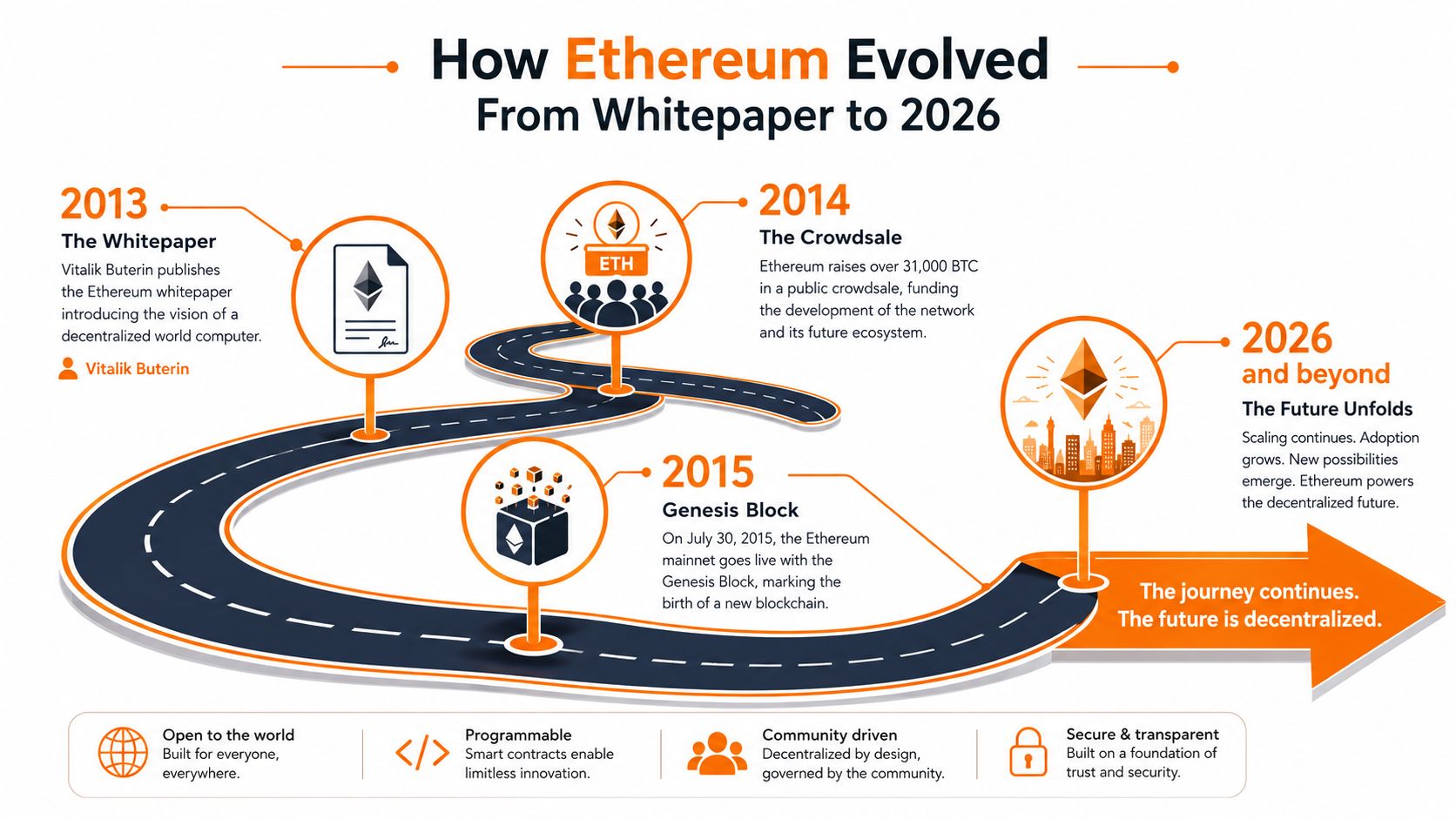
The biggest architectural change began with the Beacon Chain launch in 2020 and the Merge in September 2022. Ethereum changed from proof of work, in which miners used computing hardware and electricity, to proof of stake. Validators now help secure the network by committing capital and carrying out their duties correctly.
The environmental effect was substantial. The Cambridge Centre for Alternative Finance estimates annual electricity use at about 7.87 GWh, or roughly 0.90 MW of continuous load, around 99.96% lower than pre-Merge Ethereum, in its environmental footprint report.
Ethereum has continued changing through upgrades such as Dencun, which reduced costs for layer-2 networks. In 2026, development remains focused on scaling and making the network easier to use. Ethereum is better understood as shared infrastructure that keeps adapting to new technical and practical problems, rather than as a fixed product.
The Building Blocks of the Ethereum Network
A post office analogy makes Ethereum's architecture easier to hold in your head.
Your Ethereum wallet is like a key ring for a post office box. The public address is the detail you can share so someone can send you assets. The private key is the secret that proves you're allowed to authorise activity from that address. Losing the private key can mean losing access, while exposing it can let someone else take control.
Ethereum has two account types:
- Externally owned accounts: Controlled by a person or organisation through a private key.
- Contract accounts: Controlled by code stored on Ethereum. They respond when users or other contracts call them.
The Ethereum Virtual Machine, or EVM, is the network's shared sorting room. Computers running Ethereum execute the same contract instructions and check whether the resulting state follows the rules. If a contract says an exchange should send one asset after receiving another, the EVM processes that instruction consistently across the network.
From transaction to block
A transaction is like a delivery van carrying instructions. It might say, “send this amount of ETH to that address” or “call this function in a lending contract”. The sender pays a fee called gas, with the price commonly expressed in gwei, a small denomination of ETH.
Validators collect valid transactions into blocks. The blocks form a chronological chain, and nodes around the world keep copies of the ledger. That distribution matters because one company can't rewrite your balance or delete an inconvenient transaction from everyone's records.
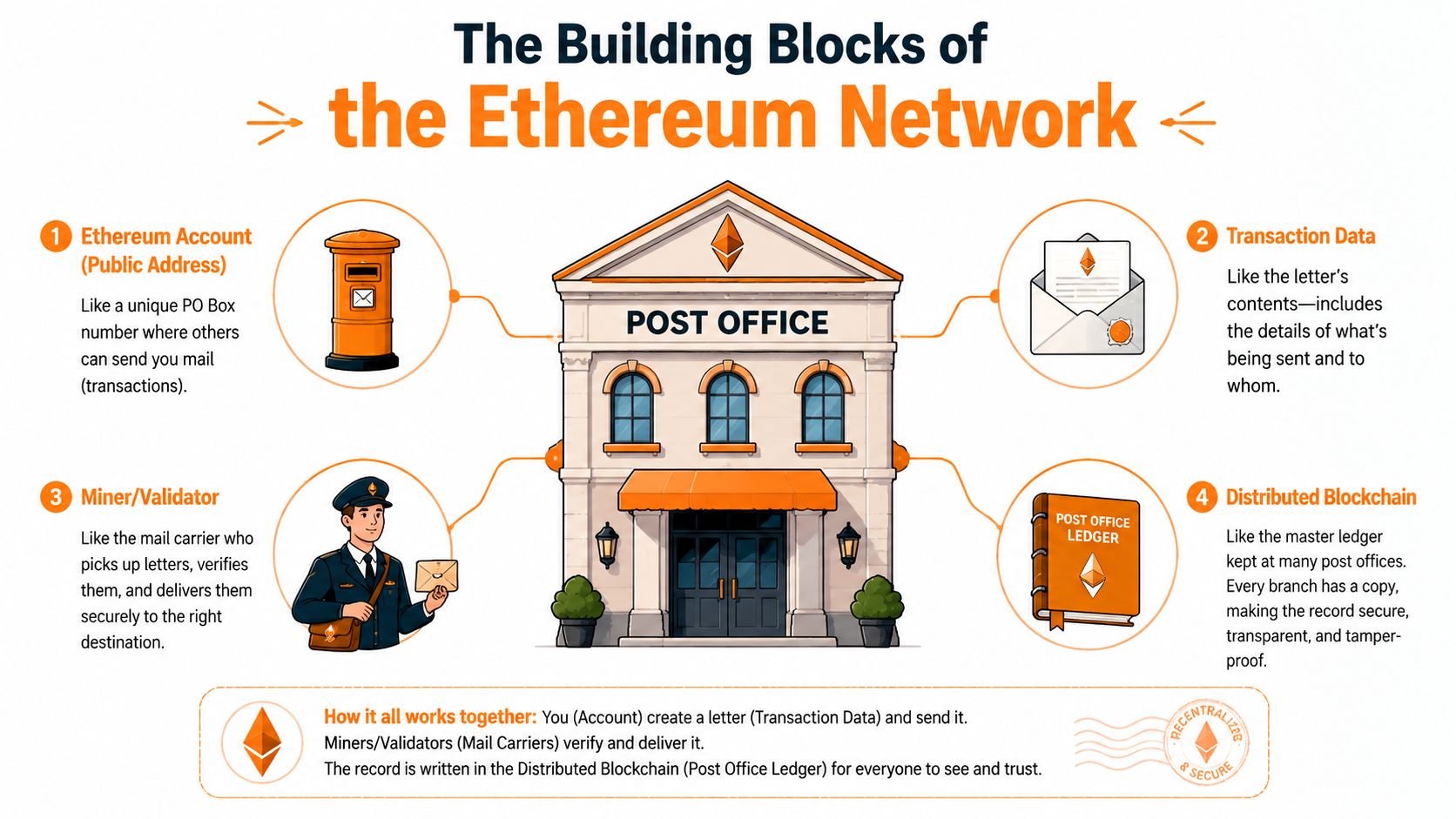
The shared state is the key idea. Every participating computer works from the same record of account balances and contract data, subject to the network's consensus rules. Smart contracts become useful because users can inspect the rules and rely on the network to execute them in a shared environment, rather than trusting one private database.
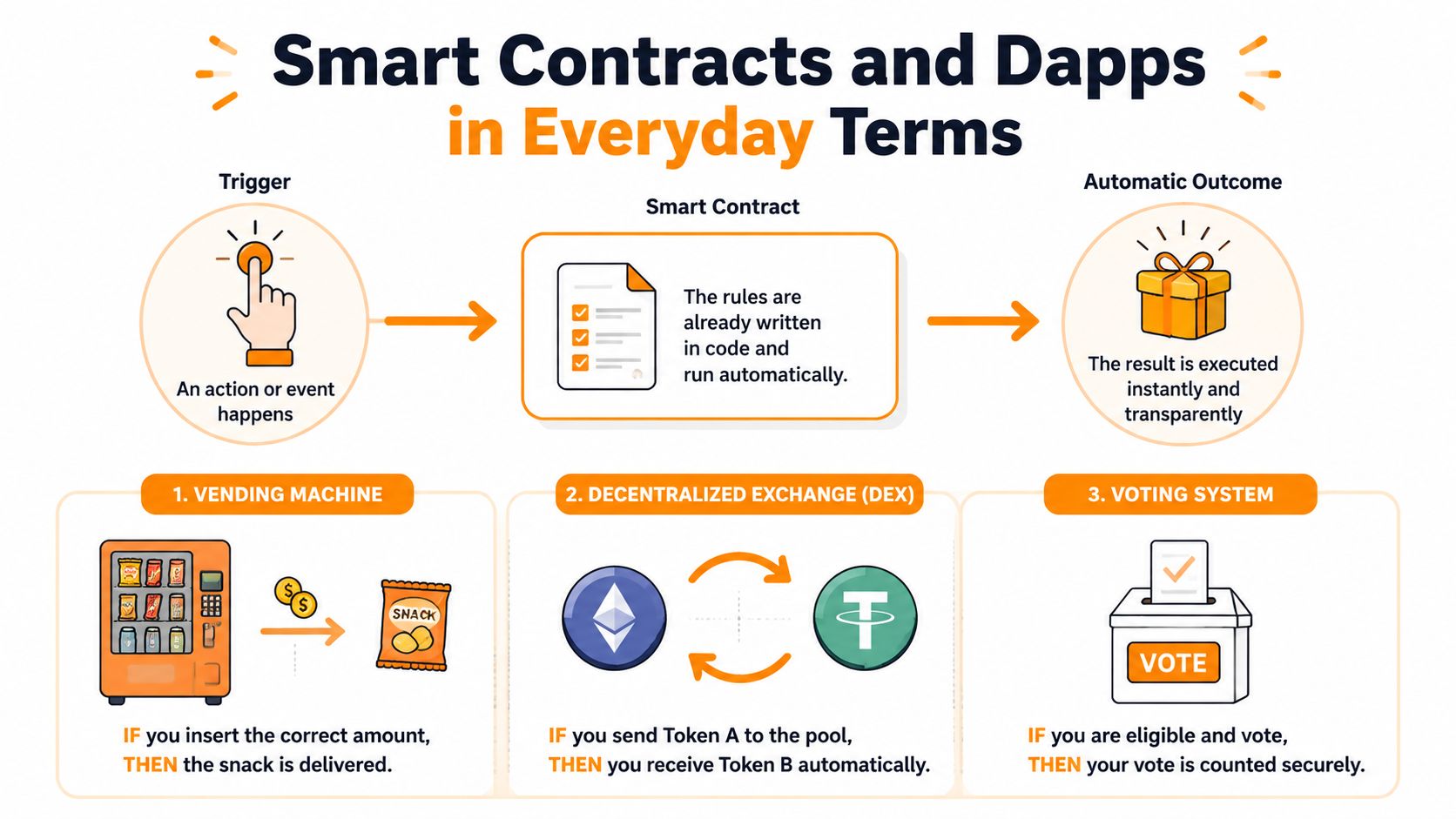
Smart Contracts and Dapps in Everyday Terms
A smart contract is an if-then programme stored on Ethereum. It doesn't think like a person or understand intent. It follows the instructions written into its code when the required conditions are met.
A vending machine is a good starting point. If you insert the required coins and select a valid button, the machine releases the chosen snack. A smart contract works similarly, except the trigger and outcome are recorded on a blockchain and the rules can control digital assets.
Consider three examples:
- A vending machine rule: If the contract receives the required payment, then it transfers the specified item or token.
- A Uniswap swap: If you provide one token to the exchange contract, it calculates the trade using its liquidity rules and returns another token, subject to the transaction's conditions.
- An NFT mint: If you send the required transaction to the minting contract, it creates a unique token and records the resulting ownership on the shared ledger.
These examples show why Ethereum is programmable. ETH and tokens aren't merely entries sitting in a wallet. Smart contracts can use them as inputs, collateral, payments, votes or proof of ownership.
What makes a dapp different
A decentralised application, or dapp, usually has a familiar website or mobile interface, but some of its back-end logic runs through smart contracts rather than only through a company's private server. A decentralised exchange can therefore let users trade through code that manages the swap, rather than requiring a traditional broker to hold every asset and approve every transaction.
Removing a middleman can make rules visible and execution automatic. It doesn't remove risk. Bugs, poor design, malicious contracts, compromised websites and misleading tokens can still harm users. The code is only as dependable as the people who wrote, tested and reviewed it.
For a fuller foundation, read what smart contracts are and how they work before connecting a wallet to a dapp.
Wallets, Gas, and Confirming Your First Transaction
A wallet isn't a coin jar. It's more like a key ring that lets you authorise actions involving assets recorded on Ethereum. With self-custody, you control the private keys. With a custodial exchange account, the exchange controls the keys and gives you an account interface.
Gas is the fee for asking validators to process your transaction. The cost changes with demand for available block space. A simple transfer and a complex contract interaction can require different amounts of work, so never approve a transaction without checking the fee and destination.
Use this checklist for a first interaction:
- Choose a wallet: Select a reputable software wallet or hardware wallet, and download it from the official source.
- Buy a small amount of ETH: Use an established platform, and leave enough ETH to cover the transaction fee.
- Protect the seed phrase: Write it down offline. Don't store it in a screenshot, cloud note or message.
- Review before signing: Check the recipient address, network, asset and requested permissions in the wallet.
- Verify the result: Use a block explorer such as Etherscan to inspect the transaction status and destination.
Practical rule: A wallet prompt is an authorisation request, not a routine pop-up. Read what you're signing.
Common traps include phishing pages, unlimited token approvals and address poisoning. A lookalike website can ask you to connect your wallet, while a malicious approval may allow a contract to move tokens later. Address poisoning uses a similar-looking address to confuse you in your transaction history, so compare the full address before sending.
For a deeper explanation of network fees, explore how Ethereum gas fees work and how to manage them. UK users should also keep clear records of purchases, disposals, transfers and staking activity. A practical crypto tax guide from Allied Tax Advisors can help you think about record-keeping tools and reporting questions.
Proof of Stake and the Environmental Shift After the Merge
The Merge changed how Ethereum reaches agreement. Before it, proof of work required miners to compete with computing equipment and electricity. After it, proof of stake made validators responsible for proposing and checking blocks while committing capital to the network.
Staking is not a bank deposit. Rewards compensate participants for network duties, and returns can vary. Validators that violate protocol rules or fail important responsibilities can face penalties, commonly called slashing. Users who do not want to operate infrastructure can join a staking pool, although this adds provider and smart-contract risks.
After the Merge, Ethereum's electricity footprint became much smaller because the network no longer relied on energy-intensive mining. The change is environmental, but it also changes what participants must manage: staked capital, validator software, reliable uptime and secure keys.
| Attribute | Proof of Work, pre-Merge | Proof of Stake, post-Merge |
|---|---|---|
| Network role | Miners competed to add blocks | Validators propose and attest to blocks |
| Main resource | Computing hardware and electricity | Staked capital, software and reliable uptime |
| Environmental profile | Energy-intensive mining model | Much smaller electricity footprint |
| Main operational risk | Hardware, power costs and mining competition | Validator penalties, key security and provider risk |
The shift also changes how institutions assess Ethereum. Environmental reviews focus less on a mining fleet's power consumption and more on custody, staking arrangements, governance, liquidity and operational controls. UK users should separate these technical questions from regulation, since staking arrangements and crypto services may involve different obligations.
For a plain-language comparison, read the guide to proof of work and proof of stake.
What People Actually Build on Ethereum
Ethereum's applications make more sense when you view them as different forms of programmable money and ownership.
Decentralised finance, or DeFi, uses smart contracts to offer financial functions without a conventional central operator controlling every transaction. On Aave, users can supply assets to lending markets or borrow against collateral, subject to the protocol's rules and risks. On Uniswap, users can exchange tokens through liquidity pools rather than placing an order with a traditional exchange.
That convenience comes with technical exposure. A lending market can face bad debt, an exchange contract can contain a flaw, and token prices can move sharply. “Decentralised” describes how control and execution are arranged. It doesn't mean the activity is safe or guaranteed.
NFTs are unique on-chain tokens. They can represent digital art, event tickets, membership rights, game items or records linked to physical objects. An NFT isn't automatically the artwork itself, and owning the token doesn't always grant copyright or other legal rights. Read the project's terms instead of assuming the token proves more than it does.
DAOs, or decentralised autonomous organisations, coordinate shared treasuries and decisions through token-based governance. MakerDAO and Nouns illustrate different approaches to community-controlled resources and voting. A DAO can distribute decision-making, but voters still need to assess proposals, incentives and the code involved.
Two ways to gain exposure
UK investors can consider listed investment products or direct ownership, but they're not interchangeable. FCA-approved crypto ETNs can provide ETH exposure through a brokerage account and may be available through tax wrappers such as ISAs and SIPPs. Some Ethereum products can include staking exposure, connecting returns to validator mechanics rather than only price movement (UK retail access to crypto ETNs).
Direct self-custody gives you access to dapps, voting and on-chain transfers, but you're responsible for keys and transaction approvals. Listed products offer a more familiar investment route, while self-custody offers broader functionality and greater personal responsibility. Designers building those interfaces also shape how safely people use them, so a curated list of Web3 designers is useful for understanding the sector's user-experience work.
How Ethereum Is Regulated in the UK in 2026
The most important distinction is between ETH itself and the firms that provide services around it. The FCA treats Ether as an unregulated cryptoasset, not legal tender. Ether also sits outside the Financial Services Compensation Scheme and the Financial Ombudsman Service, and the FCA lists it alongside Bitcoin and XRP as an exchange token outside the existing regulatory perimeter (FCA explanation of current cryptoasset regulation).
That doesn't mean every business handling ETH can operate without oversight. Cryptoasset businesses providing in-scope services in the UK must register for anti-money-laundering supervision under the Money Laundering Regulations before beginning those services (FCA cryptoasset firm information). Registration is not the same as a guarantee that an asset is suitable, protected or likely to rise.
The UK is also moving towards a wider regime under the Financial Services and Markets Act framework. The new cryptoasset regime became law on 4 February 2026 and is set to come into force on 25 October 2027, giving firms a transition period before the broader FCA authorisation regime applies (FCA cryptoasset regime policy statement).
What the developing perimeter covers
Under the planned framework, firms providing cryptoasset services to UK consumers may need FCA authorisation. That can include trading platforms, intermediaries, custodians, stablecoin issuers and firms arranging staking. The government's policy materials also identify activities such as operating a cryptoasset trading platform, issuing stablecoins, and applying market-abuse and disclosure rules within the new framework (HM Treasury draft cryptoasset legislation).
A separate reporting dimension is already relevant. The Reporting Cryptoasset Service Providers, Due Diligence and Reporting Requirements Regulations 2025 came into force on 1 January 2026 (UK legislation). These rules add a practical compliance and tax-reporting layer for cryptoasset service providers, so users should expect exchanges and similar firms to focus more closely on customer information and transaction records.
| Activity | UK status in 2026 | Regulator |
|---|---|---|
| Holding ETH directly | ETH is treated as an unregulated cryptoasset | FCA perimeter does not protect the token itself |
| Buying through a crypto platform | The firm may need FCA registration for anti-money-laundering supervision | FCA |
| Operating a trading platform | Broader authorisation requirements are planned for the regime's commencement | FCA |
| Custody and intermediation | These services may fall within future authorisation requirements | FCA |
| Arranging staking | The planned regime includes firms arranging staking | FCA |
| Cryptoasset reporting | Reporting rules apply to in-scope service providers | UK statutory framework |
For a newcomer, the safe approach is practical rather than legalistic:
- Choose a reputable wallet: Use a hardware or software wallet from its official source.
- Store the seed phrase offline: Write it on paper and keep it somewhere secure. Never share it.
- Use a UK-authorised or appropriately registered platform: Check the firm's status and understand what protection it does and doesn't provide.
- Practise with a tiny test transaction: Send a small amount between wallets before attempting a complicated dapp interaction.
- Verify independently: Bookmark Etherscan and the project's official site. Check contract addresses carefully.
- Slow down around approvals: Don't sign unfamiliar messages, connect to lookalike websites or chase high yields without understanding the risks.
The Coin Course offers structured lessons on wallets, staking and reading on-chain data, which can give beginners a measured way to study one topic each week instead of rushing into unfamiliar protocols.
The Coin Course provides practical crypto education, from Ethereum fundamentals and wallet safety to DeFi, staking and on-chain analysis. Visit The Coin Course to build your understanding step by step before committing meaningful money or connecting to complex applications.