Dollar cost averaging means investing a fixed amount at regular intervals, so you buy more when prices are low and less when prices are high. In the UK, the same approach is usually called pound-cost averaging, and it can be useful for building a steady investing habit without pretending you can predict the market.
You may already be doing something similar. Perhaps £100 leaves your bank account each month for a pension, an ISA, or a savings pot. You don't wait for the perfect day to make that payment because the direct debit handles the decision for you. Investing on a schedule applies the same quiet routine to assets whose prices move around.
That matters because market headlines can make investing feel like a test of timing. One day, prices look too expensive. The next, a sharp fall makes you wonder whether you should wait for an even lower entry. A fixed contribution plan gives you a rule to follow when your emotions are offering several conflicting answers.
DCA isn't a promise of profit, and it isn't a clever way to identify the bottom. It's a method for spreading purchases over time, with particular relevance for UK investors using workplace pensions, ISAs, regular investment plans, and crypto accounts. The maths is simple, but the more important benefit is behavioural: you keep following a process instead of reacting to every price move.
The Monthly Savings Habit That Quietly Builds Wealth
Suppose your salary arrives, your bills go out, and you decide to put £100 a month into an investment platform. You choose a date shortly after payday, set up the payment, and let the same amount buy an investment each month. Some months, the price looks attractive. Other months, it feels uncomfortably high. You contribute anyway because the plan was designed before the latest headline appeared.
That routine probably feels familiar. Workplace pension contributions happen automatically from your pay, while a Direct Debit might move money into a savings pot before you have the chance to spend it. The investment version has a formal name, but the behaviour is already part of everyday UK money management.
Practical rule: Build the habit around your income date, not around your mood or the latest market prediction.
Why boring can be useful
Wealth building rarely feels dramatic while it's happening. You make the transfer, receive the units, check that the payment went through, and get on with your week. There's no need to celebrate a perfect entry because the point isn't to produce one.
Consistency also makes the decision smaller. Instead of asking, “Should I invest a large amount today?”, you ask whether the planned contribution still fits your budget. That shift can help someone who worries about buying at the wrong time, particularly when the asset is volatile.
The method has roots in long-term investing habits. HSBC UK says the idea has existed for more than 70 years and traces the term to economist Benjamin Graham in its explanation of pound-cost averaging (HSBC UK's guide to pound-cost averaging). The label may sound technical, but the action is ordinary: set aside money, invest it regularly, and accept that prices will vary.
A habit still needs boundaries
Automation shouldn't replace a budget. You need to know whether the contribution comes from genuine spare cash or money intended for rent, bills, an emergency fund, or debt repayments. That distinction becomes especially important with crypto, where regular buying can make a risky holding grow over time.
The next step is to understand exactly how each payment changes the number of units you own. Once that calculation becomes familiar, DCA stops sounding like an investing slogan and starts looking like a simple spreadsheet routine.
What Dollar Cost Averaging Means
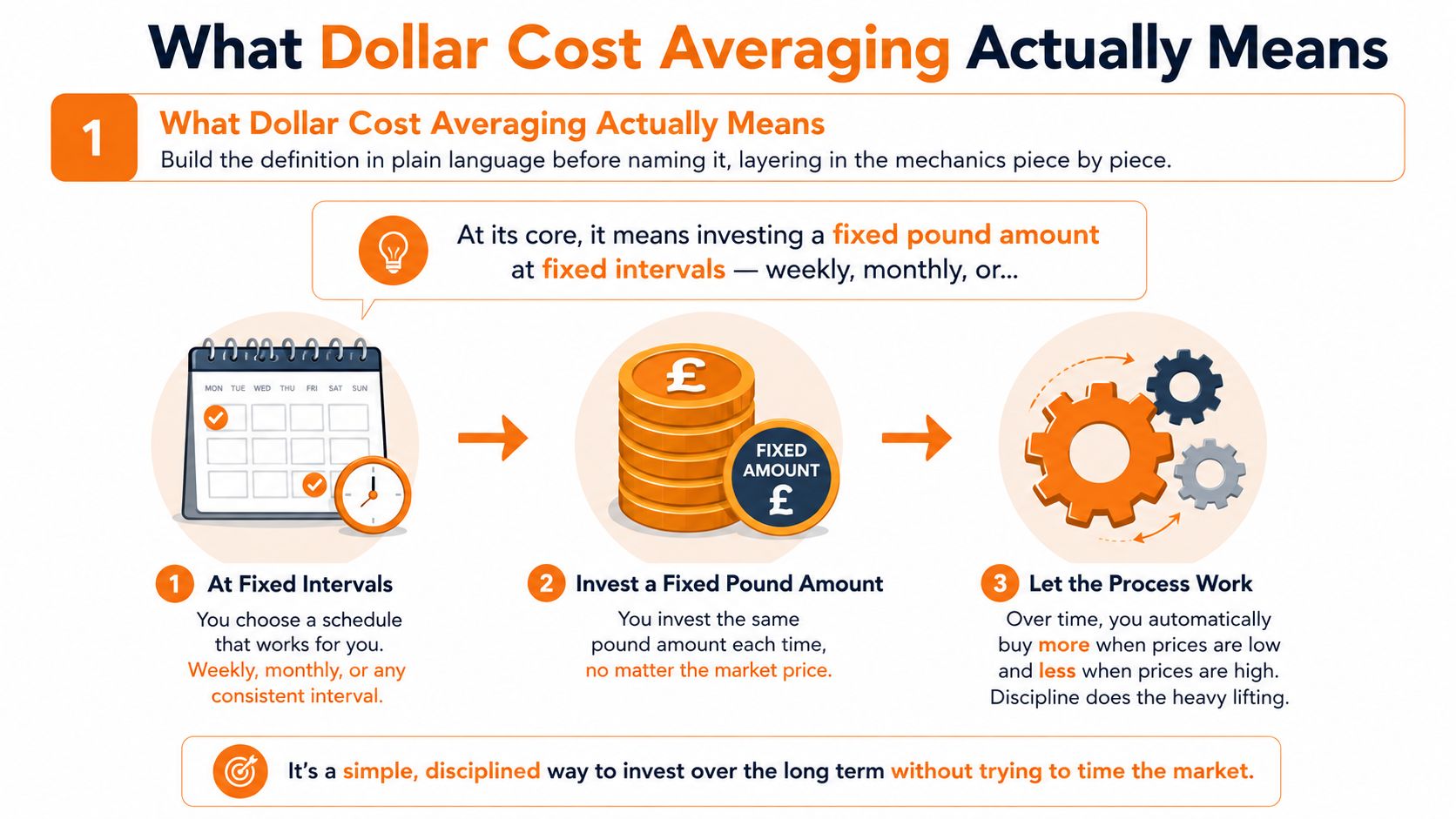
Suppose £100 arrives in your account after payday. You set that amount to buy an asset every month, whether its price is rising, falling, or barely changing. The same approach can run weekly or quarterly, provided the amount and timetable suit your finances.
UK investors often call this pound-cost averaging. “Dollar cost averaging” describes the same method in a different currency. The name changes, while the routine stays the same.
The three automatic actions
First, you buy on schedule. A recurring instruction places each contribution without a new decision every time. That suits someone investing from a monthly salary rather than deciding what to do with a large sum all at once.
Second, you spread purchases across price points. A fixed cash amount buys different quantities as the unit price changes. A lower price buys more units with the same contribution; a higher price buys fewer.
Third, you reduce the timing decision. You do not need to identify the market's cheapest point. Some purchases may look well timed later, while others may look expensive. The plan keeps the process consistent instead of relying on a forecast.
What DCA cannot do
DCA provides discipline without forecasting price direction. It cannot tell you whether Bitcoin, an index fund, or an individual share is fairly valued. An asset that keeps losing value can still make every scheduled purchase worth less, and the method offers no guarantee of profit.
Crypto adds another question: where does the contribution come from, and how large could the holding become? Regular purchases should use spare money after your budget, bills, emergency savings, and debt repayments are covered. A steady schedule can spread entry points, but it can also increase concentration in one volatile asset if you keep buying without reviewing its place in your wider finances.
Average purchase cost and future investment value are separate calculations. The first uses what you paid and how many units you received. The second depends on the eventual selling price, fees, taxes, and the asset's performance.
A useful formula is:
Average cost per unit = total amount invested ÷ total units owned
The following example applies that formula to a monthly schedule. A spreadsheet with the same columns can record your own purchases and show how each payment changes the units you hold.
How the Maths Works With a Simple Example
Take a hypothetical share and invest £100 each month for six months. The price first falls, then rises. Fractional units make the arithmetic easy to follow, so the example shows exactly how the fixed payment buys different quantities.
| Month | Share Price (£) | Amount Invested (£) | Units Bought | Total Units | Total Spent (£) | Average Cost/Unit (£) |
|---|---|---|---|---|---|---|
| 1 | 10.00 | 100 | 10.00 | 10.00 | 100 | 10.00 |
| 2 | 9.00 | 100 | 11.11 | 21.11 | 200 | 9.47 |
| 3 | 8.00 | 100 | 12.50 | 33.61 | 300 | 8.93 |
| 4 | 9.00 | 100 | 11.11 | 44.72 | 400 | 8.94 |
| 5 | 10.00 | 100 | 10.00 | 54.72 | 500 | 9.14 |
| 6 | 12.00 | 100 | 8.33 | 63.05 | 600 | 9.52 |
The first payment buys 10 units at £10. When the price falls to £8 in month three, the same £100 buys 12.5 units. When the price reaches £12 in month six, that payment buys only 8.33 units.
At the end, you've invested £600 and own approximately 63.05 units. Divide £600 by 63.05 and the average cost is about £9.52 per unit. The simple average of the six listed prices is about £9.67, so the average purchase cost is lower because the schedule bought more units at the lower prices.
A separate UK example from MoneyMagpie's explanation of dollar-cost averaging uses £100 monthly purchases at prices of £10, £5, and £20. The investor buys 10, 20, and 5 shares, invests £300, owns 35 shares, and reaches an average cost of about £8.57 per share, below the simple average of those prices.
If the latest market price in the worked table were £12, the holding would be worth approximately £756.60 before fees and taxes, compared with £600 invested. That would indicate a gain in this hypothetical example, but DCA didn't create the price rise. It only changed how the purchases were distributed.
Dollar Cost Averaging Versus Investing a Lump Sum
Suppose you have cash ready to invest today. Lump-sum investing puts the available cash to work immediately, while DCA divides it across scheduled purchases. A salary-funded plan naturally suits regular investing because the money arrives gradually. A bonus, inheritance, or other cash windfall creates a clearer choice between investing at once and spreading entry points over time.
Lump-sum investing has a mathematical advantage when prices rise, because more money spends more time in the market. DCA can feel easier to follow when an immediate fall worries you, since only part of the planned amount is exposed at the start. The trade-off resembles choosing between planting an entire packet of seeds today or planting some each month. The first approach gives more time to grow, while the second reduces the chance that every seed faces one poor starting day.
What UK evidence shows
Vanguard UK analysed the FTSE All-Share Index from 1986 to 2022 and found that lump-sum investing beat cost averaging in 61.6% to 73.7% of rolling one-year periods, depending on the market set and assumptions (Vanguard UK's cost-averaging research). In a separate comparison using global equity and bond proxies from 1976 to 2022, Vanguard reported that a 100% equity portfolio had a median return 2.2% higher when invested as a lump sum than when cost averaged over three months.
Those findings describe historical market comparisons and shouldn't be treated as a prediction for your next decision. They also need careful interpretation for crypto. Crypto trades continuously, follows different market structures, and can move sharply while you wait for the next scheduled purchase.
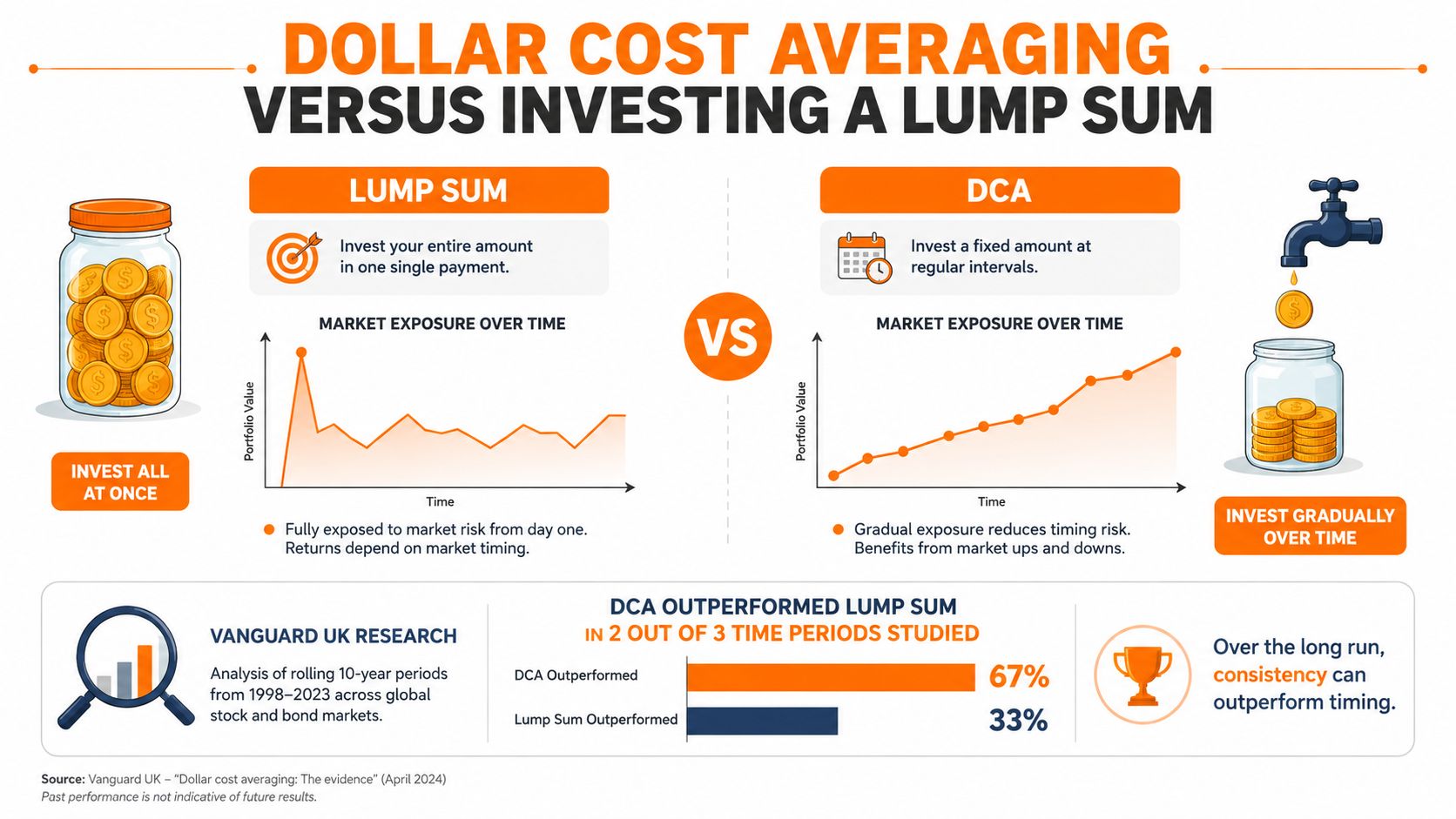
The trade-off: Lump sum prioritises time invested. DCA prioritises a smoother entry process and fewer all-or-nothing timing decisions.
For a broader framework when deploying a large cash balance, this guide to how to invest 10000 dollars can help you consider allocation, time horizon, and risk before choosing an entry method.
A practical choice depends on the money and the asset. If the cash is surplus, your horizon is long, and you could tolerate a severe fall without panic selling, lump sum may have the historical edge. If the asset is highly volatile, the money has a defined monthly budget, or a sudden loss would make you abandon the plan, DCA may prove easier to maintain. For crypto, also check the source of funds and the final portfolio concentration before automating purchases.
Why Crypto Investors Use a Different Kind of DCA
Crypto DCA needs a stricter safety check than “buy a little every month”. The first question isn't how often to buy. It's where the money comes from and how large the final holding could become.
The FCA found that 12% of UK adults owned cryptoassets in 2024, compared with 10% the prior year. Its research also found that buying through long-term savings rose from 19% in 2022 to 26% in 2024, while buying through a credit card or overdraft rose from 6% to 14% (the FCA's 2024 crypto consumer research). Those figures make source-of-funds discipline central to any UK crypto plan.
Using borrowed money to maintain recurring purchases can turn a budgeting habit into a financial strain. Crypto remains largely unregulated, and the FCA continues to highlight consumer risk, so automation should never be treated as proof that an asset is suitable.
Concentration changes the decision
The FCA reported that average crypto holdings increased from £1,595 to £1,842 between 2023 and 2024, while later FCA reporting estimated the average UK portfolio at about £2,250 by August 2025 (the FCA's crypto ownership update). A growing average holding doesn't tell you that every investor is overexposed, but it does show why repeated buying needs a portfolio-level review.
| Feature | Share-plan DCA | Crypto DCA |
|---|---|---|
| Trading pattern | Often follows salary or pension contributions | May run continuously in a market open around the clock |
| Main discipline | Avoid emotional entry timing | Control funding source, size, custody, and concentration |
| Review question | Does the fund still fit the portfolio? | Is crypto still an appropriate share of total wealth? |
| Key danger | Delayed investing in a rising market | Repeatedly adding to a highly volatile or unsuitable asset |
A crypto plan should therefore set a contribution ceiling linked to take-home pay, keep purchases simple, and review the total portfolio weight each quarter. Splitting purchases between assets can reduce single-coin concentration, but it doesn't remove crypto risk or make two volatile assets uncorrelated.
For readers comparing more active approaches, this overview of the best crypto copy trading tools is useful context, although copying another trader isn't a substitute for deciding your own risk limits. A more detailed crypto-specific walkthrough is available in this guide to dollar-cost averaging in crypto.
Setting Up Your Own DCA Plan Step by Step
A useful plan should be simple enough to follow on an ordinary payday. It should also contain limits that stop automation from becoming overexposure.
Choose the monthly figure. A cautious starting framework is 1% to 3% of take-home pay, but the correct amount is the amount that remains affordable after bills, essential saving, and debt commitments. Treat it like a Direct Debit only after checking that the money is available.
Select a suitable UK platform. Look for an FCA-registered provider that supports recurring purchases in pounds and clearly explains its fees, custody arrangements, and withdrawal process. The same day each month removes the temptation to wait for a supposedly better entry. Before opening an account, use this guide to selecting a crypto exchange to compare the practical details.
Keep the asset list controlled. One or two core assets, such as BTC and ETH, can make the plan easier to understand than a rotating list of coins. Don't change the basket because one token has appeared repeatedly on social media. A new asset should pass a separate research and suitability decision.
Automate the purchase and verify the funding. Confirm the bank account, payment date, amount, and recurring-buy instructions. If you plan to hold for more than a year, learn how self-custody works before moving assets away from the platform. Self-custody reduces dependence on a platform, but it creates responsibility for wallet security and recovery details.
Review quarterly, not constantly. Put a reminder in your calendar to check contributions, portfolio weight, custody, and fees once each quarter. Daily price checking can turn a long-term plan into a series of emotional interventions.
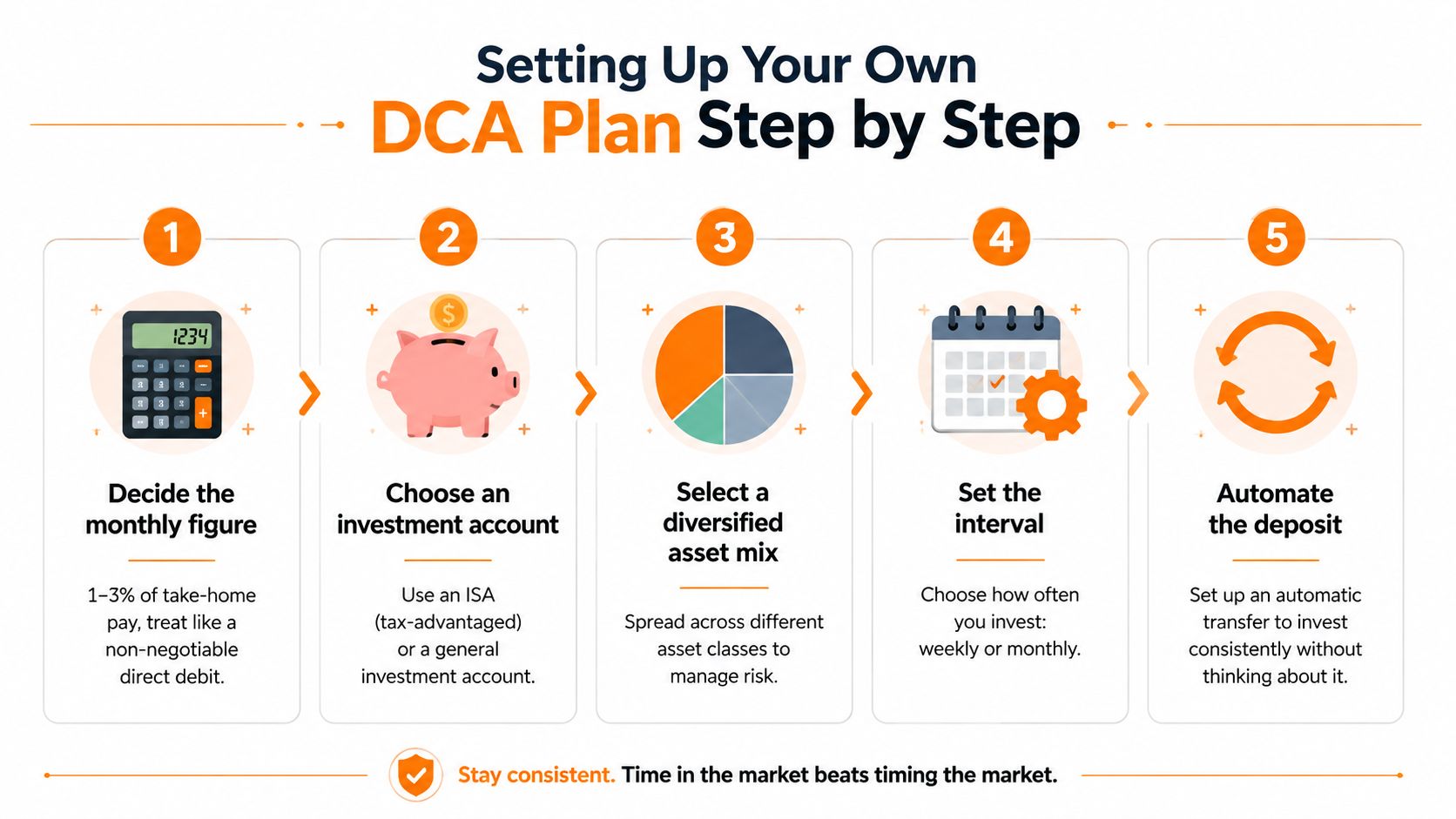
The operating checklist is short: fixed date, fixed amount, fixed assets. Automate those three decisions, then leave enough space between reviews for the plan to work as a habit rather than a reaction to noise.
Common Mistakes and Smart Habits for Long-Term Success
A DCA plan can make buying routine, yet it cannot correct poor financial judgement. The main danger appears when an investor changes the rules after a sharp price move.
Pausing during a bear market may feel sensible while the screen shows losses. Stopping then removes the regular purchase that could buy more units at lower prices. Set a minimum commitment period, automate the payment, and review the asset on a planned date rather than after a frightening headline.
Borrowing to keep buying leaves an obligation in place if the crypto price falls. Credit cards and overdrafts can turn a manageable investment habit into pressure on your household budget. Use money you can afford to lose, and cancel the recurring instruction if it relies on borrowed cash.
Ignoring concentration in one coin can turn modest monthly payments into a large portfolio exposure. Keep crypto DCA exposure below 5% to 10% of net investable assets if that matches your risk plan, and consider splitting purchases across at least two assets. This framework controls exposure, but it cannot ensure that assets move independently.
Habits that protect the process
FOMO after gains often pushes investors to increase contributions when recent performance looks exciting. Keep the payment linked to your budget, with changes made during a scheduled review. A rising price should not decide how much of your household income enters a volatile market.
Skipping cost-basis records creates avoidable work later. Record transaction dates, amounts, units, fees, and transfers in one organised place. These records show your average cost and help you raise tax questions with appropriate UK advice.
Use a quarterly checklist:
- Funding: Confirm that contributions still come from disposable income, not credit or bill money.
- Exposure: Check crypto's share of your wider investable assets.
- Cost basis: Reconcile purchases, transfers, and fees.
- Platform: Confirm that the provider's FCA registration status and operating details remain clear.
- Security: Review wallet access, recovery arrangements, and device security.
For a wider comparison of portfolio discipline, these strategies for shares, property, and super cover approaches across different investments. For crypto-specific controls, read this guide to risk management in cryptocurrency trading.
DCA works best as a repeatable process with scheduled reviews. The routine should continue only while the funding source, asset choice, concentration, custody, and risk limits still suit your circumstances.
The Coin Course offers structured guides on crypto fundamentals, investing concepts, wallets, security, and risk management. Visit The Coin Course to build your understanding before automating another contribution.