You open a wallet app, check the Bitcoin price, and send a small transaction from your phone. The screen makes the process feel simple, but that tap sets off a journey through mobile networks, fibre cables, servers, databases, security systems and blockchain software. If any part of that chain is slow or unavailable, the experience changes.
That hidden chain is digital infrastructure. It supports online banking, streaming, public services, cloud applications and cryptocurrency. Learning what is digital infrastructure means looking beyond broadband speed and seeing how physical equipment, software, people and operating processes work together.
Understanding Digital Infrastructure Basics
Digital infrastructure is the full system that lets a simple crypto action work. If you refresh a wallet balance or send coins to a friend, your phone is only the starting point. The request still has to cross networks, reach computers that can respond, follow shared rules, and return a result you can use.
That matters because crypto users feel infrastructure decisions in everyday ways. A wallet holder sees a spinner. A node operator sees dropped peers, slow sync times, or storage strain. The technical design and the user experience are tied together.
The wallet app is the front door, not the house.
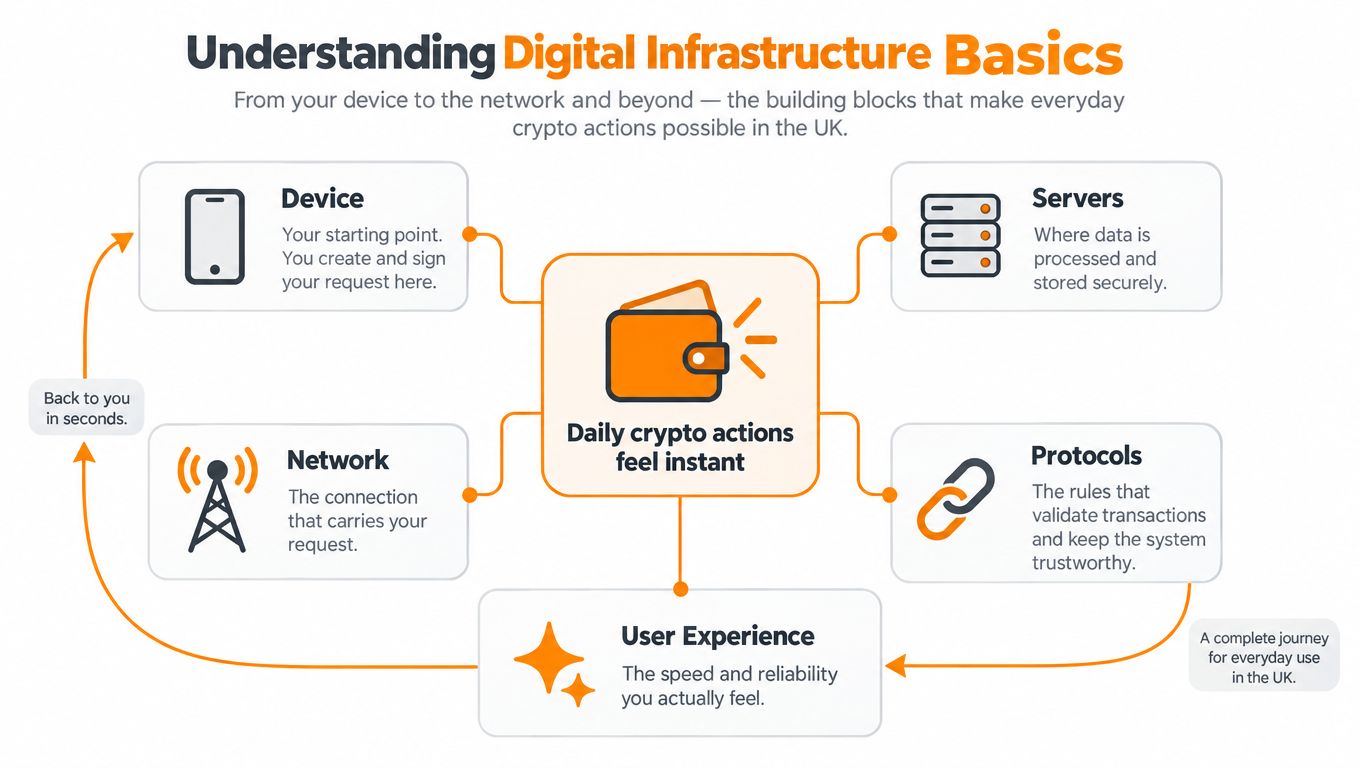
The five layers behind a simple tap
A clear way to understand the system is to break it into five connected building blocks:
- Device: Your phone or computer gives you the interface, stores some local data, and sends the request.
- Network: Wi-Fi, mobile masts, fibre lines, and internet routing carry that request to the right place.
- Servers: Computers in data centres or cloud facilities run the service, store information, and answer requests.
- Protocols: Shared rules let systems exchange data, and in blockchain networks they also govern how transactions and blocks are checked.
- User experience: This is the part you notice. Load time, reliability, error messages, and confirmation feedback.
These layers work like a relay team. If one runner slows down, the whole handoff suffers. A strong phone does not fix a weak mobile signal. A fast connection does not help if the wallet provider is overloaded. A healthy node still needs power, storage, and a path to other nodes.
This wider view matches how the UK Office for National Statistics describes digital infrastructure. Its definition includes broadband and mobile networks, telecommunications equipment, software and databases, data centres, cloud-computing facilities, and related buildings and structures. The ONS estimated market-sector investment in this broader category at £9.2 billion in 2022, compared with £1.2 billion under the narrower conventional measure of telecommunications investment. (Office for National Statistics explanation of digital infrastructure investment)
Why reliability matters to crypto users
Reliability shapes trust. If a balance appears late, a new user may assume the blockchain is failing when the delay stems from a wallet service, a congested network path, or an overloaded server. If a node falls behind, an operator may miss blocks or serve stale data to dependent apps.
This is why digital infrastructure cannot be reduced to internet speed alone. For crypto, usable access means the whole chain works together well enough to keep data current, transactions visible, and services reachable.
A simple rule helps here.
Practical rule: Judge a digital service by the whole path between your device and the service, not by the advertised speed of one connection.
Teams use monitoring to spot weak links before users complain. This plain-language infrastructure monitoring guide explains how operators watch availability, performance, and system health. Once you see digital infrastructure as an interconnected path rather than a single app or connection, everyday crypto becomes much easier to understand.
Physical and Software Components Explained
Digital infrastructure has two sides. Physical infrastructure carries and stores information, while software infrastructure tells equipment what to do and organises the information being handled. Neither side is useful on its own.
Start with the physical layer. Fibre-optic cables carry data as pulses of light through streets, buildings and undersea routes. Mobile masts connect phones to wireless networks. Routers and switches direct traffic between networks. Data centres contain servers that run applications and hold data, along with power systems, cooling, physical security and connections to several carriers.
A crypto node is physical in the same way. It runs on a real computer, whether that computer sits under a developer's desk, in a rented facility or in a cloud provider's data centre. The blockchain may be distributed, but the machines maintaining that distribution still need electricity, storage and network access.
What the software layer adds
Software turns hardware into a usable service. Databases organise information so applications can retrieve the right record. Cloud platforms provide computing and storage without requiring every team to own a data centre. Network-management systems choose routes, detect faults and help operators control capacity.
Blockchain software adds another function. A node receives transactions and blocks, checks them against the network's rules and keeps a local view of the ledger. Different nodes communicate using protocols, which are agreed procedures for sharing information and rejecting invalid data.
A simple example makes the relationship clear. A fibre route might be available, but an incorrectly configured service can't use it properly. A server might be online, but a failed database can stop a wallet interface from showing balances. Software and hardware must be maintained as one operating system rather than treated as separate purchases.
A working infrastructure stack
The stack often looks like this:
- Access equipment connects a home, office or mobile device to the wider network.
- Transport networks move data between towns, cities, data centres and internet exchanges.
- Compute and storage run applications and preserve the information those applications need.
- Security systems control access and help protect data, devices and services.
- Blockchain nodes validate and relay network activity according to protocol rules.
Cloud infrastructure can make this stack easier to scale, but it doesn't remove the underlying responsibilities. Someone still has to choose locations, manage access, monitor performance, protect credentials and plan for failures. A practical DevOps cloud infrastructure platform guide is useful for seeing how development, operations, automation and cloud resources fit together.
For a closer look at the role of a node, read this guide to how Bitcoin nodes validate transactions and secure the network. The important point is simple: code needs a physical home, and physical equipment needs software to become a dependable digital service.
How Infrastructure Powers Blockchain Networks
Blockchain users interact with an abstract ledger, but the ledger depends on ordinary infrastructure at every stage. You can follow the process from a wallet synchronising on a phone to a transaction being checked by nodes around the world.
From wallet to network
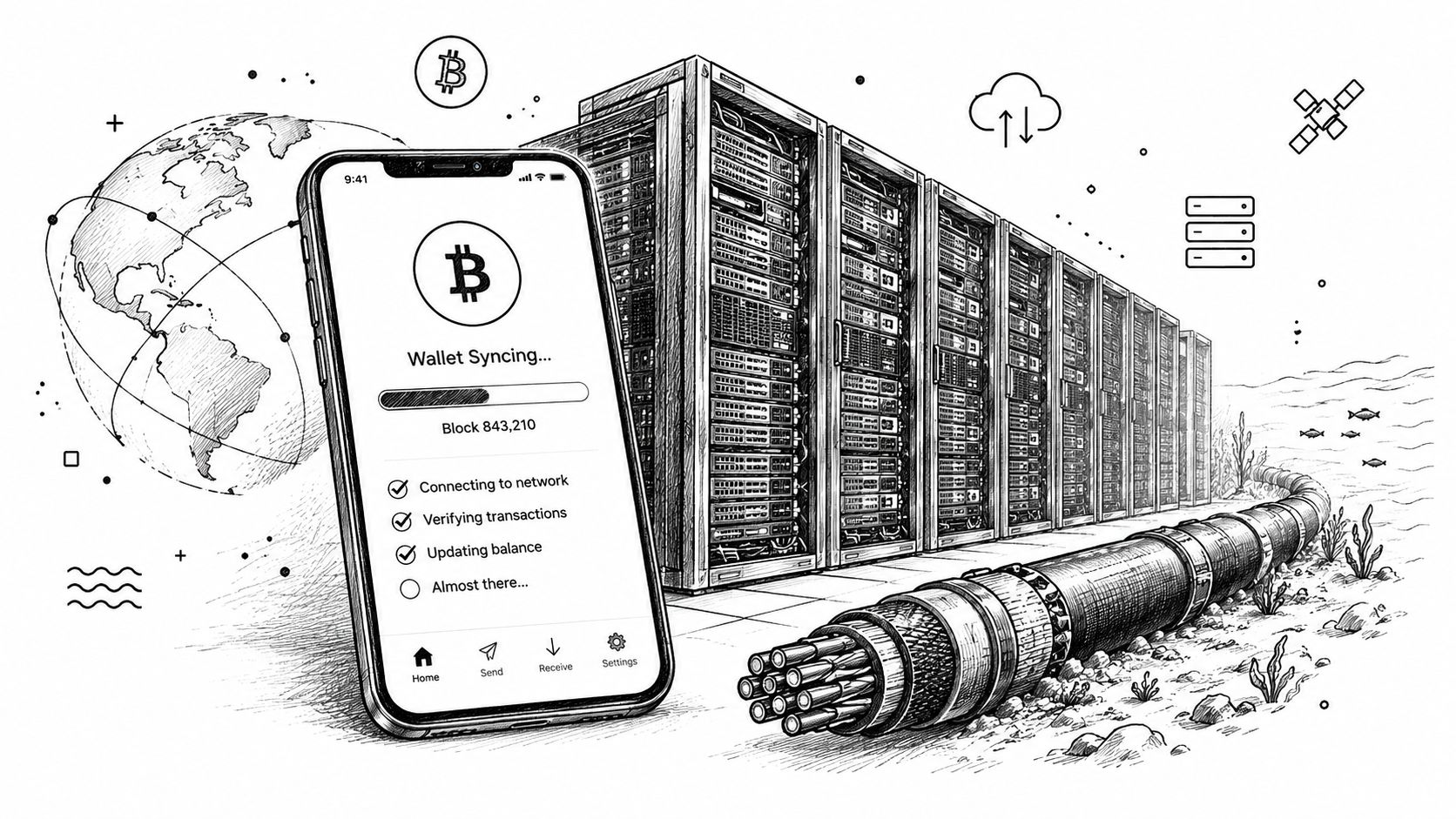
First, your device needs a connection. That connection might use home broadband, office Wi-Fi or mobile data. The request then travels through access equipment and wider network routes until it reaches a wallet service, exchange, application programming interface or blockchain node.
Next, the software needs current information. A node may download blocks from peers and check that the chain follows the relevant rules. A wallet that relies on a remote service may ask that service for balances, transaction history or fee information instead of maintaining the full ledger locally.
Then the transaction enters the network. Nodes relay it to other participants, miners or validators process activity according to the blockchain's design, and the wallet waits for updates. Each step depends on stable bandwidth, low packet loss, reliable name resolution and available servers.
What happens when a layer struggles
A weak connection can interrupt wallet synchronisation. A regional outage can prevent users from reaching a service even when the blockchain itself continues operating. A busy network can delay transaction propagation, while overloaded application servers can make a decentralised application appear broken.
Infrastructure quality also affects exchanges. Trading interfaces need dependable links to their own servers and to systems that process orders. A small delay may not change the underlying blockchain, but it can change what a user sees and when an action reaches a service.
Content-delivery and security systems add another layer. These systems help applications load from locations closer to users and filter unwanted traffic. They support the interface, but they don't replace the blockchain nodes beneath it.
This video provides another visual way to connect blockchain activity with the infrastructure that carries it:
Infrastructure and decentralisation
Decentralisation doesn't mean that physical infrastructure disappears. It means that responsibility and records can be distributed across participants rather than controlled by one central operator. Those participants still need machines, networks, storage, power and maintenance.
Anyone considering node operation should learn how miners secure and sustain cryptocurrency blockchains. The broader lesson is that blockchain innovation rides on established infrastructure. That relationship creates both strength and dependence. Distributed systems can avoid one central server becoming the only source of truth, but users and operators still need resilient paths to reach the network.
UK Digital Infrastructure Growth and Investment
A person opening a wallet app in a city flat and a person syncing a node in a rural town both depend on the same national foundation. The difference is that one may only notice it when a payment lags, while the other sees every dropped connection, every slowdown and every maintenance window.
The UK offers a clear picture of how that foundation has expanded over time. In 2004, 50% of UK households had an internet connection, and approximately two-thirds of those connections used narrowband dial-up. By 2016, more than 80% of the UK could access broadband services offering at least 24 Mbps, while average household data usage was reported at 58 GB per month. Fibre-to-the-cabinet and fibre-to-the-premises households averaged 91 GB monthly, compared with 23 GB in 2012. (UK Digital Strategy and broadband development)
Those changes matter because internet use did not just become more common. It became heavier, more continuous and more time-sensitive. Streaming, cloud tools, digital payments and blockchain services all place different kinds of demand on a network, but they share one requirement. The connection has to stay available long enough to complete the job.
The shift from superfast to gigabit access
The growth in coverage shows that shift clearly. Government reporting said superfast broadband coverage increased from 58% of premises in 2011 to more than 97%, while gigabit-capable coverage rose from 8% in July 2019 to over 67% by 2022. Good 4G coverage from at least one operator reached 92% of UK landmass.
For an ordinary household, broader coverage usually means more choice and a better chance of running several demanding services at once. For crypto users, it changes the ceiling of what is practical at home. A wallet holder may only need stable access for balances, swaps or transfers. A node operator needs something closer to a dependable road than a path that works only on quiet days. Higher coverage helps, but it does not erase latency, congestion, poor home equipment, service limits or local outages.
Public policy has also shaped the pace of expansion. Between 2020 and 2025, the UK committed £1.2 billion to help deliver gigabit-capable broadband, with a target of 85% coverage by 2025 and complete coverage by 2030.
Project Gigabit shows how that policy reaches places the market may serve more slowly. The government deployed £2 billion of public funding from 2020 to 2025, with nationwide coverage targeted for 2032. Building Digital UK reported estimated delivery of 1,373,800 premises with gigabit-capable coverage by the end of December 2025, including about 56,000 premises during that quarter. (Project Gigabit investment and delivery information)
That matters for finance as well as connectivity. As services built on tokenised assets and digital rails become more relevant, the quality of national infrastructure affects who can participate consistently and from where. The link between network capacity and financial use is already visible in discussion around tokenisation and UK financial services.
Coverage Versus Actual Usable Access
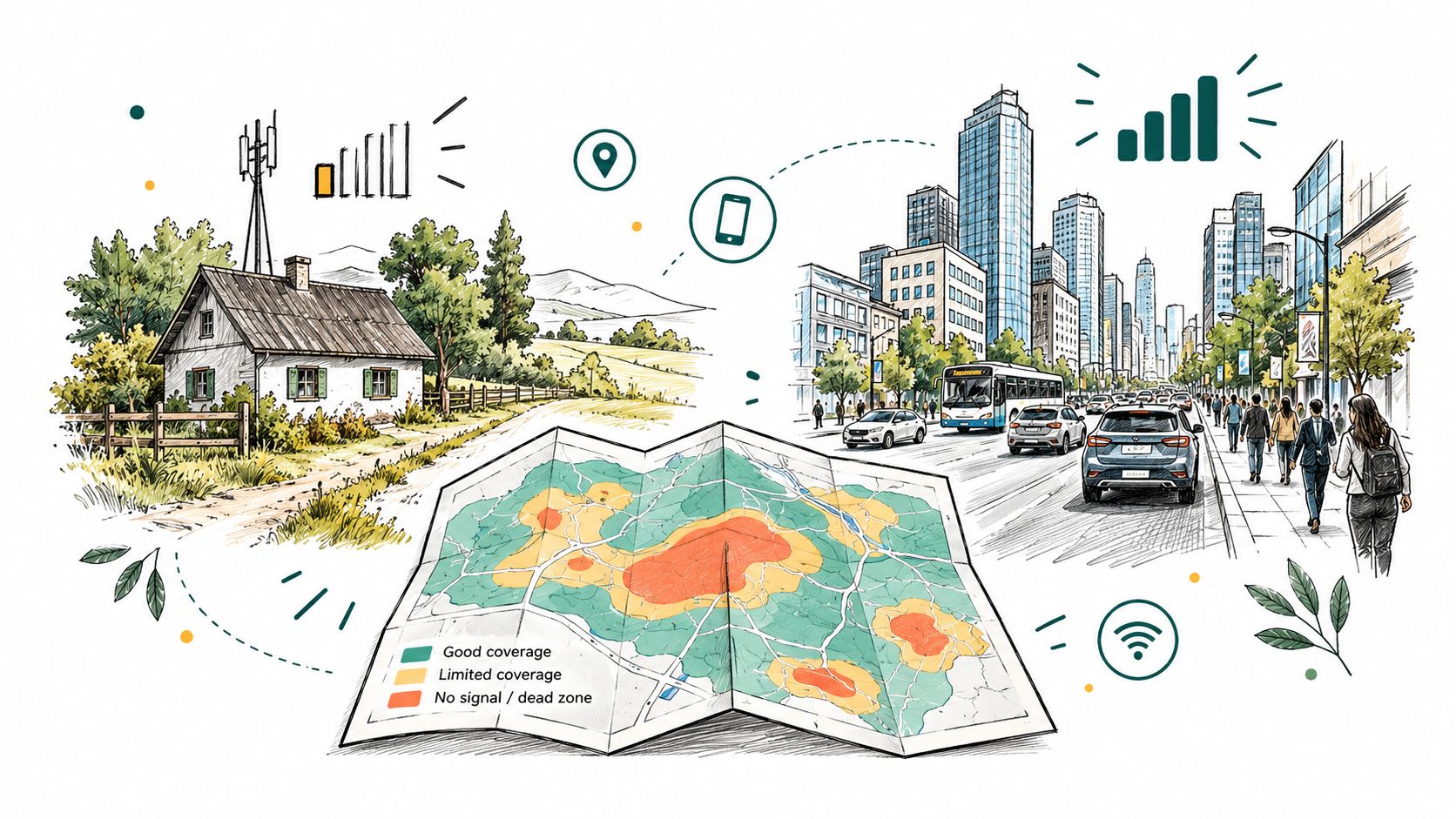
A network can pass a building without becoming useful to every person inside it. That distinction separates technical availability from usable access.
Ofcom reported in January 2025 that around 96% of UK landmass had good outdoor 4G coverage from at least one operator, while 5G reached about 62% of the landmass. The same coverage report identified 1.6 million people with no internet connection at all. (Ofcom Connected Nations update)
Those facts can exist together because a signal map measures reach, not the complete conditions for participation. A person may live in a covered area but lack affordable service, a suitable device, confidence using online systems or support when something goes wrong.
Four tests for meaningful access
A broader assessment asks four questions:
- Can the person connect? Coverage and network availability answer only this first question.
- Can the person afford it? A technically available service remains out of reach if the price is unaffordable.
- Does the person have suitable equipment? Old or damaged devices may struggle with modern applications and security updates.
- Can the person use the service safely? Skills, accessibility and confidence affect whether connectivity becomes useful.
Crypto adds specific requirements. A wallet holder needs a dependable connection for authentication and transaction updates. They also need a secure device, current software and enough understanding to check addresses, fees and approvals before signing.
Coverage tells you where a network reaches. Usable access tells you who can benefit from it.
The crypto meaning of digital inclusion
A newcomer might see a wallet balance and assume the system is straightforward. If their connection drops during an important step, or if they don't understand a security warning, the technical network hasn't delivered a safe experience. The same applies to someone learning about blockchain through a mobile device with limited data or unreliable service.
Ofcom's 2025 planned-deployment analysis estimated that 25.9 million homes, or 86% of the UK's 30.2 million homes, could obtain gigabit-capable broadband in January 2025, up from 83% in July 2024. (Ofcom planned network deployment tables) “Could obtain” describes availability, not guaranteed throughput or affordability. A responsible definition of infrastructure must include the person at the end of the connection, not only the cable, mast or premises passed.
Building Resilient Crypto Infrastructure
Resilience starts by removing dependence on one component. A node, wallet service or blockchain application becomes fragile when one provider, building, carrier, power source or staff member can stop it.
Distribute important systems across separate locations and providers. Use different internet carriers where possible, and check whether supposedly independent networks share ducts, poles, backhaul, power or upstream transit. Two services with different brand names may still depend on part of the same physical route.
Ofcom's 2025 analysis projected that, if announced plans are delivered, gigabit-capable coverage could rise from 90% of urban premises in January 2025 to 98% by January 2028, while rural coverage could increase from 58% to 89%. It also projected that up to 79% of UK homes could have access to at least two gigabit-capable networks by the end of 2027. These are projections, not guarantees, and dual coverage doesn't automatically mean physically independent paths. (Ofcom Connected Nations planned network deployment analysis)
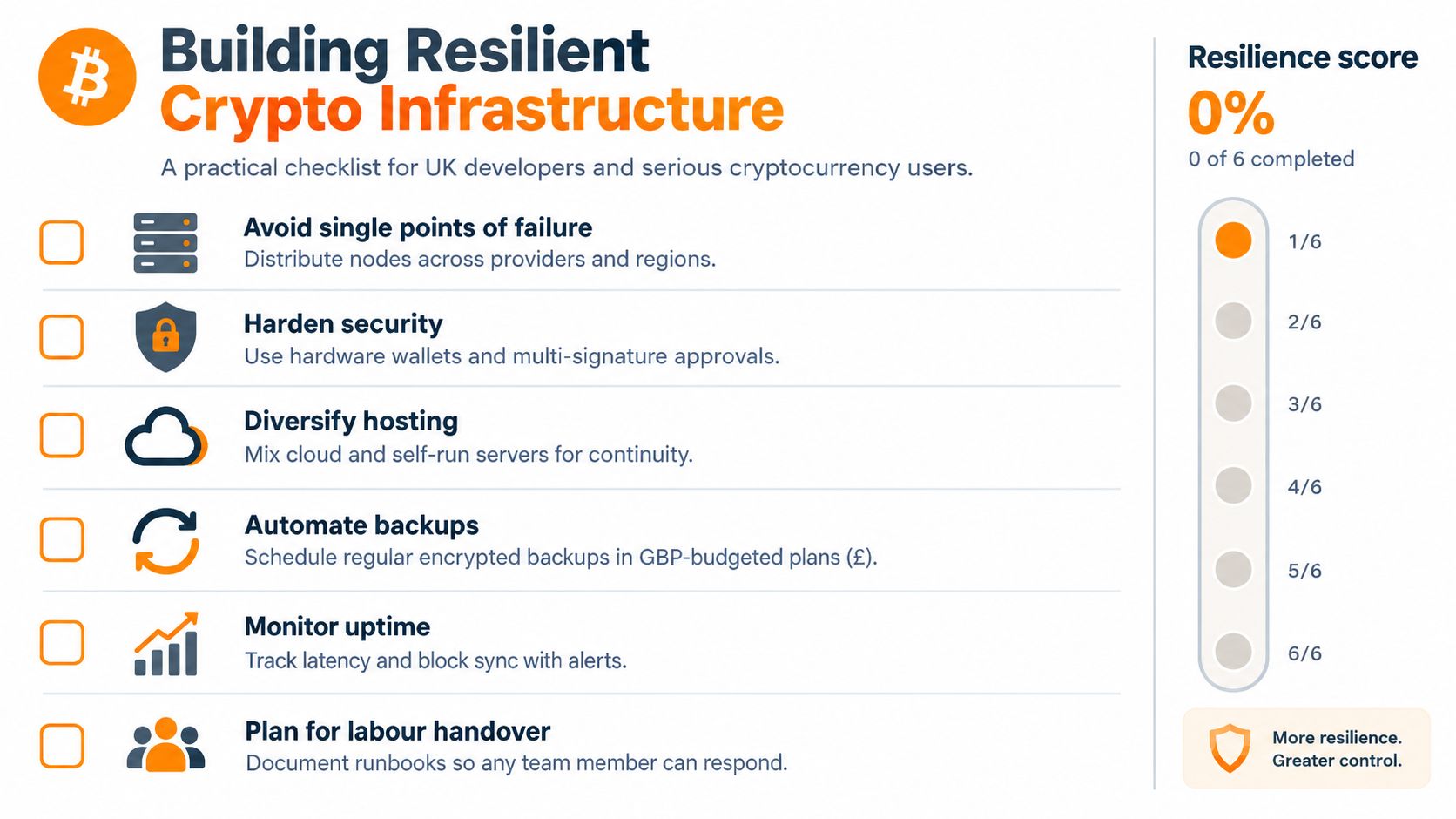
A practical resilience checklist
- Avoid one failure point: Place nodes or APIs across different regions and providers.
- Protect signing authority: Use hardware wallets and multi-signature approvals for important funds.
- Mix hosting approaches: Combine cloud resources with self-run servers where the operating model supports it.
- Back up deliberately: Keep encrypted backups and document how to restore chain state and application data.
- Monitor real performance: Track latency, packet loss, uptime and block synchronisation, not just advertised speed.
- Prepare people as well as systems: Write runbooks so another team member can respond during an outage.
For home users, resilience might mean knowing how a mobile connection can serve as a temporary alternative to home broadband. For a professional operator, it means testing recovery rather than assuming it will work. This accessible explanation of what keeps your Wi-Fi online provides useful context for thinking about network redundancy at a smaller scale.
Digital infrastructure is therefore a measurable combination of reach, capacity, availability, path diversity, compute, storage and recovery capability. The strongest design isn't necessarily the one with the highest advertised speed. It's the one that keeps operating, or recovers predictably, when a connection, server, provider or person becomes unavailable.
The Coin Course offers structured education on blockchain, wallets, nodes, security and other crypto fundamentals, helping you connect technical infrastructure with safer everyday decisions. Visit The Coin Course to build your understanding from first principles and learn how the systems behind your wallet and transactions work.