Think of a DeFi wallet as your own personal digital vault for your crypto, but with a crucial difference: you and only you hold the keys. Unlike a bank or a crypto exchange that acts as a middleman, a DeFi wallet gives you absolute, direct ownership over your digital assets. It's your personal passport to the world of Decentralised Finance (DeFi), letting you trade, lend, and earn without asking for anyone’s permission.
Your Personal Key to Decentralised Finance
Let's start with something we all know: a bank account. The bank holds your money, and you need its approval for certain things, like sending a large amount of cash overseas. They can freeze your account, and if their systems go down, you're temporarily locked out. A centralised crypto exchange, like Coinbase or Binance, works in a surprisingly similar way—they hold your crypto on your behalf.
A DeFi wallet flips this idea completely on its head. It’s less like a bank account and more like the physical wallet in your back pocket. You're the only one who can open it, take anything out, or put anything in. This is what we call non-custodial, which simply means no company or third party ever has custody of your funds.
Taking Full Control of Your Assets
This idea of self-custody is the single most important thing to grasp. When you first set up a DeFi wallet, maybe something like MetaMask or Trust Wallet, you're given a unique secret phrase. This isn't just a password; it's the master key to everything you own in that wallet. If you keep that phrase safe, nobody else can ever touch your crypto.
This complete control is what lets you interact directly with all the fascinating applications in the DeFi space, often called "dApps." You can connect your wallet to platforms to:
- Swap tokens on a decentralised exchange (DEX) like Uniswap. For example, you could trade your Ethereum for a new, trending token in seconds.
- Lend out your crypto to earn interest on a platform like Aave. You could deposit your stablecoins like USDC and start earning a passive income.
- Borrow other assets by using your existing crypto as collateral. Need cash but don't want to sell your Bitcoin? You can use it to borrow dollars.
A DeFi wallet does more than just hold your crypto. It becomes your digital identity and your access pass for the entire decentralised web. It puts you firmly in the driver's seat, cutting out the traditional gatekeepers.
DeFi Wallet vs Centralised Exchange: A Quick Comparison
So, what's the real difference between using a DeFi wallet and just leaving your coins on an exchange? It all boils down to control.
This table breaks down the fundamental differences in who controls your assets, your security responsibilities, and your access to the DeFi ecosystem.
| Feature | DeFi Wallet (You're in Control) | Centralised Exchange (They're in Control) |
|---|---|---|
| Asset Custody | You hold the private keys. Your crypto is 100% yours. | The exchange holds your private keys. You have an IOU for your crypto. |
| Security | Your responsibility. You must protect your secret phrase. | The exchange is responsible for platform security (but hacks can happen). |
| Access to DeFi | Direct, seamless access to thousands of dApps and protocols. | Limited. You can only use the services the exchange decides to offer. |
| Permission | Permissionless. No one can freeze your funds or block transactions. | Permissioned. The exchange can freeze your account or block withdrawals. |
| Anonymity & Privacy | Generally pseudonymous. Your wallet address is public, not your ID. | Requires KYC (Know Your Customer). Your identity is tied to your account. |
Ultimately, using a centralised exchange is like entrusting your money to a financial guardian who promises to keep it safe. Using a DeFi wallet is like storing your gold in a personal safe where only you know the combination.
This distinction is crucial for anyone who wants to truly explore the financial freedom that DeFi promises. It brings new responsibilities, for sure, but it also unlocks a universe of possibilities that simply don't exist in the old financial system.
How DeFi Wallets Keep Your Crypto Safe
Let's clear up a common misconception right away. A DeFi wallet doesn't actually "store" your crypto in the same way a physical wallet holds cash. Your assets—your Bitcoin, Ethereum, or any other token—always live on the blockchain, which is a massive, shared public ledger that's spread across thousands of computers worldwide.
So, what does the wallet do? It holds the keys. Specifically, it holds the secret digital keys that prove you own your crypto and give you the power to spend it.
Think of it like this: your public key is like your bank account number. You can share it with anyone who needs to send you money. It’s public information, and it's perfectly safe for people to know it. If you want a friend to send you some Ethereum, you'd give them this public address.
Your private key, on the other hand, is like your secret PIN code. It’s the code that authorises every transaction. You wouldn't share your PIN with anyone, and the same goes for your private key. It's the one thing that grants complete access to your funds, allowing you to "sign" and approve any outgoing payments.
The Master Key to Your Digital Vault
When you first fire up a new DeFi wallet, it generates something even more fundamental than your private key: a seed phrase. You'll see this as a list of 12 to 24 random words, something like apple, river, taxi, and mountain.
This isn't just a random assortment of words; it's the ultimate master key to your entire crypto portfolio.
Your seed phrase is your lifeline. It's the one and only backup you have. If your laptop breaks or you lose your phone, this sequence of words is all you need to restore your wallet and regain full access to your funds on a new device.
This is why people say, "Not your keys, not your coins." You are the sole guardian of your assets. As the infographic below illustrates, you are the starting point of control, using your keys to unlock the decentralised web.
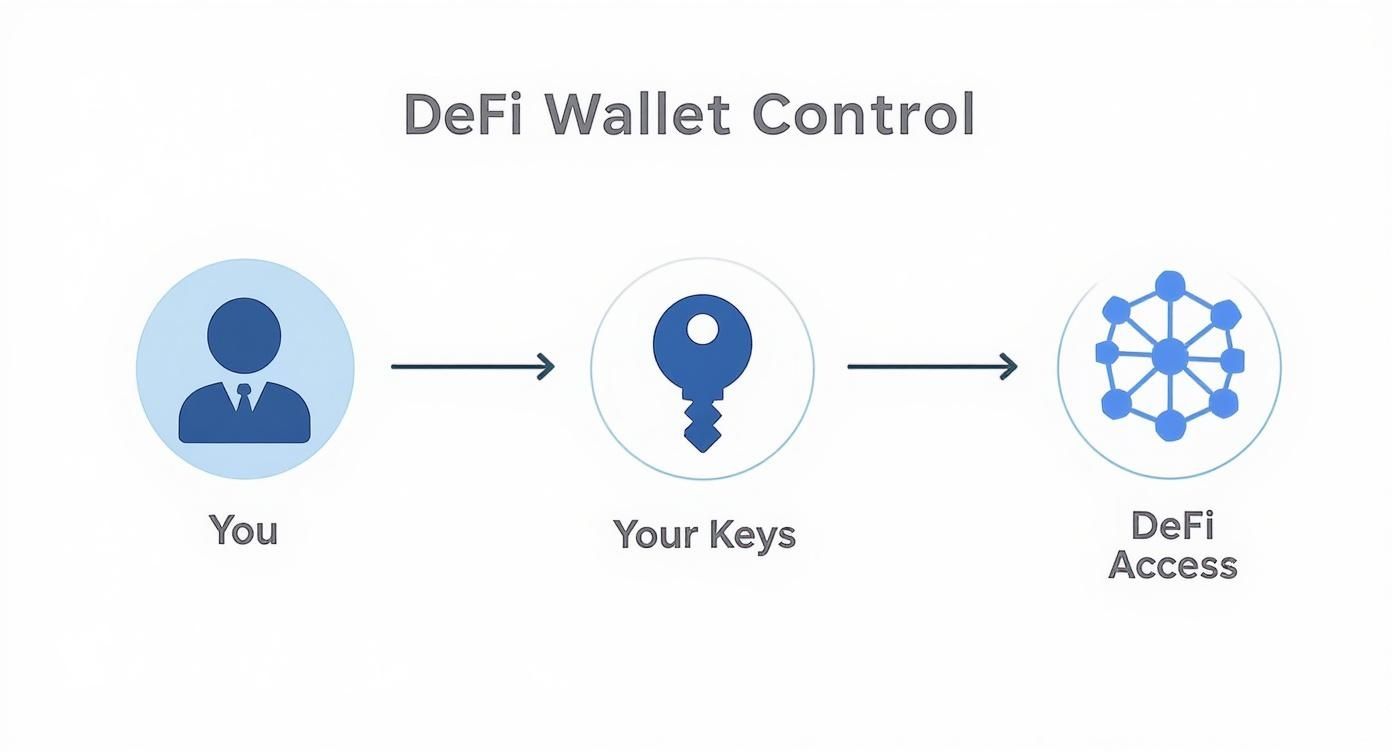
This puts all the power—and responsibility—squarely in your hands. There's no "forgot password" button or customer service hotline to call if you lose your seed phrase. That's why it's absolutely crucial to get a handle on mastering wallet backups and how to safeguard your crypto with seed phrases. If it’s gone, so is your crypto.
Signing and Sending a Transaction
So, how do these keys actually work together when you want to move some crypto? Imagine you want to send 0.1 ETH to a friend.
- First, you open your wallet, put in your friend's public address, and type in the amount.
- Your wallet then asks you to confirm the transaction. When you hit "send," it uses your private key to create a unique digital signature for that specific transaction.
- Finally, this signed transaction is broadcast to the entire blockchain network for validation.
Here's the clever part. The computers on the network can use your public key to check that the signature is valid and came from the correct private key—all without ever seeing your private key itself. This piece of digital magic proves you're the one who authorised the payment, and the network gives it the green light.
What Makes a DeFi Wallet Tick? Core Features Explained
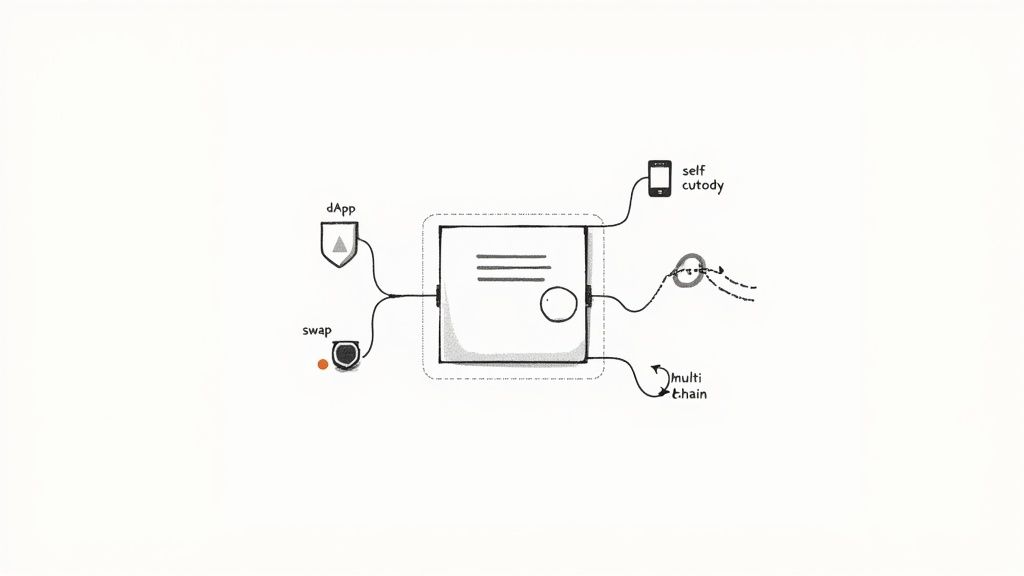
When you look under the hood of a DeFi wallet, you’ll find it’s much more than just a place to stash your crypto. A proper DeFi wallet is your personal toolkit for navigating the decentralised web. The absolute cornerstone of this is self-custody – the simple but powerful idea that you, and you alone, control your assets. Nobody can freeze your funds or stop a transaction because you hold the keys.
This one feature changes everything. With self-custody as the foundation, a whole host of other tools become possible, transforming your wallet from a simple digital vault into your command centre for all things DeFi.
Your Gateway to the Decentralised World
One of the most powerful features you’ll find is the built-in dApp browser. Imagine a special version of Chrome or Safari, but one that’s designed to connect directly and securely with decentralised applications (dApps). Instead of old-school logins with usernames and passwords, you just connect your wallet. It's that easy.
This means you can jump straight into a huge ecosystem of platforms right from your wallet's dashboard. For instance, using the dApp browser in a wallet like Trust Wallet, you could:
- Swap your SOL for a new meme coin on a Solana-based exchange like Jupiter.
- Lend out your stablecoins on Aave to start earning interest.
- Browse and buy an NFT on a marketplace like OpenSea.
By cutting out the middleman, this direct connection creates a fluid, integrated experience. It’s your personal portal to the entire DeFi universe.
Trading Without Ever Leaving Your Wallet
Another game-changing feature is in-wallet token swaps. This lets you trade one crypto for another without your funds ever leaving the safety of your wallet. Gone are the days of sending coins to a centralised exchange, making a trade, and then pulling them back out again.
Let's say you have some Ethereum (ETH) and want to get your hands on the UNI token from Uniswap. You can perform that trade right inside your MetaMask wallet. Behind the scenes, the wallet taps into various decentralised liquidity pools to find you a competitive rate, and with one click, the swap is done.
This isn't just about convenience. For anyone active in DeFi, it's a huge security boost. By keeping your assets in your wallet, you dramatically reduce their exposure to external platforms and potential risks.
Juggling Assets Across Multiple Blockchains
The crypto world is a sprawling place, with many different blockchains like Ethereum, Solana, and Cardano all hosting their own unique tokens and dApps. That’s why modern DeFi wallets come with multi-chain support, giving you a single dashboard to manage assets across all these different networks.
This is no longer a "nice-to-have" feature; it's essential. You can hold your ETH on the Ethereum network while also managing your SOL on Solana, all within the same wallet interface. This flexibility mirrors how people are actually using crypto today. Research reveals that the average DeFi wallet in the UK is connected to around 2.3 different blockchain networks and holds about 5.4 different tokens. If you're curious about UK crypto trends, you can find more stats on wallet adoption at CoinLaw.io.
Ultimately, multi-chain support makes managing a diverse crypto portfolio a much smoother and more organised experience.
Popular DeFi Wallets You Can Use Today
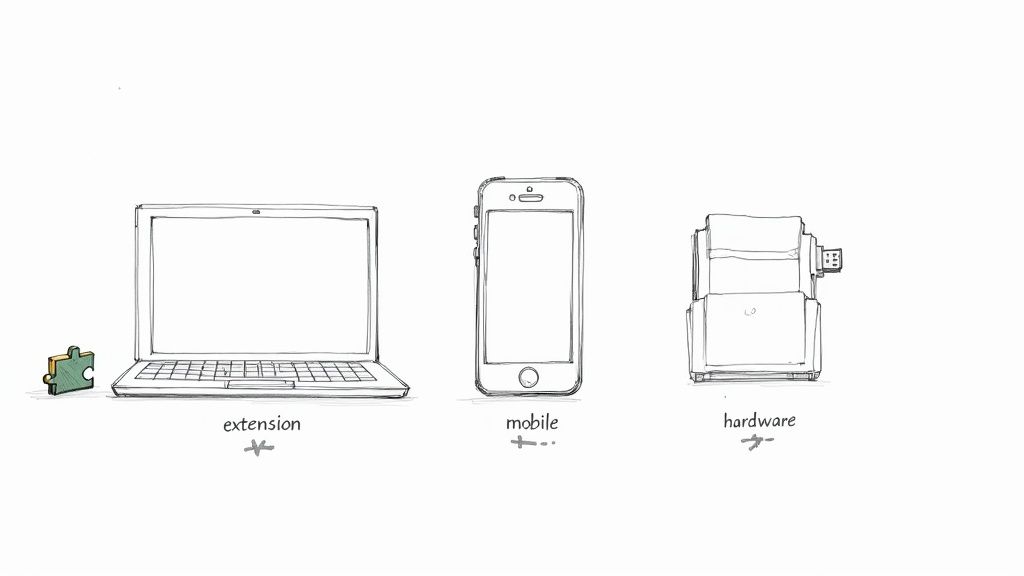
Alright, now that we've covered the theory, let's get practical and look at some of the most popular DeFi wallets you can actually start using. The crypto world isn't a one-size-fits-all place, and wallets are no exception. You’ll find different options built for different habits—whether you live on your laptop, your phone, or you’re a security hawk who wants their funds locked down tight.
Picking your first wallet can feel like a big decision, but it doesn't have to be overwhelming. The best way to start is by thinking about how you'll use it most. Are you a desktop power user, constantly exploring new dApps? Or are you always on the go, needing to manage your portfolio from your mobile?
Let's break down a few of the most trusted names in the game to help you find your perfect match.
MetaMask: The Desktop Powerhouse
If you spend most of your time on a desktop or laptop, MetaMask is almost certainly the first wallet you'll come across. It’s a browser extension that works with Chrome, Firefox, and Brave, acting as the perfect gateway between your computer and the decentralised web.
That little fox icon has become synonymous with DeFi for a good reason. It’s become the industry standard.
- Easy dApp Connection: It makes connecting to thousands of DeFi platforms—from lending protocols to NFT marketplaces—as simple as clicking a button. Seriously, it just works.
- Ethereum Native: MetaMask was born in the Ethereum ecosystem, and it remains the undisputed king for interacting with the vast majority of DeFi projects built there.
- Multi-Chain Friendly: While it started with Ethereum, you can easily add other compatible blockchains like Polygon and Avalanche. This means you’re not locked into just one network.
For anyone serious about diving deep into DeFi from their computer, MetaMask is pretty much essential.
Trust Wallet: The Mobile-First Champion
If your phone is your command centre, then Trust Wallet is probably for you. It's a mobile-first wallet, available for both iOS and Android, and was designed from the ground up for a clean, intuitive experience on the move. Don't let its simplicity fool you; it packs a serious punch.
Trust Wallet supports a staggering number of blockchains and tokens straight out of the box, making it one of the most versatile mobile wallets available. Plus, its built-in dApp browser means you can tap into the same DeFi services as a desktop user, all from the palm of your hand.
Phantom: The Solana Specialist
While MetaMask dominates the Ethereum world, Phantom is the undisputed champion of the Solana ecosystem. Solana is a rival blockchain famous for its lightning-fast and super-cheap transactions, and Phantom is the wallet built to take full advantage of that speed.
If you’re keen to explore Solana’s buzzing world of DeFi projects and NFTs, Phantom offers a sleek, user-friendly experience tailored specifically for that network. It’s available as both a browser extension and a mobile app.
Ledger: The Security Fortress
For anyone who puts security above all else, nothing beats a hardware wallet. Ledger is a giant in this space. Unlike the software wallets we've just discussed (often called "hot wallets"), a hardware wallet is a physical device that keeps your private keys completely offline.
A hardware wallet signs transactions offline, which means your secret keys are never exposed to your internet-connected computer. This makes it virtually immune to online hacking, malware, and phishing attacks.
The best part? You can connect your Ledger device to a user-friendly interface like MetaMask. This gives you the best of both worlds: the iron-clad security of "cold storage" and the smooth dApp access of a "hot wallet."
Which DeFi Wallet Is Right for You?
Choosing a wallet comes down to your priorities: convenience, security, or the specific blockchain you want to use. This table breaks down the main options to help you decide.
| Wallet | Main Platform | Best For | Standout Feature |
|---|---|---|---|
| MetaMask | Browser Extension | Desktop users exploring Ethereum & EVM chains | The industry standard for dApp connectivity |
| Trust Wallet | Mobile App (iOS/Android) | Mobile-first users needing multi-chain support | Huge out-of-the-box support for thousands of assets |
| Phantom | Browser & Mobile | Users focused on the Solana ecosystem | A seamless, fast experience tailored for Solana |
| Ledger | Physical Hardware | Security-conscious users holding large amounts | Keeps private keys completely offline in cold storage |
Ultimately, many people end up using more than one wallet. You might use a Ledger for your long-term holdings and a MetaMask or Phantom wallet for your daily DeFi activities. The key is to find the setup that makes you feel both comfortable and secure.
Understanding the Benefits and Risks of Self-Custody
Choosing a DeFi wallet is like becoming your own bank. It’s an incredibly liberating step, but with that freedom comes a great deal of personal responsibility. In the world of decentralised finance, you're in the driver's seat. There are no middlemen, but there's also no one to call if you take a wrong turn. Getting to grips with both sides of this equation is vital.
The biggest win here is achieving true financial sovereignty. Your assets belong to you and you alone, locked away and accessible only with your private keys. No corporation, government, or bank can freeze your account or block a transaction. You have complete and final say over your funds.
This autonomy also means you get a front-row seat to innovation. With a DeFi wallet, you can jump into the latest and greatest financial protocols the second they go live, without having to wait for a centralised exchange to give its approval.
The Power and the Pitfalls
This direct control, often called self-custody, is a classic double-edged sword. On one hand, it protects you from things like a company going bankrupt or external censorship. On the other, it puts all the responsibility for security squarely on you. For a closer look, our guide on understanding custodial and non-custodial crypto wallets breaks down these concepts in more detail.
Being your own bank means you need to be aware of a few key risks:
- Irreversible Loss: If you lose your seed phrase, your crypto is gone for good. There's no 'forgot password' link to click. Your funds become permanently locked away on the blockchain, out of reach for everyone, including you.
- Phishing Scams: The crypto space is full of clever scammers creating fake websites and sending dodgy links. Their goal is always the same: to trick you into giving away your seed phrase or signing a malicious transaction. For example, they might create a fake Uniswap website that looks real, hoping you'll connect your wallet.
- Smart Contract Bugs: When you use a DeFi protocol, you're interacting with its underlying smart contracts. A bug or vulnerability in that code can be exploited by hackers, putting any funds you've connected to it at risk.
The core idea behind self-custody is perfectly captured in a simple phrase: "Not your keys, not your coins." It’s a constant reminder that in crypto, real ownership means holding your own private keys.
A Growing Recognition of DeFi's Potential
Despite these personal responsibilities, the upside of DeFi is turning heads. Even major financial institutions in the UK are starting to take notice. In fact, recent surveys suggest their engagement with DeFi could leap by 2.5 times over the next couple of years, jumping from 27% to a projected 68%. This isn't just idle curiosity; it shows a serious acknowledgment of DeFi's power for diversifying portfolios and earning yield. You can dig into more of this data in a report by Coinbase on European and UK investor plans.
Ultimately, switching to a DeFi wallet requires a different mindset. It's less about passive convenience and more about active empowerment. By taking the time to learn how to protect your keys and spot potential dangers, you can navigate the exciting world of DeFi with confidence and keep your digital assets safe.
How to Get Started with Your First DeFi Wallet
Ready to take the plunge? Getting set up with your first DeFi wallet is a lot less intimidating than it sounds. Think of it as your personal key to this new financial world, putting you squarely in the driver's seat of your own assets.
Here’s a simple, no-fuss plan to get you started safely and build your confidence from the ground up.
Your Three-Step Action Plan
Choose a Reputable Wallet
First things first, pick a wallet with a solid reputation. Options like MetaMask for your desktop or Trust Wallet for your phone are great starting points. Your choice will likely come down to whether you prefer managing your crypto on a computer or on the go.Secure Your Seed Phrase
Pay close attention here—this is the most important step. As you create the wallet, it will give you a seed phrase (usually 12 or 24 words). Write these words down on paper and store it somewhere incredibly safe and offline. Never, ever save it as a screenshot or a text file on your computer or phone.Start Small and Get Comfortable
Before moving any serious money, send a very small amount of crypto to your new wallet address—maybe just $10 worth of ETH. This is just a test run to help you get a feel for how sending and receiving works, all without risking your main stack.
Remember, the golden rule of a DeFi wallet is that you are in complete control. This means you have the freedom to explore, but you are also fully responsible for your security.
Following these steps will get you up and running with a solid foundation. If you want to dig deeper into the nuts and bolts, you can learn more about how crypto wallets connect to DeFi in our step-by-step guide.
Got Questions About DeFi Wallets? Let's Clear Things Up
As you dive deeper into the world of DeFi, you're bound to have some questions. It's only natural. Getting your head around concepts like self-custody and how blockchains work is a big step.
Let's walk through some of the most common questions that pop up.
What Happens If My Wallet Provider Shuts Down?
This is a classic question, and the answer is one of the most beautiful things about crypto: absolutely nothing happens to your funds. Think of your DeFi wallet as a window, not a vault. It’s just software that lets you look at and manage your assets, which actually live on the blockchain itself.
So, if your favourite wallet app, say MetaMask or Trust Wallet, were to vanish overnight, you wouldn't lose a penny. You'd simply download another compatible wallet, pop in your secret seed phrase, and voilà—all your crypto would be right there waiting for you.
Your seed phrase is the master key to your funds on the blockchain. It grants you universal access, regardless of which wallet software you use to connect. You're never locked in.
What's the Difference Between a Hot and a Cold Wallet?
This one is all about security. The core difference boils down to a single question: is it connected to the internet?
Hot Wallets: These are the software wallets we've been talking about—mobile apps like Trust Wallet or browser extensions like MetaMask. They're called 'hot' because they're constantly online. This makes them super convenient for everyday transactions, but it also leaves them more exposed to online attacks like hacks and phishing scams.
Cold Wallets: These are physical hardware devices, like a Ledger or Trezor. They keep your private keys completely offline, which is why they're 'cold'. They're widely considered the gold standard for security because they sign transactions in a totally isolated environment, making them nearly impossible to compromise from afar.
Is Using a DeFi Wallet Truly Anonymous?
Not quite. A better word for it is pseudonymous. Your real-world identity—your name, address, or passport—isn't directly linked to your wallet. You don't have to hand over any personal details to create one.
However, every single transaction you make is recorded on a public blockchain, forever tied to your wallet's public address. This means anyone with an internet connection can look up that address and see its entire transaction history. While it’s not immediately obvious that the address belongs to you, dedicated sleuths can sometimes connect the dots by analysing activity patterns. So while it's private, it's not completely invisible.
Ready to put your new-found knowledge into practice? At The Coin Course, we've created a whole library of expert articles and guides to help you safely navigate every corner of crypto. From choosing your first wallet to mastering advanced DeFi strategies, we've got you covered. Start learning with The Coin Course today.