DeFi (decentralised finance) is a system of financial services, including lending, trading, and saving, built on blockchain networks that operate without traditional intermediaries like banks. In the UK, 93% of adults had heard of cryptoassets and 12% owned them, which the FCA extrapolated to around 7 million adults, so understanding DeFi is no longer limited to specialist traders.
You may have reached this question after seeing a token swap, a staking offer, or a wallet transaction and wondering what happens behind the screen. Perhaps you want to earn a return on digital assets without opening a conventional savings account, or you're trying to understand whether DeFi is useful finance, risky speculation, or both.
The honest answer is that DeFi can do things traditional financial services often make difficult, such as providing open access to trading and lending at any time. It also transfers much of the responsibility from a bank or broker to software, wallet security, and the user's own judgement. That combination creates opportunity, but it removes many familiar safety nets.
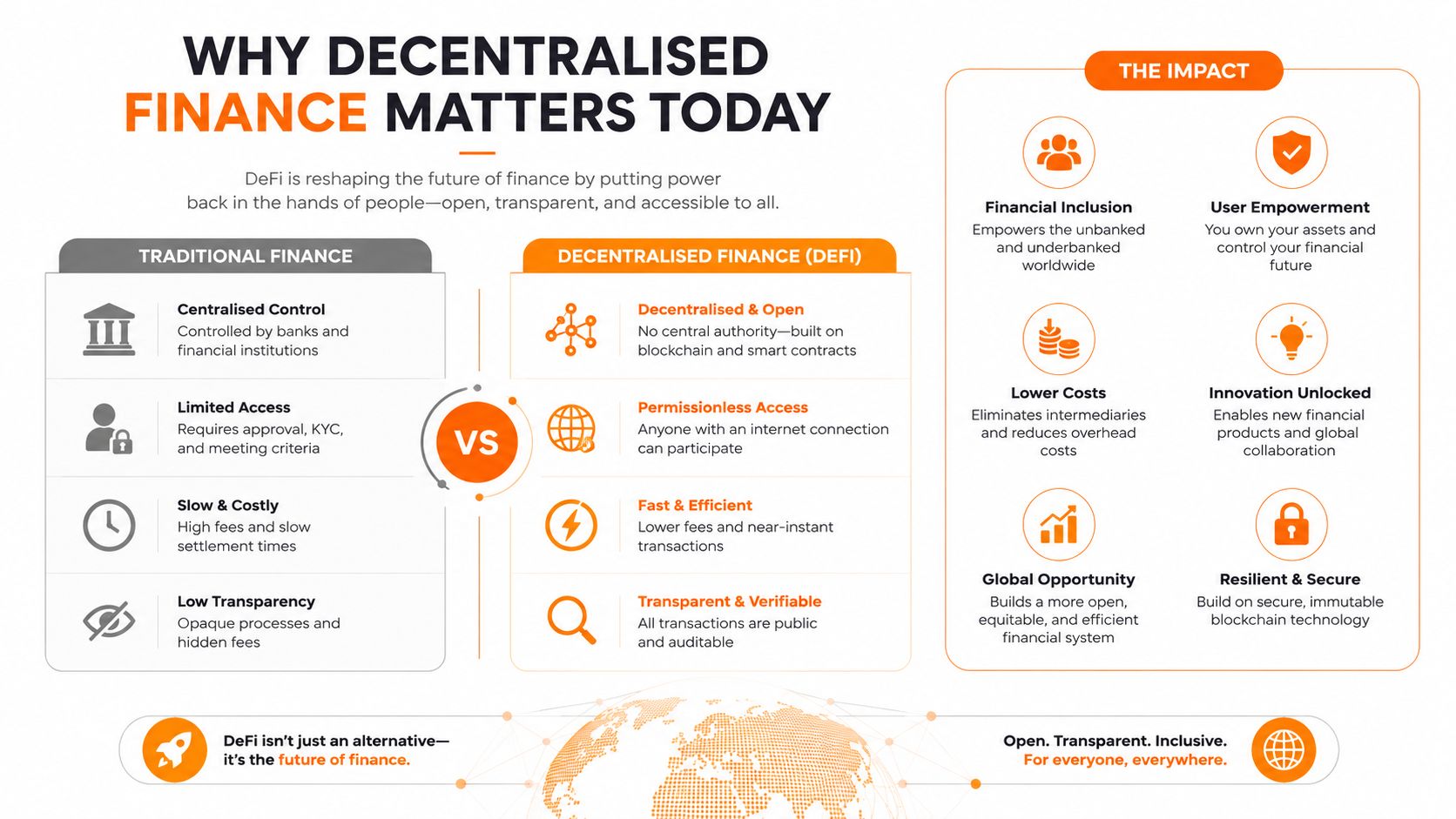
Why Decentralised Finance Matters Today
On a Sunday evening, you send £500 to a friend abroad. Your bank may apply fees, request extra checks, or delay the payment until the next business day. A DeFi transaction can run around the clock on a blockchain, letting users exchange or transfer supported assets without relying on a branch or conventional settlement timetable.
The experience still depends on the network, the asset, and the protocol. Congestion can increase fees, exchange rates can shift, and a wrong wallet address may be impossible to correct. DeFi changes who operates the service: blockchain networks and programmable contracts carry out the rules instead of one bank maintaining the account relationship.
The scale has also moved beyond a small technical experiment. The Bank of England noted that total value locked in DeFi applications had grown fivefold since February 2021 to almost US$180 billion on 8 March 2022, with lending representing around one-third of that total (Bank of England data summarised in this UK DeFi reference). This is historical data, not a current market total, but it shows how quickly interest expanded.
What users are actually doing
Market size does not show how people use crypto. UK consumer research found that the share of consumers using cryptoassets through long-term savings rose from 19% in 2022 to 26% in 2024 (FCA consumer research reference). That group will not all be using a decentralised protocol, yet the change connects crypto with saving behaviour, not only short-term trading.
The same research found that using credit cards or overdrafts to buy cryptoassets rose from 6% in 2022 to 14% in 2024. For newcomers, this is a practical warning. A DeFi product may look like a savings tool, while its returns can depend on volatile tokens, contract performance, and the user's decisions. Borrowing to fund that exposure can turn a market loss into a personal debt problem.
DeFi matters because it offers open, programmable financial services, while placing more responsibility with the user. Learn how the system works, separate protocol risks from wallet and decision-making risks, and check the UK regulatory perimeter before committing funds.
How DeFi Works Behind the Scenes
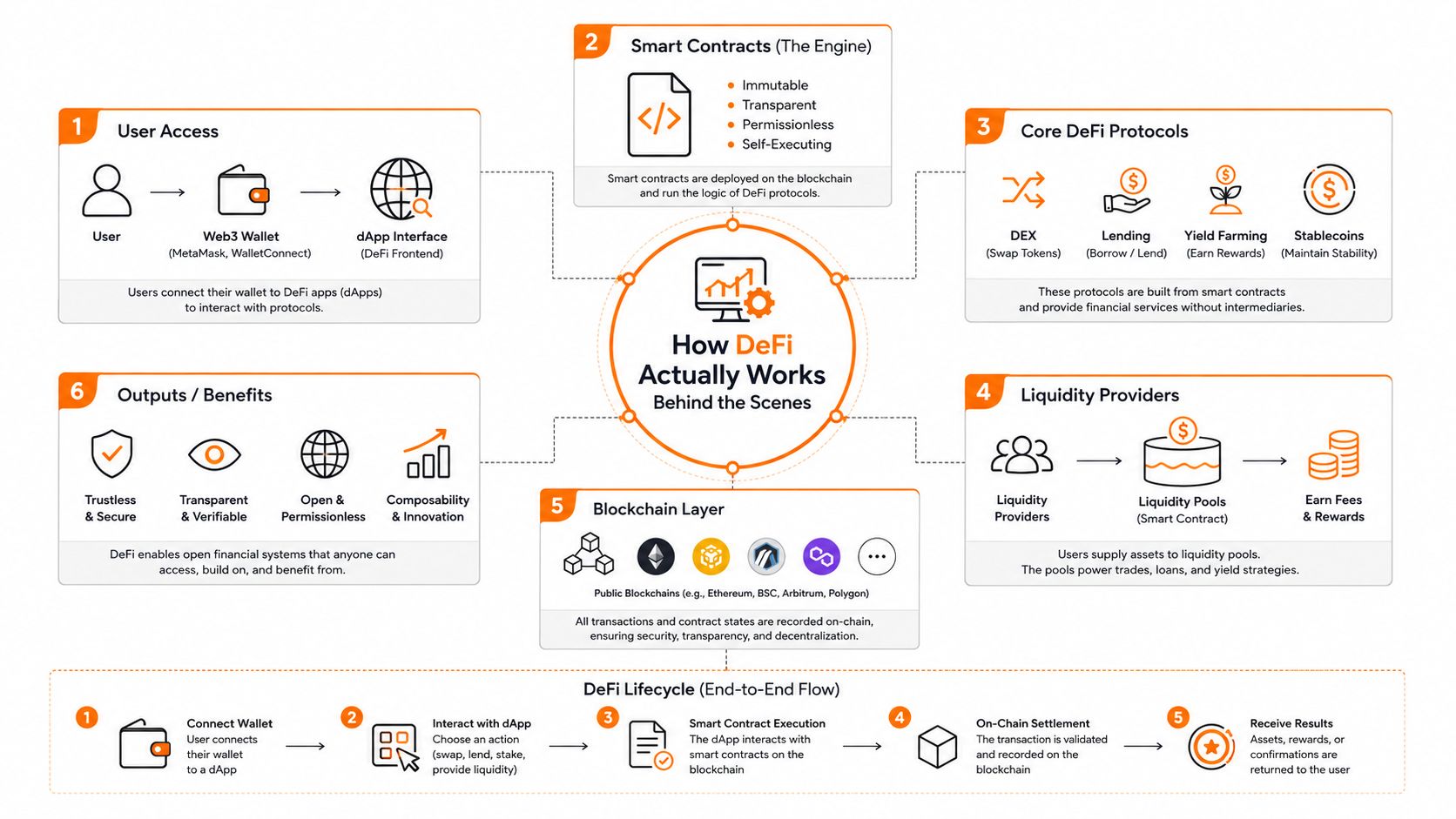
A new DeFi user may begin with a simple action: connect a wallet, swap one token for another, or deposit assets to earn a return. Behind that button, blockchain software checks balances, applies programmed rules, and records the result publicly. Following that sequence makes the system easier to understand.
Smart contracts act like digital vending machines
A smart contract is software deployed on a blockchain. It works like a vending machine. You provide the required payment, select an item, and the machine follows its programmed rules without a shop assistant approving the sale. In DeFi, the contract receives assets, checks conditions, and sends the specified result.
The comparison has limits. A vending machine normally sits behind a company that can repair or replace it. A blockchain contract may be difficult or impossible to change, depending on its design. If the code contains a flaw, the contract can produce the wrong result or release funds to an attacker. Users therefore need to assess the protocol, wallet approval, and transaction details before committing assets.
DEXs use liquidity pools
A decentralised exchange, or DEX, lets you trade tokens from a connected wallet. Instead of matching buyers and sellers through a central order book, many DEXs use liquidity pools, where users supply pairs of assets for other traders to access.
A pool works like a communal fruit bowl containing apples and oranges. A trader takes one fruit and adds the other. The pool's ratio changes, and an algorithm adjusts the exchange price. Liquidity providers may receive trading fees, but they also face price divergence, contract failure, and losses caused by changing market conditions.
For a focused explanation of this mechanism, read this beginner's guide to automated market makers.
Lending pools and stablecoins
A lending protocol resembles a peer-to-peer library. Depositors place assets into a shared pool, while borrowers take assets out after providing collateral. Code calculates interest and enforces the rules, rather than a loan officer reviewing each application.
Crypto loans are generally overcollateralised. A borrower usually deposits assets worth more than the amount borrowed because token prices can move sharply. If the collateral falls too far, the protocol may sell it automatically to reduce the outstanding debt. Liquidation can leave a borrower with fewer assets and additional transaction costs.
Stablecoins connect volatile cryptoassets with familiar currency units. Some aim to maintain a fiat-linked value through reserves, while others use crypto collateral or automated mechanisms. A stablecoin can reduce price movement during a transaction, but “stable” describes the intended design, not a guarantee that the token will keep its target value.
Yield farming involves moving assets between protocols to pursue returns from interest, trading fees, or token incentives. It resembles comparing savings rates, except the rate can change quickly and the product may carry technical, market, and liquidity risks. A displayed yield is an opportunity, not a promised income.
Finally, DeFi is composable, often described as “money Lego”. One protocol can use another protocol's token, price feed, lending market, or liquidity pool. This flexibility allows useful combinations, but it also links applications together. If one component fails or reports an incorrect price, other applications that depend on it may be affected.
Real Protocols You Can Use Right Now
The best way to understand DeFi is to examine what a user does. Uniswap, Aave, and MakerDAO represent different parts of the ecosystem, but none is a guaranteed source of income or a substitute for careful research.
Uniswap for token swaps
On Uniswap, a user connects a wallet, chooses two supported tokens, reviews the quoted exchange rate and slippage, then confirms the transaction. The trade uses liquidity supplied to pools rather than a conventional centralised order book. Uniswap operates across several blockchain networks, including Ethereum and compatible networks, so the exact fee and available market depend on the network selected.
A beginner should check the official contract and token addresses before approving a transaction. A token with a familiar name can still be a counterfeit asset, and a quoted price can move before the transaction settles.
Aave for lending and borrowing
Aave lets users supply assets to lending markets or borrow against collateral. A simple example would be depositing ETH and borrowing USDC against it. The borrower keeps exposure to the deposited asset, but must monitor collateral value, borrowing costs, and liquidation conditions. Aave also supports multiple networks and includes advanced features such as flash loans, which allow specialised users to borrow and repay funds within one transaction.
For market context and token information, this Aave asset overview can help readers distinguish the protocol from its governance token. Anyone considering the lending product should also review this step-by-step Aave lending and borrowing guide.
MakerDAO for collateralised DAI
MakerDAO allows users to lock approved collateral and mint DAI, a stablecoin designed for use across crypto markets. In practical terms, the user creates a decentralised credit line secured by assets already held in a wallet. The position remains subject to collateral rules, fees, and liquidation risk.
MKR token holders participate in Maker governance, including decisions about system parameters. That governance model matters because protocol rules can affect the safety and cost of a position.
| Protocol | Primary Function | Blockchain(s) | Beginner Tip |
|---|---|---|---|
| Uniswap | Token swapping and liquidity provision | Ethereum and compatible networks | Check token addresses and slippage before confirming |
| Aave | Lending and collateralised borrowing | Multiple blockchain networks | Understand liquidation before borrowing |
| MakerDAO | Collateralised DAI creation and governance | Ethereum and connected networks | Treat a minted stablecoin as debt, not free money |
Common DeFi Risks and Mistakes to Avoid
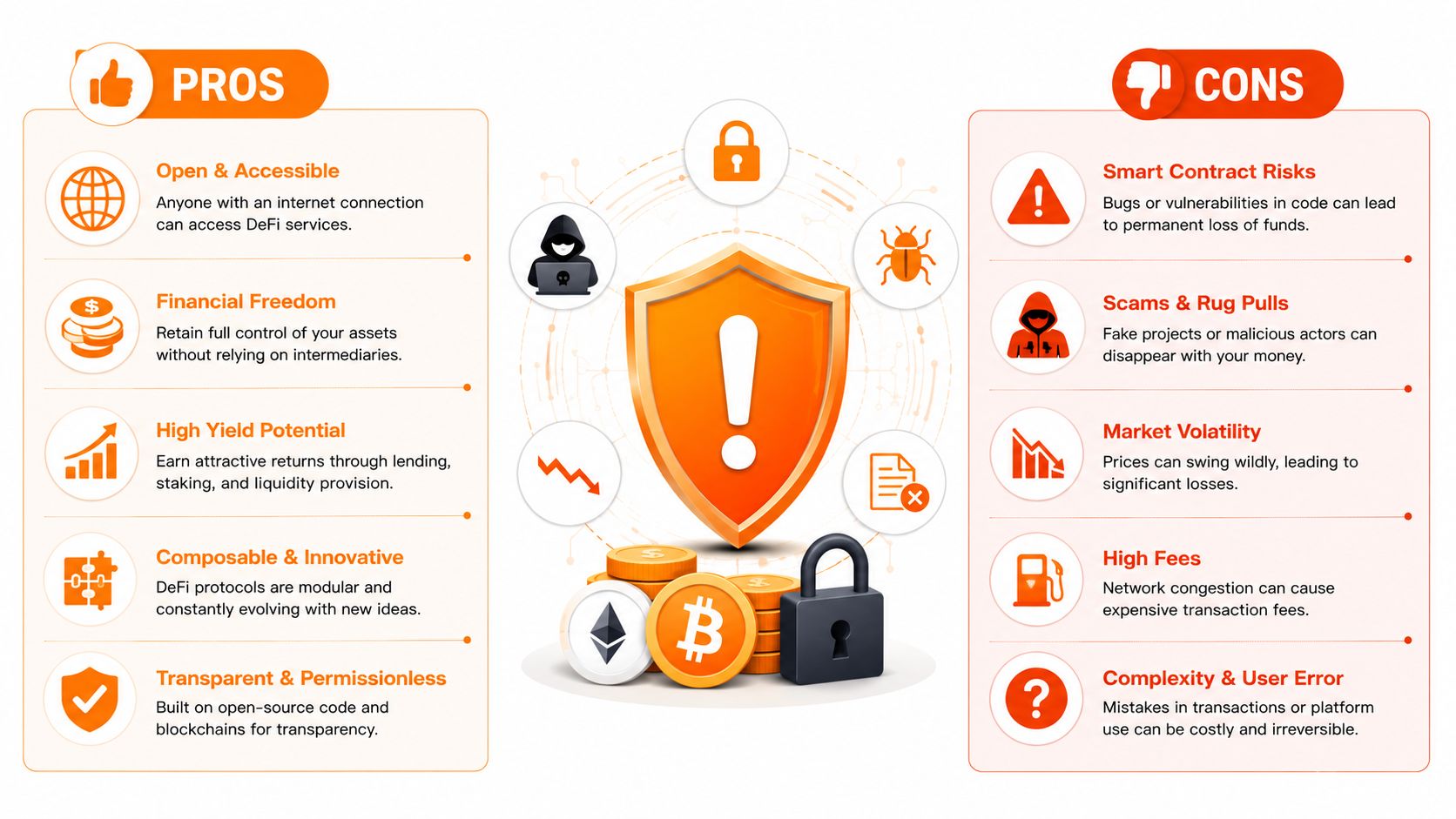
A high advertised yield isn't the same as a high-quality investment. A protocol may offer rewards in its own token, rely on optimistic assumptions, or need a constant flow of new participants to maintain returns. The collapses of Anchor and Terra are reminders that a familiar interface and attractive rate cannot protect a weak economic design.
A user also shouldn't assume that a blockchain provides total anonymity. Wallet addresses are usually pseudonymous, and transaction histories can remain visible. Specialist analytics firms can connect activity with other information, while UK tax responsibilities can still apply to taxable crypto activity.
Code can fail
Smart contracts remove a human intermediary, but they don't remove software risk. A coding error can let an attacker withdraw funds, manipulate a price feed, or call a function in an unexpected order. Flash-loan attacks use temporary liquidity to exploit weaknesses within a transaction, while reentrancy attacks repeatedly call a vulnerable contract before it updates its records.
The precise loss depends on the affected protocol, but the lesson is consistent. A popular application can still contain a dangerous bug, and an audit can reduce risk without eliminating it.
Liquidity has a hidden trade-off
Liquidity providers can experience impermanent loss when the prices of two pooled assets move apart. Suppose you add equal values of ETH and USDC to a pool, and ETH later rises sharply. The pool's pricing mechanism encourages traders to remove some ETH and add USDC until the pool reflects the new price. You may earn fees, but you could end up with less ETH than if you had just held both assets.
That loss becomes permanent when you withdraw. Beginners often focus on fee income while ignoring the asset mix they may receive at the end.
Practical rule: If you can't explain how a pool changes your exposure to each asset, don't provide liquidity yet.
Phishing creates a separate danger. A fake website can ask you to approve a malicious contract, while a fake support account may request your seed phrase. No legitimate protocol needs your seed phrase to restore access, and anyone who obtains it can control the wallet.
Before exploring common traps, read this guide to DeFi scams and how to avoid them. Keep funds spread across sensible custody arrangements, avoid unaudited contracts, and treat third-party safety ratings as research aids rather than guarantees.
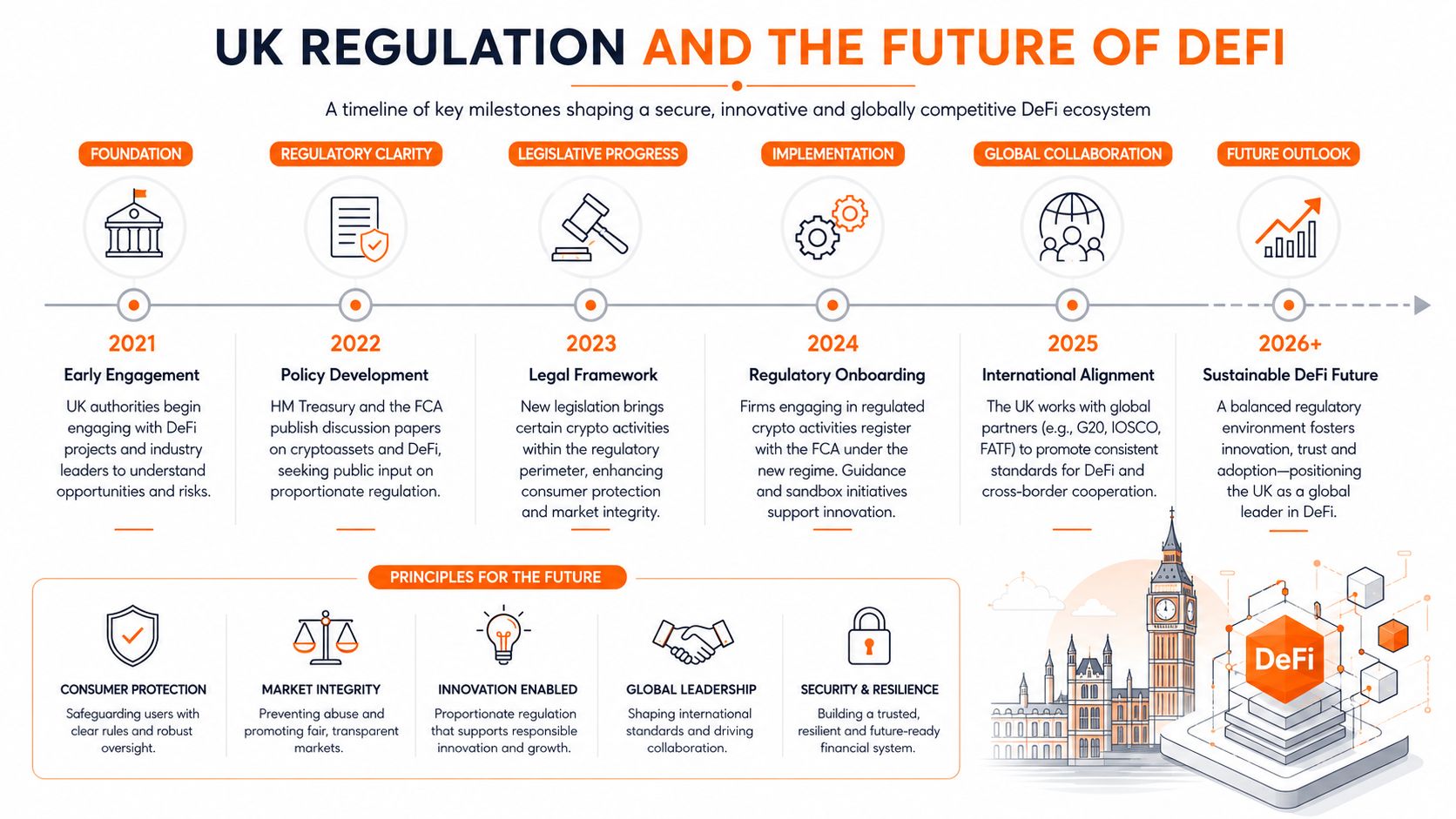
UK Regulation and the Future of DeFi
A UK user can swap tokens through a decentralised protocol while a company still controls the website, upgrade keys, or fee settings. That practical detail matters more to regulators than the label “DeFi”. The FCA's 2026 policy says the rules depend on whether an identifiable entity controls the activity, while an arrangement that is demonstrably decentralised may be treated differently (FCA policy statement).
Control can sit in several places: protocol governance, administrator keys, the front end, or important operational decisions. A smart contract may execute transactions automatically, yet a person or company can still shape how users access it. If that entity carries on the activity by way of business, the service may enter the UK regulatory perimeter.
Why the boundary matters
The FCA plans guidance on indicators of decentralisation, operational resilience, and financial-crime risk. Its published material places the regime within the Financial Services and Markets Act 2000 (Cryptoassets) Regulations 2026, with an authorisation gateway opening in late 2026 and commencement in 2027 (FCA cryptoasset regime information).
The FCA's final framework indicates that firms authorised to operate under FSMA on or after 25 October 2027 will fall under the regime (FCA discussion paper). A DeFi project with an identifiable controlling person may therefore need to prepare for UK authorisation on that future timeline.
This does not place every on-chain service in the same category as a bank. Instead, the answer depends on control, conduct, custody, and how the service reaches UK users. Builders need to consider those questions when designing interfaces, governance systems, and fee structures.
User behaviour also matters. A European institutional survey reported that half of respondents expected to allocate 5% or more of assets under management to crypto by 2025 (survey coverage from Bitcoin.com). Readers examining the local investment community can also review United Kingdom blockchain investors.
The likely outcome is a layered system. Regulated interfaces, custody services, and identifiable operators may exist alongside decentralised protocols outside the perimeter. For UK users, the practical question is which layer they are using, who controls it, and what protection the rules provide.
Getting Started with DeFi Safely
A safe first interaction should feel deliberately boring. You're testing your understanding, not trying to maximise returns.
Choose a non-custodial wallet: MetaMask and Rabby are familiar examples, but download them only from official sources. Write the seed phrase on paper, store it privately, and never save it in a photo, cloud document, email, or password manager.
Use a regulated UK exchange for funding: Buy or transfer the asset through a service you understand, then send a small amount to your wallet. Check the network carefully. Sending an asset on the wrong network can make recovery difficult or impossible.
Select the network deliberately: Ethereum may have higher gas costs than Layer 2 networks such as Arbitrum or Base. Lower fees don't remove smart-contract or market risks, so compare the protocol's supported networks before bridging assets.
Make one small test transaction: A modest swap on Uniswap can teach you how wallet confirmations, gas, token approvals, price impact, and slippage work. Verify the official website and contract addresses, and reject any transaction whose details don't match your intention.
Review approvals afterwards: Token approvals can give a smart contract permission to move a particular asset. Tools such as Revoke.cash let users review and revoke permissions, although revoking an approval also requires a blockchain transaction.
Keep your exposure limited: Start with an amount you can afford to lose entirely. Don't borrow money to experiment, and don't confuse a successful first swap with proof that a protocol is safe.
Bookmark official protocol URLs instead of relying on search adverts or social-media links. Keep a written record of deposits, swaps, withdrawals, rewards, and fees, because UK tax reporting may require transaction-level information. If you're unsure how HMRC treats a particular DeFi activity, seek advice from a qualified UK tax professional rather than guessing.
Where to Go Next on Your DeFi Journey
The core mental model is straightforward. DeFi replaces some financial middlemen with transparent, programmable code, giving users direct access while making them responsible for wallet security, transaction choices, and protocol risk.
You've now seen three essential ideas:
- Protocols: Smart contracts coordinate swaps, lending, borrowing, stablecoins, and connected services.
- Risks: Code flaws, liquidity changes, phishing, liquidation, and poor token economics can all cause losses.
- Safety: Small tests, verified URLs, limited exposure, careful approvals, and accurate records matter more than chasing a headline yield.
Choose your next step based on your goal. A cautious learner can use testnets or paper-trading dashboards before committing real funds. Someone ready to explore can study one established protocol, such as Aave or Uniswap, and use a small amount on a lower-fee network such as Arbitrum or Base. For ongoing research, DeFi Llama can provide protocol information, the Bankless podcast offers market context, and the UK FCA cryptoasset guidance can help you follow regulatory updates.
DeFi literacy is a marathon, not a sprint. The strongest habit is not finding the most exciting protocol. It's learning enough to survive mistakes, question incentives, and build knowledge before increasing exposure.
The Coin Course offers structured lessons on blockchain, wallets, DeFi, security, and advanced crypto strategies, so you can turn ideas like smart contracts and liquidity pools into practical understanding. Visit The Coin Course to keep learning from first principles and approach your next DeFi decision with greater confidence.