You've probably seen the term dapp while reading about crypto, wallets, NFTs, or DeFi, and had the same practical thought most beginners have: “Fine, but what is this thing, and is it safe for me to use?”
That's the right question.
A lot of introductions stop at the technology. They explain blockchains and smart contracts, then leave out the part normal people care about most. What happens when you click the button, connect a wallet, send money, or make a mistake? A dapp can feel a bit like a regular app at first glance, but the user experience, risks, and protections are different in ways that matter.
This guide explains what is Dapp in plain English, using real examples and simple comparisons. It also maintains a connection to everyday life, especially for UK readers who want to know not just how dapps work, but what using one means for safety, responsibility, and consumer protection.
What Is a Decentralized Application
Think about a normal social media app. You open it, log in with an email and password, scroll a feed, post something, and trust the company behind it to store your data, enforce the rules, and keep the whole thing running. If that company changes the rules, removes your account, or shuts the service, that's the end of the story.
A dapp, short for decentralized application, works differently. It's software that runs on a decentralised network instead of a single central server, and it usually relies on smart contracts to carry out actions without a middleman. Users often sign actions with a wallet instead of logging in with a normal account, and the app's backend rules are written on-chain rather than hidden on a company server, as explained in Fireblocks' definition of decentralized applications.
That sounds technical, but the basic idea is simple. A regular app is like a shop run by one owner. A dapp is more like a marketplace where the rules are posted publicly and the stalls keep operating through a wider network, not one landlord.
Why that matters to a user
This design is why people describe dapps as transparent, censorship-resistant, and trustless. “Trustless” doesn't mean “safe by default” or “no risk”. It means you're relying more on code and network rules, and less on one company keeping its promises.
For beginners, the biggest mental shift is this: a dapp isn't a separate invention from blockchain. It's the application layer that became possible once smart-contract platforms made peer-to-peer software practical. If you want a broader beginner-friendly grounding, this introduction to decentralized applications and their ecosystem gives useful extra context.
A dapp may look like a website in your browser, but the important part sits underneath. The rules don't mainly live in a company database. They live in code on a blockchain.
The first beginner confusion
Many people hear “decentralized” and assume it means there's no website, no interface, and no organisation involved. That isn't quite right.
Most dapps still have a familiar front end. You click buttons, read menus, and use a web page or mobile app. The difference is that the core actions, such as swapping tokens or recording ownership, are often handled by smart contracts on a blockchain rather than a private backend controlled by one firm.
So if you've been asking what is Dapp in the most practical sense, here's the short answer: it's an app where the important rules and transactions are handled through blockchain-based code, and you usually interact with it through a wallet instead of a normal account login.
Dapps vs Traditional Apps A Simple Comparison
A good way to understand a dapp is to hold it next to an app you already know.
A traditional app is like a restaurant owned by one company. That company picks the menu, sets the prices, changes the opening hours, and can refuse service. A dapp is closer to a community-run food market. There's still structure, but the rules are shared more openly, and no single operator controls every part of the experience.
Dapps vs Traditional Apps At a Glance
| Feature | Traditional App (e.g., Facebook, Your Bank App) | Decentralized App (Dapp) (e.g., Uniswap) |
|---|---|---|
| Backend control | One company runs the servers and sets the rules | Smart contracts on a blockchain handle core logic |
| Login method | Usually email, phone number, or username and password | Usually a crypto wallet signs actions |
| Data and records | Mostly stored in private company databases | Important records are typically stored or verified on-chain |
| Rule changes | The company can change features and policies directly | Changes often depend on deployed code or broader governance processes |
| Transparency | Users usually can't inspect the backend logic | Code is often open-source and transactions are visible on-chain |
| Failure points | A server outage or company decision can affect the whole app | Risks shift more towards contract code, wallet security, and chain reliability |
| Reversing mistakes | Support teams may reverse some actions or help recover access | Blockchain actions are often hard or impossible to reverse |
| User support | Customer service is usually part of the product | Support may be limited, informal, or community-based |
What feels different in real use
The biggest difference isn't what you see on screen. It's what happens when something goes wrong.
With a bank app, you expect a support desk, a password reset, and some process for disputing a transaction. With a dapp, you may be the person holding the keys, approving each action, and carrying the risk of sending assets to the wrong place.
That independence is part of the appeal. It's also where beginners get caught out.
Where users often get surprised
A few examples make the contrast clearer:
- Account recovery: If you forget a password for a traditional app, there's usually a reset flow. If you lose control of a wallet used with a dapp, recovery can be much harder or impossible.
- Transaction approval: In a normal finance app, pressing “confirm” often sends instructions to the company's systems. In a dapp, approving a wallet prompt can trigger an on-chain action that the network records permanently.
- Trust model: With a regular app, you trust the company. With a dapp, you trust the wallet you use, the smart contract code, and the blockchain processing the action.
Practical rule: If a dapp asks you to sign something you don't understand, stop there. Confusion is a safety signal, not a sign you should click faster.
Traditional apps trade convenience for central control. Dapps trade some convenience for user ownership, transparency, and direct interaction with blockchain systems. Neither model is automatically better in every situation. They solve different problems, and they ask different things from the user.
How Dapps Actually Work Under the Hood
When a beginner opens a dapp, it often looks like an ordinary website. There's a homepage, some buttons, maybe a “Connect Wallet” option in the corner. Underneath that familiar surface, though, the machinery is different.
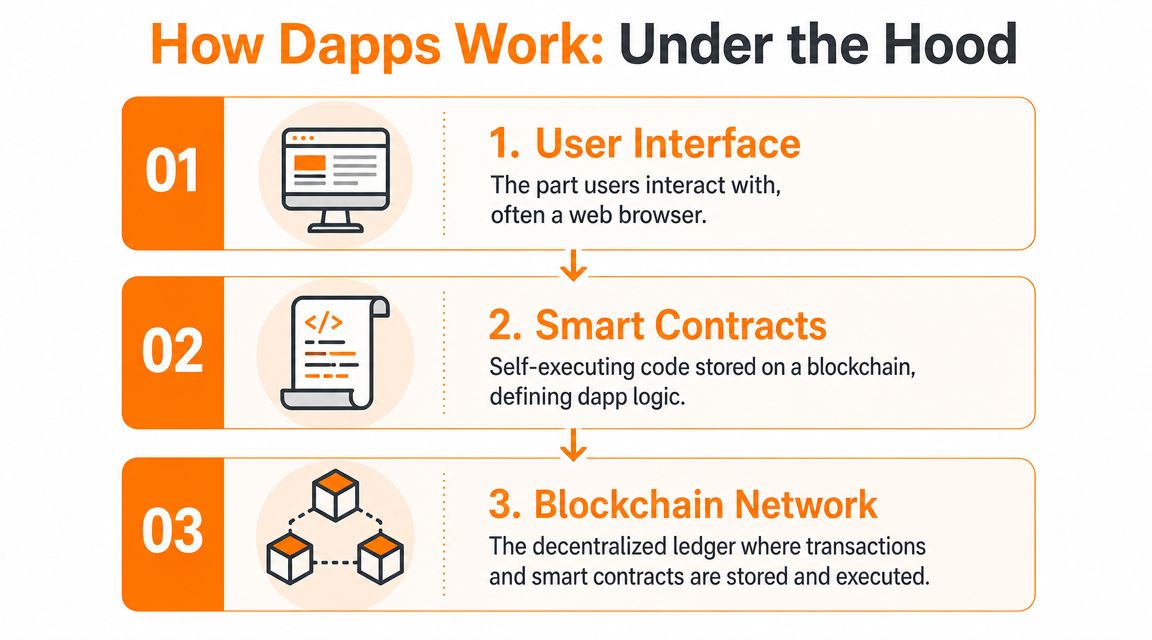
A useful way to picture it is as a small stack with a few moving parts. You have the screen you interact with, the wallet you use to approve actions, the smart contracts that define the app's rules, and the blockchain network that records and validates what happens.
The front end is familiar
A dapp is often a two-layer system. One layer is the normal client interface, like the website in your browser. The other is backend logic executed by smart contracts on a blockchain, as described in Ideasoft's explanation of dApp architecture.
That means the pretty part you click isn't the whole app. It's more like a control panel for interacting with blockchain-based logic.
If you want a companion explainer focused on the mechanics, this guide on how decentralized applications work is a handy follow-on read.
Smart contracts are like vending machines
A smart contract is easiest to understand as a digital vending machine.
You put in the right input, press the right option, and the machine gives the expected result. There's no cashier deciding whether you're allowed crisps or changing the rules halfway through the transaction. The instructions are built into the machine.
That's roughly how a smart contract behaves. If the conditions written in the code are met, it executes the programmed action.
Here's a simple example:
- You visit a token swap dapp.
- You choose to trade one token for another.
- Your wallet asks you to approve the transaction.
- The smart contract checks the rules and processes the swap.
- The blockchain records the result.
No bank clerk sits in the middle. No support rep manually moves your funds. The code handles the logic.
What the blockchain adds
The blockchain acts like a public ledger that many computers agree on together. Instead of one company database deciding what is true, the network uses distributed consensus to validate state changes.
That changes the trust model in a big way. Important actions become more transparent and tamper-resistant because the blockchain validates them, not a single company server.
For users, that has two direct consequences:
- Visibility: You can often inspect transactions and contract behaviour more openly than with a normal app.
- Finality: Once the network confirms an action, reversing it may be difficult or impossible.
The same feature that makes a dapp transparent can also make mistakes permanent.
The wallet is your key and your identity
In most dapps, your wallet does two jobs at once. It stores digital assets, and it acts as your identity when you connect to the app.
That's why wallet security matters so much. In a regular app, a hacked password is bad news. In a dapp, poor wallet security can mean someone gains the ability to approve transactions or move assets.
This is also why dapp risk often has less to do with a simple web server compromise and more to do with smart-contract correctness, key management, and the security assumptions of the underlying blockchain. For a newcomer, that's the heart of the matter. The interface may feel simple, but the core trust sits in code, keys, and network rules.
Real Dapps You Can Explore Today
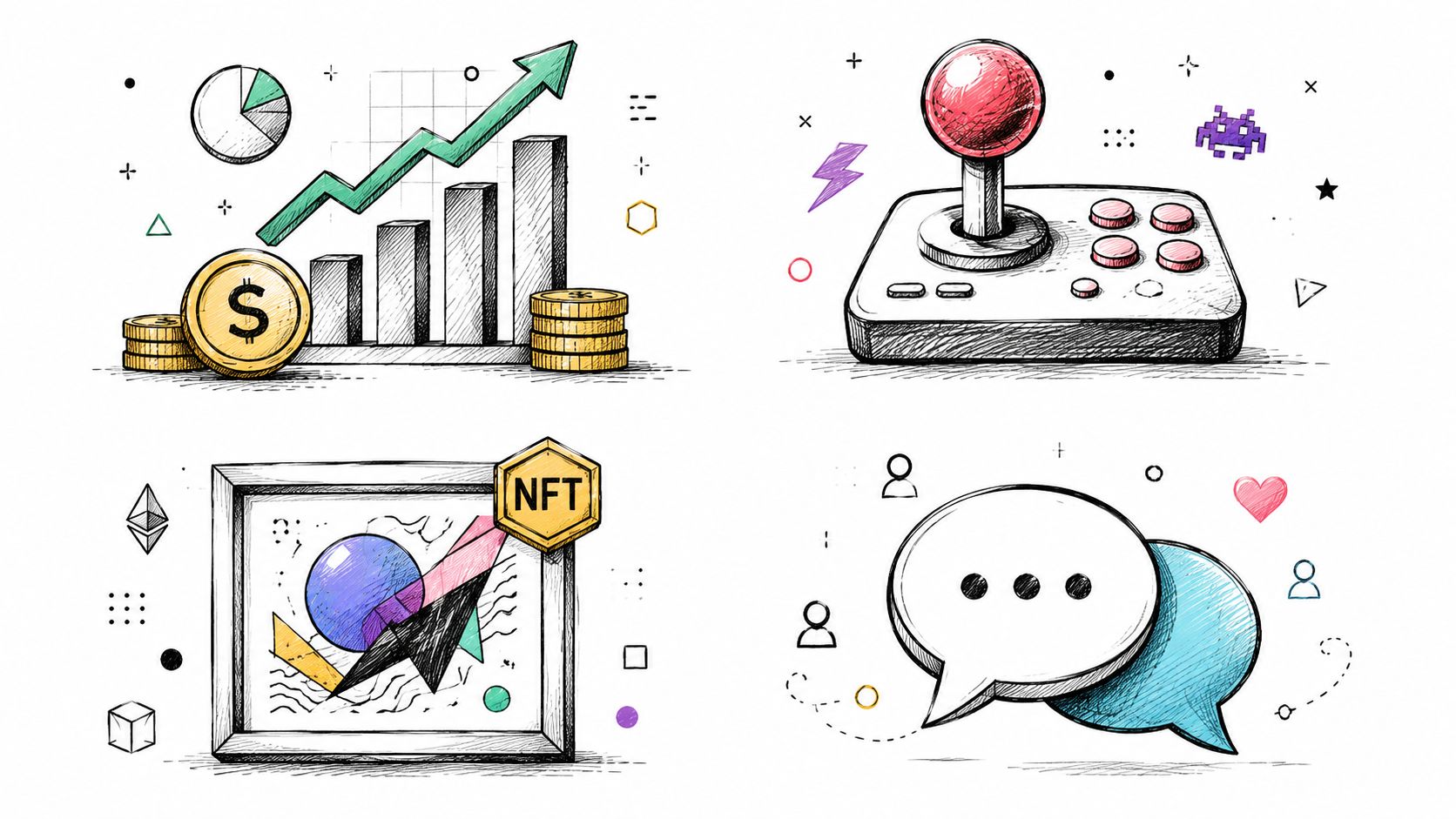
Dapps aren't just a theory or a developer hobby. You can try them today, and they already span finance, art, games, and social tools.
That said, “explore” doesn't mean “connect your wallet to everything you see”. It means learning what these apps are trying to do and noticing how the experience differs from standard web platforms.
Uniswap for swapping tokens
Uniswap is one of the most widely known examples in decentralised finance. In plain language, it lets people swap one crypto token for another without using a traditional broker.
If you've ever used a currency exchange kiosk at an airport, the idea is similar in spirit. You bring one asset and receive another. The difference is that a smart-contract system handles the logic instead of a cashier behind a counter.
For a user, the notable part is the flow. You connect a wallet, choose the assets, review the transaction, and sign. There's no account manager, and usually no form asking for the kind of profile details you'd expect from a standard fintech app.
OpenSea for digital collectibles
OpenSea is known for NFTs and digital collectibles. The simplest way to think about it is as an online marketplace where users can view, buy, list, and transfer blockchain-based items.
Even if NFTs aren't your thing, OpenSea helps make dapps more concrete because it shows how digital ownership can be handled on-chain. Instead of a game studio or art platform keeping the only internal record, ownership is tied to blockchain records and wallet addresses.
Axie Infinity and blockchain gaming
Axie Infinity is a well-known blockchain game. It helped many people understand that a dapp can also be entertainment, not just finance.
The interesting idea here is that in-game items can be linked to assets that users hold in wallets. That creates a very different relationship between the player, the platform, and the item itself. In a normal game, the publisher controls the full inventory system. In a blockchain game, some of that ownership logic moves onto blockchain rails.
Social and community dapps
Not every dapp is about trading or gaming. Some focus on communities, digital identity, or on-chain participation. These can feel less polished than mainstream social apps, but they show another side of the dapp world: software where communities may value openness and portability more than slick convenience.
A beginner doesn't need to use all these categories. The point is to see the pattern.
- Finance dapps let users swap, lend, borrow, or manage assets.
- Marketplace dapps let users buy and sell blockchain-linked items.
- Gaming dapps mix gameplay with wallet-based ownership.
- Social or governance dapps let people participate in communities or voting systems tied to blockchain tools.
Try reading a dapp the way you'd read a regular product. What can the user do, what must they approve, and who helps if something breaks?
That last question matters more than most first-time users realise.
How to Start Using a Dapp Safely
The safest first step with a dapp isn't making a big transaction. It's learning the flow with care and keeping the stakes small.
Start with a wallet you understand
Most beginners meet dapps through a wallet such as MetaMask or a mobile wallet app. The wallet is what lets you connect, sign messages, and approve transactions.
Before you use any dapp, get comfortable with the wallet itself. Learn where it shows your address, where transaction prompts appear, and what a network switch looks like.
The most important part is your recovery phrase or seed phrase. If someone gets it, they may gain control of the wallet. If you lose it, you may lose access yourself.
A few habits matter straight away:
- Write it down carefully: Store your recovery phrase somewhere private and secure.
- Never paste it into random sites: Real dapps don't need your seed phrase to connect.
- Treat wallet pop-ups seriously: A signature request is not just a harmless click.
For a focused walkthrough, this guide to safely connecting your wallet to DeFi dapps is worth reading before your first connection.
Fund the wallet cautiously
Most dapps require some crypto to do anything useful. For example, many Ethereum-based dapps need ETH to pay network fees.
If you're in the UK, the cautious approach is simple. Use a regulated crypto firm, move a small amount first, and treat your first transaction as practice rather than a big commitment.
Beginners often rush this stage and focus only on what they want to buy or swap. A better question is, “Can I comfortably afford to learn with this amount if I make an error?” That mindset reduces pressure and helps you read each screen more carefully.
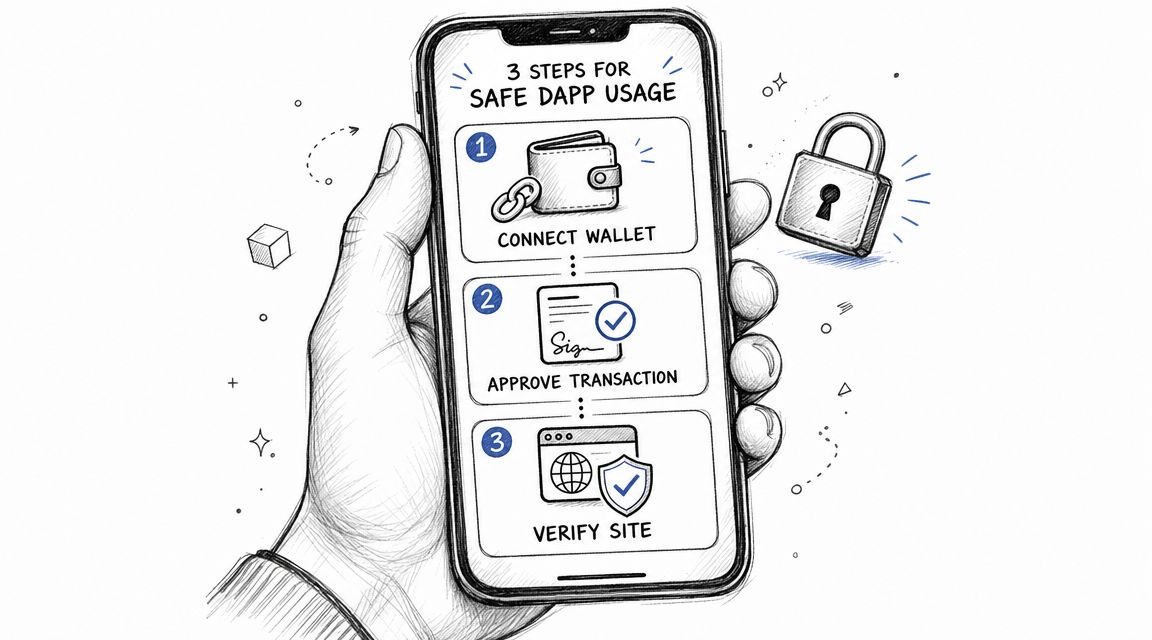
Here's a practical walkthrough to make the process easier to picture:
Connect, pause, then review
When you visit a dapp site, you'll usually see a Connect Wallet button. Clicking it doesn't always move funds. Often it just links your wallet so the app can read your address and show relevant options.
The risky moment comes after that, when the dapp asks you to sign something or approve a transaction.
Use this checklist before confirming anything:
- Check the website carefully. Fake lookalike sites are a common trap.
- Read the wallet prompt. If the request doesn't make sense, stop.
- Start with a tiny action. A small test is better than a large guess.
- Expect no undo button. If you approve something harmful, recovery may be limited.
One safe habit beats ten clever ones: slow down whenever a wallet asks for approval.
You don't need to be an engineer to use a dapp. You do need to behave more like your own security team than you would with a standard app.
Key Risks and the Future of Dapps
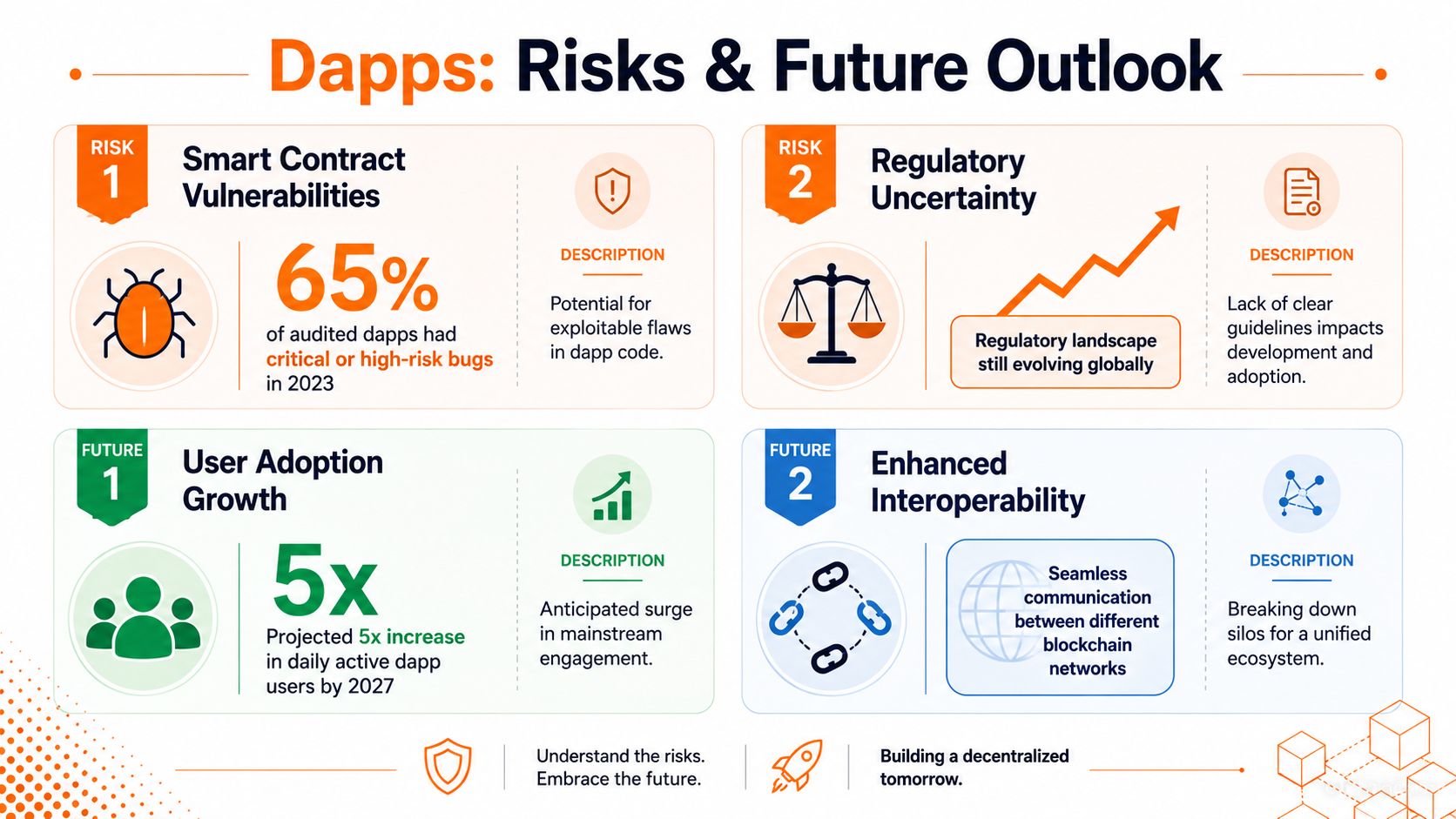
The exciting part of dapps is clear enough. They let people interact with software in a way that reduces reliance on a single company, opens up public verification, and supports new kinds of digital ownership and finance.
The hard part is that this freedom comes with responsibility, and the safety net is often thinner than beginners expect.
The main user risks
A dapp can be well designed and still be risky to use if the user signs the wrong transaction, trusts a fake site, or assumes there's a help desk that can undo the damage.
There's also an important UK-specific point that many beginner guides skip. Using a dapp doesn't automatically mean you're using a regulated financial product with familiar protections. The broader educational material around Ethereum dapps highlights a major gap in beginner understanding here, and that gap overlaps with UK regulatory concerns. As noted in Ethereum.org's dapp documentation context, UK-regulated crypto firms must comply with FCA financial promotions rules for qualifying cryptoassets, while the FCA has continued to warn that cryptoassets are high-risk and that consumers should be prepared to lose all their money.
That means a wallet connection is not the same thing as a bank relationship. It doesn't give you chargeback rights, guaranteed redress, or the sort of consumer protection many people assume is built into digital finance.
Why the sector still matters
Even with those risks, dapps aren't a sideshow anymore. One industry forecast projects the global decentralized application market at USD 42.13 billion in 2026, rising to USD 199.7 billion by 2035 at an 18.5% CAGR, according to Business Research Insights' dapp market forecast. The same forecast points to DeFi adoption and broader blockchain adoption as key growth drivers.
That projection matters because it suggests dapps are moving from an experimental corner of crypto into a broader software category used for finance, social applications, and transaction-based services.
There's also a capital-markets angle for UK readers. The VanEck Digital Transformation ETF reports that the United Kingdom represents 3.10% of the fund's net assets as of 22 May 2026, while the United States represents 75.80%, according to VanEck's DAPP ETF page. In practical terms, UK participation is visible, but much of the infrastructure and capital concentration still sits outside the UK.
A balanced way to think about the future
Dapps are promising, but they're not magic. Better interfaces, clearer wallet warnings, stronger contract practices, and better user education will matter just as much as blockchain innovation.
For now, the smartest beginner view is balanced:
- Be curious: dapps are an important part of how blockchain becomes usable.
- Be careful: decentralised doesn't mean protected.
- Be realistic: if something goes wrong, support and recovery may be limited.
- Be patient: the technology is improving, but it still asks a lot from users.
If your original question was “what is Dapp?”, the full answer is bigger than a one-line definition. A dapp is a blockchain-based application model with real potential, real utility, and real risks. Understanding all three is what makes you ready to use one well.
If you want to keep learning without the hype, The Coin Course is a strong next step. It offers beginner-friendly guides on blockchain, wallets, DeFi, security, and crypto fundamentals, with a clear focus on practical skills and safer decision-making.