Think of a crypto wallet as your personal gateway to the world of digital currencies like Bitcoin and Ethereum. It's the tool you'll use to store, send, and receive your crypto, much like a bank account for your digital money, but with one crucial difference: you're in complete control.
Understanding Your Digital Wallet
If you've ever carried a wallet for your cash and cards, you've already got the basic idea. A crypto wallet is your personal interface for managing your digital assets. But this is where the comparison to a physical wallet ends, and it’s a distinction that changes everything.
Your crypto wallet doesn't actually hold your coins in the way your leather wallet holds pound notes. Your cryptocurrency lives permanently on the blockchain – a massive, public digital ledger. What your wallet does hold are the secret keys that prove you own your coins and give you the power to spend them.
The Power of Your Private Keys
The single most important thing your wallet protects is your private key. The best way to think of this is as your digital signature and bank PIN all rolled into one. It’s a secret piece of code that unlocks your funds and authorises transactions. If anyone else gets their hands on this key, they control your crypto. For instance, if you own one Bitcoin, this key is the only thing that proves it's yours. That's why keeping it secret and safe is the golden rule.
At its core, a crypto wallet is a secure manager for your identity and assets on the blockchain. It's what lets you interact with your funds, making it an essential first step for anyone serious about crypto.
Why You Need a Crypto Wallet
Without a wallet, you can’t truly own or use cryptocurrencies independently. Sure, you can buy some Cardano (ADA) on an exchange and leave it there, but that means the exchange controls the keys, not you. A personal wallet puts you firmly in the driver's seat, giving you full command over your digital assets.
This move towards self-custody is a growing trend. In the UK, for example, the number of people using crypto wallets has shot up. Recent figures show that around 12% of UK adults – that's roughly 7 million people – now own cryptoassets. This number has more than doubled since 2020, showing a real shift towards people wanting to manage their own digital funds. You can dive deeper into these trends in The Legal 500's UK blockchain guide.
How Your Crypto Wallet Actually Works
To get your head around what’s happening inside a crypto wallet, you need to look past the slick app interface and focus on what it's really doing. It all boils down to two critical bits of information: a pair of keys. These keys work together to secure your funds and prove they belong to you.
The easiest way to think about it is like your email account. You have an email address you can give out to anyone, and then you have a password that you keep top secret. A crypto wallet runs on a very similar principle, using a public key and a private key.
The public key is used to generate a receiving address. This is the part you can share freely—it’s like your bank account number or, sticking with the analogy, your email address. There's zero risk in handing this out to someone who wants to send you crypto.
Your private key, on the other hand, is the secret sauce. Imagine it as your bank card's PIN and your signature all rolled into one. This key is what gives you the power to access your crypto and sign off on transactions. It’s absolutely vital you protect it, because if anyone else gets their hands on it, they control your funds.
The Role of Public and Private Keys
These two keys are linked together through some clever maths, but it’s a one-way street. You can't work out the private key just by knowing the public one. This is what allows you to receive funds safely without ever revealing the key that grants you access to them.
Here’s how it all comes together in a real-life scenario:
- Getting Paid: Let's say your friend wants to send you some Bitcoin. You'd give them your public wallet address. They use this address to tell the blockchain where to send the coins.
- Sending Funds: Now, imagine you want to pay for a coffee using crypto. You put in a transaction request. Behind the scenes, your wallet uses your private key to digitally "sign" this request. This signature is your proof to the network that you have the authority to move those funds.
This whole signing process happens in the blink of an eye. You just type in an amount and hit 'send,' but your wallet is doing the heavy lifting, using your private key to provide the cryptographic proof needed to get the transaction approved.
This diagram breaks down the main functions of a wallet, showing how it’s your gateway to sending, receiving, and managing your digital assets.
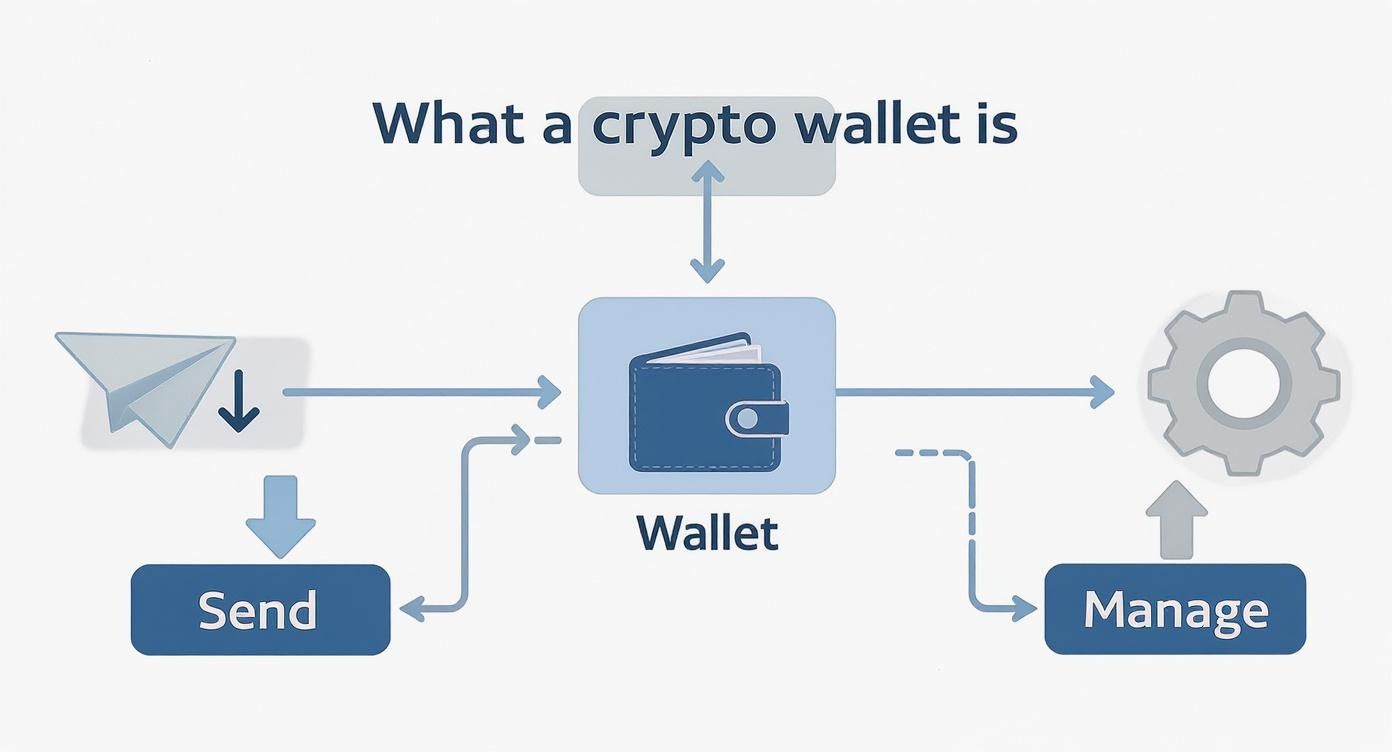
As you can see, a wallet isn't just a digital vault; it's an interactive tool for engaging with the blockchain.
Your Ultimate Backup: The Seed Phrase
So, what happens if your phone gets stolen or your laptop breaks? This is where a modern crypto wallet’s most important security feature comes into play: the seed phrase (you might also see it called a recovery phrase).
When you first set up a non-custodial wallet, it gives you a unique list of 12 to 24 random words, like apple, river, taxi, summer. This seed phrase is the master key to everything in your wallet. If you ever need to, you can use it to regenerate all your private keys and restore complete access to your funds on a brand new device.
Think of your seed phrase as the ultimate safety net. Your device can be lost, stolen, or destroyed, but as long as you have this phrase written down and stored safely, your crypto is recoverable.
The security of wallets has improved dramatically with the introduction of seed phrases. In the UK, a recent survey found that 85% of wallet users have created a seed phrase, which shows just how seriously people are taking control of their own assets. You can dig into more details about crypto wallet security trends on Wikipedia.
Because it’s so powerful, you need to treat your seed phrase with extreme care. Here are the golden rules for managing it:
- Never store it digitally. Don’t ever take a screenshot, save it in a text file on your computer, or put it in a password manager. Any digital copy is a potential target for hackers.
- Write it down on paper. Get a pen and a piece of paper and write down every word, in the correct order.
- Store it somewhere secure and offline. A fireproof safe or a safety deposit box are great options. Some people go a step further and stamp their phrase onto a small metal plate for maximum durability.
Once you understand how your public keys, private keys, and seed phrase all fit together, the technology behind a crypto wallet starts to make a lot more sense. It's a system built from the ground up to give you total control—and responsibility—over your digital wealth.
Exploring the Main Types of Crypto Wallets
Just like you might have a current account for daily spending and a savings account for your long-term goals, the crypto world offers different wallets for different needs. It's all about finding the right balance between convenience and security for you. We can break down the options into a few key categories to help you find the perfect fit.
The biggest split is between wallets that are connected to the internet and those that are kept completely offline. This single difference has huge implications for how you secure your digital assets. Think of it as the difference between keeping cash in your pocket versus storing gold bars in a high-security vault.
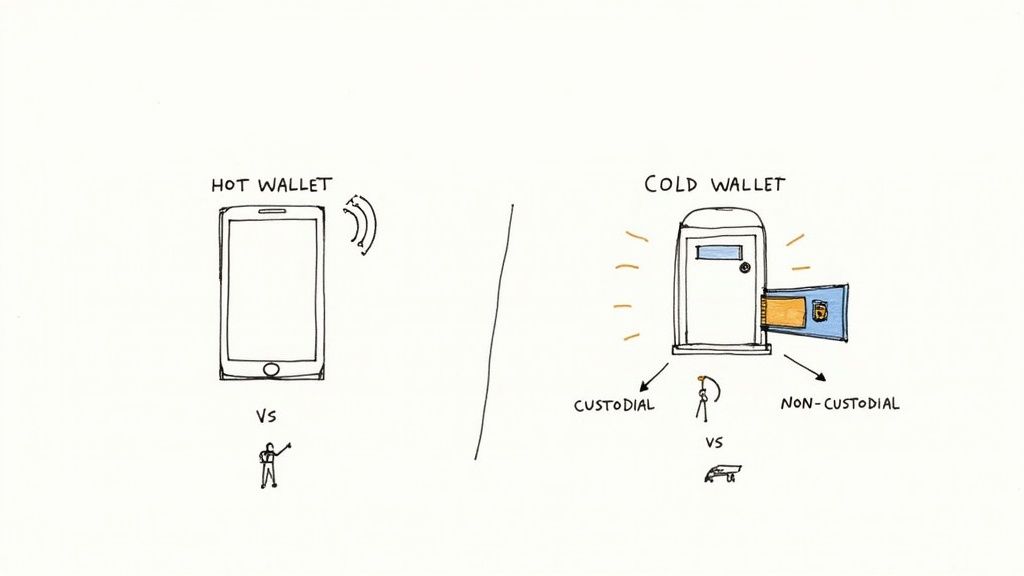
This fundamental choice—online access versus offline security—is where your wallet selection journey really begins.
Hot Wallets: The Choice for Convenience
A hot wallet is simply any crypto wallet that’s connected to the internet. This includes the mobile apps on your phone, software on your computer, and extensions you add to your web browser. Their constant online status makes them incredibly handy for everyday use.
If you’re planning on making frequent trades, interacting with decentralised apps (dApps), or just want instant access to your funds, a hot wallet is your go-to.
Popular examples like the Trust Wallet mobile app or the MetaMask browser extension are perfect illustrations. They let you send and receive crypto in seconds, making them ideal for active users exploring DeFi and NFTs. But, this convenience comes with a trade-off.
Because they’re always online, hot wallets are more vulnerable to digital threats like hacking and malware. While reputable wallets have strong security, their online nature makes them a more appealing target for cybercriminals.
It's smart to treat a hot wallet like the cash in your physical wallet. You keep enough for day-to-day spending, but you wouldn’t walk around with your entire life savings in your back pocket.
Cold Wallets: The Fortress for Your Funds
On the flip side, a cold wallet (often called cold storage) is a wallet that is kept completely offline. Your private keys are stored on a device that never touches the internet, creating an “air gap” that makes it virtually impossible for an online hacker to get to them.
The most common form of cold wallet is a hardware wallet. These are small, physical devices, often looking like a USB stick, built for one specific purpose: to keep your private keys secure.
Well-known names in this space include devices from Ledger and Trezor. To make a transaction, you connect the device to your computer or phone, physically confirm the details on the device’s secure screen, and then disconnect it. This process ensures your private keys are never exposed to an internet-connected machine.
Cold wallets are the gold standard for security. They're perfect for holding crypto long-term or storing large amounts. While they aren't built for quick, frequent trades, their protective power is second to none when it comes to securing your nest egg. For a deeper dive, check out our guide on hot wallets vs cold wallets and which is safer for your crypto assets.
Custodial vs. Non-Custodial Wallets: Who Holds the Keys?
Another crucial difference boils down to one question: who controls your private keys? Understanding this is probably the most important concept in wallet security, as it determines who has the final say over your money.
Custodial Wallets: In this case, a third party—like a crypto exchange such as Coinbase or Binance—holds and manages your private keys for you. This is handy for newcomers, as there’s no seed phrase to worry about losing. The catch? You have to trust that the third party will protect your assets. The famous crypto mantra, "not your keys, not your coins," is a direct warning about the risks of custodial services.
Non-Custodial Wallets: With these wallets, you and you alone have complete control over your private keys. All the hardware wallets we’ve mentioned (Ledger, Trezor) and most popular software wallets (MetaMask, Trust Wallet) fall into this category. It gives you true financial sovereignty but also puts all the security responsibility squarely on your shoulders. If you lose your seed phrase, there’s no one who can get your funds back for you.
To make things clearer, here’s a quick overview of how these wallet types compare.
Crypto Wallet Types At a Glance
| Wallet Type | Connection | Security Level | Ease of Use | Best For |
|---|---|---|---|---|
| Hot Wallet (Software) | Online | Good | Very Easy | Daily transactions, small amounts, DeFi/dApp access |
| Cold Wallet (Hardware) | Offline | Excellent | Moderate | Long-term holding, large amounts, maximum security |
| Custodial Wallet | Online | Depends on Custodian | Very Easy | Beginners, trading on exchanges, convenience |
| Non-Custodial Wallet | Varies | Your Responsibility | Moderate | Full control, self-sovereignty, long-term holding |
Understanding these distinctions is the first step to making a smart choice. In reality, most seasoned crypto users have a hybrid setup: a convenient hot wallet for active use and a fortress-like cold wallet for secure, long-term storage. This approach gives you the best of both worlds—everyday usability and complete peace of mind.
Setting Up Your First Crypto Wallet Step by Step
So, you’re ready to dive in and take control of your crypto. Setting up your first wallet might seem a bit daunting, but it's actually much more straightforward than you think. The good news is that the process is pretty much the same across the board for most non-custodial wallets, so once you learn it, you'll feel confident setting up any other.
Let’s walk through the essential stages. We'll use a typical software wallet as our example, but think of this less as a manual for one specific app and more as a universal blueprint. These steps will apply whether you're using a mobile app, a browser extension, or a desktop programme.
First things first, you need to choose a reputable wallet. If you're just starting out, a well-regarded software wallet like Trust Wallet, Exodus, or Phantom is a fantastic choice because they're built to be user-friendly. The crucial part here is to only download it from an official source.
Your Initial Setup Checklist
Getting your wallet up and running securely involves a few simple but non-negotiable actions. It's tempting to rush through this part, but that's a common mistake. Take your time to get it right from the very beginning.
Download the Official App: Always head directly to the official website, the Apple App Store, or the Google Play Store. Scammers are clever and often create convincing fake apps designed to steal your funds, so it pays to double-check you’re downloading the real deal.
Create a New Wallet: Once it's installed, open the app and choose the option to "Create a new wallet." The software will then begin guiding you through the setup, which leads directly to its most important security feature.
Secure Your Password: You'll be prompted to set a strong password or PIN. This password is there to protect the app on your specific device. Think of it as the first line of defence if someone ever gets their hands on your phone or computer.
This initial phase doesn't take long, but the next step is where you need to give your full attention. This is the moment you're handed the keys to your new digital vault.
The Most Important Step: Securing Your Seed Phrase
After you’ve set your password, the wallet will generate and show you a unique 12 or 24-word seed phrase. This is it—the master key to all the crypto you'll ever store in this wallet. If you lose your phone or your computer dies, this phrase is the only way to get your funds back.
Your seed phrase is the ultimate proof of ownership. Treat it with the same seriousness as the deeds to your house or the PINs to all your bank accounts. It is your final safety net.
Handling this phrase correctly is everything. Get this part right, and you've built a solid foundation for your crypto security. For an even more detailed walkthrough, our guide on getting started setting up and configuring your crypto wallet has plenty of extra tips.
Here are the absolute dos and don'ts:
- DO Write It Down Physically: Grab a pen and paper. Write each word down clearly and number them to make sure the order is perfect. The sequence matters just as much as the words themselves.
- DON'T Take a Screenshot: A screenshot creates a digital image of your master key, leaving it vulnerable on a device that could be hacked or infected with malware. Never, ever do this.
- DO Store It Securely Offline: Find a safe place that’s protected from fire, water, and anyone else's eyes. A home safe or a safety deposit box is ideal. Some people even make a few paper copies and store them in different secure locations.
- DON'T Save It Digitally: Don't even think about typing it into a notes app, sending it in an email to yourself, or saving it to a cloud drive. Any digital copy is a target just waiting to be found.
Once you’ve safely written down and stored your seed phrase, the wallet will probably ask you to confirm it by re-entering the words in the correct order. After that final check, you're all set! Your wallet is secure, and you're ready to find your public address and receive your first crypto.
Essential Practices for Keeping Your Crypto Safe
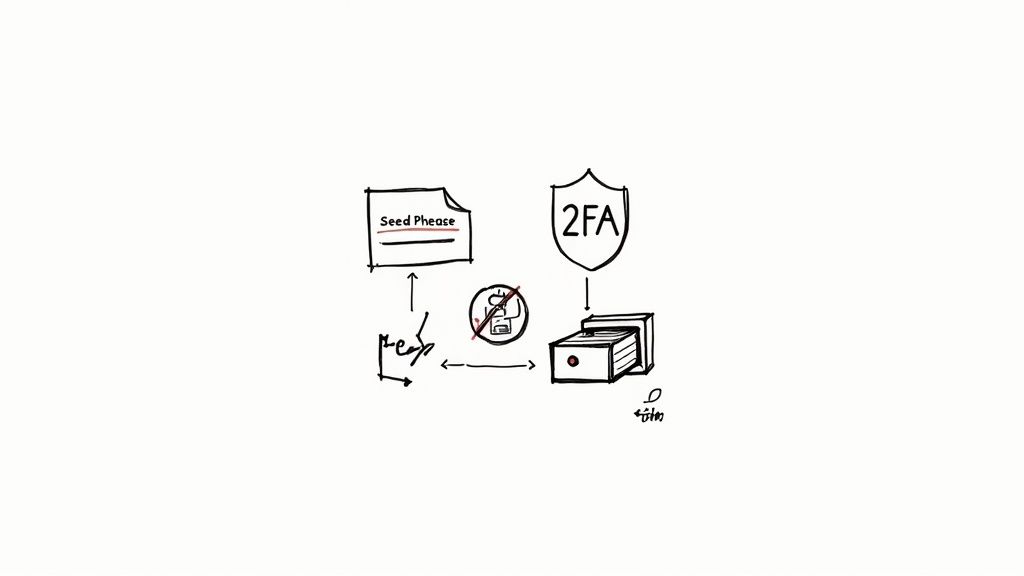
When you take full control of your crypto wallet, you’re not just holding digital assets—you’re essentially becoming your own bank. This is a huge shift in thinking, and it comes with real responsibility. There's a saying in this space that you'll hear over and over again for good reason: "Not your keys, not your coins." It’s a simple reminder that if you don't control your private keys, you don't truly own your crypto.
But don't let that responsibility feel overwhelming. Getting the basics right is all it takes to build a solid defence around your digital wealth. It’s less about being a technical wizard and more about developing a few careful habits.
Mastering Your Seed Phrase Security
Let’s be crystal clear: your seed phrase (also called a recovery phrase) is the most important secret you'll ever keep in crypto. It’s the master key that can bring your entire wallet back to life on any device, anywhere. If you lose it, your crypto is gone forever. If someone else gets it, they can drain your wallet in seconds.
Securing this phrase properly is non-negotiable. Your goal is to keep it safe from both digital threats like hackers and physical ones like a house fire or a flood.
- Store It Offline Only: Never, ever create a digital copy. That means no photos on your phone, no notes in a text file, and definitely no saving it to a cloud drive. A digital copy is a sitting duck for malware.
- Write It Down Physically: Grab a pen and paper. Write the words down clearly, in the exact order they're given. It’s a good idea to make a couple of copies and store them in different secure places.
- Use Durable Materials: Paper is fine to start, but for the long haul, consider something tougher. Stamping your seed phrase onto a small metal plate gives you fantastic protection against fire and water damage.
Think of your seed phrase as the ultimate safety net for your financial sovereignty. Its security is entirely up to you, making it the one thing you must protect above all else.
Strengthening Your Everyday Wallet Defences
Beyond storing your seed phrase, you need to think about how you protect your wallet in your day-to-day life. These habits are your frontline defence, stopping someone from gaining access to your funds if they get hold of your phone or computer.
A strong, unique password for your wallet app is the first barrier. Avoid easy-to-guess passwords like "Password123" and don't reuse one from another account. This simple step can stop a casual thief in their tracks.
Next, always enable two-factor authentication (2FA) if it’s offered. This adds a crucial second layer of security. Typically, you'll use an app like Google Authenticator that generates a temporary code. A thief would need your password and physical access to your 2FA device to get in. For a deeper dive, check out the essential guide to securing wallets and safeguarding seed phrases.
How to Spot and Avoid Common Scams
Scammers are incredibly creative and are always coming up with new tricks to get you to reveal your seed phrase or private keys. Learning to spot their tactics is one of your best defences. Phishing scams, in particular, are everywhere.
These scams might arrive as an email, a direct message on X (formerly Twitter), or a pop-up on a website. They're designed to look official—as if they're from your wallet provider or a crypto exchange. They often create a fake sense of urgency, claiming your account is at risk or offering a too-good-to-be-true giveaway to bait you into clicking a malicious link.
Here’s how to stay safe:
- Never Share Your Seed Phrase: No legitimate company or support team will ever ask you for your 12 or 24-word recovery phrase. Anyone who asks is a scammer. Period.
- Verify Website URLs: Before you connect your wallet to any website, double- and triple-check the URL. Scammers make perfect copies of real sites with tiny misspellings to catch you off guard.
- Be Wary of Unsolicited Offers: If an offer for free crypto or a "guaranteed" return lands in your inbox, it's almost certainly a scam.
Staying vigilant is vital, especially in places like the UK where crypto is becoming more mainstream. Recent figures show that nearly 35% of the UK population now engages with crypto assets, with the average UK crypto user holding over $2,286. This makes robust security more critical than ever. By keeping your guard up, you can confidently navigate the space and protect your stake in the digital economy.
Common Questions About Crypto Wallets
As you start to get your head around crypto wallets, it's completely normal for a few questions to surface. It’s a new world, and some of the concepts can feel a bit strange at first. Don’t worry, most of the common sticking points have straightforward answers.
Let's clear up some of the things that often trip people up. Getting these fundamentals right from the beginning will make your whole experience with crypto smoother and safer.
Can I Have More Than One Crypto Wallet?
Yes, absolutely. In fact, it's a very smart way to manage your crypto. Think of it like your bank accounts: you might have a current account for daily spending and a separate savings account you rarely touch. The same logic applies here, helping you organise your assets and minimise risk.
A popular strategy is to keep a small amount of crypto in a mobile "hot wallet" for quick trades or payments. For example, you might keep some Solana (SOL) in a Phantom wallet for buying NFTs. Then, you can store the bulk of your holdings, like your Bitcoin, in an ultra-secure "cold" hardware wallet, which stays completely offline. You can create as many wallets as you like—there's no limit.
What Happens If I Lose My Phone or Laptop?
This is probably the number one fear for anyone starting out, but the solution really shows off the power of how blockchains work. If your device gets lost, stolen, or just stops working, your crypto is perfectly safe, provided you've backed up your seed phrase.
Your funds aren't actually stored on your device. They live on the blockchain. Your phone or laptop is just the tool you use to access them with your private keys.
If you lose your device, you can simply install your wallet software on a new one and use your 12 or 24-word seed phrase to restore full access to all your funds. This is why that phrase is the single most important thing you need to protect.
Are Crypto Wallets Completely Anonymous?
This is a big misunderstanding. Crypto wallets are pseudonymous, not anonymous. There’s a key difference. Your wallet address—that long string of characters—isn’t directly linked to your name or home address. In that sense, it offers privacy, a bit like using a pen name.
However, every single transaction is permanently recorded on the public blockchain, tied to that address. If your wallet address ever gets linked to your real identity (for instance, by withdrawing from an exchange where you've verified your ID), an investigator could potentially trace your entire transaction history. So, while you have a layer of privacy, you're not invisible.
Do I Need a Separate Wallet for Each Cryptocurrency?
Thankfully, no. That used to be the case in the very early days, but modern wallets have made things much simpler. The vast majority of wallets you'll come across today are multi-currency, meaning they can hold lots of different digital assets all in one place.
Popular software wallets like Exodus or hardware wallets from Ledger can handle Bitcoin, Ethereum, and thousands of other coins and tokens all at once. Before you settle on a wallet, it's always a good idea to pop over to its official website and check its list of supported assets. A quick check will ensure it’s a perfect fit for everything you plan to hold.
Ready to take the next step in your crypto education? At The Coin Course, we provide clear, expert-led guides to help you master everything from wallet security to advanced trading strategies. Start your journey with confidence by exploring our resources at https://thecoincourse.com.