You've connected your wallet to a lending app, deposited crypto as collateral, and watched the transaction appear on the blockchain. The code is automatic, the records are public, and the network is working normally. Then a price feed reports the wrong value, and the contract sells your collateral or approves a loan under conditions that never existed in the actual market.
That's the practical reason what is an oracle in blockchain matters. An oracle brings information from outside a blockchain into the system so a smart contract can respond to events it can't observe by itself. For UK users and developers, the important question isn't only whether an oracle works. It's who supplies the data, how the feed is protected, and what happens when the information is late, wrong, or disputed.
Why Your Smart Contract Needs a Data Bridge
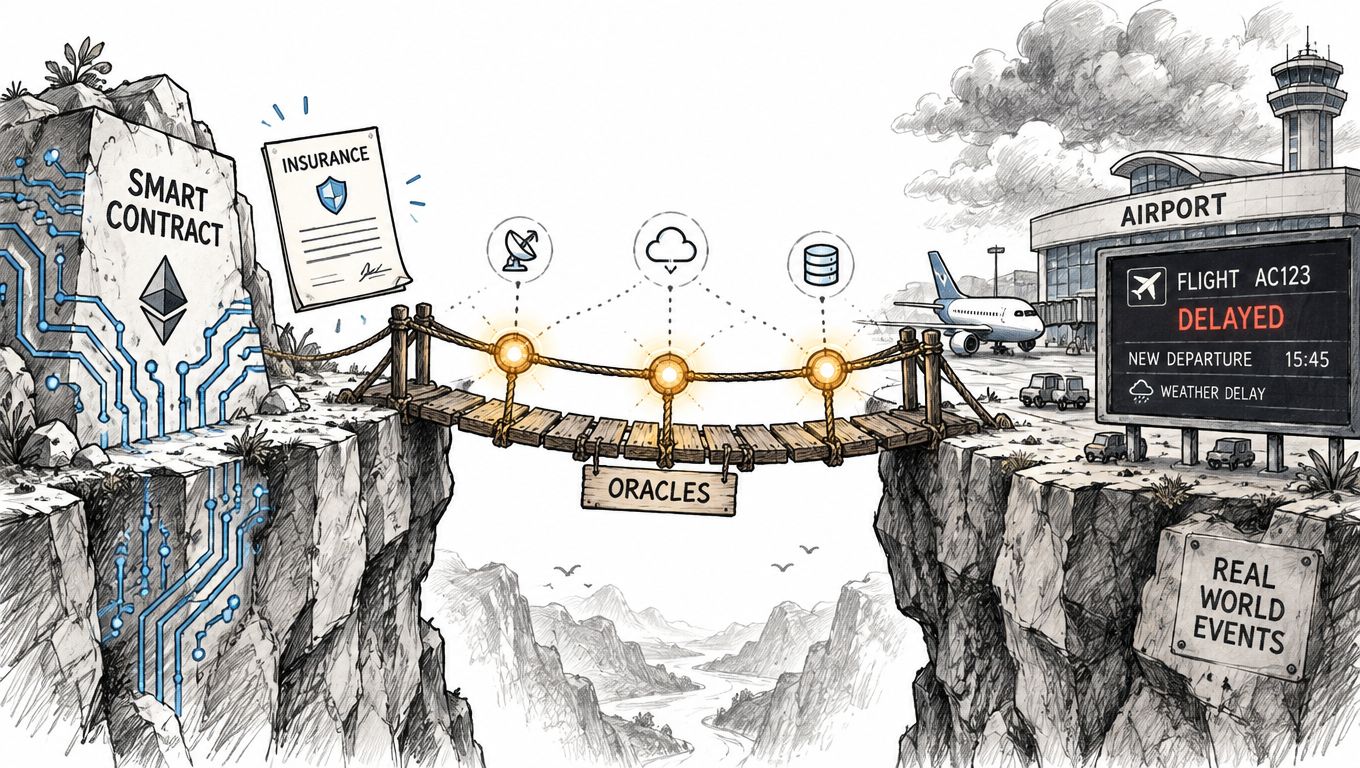
Suppose you create an insurance contract that pays automatically when your flight is delayed. You set the rule clearly: if the flight arrives late, release the payout to the passenger. The smart contract can hold the funds and follow the rule, but it can't open an airline database or check the airport's arrival board on its own.
That limitation comes from how blockchains operate. A blockchain normally verifies transactions using information already available within its own network. It can confirm that a token moved, a wallet signed a transaction, or a contract's internal balance changed. It can't independently observe a flight status, a weather event, a share price, a shipment's location, or a payment made through a conventional bank.
The result is a gap between blockchain-native facts and real-world facts. The insurance contract knows its own instructions, but it doesn't know whether the plane landed late. Without an outside input, it can't complete the promise it was designed to make.
The missing connection
A smart contract is a set of coded rules that automatically executes and records a transaction when predetermined conditions are met. The UK Government's explanation of cryptoasset infrastructure describes smart contracts as open-source, codified rules that execute once those parameters are satisfied.
The contract can do the automatic part. It needs another mechanism to confirm the outside condition. That mechanism is the oracle, a data bridge between the contract and the information it needs.
This pattern appears across financial and commercial applications. A lending protocol needs an asset price to decide whether collateral remains sufficient. A trade-finance contract may need delivery confirmation. A prediction market may need the outcome of an event. A tokenised asset platform may need a reserve figure or net asset value.
You can find a beginner-friendly overview in this guide to blockchain oracles and smart contracts. The central idea is simple: the blockchain can enforce a rule, but an oracle supplies facts that sit outside the ledger.
Defining the Blockchain Oracle Simply
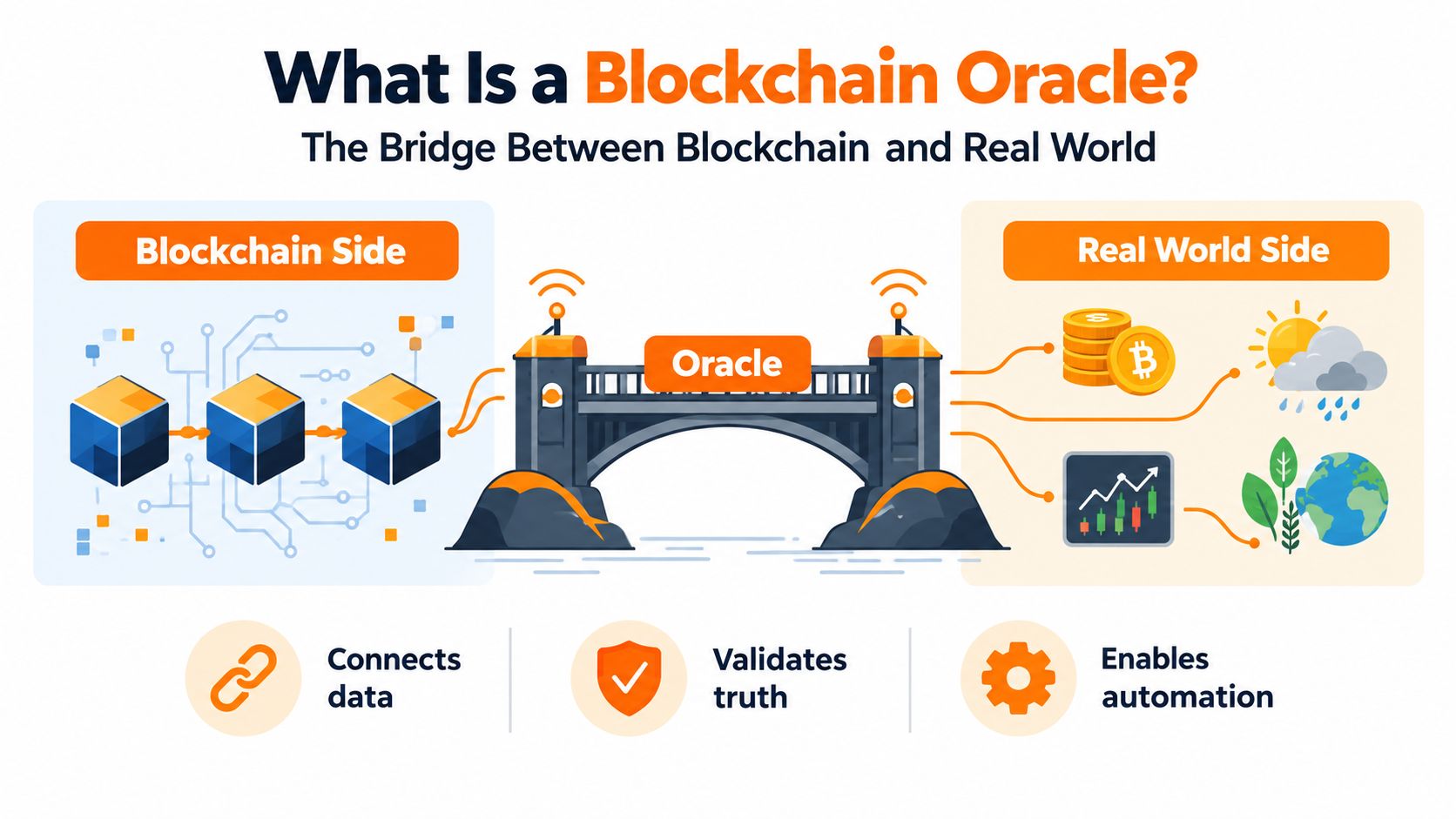
An oracle is a mechanism or service that connects a blockchain or distributed-ledger system with information outside that ledger. It may transfer external information into a blockchain, send information from a blockchain to an outside system, or help move information between blockchain networks.
Think of a blockchain as a secure office with no windows. Everyone inside can inspect the same records and agree on what happened within the office. But nobody inside can see the weather, a share price, a delivery van, or an exchange rate unless someone brings that information in.
The oracle acts as the doorway or bridge. It collects an outside observation, processes it according to its design, and makes the result available to a smart contract.
Why blockchains can't simply look things up
Blockchains are built for deterministic execution. That means the same transaction should produce the same result for the computers checking it across the network. If one computer could freely call a changing website or API while processing a transaction, different computers might receive different answers.
A smart contract therefore relies on information that the blockchain can reproduce and verify. An external data feed turns a changing real-world observation into an input the network can use.
A pound exchange rate provides a useful example. A contract could say, “Release the funds when the pound reaches a specified value.” The contract can compare numbers and release funds automatically, but it needs a data feed to tell it whether that exchange rate has been reached.
A simple three-part model
You can understand most oracle systems through three steps:
- Collect the information. A provider obtains data from an exchange, database, sensor, website, institution, or another system.
- Assess or combine the information. The oracle may compare several observations, reject unusual values, apply an aggregation rule, or attach evidence about when and where the data came from.
- Publish the result on-chain. The smart contract receives the value and applies its own instructions.
The word “oracle” can sound mystical, but the job is practical. It supplies the missing input that lets automated code respond to a fact beyond the blockchain.
That input could be a cryptocurrency price, an interest rate, a proof-of-reserves figure, a shipment status, a weather reading, or the result of an event. The blockchain records what the oracle reported, but it doesn't automatically prove that the original report was truthful. That distinction becomes the main risk.
Types of Oracles and How They Differ
Oracle designs differ mainly in where data comes from, how many parties provide it, and which direction information travels. A single feed may be convenient for a simple application, while a financial protocol handling collateral needs stronger safeguards.
| Oracle type | How it works | Main advantage | Main concern | Suitable example |
|---|---|---|---|---|
| Centralised | One operator or source supplies the value | Simple governance and low latency | A single point of failure | A private application using one trusted business database |
| Decentralised | Several providers contribute observations and a network combines them | Reduces dependence on one operator | More coordination, cost, and possible delay | A lending protocol using an aggregated asset-price feed |
| Inbound | Information moves from an outside system onto the blockchain | Lets contracts respond to external events | The input may be stale, inaccurate, or manipulated | A collateral price or flight-status result |
| Outbound | A blockchain event triggers an action outside the blockchain | Connects on-chain activity to external services | The receiving system and operator must also be trusted | A payment instruction or notification sent to another system |
Centralised and decentralised approaches
A centralised oracle resembles a single clerk reading a value from one source and entering it into the contract. This can be fast and easy to operate. It can also fail if the clerk is hacked, becomes unavailable, supplies a bad figure, or has too much control over the application.
A decentralised oracle network asks multiple sources for their observations. The network then uses a method such as a median, average, source limit, or update threshold to publish a combined value. If one source reports something far away from the others, the design may exclude it.
That doesn't make decentralisation perfect. Several sources may rely on similar underlying markets, experience the same outage, or be influenced by coordinated manipulation. It reduces one type of dependence while adding coordination and governance questions.
Inbound and outbound flows
Most beginner examples focus on inbound oracles, because DeFi contracts commonly need external prices or event results. Outbound oracles work in the opposite direction. They allow an on-chain event to communicate with an external service, although that service still needs its own controls and authority.
For a DeFi lending protocol, a decentralised inbound feed is usually more appropriate than a single-source feed because an incorrect price can affect collateral checks. A basic prediction market might accept a different design, particularly if its outcome process includes clear human review and a dispute mechanism.
The right choice depends on the consequences of an error. Latency matters, but so do source diversity, update behaviour, fallback rules, and the ability to pause the contract.
Understanding the Oracle Problem and Risks
The oracle problem is the gap between recording information securely and showing that the information was correct before it entered the blockchain. Once a smart contract receives a value, the blockchain can record the resulting transaction and make later changes difficult. It cannot independently return to an exchange, database, sensor, or legal record to check whether that value was truthful.
Consider a lending contract that liquidates collateral when an asset price falls below a set threshold. An accurate feed allows the contract to act quickly and consistently. A wrong, delayed, or manipulated price can trigger the same automatic process against the wrong borrower. For a practical explanation of this DeFi connection, see how oracles underpin decentralised finance.
The FCA's research on maximal extractable value and blockchain oracles describes oracles as important infrastructure for decentralised applications, including lending platforms. It also warns that attackers can alter data flows directly or influence them indirectly through methods such as flash loans.
Where failures can begin
An oracle-dependent application can fail at several points:
- Source failure: An exchange, API, sensor, or database reports inaccurate information or stops responding.
- Operator failure: A provider is compromised, makes an operational mistake, or updates the feed too slowly.
- Aggregation failure: A network accepts an abnormal observation or uses a weak method to combine reports.
- Market manipulation: An attacker moves a thinly traded market or exploits a temporary price difference to influence the feed.
- Governance failure: Protocol controllers delay an emergency response or disagree about the appropriate action.
- Contract failure: The smart contract handles stale, missing, or extreme data poorly.
The Bank of England's DLT Innovation Challenge material identifies compromise, manipulation, accuracy, and governance as risks associated with oracle services. Blockchain consensus therefore covers only part of the security boundary. The oracle and its data providers also influence the result.
Practical rule: A tamper-resistant contract can still produce a wrong result if it receives a tampered input.
Controls that reduce exposure
The highest-impact controls are diverse, independent data sources, plus deviation limits and circuit breakers that can reject an unusual price or pause an automatic action. Supporting controls include aggregation rules, cryptographic authentication where available, freshness timestamps, quorum requirements, and emergency pause functions.
Developers should document who operates each feed, what happens during an outage, and who must respond. These measures do not remove risk. They give the protocol more ways to identify suspicious data and stop losses before they spread.
For UK users and investors, the practical lesson is clear. The blockchain may be operating correctly while an oracle-dependent application misprices collateral, causes an unjustified liquidation, or approves borrowing against insufficient value. Assess the feed design, its failure controls, and its response process rather than treating “decentralised” as a guarantee.
Real-World Examples Like Chainlink
A decentralised price feed makes the process easier to visualise. Several data sources provide observations about an asset. Oracle nodes collect those observations, apply an aggregation process, and publish a resulting value to a blockchain. A lending contract then reads that value when checking collateral.
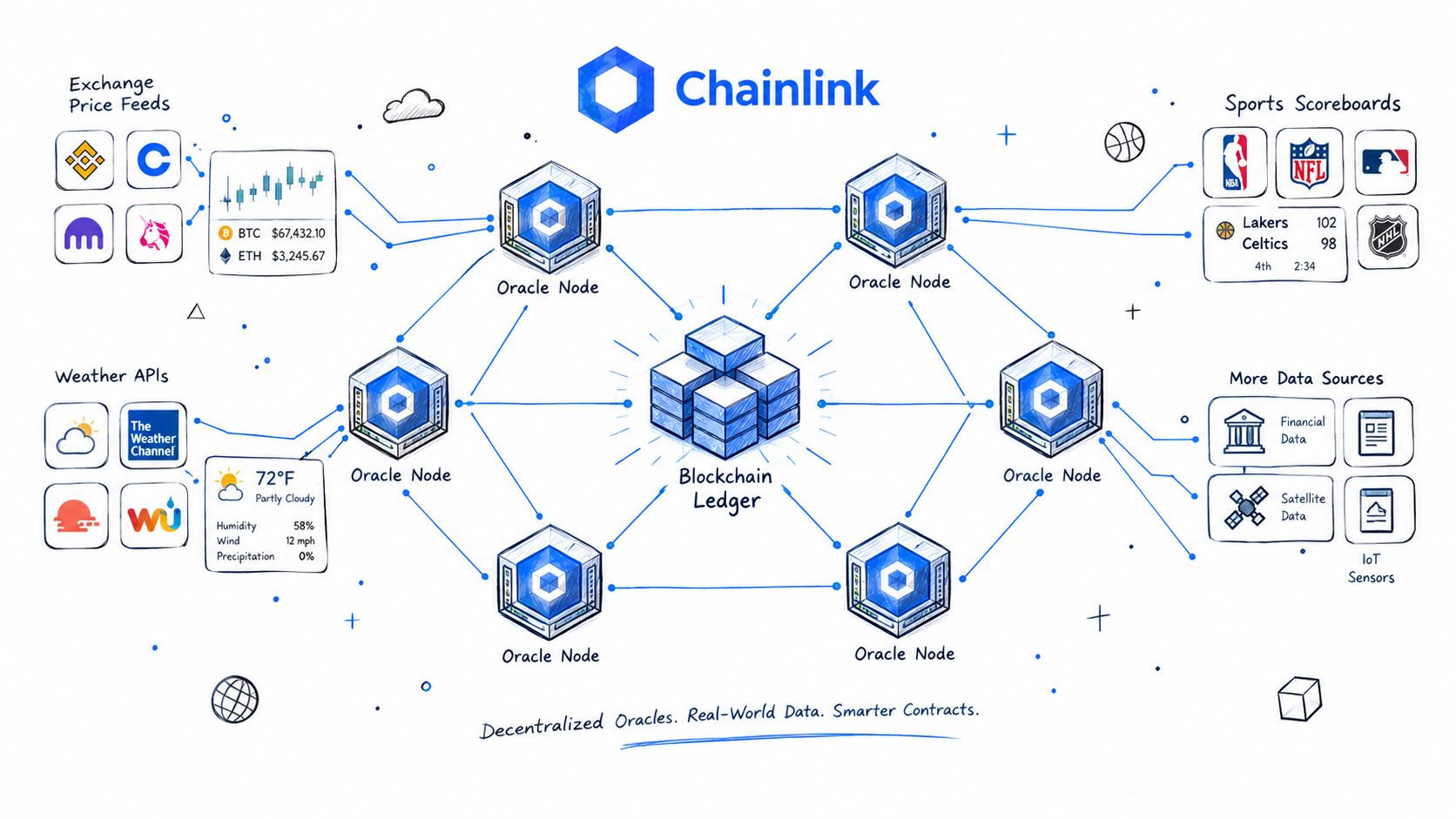
Chainlink is a well-known example of this model. Its data services connect smart contracts with external information, including market data and proof-of-reserves information. The Chainlink Data Feeds documentation explains how feeds can supply asset prices and other values used by blockchain applications.
Suppose a lending app needs the current value of an asset. The application doesn't want to trust a single exchange, because that venue could suffer an outage or show a price that differs from the broader market. A network can collect observations from several sources and publish a combined figure. The contract uses that figure to decide whether a borrower remains within its collateral requirements.
From data source to contract
The flow often looks like this:
- External providers publish observations. These may come from exchanges, market data services, APIs, institutions, or other systems.
- Oracle nodes retrieve the observations. Operators may use different sources so the application doesn't depend on one connection.
- The network combines the values. An aggregation rule can limit the effect of an unusual observation.
- The result reaches the blockchain. The smart contract reads the published value and follows its programmed rules.
- The application records the outcome. The resulting loan, trade, settlement, or other transaction becomes visible on-chain.
Oracles can provide more than crypto prices. Applications may use them for interest rates, reserve attestations, net asset values, delivery confirmations, and event outcomes. The design still matters because each data type has its own source, timing, and dispute risks.
A separate example is a prediction market. It may need an event result rather than a market price, so the key question becomes who determines the outcome and how disputes are handled. Readers exploring the connection between oracle feeds and prediction-market data can review Chainlink data for Polymarket for additional context.
The commercial and infrastructure side also keeps developing. For example, this report on a Chainlink deal involving large-scale value movement shows how oracle infrastructure can sit between blockchain systems and established financial technology.
The following video offers a visual explanation of how oracle networks connect external data with smart contracts:
The important point isn't the brand name. Chainlink, Pyth, RedStone, and other providers can use different architectures, source arrangements, and delivery methods. Users should examine the specific feed used by a protocol rather than assuming that one provider makes every application equally safe.
Key Takeaways for Crypto Users and Developers
An oracle is the connection between a blockchain's internal records and facts outside the network. It makes applications such as lending, insurance, tokenised assets, and prediction markets possible, but it also introduces a new trust and security dependency.
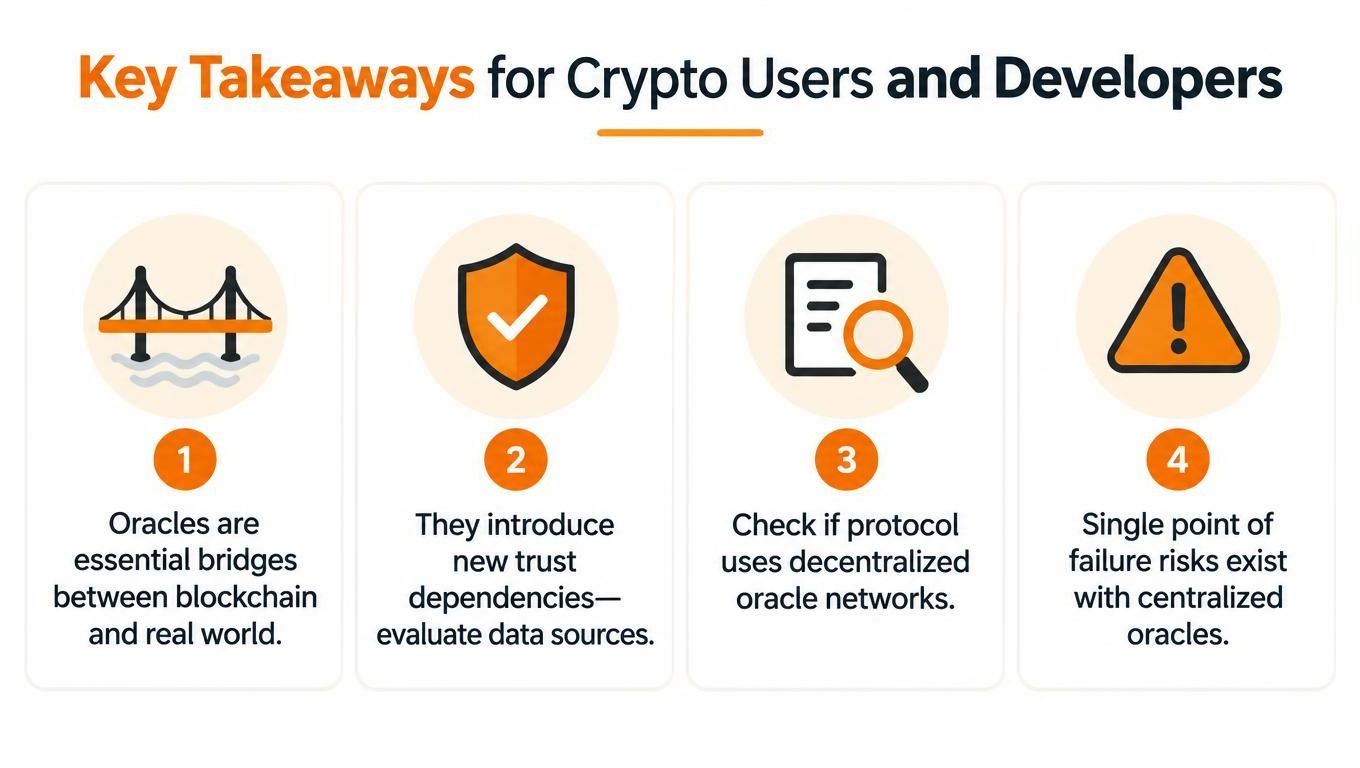
Before using an oracle-dependent protocol, ask:
- Source diversity: Does the feed use several independent providers, or does one operator control the value?
- Freshness: Does the application reject stale data and show when the feed was last updated?
- Outlier controls: Does it use a median, deviation limit, circuit breaker, or another method to handle abnormal readings?
- Failure response: Can the protocol pause risky actions during an outage, and does it explain who responds?
- Accountability: Are the oracle operator, developers, governors, and users clearly identified in the available documentation?
- Access and legal status: If you're in the UK, can you distinguish the technical oracle from the regulated or potentially regulated business using it?
UK policy treats an oracle as a data connection, not automatically as an authorised exchange, custodian, or trading platform. The UK regulatory framework for cryptoasset activities covers activities such as trading platforms, qualifying stablecoin issuance, custody, dealing, arranging deals, and staking under the applicable regime. Supplying data to one of these services doesn't by itself grant the oracle authorisation for those activities.
Frequently Asked Questions About Oracles
Are blockchain oracles regulated in the UK?
An oracle isn't automatically a regulated financial service just because it supplies data. UK rules may apply to the business using the oracle or performing activities such as operating a trading platform, safeguarding cryptoassets, issuing qualifying stablecoins, or arranging deals.
The FCA's 2025 cryptoasset consumer research found that 8% of UK adults, around 4.5 million people, owned cryptoassets in 2025, with an estimated average portfolio of £2,250. The same research found that 25% of UK crypto users would be more likely to invest if cryptoassets were more regulated, while 73% used centralised exchanges to acquire crypto and 22% reported staking. Regulation may improve disclosures and operating standards, but it doesn't guarantee compensation after a faulty feed or smart-contract failure.
How does an oracle affect smart-contract security?
It expands the security boundary. A contract can contain correct code and run on a healthy blockchain, yet still make a bad decision if the oracle supplies inaccurate, manipulated, or outdated data.
Developers should treat the feed as part of the application's core security design. They need to consider source independence, authentication, update frequency, deviation rules, stale-data handling, emergency controls, and governance.
What happens if an oracle feed fails?
The outcome depends on the protocol. A well-designed application may reject stale data, pause liquidations, switch to a fallback feed, or require a governance decision. A poorly designed one may continue using an old value, accept an abnormal value, or execute automatically before anyone can intervene.
Users should read the protocol's oracle documentation before depositing funds. Look for the feed operator, source methodology, update conditions, incident process, and any stated limits on recovery. Blockchain immutability can preserve the record of a failure, but it can't automatically reverse the loss.
The Coin Course offers structured education on blockchain fundamentals, DeFi, wallets, security, and advanced crypto concepts, including practical guidance for evaluating smart-contract and oracle risks. Visit The Coin Course to build the knowledge needed to assess protocols and protect your assets with greater confidence.