A Decentralised Autonomous Organisation (DAO) is a fresh, new way of building an online community. Instead of being run by one boss or a small group of directors, it's managed by all of its members. Imagine it as a digital club where all the rules are written in computer code on a blockchain, and every big decision is decided by a group vote. This isn't just a small change to how businesses work; it’s a total flip, moving power from a central leader to the entire group.
What Is a DAO in Simple Terms
Think about a normal company for a second. There’s a CEO at the top, a board of directors, and a clear ladder of command. All the big decisions are usually made behind closed doors by just a handful of people.
Now, turn that idea completely upside down. Picture a community that is owned and run by its members, where every single action—like spending money from a shared bank account or changing the group’s rules—is suggested, talked about, and voted on by everyone who has a stake in it. That, in a nutshell, is a DAO.
A Decentralised Autonomous Organisation is an organisation that exists on the blockchain, run by computer code (smart contracts) and the shared decisions of its members. These smart contracts aren't just guidelines; they are the organisation's unbreakable rulebook. They automatically carry out decisions as soon as a vote passes, which removes the need for human managers and makes the whole operation transparent and fair for everyone.
The buzz around DAOs has grown right alongside the rise in popularity of digital assets. Here in the UK, for instance, the fast increase in crypto adoption has created a perfect environment for these new organisations to grow. As of 2025, almost 35% of the population—that’s about 24 million people—now own or use some form of crypto asset.
Moving Away from Central Control
The biggest change a DAO introduces is the shift from a top-down, centralised structure to a flat, decentralised one. Instead of trusting a CEO or a board to look after the money and decide on the strategy, a DAO's treasury is controlled directly by all its members.
This new way of doing things has some fantastic benefits:
- Full Transparency: Every transaction, every vote, and every suggestion is recorded on a public blockchain. Nothing is hidden. For example, you can see exactly how much was spent on a project and who approved it.
- Community Governance: Members use special "governance tokens" to vote on ideas, giving them a real say in how the organisation moves forward.
- Automated Rules: Because the main rules are enforced by code, the risk of human error or someone abusing their power is massively reduced.
A DAO is basically an internet-native organisation with a shared bank account. No single person can access the funds without the group's permission; it’s all managed together.
This model is a world away from the traditional structures we're used to. To really understand this, it’s worth taking a closer look at the core differences between centralised vs decentralised systems in more detail. Getting a handle on this difference is key to seeing why so many people are exploring what a DAO is and how it can be used for everything from finance to art clubs.
Traditional Company vs DAO A Quick Comparison
To make the difference even clearer, let's break down the main ways a standard organisation and a DAO are not alike. The table below shows how they differ on everything from their structure and how they make decisions to how open they are.
| Feature | Traditional Company | DAO (Decentralised Autonomous Organisation) |
|---|---|---|
| Structure | Hierarchical (Top-down management) | Flat and decentralised (Community-led) |
| Governance | Board of Directors and Executives make key decisions | Members vote on proposals using governance tokens |
| Rules | Internal policies, legal contracts | Smart contracts on a blockchain (Code is law) |
| Transparency | Often opaque; decisions made behind closed doors | Fully transparent; all actions and votes are on a public ledger |
| Operations | Requires human intermediaries and management | Automated through smart contracts once consensus is reached |
| Entry | Typically requires employment or investment through formal channels | Generally open; participation often requires holding the DAO's token |
As you can see, the DAO model really does flip the traditional corporate structure on its head, choosing community ownership and open teamwork over strict, top-down control.
How DAOs Actually Work Under the Hood
To really understand a DAO, you need to look past the fancy words and get into the basics. At their heart, DAOs run on two main things: smart contracts and governance tokens. It's how these two things work together that makes a decentralised, community-led organisation possible.
Think of smart contracts as the DAO's rulebook, but this rulebook is written in computer code and stored on the blockchain. It sets out all the basic laws of the organisation—how decisions are made, how money is spent, who can join—and automatically makes sure they are followed. Crucially, once these rules are in place, they can’t be secretly changed by anyone.
Governance tokens, on the other hand, are your ticket to having a say. Holding these tokens is like owning shares in a company, but instead of just having financial value, they give you voting power. The more tokens you have, the more weight your vote usually has when it's time to make a decision.
The Decision-Making Process in Action
So, how does this all work in the real world? Let’s say a DAO that funds local art projects wants to approve a new mural for a community centre.
Here’s a simple breakdown of how that would happen:
- Putting an Idea on the Table: A member writes up a proposal on the DAO's online forum. It will include all the key details: the artist's name, their vision for the mural, and the requested budget—for example, £5,000.
- Community Discussion: Before any votes are cast, the proposal is shared for the whole community to discuss. Members can ask questions, suggest changes, or just show their support in a forum or a group chat.
- Casting the Votes: After the discussion is over, the official vote begins. Members use their governance tokens to vote: "Yes," "No," or "Abstain." The smart contract counts the votes automatically, so there's no chance of mistakes or cheating.
- Action Stations: If the proposal gets enough support to pass the target (for instance, over 50% of votes are "Yes"), the magic happens. The smart contract automatically triggers the payment, sending the £5,000 from the DAO’s shared wallet straight to the artist’s wallet. There’s no finance department, no manual bank transfer, and no waiting around.
The beauty of this system is that every single step is recorded forever on the blockchain. Anyone, anywhere, can go back and check the proposal, see how the vote went, and confirm the money was sent exactly as the community decided.
This infographic paints a clear picture of how different this bottom-up structure is compared to a traditional, top-down company.
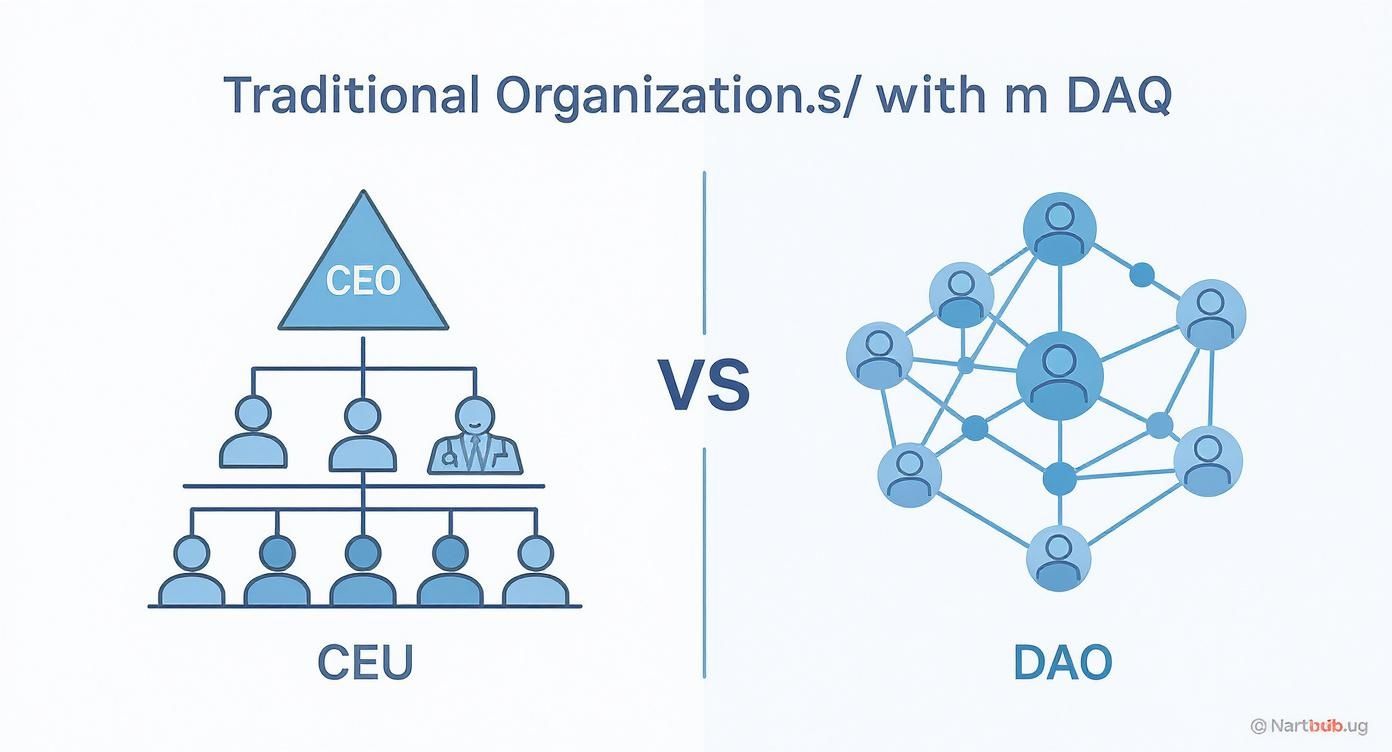
As you can see, power isn't held by a few people at the top; it's spread across the whole network of members. This entire system relies on the community reaching an agreement, a process managed by something called a consensus mechanism. To really appreciate how a leaderless organisation can work so securely, it's worth understanding consensus mechanisms and the important role they play. It's this trust, built right into the code, that makes it all work.
Exploring the Many Flavours of DAOs
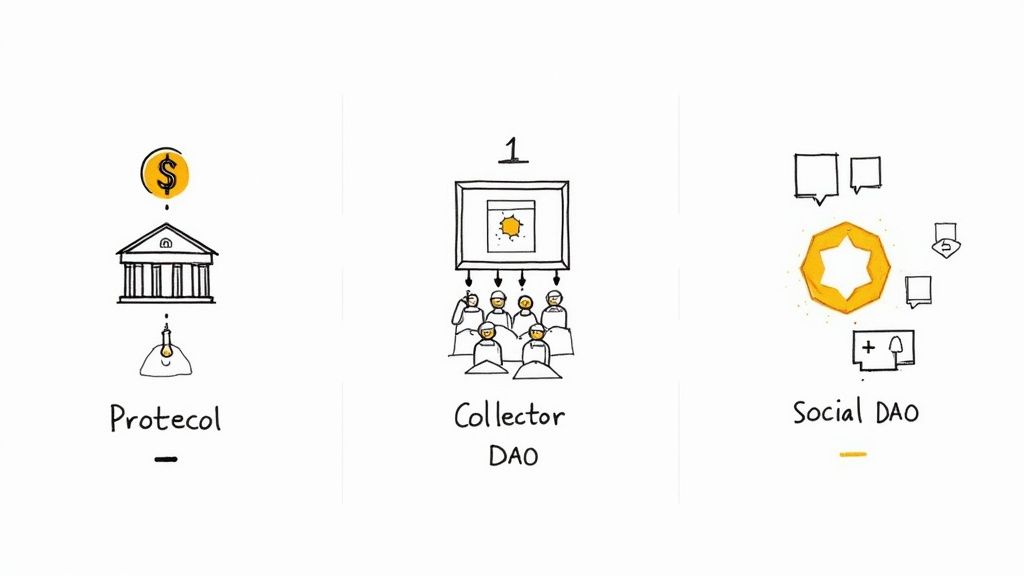
‘DAO’ isn’t a one-size-fits-all term. Think of it less like a specific kind of company and more like a flexible blueprint that communities can shape to fit almost any goal you can think of. The best way to really get your head around what a DAO is, is to look at the amazing variety of ways they're being used in the real world.
While the basic mechanics of smart contracts and group voting are the same, their missions can be completely different. We're seeing DAOs pop up to manage everything from complicated financial products to exclusive social clubs.
Let's look at a few common types to see just how flexible this model really is.
Protocol DAOs
These are the big players in the DAO world. Protocol DAOs are in charge of running decentralised finance (DeFi) applications that can manage millions, or even billions, of pounds in assets. Instead of a tech company calling all the shots, the people who actually use the service get to guide its future.
A great example is MakerDAO. This organisation is the backbone of DAI, a type of cryptocurrency called a stablecoin that aims to keep its value equal to the US dollar.
- What they do: The community of MakerDAO token holders votes on important decisions, like setting the "stability fees" (which are a bit like interest rates) and deciding what other assets can be used to back the currency.
- Why it works: This democratic way of doing things means there’s no need for a central bank or a traditional financial company. The community works together to keep DAI stable, and every decision is open and carried out automatically by the code.
Collector DAOs
Have you ever dreamed of owning a priceless piece of art but didn't have a few million pounds to spare? That’s the kind of problem Collector DAOs solve in the digital world. They are basically investment clubs where members pool their money to buy valuable assets, usually NFTs (Non-Fungible Tokens).
PleasrDAO is one of the most famous examples. It became well-known when a group of DeFi leaders, artists, and NFT collectors teamed up to buy a single, famous piece of digital art.
They successfully pooled their money to buy an NFT for over $5.4 million. Since then, PleasrDAO has become like a digital art gallery, collecting culturally important pieces, with every new purchase approved by a member vote.
This model is a game-changer, giving a whole community shared ownership of assets that would normally only be available to the super-rich.
Social DAOs
Not every DAO is about money or expensive assets. A growing number are basically online social clubs, where you need a specific token to become a member and get access. They are creating new kinds of communities built on shared interests and a sense of collective ownership.
Friends with Benefits (FWB) is probably the most well-known social DAO. It describes itself as a community of Web3 creators, thinkers, and artists. To join, you have to apply and own a certain number of $FWB tokens.
But this isn't just about getting into a fancy online chat group. Owning the tokens unlocks a global network of creative people, exclusive parties and events in cities like London and New York, and a say in creative projects funded by the community's own treasury. It’s a self-governing cultural club, powered by its own members.
From finance to art to socialising, it’s clear a DAO is less of a "thing" and more of a powerful new tool for getting people organised around a shared goal.
Weighing the DAO Model
Moving an organisation's core decision-making from a private boardroom to an open, global community has some big effects. By its very nature, a DAO offers a level of openness that traditional companies can't easily match. Every single vote, transaction, and rule change is permanently recorded on a public blockchain, open for anyone to look at.
This structure creates a truly democratic space. Instead of a CEO making all the decisions alone, every member holding a governance token gets a direct say in the organisation’s future. This shared ownership often leads to amazing engagement because members are, quite literally, invested in the project's success. For example, a DAO focused on protecting the environment can guarantee that its funds are only ever spent on green projects the whole community believes in, with no risk of secret deals.
The Upside of Decentralisation
Beyond just being open, DAOs offer some clear practical advantages:
- Global Collaboration: Anyone, anywhere in the world, can join and contribute. This breaks down geographical barriers and helps build a wonderfully diverse pool of talent.
- Less Bureaucracy: Smart contracts handle many of the day-to-day tasks automatically, from paying contributors to assigning funds, which cuts out layers of middle management.
- Censorship-Resistant: Because they run on decentralised networks, DAOs are incredibly difficult for any single group—including governments—to shut down or interfere with.
At its best, a DAO operates like a glass box. You can see everything that goes on inside, and the rules of the game are clear to everyone from day one. This builds a foundation of trust that is hard to create in a top-down system.
Facing the Practical Challenges
Of course, the model isn't perfect. The very same democracy that makes DAOs so interesting can also be one of their biggest problems. Getting thousands of members to agree on a direction can be painfully slow, sometimes causing a project to miss a key opportunity while waiting for a vote to finish. It’s like trying to get a huge group of friends to agree on where to go for dinner.
Security is another huge concern. While the blockchain itself is secure, the smart contracts that form the DAO's foundation can have bugs or weaknesses. A clever hacker can take advantage of a single mistake in the code and potentially drain the entire treasury, with no "undo" button to get the money back.
Finally, DAOs still exist in a bit of a legal grey area. Most countries, including the UK, haven't set up clear legal rules for them. This creates a lot of uncertainty around important issues like who is responsible if something goes wrong, how they should be taxed, and how they can make legal agreements. While individual users are often happy to jump in, this lack of clarity makes larger, more traditional institutions nervous about getting involved.
To give you a clearer picture, here’s a quick breakdown of the pros and cons.
Weighing the DAO Model
| Advantages of DAOs | Disadvantages of DAOs |
|---|---|
| Unmatched Transparency: All operations and finances are public on the blockchain. | Slow Decision-Making: Reaching consensus can be cumbersome and inefficient. |
| Community-Driven: Decisions reflect the collective will of its members, not a select few. | Security Vulnerabilities: Bugs in smart contracts can lead to catastrophic financial loss. |
| Global & Accessible: Anyone with an internet connection can participate. | Unclear Legal Status: Operating in a regulatory grey area creates risk and uncertainty. |
| Automated & Efficient: Smart contracts reduce overhead and human error. | Potential for Voter Apathy: Low participation can lead to control by a small group. |
| Censorship-Resistant: Highly resilient to external interference or shutdown. | Scalability Hurdles: Governance can become chaotic as the member base grows. |
Things are definitely improving; for example, global trends show that 72% of DAO treasuries now use multi-signature wallets to improve security. However, the path to full legal recognition and perfect security is still being built. You can learn more about how the industry is tackling these challenges in Chainalysis's 2025 crypto adoption report.
The Future of DAOs and UK Regulation
As DAOs grow from small online communities into serious economic players, they’re starting to run into a major hurdle: traditional legal systems. These new digital-first organisations just don’t fit into the old boxes of ‘company,’ ‘partnership,’ or ‘charity,’ which creates a lot of confusion for everyone involved.
This legal grey area isn't just a theoretical puzzle; it’s a real-world problem. Without a recognised legal status, a DAO can't do the basic things we expect from any organisation. How does it sign a rental agreement for an office, open a normal bank account, or hire its first employee? More importantly, who is legally responsible if something goes wrong? These are the tough questions that governments, including here in the UK, are now trying to answer.
The main challenge is finding the right balance. Regulators need to provide clear rules and protection without killing the very decentralised spirit that makes DAOs so special. If rules are too strict, they risk stopping innovation and pushing these exciting projects to other countries. If they do nothing, they leave members and partners exposed to big risks.
Forging a New Path in the UK
The UK has been clear about its goal to become a global hub for crypto and digital assets, and figuring out a smart way to handle DAOs is a key part of that plan. Instead of trying to squeeze these new structures into old laws, legal experts are thinking about how to give them proper legal standing. The aim is to build trust and make it easier for them to become part of the mainstream economy.
One of the most interesting ideas is to adapt an existing legal structure for the digital age, rather than starting completely from scratch. This offers a way forward that builds on something familiar and well-understood.
A notable academic idea is the 'DAOLLP' model. This concept cleverly adapts the UK’s existing Limited Liability Partnership (LLP) framework to give DAOs a legal identity. This would allow them to sign contracts, own property, and even take part in legal cases, all while making sure they follow important anti-money laundering (AML) and know-your-customer (KYC) rules. You can explore the full details of this proposed framework in the Corporate and Commercial Law Journal.
This kind of forward-thinking regulation could be a real game-changer. By setting up a clear, officially recognised status for DAOs, the UK could become a world leader in this area. It would provide the certainty needed for DAOs to confidently work with the wider economy, hire people, and invest for the future.
For anyone wondering what is a DAO’s true potential, the answer is likely being written in these changing legal frameworks that aim to connect decentralised ideas with real-world needs.
How to Get Involved with Your First DAO
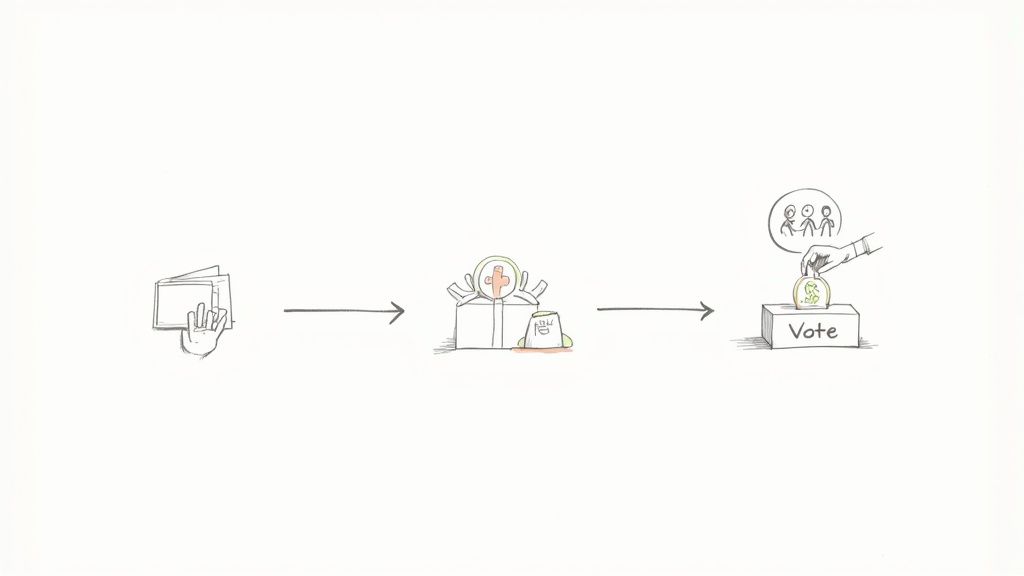
Jumping into your first DAO might sound a bit technical, but it’s easier than you might think. The journey begins with a couple of key tools that act as your passport into the world of decentralised communities.
First up, you'll need a crypto wallet. Think of it as your digital ID and bank account all in one. A popular choice like MetaMask is a great place to start; it’s a simple extension for your web browser that lets you hold crypto and connect to blockchain applications, including DAOs. This wallet is where you'll keep your digital assets and, most importantly, cast your votes.
With your wallet ready, the next step is to add some cryptocurrency. Since most DAOs are built on the Ethereum network, having some Ether (ETH) is usually a must. You can buy ETH on any major crypto exchange and then send it over to your wallet. You'll need this to cover transaction costs, known as ‘gas fees’, which are a bit like paying a small fee to process any action on the blockchain.
Finding Your Tribe
Wallet funded? Now for the fun part: finding a DAO that you are actually interested in. There are DAOs for almost everything, from managing huge financial platforms to funding small art projects. The trick is knowing where to look.
These community hangouts are where you'll get a real feel for what a DAO is all about:
Discord Servers: This is the digital town hall for most DAOs. It's where the day-to-day chats happen. Joining a project's Discord is the perfect way to listen in and get a sense of the community's personality before you jump in.
Governance Forums: Platforms like Discourse are where the more serious discussions take place. Here, members formally debate proposals and plan for the future. Reading through these conversations gives you a front-row seat to the decisions that shape the organisation.
Discovery Platforms: There are websites designed just to list and sort DAOs. They are great for filtering projects by their purpose, size, or how active they are, helping you find the right fit.
To have a real say and cast votes, you'll usually need to hold the DAO's unique governance token. This token is your proof of membership and decides how much your vote is worth. You can typically get these tokens from a decentralised exchange.
Understanding how these tokens work is key, as they are what give you a genuine voice in where the community goes next. You can learn more about how governance tokens and DAO voting are linked together to make decentralised decisions possible. Once you take these first few steps, you'll be ready to join and contribute to a project you're truly passionate about.
Your DAO Questions, Answered
As you explore the world of DAOs, it's normal for a few questions to pop up. We've gathered the most common ones we hear, giving simple answers to help you get a practical idea of how this all works.
Let's clear up some of the most frequent points of confusion.
Do I Need to Be a Coder to Join a DAO?
Definitely not. This is probably the biggest myth that stops people from getting involved. While the foundation of a DAO is code, the daily activities and the members themselves are rarely technical.
Most DAOs are looking for all sorts of different skills. Think of them like any other group; they need people who are great at:
- Marketing and telling people about the project
- Community management and helping discussions run smoothly
- Design and creating cool visuals or articles
- Managing the money in the shared treasury
Your contribution comes from taking part in discussions, voting on ideas, and sharing your own unique skills – not from writing a single line of code.
How Do DAOs Actually Make Money?
There’s no single answer here, as DAOs have many different ways of operating. A common way for those in decentralised finance (DeFi) is to take a very small fee from the transactions that happen on their platform. For example, a decentralised exchange might earn 0.3% on every trade.
Others work more like a group investment fund. Members put their money together to buy things like valuable NFTs or invest in new crypto projects they think will be successful. Many DAOs also get their initial funding by selling their own governance token, which fills up a community wallet to pay for future projects and operations.
Are DAOs Legal in the UK?
This is a bit of a tricky one. The legal status of DAOs in the UK is still being figured out. Right now, they don't fit neatly into any of the traditional legal categories, like a limited company or a partnership.
Because of this, they operate in a legal grey area. The good news is that there’s a lot of discussion happening between government regulators and legal experts to create a proper legal structure for them. This would give DAOs official recognition and make it much easier and safer for them to operate.
What’s the Difference Between a DAO Token and Bitcoin?
This is a really important difference. Bitcoin was created to be a digital currency. Its job is to be a store of value and a way to send money—its purpose is purely financial.
A DAO governance token, however, is more like a membership card that comes with voting rights. It does have a monetary value, yes, but its main purpose is to give you a say in how the organisation is run. Think of it as proof of your stake and influence within that specific community.
At The Coin Course, our mission is to deliver clear, practical education that empowers you to navigate the world of digital assets with confidence. Whether you're a complete beginner or looking to build on your existing knowledge, we have resources to support your journey. Explore our full library of guides at The Coin Course.