
You check your phone over breakfast, open your crypto app, and everything's red. Bitcoin is down. Your altcoins are down more. The part that stings most isn't just the price move. It's not knowing whether this is a normal wobble, a genuine buying chance, or the start of something uglier.
That's where a lot of people get stuck. They hear “buy the dip” so often that it starts to sound like a law of nature. But it isn't. Some dips are routine. Some are warnings. Some are traps.
If you've been asking what are dips in crypto, the simple answer is this: a dip is a drop in price. The useful answer is better. A dip is a price drop that you need to classify before you act.
An Introduction to Market Dips
In everyday UK English, “dip” is commonly used for a small downward movement in numbers. Cambridge notes that it sits alongside words like fall, drop, and decrease, and it usually suggests a modest, limited move rather than a collapse, which is why the term shows up so often in data reporting and market commentary in the UK in Cambridge's explanation of data language.
That everyday meaning helps a lot in crypto. A dip is like seeing your favourite coffee beans on sale. If you already wanted them, a lower price might be welcome. But if the shop is clearing them out because they're stale, the “sale” means something very different.
That's the first mental shift worth making. A dip isn't automatically good or bad. It's a change in price, and your job is to work out what kind of change you're looking at.
For newer investors, panic often takes over. Red candles can feel personal, especially when you bought only a few days earlier. But markets move in cycles, and short-term drops are part of that rhythm. If you want a broader view of how these swings fit into the bigger picture, this guide to crypto market cycles is a helpful companion.
Why the word matters
The word “dip” sounds mild, and sometimes that's exactly right. Prices can slide for a short period, then recover. Traders may call that a healthy pause. Long-term investors may call it noise.
But in crypto, people also use “dip” very loosely. One person uses it for a tiny pullback. Another uses it for a brutal sell-off. That sloppy language causes bad decisions because not every drop deserves the same response.
Practical rule: Don't ask “Should I buy this dip?” first. Ask “What type of drop is this?” first.
If you only remember one thing from this article, make it that. Classification comes before action.
Four Types of Market Drops to Recognise
When people say “the market dipped”, they often bundle very different situations into one phrase. That's like calling a drizzle, a storm, and a flood “a bit of rain”. Technically, yes. Practically, not useful.
A better framework is to sort price drops into four buckets: pullbacks, corrections, bear market declines, and flash crashes.
Comparing different market dips
| Dip Type | Typical Drop Size | Typical Duration | Description |
|---|---|---|---|
| Pullback | Small | Short | A brief breather during an existing uptrend |
| Correction | Medium | Weeks or longer | A more serious reset after strong price runs or changing sentiment |
| Bear market decline | Large | Long | A broad, grinding downturn where sellers stay in control |
| Flash crash | Very sharp | Very short | A sudden plunge, often driven by panic, liquidations, or thin liquidity |
This table avoids made-up precision for a reason. In crypto, context matters more than a neat formula. The same-looking chart can mean very different things depending on news flow, market structure, and how price behaves after the initial drop.
Pullbacks feel like a quick breather
A pullback is the mildest version. Think of a runner easing off pace to catch their breath. The overall trend may still be healthy, but price pauses or slips before trying to move higher again.
You'll often see this after a fast rally. Early buyers take profits. Late buyers get nervous. Price softens, sentiment cools, and then the market tests whether demand is still there.
For a long-term investor, a pullback is often the least dramatic kind of dip. It doesn't mean the whole story has changed.
Corrections are more serious
A correction goes beyond a quick wobble. It usually feels heavier and lasts longer. Confidence weakens. Headlines turn negative. People who were cheerful a week ago start asking if they made a mistake.
A useful analogy is a shop that cuts prices after overestimating demand. The products aren't necessarily bad. The price just got ahead of itself, and now the market is resetting expectations.
A correction hurts more than a pullback because it challenges your conviction, not just your entry price.
That's why many investors freeze here. The move is deep enough to feel scary, but not always deep enough to clearly signal a lasting downturn.
Bear market declines are the long winter
A bear market decline is different in tone as much as size. This is the long winter version. Rallies fade quickly. Traders sell strength instead of buying weakness. Good news stops lifting prices for long.
In this environment, “buying the dip” can become expensive if you do it mechanically. You buy one drop, then another arrives. You buy that one, and the market sinks again. The issue isn't just that price is lower. It's that the wider trend has changed.
Flash crashes are fast and messy
A flash crash is the most violent but often the shortest. Price drops hard in a very short window, usually because liquidity disappears, stop orders trigger, or leverage gets wiped out in a rush.
These events can reverse quickly, but they're dangerous because decision-making collapses under speed. If you've ever watched a chart fall so fast that it barely looks real, that's the feeling.
A simple way to think about the four types is this:
- Pullback means the market is taking a breath.
- Correction means the market is resetting.
- Bear decline means the market may have changed direction.
- Flash crash means the market is dislocated for a moment.
Why Do Dips Happen Key Causes and Indicators
Most dips don't come out of nowhere. There's usually a trigger, even if it only becomes obvious afterwards. In crypto, I like to group them into three broad causes: big-picture news, crypto-specific events, and chart behaviour.

Big-picture news can shake everything
Sometimes crypto falls because the wider financial mood changes. Traders may react to inflation updates, interest-rate expectations, recession fears, or shifts in global risk appetite.
Imagine a high street where every shop sees fewer customers on the same rainy day. One shop didn't suddenly become terrible. The whole street got quieter.
That matters because crypto doesn't trade in isolation. If investors want less risk across the board, digital assets often feel that pressure too.
Crypto-specific events hit confidence directly
Other dips start inside crypto itself. A regulator makes a surprising announcement. A project has a security issue. An exchange faces scrutiny. Tokens entering circulation worry holders. A blockchain upgrade creates uncertainty.
These events can hit one coin, one sector, or the entire market, depending on how important the story is. A problem with a small token may stay local. A major exchange issue can ripple far wider.
If you want another lens beyond price alone, it helps to learn how investors read on-chain metrics for crypto analysis. Wallet flows, exchange balances, and network activity can sometimes add useful context when sentiment turns.
Chart signals can invite a dip even without dramatic news
Sometimes the cause is less about headlines and more about positioning. Price runs too far, too fast. Buyers get exhausted. The asset reaches an area where many traders are already planning to sell. Momentum slows, then slips.
This is the market version of a queue forming outside a shop during a sale. At first, demand looks strong. Then the crowd thins, the early excitement fades, and the price stops rising because the eager buyers have already acted.
Watch for a few clues when price starts falling:
- Loss of momentum means rallies get weaker before the drop.
- Repeated rejection near the same area suggests sellers are active there.
- Heavy reaction to bad news can show sentiment was fragile already.
- Weak bounce after the drop often hints that buyers aren't confident yet.
A useful habit: Don't only ask what fell. Ask what changed in the story around it.
That question often tells you whether you're dealing with a routine dip or the start of something larger.
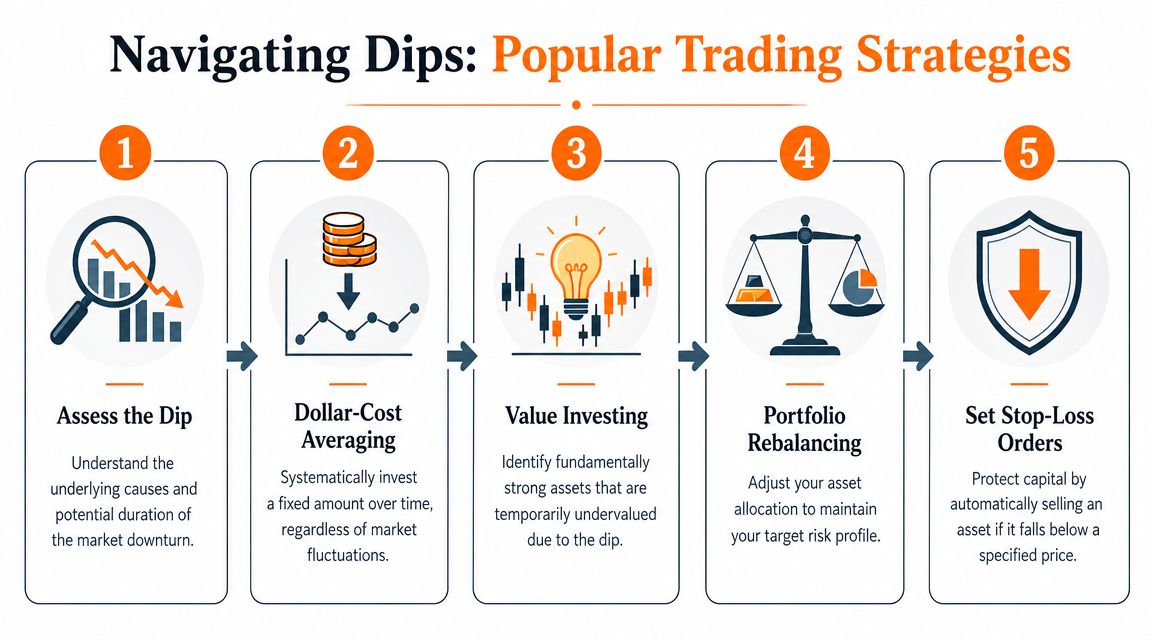
Navigating the Drop with Popular Trading Strategies
A dip only becomes manageable when you pair it with a plan. Without one, you end up doing what many do under stress. Buying randomly, selling emotionally, or doing both in the same week.
Dollar-cost averaging keeps things simple
Dollar-cost averaging, often shortened to DCA, means investing a fixed amount on a regular schedule instead of trying to pick the perfect moment. If you're new, this is often the calmest way to handle dips.
Say you've got £500 that you want to put into Bitcoin. You could buy all at once. Or you could split it into five £100 buys over time. If the market falls after your first buy, you still have cash left. If it rises, you still got some exposure.
The strength of DCA is behavioural as much as financial. It reduces the pressure to be clever every day. If you want a practical breakdown, this guide to the dollar-cost averaging strategy is worth reading.
Scaling in suits uncertain conditions
Scaling in is similar to DCA, but more flexible. Instead of buying on a fixed schedule, you buy in parts as the market develops.
For example, with £500, you might put in £150 on the first drop, keep £150 ready if price falls into a stronger support area, and leave the final £200 for either confirmation of a rebound or a deeper sell-off. That gives you room to react instead of committing everything too early.
This approach works well when you think an asset is attractive, but you don't trust the first bounce.
Decision shortcut: If you're unsure whether the dip is shallow or deep, scaling in usually makes more sense than going all in.
Lump-sum buying is simple but riskier
Some investors prefer the direct approach. They see a drop, decide the asset is undervalued, and buy at once.
This can work well if the dip is brief and the trend resumes quickly. But it carries more timing risk. If you use your whole budget immediately and price drops further, you lose flexibility.
That doesn't make lump-sum buying wrong. It just means it fits best when your conviction is high, your time horizon is long, and you've accepted that your entry may not be perfect.
A simple example: if you buy £500 in one go and the market keeps sliding, your only choices afterwards are to hold, sell, or add more capital. Scaling in would have left more room to manoeuvre.
Here's a quick way to match strategy to situation:
- Use DCA when you're building a long-term position and want less stress.
- Use scaling in when volatility is high and you want flexibility.
- Use lump sum when you've done the work and can tolerate imperfect timing.
- Use no-buy when the story around the asset looks broken.
A short video can help make these choices more concrete:
Stop-losses are about protection, not prediction
A stop-loss is an instruction to exit if price falls to a level you've already chosen. This matters most for traders and shorter-term participants.
Suppose you buy a coin for £500 worth and decide in advance that if the setup fails, you'll exit after a defined drop. You're not saying the asset is bad forever. You're saying this specific trade idea didn't work.
That small distinction saves people a lot of pain. A stop-loss isn't there to prove you were wrong. It's there to stop one bad situation from becoming a portfolio problem.
Rebalancing can be the quiet professional move
This one gets less attention, but it's useful. If a dip leaves your portfolio badly tilted, you can rebalance back toward your target mix.
Say crypto has grown too large a share of your holdings during a rally, then drops sharply. Rebalancing forces you to review your allocation rather than react to fear. It's less exciting than “buy the dip”, but often more disciplined.
The Dangers of Dip Buying and How to Avoid Them
The phrase “buy the dip” sounds smart because it implies confidence. The problem is that confidence and accuracy aren't the same thing.
One of the oldest mistakes in markets is catching a falling knife. You see a sharp drop, assume it must be cheap, buy quickly, and then watch the price continue to sink. The lower price wasn't the opportunity. It was the warning.
Why a cheap price can still be expensive
A falling coin can look like a bargain in the same way a cracked phone on a resale site looks like a bargain. The sticker price is lower. But if the underlying problem is serious, the deal isn't really a deal.
This happens in crypto when people focus only on distance from the recent high. They say, “It's down a lot, so it has to be value.” That logic misses the key question. Why did it fall?
If the answer is temporary fear, you may be looking at a normal dip. If the answer is loss of trust, regulatory damage, broken tokenomics, or a major security problem, the lower price may be fully justified.
Waiting can be a position
Many newcomers think they have only two options. Buy now or miss out. In reality, waiting is a valid move.
You can wait for steadier price action. You can wait for the selling to slow. You can wait for buyers to defend a level more than once. You can wait for bad news to stop getting worse.
That won't give you the exact bottom. It may give you something better: a more informed entry.
For a practical trading explanation of this mistake, Colibri Trader on falling knives gives a clear breakdown of why rushing into a hard sell-off can go wrong.
The market doesn't give prizes for bravery. It rewards good decisions made at the right time.
Two risks people often miss
Beyond the obvious price risk, dip buyers often overlook two other dangers:
- Liquidity risk matters in thinner markets. You may want to sell, but buyers can disappear when fear spikes.
- Narrative risk matters when the whole story changes. A project can move from “temporarily out of favour” to “structurally weakened” very quickly.
A useful filter is this short checklist:
- Has the news changed the asset's long-term case?
- Is price dropping on panic, or on information showing a real issue?
- Would I still want to own this if recovery takes longer than I hope?
If you can't answer those calmly, buying more probably isn't the next move.
Your Action Plan for the Next Market Dip
When the next dip arrives, you don't want to build your plan in the middle of stress. You want the plan ready before the chart turns red.

A simple checklist you can actually use
Keep this framework somewhere easy to find:
- Define your role. Decide whether you're acting as a long-term investor, a swing trader, or a short-term speculator. A dip means different things to each.
- Classify the drop. Ask whether this looks like a pullback, correction, bear-phase decline, or flash crash.
- Check the cause. Look for macro news, crypto-specific developments, or chart-based exhaustion.
- Choose one response. DCA, scale in, rebalance, hold cash, or use a stop-loss. Don't mix five strategies in a panic.
- Set your risk line. Know in advance what would make you reduce exposure or walk away.
Make the plan personal
Your best dip strategy depends on your time horizon, cash reserves, and emotional tolerance. Someone building a position slowly can treat dips very differently from someone trading short-term momentum.
That's why generic slogans are dangerous. “Buy the dip” tells you almost nothing. A personal rule like “I only add through DCA when the long-term thesis is intact” is much more useful.
If you want a broader refresher on protecting capital before you focus on upside, these trading risk management strategies offer practical ideas that fit well with a dip plan.
Final takeaway: The best investors don't react faster. They prepare better.
A dip is only scary when it's undefined. Once you can name the kind of drop, understand the likely cause, and match it with a fitting response, you stop treating every red day like an emergency.
If you want to build that kind of confidence step by step, The Coin Course offers clear crypto education on market cycles, trading, risk, wallets, and blockchain basics so you can make decisions with more structure and less guesswork.