You're probably looking at a futures chart that seems to move too fast, too far, and for no obvious reason. One candle looks like a breakout. The next one wipes it out. You place a trade, price flicks against you, and suddenly you're wondering whether futures trading is skill, luck, or just organised chaos.
That feeling is normal. Futures compress a lot into one screen: amplified market exposure, margin, expiry, volatility, and the constant pressure to decide quickly. The mistake most beginners make isn't being cautious. It's trading before they've built a repeatable plan.
A good trader works more like a pilot than a gambler. A pilot doesn't improvise take-off because the weather looks interesting. They use a checklist, a route, and clear rules for what to do if conditions change. The same is true with trading strategies for futures. You need a framework for when to enter, when to stay out, where to place risk, and what kind of market suits each method.
That's what follows here. Not fantasy. Not quick-riches talk. Just a practical way to understand futures, learn the main strategy types, and then adapt them to crypto futures without copying old market rules blindly.
Your First Steps into Futures Trading
Most new traders start the same way. They open a chart, zoom in and out a few times, add a couple of indicators, and hope the market will suddenly make sense. It rarely does.
What helps is reducing futures trading to a few decisions you can control.
Start with the only questions that matter
Before you think about profit, ask these:
- What market am I trading: An index future, an oil contract, or a crypto perpetual doesn't behave the same way.
- What condition is the market in: Trending, ranging, or breaking out from a level.
- How much am I willing to lose if I'm wrong: This comes before entry, not after.
- What would prove my idea invalid: If you can't answer that, you don't have a trade yet.
A beginner often wants a magic setup. A better aim is a simple routine. Check the chart. Define the market condition. Choose one strategy that fits it. Set the risk. Then either take the trade or leave it alone.
Practical rule: If you can't explain your trade in one short sentence, it's probably too vague to execute well.
Think in systems, not single trades
One winning trade proves very little. One losing trade proves very little too. What matters is whether your method makes sense over a series of trades.
That mindset changes everything. Instead of asking, “Will this trade work?”, you start asking, “Is this the kind of setup my plan says to take?” That's a calmer question, and it leads to better behaviour.
For many new traders, the first useful milestone isn't making money. It's placing trades that match the plan. Once you can do that consistently, improvement becomes possible.
Futures Trading Fundamentals You Must Know
A futures contract can sound more complicated than it is. At its core, it's just an agreement tied to the price of something, such as an index, oil, gold, or Bitcoin, that traders buy and sell in a standardised market.
A simple way to understand a futures contract
Think of a futures contract like pre-ordering a popular video game at a fixed price before launch. You agree to the price now because you think the value later will be different. If the market price rises and you locked in lower, that helps you. If the price falls, it hurts you.
In trading, you usually aren't interested in receiving barrels of oil or truckloads of wheat. You're trading the price movement of the contract itself.
Three terms matter early:
| Term | Plain meaning | Why it matters |
|---|---|---|
| Long | You buy because you think price will rise | You profit if the market goes up |
| Short | You sell because you think price will fall | You profit if the market goes down |
| Expiry | The contract has a set end date | You must know when that contract stops trading |
If you're still sorting out the difference between direct asset ownership and derivatives, this guide on spot markets vs derivatives gives a useful grounding.
Margin and leverage without the jargon
This allows you to control a larger position with a smaller amount of money. The easiest analogy is a mortgage deposit. You don't buy the whole house in cash. You put down a portion to control the full asset.
That's what margin is in futures. It's the amount your broker requires to open and hold the position.
The attraction is obvious. Smaller capital can control a bigger market exposure. The danger is just as obvious. Your profit and loss move on the full position, not only on the margin you posted.
A trader who only looks at how little margin is required often ends up trading a size that their account can't absorb.
Why futures feel fast
Futures are standardised and involve magnified exposure, so price movement has immediate consequences. Small market changes can have an outsized effect on your account compared with buying an asset outright.
This is why beginners should treat contract size with respect. It's also why many traders prefer smaller versions of contracts when learning. The point isn't to maximise size. It's to stay in the game long enough to learn.
One more practical point matters in the UK. IG notes that, in the UK, futures trading strategies are often structured with tax efficiency in mind, and profits may be subject to capital gains tax rather than income tax, which influences how traders think about futures, spread trading, and hedging in portfolio planning through its UK futures guide.
Exploring Core Trading Strategies for Every Market
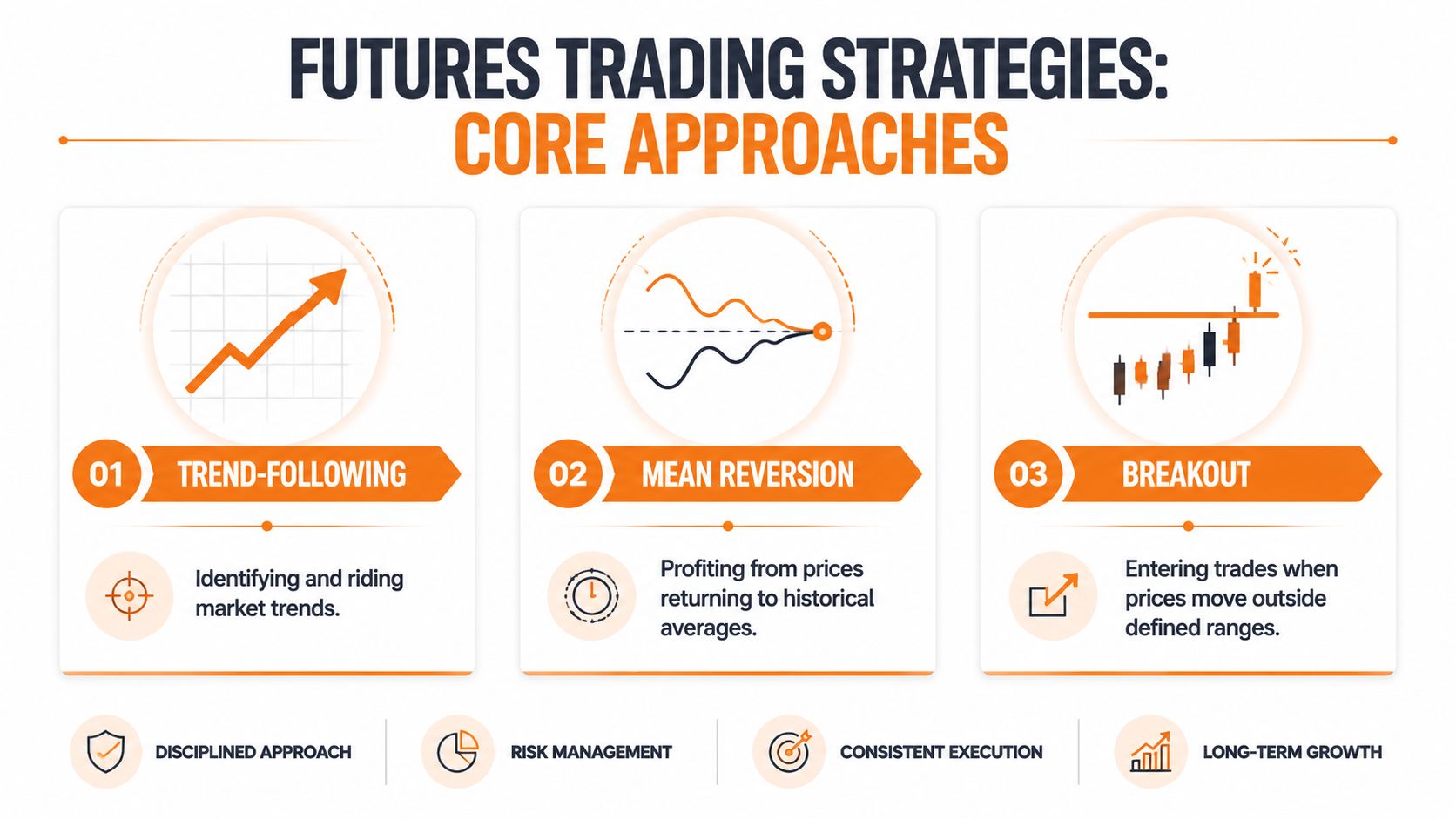
The best trading strategies for futures aren't “best” in every condition. Each one matches a different kind of price behaviour. Use the wrong tool in the wrong environment and even a good idea breaks down.
Trend-following
Trend-following is like surfing a wave. You're not trying to predict every splash. You're trying to catch a move that's already showing direction and stay with it while the wave lasts.
This is often the first strategy that makes sense to beginners because it aligns with what charts show clearly: higher highs in an uptrend, lower lows in a downtrend.
A useful rule-based example comes from UK futures education. TradeAlgo notes that trend-following systems are effective during 30-40% of market sessions where markets move in one direction, and it also highlights the 20-day SMA as a primary trend filter for entries in that framework in its guide to futures trading strategies.
That gives you a practical lens:
- When it fits: Clean directional markets
- What you look for: Price holding above or below a trend filter
- Typical mistake: Forcing trend trades in sideways sessions
A simple example would be an index future trading above its 20-day SMA, then breaking above a recent swing with strong participation. The trader isn't buying because the market feels strong. They're buying because the market has already shown a directional bias.
Mean reversion
Mean reversion works more like a stretched rubber band. Price moves too far from its typical area, then snaps back toward the middle.
This can work well in markets that keep oscillating rather than trending. It's common in quieter sessions or after a short-lived emotional move. The trap is obvious. A move that looks “too far” can keep going much further.
That's why mean reversion traders need clear invalidation. If price doesn't revert quickly, the premise is weakening.
Try thinking of it this way:
- Find the stretch: Price moves sharply away from its recent average.
- Check the environment: Is the market range-bound, or is it starting a trend?
- Plan the return: The target is usually a move back toward the average, not a huge home run.
Breakout trading
Breakout trading is about price leaving a defined box. The market spends time coiling, building a range, and then finally pushes beyond it.
A straightforward UK example is the 15-minute opening range breakout. In that method, traders place buy orders 1 tick above the high and sell orders 1 tick below the low of the first 15-minute bar, using a 4-point stop and 20-point target, while widening the stop to the full bar height when volatility exceeds 25, as described in this opening range breakout video.
That example matters because it shows what real breakout trading looks like. Not vague “buy strength” language. Specific levels, specific risk, specific conditions.
Breakout traders don't get paid for being early. They get paid for entering when price proves it can leave the range.
Scalping in the right context
Scalping is closer to shopkeeping than investing. A shopkeeper doesn't rely on one giant sale. They make many small, controlled sales through the day. A scalper does the same with price movement.
This approach demands fast execution, tight discipline, and a market with enough liquidity to enter and exit cleanly. It's not ideal for a beginner who still struggles to define market structure.
Still, it has its place. In active sessions, advanced traders often use scalping around known levels, brief momentum bursts, or highly liquid open periods.
Choosing the strategy by market condition
A practical trader doesn't marry one setup. They match the setup to the tape.
- Directional session: Trend-following usually makes more sense.
- Quiet, two-sided session: Mean reversion may be cleaner.
- Compression near key levels: Breakout logic becomes attractive.
- Fast liquid session with precise execution: Scalping can work for experienced hands.
That's the key lesson. Futures strategies are less about loyalty to a style and more about recognising what the market is offering today.
Advanced Approaches Spread Trading and Hedging
Most beginners think futures trading means one thing: pick a direction and hope price goes there. Advanced traders often think differently. They focus on relationships.
Spread trading changes the question
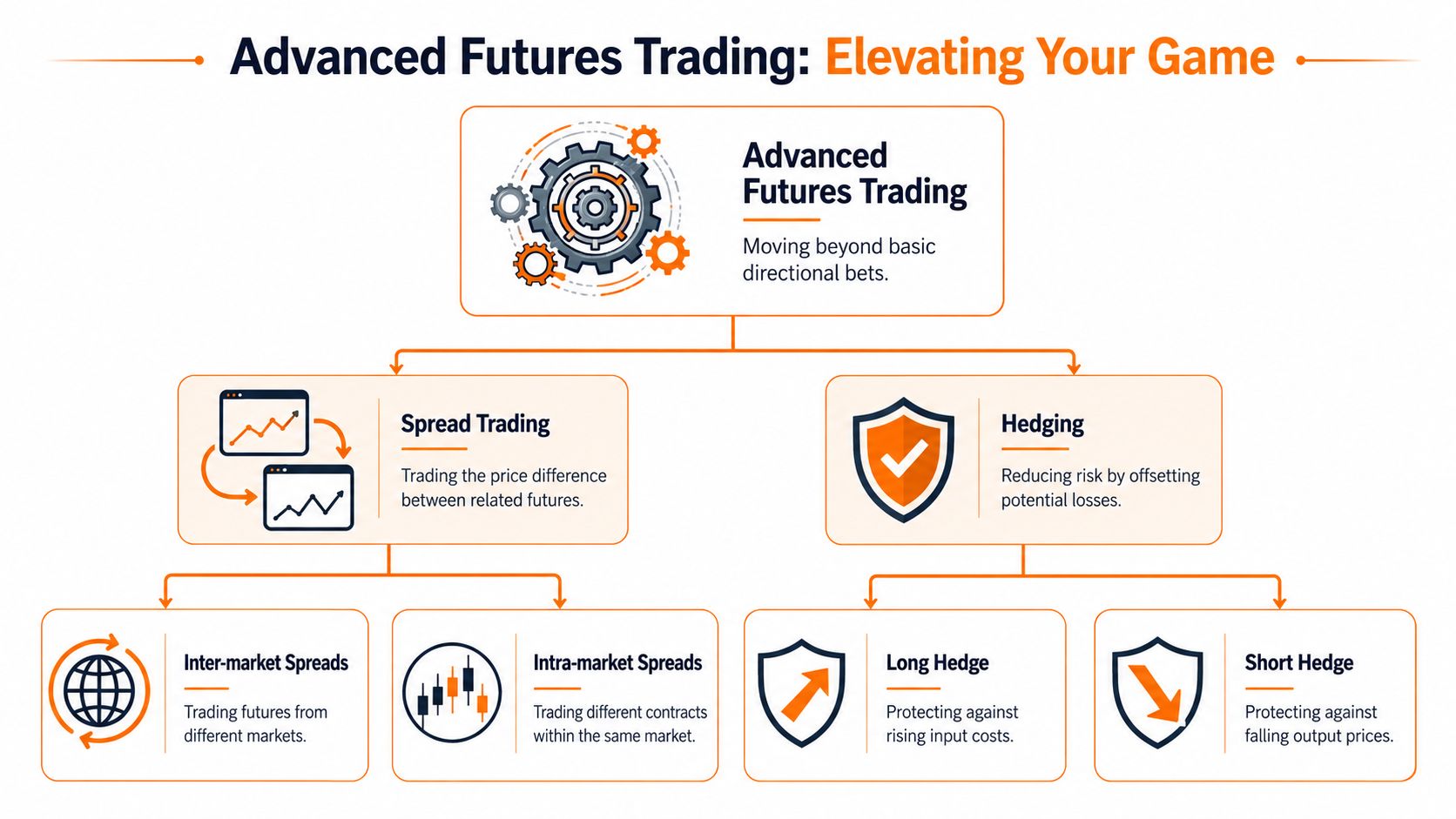
With spread trading, you aren't asking whether one market will rise or fall. You're asking whether the difference between two related contracts will widen or narrow.
That's a major shift in thinking.
You might trade two different contract months in the same market. Or you might compare related markets that usually move in connection with each other. The opportunity comes from change in the gap between them, not from absolute direction alone.
A plain example helps. If two related energy contracts have moved unusually far apart, a spread trader may believe the gap will compress. One side is bought, the other is sold. The trade expresses a relationship, not a single outright view.
Hedging is insurance, not excitement
Hedging is what many professionals use futures for when they want protection rather than speculation. If you already hold an exposure elsewhere, a futures position can help offset part of the risk.
Think of a business worried about rising input costs, or an investor who wants to reduce downside risk on an existing portfolio. A hedge won't make the problem disappear, but it can soften the blow if the market moves the wrong way.
The key point is intent. A speculative trade seeks profit from movement. A hedge seeks stability against an unwanted move.
Good hedging often feels boring. That's fine. Insurance is supposed to feel boring until you need it.
Why these approaches matter in the UK
In the UK, futures strategy design often isn't only about chart patterns. It's also shaped by account structure and tax treatment. IG explains that futures trading strategies are often built around tax efficiency, with profits potentially subject to capital gains tax rather than income tax, which influences the use of spread trading and hedging in practice in its overview of UK futures trading.
That matters because it shows how advanced strategy isn't just technical. It's operational. Skilled traders think about structure, risk, exposure, and execution together.
Where algorithmic execution fits
Spread trading and hedging both benefit from consistency. That's one reason some traders move toward algorithmic tools. A rule can be coded. A hedge can be monitored mechanically. A spread can be executed with less hesitation than a manual click in a fast market.
If you want to see how that logic turns into code, a practical next step is to learn algorithmic trading in Python. Even if you never automate fully, learning the process improves discipline because it forces you to define entries, exits, and risk in precise terms.
Managing Risk and Margin Like a Professional
The traders who last aren't the ones who predict every move. They're the ones who survive their mistakes cheaply.

Stop-losses need structure
A random stop is just fear with a number attached. Professional risk control is different. It uses market behaviour.
One practical method is the Average True Range, or ATR. In UK futures trading, professional traders often calculate a volatility-adjusted stop by multiplying the ATR by 2.0, so if ATR is 33 ticks, the stop becomes 66 ticks, as outlined in this advanced futures risk guide.
That approach matters because it adjusts the stop to the market's normal movement. In a noisy market, a stop that's too tight gets clipped for no good reason. In a quieter market, an oversized stop creates unnecessary exposure.
Position size is your real risk tool
Many traders obsess over entry and barely think about size. That's backwards.
If your size is too large, even a good setup feels unbearable. You'll cut winners early, widen stops, or refuse to take the next trade after a loss. If the size is sensible, you can follow your plan.
Use this checklist before any trade:
- Define the stop first: Your position should come from your stop distance, not your ego.
- Match size to account reality: Don't trade the biggest exposure your margin allows.
- Accept the loss before entry: If that amount feels too painful, reduce the size.
For traders who need a clearer base on magnified trading potential and exposure, this beginner-friendly guide to mastering margin and managing risk is worth reviewing.
Brackets and discipline
The same Edge Clear material also discusses using OCO brackets, which means one order can cancel the other when either the stop or target is hit. That helps remove the worst habit in manual trading: changing the plan mid-trade because the latest candle feels emotional.
The market doesn't care what you hoped would happen. Your job is to define the trade so clearly that your account can survive being wrong many times while still being available for the next good setup.
Applying Trading Strategies to Crypto Futures
Crypto futures look familiar to traders coming from traditional markets, but the structure isn't identical. The chart may still trend, range, and break out, yet the behaviour around liquidation pressure and around-the-clock trading changes how you apply those ideas.
Traditional ideas still work, but they need adjustment
Trend-following often adapts well to crypto because digital assets can move in strong, sustained runs. When a major coin trends, the move can be cleaner than many choppy traditional sessions.
Mean reversion is trickier. In crypto, a move that looks overextended can stay overextended because liquidations and momentum traders keep pushing the same direction. That doesn't mean mean reversion is useless. It means the trader must be more selective and far stricter about risk.
Perpetual swaps add another layer. Unlike dated futures, they usually don't expire, and funding rates affect the cost of holding positions over time. That creates a market where timing and holding period matter even more.
For a broader grounding in crypto derivative structure, this guide on understanding futures and options in digital assets is a useful companion.
A warning from gap trading
One of the easiest mistakes in crypto futures is importing a stock market rule and assuming it works the same way. Gap logic is a good example.
In UK futures markets during high-volatility events, 75% of gaps do not fill within the first hour, according to Trading Balance's work on gaps and how to trade them. That's a sharp warning against lazy “fade the gap” thinking.
Crypto futures often show the same kind of danger in a different form. The market is highly liquid, magnifying potential profits and losses, and often trend-confirming when momentum starts to build. A trader who blindly fades a sharp move because “it has to come back” can get trapped quickly.
Don't copy a pattern from another market until you know why it worked there and whether the same structure exists in crypto.
Finding setups without chasing everything
Crypto traders have another challenge. There are always too many charts. That's where tools can help narrow the field. If you want a cleaner process for idea generation, you can find crypto trades with screener tools rather than scrolling endlessly and forcing setups that aren't there.
A practical approach is to scan for strong directional movement, clear support and resistance, or unusual volume expansion, then apply the same disciplined trade selection you'd use in an index or commodity future.
This video gives a useful visual complement for thinking through crypto futures execution:
The bridge between traditional and crypto futures isn't about copying setups word for word. It's about carrying over principles: respect the power of magnified positions, match the strategy to the market condition, and never assume a fast market owes you a reversal.
Frequently Asked Questions About Futures Strategies
Which strategy is best for a beginner
Start with trend-following on higher timeframes. It's easier to read than scalping, and it teaches a vital lesson early: trade with direction rather than fighting every move. Keep the rules simple and avoid jumping between methods every few days.
How much capital do I really need to start
There isn't one universal number because contract size, broker requirements, and market choice all differ. What matters more is using a size small enough that one normal losing trade doesn't damage your account or your confidence. Many beginners are better served by smaller contract formats and slower execution rather than trying to maximise their trading power.
How can I test these strategies without losing money
Use paper trading first, but use it seriously. Record entries, exits, stop placement, and the reason for every trade. Then review the results for patterns. Backtesting can also help, especially for rule-based methods like moving average filters or opening range logic. The point isn't to prove a strategy is perfect. It's to see whether the rules are clear enough to follow and whether the method fits your temperament.
The Coin Course is a strong place to keep building from here. If you want practical crypto education that starts with first principles and grows into advanced trading, derivatives, wallets, security, and market analysis, explore The Coin Course.