When you trade Bitcoin with leverage, you’re essentially using borrowed money from an exchange to open a much larger position than you could with just your own funds. This trick can seriously boost your exposure to Bitcoin's famously wild price swings, creating the chance for big profits from even small market shifts.
But here’s the really important part: this boost works both ways. Your losses can be magnified just as dramatically as your gains.
What Is Bitcoin Leverage Trading?
At its heart, trading Bitcoin with leverage is all about controlling a big position with a relatively small amount of your own cash. Think of it like putting a deposit down on a house. You pay a small percentage upfront—your margin—to gain control of a much more valuable asset.
In the world of crypto trading, that margin is your collateral. The exchange lends you the rest of the money needed to make the trade happen. For instance, with 10x leverage, you could command a £10,000 Bitcoin position with just £1,000 of your own money. The exchange chips in the other £9,000.
If you want to get a better handle on the history and technology behind the coin itself, our guide on Bitcoin, the first cryptocurrency, is a fantastic place to start.
This method is super popular in crypto because even tiny price changes can be worth jumping on. By using leverage, traders are looking to turn those small, everyday market movements into much more meaningful returns.
The Core Mechanics Explained
So, how does it all come together in a real trade? You'll need to get familiar with a few key terms.
- Leverage Ratio: This is shown as a multiplier, like 5x, 10x, or even 100x. A 5x ratio means you can open a position five times the value of your margin.
- Margin: This is the money you put up yourself. It's your "skin in the game," acting as a good-faith deposit to secure the loan from the exchange.
- Liquidation: This is the biggest danger you face. If the market moves against you and your losses eat up nearly all of your margin, the exchange will automatically close your position. This is done to stop you from losing more than you put in, but it means you lose your entire initial stake.
Let’s walk through a quick example. Imagine you want to bet that Bitcoin will go up (go long) with a £1,000 position. You put down £200 of your own money and use 5x leverage. If Bitcoin's price climbs by 10%, your position is now worth £1,100. The £100 profit you made is a massive 50% return on your initial £200 margin.
The real power of leverage is its ability to boost returns on your invested capital. A modest 2% market move can translate into a 20% gain on your margin if you are using 10x leverage. But the reverse is also true, making risk management essential.
Why UK Traders Use Leverage
Many traders here in the UK are drawn to leverage for a few good reasons. First, it's incredibly efficient with your money. You can gain exposure to significant market action without tying up huge sums in one trade.
This is especially handy for short-term trading styles, where the goal is to profit from daily ups and downs rather than playing the long game of holding for years. For instance, a day trader might use leverage to make a meaningful profit on a price swing that only lasts a few hours.
Choosing the Right UK Leverage Trading Platform
Picking where you trade Bitcoin with leverage is the first, and maybe the most important, decision you'll make. It’s about so much more than just finding the lowest fees. You need a platform that’s secure, reliable, and actually fits your trading style. Get this choice right, and you can focus all your energy on your strategy, not on wrestling with the tools you're using.
The crypto scene here in the UK is booming. In fact, Britain has quickly become a major hub for digital assets, with recent studies showing that almost 24 million people in the UK—that’s about 35% of the population—now own or use crypto. This is a massive 6% jump in ownership from just last year, which really shows how mainstream this is getting.
This surge in interest means there are plenty of platforms fighting for your business, but they are definitely not all the same. Your job is to cut through the advertising and find one that's both powerful and trustworthy.
What to Look For in a UK Platform
When you’re trading Bitcoin with leverage, the platform itself can be the difference between a good experience and a terrible one. Some are clearly built for high-speed day traders glued to their screens, while others are designed to be more welcoming for people just starting out.
Here’s a practical checklist of what really matters:
- Regulatory Standing: First things first, is the platform registered with the Financial Conduct Authority (FCA)? While the rules around crypto are still evolving, an FCA-registered firm shows a serious commitment to following the rules and keeping things secure. It gives you a much-needed layer of reassurance.
- Leverage Offered: How much leverage can you actually use? You'll see platforms offering anything from a conservative 2x right up to a mind-boggling 100x. That high leverage might look tempting, but it comes with extreme risk. A good platform gives you flexible options, letting you adjust the risk up or down to a level you’re comfortable with.
- User Interface (UI): Can you actually find your way around the platform? A clunky, confusing layout can lead to expensive mistakes, especially when the market is moving against you in a flash. You want a clean, simple design where placing an order, checking your positions, and monitoring your margin is easy.
A platform’s user experience is absolutely critical. Just imagine you need to close a losing trade right now. A clumsy interface could cost you precious seconds, turning a small, manageable loss into a big one. A slick platform, on the other hand, lets you act quickly when it counts.
Comparing Top UK-Friendly Leverage Trading Platforms
To give you a head start, here is a quick comparison of a few popular platforms available to UK traders. This isn't a complete list, but it highlights the kind of features you should be looking at when making your own decision.
| Platform Feature | Platform A | Platform B | Platform C |
|---|---|---|---|
| Max Leverage (BTC) | Up to 100x | Up to 20x | Up to 50x |
| FCA Registered | Yes (Cryptoasset Firm) | Yes (E-Money Institution) | No (Operates Offshore) |
| Trading Fees (Maker/Taker) | 0.02% / 0.05% | 0.10% / 0.10% | 0.01% / 0.06% |
| Funding Rate Frequency | Every 8 hours | Every 4 hours | Every 1 hour |
| UI Best For | Experienced Traders | Beginners & Intermediates | High-Frequency Traders |
| Key Security Feature | Cold Storage Insurance | Whitelisting Addresses | Customisable API Keys |
As you can see, the "best" platform really depends on what you need. Platform A offers high leverage for seasoned pros, while Platform B is more welcoming for newcomers. Platform C might attract active traders with its low maker fees but carries different risks because of where it's based. Always do your own thorough research.
Understanding the Full Cost of Trading
Fees can quietly eat away at your profits if you're not careful, and they aren’t always as simple as they seem. A platform might shout about its "low trading fees" while hiding higher costs elsewhere. It’s vital you get the full picture before you deposit a single pound.
The one cost that trips up most new leverage traders is the funding rate. It’s a small fee paid between long and short positions to keep the contract price close to Bitcoin's spot price. Depending on market feeling, you could either pay this fee or receive it, and it’s typically charged every few hours.
Beyond the main trading fees, make sure you look for:
- Funding Rates: As mentioned, these are ongoing costs for holding a leveraged position open for any length of time.
- Withdrawal Charges: Some exchanges will charge you a flat fee or a percentage just to move your funds out.
- Deposit Fees: Less common for crypto, but watch out for fees on bank transfers or debit card payments.
Think about it this way: a trader making dozens of quick trades a day will be laser-focused on finding the lowest possible trading fees, even if the funding rates are just average. But if you plan to hold a position for several days or weeks, those funding rates become far more important, as they can seriously add up.
Security Is Non-Negotiable
Last, but most importantly, we need to talk about security. When you’re trading, especially with leverage, you are placing your money in the hands of another company. Strong security isn't just a "nice-to-have" feature; it's an absolute deal-breaker.
Look for platforms that offer solid protection for both your account and their overall assets. At a minimum, this means two-factor authentication (2FA), which adds a vital shield to your login. You should also check if the platform holds the majority of customer funds in cold storage—basically, offline wallets that are disconnected from the internet and safe from online hackers. These are the basics of keeping your money safe.
For a much deeper dive into this, you should read our guide on how to secure your assets on an exchange.
Placing Your First Levered Bitcoin Trade
Alright, you’ve picked your platform and you're ready to get started. This is where the theory becomes real—moving from just reading about leveraged trading to actually opening and managing a position. It can feel a bit scary at first, but once you break it down into a few clear steps, you’ll see it’s perfectly doable.
We're going to walk through the entire process, from getting your account ready for action to understanding the different ways you can enter the market. Think of this as your hands-on guide to placing that first trade with confidence and a solid plan.
First, though, a quick recap. This infographic nails the key decisions you should have already made when choosing a platform, focusing on regulation, leverage, and security.
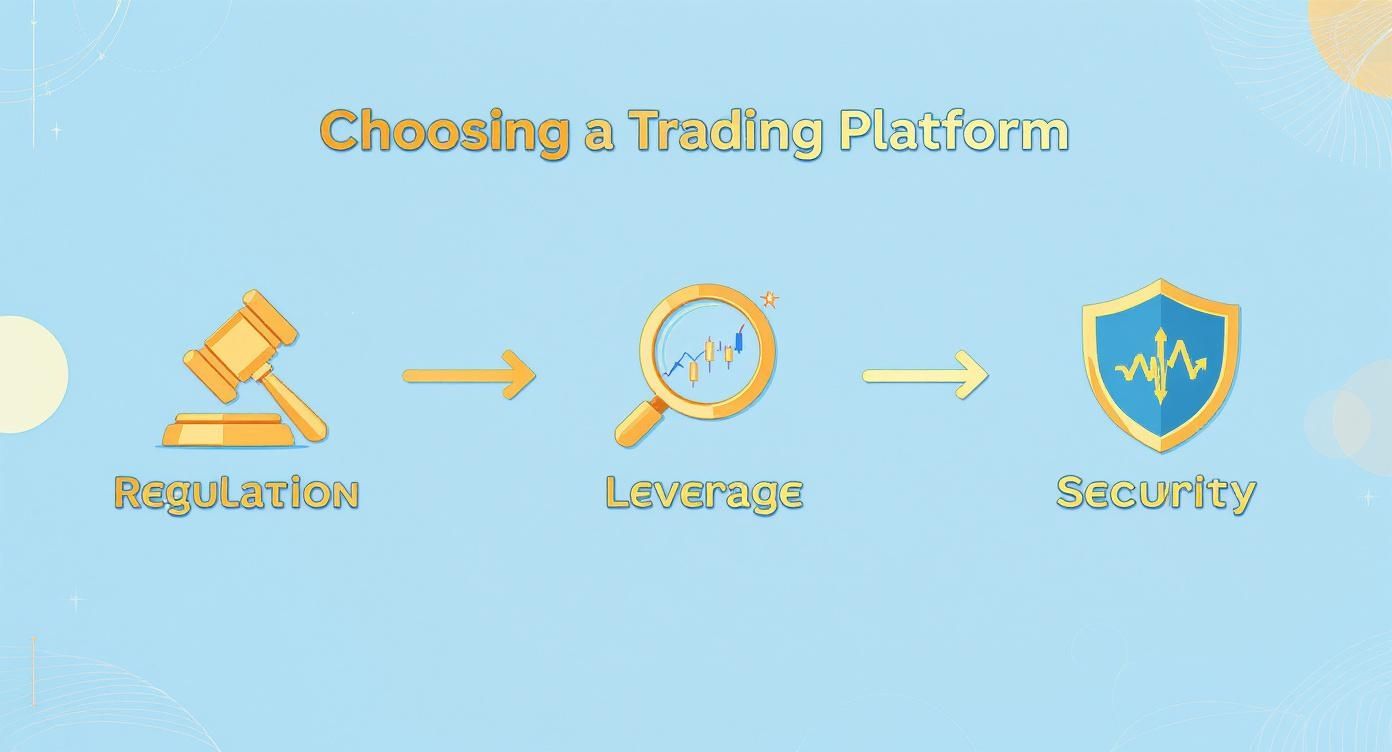
Having a solid foundation starts with picking the right place to trade. It’s crucial that the platform lines up with your risk tolerance and meets the key safety standards here in the UK.
Setting Up and Funding Your Account
First things first: you need to set up and fund your margin account. This is usually a pretty painless process. You’ll complete any final identity checks needed for this type of trading, then get some funds in there. Most exchanges let you deposit pounds (GBP) directly via bank transfer or debit card, or you can send over crypto you already own from another wallet.
A piece of advice from experience: start small. Only deposit an amount of money you are genuinely prepared to lose. This isn't just a tired old warning; it’s a vital psychological safety net. It frees you up to learn how the platform works without the gut-wrenching stress of risking your rent money.
Your initial deposit is your trading capital. From this pool of funds, you will allocate a smaller portion as margin for each trade. Never put your entire account balance into a single leveraged position.
Going Long vs. Going Short
One of the coolest things about trading with leverage is the ability to profit whether the market is going up or down. This is a world away from simply buying Bitcoin and hoping its value rises over time.
- Going Long: This is the one most people find easy to understand. You open a 'long' position if you think the price of Bitcoin is about to increase. You're betting on the price heading upwards.
- Going Short: On the other hand, you open a 'short' position if you predict the price of Bitcoin is going to decrease. This is how you can potentially profit from a falling market.
For example, imagine a major tech company like Apple announces it’s adding Bitcoin to its company funds. That’s a positive signal, and you might decide to go long. But if news breaks about a government planning a harsh crackdown on crypto, you might see that as a sign of a downturn and decide going short is the smarter move.
A Practical Example of a Long Trade
Let's put some real numbers to this. You've done your research and believe Bitcoin's price is ready for a climb. You want to open a position worth £1,000 and decide to use 5x leverage—a sensible starting point.
Here’s how that breaks down:
- Calculate Your Margin: The total position size is £1,000. With 5x leverage, the actual cash you need to put up (your margin) is the total position size divided by your leverage.
- £1,000 / 5 = £200
- Place the Order: You'll find the BTC trading pair (for example, BTC/GBP) on your platform and get ready to set up your trade.
That £200 is your skin in the game—the capital you are risking. The exchange fronts the other £800 to bring your total exposure up to the full £1,000.
So, what happens if you're right? If Bitcoin’s price rallies by 10%, your £1,000 position is now worth £1,100. When you close the trade, you pay back the £800 you borrowed, leaving you with £300. Your initial £200 has just made a £100 profit. That's a 50% return on your own money, all thanks to leverage.
Understanding Market and Limit Orders
When it comes to actually placing your trade, you won't just see a single "buy" button. You have to tell the exchange how to carry out your order. The two most basic types are Market and Limit orders.
Market Order
This is the simplest choice. A market order tells the exchange, "Get me into this trade right now at whatever the current price is."
- Pro: It's fast. Your order is pretty much guaranteed to be filled instantly.
- Con: In a fast-moving market, the price can change in the split second it takes to execute your trade. You might end up paying a bit more than you expected. This is called "slippage."
Limit Order
A limit order gives you much more control. It tells the exchange to only carry out your trade at a specific price you set, or better.
- Pro: You get to name your entry price, making sure you don’t chase a price spike or get a bad entry.
- Con: There's no guarantee your order will ever be filled. If the market price never drops (for a long) or rises (for a short) to your limit price, you'll be left on the sidelines.
For anyone just starting out, I’d strongly suggest using limit orders. It forces you to be disciplined and helps you avoid getting swept up in market hype. For example, if Bitcoin is trading at £50,000, you might set a limit order to buy at £49,800, patiently waiting for a small dip to get a better entry point.
Essential Risk Management Strategies
Let's be clear: when you trade Bitcoin with leverage, you’re playing with fire. It's a fantastic tool for boosting your gains, but it can just as easily burn through your trading account. This is why managing risk isn't just another chapter in a trading book; it's the single most important skill you'll ever learn.
Good risk management isn't about vague ideas. It's about the solid, non-negotiable rules you apply to every single trade. Without a solid plan to protect yourself from losses, you're just gambling in one of the world's most unpredictable markets.
Setting Your Safety Nets: Stop-Loss and Take-Profit
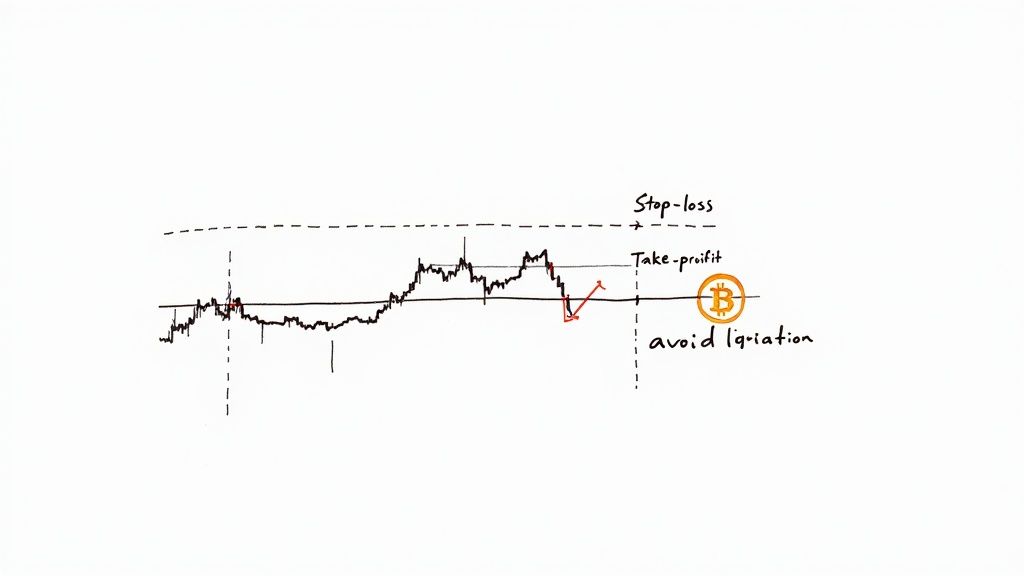
First things first, let's talk about your two most important safety nets: the stop-loss and take-profit orders. Think of these as your automated escape hatches, which you set before you even enter a trade. This is vital because it takes emotion out of the picture when prices are flying and the pressure is on.
A stop-loss order is your defence. It’s a simple instruction to your exchange to automatically close your trade if the price moves against you to a certain point. Its job is to put a hard limit on how much you can lose.
Imagine you decide to go long on Bitcoin at £50,000, but you’re only comfortable risking £200 on this idea. You'd place a stop-loss order at a price—let's say £49,800—that ensures if you're wrong, your loss is limited to that £200. If the market turns south, your trade is closed. No questions asked. You've protected the rest of your money to fight another day.
On the other hand, a take-profit order is your offence. It does the opposite, automatically closing your position to lock in your gains once the price hits your target. These automated orders are your best friends because they work 24/7, even when you’re asleep. To get a better grasp of how these mechanics work, especially when the market gets shaky, our guide on leverage trading and margin calls explains it all in more detail.
Calculating Your Risk-to-Reward Ratio
Before clicking that "buy" or "sell" button, you need to ask yourself one simple question: "Is the potential reward worth the risk?" This is where the risk-to-reward ratio comes in. It's a quick calculation that compares your potential upside against your potential downside.
Let's stick with our example:
- Entry Price: £50,000
- Stop-Loss (Your Risk): £49,800 (a £200 risk)
- Take-Profit (Your Reward): £50,600 (a £600 potential gain)
In this trade, you're risking £200 for a shot at making £600. Your risk-to-reward ratio is a healthy 1:3.
A good risk-to-reward ratio, like 1:2 or higher, is the foundation of any long-term trading strategy. It means your winning trades more than cover your losing ones, so you don't need to be right every time to be profitable.
Seriously, never enter a trade where you stand to lose more than you could potentially gain. It's a statistical trap that will empty your account over time.
Position Sizing and Capital Preservation
One of the fastest ways to lose your account is by going too big on a single trade. A professional approach to leverage trading is all about disciplined position sizing. This means you only ever risk a small, fixed percentage of your total trading money on any one idea.
The golden rule here is to risk no more than 1-2% of your account per trade.
- For instance, if you're working with a £5,000 trading account, a 1% risk means your maximum loss on any single trade is capped at just £50.
- This rule forces you to adjust how much you trade or where you place your stop-loss, stopping one bad call from ending your trading career.
This discipline is your key to sticking around. The crypto markets are incredibly sensitive to leverage, as we saw during the massive $19 billion crash in 2025, which was hugely sped up by over-leveraged positions. At that time, the total value of open Bitcoin futures contracts had skyrocketed, showing just how many traders were taking on unmanageable risk.
Always remember: your number one job is to protect your capital. The profits will come, but only if you have money left to trade with.
Practical Tips from Experienced Traders
Once you've got the hang of placing trades and setting stop-losses, it's time to start thinking like a pro. This is about more than just chart patterns; it's about learning to read the market’s mood and, just as importantly, your own. The best traders I know have a toolkit of simple habits that keep them grounded and consistent day after day.
These aren't complicated secrets. They are simple, repeatable actions that make a massive difference in the long run. Adopting them will help you stay disciplined when you trade Bitcoin with leverage, turning those high-stress moments into valuable learning experiences.
Gauge the Market's Mood
The crypto market runs on emotion just as much as it does on data. Fear and greed are powerful forces, and if you can get a read on the collective feeling of other traders, you'll have a serious advantage.
One of the easiest ways to do this is with the Crypto Fear & Greed Index. This useful tool pulls together data from market volatility, social media buzz, and trading volume to give a simple score from 0 (Extreme Fear) to 100 (Extreme Greed).
- Extreme Fear: This often means investors are panicking. For someone who thinks differently, it can signal a great buying opportunity.
- Extreme Greed: This suggests the market is getting too excited and might be due for a drop. It's a time to be extra careful with your long positions.
It’s not a crystal ball, of course, but giving it a quick look each day provides helpful context. For instance, you might spot a perfect long setup on your chart, but if the index is flashing "Extreme Greed," you could decide to take a smaller position or tighten your stop-loss.
Master Your Trading Psychology
Leverage has a funny way of magnifying your emotions right alongside your money. The psychological pressure can be huge, and it causes even the smartest traders to make silly mistakes. The real skill is learning to spot these emotional traps before you fall into them.
One of the most destructive habits is 'revenge trading'. You know the feeling: you take a loss, and your first instinct is to jump straight back in to "win it back." This is a purely emotional reaction, not a strategic one, and it's a fast track to even bigger losses.
A loss is not a personal failure; it's a business expense. The moment you feel angry or frustrated after a trade, the best thing you can do is step away from the screen. Go for a walk, clear your head, and come back when you can think clearly again.
Another tip is to avoid getting emotionally attached to any single trade. Your analysis could be perfect, but as the old saying goes, the market can stay irrational longer than you can stay in business. If a trade goes against you and hits your stop-loss, just accept it and move on. Your job is to manage risk, not to be right every single time.
Keep a Simple Trading Journal
This might sound like a chore, but trust me, keeping a trading journal is one of the most powerful things you can do to get better. It doesn’t have to be anything fancy. A simple spreadsheet or even a physical notebook is all you need to start tracking your performance and learning from your wins and your losses.
For every trade you take, just write down a few key things:
- The Setup: Why did you take this trade? What was your reasoning?
- Entry & Exit: The exact prices where you got in and out.
- Risk vs. Reward: What was your planned risk-to-reward ratio before you entered?
- The Outcome: The final profit or loss.
- Your Feelings: How did you feel during the trade? Were you calm, nervous, or a bit greedy?
Reviewing your journal at the end of each week helps you spot patterns you'd otherwise miss. You might find you're brilliant on weekday mornings but always seem to lose money on Friday afternoons. Or maybe you'll realise that every time you break your "1% risk per trade" rule, you live to regret it. This kind of self-awareness is priceless.
The UK trading scene is always changing. A recent report showed that while the total number of UK leverage traders dipped slightly to 167,000 in 2025, the ones who stayed were more active than ever, with trader dormancy hitting a five-year low. This points to a smaller, more committed group of traders navigating the markets. You can find more insights in the 2025 UK Leverage Trading Report. It just goes to show how important discipline and constant improvement are, as the traders who stick around are almost certainly the ones with solid routines.
Got Questions About Leverage Trading? We’ve Got Answers
Even with the best strategy in hand, stepping into the world of leveraged Bitcoin trading can feel a bit intimidating. Questions always come up, and that’s a good thing. It means you’re thinking critically. We've gathered some of the most common questions we hear from traders here in the UK to help you get started on the right foot.
Think of this as your go-to FAQ. The aim is to give you clear, simple answers you can use right away, so you can trade with more confidence and less confusion.
Can You Actually Trade Bitcoin With Leverage In The UK?
Yes, you certainly can. People in the UK are able to trade Bitcoin and other cryptocurrencies using leverage, but there's an important detail. You need to use a platform that follows the local rules. The Financial Conduct Authority (FCA) keeps a close watch on these things, so picking an exchange that's registered with them is a smart move. It adds a layer of safety you won't get on other platforms.
You might see exchanges based in other countries dangling promises of extremely high leverage, but sticking with a regulated platform is a far safer bet, particularly when you're just starting out. Always double-check a platform's regulatory status before you even think about depositing your money.
What’s A Sensible Amount Of Leverage For A Beginner?
When you're just starting out, less is definitely more. I always advise newcomers to begin with a really low level of leverage, like 2x or 3x at the most. This lets you get a real feel for how leverage boosts your results—both the good and the bad—without risking your entire account from day one.
It's easy to be tempted by 50x or 100x leverage, but that's a professional's game. At that level, the tiniest market flicker against your position can wipe you out instantly. Starting small gives you room to make mistakes and learn from them without a disaster.
Once you’ve got a trading strategy that’s consistently working and you truly understand the risks, you can think about slowly increasing it. There's no prize for being the fastest; smart, disciplined trading is what wins in the long run.
What Does It Mean If My Leveraged Trade Gets Liquidated?
Liquidation is a word you'll hear a lot, and it's something you want to avoid at all costs. It’s when the exchange forcibly closes your position because the market has moved so far against you that your losses are about to eat up your entire margin—the money you put down. The exchange steps in and shuts the trade to make sure you don't lose more money than you have in that position.
Let's imagine you opened a position with £200 of your own money as margin. If the trade goes badly wrong, the exchange will automatically liquidate it just as your losses approach that £200 mark.
- The £200 margin you committed to that trade is gone.
- Crucially, the rest of the money sitting in your trading account remains untouched.
- Some exchanges might also charge a small fee for the liquidation itself.
This is exactly why things like managing your position size and setting a stop-loss are essential. They are your first line of defence. Think of liquidation as the exchange’s safety net, but your own risk management is what’s meant to stop you from ever needing it.
Ready to put your knowledge into practice with a trusted educational resource? At The Coin Course, we provide clear, expert-led guides to help you navigate every aspect of the crypto world with confidence. Start your learning journey with The Coin Course today.