
You leave your Bitcoin on an exchange because you plan to trade it later. Then withdrawals pause, the support queue grows, and you realise that owning an asset isn't the same as controlling it. The exchange, its banking partners, custody system, cloud provider, security team, and compliance decisions have all become part of your risk.
That is the practical meaning of third party risk in crypto. Whenever another organisation controls your assets, supplies information to a transaction, runs infrastructure, or operates code you depend on, its weaknesses can affect you. The same supplier-oversight problem that concerns UK companies also affects exchange users, token holders, businesses building wallets, and people depositing funds into DeFi.
What Third Party Risk Really Means in Crypto
A third party is any outside provider that sits between you and the result you want. In crypto, that might be an exchange holding your Bitcoin, a custodian protecting private keys, an oracle reporting an asset price, or an RPC provider carrying your wallet's request to a blockchain.
Consider two users. One leaves coins on a centralised exchange. The exchange doesn't merely provide a trading screen. It may custody the coins, manage withdrawals, connect to payment partners, store customer information, and rely on external infrastructure. If one of those links fails, the user may face a frozen balance even when the underlying blockchain is operating normally.
The second user keeps assets in a hardware wallet. That removes direct custody by an exchange, but it doesn't remove every dependency. The wallet may rely on node software, an RPC endpoint, price feeds, bridge contracts, and a device manufacturer. Self-custody reduces some forms of counterparty exposure, but it doesn't create a risk-free environment.
Practical rule: Ask who can stop, change, delay, misprice, or redirect the action you're taking.
UK financial regulation provides a useful way to think about this. Firms are expected to map the people, processes, technology, facilities, and information needed to deliver important business services, including dependencies on third parties, as explained by the FCA's guidance on outsourcing and operational resilience. A crypto user can apply the same logic on a smaller scale: map every provider that touches a deposit, withdrawal, trade, smart-contract call, or recovery process.
For a clearer comparison between direct custody and personal control, review this guide to custodial and non-custodial wallets for different use cases. The key question isn't whether a provider looks familiar. It's whether you understand what it controls, what it depends on, and what happens when it fails.
The Main Types of Crypto Third Parties
Start by naming the provider before judging it. Different providers create different failure paths, so a crypto exchange shouldn't be assessed in exactly the same way as an oracle.
Custodians and exchanges
Custodians resemble safety-deposit-box operators, except they hold or control private keys for you. Their core risks include key management, internal access, insolvency, withdrawal controls, and the legal treatment of customer assets.
Centralised exchanges combine features of a brokerage, trading venue, and bank account. They match buyers and sellers, maintain an internal balance, and often control withdrawals. A useful explanation of the difference between centralised and decentralised venues appears in this comparison of centralised and decentralised exchanges.
Oracles and infrastructure
Oracles act like weather reporters for smart contracts. A lending protocol might use an oracle to decide whether collateral is worth enough, while a derivatives platform may use one to calculate settlement values. If the feed is delayed, manipulated, or unavailable, a correct contract can still produce a harmful result.
Infrastructure providers include RPC node operators, wallet SDKs, cloud hosts, analytics systems, and notification services. They're like roads and power networks for a crypto application. Users may never see them, but a failure can prevent a wallet from displaying a balance or submitting a transaction.
Auditors and proof-of-reserve firms resemble building inspectors. They review code, controls, or reported reserves, but their work has boundaries. An audit doesn't guarantee that a contract can't fail, and a reserve attestation doesn't automatically explain liabilities, withdrawal rights, or how assets are used.
DeFi protocol teams form a further category. Governance-token holders, developers, upgrade administrators, and multisignature signers can influence contracts that users treat as neutral software. Their role may look different from a vendor relationship, but the dependency is similar.
| Third Party Type | Role in Crypto | Primary Risk |
|---|---|---|
| Custodian | Holds or controls private keys | Loss of access, misuse, or insolvency |
| Centralised exchange | Matches trades and records balances | Withdrawal freezes, custody failure, or market disruption |
| Oracle | Supplies external data to contracts | Manipulated or unavailable pricing |
| Infrastructure provider | Runs nodes, APIs, hosting, or wallet tools | Outage, censorship, or compromised access |
| Auditor or reserve reviewer | Examines code, controls, or reserves | False confidence or incomplete scope |
| DeFi protocol team | Maintains governance and upgrade powers | Malicious change, poor decisions, or signer compromise |
The Risk Categories You Should Care About
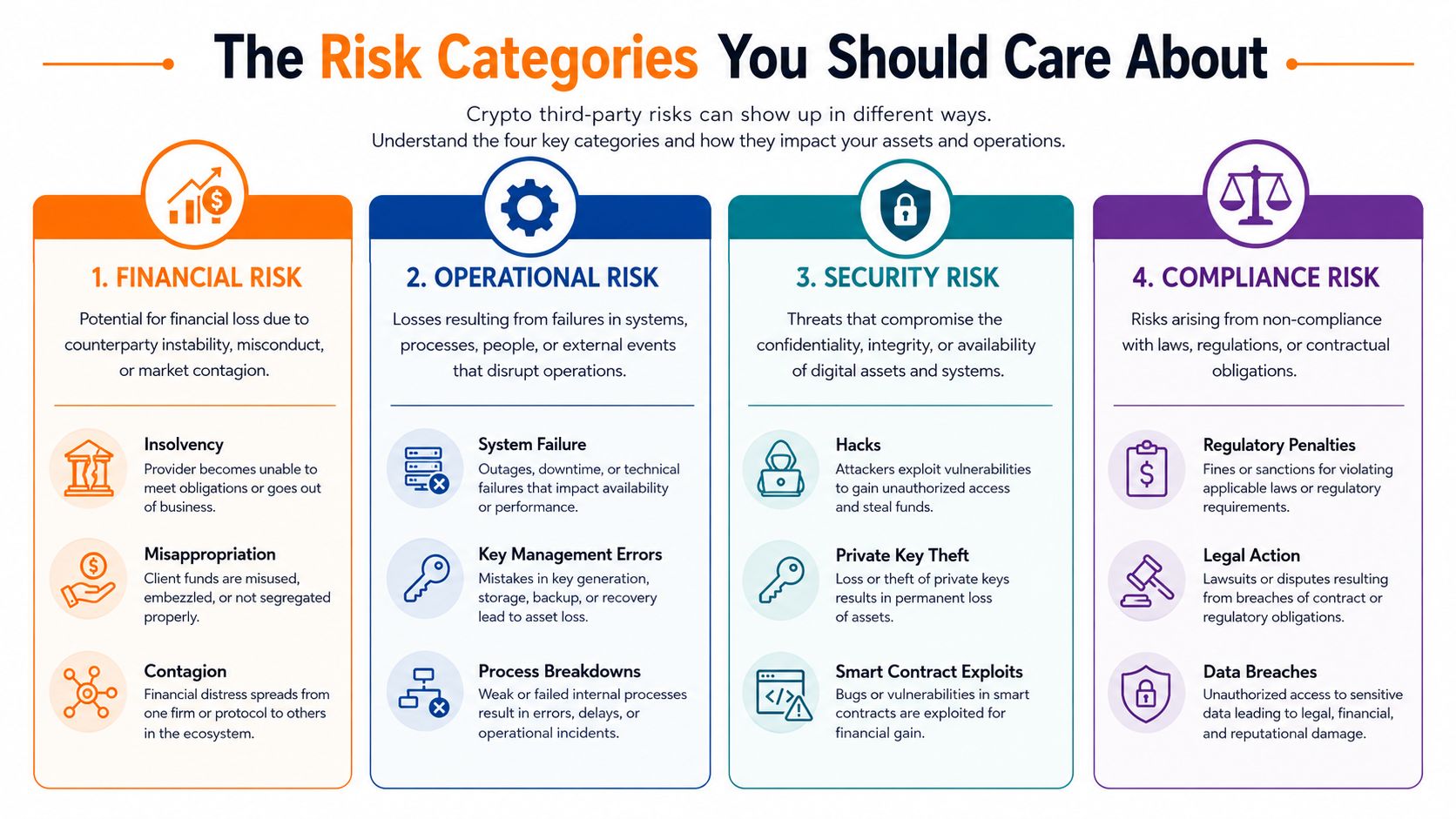
Crypto third party risk becomes easier to manage when you sort it into four practical buckets. The labels overlap, but they help you ask better questions before you deposit funds or integrate a service.
Financial risk
Financial risk concerns whether a provider can meet its obligations. An exchange might become insolvent, misuse customer funds, or lend assets onward through opaque arrangements. A lending protocol can also spread losses when collateral values fall and several participants depend on the same liquidity source.
For an individual, the visible result may be a withdrawal delay. For a business, it may be an inability to settle trades, pay customers, or access working capital.
Technical risk
Technical risk covers smart-contract bugs, flawed key management, unsafe upgrades, and manipulated data. A bridge may verify the wrong message. An oracle may publish an incorrect price. A wallet integration may expose a signing request that the user can't properly inspect.
Technical design matters because blockchain transactions are often difficult or impossible to reverse once authorised.
Operational risk
Operational risk appears when people and processes fail. Examples include an exchange outage, an insider with excessive permissions, weak separation of duties, or a support team that can't respond during an incident. Concentrating privileged access in one provider or one service desk can turn a small disruption into a broad loss of availability.
Regulatory risk
Regulatory risk includes licensing gaps, sanctions exposure, enforcement action, and uncertainty about how customer assets are handled during insolvency. A provider might remain technically online while becoming unable to serve users in a particular jurisdiction.
These categories connect to a broader UK concern. The Cyber Security Breaches Survey 2025 estimated that 43% of UK businesses experienced a cyber breach or attack in the previous 12 months, while the NCSC highlighted that only 13% reviewed immediate-supplier risk and 7% reviewed wider supply-chain risk. In crypto, that oversight gap can convert one provider failure into frozen accounts, drained wallets, or disrupted applications.
Real Incidents That Show How Things Go Wrong
Crypto failures often begin with a simple trust decision. A user deposits funds, a developer connects a bridge, or a protocol accepts a data feed. The failure appears later, after the dependency has become invisible.
The Mt. Gox collapse shows the custody version of this story. In 2014, the exchange failure involved 850,000 BTC lost, as represented in the supplied timeline visual. Users had treated exchange balances as available Bitcoin, but the exchange's internal controls and oversight did not protect that assumption. The lesson is direct: a balance shown on a platform isn't the same as a private key held by you.
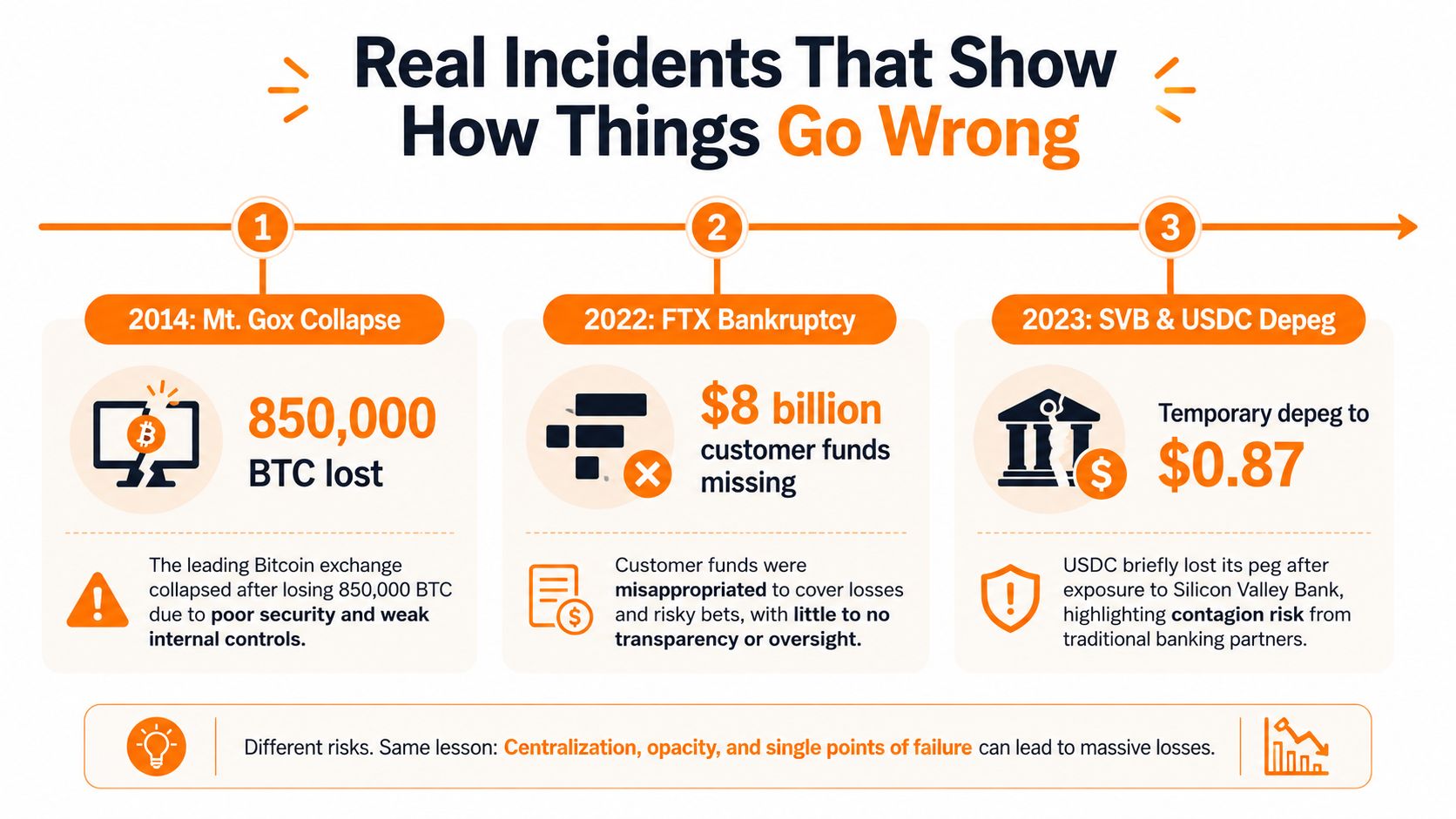
The Ronin bridge attack in 2022 highlights infrastructure concentration. Attackers compromised enough of the validator arrangement associated with Sky Mavis to drain roughly $625 million, a figure included in the supplied incident plan. A bridge isn't only a smart contract. It depends on validators, signing processes, monitoring, and the organisation coordinating them. If those controls cluster around a small group, one compromise can affect every connected user.
Wormhole offers a different lesson. In 2022, an attacker bypassed signature checks and minted 120,000 wrapped ETH on Solana, according to the supplied incident description. The failure wasn't a frozen exchange account. It was a weakness in the verification logic that allowed the bridge to accept an invalid message.
A provider can fail by losing your assets, stopping your access, or telling a smart contract something that isn't true.
These examples also explain why a security review must cover more than the headline product. An exchange needs custody and financial scrutiny. A bridge needs validator and message-verification scrutiny. An oracle needs data-source and update-control scrutiny. Even a hardware wallet deserves careful review of its software and signing flow, as shown by the discussion of a Coldcard wallet flaw exposing years of Bitcoin seeds.
For additional visual context, the following video accompanies the incident timeline:
A Simple Framework to Assess Any Provider
You don't need to become a forensic accountant or smart-contract auditor before using a crypto service. You do need a repeatable way to ask what you're trusting and what evidence supports that trust.
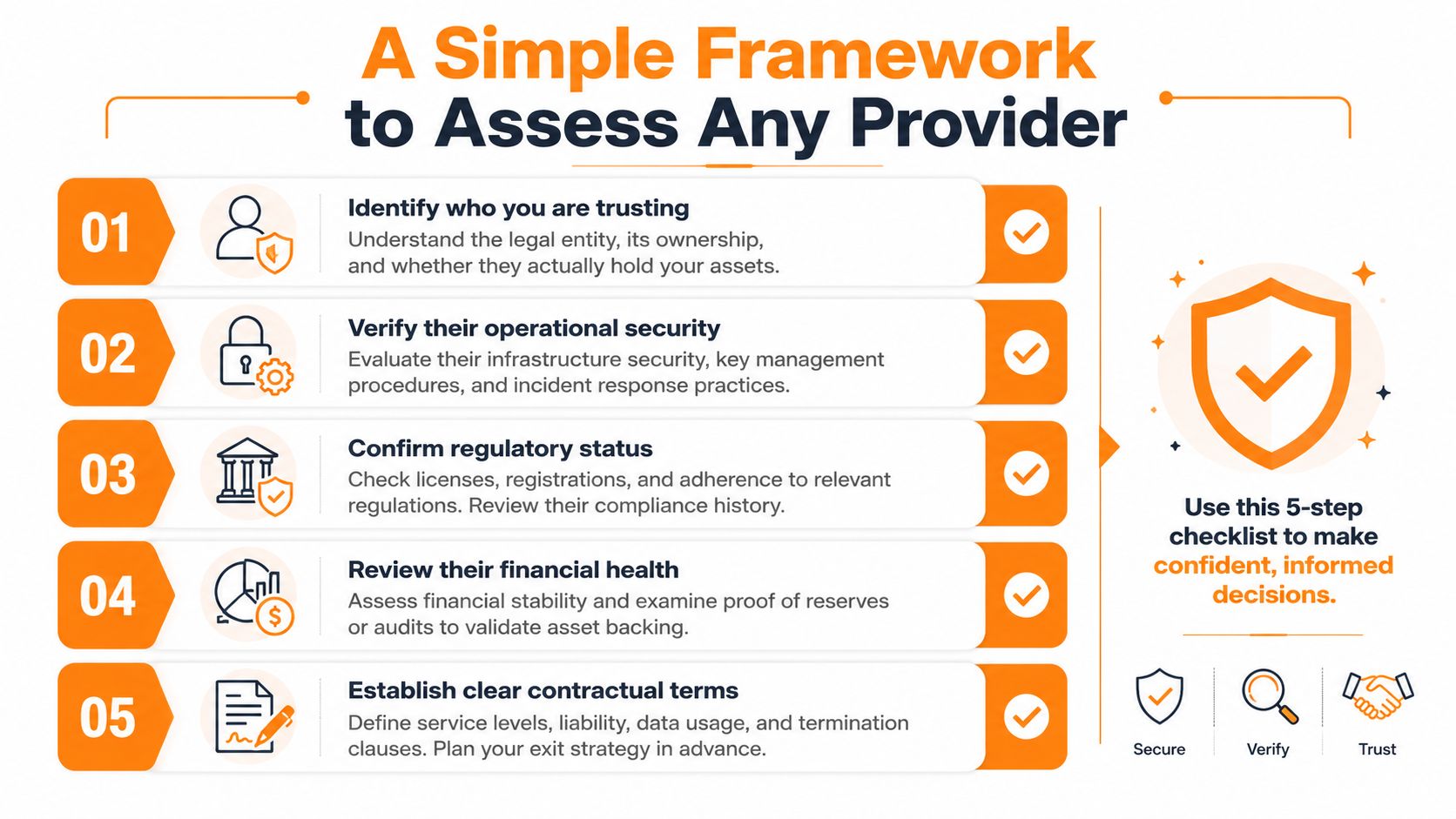
Five questions before you connect funds
Identify the relationship. Does the provider hold your assets, move them, price them, host the application, or merely supply information? An exchange with custody power deserves more attention than a portfolio tracker that only reads public addresses.
Check the history. Search for earlier breaches, outages, regulatory action, governance disputes, and incident post-mortems. Focus on the response as well as the failure. Did the provider communicate clearly, contain the issue, and explain what changed?
Inspect the controls. Look for evidence about key management, access separation, reserve reporting, independent audits, bug bounties, upgrade permissions, and withdrawal safeguards. Treat marketing language as a starting point, not proof.
Map the legal position. Find the operating entity, its jurisdiction, relevant permissions, and the rules that may apply if it fails. A user needs to know whether assets are segregated, how claims are handled, and which court or regulator might be involved.
Set your exposure. Decide how much loss, delay, or disruption you could tolerate from this single provider. Your risk decision should account for both the amount deposited and the role the provider plays in your wider strategy.
Businesses can turn these questions into ownership, evidence, approval, and review processes. The practical guidance on vendor management tips for finance teams is useful when several departments share responsibility for provider decisions.
A short checklist to save
- I know exactly what the provider controls.
- I've checked its incident and regulatory history.
- I've reviewed evidence of security and financial controls.
- I understand the jurisdiction and failure process.
- I've chosen an exposure level that fits my tolerance.
Mitigation Strategies for Individuals and Businesses
Mitigation doesn't mean finding a provider with no weaknesses. That provider doesn't exist. It means reducing the damage from one failure by limiting access, separating responsibilities, and keeping an exit route.
For individuals, start with the custody decision. Keep long-term holdings in a hardware wallet when you understand how to secure and recover it, and use a separate wallet for active trading or DeFi experimentation. This separation prevents a routine connection to an unfamiliar application from exposing your savings.
Use more than one reputable custodian if you need custodial services, rather than placing every exchange balance with one company. Enable address whitelisting and withdrawal delays where available, and avoid lending assets through platforms that can't explain their reserves, liabilities, and withdrawal process in plain language.
Businesses need a more formal control set. Before onboarding a custodian, oracle, cloud provider, or wallet vendor, document the service, data access, criticality, dependencies, and exit plan. Request relevant audit reports, such as SOC 2 or an equivalent assurance report, then test whether the report covers the service your team will use.
Set exposure limits for each provider. Use multisignature custody with signers distributed across locations and roles, so one compromised device or employee can't authorise a transfer alone. Require contractual terms covering incident notification, access logging, audit rights, data handling, service continuity, and assistance during an orderly exit.
| Action Area | Individuals | Businesses |
|---|---|---|
| Custody | Separate long-term and active-use wallets | Use policy-based, multisignature custody |
| Provider spread | Avoid relying on one custodian | Set exposure limits by provider and service |
| Access control | Enable whitelists and withdrawal delays | Apply least privilege and approval controls |
| Due diligence | Review reserves, history, and withdrawal terms | Assess every critical provider before onboarding |
| Recovery | Keep tested wallet backups | Maintain documented failover and exit plans |
The UK operational-resilience approach treats concentration as a systemic issue. The Bank of England's framework for critical third parties says firms must remain within their impact tolerances even when important services rely on external providers. For crypto businesses, that means testing what happens if a cloud host, oracle, bridge operator, or data processor becomes unavailable.
Why Ongoing Monitoring Beats One-Off Checks
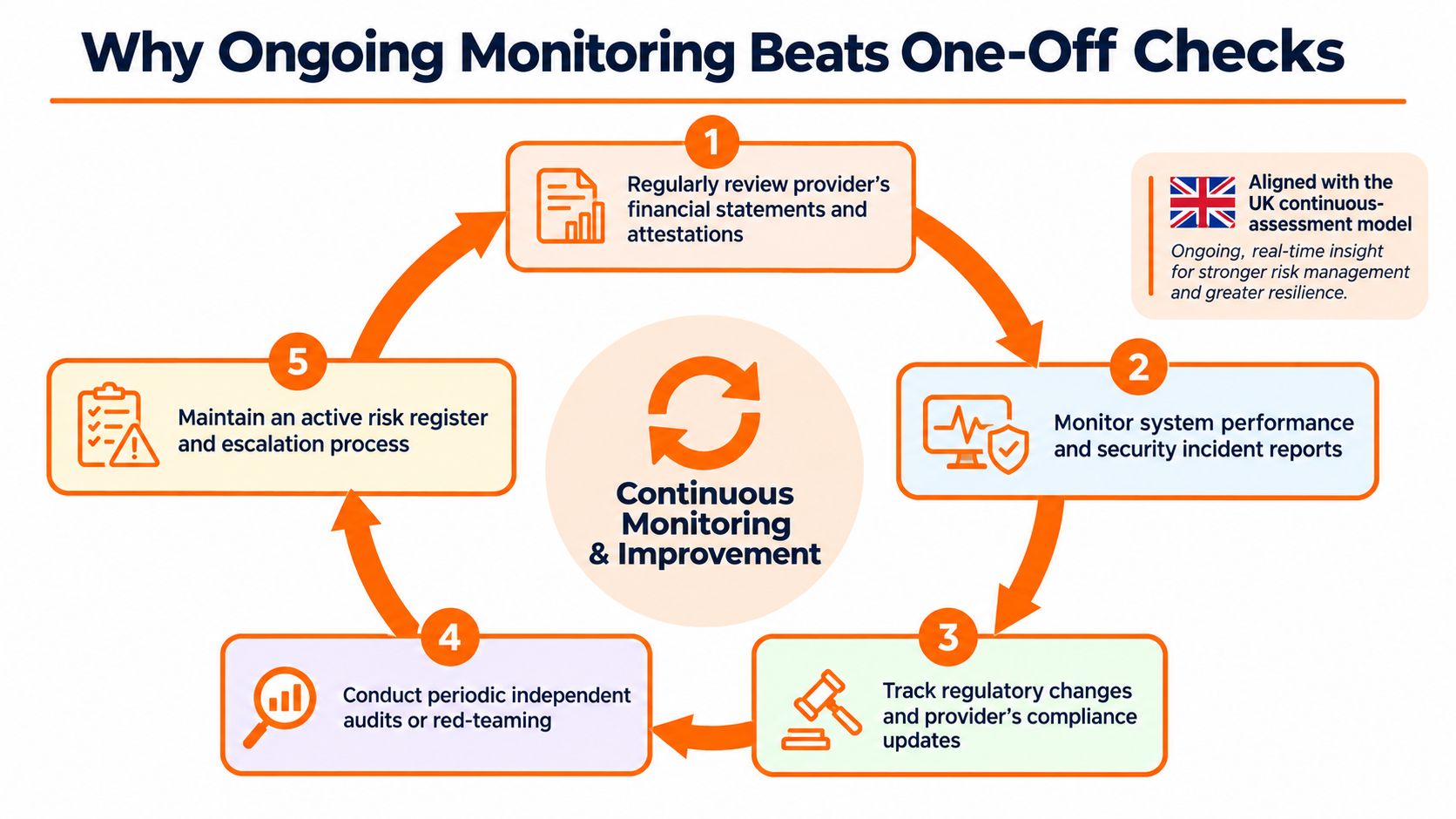
A clean onboarding review is a snapshot. Crypto providers can change custody arrangements, upgrade contracts, replace signers, alter governance, lose a licence, or add a dependency after you've approved them.
UK evidence shows why this matters. The government's 2025/2026 survey found that only 15% of businesses formally reviewed cyber risks from immediate suppliers and 6% reviewed wider supply chains, while independent UK research reported that 82.4% of organisations experienced at least one supply-chain cyber incident in the previous 12 months. That research also reported 41.8% experienced two incidents and 5.4% experienced three or more, all detailed in Risk Ledger's UK supply-chain research.
The difference isn't merely administrative. A provider may pass an initial check and later introduce a risky contract upgrade, lose a key staff member, depend on a new cloud service, or face a regulatory restriction. The FCA's critical third party regime took effect on 1 January 2025, reflecting the regulators' focus on managing major service-provider disruption rather than relying only on entry checks.
A lightweight monitoring rhythm
- Daily: Check for withdrawal problems, unusual wallet activity, oracle outages, failed transactions, and security announcements affecting providers you actively use.
- Weekly: Review governance proposals, contract upgrade permissions, reserve attestations, licensing news, and incident disclosures for critical services.
- Quarterly: Reassess provider exposure, permissions, legal terms, backup routes, and whether the provider still fits your risk tolerance.
Businesses should keep an active risk register, assign an owner to each dependency, and record escalation triggers. The FCA's operational-resilience guidance expects firms to manage third-party risks throughout the arrangement, from beginning to end. That lifecycle mindset also works for individuals. If your reason for trusting a provider has changed, your risk assessment should change with it.
Key Takeaways and Your Next Steps
Third party risk becomes manageable when you turn trust into a list of observable decisions. You don't need perfect certainty. You need enough visibility to avoid placing all your assets, permissions, and transaction paths behind one untested dependency.
Build these five habits:
- Know who holds control. This week, list every exchange, custodian, protocol, oracle, bridge, wallet provider, and infrastructure service that can affect your funds.
- Spread critical exposure. Move away from a single point of custody or execution where your situation allows it. Separate long-term savings from active trading funds.
- Prefer evidence over promises. Check reserve attestations, audit scope, upgrade powers, signer arrangements, incident reports, and withdrawal rules instead of relying on branding.
- Read the failure history. A provider's response to an outage or breach reveals how it behaves under pressure. Note what changed after the event.
- Review on a schedule. Put a recurring review in your calendar. Confirm that permissions, balances, provider status, and exit routes still match your plan.
UK firms face a persistent oversight gap. The 2021 BlueVoyant research reported that 97% of UK organisations suffered a supply-chain breach in the prior year, up from 82% in 2020, and that 39% of British firms had no way to know whether a cyber risk emerged at a third-party vendor, as reported by Infosecurity Magazine. Crypto users face the same basic problem whenever they trust a provider without maintaining visibility.
Third party risk never disappears. You manage it by limiting concentration, checking evidence, monitoring change, and keeping a realistic route to withdraw or switch.
The Coin Course helps you build crypto knowledge from first principles, including wallets, DeFi, trading, and practical security controls. Visit The Coin Course to learn how to evaluate providers and protect your assets with greater confidence.