
You check your savings balance and see the same figure you expected. The number hasn't fallen, yet your weekly shop feels more expensive, your energy bills take a larger share of your income, and the money buys less than it once did. That uncomfortable gap explains why people search for a store of value, an asset designed to help preserve purchasing power rather than merely display a stable number on a bank statement.
The choice isn't limited to gold, cash, or Bitcoin. UK savers also need to consider access, account type, tax treatment, and the length of time they can leave their money untouched. A useful decision starts with a simple question: what job must this money perform?
Understanding the Core Concept of Wealth Preservation
Suppose you bury two containers in your garden and plan to open them years later. One contains fresh groceries. The other holds a gold coin. The groceries may have been useful when you bought them, but they won't remain edible. The coin doesn't spoil, and someone may still be willing to exchange it for goods when you recover it.
That example captures the basic purpose of a store of value. It holds wealth in a form that can remain useful over time, even as prices, currencies, and personal circumstances change. It doesn't need to rise in price every day, and it doesn't promise a profit. Its job is more modest and more important, to help you carry purchasing power from today into the future.

Three qualities make the role possible
A practical store of value usually needs three qualities:
- Durability: The asset must survive physical use and the passage of time. A well-made gold coin doesn't rot like food or wear out like a cheap household item.
- Scarcity: Supply must be limited enough that new units can't be created without restraint. Scarcity doesn't guarantee a rising price, but unlimited supply can make preservation harder.
- Acceptance: Other people must recognise the asset and agree that it can be exchanged, sold, or used as collateral.
These qualities work together. A rare object nobody wants may be difficult to sell. A widely accepted item that deteriorates quickly may preserve little wealth. A durable asset that can be produced endlessly may lose purchasing power as supply expands.
The hidden cost of leaving wealth exposed
Money sitting in an account can look safe because the balance is clear. Yet if prices rise faster than the interest paid, the account loses real value, even when the nominal balance increases. You may still have the same pounds, but those pounds command fewer goods and services.
That makes wealth preservation an active task. Holding cash, buying gold, owning property, or using a digital asset each involves a different compromise between convenience, risk, and purchasing power. For anyone assessing inherited jewellery, bullion, or foreign coins, a practical guide to gold coin valuation at Carat 24 can help clarify why weight, purity, condition, and market demand affect what a coin is worth.
Practical rule: Don't ask only whether an asset is valuable today. Ask whether people are likely to value it when you need to exchange it.
The Historical and Institutional Role of Gold
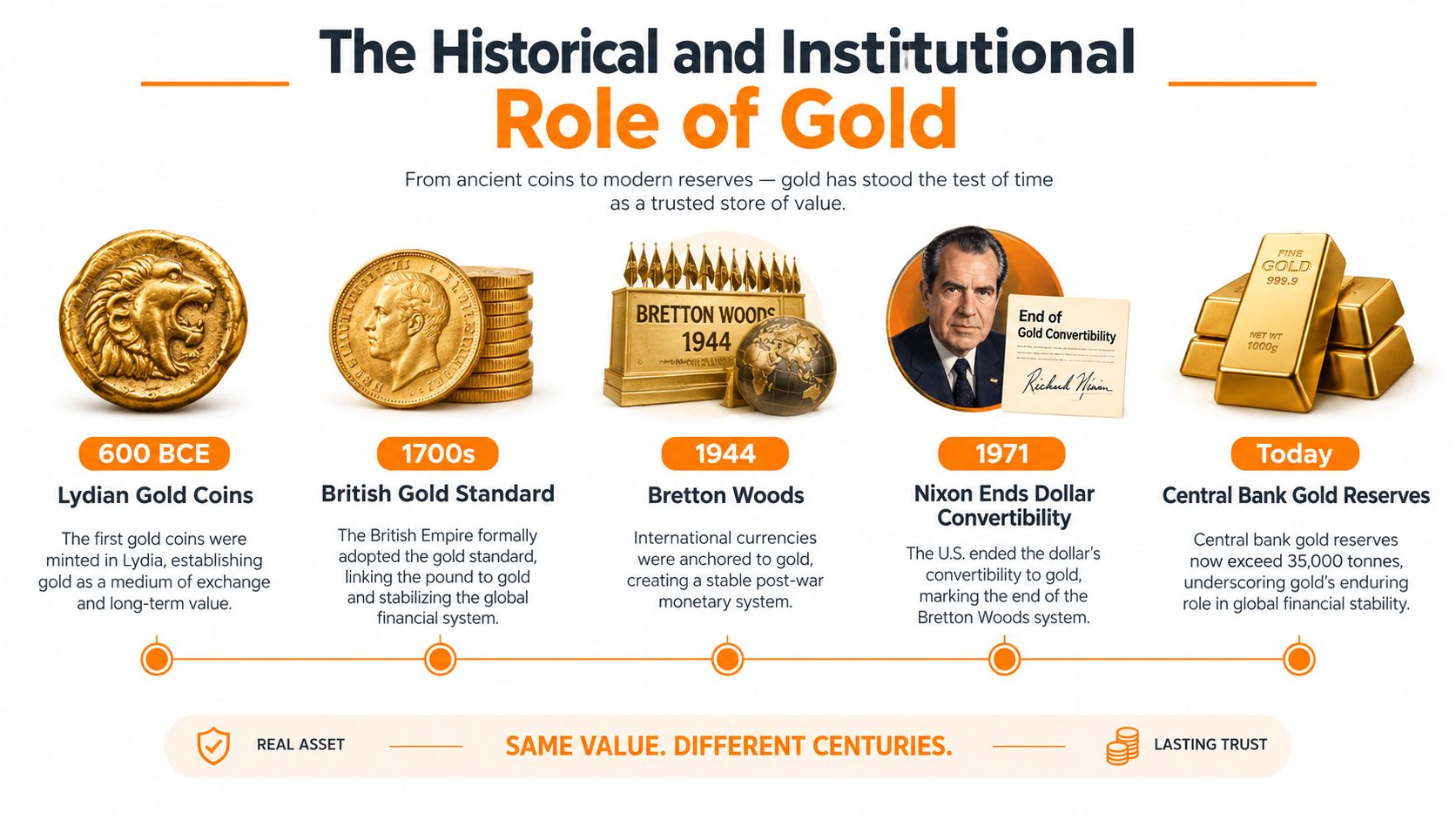
Gold has a special place in the store-of-value conversation because people, merchants, and governments have used it across long periods of history. That history doesn't make gold risk-free. It does show why investors continue to treat physical bullion as a reference point when confidence in currencies or financial markets weakens.
In the UK, the pound price provides a clear illustration. Gold rose from about £17 per ounce in 1971 to a record £3,964 in March 2026, which implies roughly 10% annual growth in sterling terms across that period, according to UK gold price history. UK Retail Prices Index inflation averaged about 5.6% a year over the same span, so gold outpaced long-run price inflation in pounds.
That result shouldn't be read as a promise that gold will beat inflation over every year or every investment period. The timing of a purchase matters, and gold can fall or remain weak in real terms for extended periods.
A long relationship with the pound
The Bank of England records that Britain remained on the gold standard from the early eighteenth century until 1931, apart from wartime suspensions from 1797 to 1819 and 1914 to 1925. Those periods help explain why gold and monetary stability became closely connected in British financial history. Changes in the monetary system could coincide with inflation, later deflation, and pressure on the value of money.
Another UK market comparison shows gold rising from about £14.50 in January 1970 to more than £300 by February 1980, while UK inflation averaged over 12.5% during that decade and reached 24.2% in 1975. The lesson isn't that gold moves in a straight line. It's that investors often turn to assets with constrained supply when they fear that cash will lose purchasing power.
Why central banks still hold it
Gold also has an institutional role. The Bank of England says its vault holds an annual average of around 400,000 bars over the last decade, representing about 60% of all gold held in London vaults, as described in its account of banking services for central bank customers. London remains a major centre for physical gold storage and trading, so the vault's importance extends beyond the coins and bars owned by the UK itself.
The Bank manages the UK's official gold and foreign currency reserves for the Government. Those reserves sit alongside foreign currency assets, International Monetary Fund special drawing rights, and the UK's Reserve Tranche Position at the IMF. The Bank also records the weight of gold held in custody on the last business day of each month through its official foreign currency reserves information.
For a beginner, the key distinction is simple. Gold can serve as a long-term wealth-preservation asset, but it isn't the same as cash in an emergency account. It has a market price, storage considerations, and short-term volatility. A discussion of gold reaching a three-month high while Bitcoin tests £80,000 illustrates why different assets can attract attention at different moments.
Why Cash Often Fails as a Reliable Store of Value
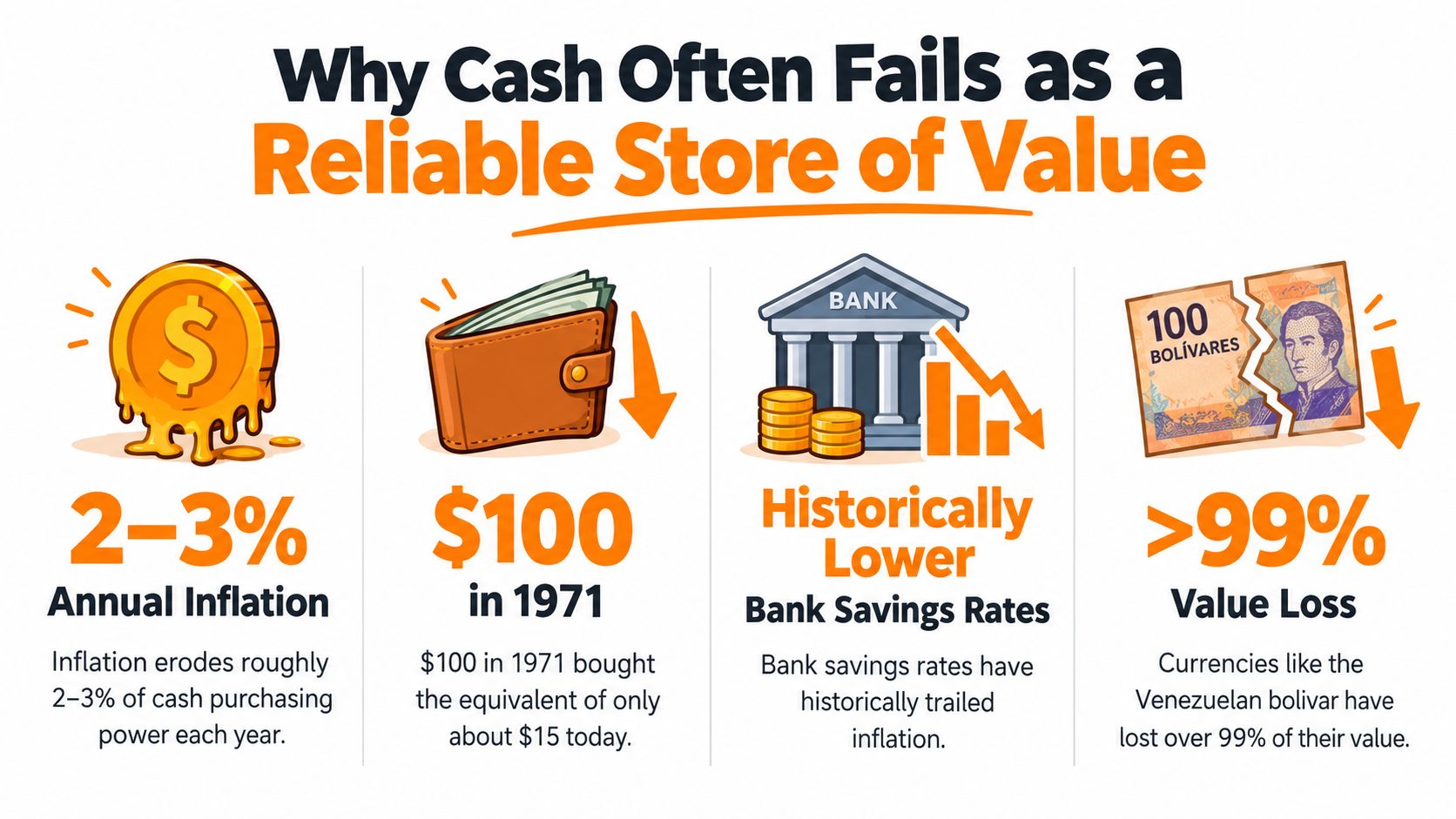
Cash feels safe because it doesn't swing visibly like a share, a gold bar, or a cryptocurrency. Your bank balance may show the same number tomorrow morning. The problem is that nominal safety isn't the same as purchasing-power safety.
If an account pays less interest than the rate at which consumer prices rise, your real return is negative. For example, a UK savings analysis explains that a 4.28% account rate alongside 3.1% inflation implies roughly a 1.1% real return, while a 2.53% rate would imply about a 0.6% real loss, as set out in this explanation of why savings rates are rising. The calculation is straightforward: compare what your account adds with what everyday prices take away.
The account rate matters more than the headline rate
Many savers don't receive the best advertised rate. The Bank of England-linked figures in the same UK savings discussion show that the effective rate on the existing stock of individuals' sight deposits was only 1.65% in July 2026, below the prevailing policy rate. An old current account or easy-access account can therefore lose ground while appearing perfectly stable.
UK household behaviour makes the issue more practical. The ONS reported a household saving ratio of 10.9% in Q1 2025 and 10.8% in Q2 2025, while the Bank of England said the ratio remained above pre-pandemic norms as households rebuilt precautionary savings. Holding a buffer is sensible, but a large buffer in a low-paying account can steadily erode.
The estimated scale is substantial. UK-focused analysis put the true loss suffered by savers at around £17.6bn in 2025, with households holding roughly £1.88tn in cash deposits, because inflation outpaced average deposit rates, according to the ONS quarterly economic commentary.
Cash still has an important job
This doesn't mean you should replace every pound of cash with gold or Bitcoin. Cash is useful for rent, bills, unexpected repairs, and goals that are close enough that a market fall would cause real trouble. Its strengths are liquidity, simplicity, and predictable access, not guaranteed preservation of purchasing power.
A sensible review asks four questions:
- What rate does your specific account pay? Don't rely on the best rate mentioned in an advert.
- How does that rate compare with CPI inflation? A positive balance can still deliver a negative real return.
- When will you need the money? Short-term spending needs usually require more liquidity.
- Could a different wrapper improve the result? A notice account or Cash ISA may offer a different balance of access, interest, and tax treatment.
For a wider discussion of how government borrowing can influence markets and interest in gold, see what a US national debt above $40 trillion may mean for markets and gold. The point isn't to predict a particular market outcome. It's to recognise that keeping cash is a choice with an opportunity cost.
Evaluating Bitcoin and Digital Assets Against Traditional Options
Bitcoin appeals to people who want a digitally native asset with constrained supply, portable ownership, and no dependence on a single commercial bank. Gold offers physical durability and a long history of acceptance. Cash offers immediate spending power and a familiar legal and banking system.
Those strengths solve different problems. A gold coin can be held without an internet connection, but it requires secure storage and a buyer when you want to sell. Bitcoin can be transferred across borders using digital infrastructure, but losing access credentials or choosing an unsafe platform can create serious risks. Cash is easy to spend, but its purchasing power depends on inflation and the interest paid on the account holding it.
Scarcity isn't the same as stability
Bitcoin's programmed scarcity is central to its appeal. Supporters see a supply rule that can't be changed casually as a contrast with fiat money, where central banks and financial systems can expand the quantity of currency and deposits. Gold is also scarce, but its supply changes through mining, recycling, and new discoveries.
Scarcity can support a store-of-value case, but it can't guarantee a stable price. An asset can be scarce and still move sharply when buyers and sellers change their expectations. That makes Bitcoin a potential long-term option for someone who understands high uncertainty, not a replacement for emergency cash.
A UK-focused comparison found that gold bested Bitcoin as an inflation hedge during the cost-of-living crisis period. It described gold as delivering a healthy real return while Bitcoin's price swings made it difficult to rely on as a stable store of value, as discussed in this UK comparison of investments during the cost-of-living crisis.
Compare the job, not just the asset
| Asset Class | Scarcity Profile | Inflation Resistance | Short-Term Volatility |
|---|---|---|---|
| Cash | Supply can expand through the monetary and banking system | Depends heavily on the account rate versus inflation | Usually low in nominal terms |
| Gold | Physically limited and costly to produce | Stronger over long horizons and during some periods of currency weakness | Can fluctuate and may suffer weak real periods |
| Bitcoin | Programmed digital scarcity | Potentially attractive to believers in long-term monetary scarcity | High, with sharp price movements possible |
The comparison doesn't identify a universal winner. It shows why a household might keep cash for immediate obligations, consider gold for long-term diversification, and treat Bitcoin as a speculative allocation whose size reflects its risk.
Anyone exploring the digital side should first understand wallets, private keys, transactions, and custody rather than starting with a price forecast. A structured introduction such as unpacking Bitcoin as the pioneer of digital currency can help separate the technology from the investment claims.
Practical Metrics for Choosing the Right Asset
Choosing a store of value becomes easier when you stop asking, “Which asset is best?” and instead ask, “Which asset fits this particular purpose?” A fund for next month's bills needs different characteristics from money intended to support you decades from now.
Start with time horizon. If you may need the money soon, a sharp price fall can turn a manageable plan into a forced sale. Longer horizons give you more opportunity to tolerate market cycles, but they don't remove the need to understand the asset.
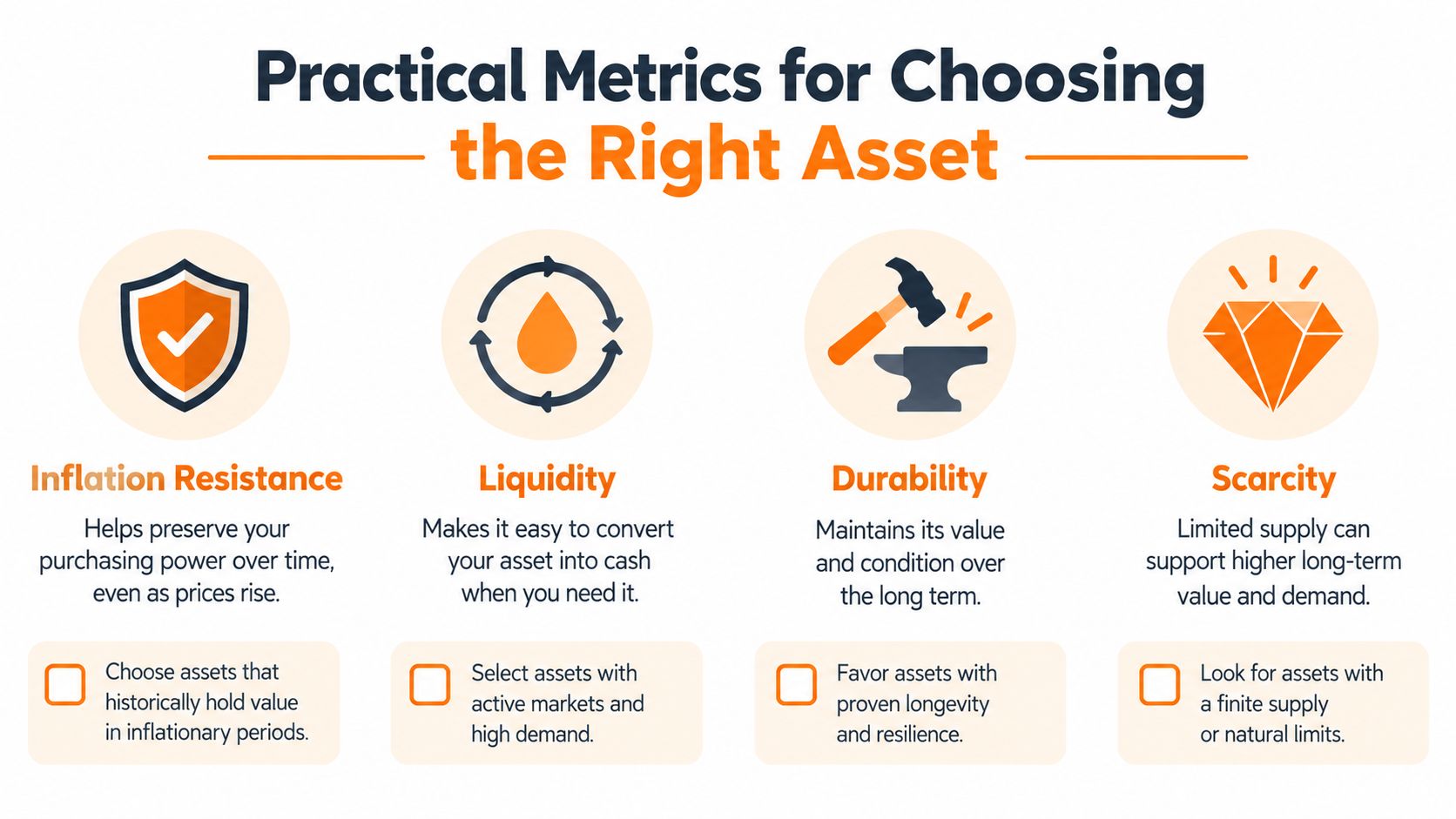
Four questions to apply before committing money
Inflation resistance asks whether the asset has historically helped preserve purchasing power when prices rise. Gold's record is more convincing over very long periods than over short windows. A deposit account may protect the nominal balance while failing this test if its rate trails inflation.
Liquidity asks how quickly and cheaply you can turn the asset into spendable money. Easy-access cash scores highly. Physical gold may be sellable, but the price offered can vary by dealer, product, condition, and market. Bitcoin can trade continuously through digital platforms, but access, custody, and market risk still matter.
Durability covers both the asset and the way you hold it. A gold bar needs secure storage and insurance decisions. Digital assets require careful wallet and key management. Cash held in an account depends on the reliability of the banking arrangement and the terms attached to it.
Scarcity considers how easily new supply can dilute existing units. Scarcity can support long-term value, but it doesn't prevent price declines or guarantee acceptance. Treat it as one part of the assessment, not a complete investment thesis.
The wrapper can change the outcome
The UK decision isn't just cash versus gold versus Bitcoin. It also involves the account or wrapper around the asset. Cash ISAs and notice accounts have attracted more money because longer deposits may offer above-inflation returns, and deposits in Cash ISAs were up about 15% in December 2025 compared with a year earlier, according to the UK Finance Household Finance Review.
Tax treatment, access rules, charges, and withdrawal restrictions can matter as much as the asset itself. A tax-efficient wrapper may improve the amount you keep, while a restriction on access may make the same product unsuitable for an emergency reserve.
The Coin Course includes material on gold and silver content, coin value, a value spreadsheet tool, and the coin marketplace, which can support practical research into physical coins. Its cryptocurrency lessons address wallets, security, and digital asset fundamentals. Use education to improve your decisions, but check current tax rules and consider regulated financial advice where appropriate.
Common Misconceptions and Hidden Risks
A store of value doesn't need to rise every month. Its purpose is to help protect purchasing power over a suitable period, not to provide a smooth chart or a guaranteed return. An asset can rise in pounds while still failing to keep pace with the goods and services you care about.
Gold shows why time horizon matters. A UK study using annual data from 1257 to 2016 found that gold and the Retail Price Index were cointegrated only during the last century. The conclusion was that gold preserves purchasing power against inflation over very long horizons rather than acting as a dependable short-term hedge, as explained in the study of gold and inflation in the UK.
The risks people overlook
- Buying after a strong rise: A celebrated asset may already reflect optimistic expectations. Past momentum doesn't tell you what happens next.
- Confusing price with purchasing power: A higher pound price doesn't automatically mean greater real wealth.
- Using one asset for every purpose: Emergency money, retirement savings, and speculative capital shouldn't all face the same risks.
- Ignoring access costs: Dealer spreads, storage, insurance, platform fees, and tax rules can reduce what you receive when selling.
- Trusting scarcity alone: Limited supply doesn't create demand, liquidity, or a stable market by itself.
Concentration creates a second danger. Someone who holds only property may face illiquidity and local market risk. Someone who holds only precious metals may experience long periods without income. Someone who holds only digital tokens may face severe price swings, technical risks, custody failures, and changing regulation.
A resilient plan doesn't try to remove every risk. It assigns each risk to money that can afford to carry it.
Psychology makes these mistakes harder to avoid. Investors often chase an asset after seeing its strongest performance, then lose confidence during a decline. A written purpose, time horizon, and maximum acceptable loss can reduce the chance of making a rushed decision at the worst moment.
Building a Resilient Strategy for the Future
Wealth preservation works better as a system than as a single purchase. Cash can cover immediate needs. Gold can provide a physical, historically recognised asset for long-term diversification. Bitcoin may suit a person who understands digital custody and accepts substantial volatility in exchange for exposure to programmed scarcity.
The proportions depend on your circumstances. Someone with unstable income may need a larger liquid reserve. Someone saving for a distant goal may have more time to consider assets whose prices move around. Someone who cannot tolerate a large fall should not buy an asset just because its long-term story sounds compelling.
A simple maintenance routine
Review the interest rate on each cash account and compare it with inflation. Check whether the account remains suitable for the access you need. Revisit tax wrappers, charges, and withdrawal terms when your goals change.
For physical gold, keep records of purchase price, weight, purity, storage, and insurance. For Bitcoin, prioritise wallet security, backup procedures, transaction checks, and a clear limit on how much money you can afford to expose to high volatility. Don't let a convenient app substitute for understanding who controls the asset and how you recover access.
Long-term perspective: The right store of value is the one that matches your time horizon, preserves useful purchasing power, and remains manageable when markets become uncomfortable.
No asset performs perfectly in every environment. Cash may lose real value, gold may fluctuate, and Bitcoin may move far more sharply than a cautious saver expects. A diversified defence gives each asset a defined role instead of asking one holding to solve liquidity, inflation, growth, and security at the same time.
The Coin Course can help you build that knowledge with practical lessons on coin value, precious-metal content, blockchain fundamentals, wallets, security, and digital asset risk. Visit The Coin Course to study the tools behind these assets before deciding how they fit into your own wealth-preservation plan.