The market moves sharply while you're checking your phone. Your crypto position is suddenly worth much less, and you have three uncomfortable choices: sell, hold, or add. Without a plan, the decision usually follows fear, overconfidence, or a social-media post. With a plan, you can act according to limits you chose before the price moved.
Effective risk management techniques work together. Research reduces project risk, position sizing limits exposure, liquidity gives you flexibility, exit rules control losses, and secure custody protects the assets themselves. The same practical thinking used in an event risk management guide applies here: identify what could go wrong, put controls in place, and review whether those controls still work.
The techniques below form a complete system. They move from selecting projects and designing a portfolio to entering trades, managing exits, taking profits, preserving liquidity, and protecting long-term holdings. The examples are illustrations, not guarantees or personal financial advice.
1. Diversification Across Asset Classes
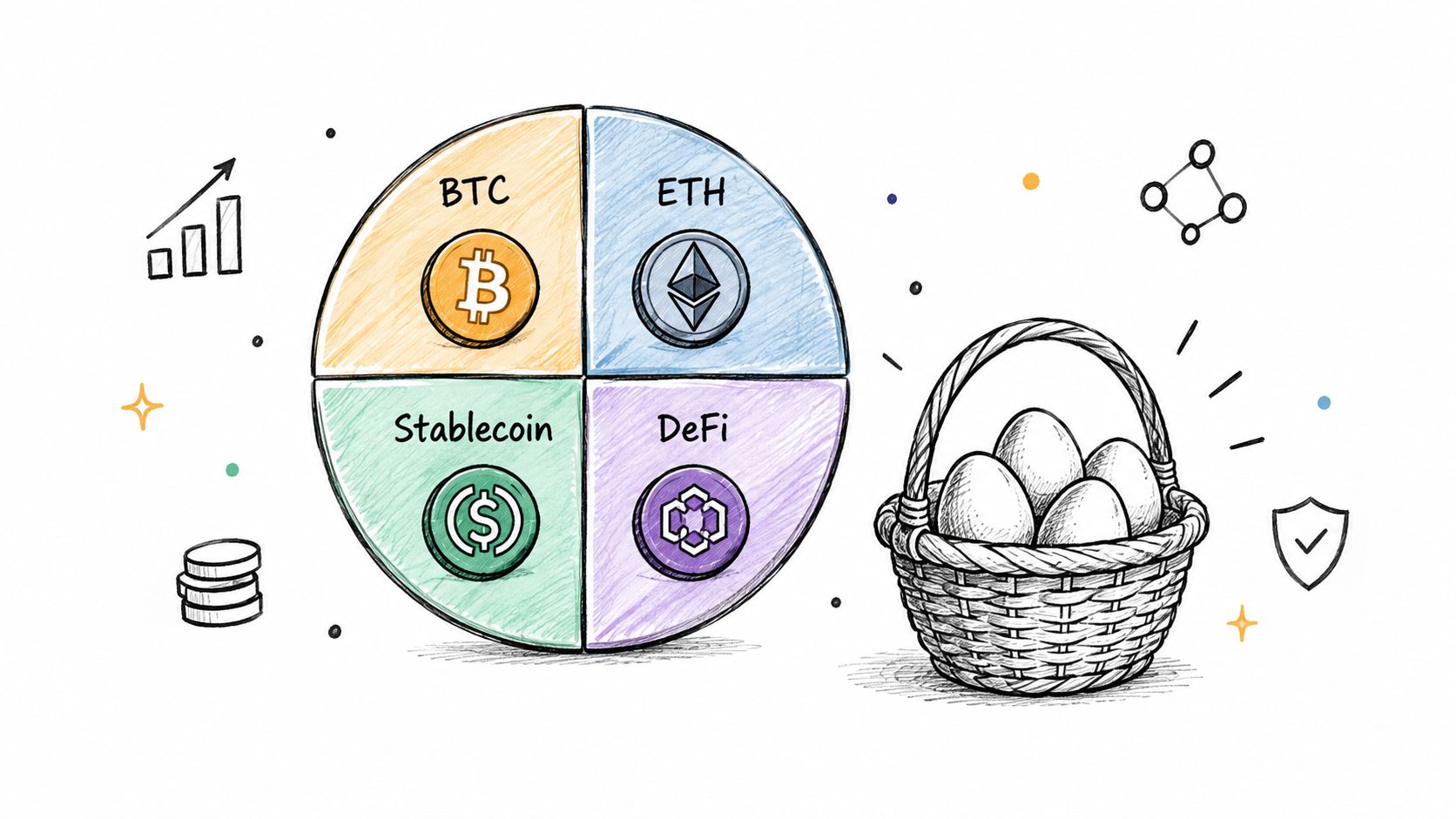
Putting all your crypto money into one token creates a single point of failure. If that project suffers a technical problem, loses market interest, or becomes difficult to trade, the whole portfolio feels the impact. Diversification spreads exposure across assets with different roles, although it can't remove market-wide risk.
A simple portfolio might contain Bitcoin as a major asset, Ethereum for smart-contract exposure, stablecoins for liquidity, and a smaller allocation to decentralised finance tokens. Another investor could combine established assets with selected layer-2 projects, while a more specialised portfolio might include exposure to NFT infrastructure, DeFi applications, and traditional crypto assets.
The key is to diversify deliberately, not collect coins at random. Ten tokens that depend on the same chain, exchange, or market narrative may provide less protection than their number suggests.
Build around roles, not hype
Start with assets you understand before adding smaller projects. Record each holding's purpose, expected liquidity, custody method, and main failure risk in a spreadsheet or portfolio app. A structured guide to building a diversified crypto portfolio can help you define those categories.
Review the allocation on a chosen schedule and rebalance when one asset becomes too large. Don't chase every new coin because it is trending. Diversification works best when it prevents one mistake from dominating the portfolio, not when it becomes an excuse to buy everything.
2. Position Sizing and Risk Per Trade
Position sizing answers a practical question before you click buy: how much can this decision cost me if it goes wrong? The answer should reflect your total portfolio, the distance to your invalidation or stop level, and the volatility of the asset.
A common planning method is:
Position size = (account size × risk percentage) ÷ distance to stop-loss
For example, a trader with a £10,000 portfolio might decide that one trade should risk only a small, predefined fraction of the account. If the planned stop is relatively close, the position can be larger. If the asset is volatile and the stop must sit farther away, the position should be smaller.
This is more useful than assigning the same cash amount to every trade. A volatile altcoin and a liquid major asset can move very differently, so equal-sized positions don't necessarily carry equal risk.
Practical rule: Write down the entry, invalidation price, position size, and maximum acceptable loss before placing the order.
Never increase the size of the next trade just because the last one lost. That behaviour turns a controlled loss into an attempt to recover emotionally. The crypto trading risk-management guidance from The Coin Course provides a useful framework for documenting these decisions.
Review your sizing when your portfolio value, income, objectives, or experience changes. A position that felt reasonable in a small experimental account may be too large after your circumstances change, and a size that worked in calm markets may be excessive during a volatile period.
3. Dollar-Cost Averaging
Dollar-cost averaging, or DCA, replaces one large timing decision with a series of smaller planned purchases. You invest a set amount at regular intervals whether the price is rising, falling, or moving sideways. That means you'll sometimes buy at an expensive price and sometimes at a cheaper one, but you aren't relying on a perfect entry.
An investor might automate a monthly Bitcoin purchase, contribute a smaller amount to Ethereum each week, or direct part of each pay packet into a defined crypto allocation. The amount should fit the person's budget and shouldn't compete with emergency savings, essential bills, or debt repayments.
DCA is particularly useful for someone who wants long-term exposure but knows they'll struggle to predict short-term market moves. Automation also reduces the temptation to wait forever for a “better” price.
Know what DCA can't do
DCA doesn't protect you from choosing a weak project. Regular purchases into a token with poor security, weak liquidity, or an unsustainable business model can spread the mistake over time instead of fixing it. Research still comes first.
Set an interval that matches your income, then review the plan occasionally rather than checking prices every hour. You can keep uncommitted funds in cash or a stablecoin, but that introduces its own issuer, platform, and custody risks. Use DCA as an entry method, not as a reason to ignore valuation, project quality, or your overall allocation. The DCA guide for managing crypto volatility explains how a scheduled approach can fit into a wider plan.
4. Stop-Loss Orders and Exit Planning
A stop-loss order turns a preselected price into an automatic exit instruction. If you buy Ethereum at £2,500 and set an exit around £2,250, the order is designed to limit the loss if the trade thesis fails. The exact result can differ during a fast market, because execution depends on available liquidity and the order type.
A stop isn't a prediction that the asset will never recover. It's a decision that the current trade no longer fits your original risk limit. Without that decision, many traders lower their standards as the price falls, telling themselves they'll sell after a rebound that may not arrive.
Plan the exit before the entry
Define three points before trading:
- Invalidation: the price or event that proves your thesis is wrong.
- Maximum loss: the amount you're prepared to lose on the position.
- Action after execution: whether you'll reassess, remain out, or follow a separate re-entry plan.
Trailing stops can help a swing trader protect part of a gain as price rises, but they can also trigger during normal volatility. A very tight stop may produce repeated small losses, while a wide stop requires a smaller position. Don't move a stop lower just because the market moved against you.
News, thin order books, and overnight price gaps can all affect execution. Treat a stop as one control within a wider exit plan, not as a guarantee that the market will sell at the precise price you entered.
5. Stablecoin Reserves and Cash Equivalents
A liquid reserve gives you choices. You can meet an unexpected need without selling a long-term holding, reduce forced decisions during a downturn, or deploy a planned amount when your criteria are met. The reserve might be cash outside crypto or a stablecoin, but neither should be treated as risk-free.
Stablecoins carry issuer, redemption, smart-contract, platform, and custody risks. Holding them on an exchange adds counterparty exposure, while moving them to a wallet shifts responsibility for keys and transaction security to you. A reserve therefore needs its own storage and access plan.
Consider a portfolio where the owner keeps a defined portion in liquid assets and the remainder in longer-term holdings. The right balance depends on income stability, emergency savings, investment horizon, and tolerance for missing a rapid price rise. A cash reserve intended for rent or food shouldn't be exposed to a speculative market.
Liquidity is a risk control, not a failed investment. It gives you time to make a decision instead of forcing a sale.
Write down when the reserve may be used. Valid reasons could include a genuine emergency, scheduled rebalancing, or a preplanned purchase after specific market conditions. “Buying the dip” without a limit can turn the reserve into another impulsive position. Keep essential living money separate from opportunistic trading capital, and review the split whenever your financial circumstances change.
6. Security Audits and Due Diligence
A promising token can still expose you to contract bugs, concentrated ownership, weak governance, or an anonymous team with no clear accountability. Due diligence doesn't prove that a project is safe, but it can help you reject obvious risks before committing funds.
Start with the project's whitepaper and documentation. Can you explain what the product does, who uses it, how the token functions, and what could make the system fail? Check whether an independent auditor reviewed the relevant contracts, then verify the audit on the auditor's own website rather than relying only on a project's marketing page.
Look for evidence of active development, transparent updates, and clear responses to reported issues. A GitHub repository can provide context, but activity alone isn't proof of quality. Community channels can reveal useful questions, yet promotional comments and confident moderators don't replace technical evidence.
A practical screening pass
- Contract review: Find the audited contract address and check that it matches the one users interact with.
- Team background: Verify claimed experience through credible professional profiles and prior work.
- Token design: Understand supply, vesting schedules, governance powers, and concentration before buying.
- Return claims: Treat guaranteed returns and overnight-wealth promises as immediate warning signs.
- Trading conditions: Check liquidity, withdrawal rules, and whether you could exit without relying on a single venue.
Useful market directories can help you gather basic information, but they're starting points rather than approvals. If you can't explain the main failure modes, keep the allocation small or don't participate.
7. Portfolio Rebalancing and Review Schedules
A portfolio drifts as prices change. An asset that began as a modest holding can become the dominant exposure after a strong rally, while a fall can reduce another allocation to a level that no longer supports your original plan. Rebalancing brings the portfolio back towards its intended structure.
Suppose your target is 50% Bitcoin, 30% Ethereum, and 20% liquid reserves. If Bitcoin grows far beyond its intended role, you might sell part of it, direct new contributions elsewhere, or accept the larger exposure after recording why. The choice depends on tax, fees, liquidity, and your conviction, not just a calendar.
A scheduled review prevents constant trading. Many long-term holders choose a quarterly or annual review, while active traders may use allocation bands and act only when a holding moves materially outside its target.
“Rebalancing” shouldn't mean reacting to every candle. It means returning to a documented risk decision.
Use new contributions to correct drift where practical. That can reduce unnecessary transactions, but it won't always be enough when one position has grown substantially. Keep records of purchases, transfers, sales, and fees so you can calculate gains accurately and understand the tax consequences in your jurisdiction.
During each review, ask whether the project still meets your original criteria, whether custody remains appropriate, and whether your financial situation has changed. Rebalancing a portfolio back towards a broken thesis only preserves the wrong risk.
8. Volatility Analysis and Market Cycle Awareness
Volatility changes the meaning of every other control. A stop that works in a calm market may be hit repeatedly during a fast session. A position that feels manageable during quiet trading may become too large when news, borrowing, or thin liquidity accelerates price movements.
Review historical price behaviour using tools such as TradingView or CoinGecko, but don't mistake past movement for a forecast. Compare the asset's typical range with your planned stop and position size. If normal fluctuations can reach your stop, reduce the position, widen the stop and accept the resulting smaller exposure, or skip the trade.
Market-cycle awareness helps you avoid treating every rally as permanent and every decline as a buying opportunity. In a broad uptrend, profit-taking and rebalancing can protect gains. In a falling market, preserving liquidity and reducing borrowed exposure may matter more than finding the perfect bottom.
Use volatility as an operating signal
- High movement: Reduce position sizes and avoid using borrowed exposure.
- Major announcements: Expect wider spreads, delayed decisions, and rapid reversals.
- Strong gains: Take partial profits according to the plan instead of relying on hope.
- Broad weakness: Recheck project fundamentals before adding to a losing position.
Sentiment tools can show whether traders are optimistic or fearful, but they don't tell you what an asset is worth. A journal is more useful than a memorable chart. Record why you entered, what volatility looked like, how you responded, and whether the result came from a sound process or luck.
9. Cold Storage and Multi-Signature Security
Price risk isn't the only threat. An exchange account can be compromised, a phishing message can redirect a transaction, or a lost recovery phrase can make a wallet inaccessible. Custody controls protect the asset after you've made the investment decision.
Cold storage keeps signing keys offline, typically through a hardware wallet. Multi-signature custody requires more than one key or approval for a transaction, which can reduce the danger of one compromised device. A shared arrangement might use a 2-of-3 setup, with separate key locations and a recovery process agreed in advance.
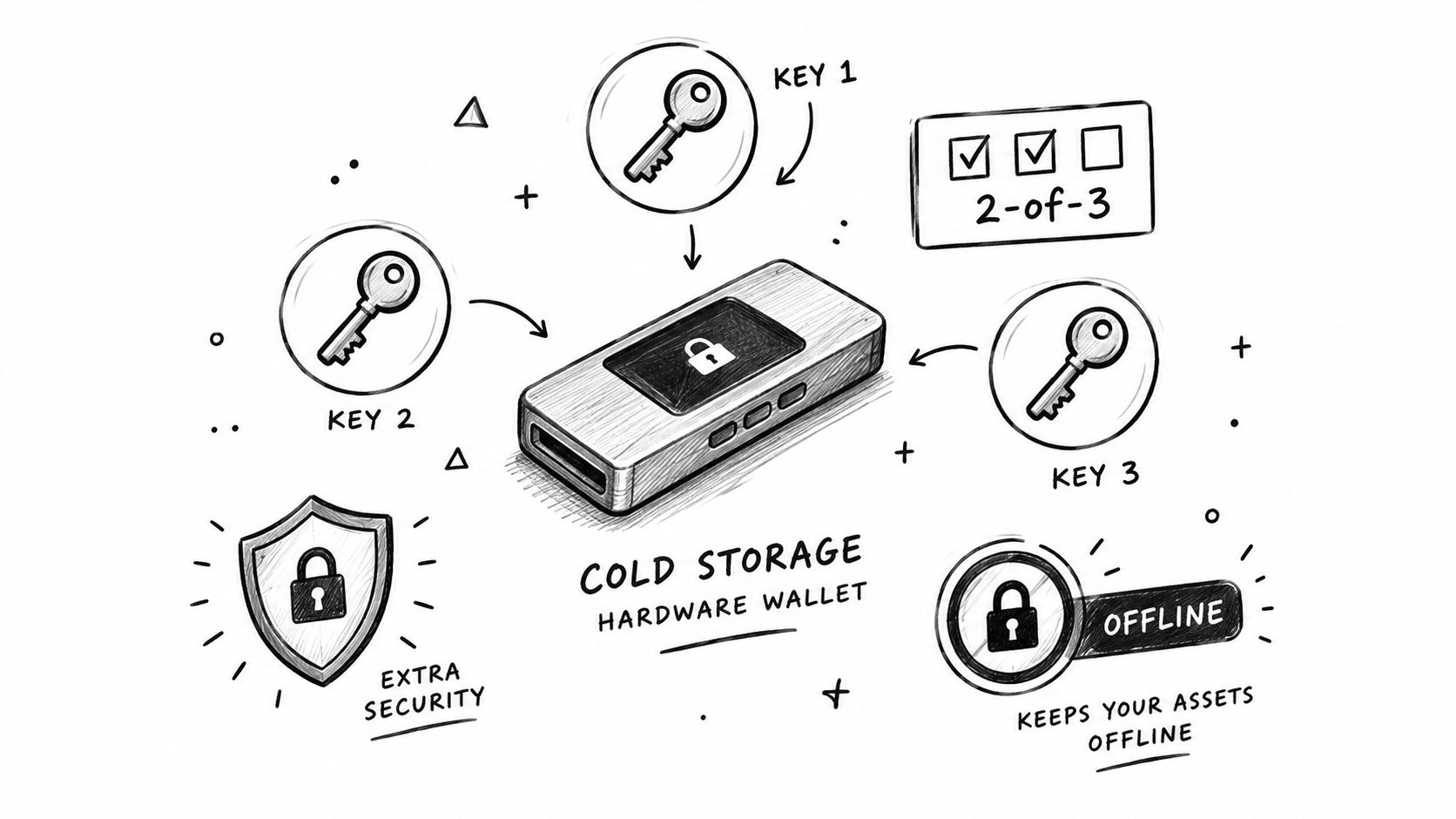
Buy a hardware wallet from the manufacturer or an authorised source, never a used device. Store recovery words privately in secure locations, and don't photograph, email, or type them into a website. Test the recovery process with a small amount before trusting it with substantial holdings.
Self-custody gives you control, but it also gives you responsibility. You can lose access through poor backups, inheritance gaps, malware, or a mistaken address. Keep only the amount needed for active trading on an exchange, and match the custody method to your technical ability, the value at risk, and the need for quick access.
For larger holdings, separate devices, geographic backup, and multi-signature arrangements may be appropriate. Complexity isn't automatically safer. A system nobody can operate or recover is a security failure with better branding.
10. Regular Profit-Taking and Scaling Out
A gain becomes useful only when you decide what to do with it. Profit-taking means selling part of a position after a rise, while scaling out spreads that decision across several levels. This reduces the pressure to identify one perfect exit and can lower exposure if the market reverses.
For example, an Ethereum holder might define several target zones before entering and sell a portion at each one. Another investor could withdraw part of the original capital after a strong move, leaving a smaller position to participate in further upside. Someone using crypto to support living costs might convert gains into pounds rather than automatically reinvesting them.
The method should match the purpose of the portfolio. A short-term trade needs explicit targets and invalidation. A long-term holding might use allocation bands, tax planning, and periodic withdrawals instead of tight price targets.
Make gains part of the plan
- Set targets early: Decide what percentage or price conditions trigger a sale before enthusiasm takes over.
- Define the destination: Move proceeds to cash, emergency savings, debt repayment, or a planned allocation.
- Protect the remainder: Recalculate its size and downside after each partial sale.
- Record the transaction: Keep dates, quantities, prices, fees, and wallet movements for tax records.
Take-profit orders can automate execution, but they may fill in thin markets or leave you with less exposure than intended. Manual scaling offers more judgement but demands discipline. Don't treat selling as a failure because the price later rises. A realised profit can fund real goals and reduce the chance that a temporary gain becomes a permanent loss.
Top 10 Risk Management Techniques Comparison
| Strategy | Implementation Complexity 🔄 | Resource Requirements 💡 | Expected Outcomes 📊⭐ | Ideal Use Cases | Key Advantages ⭐ |
|---|---|---|---|---|---|
| Diversification Across Asset Classes | Medium 🔄, needs tracking and periodic rebalancing | Multiple holdings, portfolio tracker, trading fees | 📊 Lower volatility; ⭐ broader market exposure | Retail investors, active traders seeking stability | ⭐ Reduces single-asset risk; captures multiple sector gains |
| Position Sizing and Risk Per Trade | Low–Medium 🔄, simple math per trade | Calculator/spreadsheet, stop-loss tools | 📊 Controlled drawdowns; ⭐ capital preservation | Active traders, disciplined investors | ⭐ Limits large losses; enforces discipline |
| Dollar-Cost Averaging (DCA) | Low 🔄, highly repeatable, automatable | Regular cash flow, exchange auto-buy | 📊 Smoother entry price; ⭐ reduced timing risk | Beginners, long-term holders, salaried investors | ⭐ Removes timing emotion; easy to automate |
| Stop-Loss Orders and Exit Planning | Low–Medium 🔄, set rules per trade | Exchange order types, monitoring | 📊 Limits downside; ⭐ enforces exits | Traders and investors needing protection | ⭐ Removes emotion; caps losses automatically |
| Stablecoin Reserves and Cash Equivalents | Low 🔄, simple allocation strategy | Stablecoins/cash holdings, secure wallets | 📊 Liquidity for dips; ⭐ reduced forced selling | Traders buying dips, conservative holders | ⭐ Provides dry powder; lowers short-term stress |
| Security Audits and Due Diligence | High 🔄, detailed research and verification | Time, technical knowledge, audit reports | 📊 Fewer scams; ⭐ higher confidence in projects | New project investors, DeFi participants | ⭐ Identifies red flags; avoids obvious fraud |
| Portfolio Rebalancing and Review Schedules | Medium 🔄, periodic adjustments required | Tracking tools, possible tax planning | 📊 Maintains target risk; ⭐ systematic profit-taking | Long-term investors, portfolio managers | ⭐ Keeps risk consistent; enforces discipline |
| Volatility Analysis and Market Cycle Awareness | Medium–High 🔄, requires analysis skills | Charting tools, historical data, indicators | 📊 Better timing and size decisions; ⭐ improved readiness | Active traders, risk-aware investors | ⭐ Helps adjust risk and spot opportunities |
| Cold Storage and Multi-Signature Security | High 🔄, technical setup and safekeeping | Hardware wallets, backup storage, possible multisig services | 📊 Strong theft protection; ⭐ secure long-term custody | High-net-worth holders, long-term storage | ⭐ Protects from hacks; reduces single-point failure |
| Regular Profit-Taking and Scaling Out | Low–Medium 🔄, plan and execute sell targets | Exchange orders, tax considerations | 📊 Realized gains; ⭐ reduced exposure to reversals | Traders converting gains, income-focused investors | ⭐ Locks in profits; reduces emotional holding decisions |
Turn Ten Techniques Into One Working System
The strongest risk management techniques don't operate as isolated tricks. Due diligence determines whether a project deserves any allocation. Diversification prevents one asset or protocol from dominating the portfolio. Position sizing connects each trade to a defined loss limit, while DCA or other planned entries reduce the pressure to guess the perfect moment.
Liquidity adds another layer of control. A cash or stablecoin reserve can help you avoid selling long-term holdings during an emergency, but it must be stored securely and treated as exposed to its own operational and counterparty risks. Exit rules then provide a response when the original thesis fails, when volatility changes, or when a position grows beyond its intended role.
The system should also account for the human tendency to change plans under pressure. A trader who says they'll sell at a predefined level may move that level after a loss. An investor who intends to diversify may chase the latest token after a rally. Written rules, recorded decisions, and automated orders can reduce those reactions, although no tool replaces judgement.
Use a simple portfolio record with columns for:
- Asset and purpose: Why you own it and what role it plays.
- Entry plan: Purchase method, timing, and maximum allocation.
- Risk limit: Invalidation point and amount you're prepared to lose.
- Liquidity route: Where you'd sell and how you'd access the proceeds.
- Custody method: Exchange, hardware wallet, or multi-signature arrangement.
- Review trigger: Calendar date or allocation band that prompts reassessment.
- Exit and profit plan: Conditions for reducing or closing the position.
Before buying, research the project and check the custody route. During the position, monitor exposure, liquidity, volatility, and the distance to your exit. After closing or reducing it, record what happened and whether the decision followed the plan.
UK investors should take the FCA's warnings seriously. The regulator describes cryptoassets as high-risk, says investors should be prepared to lose all the money invested, and warns that prices may fall quickly, assets may be difficult to convert into cash, and ordinary protections such as the Financial Ombudsman Service or Financial Services Compensation Scheme may not apply. The FCA's risk-warning guidance supports a basic rule: use only money you can afford to lose, don't borrow to invest, and keep emergency savings outside crypto.
Fraud controls belong in the same plan. Check a firm independently through the FCA register, ignore guaranteed-return claims, and pause when a promoter creates urgency. The FCA has described the crypto market as a target for scams, so a convincing message or polished website isn't evidence of legitimacy. Never send funds to a personal wallet or unfamiliar address just because someone claims to be an adviser, support agent, or investment manager.
Your final routine can stay simple. Write the plan, record every decision, check the portfolio on a chosen schedule, and update assumptions when your finances, custody needs, or the project changes. Don't chase the market because a chart moved without you. The Coin Course offers structured educational material on crypto fundamentals, wallets, trading, DeFi, NFTs, security, and practical safety, making it a relevant resource for readers who want to build knowledge before changing their process. Its material is educational, and the examples in this article aren't personal financial advice.
The Coin Course offers practical learning on crypto fundamentals, wallets, trading, security, and safer asset management, including guidance on protecting seed phrases offline. Visit The Coin Course to build a more structured understanding of the controls behind your crypto decisions.