The giant legal battle of Ripple vs SEC really boils down to one simple question: is the digital token XRP a security or is it a currency? The U.S. Securities and Exchange Commission (SEC) argued that Ripple's sales of XRP were like an illegal, unregistered sale of company stock—imagine selling shares in Apple without filing the proper paperwork. On the other side, Ripple fought back, saying XRP is a digital currency, created to make sending money internationally fast and cheap, not an investment deal.
Understanding The Core Ripple vs SEC Dispute
This high-stakes legal clash started back in December 2020. The SEC's case basically claimed that by selling $1.3 billion worth of XRP, Ripple was asking people to invest in its own business. If that's the case, Ripple should have registered those sales just like any normal company would before going public on the stock market.
Ripple’s whole defense is built on the idea that XRP has a clear, real-world use. They describe it as a "bridge currency." For example, if a bank in London wants to send money to a bank in Tokyo, they could use XRP to complete the transaction in seconds, instead of waiting days for an old system like SWIFT to clear it. In their eyes, it's a handy digital tool for moving money, not a share that gives you ownership in Ripple Labs.
The Howey Test Explained
When American courts need to decide if something is a security, they often use a checklist from a 1946 Supreme Court case. It's called the "Howey Test," and it has four main points:
- An investment of money
- In a common enterprise (like a business)
- With the expectation of making a profit
- Coming from the work of others
The SEC’s case is built on this test. They argue that people bought XRP hoping its value would go up because of Ripple's hard work in building the XRP network. Ripple disagreed, saying most people buy XRP to use it for payments or trade it on the open market, completely separate from what the company is doing.
The Howey Test is the legal measuring stick at the heart of this argument. A huge question in this case is whether a legal idea from the 1940s can really be applied to modern digital money.
A Clear Comparison Of Arguments
To really get the picture, it helps to see the arguments laid out next to each other. This table breaks down the main conflict between the SEC and Ripple.
Key Arguments In The Ripple vs SEC Case
Here's a side-by-side look at the main points from both Ripple Labs and the SEC, offering a clear snapshot of their positions.
| Core Issue | The SEC's Position | Ripple's Counter-Argument |
|---|---|---|
| Nature of XRP | An "investment contract," making it a security. | A digital currency with a practical use for payments. |
| Buyer Expectation | People bought XRP expecting profits from Ripple's efforts. | People buy XRP to use it as a bridge for money transfers. |
| Promotional Efforts | Ripple advertised XRP to boost its value for investors. | The company promoted XRP to get more people to use it. |
As you can tell, their viewpoints are on different planets, which is why this has been such a long and tricky case.
The final outcome will have effects that stretch far beyond America. Even though this is a US legal fight, it has definitely influenced how regulators think elsewhere. In the UK, for instance, the Financial Conduct Authority (FCA) has been very careful, setting up a tough registration process for crypto companies. This was partly shaped by the global uncertainty stirred up by major cases like Ripple vs SEC. You can explore more about how the SEC vs Ripple case has shaped crypto regulation in the UK.
A Timeline Of Major Events In The Ripple Lawsuit
To truly understand the Ripple vs SEC lawsuit, you need to look at the key moments that have defined this legal drama. This wasn't a quick affair; it has been a multi-year chess match filled with clever moves, crucial rulings, and surprising twists that has kept the entire crypto world watching.
It all started on 22 December 2020. That was the day the SEC officially filed its lawsuit against Ripple Labs and two of its leaders, Brad Garlinghouse and Chris Larsen. The SEC’s main claim was straightforward: by selling XRP, the company had carried out a huge, unregistered sale of securities, raising over $1.3 billion. The reaction was instant and harsh; major crypto exchanges like Coinbase rushed to remove XRP from their platforms, and its price fell off a cliff.
Early Legal Skirmishes
The first year or so was like a tug-of-war over evidence. One of the biggest fights was over a set of internal SEC documents that became known as the "Hinman Documents." These files were about a 2018 speech by William Hinman, a former top official at the SEC, where he suggested that Ether (the cryptocurrency of the Ethereum network) wasn't a security.
Ripple's lawyers fought hard to get their hands on these documents. They argued that these files were vital for their "fair notice" defense—in simple terms, they claimed the SEC never gave them a clear warning that XRP might be seen as a security. The argument over these documents dragged on for many months, becoming a major obstacle in the early phase of the case.
A Game-Changing Ruling
The moment everyone had been waiting for finally came on 13 July 2023. Judge Analisa Torres delivered a summary judgment that completely altered the conversation around crypto rules in the United States.
Her decision wasn't a total victory for either side, but a clever split decision:
- Programmatic Sales: She decided that XRP sold to everyday people on crypto exchanges did not count as selling securities. Her logic was that these regular buyers couldn't know if their money was actually going to Ripple, which broke a key part of the Howey Test.
- Institutional Sales: On the flip side, she ruled that direct XRP sales to big-time investors did count as unregistered securities sales. In those deals, the buyers knew they were dealing directly with Ripple and were banking on the company's work to boost the value of their holdings.
This difference was a massive win for Ripple and, in turn, the wider crypto market. It set a legal example suggesting that tokens sold on public exchanges aren't automatically securities. It's no surprise that the price of XRP jumped by over 70% within hours of the news.
Judge Torres's ruling was so celebrated because it challenged the SEC's "all-or-nothing" attitude. By drawing a line between different kinds of sales, the court offered a much more detailed guide for applying old laws to new tech.
The Aftermath And Ongoing Battle
After the July 2023 ruling, the SEC first said it would appeal the part about sales on exchanges. But in a surprising twist, the regulator dropped all charges against Garlinghouse and Larsen in October 2023, hinting that it was changing its strategy.
From that point on, the case zeroed in on the penalty phase. The court had already ruled Ripple's sales to institutions were illegal, so the only thing left to decide was how much they'd have to pay. The SEC demanded a massive fine of nearly $2 billion. Ripple fought back, saying the penalty should be no more than $10 million.
As of mid-2024, we're still waiting for the final decision on these penalties. This ruling will mark the end of the main part of this historic case, at least until the appeals process, which is almost certain to happen, kicks off.
Analysing The Legal Arguments From Both Sides
To get a good handle on the Ripple vs. SEC battle, you have to look at the legal strategies each side used. This wasn't just a small disagreement; it was a major clash over how laws written nearly a century ago should apply to brand-new technology and financial markets. The arguments from both the U.S. Securities and Exchange Commission and Ripple Labs tell us a lot about the growing pains of regulating digital money.
The SEC’s whole case was built on a legal idea from the 1940s: the Howey Test. This checklist has long been the SEC's favorite tool for figuring out if something is an "investment contract" and, therefore, a security.
The SEC's Strategy: The Howey Test
The SEC carefully argued that Ripple's sales of XRP ticked every single box of the Howey Test. They noted that Ripple raised billions of dollars by selling XRP to the public, which they called an "investment of money." They then said this was done within a "common enterprise"—Ripple's business—where buyers had a clear "expectation of profit."
Where the SEC really pushed its point was on the final part of the test: that profits must come "from the efforts of others." To prove this, they presented Ripple’s own marketing materials and public statements. For example, they showed company blog posts and brochures where Ripple talked about its work developing the XRP ecosystem and forming new partnerships. The SEC's message was clear: these statements led buyers to believe XRP's value would go up because of Ripple's hard work, not because the token was useful on its own.
The SEC's argument was straightforward: "Ripple told the world it was working to make XRP more valuable, and people bought it based on that promise. That makes it a security."
This visual breaks down the key events in the lawsuit, from the initial filing right through to the appeals stage.
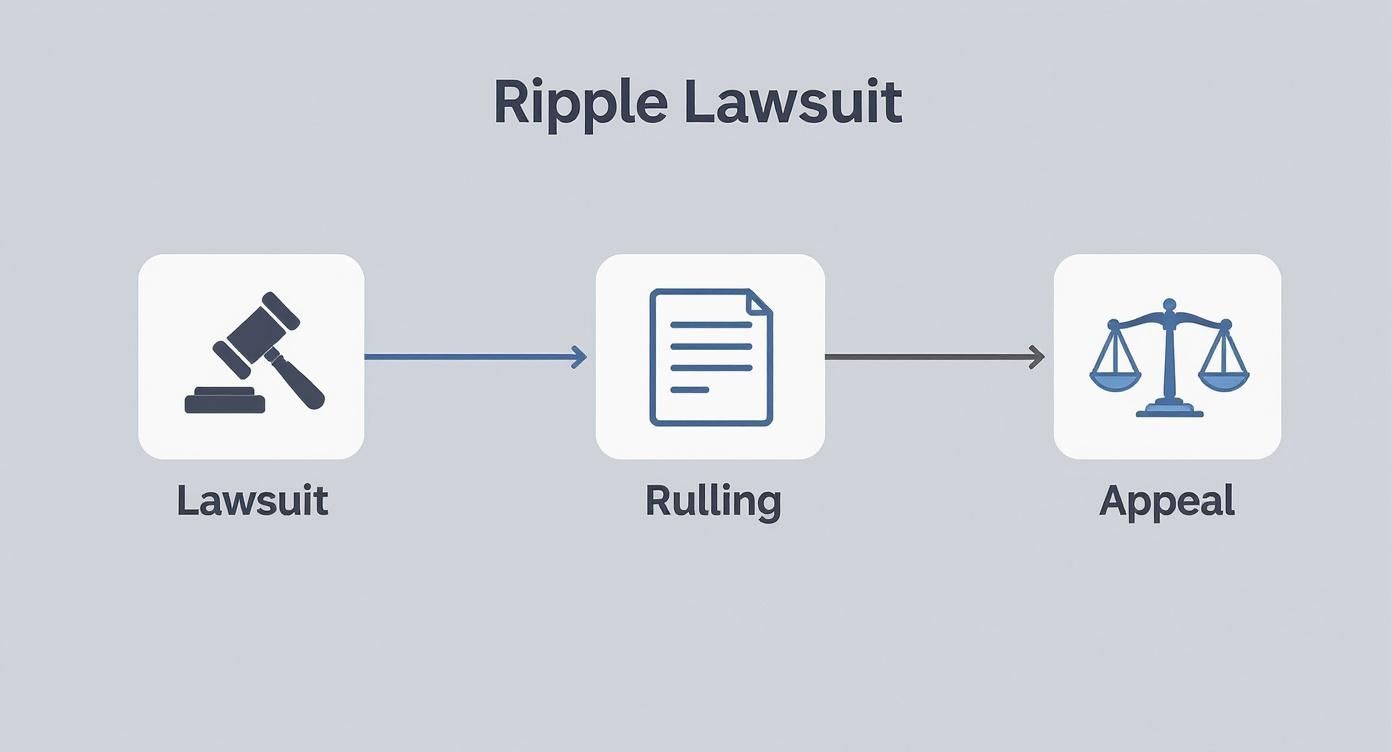
The infographic does a great job of showing the different stages of this legal marathon. It helps you see the long road both sides have travelled, from the lawsuit's start to the critical ruling and the appeals that came after.
Ripple’s Counter-Attack: Three Key Defences
Ripple’s legal team didn't just stand there; they launched a counter-attack with several prongs, designed to take the SEC's case apart piece by piece. Their defense was built on three main ideas.
First, they argued that no investment contract ever existed between the company and most people who bought XRP. Ripple insisted that the huge majority of people bought their XRP on places like crypto exchanges, with no formal deal or direct connection to Ripple Labs. They argued that when someone bought XRP on an exchange like Binance, they had no clue who was selling it, which breaks the direct link needed for an investment contract.
Second, Ripple repeatedly highlighted XRP's real-world usefulness. They provided evidence showing it was being used as a bridge currency for fast and cheap international payments. Unlike a company share, which just represents ownership, Ripple argued that XRP has a practical function all on its own. For instance, a bank could use XRP to settle a payment between the UK and Japan in seconds—a function that has nothing to do with hoping for a profit.
Finally, Ripple used a powerful and controversial defense: a lack of "fair notice." The company claimed the SEC had failed for years to give clear rules on which digital assets were considered securities. They pointed out that regulators had sent mixed messages, making it deeply unfair for the SEC to punish them years later for breaking rules that were never clearly explained. This argument resonated with many in the crypto community, who have been asking for clear regulations for years. Sorting out these classifications is a big challenge; you can learn more by looking at our guide on navigating regulatory requirements for security tokens.
Each of these arguments was a calculated move against the SEC’s reliance on the Howey Test, forcing the court to look beyond old definitions and think about the special nature of digital assets. In the end, it was the strengths and weaknesses of these opposing strategies that led to the split decision that has defined this landmark case.
How The Lawsuit Impacted XRP Investors And The Market

The Ripple vs SEC legal showdown sent shockwaves far beyond the courtroom, hitting the wallets of investors and the wider crypto market in a big way. The immediate fallout after the SEC’s lawsuit in December 2020 was pure chaos. Major exchanges, scared of getting in trouble with regulators, rushed to delist XRP, which effectively trapped millions of users.
This sudden delisting was a huge problem. In the UK, people holding XRP on platforms like Coinbase were left stuck, unable to buy or sell their tokens. They were holding an asset whose value had crashed by over 60% in just a couple of days. It was a time of great confusion, with everyday investors wondering if their holdings would ever recover or if they'd be able to trade them on major platforms again.
The Price Rollercoaster And Investor Sentiment
XRP's price became a live report card for the courtroom battle. Every new legal document filed and every comment from the judge sent waves of volatility through the market. All of a sudden, investors had to become amateur legal experts, trying to read court papers to guess where the price was going next.
Then came the bombshell ruling in July 2023. Judge Torres's decision that sales of XRP on exchanges were not securities sales was like a starting gun for the market.
- Immediate Price Surge: Within hours of the news, XRP’s price shot up by over 70%.
- Relisting Frenzy: Big exchanges like Coinbase and Kraken rushed to relist XRP, giving access back to countless investors.
- Renewed Confidence: The ruling brought a huge wave of confidence back to the XRP community, confirming their long-held belief that the token was not a security.
This was a perfect example of how clear rules—or even a big step toward them—can completely change market behavior and bring back investor trust. It showed just how hungry the market was for legal direction.
Broader Market Jitters And The UK Perspective
The lawsuit's impact wasn’t just about XRP. It cast a long shadow over the entire crypto industry, creating a real climate of fear. Investors in other altcoins started to get nervous, wondering if their favorite projects would be the next ones the SEC would target. This caused widespread anxiety across the market.
The Ripple lawsuit made the whole crypto market face its regulatory weaknesses. It showed the risk that many digital assets could, according to the SEC's view, be labeled as unregistered securities, which put a freeze on innovation and investment.
This legal battle had a fascinating effect on the UK's crypto scene, especially by boosting the confidence of big, institutional investors. A 2024 report found that institutional investment in UK-based crypto funds went up by 25% in the year after the July 2023 ruling. In that same report, a whopping 70% of institutional investors surveyed said the ruling was a key reason they increased their investment in digital assets.
The percentage of UK institutional investors holding XRP also grew from 12% in 2022 to 28% in 2024, showing a clear jump in confidence after Ripple’s partial legal win. For more context on this, you can read about how the case shaped the crypto future on foxbusiness.com.
This kind of buy-in from big investors is crucial for the long-term health of the market, as it signals that crypto is becoming a more mature asset. Still, regular investors are watching every new development, knowing the final result of this case will set the rules for years to come. The management of large XRP holdings also remains a big topic, as it can affect market stability. You can read more about what a massive 200 million XRP lock-up means for Ripple’s future in our detailed analysis.
What The Ripple Case Means For UK Crypto Regulation
Even though the Ripple vs. SEC lawsuit happened thousands of miles away in an American courtroom, its effects are making serious waves here in the United Kingdom. Regulators in Britain, especially the Financial Conduct Authority (FCA), have been watching the case very closely. This American legal drama is much more than a foreign story; it's a real-life lesson that is actively shaping the future of crypto rules in the UK.
The UK has been slowly and carefully building its own set of rules for digital assets. The goal has always been to find a good balance between protecting consumers and making the UK a top spot for financial technology. The Ripple case offers a valuable, real-world lesson on just how complicated this is, especially when trying to make old financial laws fit new technology.
A Blueprint For Smarter Regulation
Maybe the most important thing to come out of the case was the judge’s decision to separate different kinds of XRP sales. The ruling that sales on public exchanges were not securities, while direct sales to institutions were, offered a much more detailed approach than the SEC's one-size-fits-all strategy.
This distinction is incredibly helpful for UK regulators. Instead of a total ban or a single, strict definition, the case shows a possible way forward:
- Retail vs. Institutional: It suggests that rules could be different for assets sold to the general public on exchanges compared to those sold in private deals to large, experienced investors.
- Context Matters: It shows that how a digital asset is sold and advertised could be more important than the technology behind it when deciding its legal status.
This way of thinking is a perfect match for the UK's goal of creating a flexible set of rules that can change as the market grows. It moves the conversation from a simple "is it or isn't it a security?" to a more practical one about risk and investor protection in different situations. You can see a similar approach in how the UK is dealing with stablecoins by reading about essential UK stablecoin regulations.
The US court's split decision offers a great model for the FCA. It suggests that regulation doesn't have to be a hammer; it can be a scalpel, carefully used to handle specific risks without choking the entire industry.
Sparking A Conversation On Security Tokens
The Ripple case has directly added fuel to the conversation in the UK about which digital assets might be classified as securities and how they should be handled. It has created a need for clearer guidelines, especially for security token offerings (STOs), where a token represents ownership in a real-world asset, like a piece of a building or a share in a private company.
The lawsuit has indirectly influenced the UK's direction here. Back in 2022, the UK government started a discussion on crypto regulation, and the Ripple case was brought up as a perfect example of the challenges in classification. The progress since then has been huge.
By the end of 2023, the UK Treasury reported that 15% of all crypto firms registered with the FCA were involved in security token activities—a category that looks a lot like the institutional sales of XRP. On top of that, applications for STOs jumped by 40% in 2023 compared to the year before. This increase is partly because of the growing clarity that landmark cases like Ripple vs. SEC are providing. While legal fights definitely create confusion in the short term, they ultimately help the market grow up by setting clearer rules of the road.
What Happens Next For Ripple And The SEC?
While the main courtroom drama might be over, the Ripple vs SEC story is far from finished. It's now moved into a slower, but just as important, final stage. The huge ruling in July 2023 was a big moment, but the legal fight continues, focusing now on the fines for Ripple's institutional sales and the almost certain appeals from both sides.
The very next step is for the court to decide the final penalty Ripple must pay for selling XRP directly to institutional investors. This is a point of major disagreement. The SEC has been pushing for a gigantic sum of around $2 billion, while Ripple’s lawyers are arguing for a penalty that’s a tiny fraction of that, at no more than $10 million. The judge’s final decision on this will close this chapter of the lawsuit, but it will almost certainly open the next one.
The Inevitable Appeals Process
You can be sure that whichever side feels it lost out in the final decision will file an appeal. The SEC, in particular, will almost certainly fight the ruling that sales of XRP on exchanges were not securities. That part of the decision set a legal example that the regulator is desperate to have overturned.
An appeal would send the case to a higher court, the Second Circuit Court of Appeals, where a new group of judges will take a close look at the original ruling. This isn't a new trial; it's a deep dive into the legal arguments to see if any mistakes were made. This process alone could easily add another year or two to the timeline, so a final end to the Ripple vs SEC case is still a long way off.
The appeals process is where legal precedents are truly set in stone. The result at this higher court level will have a more lasting and widespread impact on how other cryptocurrencies are regulated in the US.
Ripple's Future Beyond The Courtroom
No matter what the final legal result is, Ripple is already moving forward. The company is aggressively growing its business far beyond the United States. They've been busy making partnerships in places with much clearer rules for crypto, like the UK, Europe, and across Asia. For example, they've partnered with a major payments company in Singapore to speed up money transfers. This global-first strategy means Ripple can keep building its payments network without its success being tied only to the US market.
For the SEC, this case has been a real eye-opener. The partial loss has put its aggressive enforcement strategy under the spotlight. In the future, we'll probably see the regulator take a more targeted approach. It will likely go after cases with clearer evidence of investment contracts—especially around Initial Coin Offerings (ICOs) and direct institutional sales—rather than starting fights over established tokens already trading on public exchanges.
Ripple vs. SEC: Your Questions Answered
The Ripple and SEC lawsuit has been a wild ride, leaving many people in the crypto community with important questions. Let's break down some of the most common ones to give you a clearer picture of what's going on.
What Was The Final Ruling In The Ripple vs SEC Case?
While the legal fight isn't completely finished, we did get a massive decision from Judge Analisa Torres in July 2023. It was a split ruling that had something for both sides.
The judge found that XRP sold to the public on exchanges was not an investment contract, and so it was not a security. This was a huge win for Ripple. However, she also ruled that the £770 million worth of XRP sold directly to big investors did count as securities sales. So, it was a partial victory for both, and the case is now moving toward figuring out the penalties for those institutional sales, with appeals almost guaranteed to follow.
Is It Safe To Invest In XRP In The UK?
Investing in any crypto, including XRP, comes with risk—the market can be extremely up and down. That being said, Ripple's partial win in the US has removed some of the regulatory fog that had been hanging over XRP for years.
Here in the UK, XRP is not considered a security and is easy to buy on major exchanges. The most important thing for any British investor is to do your own research. Understand what the project is about, be aware of the market risks, and always follow the golden rule: never invest more than you are prepared to lose.
For UK investors, the main idea hasn't changed. The legal clarity from the Ripple vs SEC case lowers the regulatory risk, but the market risk is still very much there. Doing your homework should always be your top priority.
How Does This Case Affect Other Cryptocurrencies?
This case sends huge ripples—pun intended—across the whole crypto industry. The ruling that sales on public exchanges are not securities transactions sets a powerful example. It gives other crypto projects that were launched in a similar way a possible defense against SEC action. For instance, a project that sold its tokens mainly through exchanges like Kraken or Coinbase now has a strong argument that it wasn't selling securities.
But it's not all good news. The decision also confirmed the SEC's power to chase after projects that sold tokens directly to institutional buyers. This has basically drawn a new, if slightly blurry, line in the sand. Other crypto projects now have a much clearer idea of what the SEC will focus on, which will likely lead to more targeted enforcement from the regulator in the future.
At The Coin Course, we believe that clear, expert knowledge is the key to navigating the crypto world with confidence. Explore our comprehensive articles and guides to master blockchain from the ground up. Start your learning journey today at https://thecoincourse.com.