The core difference between Proof of Work and Proof of Stake really boils down to this: Proof of Work (PoW) uses raw computing power to keep a network safe—think of it as a digital strongman competition. In contrast, Proof of Stake (PoS) uses an economic stake, a bit like a lottery where the more tickets you hold, the better your chances of winning.
Choosing between cryptocurrencies built on these models often means weighing up the value of battle-tested security against the perks of energy efficiency and smoother scaling.
Understanding the Core Concepts
Before we dive deep into the proof of work vs proof of stake debate, it's key to get a handle on how each one works. These systems, known as consensus mechanisms, are the backbone of a blockchain. They make sure every transaction is legitimate and the network stays secure without needing a central authority like a bank watching over everything.
What is Proof of Work (PoW)
Imagine Proof of Work as a high-stakes, never-ending digital puzzle. In a PoW system, powerful computers called miners all race against each other to solve a ridiculously tricky math problem.
The first miner to find the solution gets the right to add the latest batch of transactions (a "block") to the blockchain. As a reward for their effort—the "work"—they receive brand-new cryptocurrency and any transaction fees from that block.
- Bitcoin is the original and most famous example of PoW. Its entire network security depends on the massive, combined computing power of its miners spread all over the world. Other coins like Dogecoin and Litecoin also use this method.
- The whole process is designed to be difficult and energy-hungry. This high cost is what prevents any single person or group from easily taking over the network.
This infographic gives a great visual breakdown of the competitive hustle of PoW versus the stake-based selection of PoS.
As you can see, PoW is all about active, energy-burning computation, while PoS is built on the quieter, economic investment of its users.
What is Proof of Stake (PoS)
Proof of Stake, on the other hand, operates more like a raffle where your investment size gives you more tickets. Instead of miners burning electricity, users known as validators lock up a certain amount of their own coins as collateral. This is called "staking".
The network then picks a validator at random to create the next block. The more coins you've staked, the higher your chances of being chosen. If a validator tries to sneak in a fake transaction, they can be punished by having their staked funds taken away. This penalty process is known as "slashing".
This financial penalty is the secret sauce to PoS security. It gives validators a powerful reason to play by the rules and keep the network honest because their own money is literally on the line.
This whole debate has real-world importance, especially as the UK is seeing rapid growth in crypto adoption. With nearly 24 million people using cryptocurrencies, the huge energy use of PoW has pushed PoS into the limelight. For example, when Ethereum switched to PoS, its energy consumption dropped by an estimated 99.95%. This change not only fits with the UK's increasing focus on sustainability but also provides the kind of clarity that big investors look for. You can read more about the UK's crypto adoption trends from The Beer Connoisseur.
Comparing the Core Mechanics of PoW and PoS
https://www.youtube.com/embed/OTn5lC_nn80
While both Proof of Work (PoW) and Proof of Stake (PoS) aim to keep a blockchain secure and honest, they take completely different paths to get there. The difference isn't just a tiny technical detail; it affects everything from who can join the network to its impact on the environment. Let's break down the real-world differences between proof of work vs proof of stake to see how they measure up.
At its heart, the conversation often kicks off with energy. PoW is built on intense computer work, which naturally uses a huge amount of electricity. PoS, in contrast, secures the network using an economic stake, a method that is far less power-hungry.
Energy Consumption: A Tale of Two Extremes
The most obvious difference is energy use. PoW systems like Bitcoin run like a constant global contest, where powerful computers race to solve complicated math puzzles. This non-stop competition is what defends the network, but it comes at a high environmental cost.
In sharp contrast, PoS networks have pretty much done away with this digital race. Because validators are chosen based on the number of coins they've "staked" as collateral, there’s no need for an energy-draining free-for-all. When Ethereum, a major crypto player, switched to PoS in an event called "The Merge," its energy use fell by over 99%. That one move showed just how massive the difference is.
Hardware Requirements: Who Gets to Participate?
Another key point of comparison is the gear needed to get involved. To join a PoW network, you need special, costly hardware called Application-Specific Integrated Circuits (ASICs). These machines are built for one job only: mining cryptocurrencies. This creates a high barrier to entry, as you need a lot of money and access to cheap power to even think about competing. To dig deeper, you can explore our guide on the role of miners in cryptocurrency networks.
PoS completely changes this picture. You don't need a room full of servers to become a validator. Instead, the main requirement is owning and staking the network's own crypto. While some networks, like Ethereum, demand a large stake (currently 32 ETH), many others, such as Cardano or Solana, let people with smaller amounts join "staking pools," making it much easier for the average person to participate.
The core difference is this: PoW security costs a lot in hardware and electricity, while PoS security costs a lot in the cryptocurrency itself. This completely changes who can join in and how the network is kept safe.
Key Differences Between Proof of Work and Proof of Stake
To put it all in perspective, here’s a side-by-side look at the basic features of PoW and PoS. This table shows their different ways of securing a blockchain.
| Feature | Proof of Work (PoW) | Proof of Stake (PoS) |
|---|---|---|
| Validation Method | Miners solve complex math puzzles. | Validators are chosen based on the amount of staked coins. |
| Energy Consumption | Extremely high, similar to some countries. | Very low, a reduction of over 99% compared to PoW. |
| Hardware Requirement | Special, expensive hardware (ASICs) is needed. | A standard computer is enough; no special gear needed. |
| Barrier to Entry | High due to hardware costs and energy use. | Lower, as it's based on owning crypto, not hardware. |
| Attack Vector | Requires 51% of the network's total computing power. | Needs a majority of the total staked cryptocurrency. |
| Attack Disincentive | The huge cost of hardware and electricity. | Financial penalties via slashing of the attacker's stake. |
| Centralisation Risk | Control by large, industrial-scale mining groups. | Wealth concentration, where the rich get more powerful. |
As you can see, the trade-offs are big. One model prefers raw power and investment in physical machines, while the other is built entirely on financial incentives and direct investment in the network's currency.
The Security Model: A Look at Attack Vectors
When comparing proof of work vs proof of stake, security is everything. Both systems are designed to be incredibly strong, but their defenses are built on totally different ideas.
PoW's security is all about brute force. To successfully attack a network like Bitcoin, a bad actor would need to control 51% of the network's entire mining power. For a big, established chain, gathering that much hardware and electricity is an incredibly expensive and difficult job, making it a powerful deterrent.
PoS security is purely financial. An attacker would need to buy up a majority of the staked coins to gain control. But here's the clever part: if they try to cheat the system, there's an automatic defense called slashing. This means the attacker's own staked coins would be destroyed as a penalty, creating a huge financial reason not to cheat. It's like a security deposit—if you break the rules, you lose it.
Decentralisation Potential
Finally, let's talk about how each model affects decentralisation—the core idea that no single person or group should have control.
- PoW's Challenge: In theory, anyone can be a miner. In reality, the high costs of ASICs and electricity have led to the creation of huge, professional mining pools. A small number of these pools now control a big chunk of networks like Bitcoin, which raises real worries about centralisation.
- PoS's Challenge: By lowering the hardware barrier, PoS opens the door for more people to join in. However, it brings a different risk: wealth concentration. Those with the most coins have the most influence, which could create a "rich-get-richer" situation where a few wealthy validators gain too much control.
Ultimately, both models face their own unique challenges in the journey towards true decentralisation. PoW’s problem is industrial, tied to hardware and energy, whereas PoS's problem is purely financial.
Analysing the Great Energy Debate
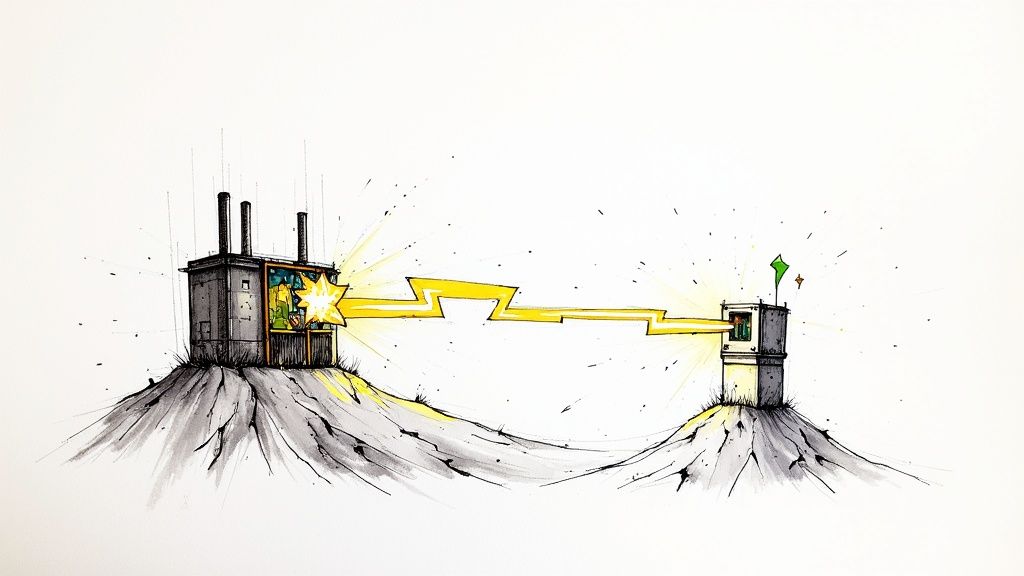
When people argue about proof of work vs proof of stake, there’s one topic that always gets heated: energy consumption. This isn't just a minor technical point; it's a huge issue that shapes public opinion, catches the attention of regulators, and frankly, decides the future of blockchain, especially for environmentally-aware UK investors.
Proof of Work (PoW) secures its network through what is basically a global, digital arms race. You have miners all over the world running powerful, special computers 24/7, all burning electricity as they compete to solve the next crypto puzzle. This constant competition is what gives networks like Bitcoin their legendary security, but it comes with a massive energy bill.
The amount of power this uses is truly stunning. At times, the Bitcoin network's annual electricity usage has been comparable to that of entire countries, like Sweden or Argentina. It’s no surprise, then, that this has led to some very serious questions about its carbon footprint and long-term sustainability.
The Proof of Stake Alternative
This is exactly where Proof of Stake (PoS) steps in, offering a completely different approach. Instead of relying on raw computing power, PoS secures the network with a financial stake. It gets rid of the energy-hungry puzzle-solving competition and replaces it with a system where validators simply lock up their own cryptocurrency as collateral to get a chance at approving transactions.
This fundamental change in how it works almost completely removes the need for huge energy use. Validators don't need warehouses packed with noisy, power-guzzling machines; a good home computer will often do the trick. The security doesn’t come from burning electricity, but from the simple financial threat of losing their staked coins if they try to cheat the system.
By moving from a model based on computer work to one based on financial responsibility, Proof of Stake totally changes the energy picture. It turns network security from an energy-heavy problem into a money-heavy one.
The Ethereum Merge: A Real-World Case Study
The most powerful example we have of this change in action is Ethereum's famous switch from PoW to PoS in September 2022, an event known as "The Merge." Before this upgrade, Ethereum's energy consumption was similar to that of a medium-sized European country.
After flipping the switch to Proof of Stake, the results were nothing short of incredible.
- Energy Reduction: Ethereum’s electricity consumption dropped by an estimated 99.95%. Literally overnight. It's hard to overstate this—it was one of the biggest decarbonisation events ever achieved by any industry.
- Hardware Obsolescence: The huge, worldwide network of Ethereum miners, with their millions of special graphics cards, were made useless for securing the network almost instantly.
- A New Standard: The smooth changeover showed that a major, multi-billion-dollar blockchain could operate securely and efficiently without the massive environmental baggage of PoW.
This amazing reduction has certainly not gone unnoticed. For a more detailed look, our complete guide on the environmental impact of cryptocurrency explains why this is such a critical conversation for the industry. The success of The Merge has put pressure on other networks and has become a key point for UK regulators and big investors who are increasingly guided by Environmental, Social, and Governance (ESG) principles. The debate over proof of work vs proof of stake is now, more than ever, a debate about sustainable technology.
Security and Decentralisation Under the Microscope

Security and decentralisation are the very foundations of blockchain. They're what give the technology its revolutionary power. But when we get into the proof of work vs proof of stake debate, it's clear these two systems protect the network from completely different angles, each with its own set of pros and cons.
Proof of Work (PoW) basically builds its fortress with bricks of raw computing power. It's incredibly difficult to break, but this strength creates risks of centralisation. On the other hand, Proof of Stake (PoS) uses financial incentives as its shield, making it easier for people to join but raising different worries about wealth getting concentrated in a few hands.
The PoW Security Model: A 51% Attack
The security behind Proof of Work networks like Bitcoin is legendary. It all boils down to the huge cost and effort needed to overpower it. To even try to change the transaction history, a bad actor would have to control the majority of the network's computing power—a situation known as a 51% attack.
For a network as big as Bitcoin, this is almost impossible. The attacker would need to get a gigantic number of expensive, special mining machines (ASICs) and then pay for an eye-watering amount of electricity to run them. The sheer financial and logistical challenge makes it practically undoable.
But here’s the twist. This very need for expensive hardware has led to a centralisation problem. The mining industry is now dominated by a handful of massive mining pools, where individual miners join forces to combine their processing power. In theory, if just a few of these pools decided to work together, they could gather enough power to pose a real threat to the network's integrity.
The PoS Security Model: Slashing and Economic Penalties
Proof of Stake gets rid of the computing arms race and instead focuses on financial responsibility. Instead of trying to overpower the network with processing power, an attacker would need to buy up a majority of the total cryptocurrency being staked.
This is where a clever defense system called slashing comes in. If a validator—the PoS version of a miner—tries to do something dishonest, like approving a fake transaction, the system can automatically punish them by destroying a part of their staked coins.
This creates a strong financial reason not to cheat. Why would an attacker spend billions buying enough coins to control the network, only to have that huge investment destroyed the moment they try to misuse their power?
This model makes it much easier to get involved. You don’t need a warehouse full of special hardware; you just need enough of the network's coin to put up as a stake. This accessibility often leads to a more diverse group of validators from all over the world, a big difference from the highly specialized world of PoW mining. You can dive deeper into these different approaches in our guide to understanding consensus mechanisms.
Centralisation Risks: A Different Flavour
While PoS neatly avoids the centralisation risk from mining pools, it introduces a new one: wealth concentration. In a PoS system, the more coins you stake, the more power you have to validate transactions and the more rewards you earn.
This can create a "rich-get-richer" cycle, where the wealthiest stakers could, over time, gain too much control over the network. If a few large crypto exchanges or wealthy individuals end up holding most of the staked tokens, it starts to raise valid questions about how truly decentralised the network is.
Here’s a quick breakdown of how these security trade-offs stack up:
| Security Aspect | Proof of Work (PoW) | Proof of Stake (PoS) |
|---|---|---|
| Primary Defence | Massive computing power makes attacks too expensive. | Financial penalties (slashing) make attacks unprofitable. |
| Attack Scenario | 51% Attack: Requires control of the majority of computing power. | Majority Stake Attack: Requires control of most staked coins. |
| Centralisation Risk | Mining Pools: A few large pools can dominate the network. | Wealth Concentration: The wealthiest stakers gain more influence. |
| Barrier to Entry | High: Needs expensive, special hardware and cheap electricity. | Lower: Needs money to buy coins, but no special hardware. |
Ultimately, there isn't a perfect answer here. PoW’s security is time-tested and based on the physical realities of energy and hardware, but it risks centralisation through industrial-scale mining. PoS offers a more accessible and energy-efficient option, but its security relies on financial theory and the ongoing risk that wealth—and therefore power—could become too concentrated.
Real-World Adoption and Use Cases
Theory is one thing, but how does the Proof of Work vs Proof of Stake debate actually play out in the real world? The method a project chooses isn't just a technical detail; it's a core decision that shapes its entire purpose, from security approach to growth ambitions. Let’s look at how the biggest names in crypto have chosen their sides.
Bitcoin: The Original Proof of Work Powerhouse
When you talk about Proof of Work (PoW), you’re really talking about Bitcoin. As the world's first cryptocurrency, it wrote the rules for creating a secure, decentralised digital asset. Bitcoin's main goal is to be a reliable store of value—a type of money free from control—and PoW is the engine that makes this happen.
The massive amount of energy and raw computing power poured into mining Bitcoin makes its network incredibly secure. It’s been running for over a decade without a single successful hack, giving its PoW model an unmatched track record. This battle-tested security is exactly what gives investors the confidence to treat it as "digital gold". That slow, ten-minute block time isn't a bug; it's a deliberate feature that puts predictability and safety above all else.
Ethereum: The PoS Platform for dApps
On the other side, Ethereum is the star example of a Proof of Stake (PoS) blockchain. Its famous 2022 switch from PoW to PoS, known as "The Merge," wasn't just a technical update; it was a strategic move to support its goal of becoming a global computer for decentralised applications (dApps) and smart contracts.
For Ethereum, the energy demands and slow speeds of PoW were becoming a major problem. The switch to PoS brought two game-changing benefits:
- Sustainability: It cut Ethereum’s energy consumption by over 99%, silencing many of its environmental critics.
- Scalability: The move was a vital first step in a bigger plan to make the network faster and cheaper, allowing it to host thousands of dApps, from finance to gaming, without slowing to a crawl.
By choosing PoS, Ethereum made a clear decision to prioritise efficiency and its ability to grow, a move designed to better serve its millions of users and developers.
PoS is quickly becoming popular worldwide, mainly thanks to its green and scalable features. In the UK, clear rules have been a key reason for big investors looking at PoS. When HMRC clarified the tax rules for staking, it gave companies the certainty they needed to get involved.
This regulatory clarity is leading to real growth. UK-based exchanges are now offering staking products to meet this demand, giving firms easy access without the technical hassle. This trend is part of a wider European shift towards greener blockchain tech as regulators look more closely at PoW's energy use. While solid data comparing PoW and PoS adoption in the UK is scarce, the nation's crypto-friendly attitude points towards a bright future for PoS. You can find more insights on this topic by exploring the rise of Proof of Stake on deveshinsights.com.
Exploring Other Noteworthy Examples
The Proof of Work vs Proof of Stake world isn't just a two-horse race. Many other projects have picked a path that fits their specific goals.
- Litecoin (PoW): Often called the "silver to Bitcoin's gold," Litecoin is another long-standing PoW chain. It was designed from the start to be a faster, lighter version of Bitcoin, with quicker block times for more practical, everyday payments. Its continued use of PoW shows its commitment to the security model that Bitcoin created.
- Cardano (PoS): Cardano took a different approach, building its PoS blockchain with a strong focus on academic research and peer-reviewed development. Its choice of PoS was planned from day one, aiming to create a highly scalable and sustainable home for smart contracts and dApps that could compete with Ethereum.
Ultimately, these examples show there’s no single "best" answer. The choice between PoW and PoS is deeply strategic, tied directly to whether a project’s main goal is to be a fortress of value, a high-speed platform for apps, or something else entirely.
Where Do We Go From Here?
The ongoing debate between Proof of Work and Proof of Stake isn't just a technical argument; it’s a conversation about what the future of blockchain should look like. As the technology matures, both models are being constantly refined and improved to fix their weaknesses. The real question isn't which one will win, but rather, where each model fits best in an increasingly diverse, multi-chain world.
For Proof of Work, the elephant in the room has always been its energy use. A lot of smart people are working on ways to make mining less of a drain on our power grids. This includes everything from encouraging miners to use green energy sources, like solar or wind, to designing hardware that uses less electricity. The challenge is to keep PoW's proven security while drastically reducing its environmental footprint.
Hybrids and New Twists on Old Ideas
Over in the Proof of Stake camp, the focus is on strengthening security and preventing the "rich get richer" problem. Developers are trying out more advanced slashing penalties and reputation systems to keep validators honest. The goal is to build PoS networks that are not only secure but also genuinely fair for everyone.
We're also starting to see some interesting hybrid models appear, trying to take the best parts from both systems. Imagine a blockchain that uses PoW for its raw security but then adds a PoS layer on top to confirm transactions much faster. It's all about finding a more balanced and practical solution.
The future probably isn’t a winner-takes-all situation. We're more likely heading towards a vibrant ecosystem where different consensus mechanisms live side-by-side, each suited for a specific job—whether that's running a global financial system or securing a one-of-a-kind piece of digital art.
The UK's Part in the Story
With its strong interest from big financial players, the UK's crypto scene is playing a key role in how both PoW and PoS are being used. Crypto ownership has jumped from just 4% in 2021 to 12% more recently, and the country’s regulators are trying to keep up.
Lately, the conversation in the UK has shifted towards PoS, mainly because it aligns well with national environmental goals. This isn't just talk; UK financial firms are actively investing in special staking infrastructure, showing a clear, forward-thinking move towards greener blockchain technology. You can find more details on UK Bitcoin adoption and trends on Bitcourier.
Frequently Asked Questions
When you dig into the Proof of Work vs Proof of Stake debate, a few questions always seem to pop up. Let's tackle them head-on with some straight-talking answers to clear things up.
Which is More Secure, Proof of Work or Proof of Stake?
This is a hot topic, and the honest answer is that they're both very secure, just in different ways. Proof of Work's security is all about raw, physical power. An attacker needs to control an unbelievable amount of computing hardware, making it extremely expensive to pull off. Bitcoin has been running on this model for over a decade, so it's incredibly well-tested.
Proof of Stake, on the other hand, puts its trust in financial incentives. To attack the network, you'd need to own a huge chunk of the cryptocurrency itself. If you try anything dodgy, the network can automatically destroy your staked coins through a process called "slashing." So, while PoW has a longer history, PoS offers a clever, money-based security model.
Is It Easier to Get Involved With PoW or PoS?
For the average person, getting into Proof of Stake is much simpler than Proof of Work. To mine a PoW coin like Bitcoin, you need to buy expensive, special gear (like an ASIC miner) and hope you have access to cheap electricity to make it profitable.
With PoS, it's a completely different story. You can often start by joining a staking pool right on a crypto exchange with just a small amount of the right coin. It makes it much easier for almost anyone to get involved in securing the network and earning rewards.
Why Did Ethereum Bother Switching from PoW to PoS?
Ethereum’s big move, known as "The Merge," wasn't just for show. It was driven by two huge goals: to become environmentally friendly and to prepare for future growth. By switching to PoS, Ethereum cut its energy use by an incredible 99.9%, silencing many of its loudest critics.
But it was more than just going green. This change laid the foundation for future upgrades aimed at making the network faster and cheaper to use. To support a massive ecosystem of apps, Ethereum had to evolve, and this was its biggest strategic step towards wider use.
Which is a Better Investment for a Beginner?
Thinking about which system is "better" for investment is the wrong way to look at it. Your focus should always be on the specific crypto project you’re interested in—what it does, the team behind it, and its core technology.
For example, Bitcoin (a PoW network) is often seen as a digital version of gold, a store of value. Ethereum (a PoS network) is more like a global computer for building apps. Your investment should be based on which project's long-term vision you believe in more, not the engine running it.
At The Coin Course, our goal is to break down the crypto world into clear, expert-led guides. Whether you're grappling with core concepts or exploring advanced strategies, we're here to help you build your knowledge with confidence. Find more insights at https://thecoincourse.com.
Article created using Outrank