You're probably doing one of two things right now. Either you've got a trading app open every few minutes, checking whether Bitcoin, Ether, or your latest altcoin pick has moved, or you've stepped away for an hour and come back to find the market did something dramatic without you.
That cycle gets old fast. It pulls your attention all day, makes every little move feel urgent, and nudges you towards emotional decisions. You start chasing pumps, second-guessing your entries, and buying because a candle looks exciting rather than because your plan says it's time.
Price tracking tools help break that habit. Used properly, they act like a calm layer between you and the noise. Instead of staring at charts all day, you set conditions, define what matters, and let the tool tap you on the shoulder when the market reaches your level. That sounds simple, but it changes your whole workflow. You stop reacting and start preparing.
Stop Watching Charts All Day
A lot of newcomers think serious crypto investing means constant screen time. They imagine experienced traders sitting in front of six charts, catching every move live. In reality, many individuals who try that burn out.
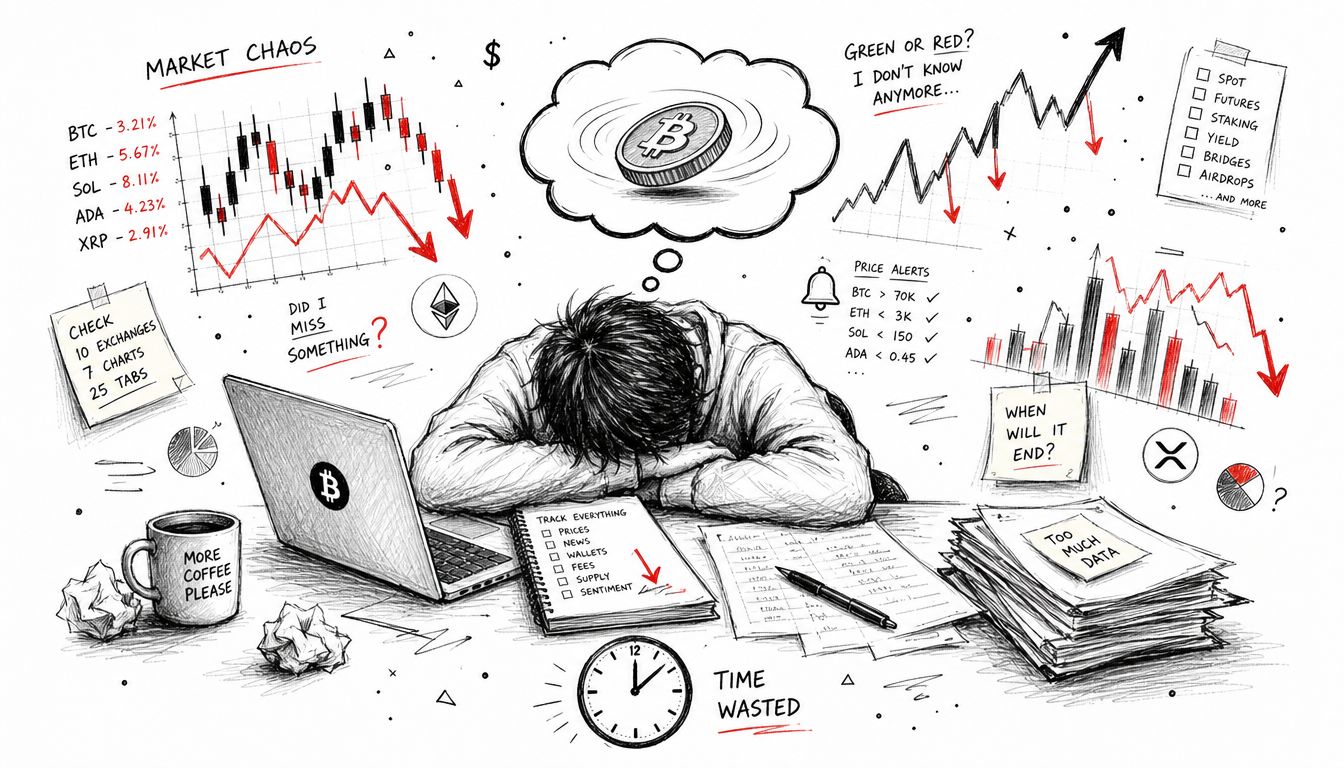
Take a familiar example. You buy a small amount of Bitcoin and tell yourself you'll add more if price dips. Then the day gets busy. You check during lunch, then on the train home, then before bed. Each look gives you a new emotion. Relief if it's green. Regret if it's red. FOMO if it suddenly jumps after you decided to wait.
That isn't a system. It's just stress.
The real problem isn't volatility
Crypto moves quickly, but speed isn't the main issue. The core problem is that many individuals try to track a fast market manually. That means you're relying on memory, impulse, and whatever app you happen to have open at the time.
A price tracker changes that. You tell it what matters first.
- Target prices: “Alert me if Bitcoin falls to my buy zone.”
- Breakout levels: “Tell me if this altcoin pushes above resistance.”
- Portfolio checks: “Let me know if one holding starts moving harder than the rest.”
Practical rule: If you only notice a move after it has already happened, you're managing your investments backwards.
Calm beats constant attention
Think of price tracking tools as a filter. They don't remove market risk. They remove unnecessary noise. Instead of watching every wiggle, you focus on moments that connect to your strategy.
That matters whether you're doing simple DCA, short-term swing trading, or just learning how markets behave. A beginner needs fewer alerts, not more. One or two useful signals can teach you more than ten hours of random chart watching.
The biggest shift is mental. You stop asking, “What is the market doing right this second?” and start asking, “What would make me act?” That's how disciplined investors protect both their time and their nerves.
Your Personal Crypto Market Assistant
The easiest way to understand price tracking tools is to think of them as a personal market assistant. They watch prices for you, keep notes, and send an update when something important happens.
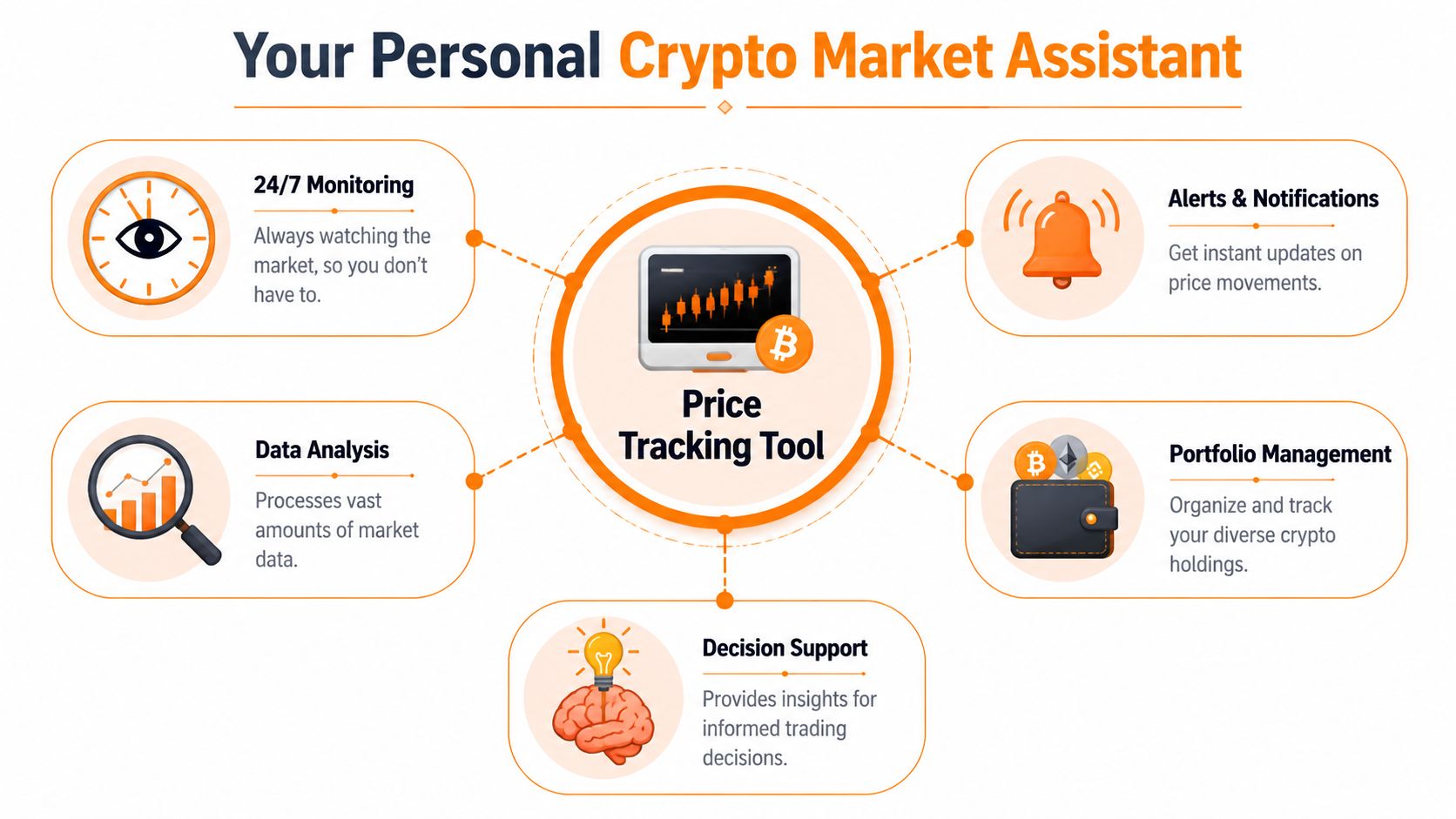
That idea already exists outside crypto. CamelCamelCamel, one of the most recognized free Amazon price trackers, monitors prices for millions of products across major Amazon stores, including the UK marketplace. It provides detailed price history graphs and alerts, allowing consumers to verify if a current sale price is a good deal before buying (IProyal's overview of price tracking tools).
If you've ever used a shopping alert for headphones, a laptop, or a game console, the logic is the same. You don't sit on the product page all week. You let the tool do the boring part.
What that looks like in crypto
In crypto, a good price tracker usually watches more than a single number. Price matters most, but it helps to see the full context around the move.
Common dashboard items include:
- Spot price: The live or near-live price of the asset.
- Percentage change: A quick view of whether momentum is rising or cooling.
- Trading volume: Useful for judging whether a move has real participation behind it.
- Market capitalisation: A rough sense of an asset's size compared with others.
- Watchlists and portfolio views: A cleaner way to track a handful of coins without opening ten exchange tabs.
Some tools focus on alerts. Others combine alerts, portfolio tracking, and charting in one place. If you want to follow holdings without exposing spending permissions, a watch-only public key crypto wallet for portfolio tracking can be a useful setup.
Why beginners get value so quickly
New investors often think they need advanced indicators first. Usually they don't. They need a cleaner workflow.
A simple setup can do a lot:
- Add a small watchlist of coins you care about.
- Set one buy alert below the current price.
- Set one warning alert above the current price.
- Review the move only when the alert arrives.
A tracker won't make decisions for you. It gives you the space to make better ones.
That's the key. Price tracking tools are not magic prediction engines. They're decision-support tools. Their job is to watch, organise, and notify. Your job is to connect those alerts to a plan.
Understanding the Dashboard Dials
When you open a price tracker for the first time, it can look busy. There are charts, numbers, coloured candles, tabs for volume, and sometimes enough blinking data to make a newcomer close the app immediately.
The trick is to stop treating the dashboard as one giant wall of information. Break it into a few dials. Each dial answers a different question.
Historical charts and why the past still matters
The first dial is the historical price chart. This isn't just a picture of old moves. It helps you see where buyers and sellers have reacted before.
If a coin has repeatedly bounced around the same level, that area may matter again. If it keeps failing near a certain price, that can hint at resistance. Even if you're not a technical analyst, this gives you context for setting alerts in sensible places.
Some professional tracking systems in other markets process historical data spanning 2+ years for more accurate modelling, and they depend on detailed product matching to avoid false positives. That level of granularity is tied directly to creating an actionable pricing strategy, as outlined in Visualping's discussion of competitor price tracking tools. In crypto, the lesson is similar. Better history and cleaner data usually lead to better decisions.
If chart reading still feels fuzzy, this guide on decoding crypto charts for beginners helps turn those lines into something more practical.
Volume and market participation
The second dial is volume. Price can move on very thin activity, especially in smaller coins. That's why volume matters. It helps you judge whether a move has broad participation or whether a few trades are pushing the chart around.
Here's a simple explanation:
- Price rises with strong volume: More people are involved. The move may carry more weight.
- Price rises with weak volume: Be careful. The move may fade quickly.
- Price drops with strong volume: Sellers are active. Don't ignore that.
- Price stalls while volume builds: The market may be preparing for a larger move.
Alerts and the role of pre-commitment
The third dial is the one that changes behaviour most. Alerts.
An alert is a pre-commitment. You decide in advance what matters, then let the tool notify you later. This helps reduce one of the biggest beginner mistakes in crypto, making decisions in the heat of the moment.
Set alerts where action becomes possible, not where curiosity gets triggered.
Useful alert types include price thresholds, percentage moves, and repeated tests of the same level. Some traders also like alerts for unusual volume spikes because those can hint at a sentiment shift before price fully breaks out.
Watchlists and portfolio grouping
The last dial is organisational. Watchlists sound basic, but they're often the feature that keeps your process tidy.
A good watchlist lets you group assets by purpose:
| Group | What goes in it | Why it helps |
|---|---|---|
| Core holdings | Long-term assets like BTC or ETH | Keeps your main positions separate from experiments |
| Active trades | Coins you're managing closely | Stops you missing levels that matter today |
| Research list | Tokens you're studying but don't own yet | Lets you observe before committing money |
That small bit of structure prevents mental clutter. Instead of one giant list of random coins, you have categories that match your strategy.
Putting Your Price Tracker to Work
Features matter, but workflow matters more. A tool becomes useful when it fits how you invest.
Below are a few practical setups that map price tracking tools to common crypto approaches.
A DCA investor buying weakness
Say you want to build a Bitcoin position without guessing the perfect bottom. You can still use DCA, but with more intention.
Set a recurring buy plan if that suits your routine, then add alerts below the current market price. When one triggers, you review whether the dip matches your rules. Maybe you add your scheduled amount. Maybe you add a little extra because price has reached a zone you already marked.
This gives you structure without turning DCA into frantic market timing.
A simple workflow:
- Choose your core asset such as Bitcoin or Ether.
- Pick your regular interval for adding funds.
- Mark one or two dip levels where you'd like to pay closer attention.
- Let the alert prompt a review, not an automatic emotional buy.
A swing trader waiting for confirmation
Swing traders often lose money by entering too early. They see price getting close to resistance and jump in before the breakout is real.
A tracker helps by making you more patient. Instead of watching every candle, you set an alert slightly above the level that matters. If the market reaches it, you check volume, structure, and whether the move still looks clean.
Advanced monitoring systems in other fast-moving markets use API-driven architecture for real-time alerts. Premium tools can monitor at 30-second intervals and provide evidence of a change within 0.5 seconds of detection, which is described as a 98% improvement over older methods and linked to a 15-20% increase in margin optimisation for active traders in UK Data Services' build-versus-buy analysis. Crypto traders can take the practical lesson from that: speed matters most when your strategy depends on quick execution around key levels.
Monitoring a volatile altcoin without obsession
Small-cap and newly listed coins can tempt you into constant checking. They move fast, spread quickly on social media, and often retrace just as fast.
For those, don't create a dozen alerts. Use a narrow system:
- One upside alert near the level where momentum might become interesting
- One downside alert where the setup clearly weakens
- One note to yourself explaining why the coin is on your list at all
That last part matters. When an alert fires, you want a reasoned starting point, not a blank emotional reaction.
If you can't explain why an alert matters before it triggers, the alert probably isn't useful.
Spotting sentiment shifts
Sometimes the best use of a tracker isn't to buy or sell immediately. It's to notice a change in tone.
You may see one sector move first. For example, a group of AI-related tokens starts waking up together, or exchange tokens begin to strengthen after weeks of weakness. A watchlist built by theme can make those shifts easier to notice than a single-coin view.
That's where price tracking tools become more than alarms. They become pattern detectors in your daily routine.
Finding the Perfect Tool for Your Goals
The best tool isn't the one with the longest feature list. It's the one that fits how you invest, how often you trade, and how much complexity you will use.
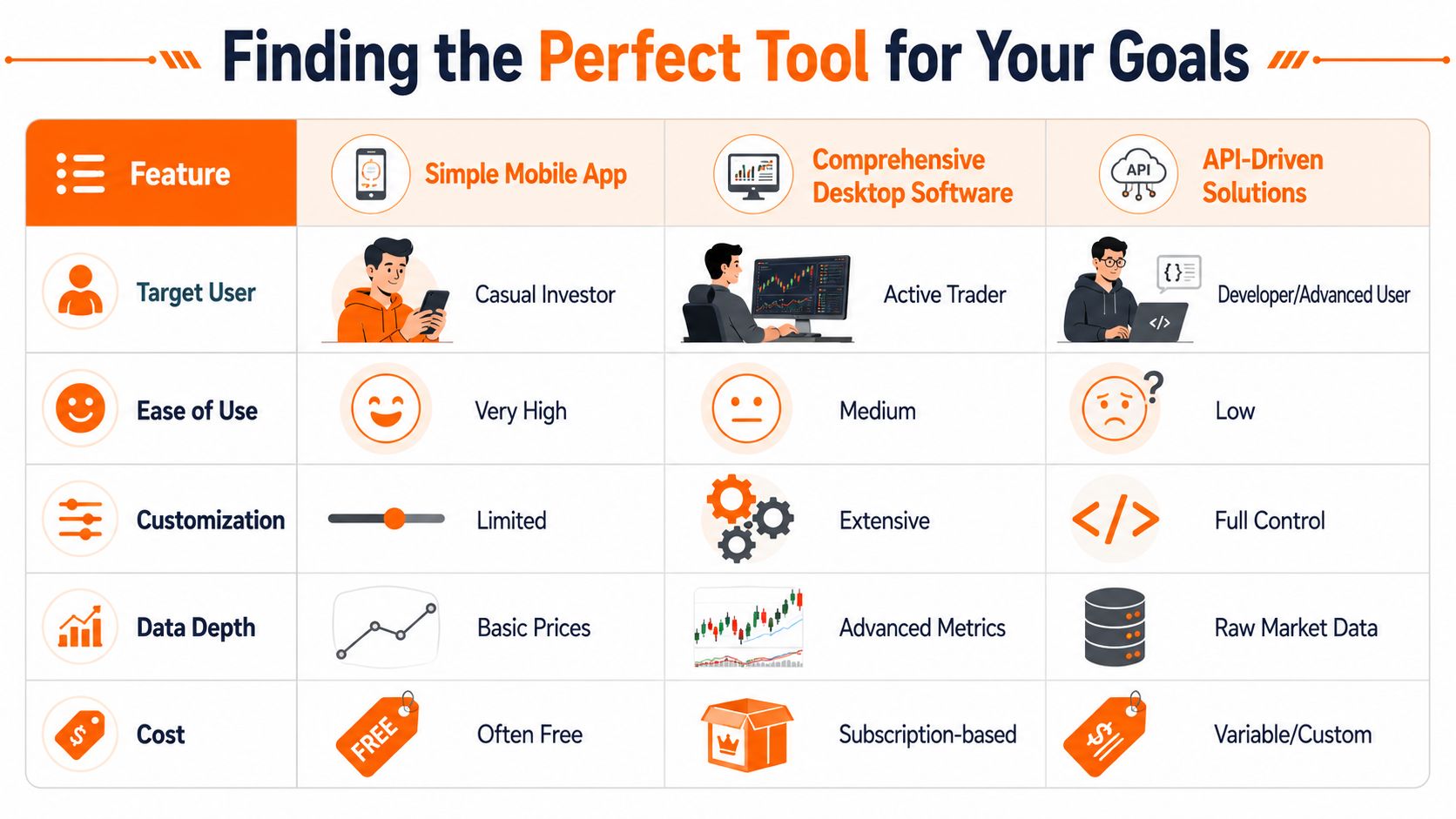
A lot of people overbuy here. They sign up for something designed for power users, then end up using only the basic watchlist. Others do the opposite and stick with a bare-bones phone app even though they need stronger charting and more flexible alerts.
Three broad categories
| Tool Category | Best For | Key Features | Typical Cost |
|---|---|---|---|
| Simple mobile app | Casual investors and beginners | Price alerts, watchlists, basic portfolio view | Often free |
| Comprehensive desktop software | Active traders | Advanced charts, deeper custom alerts, multi-panel analysis | Subscription-based |
| API-driven solutions | Developers and advanced users | Custom automation, direct data handling, flexible integrations | Variable or custom |
Some people also want broader tracking across assets, not just crypto. If that's your situation, this guide to tools for multi-asset portfolio tracking gives a useful wider-angle view.
Cost matters more than people admit
Price tracking tools can get expensive fast. In broader monitoring markets, tools like Dealavo start at £99–$399/month, and free options often cover only a narrow slice such as a single channel like Amazon UK, according to UK Data Services' overview of price monitoring services. The crypto lesson is straightforward. Don't pay for enterprise-grade complexity if your real need is two watchlists and a few clean alerts.
Before choosing, ask yourself:
- Are you passive or active? If you mainly accumulate, a mobile app may be enough.
- Do you need portfolio tracking too? If yes, look for combined monitoring and holdings views.
- Do you trade on multiple exchanges? Exchange support matters more than fancy design.
- Will you use automation responsibly? API-based tools are powerful, but they demand care.
- Can you tolerate a steeper learning curve? Stronger tools often take time to set up properly.
A short explainer can help visualise those differences:
A practical selection checklist
Don't choose by homepage slogans. Test the workflow.
- Alert quality: Can you set alerts that match your actual strategy?
- Data coverage: Does it support the coins and exchanges you follow?
- Interface clarity: Can you understand the dashboard at a glance?
- Security options: Does it support read-only access if you connect accounts?
- Portability: Is it good on mobile, desktop, or both?
The right answer for a long-term investor and a full-time trader won't be the same. That's normal. A tool should fit your process, not force you into somebody else's.
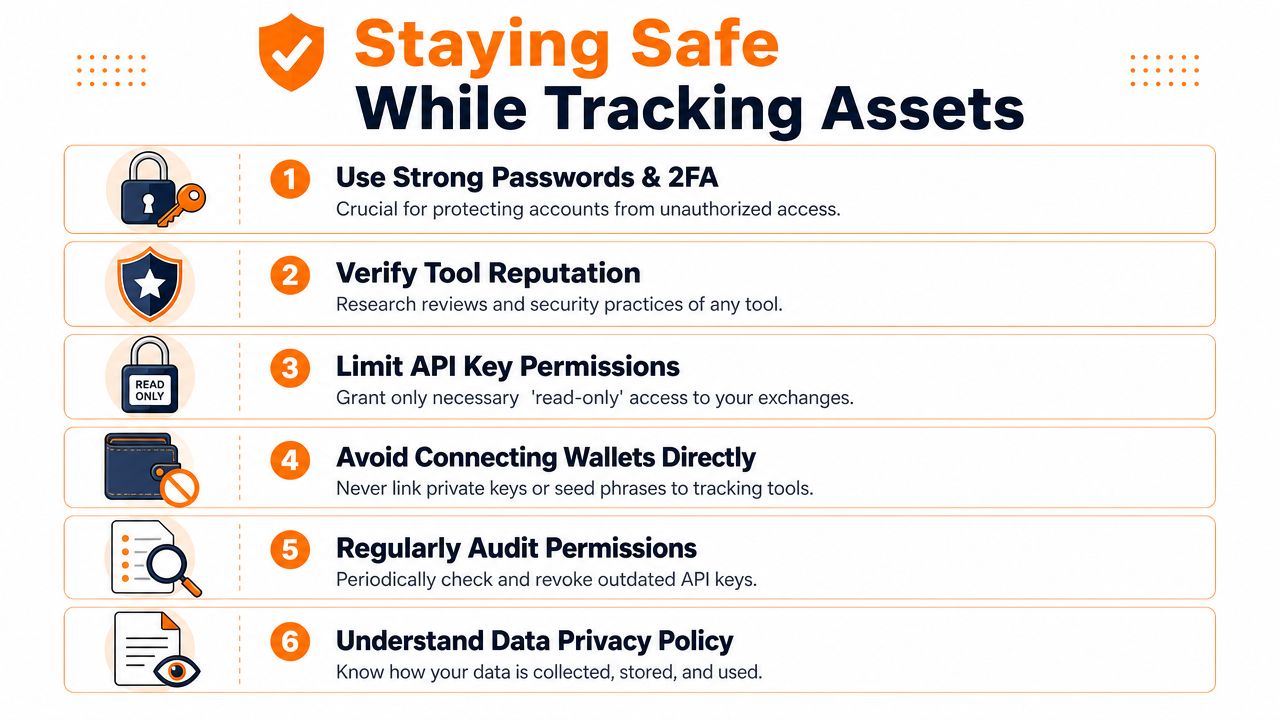
Staying Safe While Tracking Assets
Tracking tools can save time, but they can also create risk if you connect them carelessly. The most important rule is simple. A price tracker should help you observe the market, not hand over control of your funds.
Read-only means read-only
If a tool asks to connect to your exchange through an API, check the permissions carefully. For portfolio tracking, read-only access is the standard you want. It lets the app view balances and history without giving it the ability to trade or withdraw.
Never enter a seed phrase or private key into a tracking tool. Not for convenience. Not for “enhanced syncing”. Not for anything.
For a stronger security baseline, review these essential exchange security practices.
Data quality affects decisions
Good security isn't only about account protection. It's also about decision quality. If a tracker uses delayed or messy data, you can end up making the wrong move for perfectly avoidable reasons.
In UK retail, pricing has to be unambiguous, in sterling, and inclusive of VAT, while small shops with a retail area under 280 m² are exempt from certain rules, which shows how messy real-world data collection can get across exemptions and tax treatments, as explained by Business Companion's pricing guidance. Crypto has its own version of this problem. Different exchanges can show slightly different prices, list pairs differently, or update data on different schedules.
Check where the tool gets its data before you trust the numbers it shows.
Safety habits worth keeping
A short checklist goes a long way:
- Use strong passwords and 2FA: Your tracking account can still become a weak entry point.
- Audit connected keys regularly: Remove anything you no longer use.
- Read the privacy policy: Know what the tool stores about your portfolio.
- Separate tracking from execution: You don't need every app to place trades.
- Review risk before acting: After an alert, it helps to analyze trade expectancy rather than jump in on emotion.
Security-first users tend to look slower from the outside. In practice, they usually last longer.
Your Next Step to Smarter Investing
Price tracking tools don't give you an edge because they're flashy. They help because they change your behaviour. You stop hovering over charts. You define conditions in advance. You organise your watchlist around your strategy. You let alerts bring you back only when something relevant happens.
That shift is bigger than it looks. It moves you from reactive watching to deliberate decision-making. For DCA investors, that means calmer buying. For swing traders, it means waiting for confirmation instead of forcing entries. For curious beginners, it means learning the market without getting swallowed by it.
Start small. Pick one reputable tool, create a short watchlist, and set a few alerts tied to real decisions. Don't try to monitor everything. Track what matters to your plan.
If you do that well, price tracking tools become more than a convenience. They become part of a disciplined workflow that saves time, reduces emotional mistakes, and helps you act with more purpose when the market finally reaches your level.
The best next move is to keep building that discipline with clear, practical education. The Coin Course offers beginner-friendly and advanced guides on crypto investing, wallets, trading, and security, so you can turn tools and alerts into a stronger long-term process.