You're probably here because the promise sounds clean and simple. Use crypto, skip the paperwork, keep your privacy, start playing in minutes.
That's the sales pitch behind a No KYC crypto casino. For some people, that sounds convenient. For others, it sounds like a way to avoid handing over a passport, proof of address, and financial details to a gambling site they barely know.
The problem is that privacy and safety often pull in opposite directions. The fewer checks a platform runs, the less friction you face. But those same missing checks can also mean weaker consumer protection, thinner fraud controls, and very little help if the operator freezes your funds or disappears.
A cautious way to think about it is this. A no KYC crypto casino isn't just a gambling product. It's a trust test. You're deciding how much you're willing to rely on code, branding, and reputation when the usual guardrails are missing.
What Is a No KYC Crypto Casino
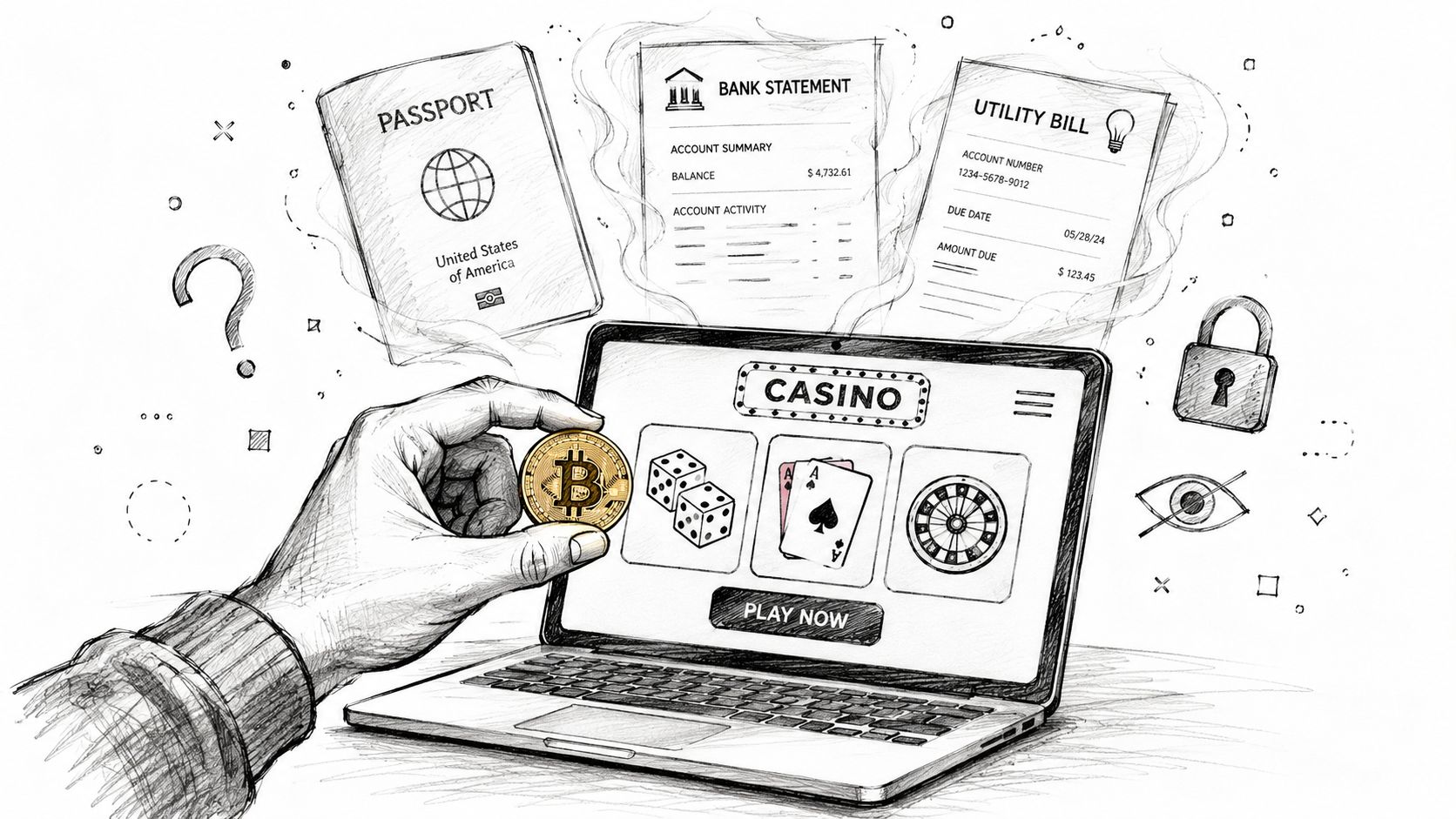
A No KYC crypto casino is an online gambling platform that accepts cryptocurrency and either skips identity checks entirely or delays them until later. “KYC” means Know Your Customer. In normal financial and gambling settings, that's the process where a business asks for documents such as a passport, driving licence, selfie, or proof of address.
If a casino says it's “no KYC”, it usually means you can create an account, deposit crypto, and start playing without first submitting those documents.
What it is and what it isn't
That label can confuse people, because it gets used loosely.
A no KYC crypto casino is usually one of these:
- A crypto-first gambling site that lets you deposit with Bitcoin, Ether, stablecoins, or other tokens and play straight away
- A lightly regulated offshore platform that doesn't apply the same customer checks you'd expect from a UK-facing operator
- A site that says “no KYC” upfront but may still ask for documents later, often when you try to withdraw or when your activity triggers internal review
It is not the same as:
- A UK-regulated online casino that accepts crypto through a compliant process
- A private wallet app, because a casino is still an operator taking bets and managing risk
- A trustless system by default, because many of these platforms still depend heavily on central control behind the scenes
Why people look for them
The appeal is easy to understand. You might not want your gambling activity tied to your real-world identity. You might not want to upload sensitive documents to a site you found through a search result or a social media post. You might also just want speed.
Privacy is a real concern. Handing identity documents to an unfamiliar gambling platform can feel riskier than the gambling itself.
That's the honest starting point. Wanting more privacy doesn't make someone reckless. But the next question matters more: what protections are you giving up in exchange?
A simple way to frame the trade-off
This is similar to paying for something in cash at a market versus opening an account with a bank-linked service. Cash reveals less about you. But if the seller cheats you, there may be no refund path, no dispute process, and no account history that helps prove what happened.
That same tension sits at the centre of the no KYC crypto casino model. It offers less data exposure at the front door, but often less protection when things go wrong.
How These Anonymous Casinos Actually Work
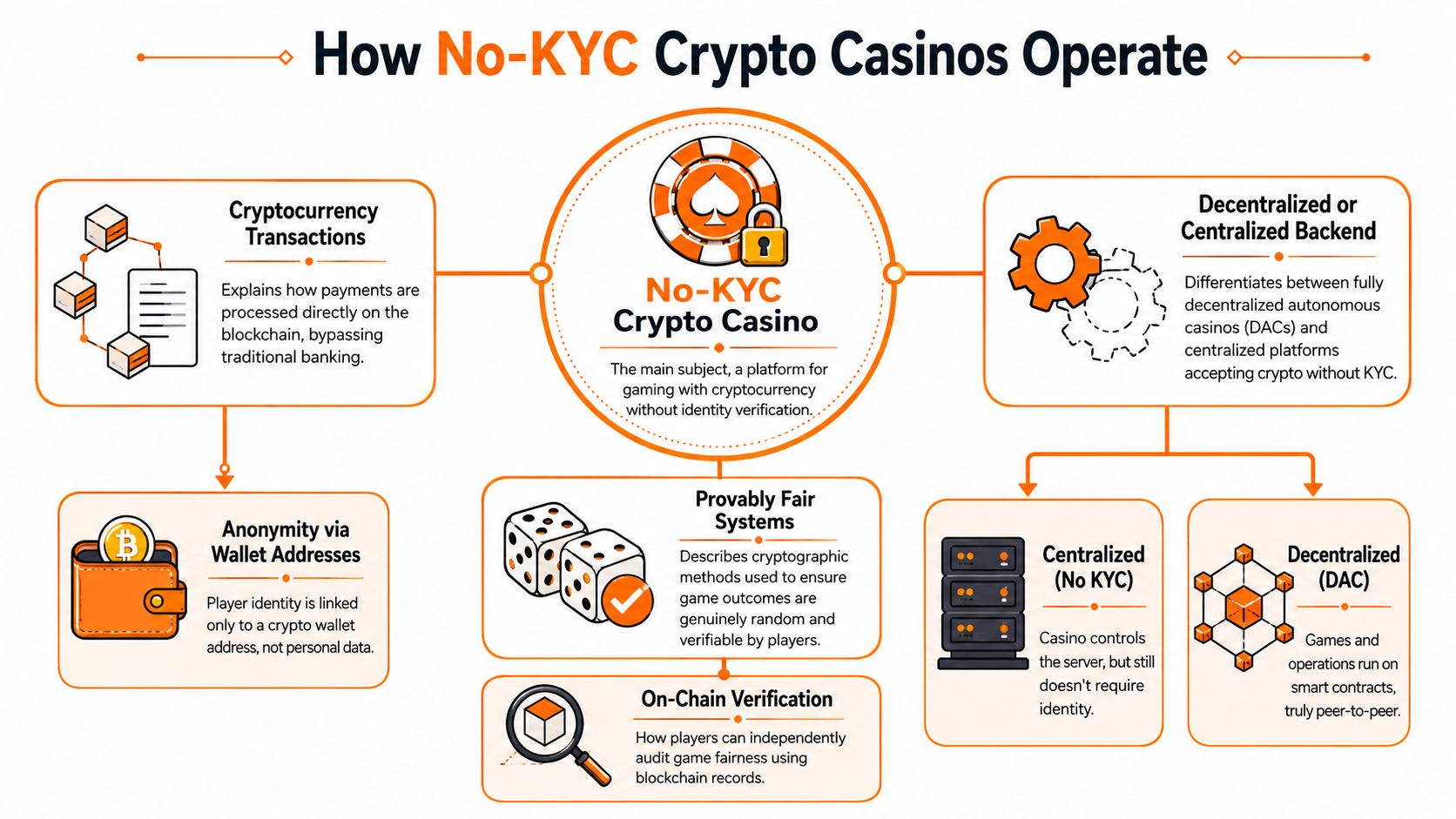
Under the surface, these platforms mix a few different systems. Crypto payments, account management, game software, and sometimes smart contracts all interact. People often assume that because crypto is involved, everything must be transparent and decentralised. That usually isn't true.
Here's the infographic version first.
Custodial and non-custodial setups
The first thing to understand is who controls the funds while you play.
In a custodial setup, the casino takes custody of your crypto after you deposit. That's similar to handing chips to a cashier and trusting the venue's internal balance system. Your wallet sends coins in, and the casino's database tracks what you're owed.
In a non-custodial or wallet-connected setup, you keep more direct control from your own wallet. That's closer to paying with notes from your own pocket each time. In theory, this reduces the need to trust the platform with one large pooled balance. In practice, it still depends on how the games and contracts are built.
A wallet connection alone doesn't make a site safer. If the smart contract is flawed, or if the front end tricks you into signing the wrong transaction, you can still lose funds.
On-chain payments and off-chain gameplay
Many readers get tripped up at this point.
Crypto casinos often use blockchain for deposits and withdrawals, but not for every moment of gameplay. The payment layer may be public and auditable on-chain. The actual spin, hand, or roll often happens off-chain on the operator's servers.
That distinction matters because, as noted in this explanation of blockchain payments and transparency in crypto casinos, blockchain improves the payment layer, not the whole wagering stack. A transaction can be visible on a public ledger while the game logic still depends on the operator's random number generation, smart-contract design, and backend controls.
Practical rule: “Blockchain casino” doesn't automatically mean the game itself is trustless. Often it only means the money moved through crypto rails.
To make that more concrete, think of a fruit machine in a pub. You can see the coins go in. That doesn't tell you whether the machine's internal logic is fair. The same idea applies here.
A short visual walkthrough can help if you're new to the mechanics.
What “provably fair” usually means
You'll see the phrase provably fair everywhere in crypto gambling. The basic idea is that the casino uses cryptographic inputs, often a server seed, a client seed, and a nonce, so players can verify that a game result wasn't altered after the fact.
Used well, this is helpful. It's like a card shuffle where the method can be checked later instead of taking the dealer's word for it.
But there are two catches:
- You still have to verify it yourself. Most players never do.
- The claim can be badly implemented or misleading. A site can advertise fairness tools while still controlling other important parts of the experience, such as balances, withdrawals, bonus rules, or access to support.
Centralised versus decentralised in plain language
A lot of “anonymous casinos” are still ordinary businesses with servers, admins, wallets, and internal controls. They may accept crypto and ask for no ID, but they remain centralised.
A more decentralised protocol may run key functions through smart contracts on a public chain. That can improve transparency. It can also create new risks, including contract bugs, poor governance, or irreversible wallet errors.
Here's the easiest way to separate the models:
| Model | Who controls most operations | Main risk |
|---|---|---|
| Custodial no KYC site | The operator | You trust the operator not to freeze or misuse funds |
| Wallet-connected casino | Shared between user and platform | Bad approvals, contract flaws, front-end tricks |
| Decentralised protocol | Smart contracts and governance | Code risk, wallet mistakes, weaker customer support |
The Appeal and the Uncomfortable Questions
People don't look for a no KYC crypto casino by accident. They usually have a reason, and some of those reasons are perfectly understandable.
Why players are drawn to it
For one group, it's mainly about privacy. They don't want gambling records connected to their name, bank account, or scanned documents. If you've spent time in crypto, that instinct probably feels familiar. Many users already separate wallets, avoid oversharing, and prefer systems that collect less data.
For another group, it's about speed. Traditional onboarding can be slow, repetitive, and intrusive. Upload a document. Wait. Take a selfie. Wait again. Get asked for more.
There's also a practical layer. The UK Gambling Commission's annual Gambling Survey for Great Britain reported that 2.5% of adults had used at least one online casino, slot, bingo, or instant-win product in the previous four weeks in 2024, and 1.8% of adults said they had used a crypto asset in gambling at some point, according to the UNLV-hosted summary of UK gambling and crypto findings. That doesn't prove no KYC platforms are safe. It does show there is real demand at the overlap of online gambling and crypto use.
Where the hard questions start
Privacy has a legitimate side. It also has a darker edge when financial systems remove identity checks altogether.
If a platform doesn't know who its users are, it becomes harder to stop money laundering, sanctions evasion, stolen-fund movement, multi-account abuse, and problem gambling patterns that would normally trigger review. Regulators focus on KYC for a reason. It isn't only bureaucracy. It's also about tracing risky behaviour and reducing harm.
A system that protects user privacy can also shield bad actors. That's the uncomfortable part most marketing pages leave out.
The personal trade-off
For an ordinary user, the ethical question quickly becomes practical. If a platform avoids checks designed to catch abuse, what else is it willing to avoid? Responsible gambling tools? Source-of-funds review? Fair dispute handling?
That doesn't mean every anonymous site is malicious. It means the business model creates blind spots by design. And when a platform is built around limited visibility, honest users can end up carrying the same risk created by dishonest ones.
Understanding the Legal and Regulatory Minefield
The legal issue isn't just whether crypto is used. The key issue is whether the operator follows the rules of the market it serves.
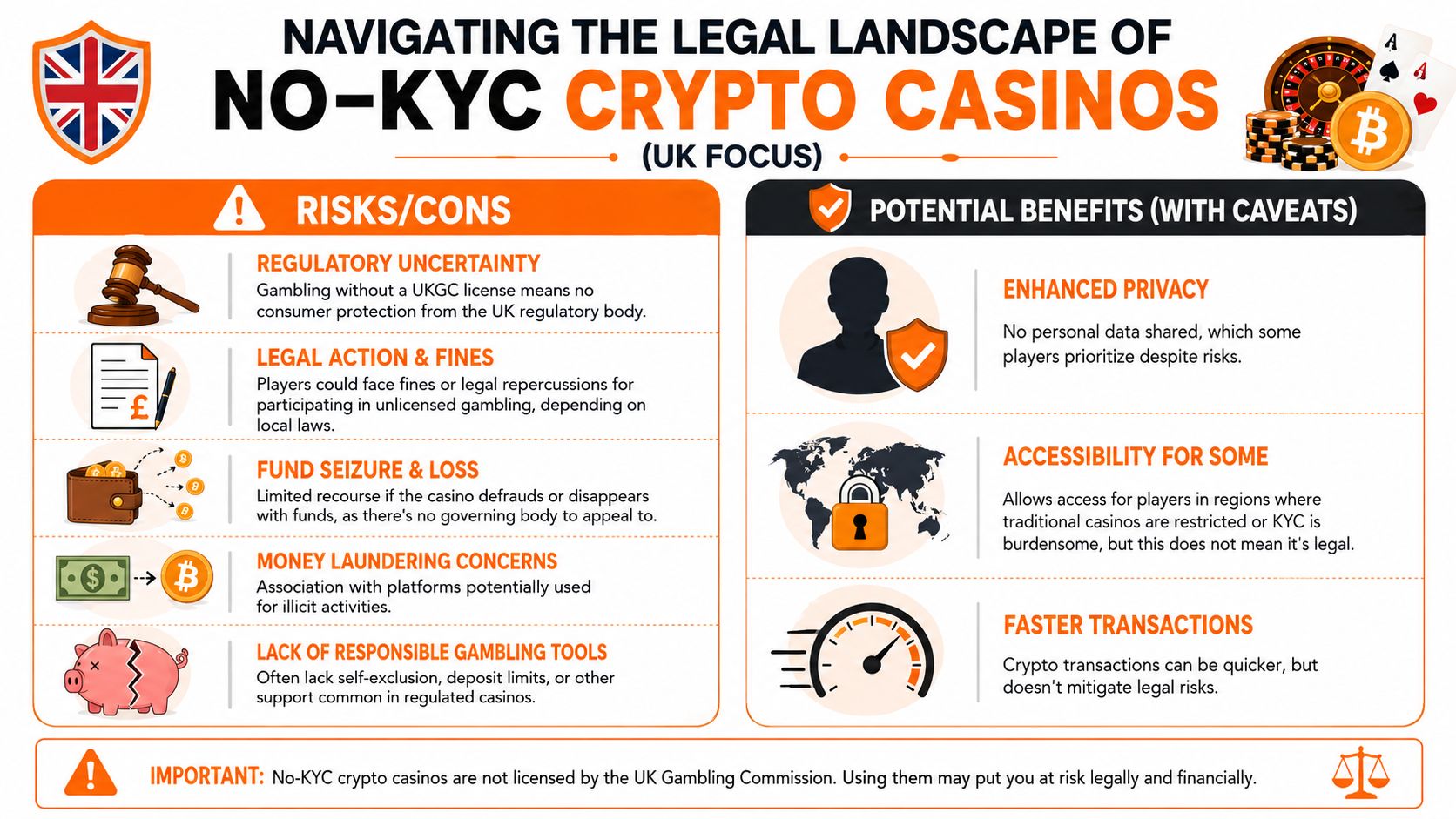
In the UK, licensed online gambling operators work under a strict anti-money laundering and customer due diligence framework. As explained in this overview of crypto casino compliance requirements, identity and affordability checks are part of the Gambling Commission's expectations when risk indicators appear. That creates a direct conflict with the no KYC model, because pseudonymous wallet flows don't line up neatly with source-of-funds checks or identity verification before higher-risk play or withdrawals.
What “unregulated” really means for a player
Some people hear “offshore” or “unregulated” and think it means fewer rules. What it often means in practice is fewer protections for you.
If a casino isn't licensed under a serious regime relevant to your location, you may not have:
- A reliable complaints path if winnings are withheld
- Clear standards for safer gambling tools such as limits or exclusions
- Meaningful oversight of advertising, bonus terms, or internal controls
- Any realistic recourse if the operator vanishes or changes terms overnight
A legal grey area can feel flexible right up until you need help.
A quick way to assess the mismatch
Here's a simple UK-focused comparison:
| Question | UK-regulated operator | Typical no KYC offshore casino |
|---|---|---|
| Identity checks | Expected when risk appears | Often avoided or delayed |
| Source of funds review | Part of higher-risk due diligence | Often unclear |
| Complaints route | Formal and structured | Often informal or absent |
| Player protection rules | Defined by licence conditions | Varies widely |
You can also track how lawmakers and regulators keep revisiting crypto-related financial clarity through developments such as the Senate Banking Committee's updated CLARITY Act discussion. The details differ by country, but the direction is clear. Crypto-linked financial activity is getting more scrutiny, not less.
Why this matters even if you “just want to play”
A lot of users assume their personal risk ends with losing a deposit. Legally, the bigger issue is that you may be dealing with an operator that has chosen to stand outside stronger consumer standards.
Unprotected doesn't mean unrestricted. It means you may be on your own if the platform treats you unfairly.
That's the legal core of the no KYC crypto casino question. The privacy may be real. The safety net may not be.
Major Security Threats and Fraud Scenarios
The most expensive mistake in crypto gambling usually isn't a bad bet. It's trusting the wrong platform.
To make this real, it helps to think in scenarios rather than abstract warnings.
The site that disappears
A player finds a slick-looking casino with a polished interface, active social posts, and generous promotions. Deposits work. Small withdrawals work. Confidence builds. Then one day the site stops processing payouts. Support replies become vague, then silent. The domain changes, the chat closes, and funds are gone.
That's the basic shape of an exit scam. In crypto circles, people often call it a rug pull. The operator doesn't need to hack you if it already controls the wallets or internal ledger.
Red flags often show up before the collapse:
- Terms that change suddenly after you win
- Withdrawal delays blamed on “security review” with no detail
- Pressure to deposit more to achieve VIP status or release funds
- Anonymous ownership with no accountable team or licensing trail
The game that isn't as fair as it sounds
Another user sees “provably fair” on every game page and assumes manipulation is impossible. But the phrase can be used as marketing decoration.
A fair result system is only one piece of trust. A casino can still create trouble through hidden limits, selective verification, blocked withdrawals, or poorly designed contracts. Even when the game maths is sound, the wider platform can be unsafe.
If you want a broader sense of how attackers and deceptive operators exploit user trust, this guide on how hackers trick crypto users through social engineering attacks is worth reading. Many of the same tactics apply here. Urgency, fake support, impersonation, and polished interfaces all push people to act before thinking.
The account takeover nobody sees coming
A third player uses the same password they used elsewhere, skips two-factor authentication, and connects a wallet through a laptop full of browser extensions. One phishing message later, the account is compromised. If the casino's internal security is weak, the attacker may change settings, drain balances, or redirect withdrawals.
Common weak points include:
- Reused passwords across exchanges, email accounts, and gambling sites
- Fake support accounts asking for wallet screenshots or seed phrases
- Malicious wallet approvals that grant more access than expected
- Thin customer support that can't or won't freeze suspicious activity quickly
The biggest risk isn't always “the house wins”. Sometimes the platform, a scammer, or a compromised device takes the whole balance before the game even matters.
The withdrawal trap
This one catches cautious users because it appears late. A site lets you deposit and play without friction, but once you request a larger withdrawal, it suddenly asks for identity documents, source-of-funds evidence, or extra wagering conditions buried in bonus language.
At that point, the original “no KYC” promise grants them power. You've already sent funds, built a balance, and exposed your activity. The operator now controls the pace, the questions, and the release of your money.
That's why the safest time to judge a platform is before the first deposit, not after a payout problem starts.
Safer Alternatives for Crypto Gaming
If your interest is crypto plus gaming, the answer doesn't have to be “take the risk or stay away completely”. There are safer paths, though each comes with trade-offs of its own.
The important shift is this: instead of asking, “How do I avoid checks?” ask, “Which setup gives me the clearest rules, the fairest treatment, and the smallest chance of catastrophic loss?”
Option one: licensed crypto casinos
Some gambling platforms accept crypto while still operating under a recognised licensing framework. That doesn't remove risk, but it usually means there are clearer rules around customer checks, complaints, safer gambling tools, and fund handling.
When assessing a licensed operator, check for:
- Licence details you can verify on the regulator's register
- Clear terms for deposits and withdrawals
- Responsible gambling controls such as limits or self-exclusion
- Support channels that identify the operator properly
This route won't suit people who want complete anonymity. It does suit people who care more about recourse than secrecy.
Option two: decentralised betting protocols
Some users prefer protocols that run key functions on public smart contracts rather than trusting a central casino operator. These systems can offer stronger transparency around settlement and rules.
But they introduce a different skill requirement. You need to understand wallet permissions, contract interaction, and the risk that code errors are irreversible. A decentralised protocol may reduce one kind of trust problem while increasing another.
Option three: regulated use of crypto in the wider ecosystem
There's also a middle ground. You can keep good privacy habits without chasing full anonymity. Use separate wallets, minimise unnecessary data sharing, secure your devices, and choose platforms that explain their compliance standards rather than hiding them.
That matters because there is real user demand for crypto-linked gambling services. In the UK, 1.8% of adults said they had used a crypto asset in gambling at some point in 2024, according to the UNLV-hosted summary of the Gambling Survey for Great Britain. Safer, regulated options can serve that demand without copying the most dangerous parts of the no KYC model.
Crypto Gaming Options Compared
| Feature | No-KYC Casino | Licensed Crypto Casino | Decentralised Protocol |
|---|---|---|---|
| Identity checks | Minimal or delayed | Expected under licence rules | Usually wallet-based, depends on protocol and access route |
| Privacy | Higher at signup | Lower at signup | Can be high at wallet level |
| Consumer recourse | Often weak | Stronger than unregulated options | Usually limited, often code-first |
| Main trust assumption | Trust the operator informally | Trust a regulated operator and oversight process | Trust the smart contracts and your wallet security |
| Ease of use | Often simple upfront | Moderate | Can be harder for beginners |
| Biggest danger | Frozen funds or operator misconduct | Data sharing and normal gambling risk | Contract bugs, wallet mistakes, poor support |
Safer doesn't mean risk-free. It means the risks are clearer, more limited, and easier to evaluate before you commit funds.
Essential Best Practices for Mitigating Risk
Whatever corner of crypto you explore, habits matter more than slogans. A careful user can still lose money, but sloppy routines make losses much more likely.
A short checklist worth keeping
- Use a separate wallet: Keep a dedicated hot wallet for any online platform. Never expose your main holdings to gambling sites, dApps, or unknown contracts.
- Limit the balance: Only send funds you can afford to lose completely. In crypto, “temporary issue” can become permanent loss very quickly.
- Verify before trusting: Check licence claims, wallet permissions, terms, and support channels for yourself. If a platform is vague when your money is still outside, it won't become clearer once funds are inside.
- Treat bonuses with suspicion: Big bonus language often hides strict conditions, selective enforcement, or withdrawal traps.
- Secure the basics: Use unique passwords, strong two-factor authentication where available, and a clean device setup.
- Leave at the first pressure signal: If support pushes you to deposit more, act urgently, or share sensitive information, walk away.
For a broader foundation, this guide on safeguarding your crypto assets with essential security steps covers the habits every crypto user should build long before they connect a wallet to anything risky.
A no KYC crypto casino sells convenience. Your job is to measure the hidden cost. If the platform offers privacy by removing the very checks that protect users, the safest move is often the simplest one. Don't deposit.
If you want to build real crypto knowledge before taking risks with wallets, platforms, or digital assets, The Coin Course is a strong place to start. It focuses on practical education, clear explanations, and security-first thinking so you can make informed decisions instead of learning expensive lessons the hard way.