
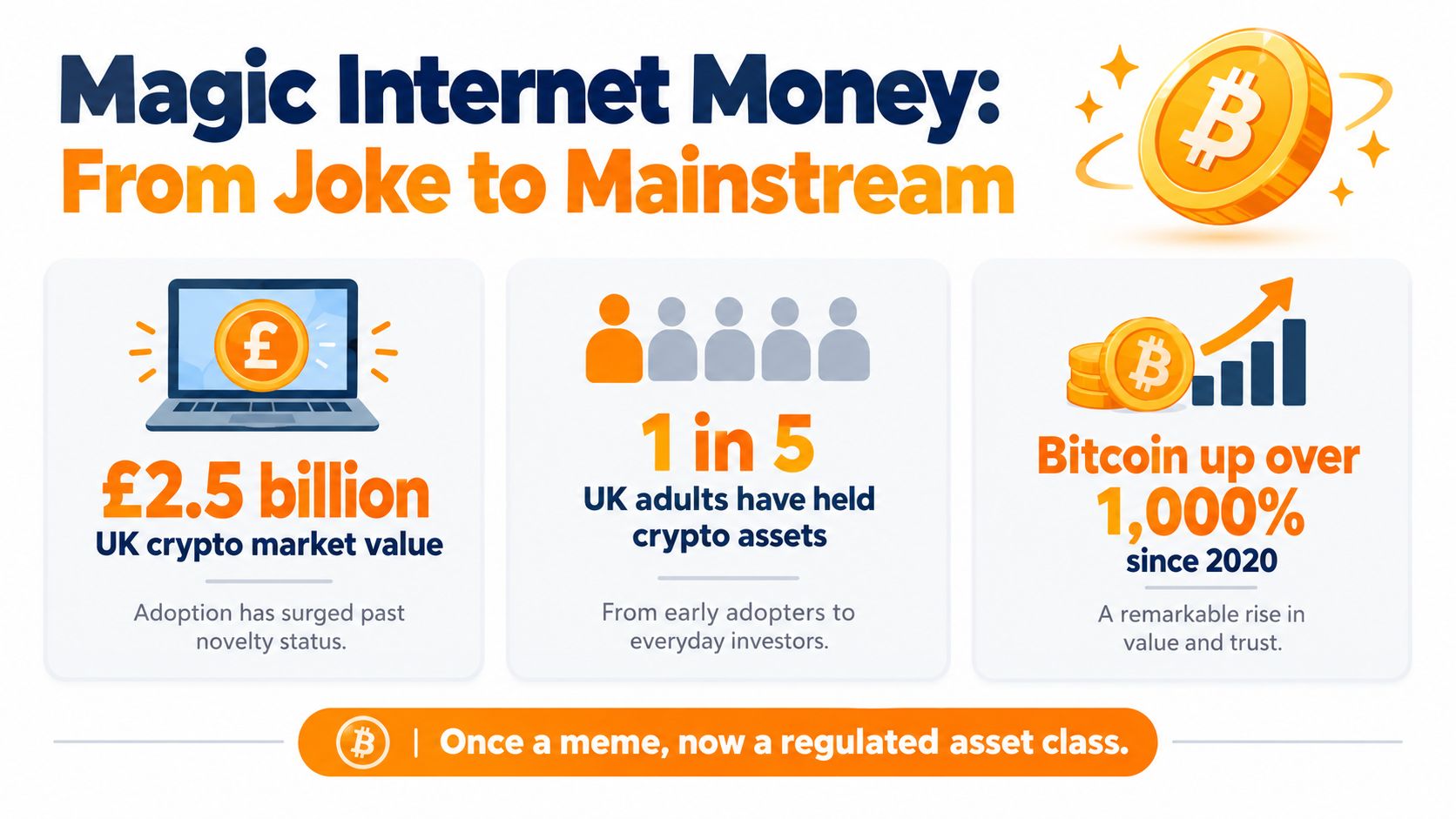
In August 2024, 12% of UK adults owned cryptoassets, equivalent to approximately 7 million people, according to the Financial Conduct Authority's consumer research. That figure changes the meaning of magic internet money. The phrase sounds like an online joke about imaginary coins, yet millions of people in Britain have interacted with digital assets through exchanges, wallets and blockchain networks.
The joke still captures something useful. Crypto can feel magical when money moves without a traditional bank, ownership depends on a cryptographic key and a public ledger replaces familiar paperwork. But the serious side matters more than the playful name. UK users must understand what a cryptoasset is, how a blockchain records ownership, what protection may be missing, how self-custody can fail and why tax rules still apply.
Defining Magic Internet Money and Its Mainstream Rise
“Magic internet money” is an informal name for cryptocurrency, particularly Bitcoin. The phrase captures the surprise of digital value moving online without a central bank issuing each payment or a commercial bank keeping the only official account record.
A bank account resembles a private notebook maintained by your bank. The bank records deposits, withdrawals and transfers, while its systems provide the account history. A public blockchain resembles a shared digital notebook instead. Many computers hold copies of the record, and software rules determine which new entries the network accepts.
The label covers different kinds of assets. Some are intended for payments, some provide access to software or decentralised applications, and others represent claims connected with a specific project. Bitcoin is the best-known example, but “crypto” describes a broad group of assets with different functions, risks and practical uses.
From online curiosity to UK financial topic
The FCA found that UK ownership increased from approximately 4.4% of adults in 2021 to 12% in 2024, rising from roughly 2.2 million people to about 7 million people, according to the FCA's 2024 consumer research. The figures do not show that crypto has become everyday money. They do show that digital assets reached far beyond a small group of programmers and early enthusiasts. The same research found that 93% of UK adults had heard of cryptoassets, so public awareness was much broader than ownership.
The FCA's 2024 findings distinguish awareness from ownership, an important distinction for beginners. Hearing about Bitcoin does not mean holding it, and holding a small amount does not mean using crypto for regular payments.
Ownership also varied considerably. The research reported an average holding of approximately £1,842 per owner, compared with £1,595 in earlier research. An average can hide large differences. A person with a modest balance and someone with a much larger portfolio may both be included, so the figure does not describe the typical beginner's position.
Useful distinction: Hearing about Bitcoin, owning a small amount and using crypto for regular payments are three different forms of involvement.
Traditional pounds operate within the UK's central banking and financial system. Bitcoin uses software rules and a distributed network to record transfers. That arrangement can offer a different way to hold and move value, while placing more responsibility on the user. A bank may have procedures for investigating an account error or attempting recovery. A blockchain transfer may not provide an equivalent route.
“Magic internet money” is therefore a memorable description, not a guarantee of usefulness or safety. It refers to digital value recorded by computer networks. Its practical value depends on the asset, the platform, the user's security practices and whether other people or businesses accept it. UK users must also treat the playful nickname separately from the serious questions of regulation, tax and personal responsibility.
How Blockchain and Consensus Mechanisms Actually Work
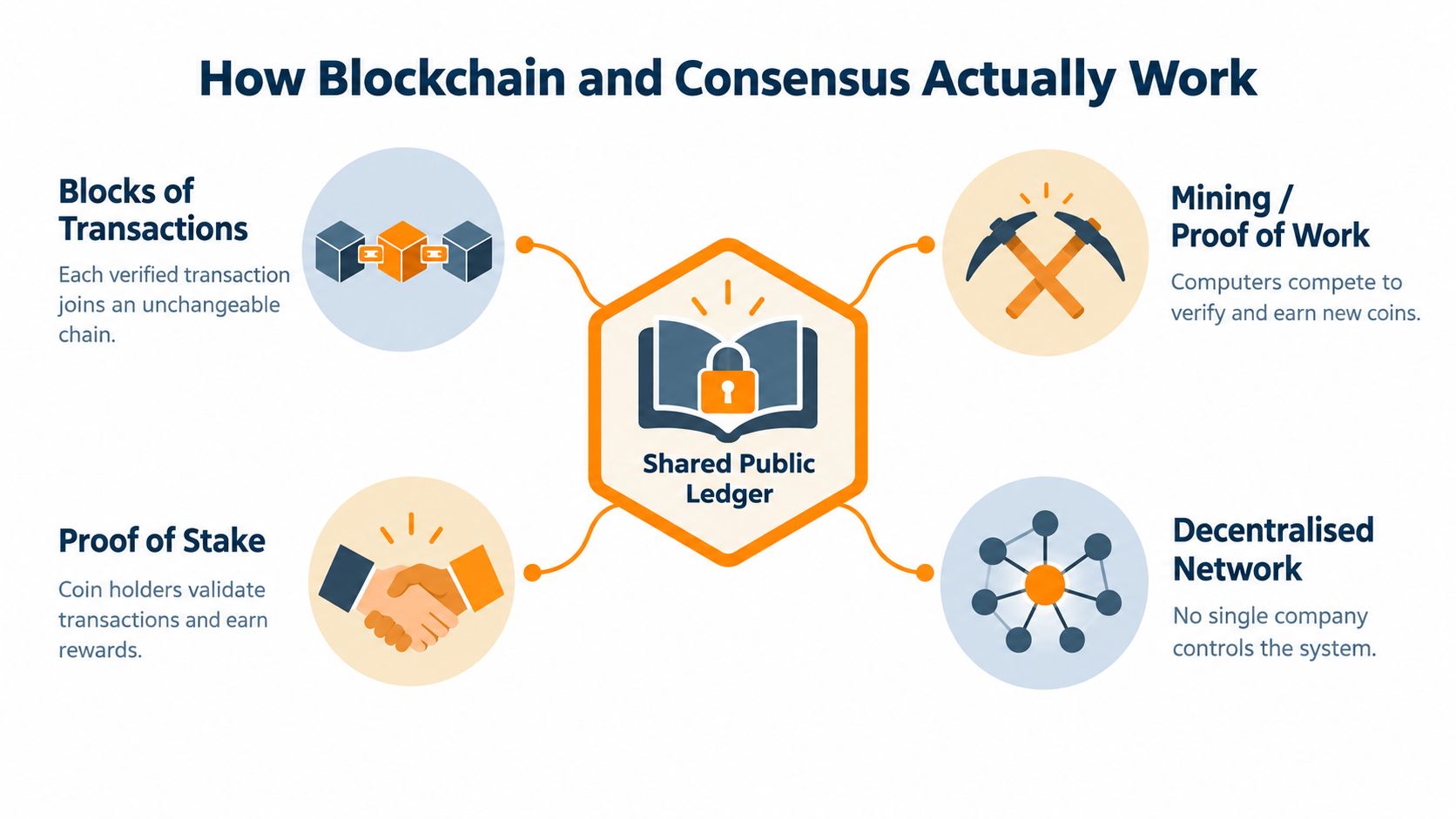
A blockchain is easiest to understand as a shared digital notebook. Each page contains a group of transactions. Once the network accepts that page, it links to the previous page using cryptographic information, creating a chain that makes unauthorised changes difficult to hide.
Suppose Alice sends Bitcoin to Ben. Her wallet uses a private key to create a digital signature, which proves that the person authorising the transfer controls the relevant funds. Network participants check the signature, confirm that Alice hasn't already spent those funds and then include the transaction in a new block.
Who decides which transactions count
A centralised database has one controlling organisation. A bank can approve entries, reverse them under its procedures or suspend an account. A decentralised blockchain distributes the record across participating computers, so the system needs a method for agreeing on the valid version of events.
That method is called a consensus mechanism. It doesn't create trust by making every participant personally trustworthy. Instead, it uses software rules, economic incentives and verification procedures so that the network can agree without relying on a single bank or administrator.
Bitcoin uses proof of work. Miners compete to perform computational work, and the winning participant can propose a block that other computers verify. Proof of stake uses a different approach. Participants commit assets to the network, and the protocol selects validators under its rules. Those mechanisms have different operational, environmental and security characteristics, so a label such as “blockchain” doesn't tell you everything about a project.
For a clearer comparison of the two major approaches, see this guide to proof of work and proof of stake consensus mechanisms.
Why the record is difficult to alter
Each block refers to earlier information, while many independent computers hold and check copies of the ledger. Changing an old transaction would therefore require overcoming the network's validation rules and dealing with the copies held elsewhere. That makes casual counterfeiting impractical, although it doesn't make every crypto project safe or every wallet secure.
The network also doesn't know you as a person. It recognises addresses and signatures. If you lose the key needed to sign transactions, the system cannot identify you through a passport and reset access. That technical feature becomes a practical responsibility, particularly for people who hold assets outside an exchange.
The key idea is straightforward: blockchain technology replaces one central record keeper with a shared process for recording and checking transactions. It can reduce dependence on a single intermediary, but it can't remove the need for sound software, reliable platforms and careful users.
The Economics of Digital Scarcity and Network Effects
A digital asset has no physical form, so its value can't come from holding a coin in your hand. Value comes from a combination of verifiable ownership, scarcity, utility, liquidity and social agreement. People may value an asset because they expect others to recognise it, use its network or buy it later.
Bitcoin illustrates the scarcity argument. Its software is designed around a predictable issuance schedule and a fixed maximum supply. That contrasts with ordinary fiat currency, where supply decisions sit within a monetary system involving central banks and commercial banks. Predictable scarcity doesn't guarantee a price, though. A scarce item can still lose demand.
Why more users can change the network
Network effects appear when a system becomes more useful as more people participate. A payment network with only one user has little practical value. A network with many wallets, exchanges, developers and potential recipients offers more opportunities for transfer and use.
This effect can strengthen an established asset, but it can also magnify disappointment. New participants may arrive because an asset is popular, while existing users may value it partly because new participants are arriving. If demand weakens, the same expectations can work in reverse.
Learn more about how network effects shape cryptocurrency success before treating popularity as proof of utility.
Price also reflects market structure. Crypto markets trade across platforms, and available liquidity can vary. A large order in a thin market may move the price more than a similar order in a deeper market. News, interest-rate expectations, regulation, technical failures and changes in investor confidence can all influence demand.
Scarcity isn't the same as stability
A fixed supply can support a long-term investment argument, but it doesn't make Bitcoin a stable pound substitute. Someone who needs money for rent or a near-term bill can't assume that a volatile asset will preserve its value at the moment they need to sell.
Some traders try to profit from falling prices through short positions, but that strategy introduces its own risks, including borrowing costs, liquidation and losses that can grow quickly. Beginners who want to understand the mechanics should start with trading education on shorting Bitcoin rather than treating a falling market as an easy opportunity.
The practical conclusion is modest. Digital scarcity may explain why an asset can be valuable, and network effects may explain why adoption matters, but neither removes uncertainty. A useful network is not automatically a safe investment, and a scarce asset is not automatically everyday money.
Navigating UK Crypto Regulation and Consumer Risks
A familiar app can make crypto feel as safe as online banking. The interface may show balances, buttons and transaction histories, but buying Bitcoin through it does not give Bitcoin the same protection as a bank deposit or regulated investment.
The FCA states that many tokens, including Bitcoin, aren't currently regulated in the UK. Its consumer research found that 49% of people who hadn't bought cryptoassets expected no protection or recourse if something went wrong. This finding is documented in the FCA's 2025 consumer research.
The platform and the token are different
A crypto business may have obligations concerning its activities, registration or anti-money-laundering controls. Those obligations do not make every token it lists a regulated financial product. Before buying, separate three questions:
- Who operates the platform? An exchange manages the interface, account access and often the custody arrangement.
- What asset are you buying? The token itself may remain outside the FCA's regulatory remit.
- What happens after a problem? Complaints, insolvency, fraud and mistaken transfers may not follow the same resolution route as an ordinary banking dispute.
A regulated-looking platform therefore does not guarantee that the underlying asset is protected. The business and the token are separate parts of the transaction.
Scams and exchange dependence
Crypto scams can involve fake investment websites, impersonation, urgent messages and promises of guaranteed returns. A scammer might tell someone to buy through a genuine exchange, then persuade them to send the assets to a wallet controlled by the scammer. The exchange may not be able to reverse that transfer.
The FCA has found that centralised exchanges are the dominant route into crypto for UK consumers. Platform reliability, account security and withdrawal procedures therefore matter in practical terms. They affect whether users can access funds, move them safely and respond to suspicious activity.
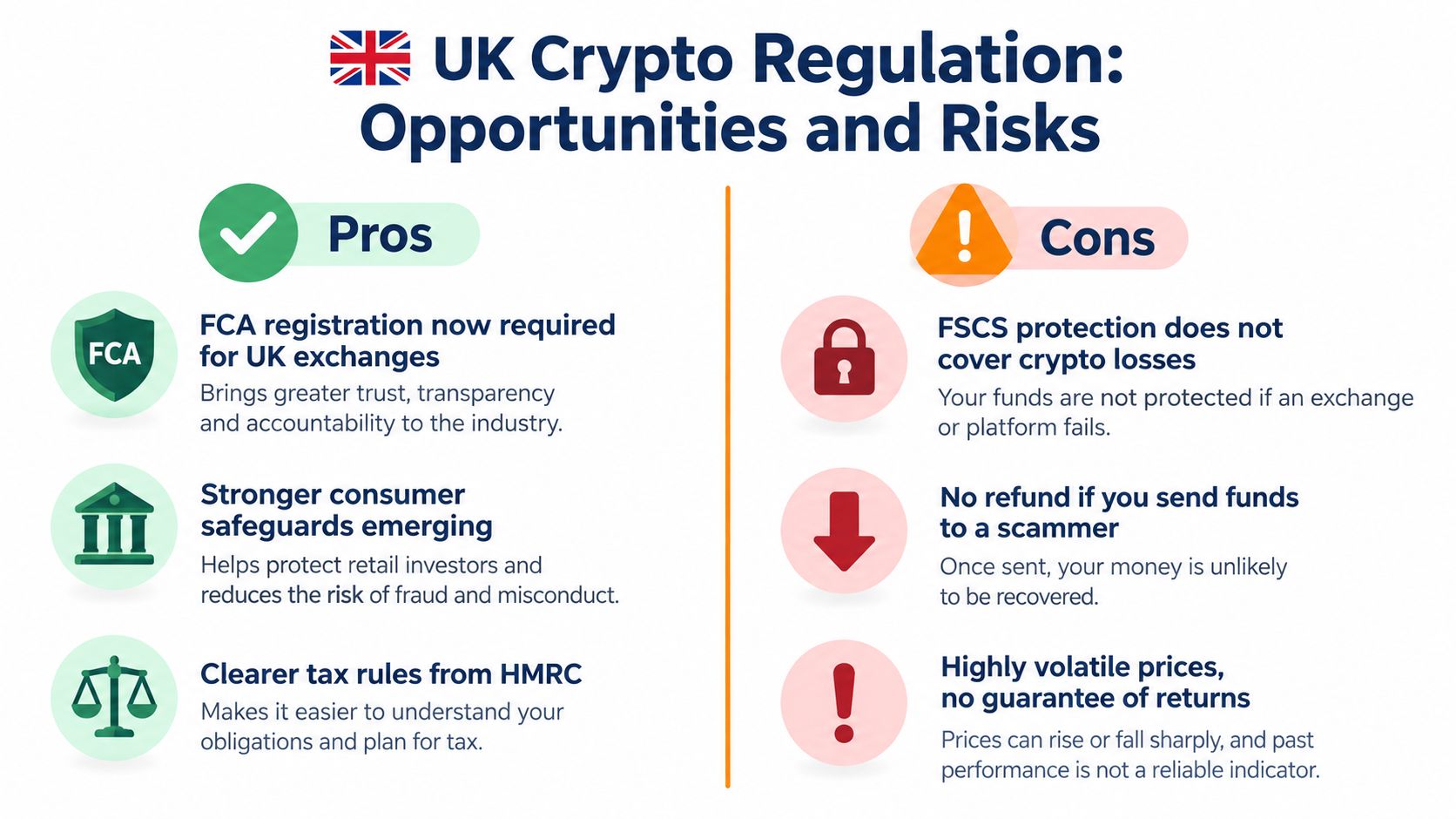
Before sending money, verify the provider's identity through official UK sources. Ignore unsolicited investment approaches, and treat guaranteed returns as a warning sign. A familiar logo or polished mobile application is not a substitute for independent checks.
Practical rule: Regulation of a business doesn't remove the market, custody or fraud risks attached to the asset you buy.
UK rules may become clearer over time, but beginners should rely on protections available today rather than assumptions about future regulation. Read the platform's custody terms, understand its withdrawal controls and keep only an amount you can afford to lose.
Mastering Self-Custody and Protecting Your Digital Wealth
Self-custody means holding the keys that authorise transactions yourself rather than leaving the assets under an exchange's control. An exchange account gives you a login and may show a balance, but the platform may hold the underlying keys. A personal wallet gives you control of the signing credentials, along with the responsibility to protect them.
The difference is similar to using a storage company versus keeping valuables in your own safe. The storage company may provide convenience and support, while self-storage gives you direct control but makes you responsible for access, backups and mistakes.
What a private key actually does
A private key is a secret cryptographic value used to sign a transaction. A recovery phrase is a human-readable backup that can recreate wallet access. Anyone who obtains it may be able to control the assets, while anyone who loses it may lose access.
The FCA reported that 9% of UK cryptoasset holders had forgotten a private key and consequently lost wallet access, according to its crypto market description. The finding illustrates why a blockchain doesn't provide a normal “forgot password” process. The network can verify a valid signature, but it can't decide that you are the rightful owner because you answer security questions.
For a deeper explanation, read this guide to self-custody wallets and their importance.
A sensible security arrangement
Use a security plan that separates convenience from long-term protection:
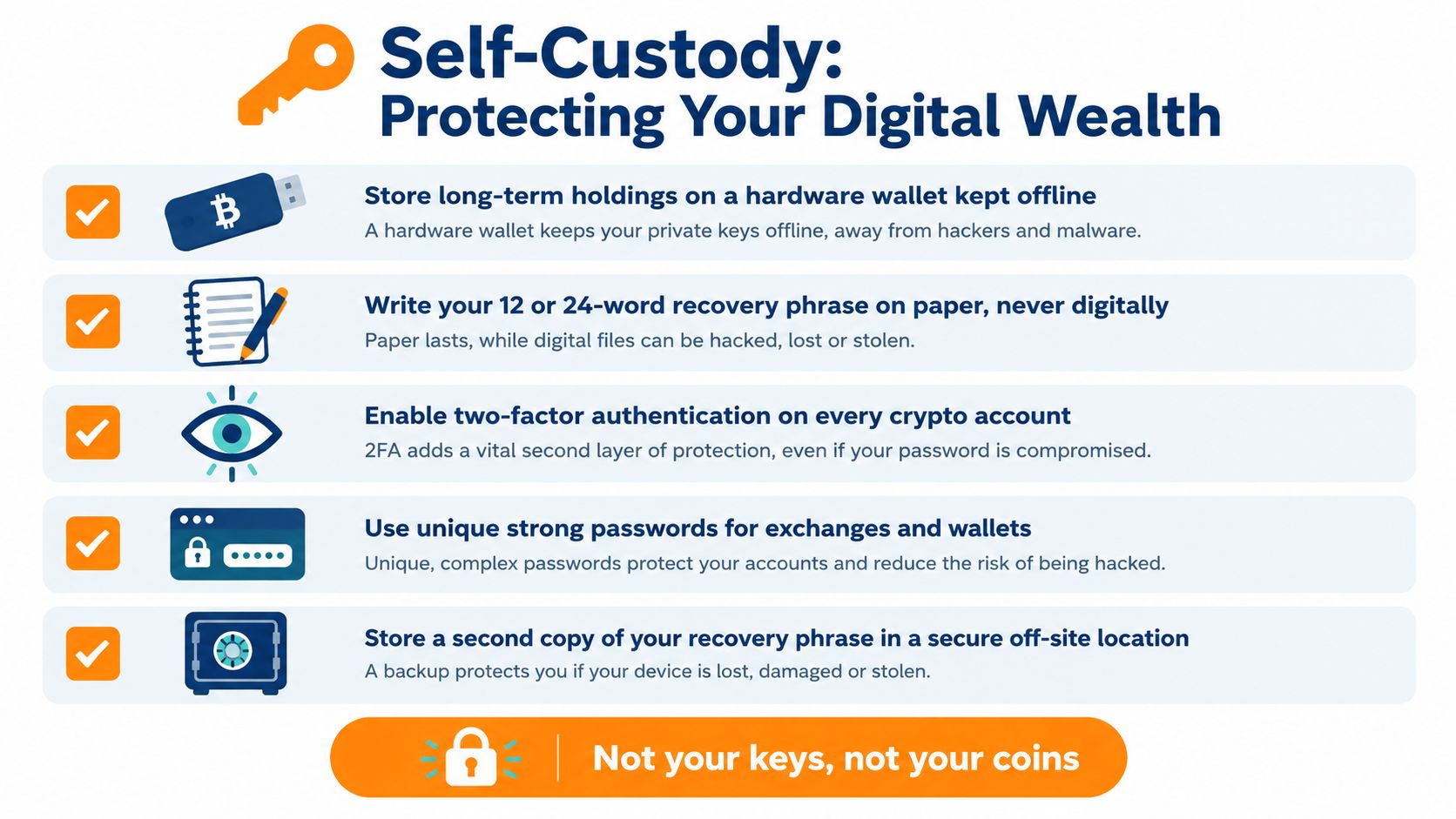
- Choose hardware storage for substantial long-term holdings. Keep the device offline when you aren't signing a transaction.
- Write the recovery phrase on paper or another durable offline material. Never photograph it or store it in ordinary cloud notes.
- Keep separate daily and long-term funds. A wallet used for frequent activity shouldn't contain everything you own.
- Protect exchange accounts with unique passwords and two-factor authentication. This reduces the chance that a stolen password alone grants access.
- Create a recovery plan. Decide how you would access the wallet after device failure, and consider a secure second copy stored separately.
Test a small transfer before moving a larger balance. Check the receiving address carefully, confirm the network and avoid typing recovery words into websites. No support agent should ask for your recovery phrase.
Self-custody isn't automatically superior for every beginner. Some people may prefer the operational support of a reputable platform, while others may accept the learning curve of a personal wallet. The important point is that convenience and control involve different responsibilities.
Understanding UK Tax Obligations for Digital Assets
Crypto taxation becomes difficult when people treat a digital token like cash in a wallet. UK tax treatment depends on what happened, how the asset was acquired, how it was disposed of and the user's wider circumstances. Buying an asset and holding it isn't the same event as selling it, exchanging it or using it to pay for something.
A disposal can include selling crypto for pounds, swapping one token for another or spending a token. The fact that no pounds reached your bank account doesn't necessarily mean nothing happened for tax purposes. You need records that connect each disposal to the relevant acquisition cost and date.
Stablecoins aren't automatically tax-free
A stablecoin aims to stay close to a reference value, such as the pound or dollar. That design goal doesn't give it a special tax status. UK tax law currently has no specific definition or separate tax regime for stablecoins, so a disposal can have tax consequences even when the token appears designed to remain near a fixed value. The position is set out in the government's stablecoin taxation consultation material.
That matters in ordinary situations. Swapping one cryptoasset for a stablecoin, converting a stablecoin into pounds or using it in a transaction may require careful consideration. A small movement in value can still matter when you calculate the relevant gain or loss.
Build records while the activity is simple
Keep transaction histories from exchanges, wallet addresses, dates, asset quantities, fees and the sterling value used for your calculations. Don't wait until a tax return deadline to reconstruct years of activity from scattered accounts.
A basic record should answer:
- What happened? Purchase, sale, swap, gift, transfer or payment.
- When did it happen? Use the transaction date and retain the platform record.
- What did it cost? Include the relevant acquisition details and allowable fees where appropriate.
- Where did the asset go? Note the exchange, wallet or recipient.
The government has proposed a future framework for eligible stablecoins. The proposal includes possible Capital Gains Tax exemption for qualifying disposals by individuals and trustees, with interest-like returns treated as savings income. The proposed measures would apply from 6 April 2027 for individuals and trustees and 1 April 2027 for companies, but those are proposed future rules, not the basis for current decisions.
Tax treatment can depend on personal facts, transaction patterns and the latest HMRC guidance. Keep evidence, avoid assuming that “stable” means “tax-free” and consult a qualified UK tax adviser when your activity is complex.
Actionable Next Steps and Continuous Learning Resources
A sensible first move isn't buying a token. It's deciding what you want to understand. Someone interested in Bitcoin as a long-term asset needs different knowledge from someone exploring payments, decentralised applications or trading.
Start with the mechanics. Learn the difference between an exchange account and a personal wallet, identify what a private key does and practise checking a transaction without risking a meaningful amount. A small test transfer can teach you how addresses, network selection and confirmations work, but it shouldn't become an excuse to trade impulsively.
A practical learning route
Use this order to build confidence:
- Define the purpose. Write down whether you're studying Bitcoin, digital payments, blockchain development or investment risk. A clear purpose helps you reject irrelevant hype.
- Check the source. Prefer documentation, regulator information and education that explains both benefits and failure modes. Marketing that promises certainty isn't education.
- Learn custody before buying. Decide whether an exchange or personal wallet fits your current skills, then understand the recovery process before transferring funds.
- Record every transaction. Save confirmations and platform statements from the first activity. Good records are easier to maintain than rebuild.
- Review projects critically. Ask what the network does, who controls upgrades, how users access it and what could cause the system to fail.
The Coin Course can sit alongside official FCA and government material as an educational resource. Its guides cover blockchain fundamentals, wallets, cryptocurrencies, decentralised finance, trading and security, so a newcomer can study one topic at a time rather than trying to absorb the whole sector at once.
Don't confuse continuous learning with constant trading. A disciplined learner can follow technical developments, practise wallet security and review tax records without making a new transaction every time the market moves. The objective is informed participation, not a race to collect every new token.
The phrase magic internet money is useful because it invites curiosity. The underlying truth is more grounded: software records ownership, networks validate transactions, markets set uncertain prices and users carry responsibilities that traditional financial systems often handle for them.
The Coin Course offers structured guides on blockchain, Bitcoin, wallets, security, trading and decentralised finance, helping you build the practical knowledge behind magic internet money. Visit The Coin Course to learn the fundamentals step by step and develop safer habits before you commit meaningful funds.