
If you're looking to learn cryptocurrency trading, the first thing to get your head around is that it's all about buying and selling digital currencies to make a profit from their changing prices. For anyone starting out in the UK, the most vital first step is knowing the difference between actively trading for quick profits and investing for long-term growth. They are two completely different ways to approach the market.
Getting Started Without Getting Overwhelmed
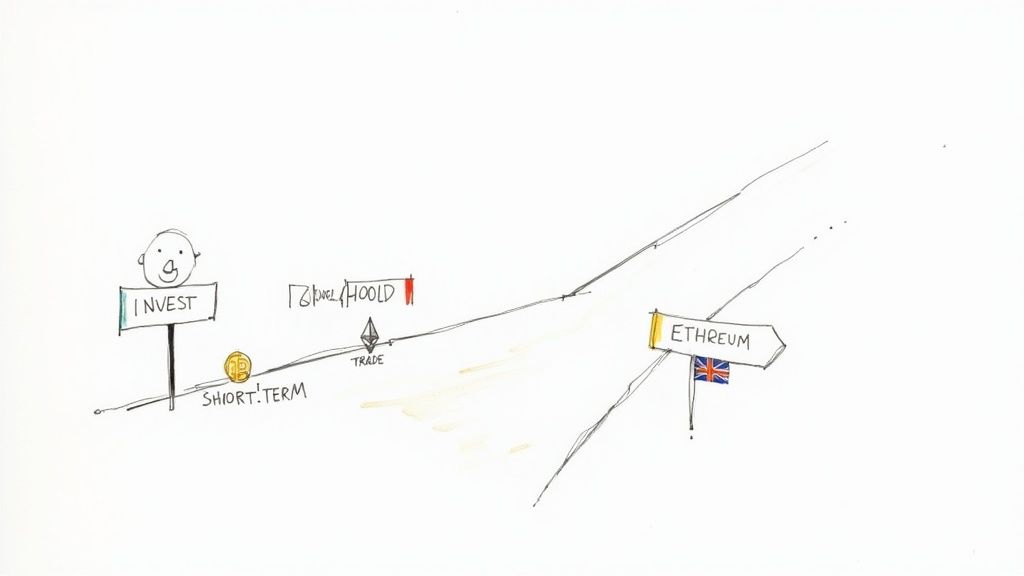
Jumping into the world of crypto for the first time can feel like learning a new language. You're hit with a whirlwind of terms like 'blockchain', 'altcoins', and 'DeFi', and it's easy to feel lost before you’ve even made a single trade.
But let's keep it simple. At its heart, crypto trading is just about guessing which way prices will move. For instance, you might buy Bitcoin today because you think its value will go up by the end of the week. Or you might sell your Solana because you have a hunch a price dip is on the horizon. This focus on short-term price moves is what makes it different from investing.
Trading Versus Investing
I find a simple property analogy helps. Imagine a property developer versus a homeowner. The developer snaps up a house to fix it up and sell it for a quick profit—that's trading. The homeowner, on the other hand, buys a house to live in for many years, hoping its value grows steadily over time—that's investing.
This is exactly how it works in crypto. An investor might buy a coin like Cardano and hold it for several years (a strategy famously called 'HODLing'), because they believe in the long-term vision of the project. A trader, however, is glued to their screen, watching price charts and reading market news, aiming to make lots of smaller profits from the daily ups and downs.
"The key distinction is your timeframe. A trader looks at today's chart and asks, 'Where is the price going next?' An investor looks at the technology and asks, 'Where will this project be in five years?' Understanding which one you are is the first step to success."
Crypto Trading vs Investing At a Glance
Here's a straightforward table to help you see the two main styles of tackling the crypto market.
| Aspect | Trading (Short-term) | Investing (Long-term) |
|---|---|---|
| Goal | Quick, frequent profits from market volatility. | Building wealth over a longer period. |
| Timeframe | Minutes, hours, days, or weeks. | Months, years, or even decades. |
| Analysis | Mainly uses technical analysis (charts, patterns). | Mainly uses fundamental analysis (project, team, tech). |
| Risk | Higher, due to sudden price swings and leverage. | Lower day-to-day risk, but still significant. |
| Activity Level | High. You need to keep a close eye on the market. | Low. Often a "buy and hold" or "set and forget" approach. |
Neither way is better than the other; they just fit different goals, personalities, and how much risk you're comfortable with.
The UK Crypto Scene
For those of us in the UK, it’s a genuinely exciting time to get involved. The local market isn't just getting bigger; it's becoming more established. We have this unique mix of deep financial knowledge from the City of London and a buzzing tech scene, which makes for a really dynamic environment for digital money.
The numbers tell the same story. The UK's crypto market revenue, starting from US$334.3 million in 2024, is set to grow in a big way. Predictions show it could reach US$619.0 million by 2030, thanks to a compound annual growth rate of 11.1% from 2025. This isn't just a small-time market anymore; it's becoming a serious slice of the UK’s financial world. You can check out the data for yourself and explore the potential growth on Grandview Research.
Think of this guide as your starting map. We're here to cut through the confusing terms and give you a strong foundation, so you feel ready and confident for the practical steps to come.
Choosing Your Platform and Securing Your Crypto
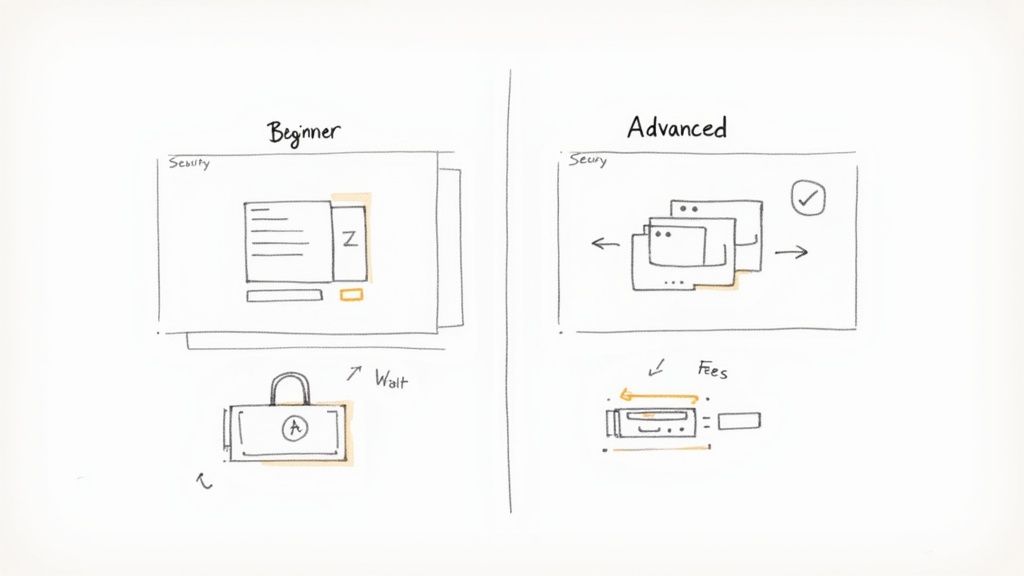
Okay, you now understand the difference between trading and investing. It's time to get hands-on. This is where you choose your trading playground and, just as crucially, build a fortress to protect your funds.
Picking the right platform and figuring out how to keep your crypto safe are easily the most important first moves you'll make. Get these right, and you're off to a brilliant start.
Your first big decision is which cryptocurrency exchange to use. Think of it simply as a digital marketplace where you can buy, sell, and swap currencies like Bitcoin and Ethereum. For anyone in the UK, the things that really matter are how easy it is to use, what the fees are, and, of course, how secure it is.
For example, a platform like Coinbase is incredibly popular with newcomers, and it's easy to see why. Its clean layout and straightforward process for linking a UK bank account make buying your first crypto feel as normal as ordering something from Amazon. Then you have exchanges like Kraken, which provides more advanced trading tools and a bigger variety of coins—something you might graduate to as you become more experienced.
Centralised vs Decentralised Exchanges
You’ll soon discover two main kinds of exchanges: Centralised (CEX) and Decentralised (DEX). A CEX, like the Coinbase or Kraken we just talked about, is run by a company. They look after your funds and make the trades happen. A DEX, such as Uniswap, works without a central company, allowing people to trade directly from their own wallets.
It’s interesting to see how the UK crypto scene has changed lately. Since late 2023, more everyday traders have started moving towards DEXs. This suggests UK traders are getting used to new rules and finding different ways to trade than the big financial firms, which still tend to prefer CEXs. If you’re curious about these market shifts, you can discover more insights about European crypto adoption on chainalysis.com.
To get started, signing up to a well-known CEX is almost always the simplest option. The steps are pretty standard:
- Sign up using your email and choose a strong, unique password.
- Verify your identity with a form of ID like a passport or driving licence (this is a standard security check called 'Know Your Customer' or KYC).
- Turn on two-factor authentication (2FA). Don't skip this—it adds a vital layer of security to your account.
This screenshot from Coinbase shows how good platforms often give you resources to help you through these early steps.
As you can see, the platform lays out its learning guides clearly, helping to explain tricky topics and build your confidence before you even put any money in.
The Golden Rule: Your Keys, Your Crypto
Once you've bought crypto on an exchange, you face the most important security decision of all: where to actually store it. Leaving a lot of crypto on an exchange is a bit like leaving a pile of cash with someone you just met; you're trusting them completely to look after it. The best habit is to move your main holdings to a personal wallet that you control.
The saying you'll hear time and again in crypto is "Not your keys, not your crypto." It simply means that if you don't personally control the private keys to your wallet, you don't truly own your digital assets.
This brings us to the two main types of wallets you should know about.
Hot Wallets vs Cold Wallets
Here’s a simple comparison. Think of a hot wallet like the wallet you carry in your pocket—it’s handy for daily spending, but you wouldn't keep your life savings in there. A cold wallet is more like a high-security safe at home—less convenient for quick access, but far, far safer for storing your valuable assets.
| Wallet Type | Description | Best For | Examples |
|---|---|---|---|
| Hot Wallet | Software that's always connected to the internet. | Small amounts for active trading and quick payments. | MetaMask, Trust Wallet |
| Cold Wallet | A physical device that stores your crypto offline. | Large amounts, long-term holdings, maximum security. | Ledger, Trezor |
A hot wallet like MetaMask often works as a browser extension or a mobile app. It's great for using DeFi platforms or keeping a small amount of crypto ready for trading.
A cold wallet, on the other hand, like a Ledger or Trezor, is a small gadget that keeps your secret keys completely offline. To send money, you have to physically press buttons on the device itself, making it almost impossible for online hackers to steal your funds. They do have a price tag (usually £50-£150), but they are absolutely the best way to secure any serious amount of crypto. Weak security is one of the biggest dangers traders face; for a closer look at this, you might find our guide on how to improve your exchange security and protect your assets useful.
The smartest approach is to use a combination of both. Use a CEX for buying crypto and maybe a hot wallet for small, active amounts you're trading with. But always, always move your main long-term investments into the safety of a cold wallet. This balanced method gives you both convenience for trading and peace of mind for your core funds.
How to Make Your First Trade
Alright, you’ve picked your platform and set up your wallet. Now for the exciting part: learning how to actually buy and sell. The trading screen can look a bit intense at first, but once you understand the basic commands, you'll see it's more straightforward than it appears.
Let's walk through a real-life situation to make this clear. Imagine you have £100 ready in your exchange account and you’ve decided to buy some Ethereum (ETH). You log in, navigate to the ETH trading page, and see its price is around £2,000 per coin. You’re ready to go, but you see a few options: market, limit, and stop-loss.
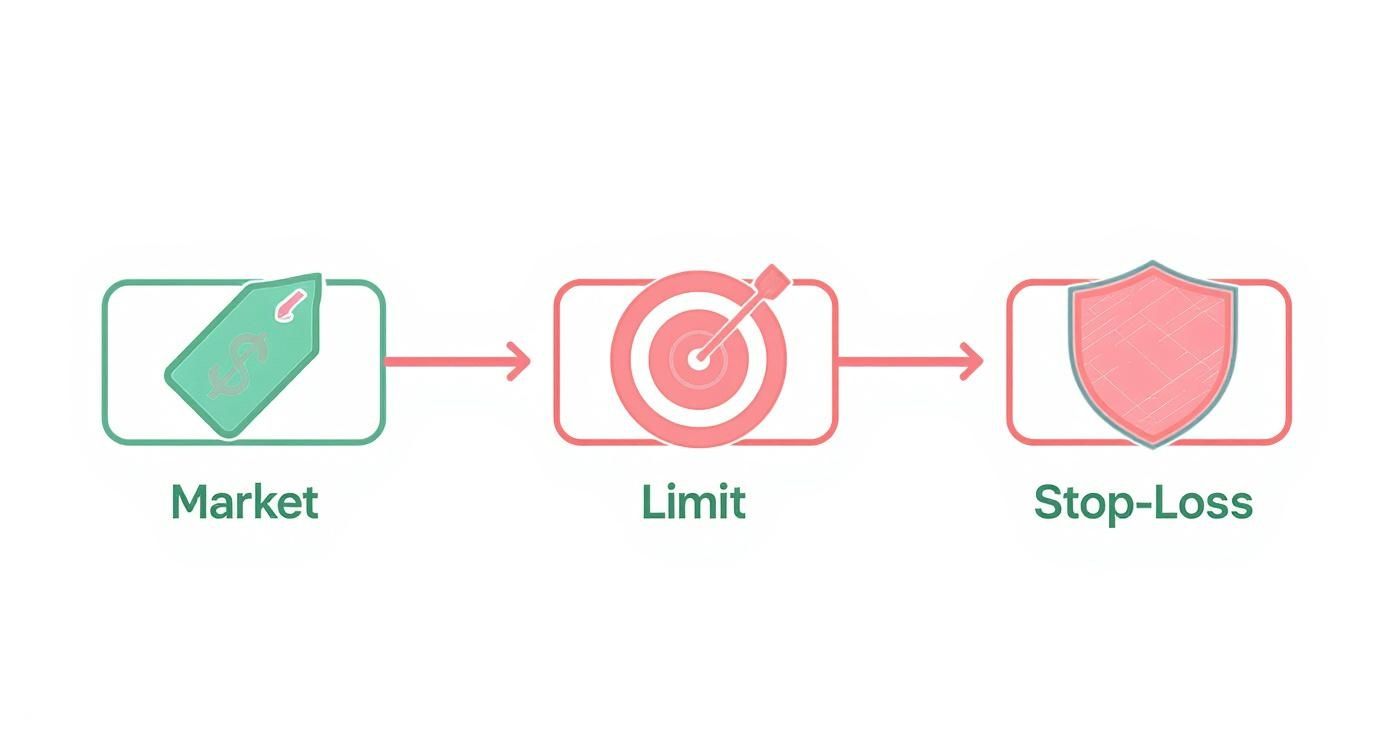
These are your main trading commands, known as order types. Understanding these three isn't just a good idea—it's absolutely essential if you want to trade well and protect your money.
Understanding Your Main Order Types
Think of order types as specific instructions you give to the exchange. Are you saying, "Buy it for me right now, whatever the price is"? Or are you saying, "I'm only interested if I can get it at this specific price"? Each one serves a different purpose.
The three you must know as a beginner are:
- Market Order: This is the 'buy it now' button. It's the quickest way to complete your trade at the best price available at that exact moment.
- Limit Order: This gives you more control. You set the exact price you want to buy or sell at, and the trade only happens if the market reaches your price.
- Stop-Loss Order: This is your safety net. It's an order to automatically sell your crypto if the price drops to a certain point, helping you limit your losses before they get too big.
Let's break down how you'd use each one to buy that £100 worth of Ethereum.
Executing Your First Purchase
When you're on the trading screen, you'll see a simple interface, usually with 'Buy' and 'Sell' boxes. This is where you'll choose your order type and tell the system how much you want to trade.
Using a Market Order for Speed
A market order is all about getting the deal done quickly. If you just want to get into the market right away, you'd select 'Market', enter £100, and click 'Buy ETH'. The exchange would instantly buy £100 worth of Ethereum for you at the current going rate (around £2,000). In a flash, you'd own about 0.05 ETH.
This is perfect when speed is your priority, but you give up a little control over the final price. The price you pay might be a tiny bit different from the one you saw a second before you clicked.
Using a Limit Order for Precision
But what if you see that £2,000 price and think it's a bit high? Maybe you suspect it'll dip a little before climbing again. This is the perfect scenario for a limit order.
You could place a limit buy order for £1,950. This tells the exchange, "I only want to buy £100 of ETH if the price falls to £1,950 or lower." Your instruction then sits in the order book, waiting. If the price of ETH does drop to your target, your order is filled automatically. If it never goes that low, your order just waits, and your £100 stays safe in your account. This is how traders try to get a better entry price.
A limit order is an exercise in patience and strategy. It's the difference between buying at the sticker price and waiting for the sale. It empowers you to trade on your terms, not just the market's.
Setting Up Your Safety Net
Once you've bought your crypto, the next move is arguably the most important: protecting your purchase. This is where a stop-loss order becomes your best friend. It’s a pre-set instruction to sell your asset if it drops to a price you're not comfortable with, stopping a small loss from turning into a disaster.
For example, after buying your ETH at £2,000, you might decide you're only willing to risk 10% of your money on this trade. So, you would set a stop-loss order at £1,800. If the market suddenly takes a downturn and ETH drops to that level, your 0.05 ETH is sold automatically. You'd get about £90 back, limiting your loss to just £10.
Without a stop-loss, a sudden market crash could wipe out a huge chunk of your £100 before you even have time to react. It’s the single most important risk management tool you have, taking the emotion out of the difficult decision to sell.
A Simple Guide to Reading Crypto Charts
Looking at your first crypto chart can feel like trying to decode a secret message. It's a mix of colours, lines, and seemingly random spikes. But once you get the hang of it, you’ll see that those charts tell a story about how traders are feeling and where a coin’s price might go next. It’s a vital skill for anyone who is serious about trading.
The most common chart you'll see is the candlestick chart. Each "candle" is just a simple visual summary of what happened to the price over a set time—whether it’s one minute, one hour, or a full day.
- A green candle shows you the price finished higher than it started. This suggests that buyers were in control during that period.
- A red candle means the opposite; the price closed lower than it opened, showing that sellers were winning the battle.
Every candle has a thick part (the 'body') and two thin lines (the 'wicks'). The body shows the opening and closing prices, while the wicks show the very highest and lowest prices the asset reached in that time. Learning to read these candles is your first step to understanding the market's mood.
Here’s what a typical Bitcoin candlestick chart from TradingView looks like.
You can see how the green and red candles group together, creating patterns. Skilled traders rely on these patterns to help them decide when to buy or sell.
Finding Your Floors and Ceilings
Two of the most basic ideas in chart reading are support and resistance. You can think of them as invisible barriers that the price seems to struggle to break through.
Support is like a price floor. It’s a level where a falling price often stops, turns around, and starts to climb again. This happens because buyers see it as a good deal and start buying. For example, if a coin keeps dropping to around £25 but rarely goes any lower, that £25 level is acting as strong support.
Resistance is the ceiling. It's a price point where a rising coin often loses momentum and reverses. Sellers start to take their profits, putting downward pressure on the price. If that same coin struggles to get past £35 every time it rallies, then £35 is its resistance level.
Identifying support and resistance levels is like creating a map for your trading journey. It helps you pinpoint logical places to buy (near support) and consider taking profits (near resistance), bringing a sense of order to the market's chaos.
Introducing Your First Technical Tools
Besides just looking at the candles, traders use technical indicators to get more information. These are simply tools that use maths on price data to show trends, momentum, and possible turning points. Let's start with two of the most popular and easy-to-use ones.
The Moving Average: Your Trend Spotter
One of the simplest and most useful tools is the Moving Average (MA). Its job is to smooth out the bumpy day-to-day price action so you can see the main trend more clearly. A 50-day moving average, for example, just shows the average closing price over the last 50 days as a single, smooth line on your chart.
- When the price is consistently staying above its moving average, it's generally a sign of an uptrend.
- When the price is consistently below the moving average, it often points to a downtrend.
Many traders also look for when a short-term MA (like the 50-day) crosses above a long-term MA (like the 200-day). This is famously called a "golden cross" and is often seen as a very strong signal that prices might be about to rise significantly.
The Relative Strength Index: Your Momentum Gauge
Next up is the Relative Strength Index (RSI). This is a momentum tool that measures how fast and how much an asset's price has changed. It's shown as a line that moves between 0 and 100.
The RSI is fantastic for spotting when an asset might be overbought or oversold.
- Overbought: An RSI reading above 70 suggests the asset has been bought up very quickly and might be due for a price drop.
- Oversold: An RSI reading below 30 suggests the asset has been sold off heavily and could be ready for a price bounce.
Let's say Bitcoin’s price has been shooting up for a week, and you see its RSI has climbed to 80. That’s a potential warning sign. It could be telling you that the rally is running out of steam and now might not be the best time to buy. On the other hand, if a market panic sends the RSI crashing down to 25, it could signal a great buying opportunity for those who think the sell-off was an overreaction.
Getting good at chart analysis takes practice; there's no shortcut. But by starting with these key building blocks—candlesticks, support and resistance, MAs, and the RSI—you’re building a fantastic foundation.
If you're ready to go a little deeper, our full guide on reading cryptocurrency charts and indicators is packed with more examples and techniques to sharpen your skills.
Smart Risk Management for Beginner Traders
Trying to guess which crypto will be the next big winner is exciting, but it’s only one part of the trading game. The real secret to staying in the market long-term is learning how to protect the money you already have. This is honestly the most important lesson for anyone just starting out.
Without a solid plan for managing your risk, one bad trade can easily wipe out all your previous wins. The good news? The best risk management tricks are surprisingly simple to understand and use from your very first trade.
The Game-Changing 1% Rule
One of the most powerful habits you can develop is the 1% rule. The idea is brilliantly simple: never risk more than 1% of your total trading money on any single trade. It's a core principle that acts as a safety barrier for your entire account.
Let's say you have a £1,000 trading account. Using the 1% rule, the absolute most you should be prepared to lose on one trade is just £10. This doesn't mean you can only trade with £10; it means you must set your stop-loss order so that if the trade goes against you, your loss is capped at that £10 mark.
Following this single rule builds discipline and protects you from the huge damage a single bad decision can cause. It keeps you in the game, helping you get through the losing streaks that every single trader, from beginner to pro, will definitely face.
Taming the Emotional Dragons: FOMO and FUD
The crypto market is driven by emotion, and two of the most dangerous feelings are FOMO and FUD. Learning to control these is a huge step towards making smart, logical decisions instead of emotional, knee-jerk reactions.
- FOMO (Fear Of Missing Out): We’ve all felt this. It’s that panicky feeling when a coin’s price is soaring, and you jump in without thinking, terrified of missing the profits. More often than not, this leads to buying near the top, right before the price falls.
- FUD (Fear, Uncertainty, and Doubt): This is the wave of negativity, often started by rumours or bad news, that scares traders into panic-selling their coins, usually for a big loss. FUD can convince you to ditch a perfectly good trading strategy.
The best weapon against both is a pre-made trading plan. When you know your entry price, profit goal, and stop-loss level before you even make a trade, you have a logical system to rely on. Your plan becomes your shield against making impulsive moves.
"A trading plan is your objective guide in a sea of emotional chaos. It's the difference between gambling on price movements and making calculated business decisions. Stick to the plan, and you remove your biggest enemy from the equation: yourself."
Having a plan is especially important in a highly active market like the UK's. The United Kingdom has quickly become a global centre for crypto, with forecasts suggesting that nearly 35% of the population will have used digital assets by 2025. With the average holding value rising to over $2,286 per user, the financial stakes are higher than ever, making disciplined risk management an absolute must. You can read the full research about the UK's crypto growth on beerconnoisseur.com.
Building a Simple Trading Plan
Don't worry, your trading plan doesn't need to be a massive document. As a beginner, it can be a simple checklist you look at before every single trade. The aim is to turn trading into a methodical process, not just a series of guesses.
Here are the key parts of your plan:
- Entry Signal: What specific thing on the chart tells you it's time to buy? For example, "I will buy if the price bounces off the 50-day moving average and a green candle forms."
- Position Size: How much money are you putting in? This should be worked out based on your 1% rule and how far away your stop-loss is.
- Take-Profit Target: At what price will you sell to lock in your profits? A good strategy is to aim for a profit that is at least twice as big as your potential loss (a 2:1 risk/reward ratio).
- Stop-Loss Level: Where will you put your stop-loss to cut your losses? This is your absolute exit plan if the trade doesn't work out.
Defining these four points before you click "buy" creates a structured way of trading. It protects your money and gives you the confidence to handle the market's famous price swings.
For a deeper dive, check out our comprehensive guide on risk management in cryptocurrency trading.
Common Questions on UK Crypto Trading
It's completely normal to have a few questions buzzing around as you start your journey into cryptocurrency trading. Let's answer some of the most common ones I hear from beginners in the UK, so you can move forward with more confidence.
How Much Money Do I Really Need to Start?
Honestly, you can start with less than the price of a pizza. Most of the major UK-friendly exchanges like Coinbase or Kraken let you deposit as little as £10 or £20.
The aim when you begin isn't to get rich overnight. It's about learning how everything works in a real-world setting.
Think of your first £50 as your tuition fee, not an investment. This mindset allows you to practise making trades, setting a stop-loss, and moving crypto to a wallet without the stress of risking a lot of money. Once you feel comfortable, you can then decide if you want to add more.
Is Crypto Trading Taxable in the UK?
Yes, absolutely. HMRC treats crypto as an asset, like shares or a house, which means any profits you make could be subject to Capital Gains Tax (CGT).
A taxable "event" occurs whenever you get rid of your crypto. This isn't just selling it for pounds; it also includes:
- Selling your crypto for pounds (GBP)
- Swapping one cryptocurrency for another (e.g., trading Bitcoin for Ethereum)
- Using crypto to buy things or pay for services
If your total profits from all your assets (not just crypto) are more than the annual tax-free allowance, you'll probably have to pay tax on the rest. This makes keeping detailed records totally essential. For every single transaction, you need to write down the date, the amount, and its value in GBP at the time. A special crypto tax tool can be a huge help here, but for proper financial advice, it's always best to talk to a qualified tax expert.
Tax is a non-negotiable part of successful trading in the UK. Ignoring it can lead to serious penalties. My advice? From day one, track everything as if you'll be audited tomorrow—it’s a habit that pays for itself.
What Are the Biggest Mistakes New Traders Make?
More often than not, the classic beginner mistakes are driven by feelings, not a lack of information. They usually fall into a few common traps:
- FOMO Trading: This is buying a coin just because its price is going through the roof and everyone on social media is talking about it. It's the quickest way to buy at the very top.
- Having No Plan: Making a trade without a clear exit strategy is a recipe for disaster. This means risking too much on one trade or, even worse, not using a stop-loss to protect your money.
- Revenge Trading: After a losing trade, it's tempting to jump straight back in to "win your money back." This almost always leads to even bigger losses because you're trading with anger, not a clear head.
- Skipping the Research: Buying a coin because a friend or an influencer told you to, without doing your own research, isn't trading—it's just gambling.
- Poor Security: Leaving all your crypto on an exchange for a long time is a massive risk. You should move the majority of it to a secure, personal wallet that only you can access.
What's the Difference Between Technical and Fundamental Analysis?
Think of these as the two main ways to look at the market. Most experienced traders I know use a bit of both.
Technical Analysis (TA), which we talked about earlier, is all about studying the charts. TA traders believe that all the information you need is already shown in an asset's price. They use patterns and indicators to predict where the price might go next. It focuses on the "when" to buy or sell.
Fundamental Analysis (FA), on the other hand, is like being a detective. It involves digging into the crypto project itself to figure out its real value. You would look at its technology, the team behind it, the problem it solves, its community, and how its coin system works (tokenomics). This is all about the "what" to buy.
A great approach is to mix them. Use fundamental analysis to find out what solid project is worth investing in, and then use technical analysis to decide when is the best time to actually buy it.
Ready to put this knowledge into practice? At The Coin Course, we provide clear, expert-led articles and guides to help you build confidence and trade smarter. Continue your journey with us and master the skills you need to succeed. Explore our full range of crypto resources on thecoincourse.com.