Layer 2 networks processed over 58.5% of all Ethereum transactions, while one estimate placed average fees at about $0.08 on Layer 2 compared with roughly $1.85 on Ethereum mainnet (UK-focused Ethereum statistics). That changes how we should think about Ethereum scaling. Layer 2 scaling solutions aren't a distant technical experiment. They're already handling a large share of activity, but moving funds to them still involves decisions about trust, bridges, liquidity, wallets, and settlement.
For a beginner in the UK, the useful question isn't "Which network is cheapest?" It's what security model am I accepting, what costs appear before and after the transaction, and can I move my assets back when I need them?
Why Ethereum Fees Hurt Regular Users
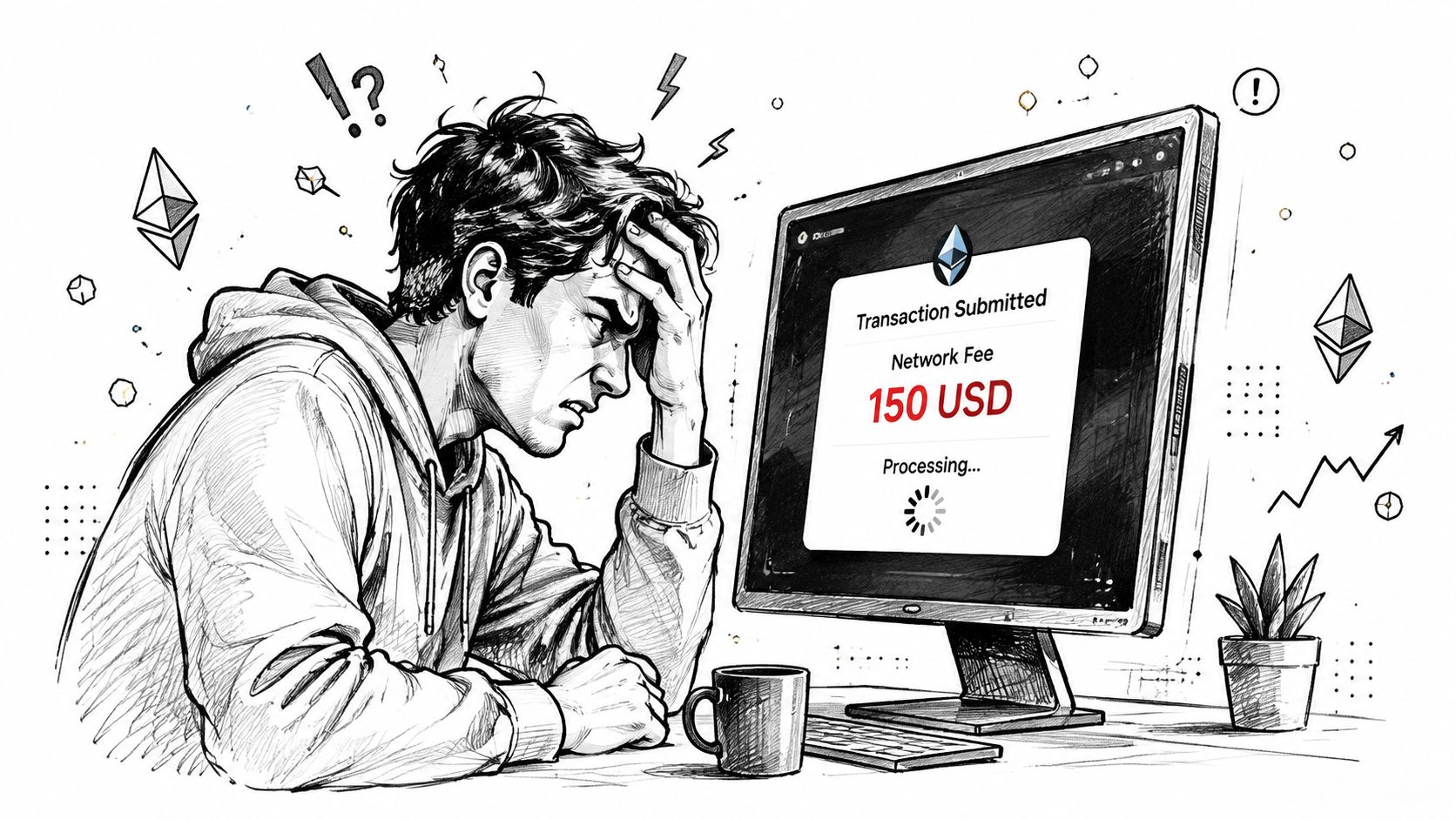
You decide to swap tokens, mint an NFT, or move funds between wallets. The transaction looks straightforward until your wallet displays a gas charge that feels out of proportion to the amount you're sending. If the network is busy, other users compete for limited block space, and your transaction may become slower or more expensive than expected.
That experience is especially frustrating for smaller UK users. A fee paid in dollars still affects the cost of a sterling-funded portfolio, and exchange rates add another layer of uncertainty. A transaction that made sense when you planned it may no longer make sense by the time you approve it.
The everyday problem with a busy mainnet
Ethereum's mainnet gives users a shared settlement environment. That strength comes with a practical limit: activity competes for the same space. Traders, DeFi users, NFT collectors, automated applications, and ordinary wallet holders may all try to have transactions processed at the same time.
The result isn't only a higher bill. You may also need to choose between waiting, increasing the fee, or cancelling the action. Beginners often assume that a failed transaction means their funds have disappeared. Usually, the assets remain in the wallet, but the network may still charge for the attempted computation.
A clear explanation of what Ethereum gas fees pay for and how users can optimise them is available in this guide to Ethereum gas fees. Understanding the fee is useful, but it doesn't remove the underlying capacity problem.
Why Layer 2 became practical
Layer 2 networks address this pressure by handling execution away from Ethereum mainnet. Users transact on a separate network, while that network connects back to Ethereum for settlement and security.
The experience is similar to using a less crowded route for routine journeys. You still rely on the same wider transport system, but you don't place every small trip on the busiest central road. For a user, that can make swaps, payments, and application interactions more affordable and responsive.
The trade-off is that the cheaper route introduces new questions. You may need to bridge assets, select the correct network in your wallet, find liquidity on a different chain, and understand how withdrawals work. Lower transaction fees are valuable, but they aren't the whole cost of changing networks.
Practical rule: Treat a Layer 2 move as a network decision, not just a fee-saving button.
What Layer 2 Scaling Solutions Actually Are
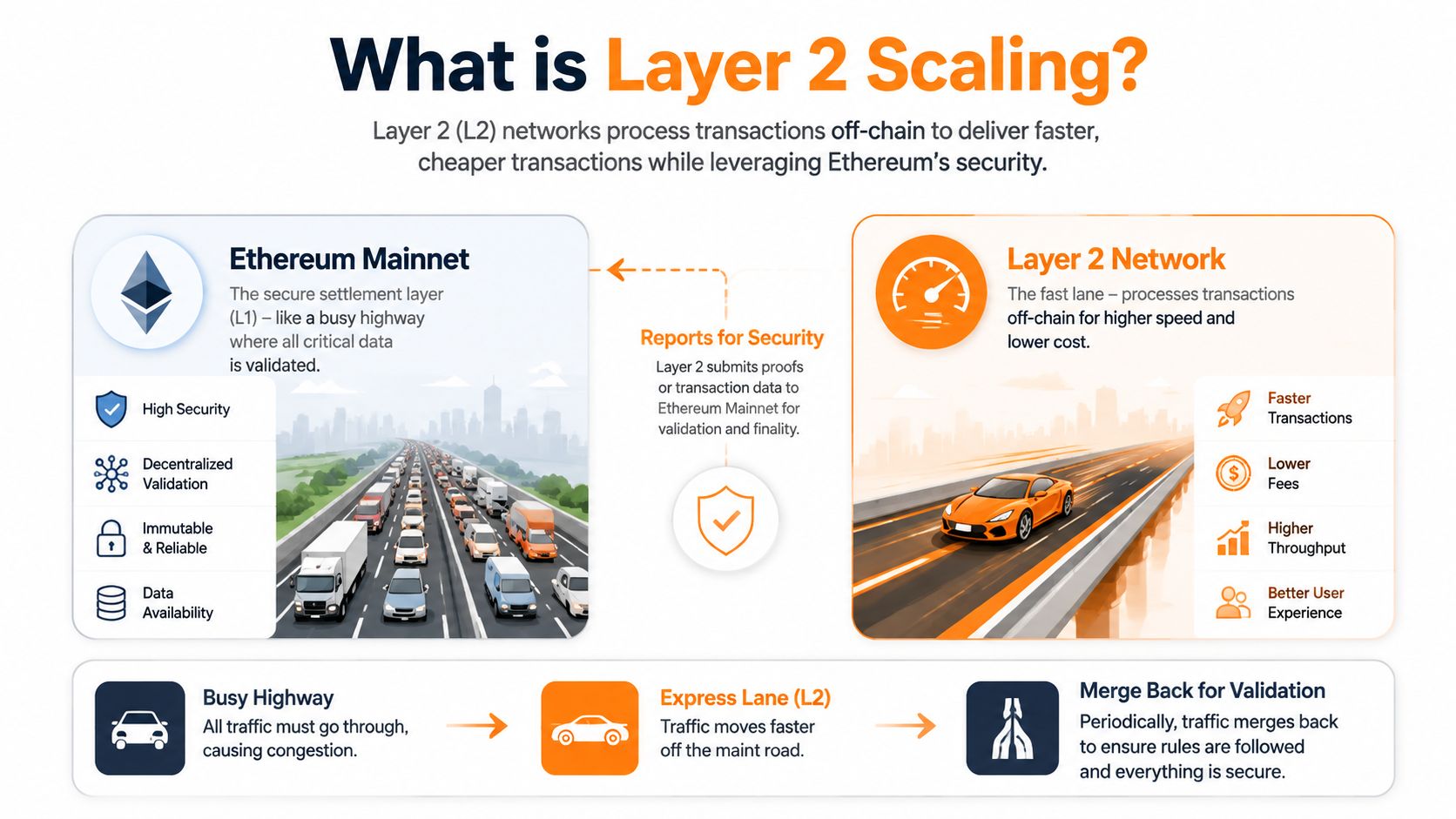
A Layer 2 is a separate blockchain built on top of Ethereum. It executes transactions outside Ethereum's main chain, then sends information back to Layer 1 so Ethereum can provide settlement and security. UK parliamentary evidence describes Layer 2 in similar terms, as a separate blockchain that extends Ethereum and moves execution outside Layer 1 to improve throughput and reduce fees (UK Parliament evidence on Layer 2).
A useful analogy is a busy motorway with an express lane. Ethereum mainnet is the main road where final records are settled. A Layer 2 is a parallel lane that can process many journeys more efficiently, then periodically reports important information back to the motorway's central system.
The basic process
You can understand the model through four steps:
- You submit a transaction to the Layer 2. Your wallet connects to the L2 rather than directly to Ethereum mainnet.
- The L2 executes the transaction. It updates balances, processes a swap, or records an application action away from the main chain.
- The L2 prepares a record of activity. It groups transactions or produces evidence that describes what happened.
- Ethereum receives settlement information. The mainnet anchors the L2's state and gives users a route to verify or challenge activity, depending on the design.
This doesn't mean every Layer 2 has identical security. Some systems inherit more of Ethereum's security than others, and the details depend on data availability, proof systems, operators, bridges, and withdrawal processes.
The key distinction is that Layer 2 doesn't replace Ethereum. An independent academic description calls Layer 2 an orthogonal scaling approach, meaning it doesn't extend or replace Layer 1's consensus assumptions (academic Layer 2 overview). It builds another execution environment around the base chain.
For a broader explanation of how the two layers relate, see this guide to Layer 1 and Layer 2 blockchain architecture.
The following video offers a visual introduction to the wider scaling idea:
Main Types of Layer 2 Scaling Solutions
Layer 2 scaling solutions don't all make the same promise. Some use fraud challenges, some use mathematical validity proofs, and others rely on a separate chain or off-chain channels. The name of a project alone isn't enough. You need to understand where its security comes from.
Optimistic rollups
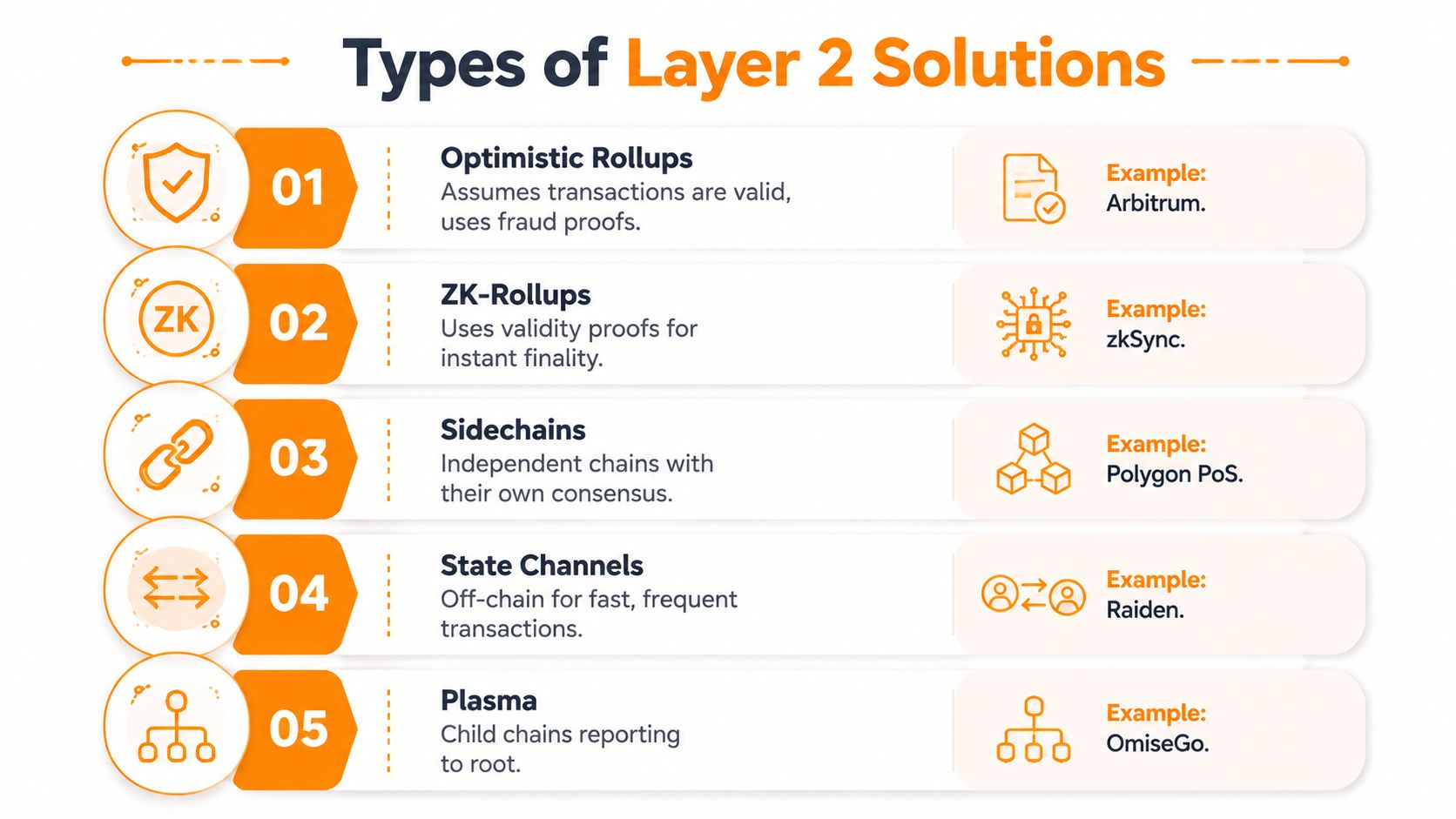
Optimistic rollups assume submitted transactions are valid unless someone challenges them. They bundle activity and use fraud proofs to contest an invalid result. Arbitrum and Optimism are well-known examples.
This model can offer a familiar smart-contract environment for DeFi developers, but users need to understand dispute and withdrawal rules. A transaction may appear complete within the L2 while the route back to Ethereum follows a different settlement process.
ZK-rollups
ZK-rollups use validity proofs. Instead of waiting for someone to identify an incorrect result, the system provides cryptographic evidence that the batch follows the required rules. zkSync Era is a prominent example.
The phrase “zero knowledge” can sound mysterious, but the practical idea is simple: the rollup submits proof that its calculations are valid without asking Ethereum to repeat every transaction individually. Developers and users still need to examine how the particular network handles data, upgrades, withdrawals, and recovery.
Sidechains
A sidechain runs alongside Ethereum and connects through a bridge. Polygon PoS is a commonly cited example. It can provide a different balance of speed, cost, and flexibility, but it has its own consensus arrangements rather than automatically inheriting Ethereum's full security model.
That makes sidechains useful for some applications, yet users shouldn't treat every Ethereum-connected network as an equivalent Layer 2.
State channels
State channels let participants conduct repeated activity off-chain and settle the result on Ethereum. Raiden is an example associated with payment channels.
This approach can suit frequent interactions between known participants. It may be less convenient for a beginner who wants to move freely among many applications, because participants must manage channel relationships and liquidity.
Plasma
Plasma uses child chains that report information back to a root chain. OmiseGo is an example from the Plasma ecosystem. The architecture can reduce mainnet activity, but exit design and data access have historically made the user experience more complex.
For developers comparing architectures, the separation between components can also be a helpful way to think about blockchain systems. A practical developer's guide to microservices explains how independent services can work together without becoming one large application. The comparison isn't exact, but it helps clarify why modular systems introduce both flexibility and coordination work.
| Type | Security Model | Speed & Cost | Example Projects |
|---|---|---|---|
| Optimistic rollups | Assumes validity, with fraud challenges | Lower-cost execution, with withdrawal considerations | Arbitrum, Optimism |
| ZK-rollups | Uses validity proofs | Efficient batch processing, with proof and data design trade-offs | zkSync |
| Sidechains | Uses independent consensus | Fast and flexible, but security differs from Ethereum | Polygon PoS |
| State channels | Off-chain activity between participants | Fast for repeated interactions | Raiden |
| Plasma | Child chains report to a root chain | Reduced mainnet activity, with more complex exits | OmiseGo |
The most direct technical comparison of optimistic and ZK systems appears in this rollups explainer. For users, the central lesson is to compare security assumptions before speed claims.
Security Assumptions and Trust Models
Low fees do not explain how a network protects your funds. Before using an L2, ask who verifies transactions, where transaction data is stored, how disputes work, and whether you can recover assets if an operator stops cooperating.
Optimistic and ZK-rollups answer these questions in different ways. An optimistic rollup treats activity as valid unless someone submits a fraud proof. That creates a challenge period, so check the network's withdrawal and dispute rules. An L2 transfer may not settle or become withdrawable on the same schedule as an Ethereum transaction.
A ZK-rollup uses a validity proof to show that its state transition follows the protocol's rules. The proof supplies a mathematical check, but it does not remove every operational risk. Smart-contract upgrades, bridge design, wallet support, and access to state data still affect how safely users can recover and verify assets.
Why data availability matters
ZK-rollups can process thousands of transactions in a batch and post a compact summary to Ethereum. They still publish transaction state data to Layer 1 as calldata, allowing independent participants to verify the rollup's state (Ethereum's ZK-rollup documentation).
Data access affects recovery, not only technical verification. If users and independent operators can obtain the required state data, they have a better chance of checking what happened and reconstructing the rollup's position. That access can also reduce the risk of an operator censoring activity or freezing users without a practical recovery route.
Security isn't one feature. It comes from the combined design of proofs, data access, contracts, bridges, operators, and withdrawal rules.
The bridge is part of the trust model
Moving assets between Ethereum and an L2 changes the risks involved. A bridge may lock assets on one network and issue a representation on another. Users then depend on the contracts and processes connecting both environments.
Liquidity can enter an L2 through several routes. One analysis estimated that about one-third of L2 TVL was bridged from Ethereum, another third was created natively, and the remainder came from external bridges. The source of liquidity matters because an asset appearing on an L2 does not prove that it arrived through the official route or that every market has equal depth.
For a UK user, the effect may appear during a withdrawal or swap. You might hold the correct token on the wrong network, find thin liquidity, or discover that a cheap route carries greater bridge or settlement risk. Compare the visible transaction fee with these less obvious costs before moving funds. A lower fee can still lead to a harder withdrawal or a worse exchange rate.
How Users Interact with Layer 2 Networks
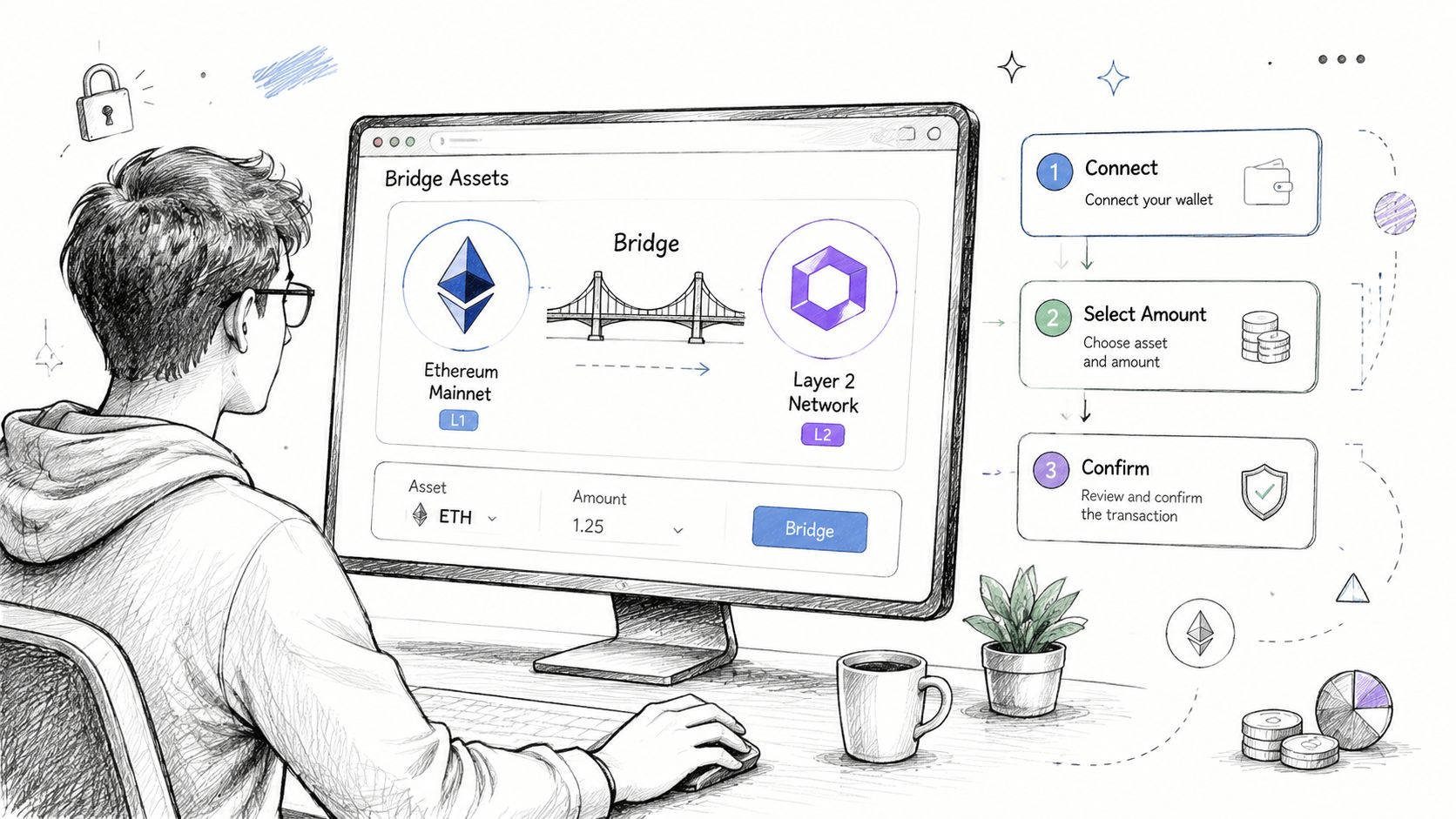
Using an L2 usually begins with a network choice, not a transaction. Your wallet must connect to the correct chain, and the application must support that chain. A familiar token name can appear on several networks, but the network itself determines where the asset can be used.
Start with the destination
Before bridging, write down the exact destination network and application. Check that your wallet supports the L2, that you have the network's native asset for transaction fees, and that the dApp recognises the token contract you intend to use.
A safe first transfer is small enough to test the route without putting your whole balance at risk. Confirm the receiving network after the transaction completes. If funds seem missing, check whether your wallet is displaying the correct chain before assuming that the bridge failed.
Treat bridging as a separate transaction
A bridge isn't a teleport button. It coordinates activity across networks, and the route may involve contracts, relayers, representations of assets, and different settlement times.
Use the official bridge or a well-established route, verify the domain carefully, and avoid approving an unfamiliar contract just because a website promises a cheaper fee. Read the transaction details in your wallet. A bridge approval can grant spending permission, which is different from sending a one-off payment.
Costs that don't appear in the headline fee
The advertised L2 transaction cost may exclude:
- The initial mainnet transaction: You may pay Ethereum gas to begin the bridge.
- The bridge charge: Some routes add a service cost or spread.
- Liquidity differences: Swapping on a smaller market can produce a less favourable price.
- The return journey: Moving assets back to Ethereum can involve another transaction and a different withdrawal process.
- Operational effort: Managing several networks, token versions, and wallets increases the chance of a user error.
Liquidity fragmentation is the reason a cheap transaction can still be inconvenient. Funds may be available on an L2 but not in the form, market, or application you need. Compare the full route rather than judging only the fee shown before approval.
Choose applications carefully
Once assets arrive, check that the dApp is deployed on the intended network and that you understand whether you are using a native asset or a bridged representation. Keep records of the network, token contract, and transaction hash, especially if you're managing funds for work, tax reporting, or a larger portfolio.
Account abstraction is an emerging direction that may make this process easier by allowing wallets to handle fees, permissions, and transaction flows in more flexible ways. It could reduce the number of network details users must manage, but it won't remove the need to understand where assets are held or which contracts receive approval.
Before approving a bridge, confirm the network, contract, asset representation, and exit route.
Risks, Best Practices, and Future Outlook
Layer 2 scaling solutions make Ethereum easier to use, but they do not remove risk. Smart-contract bugs, compromised bridges, faulty upgrades, fake websites, and incorrect network choices can still affect users. A low fee is a poor bargain if the route sends funds to a contract you have not checked.
Use established applications and begin with a small test amount. Keep wallet software updated, separate long-term holdings from experimental funds, and record the network holding each asset. A token on one chain may not work directly on another.
Institutional adoption is steering L2 design toward compliance, permissions, privacy, and customisable execution environments, according to a report highlighted in analysis of the future of Ethereum DeFi and L2 liquidity. This may produce more specialised networks and better tools for moving liquidity, while also making network choice harder for users.
Blockchain workflows need testing beyond a successful transaction. Teams assessing automated systems can use beyond exact string checks as a reminder to test behaviour, edge cases, and failure paths, not only visible results.
Use caution without avoiding L2s altogether. Check the proof model and bridge, test the route, and include liquidity and withdrawal timing in the cost.
The Coin Course offers clear guides covering blockchain fundamentals, wallets, DeFi, and security decisions. Visit The Coin Course before moving funds to Layer 2 networks or using unfamiliar crypto applications.