When you’re trying to figure out if Bitstamp is a safe place for your crypto, the simple answer is yes—but it's worth understanding the reasons why. In a world full of flashy new crypto platforms, Bitstamp has built a name for being one of the most long-standing and secure exchanges around. You could think of it as the old, reliable bank on the corner in a neighbourhood full of brand-new, unproven financial apps.
Is Bitstamp a Safe Exchange for Your Crypto?
Before we jump into the finer details, it helps to know what’s behind Bitstamp’s solid reputation. Its safety isn't built on just one thing; it’s a mix of long-term reliability, a serious commitment to following the rules, and some seriously strong security measures. These three parts are like the legs of a stool holding up its trustworthy structure.
For anyone in the UK, one of the biggest green flags is Bitstamp's relationship with the financial authorities. The platform is one of only 42 firms to be officially registered as a cryptoasset business by the UK’s Financial Conduct Authority (FCA). This isn't just a simple approval; it means Bitstamp has proven it meets strict rules designed to stop money laundering and the financing of terrorism.
Bitstamp Safety Features At a Glance
To give you a clearer picture, let's break down the key features that make Bitstamp a secure platform. This table sums up the main safety pillars designed to protect you and your digital assets. We'll explore each of these points in more detail, but this gives you a great starting point.
| Safety Feature | What It Means | How It Protects You |
|---|---|---|
| FCA Registration | Bitstamp follows strict UK financial rules. | Ensures the platform operates legally and helps stop financial crime. |
| Cold Storage | The vast majority of crypto is stored offline. | Protects your assets from online hackers, much like a bank's vault. |
| Crime Insurance | A policy covers assets held in online wallets. | Provides a financial safety net if there's a security breach. |
| Account Security | Features like 2FA and address whitelisting. | Gives you direct control to lock down your account from unwanted access. |
Each of these features plays a vital role. From top-level government oversight to the practical tools you can use every day, it's this multi-layered defence that gives users confidence in the platform.
How Bitstamp Protects Your Digital Assets
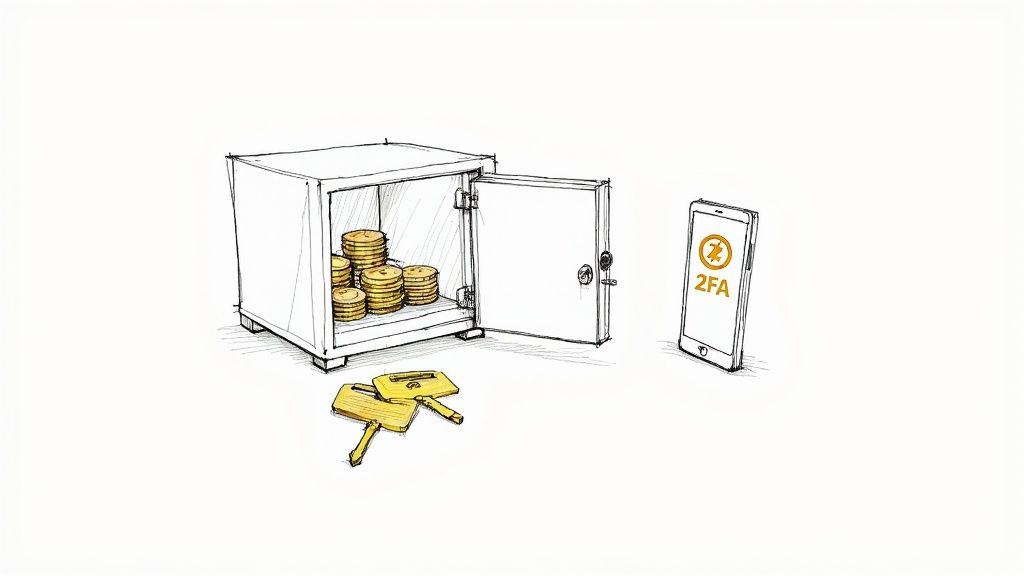
When it comes to your crypto, the big question is always: "Is it safe?" So, let's pull back the curtain on how Bitstamp actually guards your digital assets. It’s best to picture their security not as a single padlock, but as a fortress with several layers of defence, starting with the very foundation of how they store your funds.
The absolute cornerstone of Bitstamp's security strategy is cold storage. Imagine a high-security bank vault—physically sealed, completely offline, and not connected to any network. That's exactly what cold storage is for crypto. Bitstamp keeps a massive 98% of all customer assets in these offline environments.
This method dramatically reduces risk. It means that even if Bitstamp's online systems were somehow targeted by hackers, the huge majority of funds would be completely out of reach. It’s the digital version of keeping the crown jewels in a fortified tower instead of on the front counter. This practice alone is one of the biggest reasons Bitstamp has earned a reputation for safety.
The Power of Multi-Signature Wallets
What about the small amount of funds kept online to handle everyday trades and withdrawals? For these "hot wallets," Bitstamp uses another key security layer: multi-signature technology, often called "multisig."
Think of a bank's safe deposit box that needs two different keys, held by two different managers, to be opened. A single key on its own is useless. Bitstamp’s multisig wallets work on this same idea, needing multiple, separate approvals before any transaction is signed and sent.
This setup gets rid of any single point of failure. No single rogue employee or one hacked server can move funds on their own. This creates a powerful internal check against both theft and simple mistakes. If you're keen to understand more about these industry-standard practices, our guide on overall crypto exchange security is a great place to start.
Security Tools You Control
Bitstamp’s defences aren’t just about what they do behind the scenes. They also put powerful tools in your hands to bolt down your own account, and honestly, using them is essential if you’re serious about protecting your money.
Your personal security habits are just as important as the exchange's infrastructure. Think of it as the exchange building a strong front door, but you are still responsible for locking it.
The most important tool is Two-Factor Authentication (2FA). By turning it on, you’ll need to provide a second form of proof—usually a short, time-sensitive code from an app like Google Authenticator on your phone—along with your password. This makes it incredibly difficult for an attacker to get in, even if they somehow steal your login details.
Beyond 2FA, there are a couple of other key features you should switch on right away:
- Email Confirmations: Every withdrawal or big account change sends a confirmation link to your registered email. For instance, if a hacker tried to send your Bitcoin to their wallet, you'd get an email first, allowing you to stop the transaction dead in its tracks.
- Address Whitelisting: This lets you create a pre-approved list of crypto addresses you can send funds to. Once it's active, withdrawals can only go to these trusted addresses. This stops a thief from draining your account to their own wallet.
How Does Bitstamp Stack Up with UK Regulations?
When you’re looking into a crypto exchange, talk of regulation can seem like a dry subject. But in reality, it's one of the most important things to check. Asking "is Bitstamp safe?" is really asking how it measures up against official rules, and in the UK, Bitstamp has put in the effort.
For anyone trading in the UK, the most important body is the Financial Conduct Authority (FCA). Bitstamp isn't just aware of them; they're officially registered. This isn't some simple approval. It means they've opened their doors to one of the world's toughest financial watchdogs and agreed to follow a thick rulebook designed to protect people like you and me.
What FCA Registration Actually Means
The FCA’s job is to keep financial markets clean and fair. In the crypto world, that means a huge focus on stopping money laundering and terrorist financing. For an exchange to get on the FCA's register, it has to prove its systems are good enough for the job.
You don't have to take their word for it, either. You can look up Bitstamp UK Limited right on the FCA's public register.
This isn’t just about ticking a box. It provides a level of accountability you simply won't find on platforms that operate in the shadows. It’s a clear signal that Bitstamp is here to play by the UK’s rules.
Why All That 'KYC' Paperwork Is Actually a Good Thing
To stay on the right side of the FCA, Bitstamp has to be strict about who uses its platform. That's where 'Know Your Customer' (KYC) comes in. It's that part of the sign-up process where you have to upload a photo of your ID, like a passport or driver's license, and maybe take a selfie to prove you're a real person.
It can feel like a bit of a hassle, I get it. But it's a hugely important security step.
By making sure every user is properly identified, KYC makes it incredibly difficult for criminals to use the exchange for illegal activities. It’s a core part of building a safer trading environment for everyone.
Bitstamp UK Ltd. specifically operates under the UK’s Money Laundering, Terrorist Financing and Transfer of Funds Regulations. This isn't optional; it legally requires them to run solid KYC checks, monitor transactions for anything suspicious, and report it to the authorities if needed. You can read up on how Bitstamp handles these UK legal requirements on their official site.
Choosing an FCA-registered exchange provides an essential layer of trust and accountability. It separates platforms committed to compliance from those operating in the shadows, where user protection is often an afterthought.
This regulatory oversight is what sets the serious players apart. Unregulated exchanges might offer the lure of anonymity, but that often comes at the price of your security. The rules Bitstamp follows are there to create a more stable and trustworthy crypto market, which is directly tied to the safety of your money. The growing world of security tokens and regulatory compliance just goes to show how vital these frameworks are for the entire industry.
A Transparent Look at Bitstamp's Hack History
To truly know if Bitstamp is safe, you have to look at more than just its current security setup. The real test of any exchange isn't just how high its walls are, but how it reacts when those walls are broken. Bitstamp had its defining moment back in January 2015.
That’s when hackers hit one of the exchange’s online operational wallets, making off with around 19,000 bitcoins. It was a massive blow, not just to Bitstamp, but to the confidence of the entire crypto community at the time. What really matters, though, is what happened next.
Instead of trying to downplay the situation or hide what happened, Bitstamp’s leadership did something pretty rare back then: they took full responsibility. They were open and honest with their customers about the breach, which was the first crucial step on the long road to regaining trust.
From Crisis to Fortification
Their response wasn't just about good public relations, either. Bitstamp made two huge decisions that completely reshaped its future and set a new standard for how exchanges should handle a crisis.
First, they covered every single penny of the losses out of their own pockets. No user lost any of their funds. This wasn't a small thing; it was a huge financial hit that proved their commitment to their customers was more than just words on a website.
Second, they took the dramatic step of shutting down the entire platform. This wasn't just a quick fix. They completely rebuilt their security systems from the ground up, putting in place the kind of strong, multi-layered defences we've already talked about, like multi-sig wallets and much stricter internal controls.
The 2015 hack became a catalyst for change. It forced Bitstamp to become a leader in security, transforming a potential disaster into a lesson on resilience and customer protection.
This whole event is a key part of why Bitstamp is now seen as one of the safer pairs of hands in the industry. They faced a nightmare scenario, took full responsibility, and came out the other side with a fundamentally stronger security system. Their experience highlighted the critical importance of keeping most assets offline, a practice they follow religiously today.
If you're curious about the nuts and bolts of how exchanges protect funds, our guide on cold storage vs hot storage security breaks down why this strategy is so vital.
How Bitstamp's Security Stacks Up
It's one thing to say an exchange is secure, but how does it actually compare to its main competitors? Let's put Bitstamp side-by-side with other big names in the UK, like Coinbase and Kraken, to get a real sense of where it stands.
When we talk about security, it’s never just one feature. It’s a combination of things: official approval, how they store your crypto, what insurance they have, and the security tools you can use yourself. While every platform has its strong suits, Bitstamp has earned a reputation as the steady, dependable choice. They've always put a major focus on following the rules and building a solid track record, which is a huge part of the answer to "is Bitstamp safe?"
Regulatory and Compliance Ratings
One of the simplest ways to judge an exchange is by its regulatory standing. Bitstamp holds more than 50 licenses and registrations across the globe, but for UK users, its full approval from the FCA is what really matters.
But they haven't just met the basic requirements. Bitstamp earned the highest possible AA rating in CCData’s Exchange Benchmark report for five editions in a row up to April 2023. At the time, no other centralised exchange could say the same. You can read more about Bitstamp's regulatory milestones directly on their blog.
This visual tells the story of how Bitstamp bounced back from its 2015 hack to become a much more secure and trusted platform.
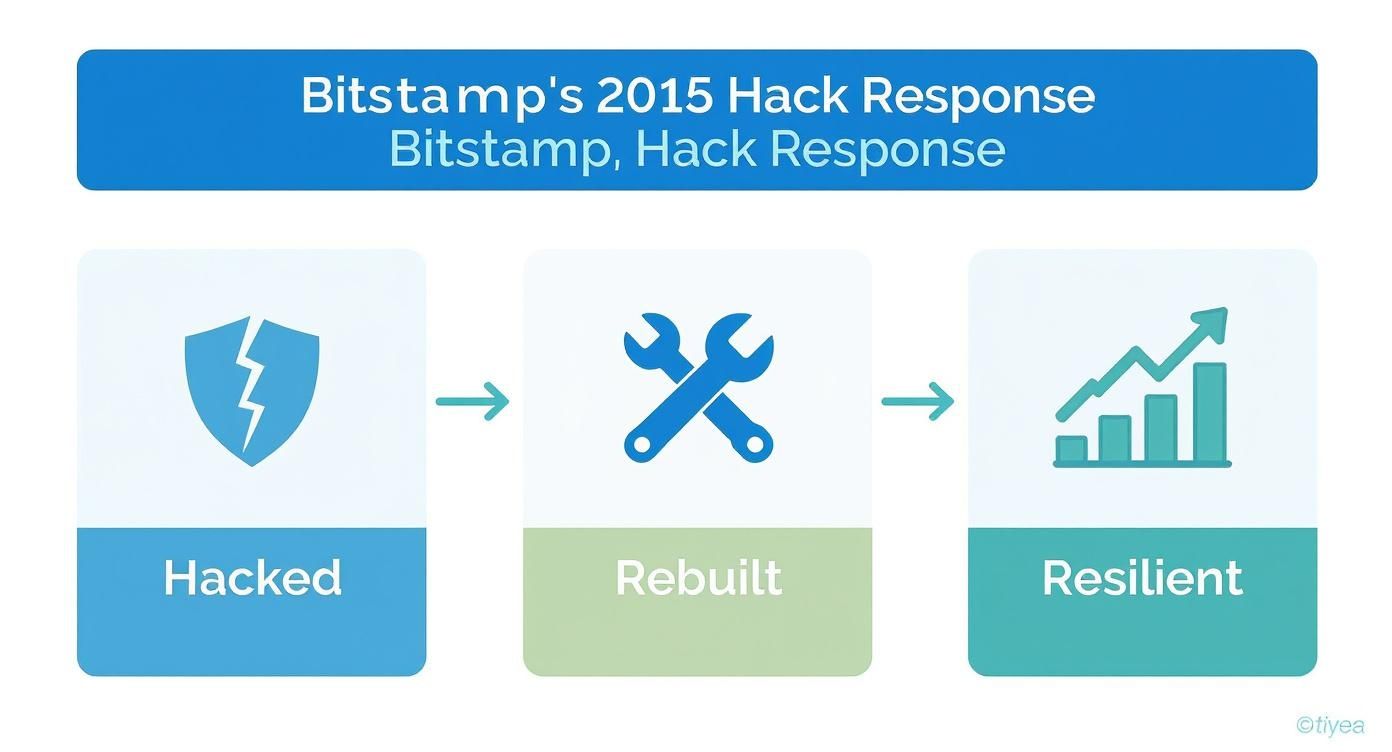
The crucial lesson here is how that major security breach became a catalyst for change, forcing them to completely overhaul their systems and build something far stronger.
A Head-to-Head Safety Comparison
So, how do the practical features compare? The table below breaks down the key safety measures across Bitstamp, Coinbase, and Kraken, giving you a clear snapshot of their different approaches.
Safety Comparison: Bitstamp vs Competitors
| Feature | Bitstamp | Coinbase | Kraken |
|---|---|---|---|
| UK FCA Registration | Yes, fully registered and compliant. | Yes, registered for cryptoasset activities. | Yes, registered for cryptoasset activities. |
| Asset Storage | ~98% of assets held in offline cold storage. | "Substantial majority" of assets in cold storage. | "Majority" of assets held in cold storage. |
| Crime Insurance | Commercial crime insurance for hot wallets. | Crime insurance policy for hot wallet assets. | No specific public crime insurance policy. |
| Proof of Reserves | Regular audits by a top accounting firm. | Provides Proof of Reserves reports. | Regular Proof of Reserves audits available. |
All three platforms are serious about security, there’s no question about that. However, Bitstamp’s long history of public audits and its top-tier regulatory standing often give it an edge for users who place a high value on proven, transparent security.
The Verdict Is Bitstamp Safe Enough for You
After looking at Bitstamp’s journey from a small startup to a fully FCA-regulated UK exchange, you might still be wondering: can it truly keep your crypto safe? The short answer is yes, but the story behind that "yes" offers deeper reassurance.
Bitstamp has weathered some serious storms. Back in 2015, it was hit by a major hack, losing a chunk of its funds. Instead of dodging the blame, the team paid back every customer and came back with much tighter security. Today, it stands as one of the oldest exchanges still operating—a clear sign of its resilience.
A huge part of this trust comes from regulation. Bitstamp’s registration with the UK Financial Conduct Authority (FCA) shows its commitment to being open and honest. This isn’t just for show—98% of client funds are kept in cold storage, disconnected from online threats.
Of course, no exchange can get rid of every single risk. Criminals are always finding new tricks, systems change, and human error is always possible. That’s why your own watchfulness is just as important as any security feature they offer.
The key takeaway is that security is a shared responsibility. Bitstamp provides a heavily fortified environment, but you hold the keys to your own account.
Your Essential Security Checklist
Make these steps a regular habit to defend your investments:
- Activate 2FA Immediately: Use an authenticator app like Google Authenticator instead of SMS texts. It's much harder for scammers to intercept an app code.
- Use a Unique Password: Create a strong, complex password you’ve never used anywhere else. A password manager app can help you create and store these securely.
- Enable Whitelisting: Limit withdrawals to a list of crypto addresses you set up in advance. This ensures your funds can’t be sent to a thief's wallet.
Got Questions About Bitstamp's Safety? We’ve Got Answers.
Even after diving into the details, you might still have a few questions. Let's tackle some of the most common ones directly to clear up any final doubts about how safe Bitstamp really is.
Are My Funds Actually Insured on Bitstamp?
Yes, they are, but it's important to understand how this works. Bitstamp has a commercial crime insurance policy, which acts as a safety net for the crypto held in its online "hot" wallets. If a security breach happened on their end, this insurance would kick in to cover the losses.
However, Bitstamp keeps a huge 98% of all customer funds safely tucked away in offline "cold" storage. This setup keeps the vast majority of assets completely disconnected from the internet and out of hackers' reach. Just remember, the insurance doesn't cover your individual account if it's compromised because someone got your password. That’s why your own security habits—like using a strong password and two-factor authentication (2FA)—are absolutely essential.
What Would Happen If Bitstamp Went Out of Business?
It’s a fair question to ask about any financial platform. Bitstamp operates with a full 1:1 reserve. In simple terms, this means for every bitcoin you own on the platform, they hold one bitcoin in their reserves, just for you.
Legally, your assets are your property, and they are kept completely separate from Bitstamp's own company funds. In the very unlikely event of bankruptcy, this separation is designed to protect your crypto from being touched by people the company owes money to. Your assets should be returned to you. This isn't just a good idea; it's a fundamental way to protect customers.
One of the key signs of a trustworthy exchange is the clear separation of client assets from company funds. This ensures that in a worst-case scenario, customer holdings are not treated as part of the company's balance sheet.
Is Bitstamp a Good Platform for Beginners?
Absolutely. For anyone just starting out with crypto, especially here in the UK, Bitstamp is a really solid choice. Its official registration with the Financial Conduct Authority (FCA) adds a layer of trust and oversight that can be incredibly comforting when you're new to it all.
The platform has a long-standing reputation for being reliable, and its website and app are pretty easy to get the hang of. You won't find every new and obscure coin there, but you'll have easy access to all the major ones like Bitcoin and Ethereum. If you care more about security and a proven track record than a massive list of coins, Bitstamp provides a safe and dependable place to begin your crypto journey.
Ready to dive deeper into the world of crypto with confidence? The Coin Course offers expert-led guides to help you master everything from fundamental security practices to advanced trading strategies. Start your learning journey today.