
Getting into crypto trading is simpler than you might think. It boils down to four main steps: learning the basics, picking a good trading platform, setting up your account, and finally, making your first trade with a clear head. You can get the setup sorted in under an hour, meaning you can step into the market quickly. The key is to do it smartly.
Your First Steps into Crypto Trading
Jumping into the world of crypto trading here in the UK might feel like a huge leap, but it's genuinely more manageable than it looks. Before you invest a single pound, though, it's vital to wrap your head around a few key ideas. This isn't about becoming a tech genius overnight; it’s about building a strong foundation so you can understand what gives these digital assets their value.
At its heart, cryptocurrency is just digital money secured by clever maths, which makes it incredibly tough to counterfeit. To get a real feel for what cryptocurrency is and how it works, you need to know a little about blockchain technology. The easiest way to picture it is as a shared, public bank ledger that securely records every single transaction for all to see.
Having this basic knowledge is your best shield in a market famous for its sudden ups and downs.
Coins vs Tokens: The Key Difference
One of the first things you'll notice is the huge number of different assets you can trade. It helps to split them into two main types: coins and tokens.
- Coins are the native currency of their own blockchains. For example, Bitcoin (BTC) is the coin for the Bitcoin network, and Ether (ETH) is the coin for the Ethereum network. They're used for all sorts of things, from paying transaction fees to helping secure the network.
- Tokens, on the other hand, are built on top of an existing blockchain (most often Ethereum). Assets like Shiba Inu (SHIB), a popular "memecoin," or Chainlink (LINK), a project that connects blockchains to real-world data, are tokens. They have a specific use within a particular project.
Understanding this difference helps you look beyond the price tag and see the real purpose and potential of a digital asset. A coin's value is deeply linked to the health and popularity of its entire blockchain, while a token's value is usually tied to the success of one specific project.
This flow chart gives you a simple visual of the path from learning the ropes to opening your account.
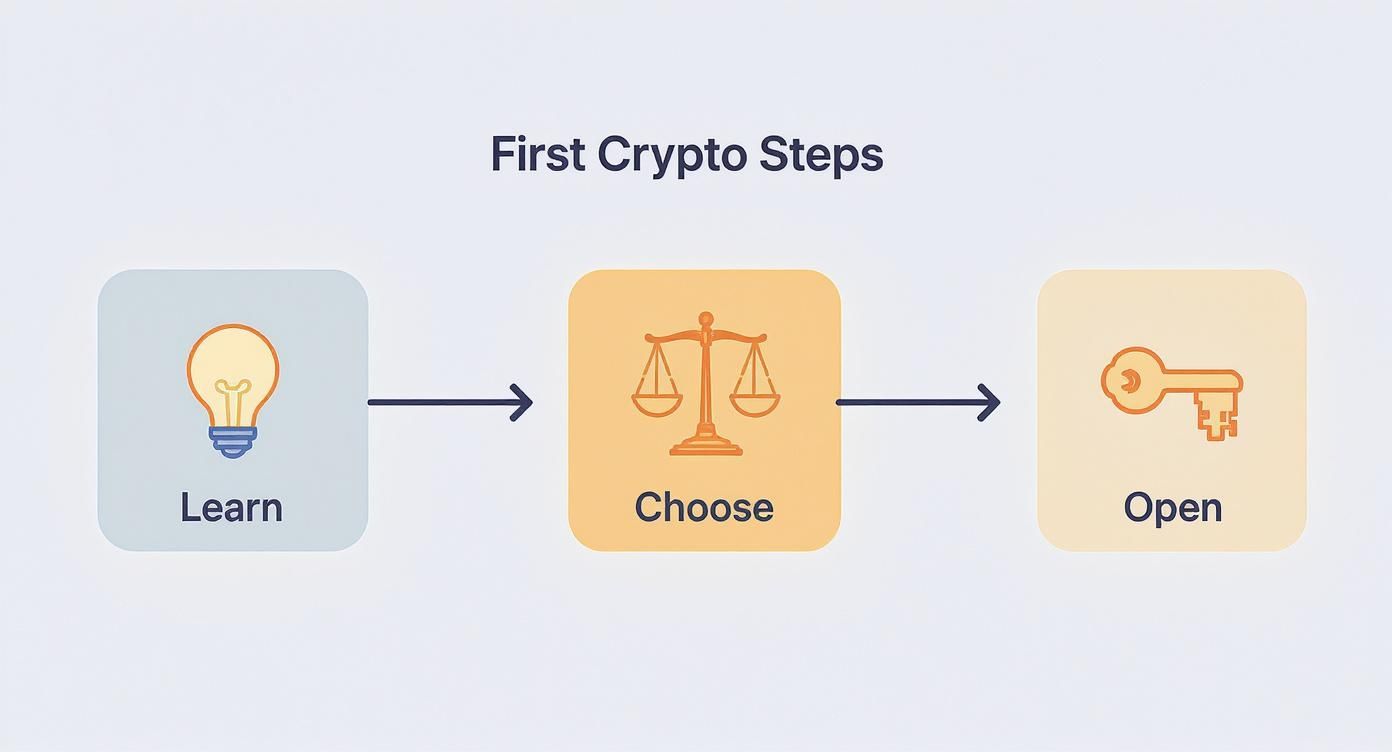
As you can see, spending time on education before you put any money on the line is the most important first step.
Choosing Your Trading Venue
Next, you need to decide where you'll actually be buying and selling. Your two main choices are centralised exchanges (CEXs) and decentralised exchanges (DEXs).
This table gives a quick comparison to help you decide where to begin.
Choosing Your Crypto Trading Platform
| Feature | Centralised Exchange (CEX) | Decentralised Exchange (DEX) |
|---|---|---|
| Ease of Use | High (User-friendly interfaces) | Low (Requires more technical skill) |
| Custody | Exchange holds your funds | You control your own funds (self-custody) |
| Regulation | Often regulated and licensed | Generally unregulated |
| Support | Customer support is available | Community-based or no support |
| Examples | Coinbase, Kraken, Binance | Uniswap, PancakeSwap, dYdX |
A CEX, like Coinbase or Kraken, is a bit like a regular stockbroker. They're designed to be easy to use, often have customer support, and are usually regulated, which makes them a great starting place for anyone new to crypto.
A DEX, such as Uniswap, operates without a central company in charge. You trade straight from your own crypto wallet. This gives you total control and privacy but also involves a steeper learning curve.
For anyone just starting, a well-known and regulated centralised exchange is almost always the best option. It offers a much safer and more supportive place to learn the ropes.
Choosing to trade in the UK means you're entering a market that's expanding quickly. The UK crypto industry generated about $334.3 million in revenue and is projected to reach $619 million by 2030, according to industry analysis. It's an exciting time to get involved.
Getting Your Exchange Account and Wallet Sorted
Okay, with the background info covered, it's time to get hands-on. The first practical thing you need to do is set up two essential pieces of your trading toolkit: an account on a cryptocurrency exchange and your own digital wallet.
Think of it like this: the exchange is your bank, where you'll do the buying and selling. The wallet is your personal, super-secure purse where you keep your digital money safe afterwards.
Creating Your Exchange Account
If you're in the UK, it’s wise to start with a regulated exchange. Platforms like Coinbase or Kraken are great choices for beginners. They are typically easy to navigate and, importantly, they follow UK financial regulations, giving you an extra bit of peace of mind.
The sign-up process is pretty simple and will feel familiar if you've ever opened an online savings account. You'll need to give some personal details and then complete what's called a Know Your Customer (KYC) check. This is a legally required step to confirm your identity.
For the KYC process, you'll generally be asked for:
- A government-issued photo ID (a valid passport or driving licence is ideal).
- Proof of your address, like a recent utility bill or bank statement.
- Sometimes, they'll ask for a quick selfie to prove it's really you.
This check can be done in minutes, but occasionally it takes a day or two. My advice is to get it sorted as soon as you sign up so you're good to go when you want to be. Once you're verified, you can add money to your account and you're officially ready to trade.
Why You Need a Crypto Wallet
You can leave your crypto on the exchange where you bought it, but from a security angle, it's not a great long-term idea. There’s a famous saying in crypto: "not your keys, not your crypto." It means if you don't hold the private keys to your digital assets, you don't really own them—the exchange does. That's why a personal wallet is so important.
You'll mainly find two types of wallets:
- Hot Wallets: These are software-based wallets on your phone or computer, like Exodus or Trust Wallet. They're connected to the internet, which makes them great for quick access and managing small amounts you trade often.
- Cold Wallets: These are physical hardware devices that look like USB sticks. Brands such as Ledger or Trezor are the market leaders. They keep your crypto completely offline, offering the best security possible. They are perfect for storing larger amounts that you plan to hold for a long time.
From my experience, the smartest way for newcomers is to use a combination. Keep a small amount of "trading cash" on the exchange, move profits or long-term investments to a secure hot wallet, and then seriously think about getting a cold wallet once your portfolio starts getting bigger.
Setting Up Your First Software Wallet
Let's do a quick walkthrough of setting up a hot wallet, using Exodus as an example, though the process is very similar for most. After you've downloaded the app, you'll reach the single most vital step: securing your secret recovery phrase (also called a seed phrase).
This is a list of 12 or 24 random words that acts as the master key to your entire wallet. If your laptop breaks or you lose your phone, this phrase is the only way to get your funds back.
You must write it down on paper and store it somewhere safe and offline. Even better, make two or three copies and keep them in different places. Never save it as a screenshot, put it in a text file on your computer, or store it in a password manager. If someone else gets that phrase, they get your crypto. It’s as simple as that.
For a deeper look into the different types and how to secure them properly, read our complete guide on choosing the right wallet for your needs. Setting up your wallet correctly is the foundation of keeping your crypto safe.
Right, your exchange account is verified, your personal wallet is ready, and now we're at the exciting part: getting your money in and actually making your first trade. This is where the action starts, but don't worry, it's simpler than it sounds.
Getting Your Pounds into the Exchange
First off, you can't buy crypto without some cash in your account. You'll need to deposit British Pounds (£) to begin. For those of us in the UK, there are a couple of common ways to do this, and each has its pros and cons.
Bank Transfer (Faster Payments): This is what I recommend for most people. You just send money from your UK bank account to the exchange, like you're paying a bill online. The best part? It's usually free. Thanks to the UK's Faster Payments system, the money often appears in your trading account in minutes, though it can sometimes take an hour or so.
Debit Card: If you need to be quick, a debit card works. It's nearly always instant, so the funds are there right away. The downside is the fees. Most exchanges will charge a small fee, usually around 1-3%, for card deposits. That might not sound like a lot, but it eats into your capital before you've even made a trade.
Honestly, for your first deposit, a bank transfer is the smarter and cheaper option. The only real reason to use a debit card is if you spot a fantastic opportunity and need to fund your account that very second.
Placing Your First Trade: Market vs. Limit Orders
With money in your account, it's tempting to dive in and click the "buy" button. But wait a moment. It's crucial to understand how you're buying. The two most basic order types are market orders and limit orders. Getting this difference is a total game-changer.
Let's quickly go over them.
Market Order: This is the "buy it now" option. You're telling the exchange, "I want this crypto, and I'll pay whatever the current best price is." It’s fast, and your order is almost guaranteed to go through. The catch? In a fast-moving market, the price you actually get might be slightly different—and often a bit worse—than the one you saw a second before clicking. For instance, you see Bitcoin at £50,000, click buy, but by the time the order is processed, you've paid £50,050.
Limit Order: This is the more controlled approach. With a limit order, you set the exact price you're willing to pay. Your order will only be filled if the asset's price drops to your target price or lower. It gives you full command over your entry point.
A limit order is your best friend for removing emotion from trading. You decide what a fair price is before you buy, set it, and then just wait for the market to come to you. It's the perfect way to avoid FOMO-driven impulse buys when prices are shooting up.
A Quick Limit Order Example
Let’s see how this works in practice. Imagine you have £150 you want to invest in Ethereum (ETH). The current price is £2,500, but you think that's a bit high and your research suggests £2,450 is a much better price to buy at.
Instead of a market buy, you'd place a limit order to buy £150 worth of ETH, but only if the price falls to £2,450.
If ETH dips to that level, your order automatically gets filled, and you've bought in at your target price. If it never drops that low, your order just sits there, unfilled, and your £150 remains safe in your account. This simple, strategic move is a key part of learning how to start trading crypto properly, not just taking a punt.
Developing a Simple Trading Strategy
https://www.youtube.com/embed/xHU5MHuUSKI
Just buying crypto is one thing, but actively trading it is a completely different ball game. If you don't have a plan, you're not really trading—you're gambling. The goal isn't to predict the market's next move perfectly, but to create a solid framework that guides your choices and keeps your emotions in check.
For anyone just figuring out how to start trading crypto, remember this: a simple strategy you can actually follow is much better than a complex one you give up on when things get stressful. It's all about making calculated decisions instead of just reacting to online hype or a sudden price drop.
Let's look at two basic strategies that are perfect for beginners.
Dollar-Cost Averaging Your Way In
One of the most sensible and least stressful methods to get started is Dollar-Cost Averaging (DCA). The idea behind it is beautifully simple: you invest a fixed amount of money at regular times, regardless of what the price is doing.
For example, you could decide to buy £50 worth of Bitcoin every Friday morning.
- If the price is high that week, your £50 will buy you a smaller amount of Bitcoin.
- If the price has dropped, that same £50 will buy you a little more.
Over the long term, this technique helps to average out your cost per coin. It's a fantastic way to avoid the classic beginner mistake of putting all your money in at a market peak because you're scared of missing out (FOMO). DCA is disciplined, requires little effort, and is brilliant for softening the impact of big price swings on your portfolio.
Getting a Feel for Swing Trading
Once you're more confident, you might want to explore Swing Trading. This approach isn't about the frantic, minute-by-minute charts of a day trader. Instead, it’s about catching the bigger price "swings" that happen over several days or even weeks.
The aim here is to spot a trend and ride it. A great place to start is by looking at a basic price chart to find support and resistance levels.
- Support is like a price floor where an asset has historically stopped falling and bounced back up. It’s created by a group of buyers who see value at that price.
- Resistance is the opposite—a price ceiling that an asset finds hard to break through, formed by sellers looking to cash in their profits.
A simple swing trading plan could be to buy a cryptocurrency when its price bounces off a strong support level, then sell as it gets close to a known resistance level. It definitely needs more attention than DCA, but it gives you a clear set of rules for when to enter and exit a trade.
The real power of a trading strategy isn't how complicated it is; it's your ability to stick to it. A simple plan that you follow with discipline is worth more than a professional strategy you ditch at the first sign of trouble.
As you get more comfortable, you'll discover a whole world beyond simply buying and selling coins. The UK crypto market has grown up a lot, now offering more advanced products. For instance, trading crypto derivatives is now a huge part of the industry, with the global average daily volume for futures and options hitting 198,000 contracts. The UK's increasing involvement shows a market with lots to explore beyond just buying and selling. You can get a better sense of this by looking into the rise of the crypto options market from recent industry analysis.
Smart Risk Management and Asset Protection
In the wild world of crypto, your most valuable skill isn't picking winning coins—it's managing risk. I've seen countless traders come and go, and the ones who last are always the ones who master risk management. This isn't about fancy maths; it's about practical, common-sense steps that protect your money and keep you in the game.
Before you even think about placing a trade, you need to learn the golden rule: never invest more than you are genuinely prepared to lose. The crypto market's wild swings aren't just a talking point; they're real. Treating your trading funds as 'at-risk' money from the start stops you from making panicked, emotional choices when the market inevitably takes a downturn.
Using a Stop-Loss as Your Safety Net
Let's talk about one of the most powerful tools you have: the stop-loss order. This is simply an automatic instruction you give the exchange to sell your crypto if it drops to a certain price. Think of it as your emergency exit, planned while you're calm and thinking clearly.
For example, let's say you buy Bitcoin at £55,000. You could immediately set a stop-loss order at £52,000. If the price suddenly crashes overnight, your trade is automatically closed at or near that £52,000 price. This simple action stops a small loss from becoming a disastrous one, all without you having to nervously watch the charts 24/7.
Setting a stop-loss isn't admitting you think you'll fail; it's what disciplined traders do. It removes the panic from the situation and makes sure one bad trade doesn't wipe out your whole portfolio.
This kind of discipline is more important than ever. In the UK, crypto is no longer a niche hobby. Around 24 million people—that's roughly 35% of the population—now own or use crypto. With the average holding per person sitting over $2,286, the need for solid risk management is bigger than ever.
Diversification and Personal Security
Another key idea is diversification. Putting all your money into a single, hyped-up 'memecoin' you saw on social media is pure gambling, not a strategy. Spreading your investment across several different assets—perhaps some big, established projects and a few more speculative ones—helps protect your portfolio if one of them does badly.
Finally, protecting your assets isn't just about smart trades; it's about basic digital security. These habits are non-negotiable for anyone serious about trading crypto safely.
- Enable Two-Factor Authentication (2FA) on all your exchange accounts. Do it now. This adds a vital security layer, needing a code from your phone to log in.
- Watch out for Phishing Scams. Never click on dodgy links in emails or messages that claim to be from an exchange. Always go directly to the official website by typing the address yourself.
- Use Strong, Unique Passwords for every single platform. A good password manager can make this easy to handle.
Getting these defensive moves right is the key to your long-term success in this market. To really get to grips with this, have a look at our complete guide on effective risk management in cryptocurrency trading.
A Few Common Crypto Questions Answered
Even with a solid plan, it’s completely normal to have a few questions buzzing around in your head when you're just starting. Getting clear answers can make all the difference, giving you the confidence to make those first trades. Let's go through some of the most common questions new UK traders have.
How Much Money Do I Really Need to Get Started?
This is the big one, right? The good news is you don't need a huge amount of money. Most good UK exchanges will let you start with as little as £10 or £20.
Realistically, though, a more sensible starting amount is probably somewhere between £100 and £500. That's a sum that won't keep you up at night if things go wrong, but it's enough to buy a meaningful amount of an asset. It also means trading fees won't eat up all your money before you've even begun.
How on Earth Do I Choose Which Crypto to Trade?
With thousands of coins out there, it's easy to feel overwhelmed by choice. A smart approach for your first few trades is to stick with the big, well-known projects that have lots of trading activity.
- Stick to the "Blue Chips": Think of coins like Bitcoin (BTC) and Ethereum (ETH) as the big, reliable companies of the crypto world. They are generally less volatile than tiny, unknown projects and have a long track record, massive trading volumes, and huge communities supporting them.
- Understand What it Does: Before buying, ask yourself a simple question: what problem does this project actually solve? A crypto with a clear purpose, like Chainlink (LINK) which connects blockchains to real-world data, usually has a much stronger foundation than a memecoin that's just based on social media hype.
My personal advice? Ignore the shiny new thing everyone is shouting about online. Pick one or two respected projects, get a feel for how their price moves, and only start looking at others once you're more comfortable and have done your own research.
What’s the Deal with Tax in the UK?
This is a very important one: yes, your crypto profits are taxable in the UK. HMRC views crypto as a capital asset, just like shares or an investment property.
This means you will likely have to pay Capital Gains Tax whenever you sell your crypto for a profit. And here’s the part that often catches people out: this also applies when you trade one crypto for another, for example, swapping Bitcoin for Ethereum. You absolutely must keep a detailed record of every single transaction—the date, the amount, and the value in pounds at that exact time. The rules can get complicated, so as you start trading more, getting advice from a tax professional who understands crypto is a very smart move.
At The Coin Course, our goal is to give you clear, practical education to help you navigate your crypto journey safely and effectively. For more expert guides and in-depth articles, explore our full library of resources at https://thecoincourse.com.