
So, you're ready to jump into the exciting world of cryptocurrency. It can feel like a huge, complicated space, but getting started is actually quite simple if you break it down into a few manageable steps. The whole process boils down to four main moves: picking a trustworthy exchange, setting up a digital wallet, doing a bit of homework on your first coin, and then finally making that first purchase.
Think of it like opening a new kind of bank account, but for digital assets—and you're the one in full control. The best part? You can start with as little as £10, so there's no need to bet the farm.
Your First Steps into Crypto Investing

Dipping your toes into crypto for the first time might seem a little daunting, but I promise it's more straightforward than it looks. The secret is to build a solid foundation by understanding a few key ideas before you invest a single pound. This isn't about becoming a crypto expert overnight; it's about building your confidence and making smart choices right from the start.
At its heart, a cryptocurrency like Bitcoin is simply digital money. It’s secured using a special kind of coding called cryptography, which makes it incredibly difficult to fake. It all runs on a technology called the blockchain—a shared, public digital record book that logs every transaction across a huge network of computers. This setup keeps everything transparent and secure without needing a middleman like a bank.
Adopting the Right Mindset
Before we get into the "how-to," let's chat about mindset. This is super important because the crypto market is famously a rollercoaster. Prices can shoot up one day and take a nosedive the next.
A successful investor's mindset focuses on long-term potential and continuous learning, not on chasing quick profits. The goal is to avoid emotional decisions, like panic-selling during a market dip or buying into hype without research.
My advice? Start with an amount of money you're genuinely okay with losing. Seriously. For example, maybe it's the cost of a few takeaway coffees, like £20. This takes the fear out of the equation and lets you focus on learning how everything works. Think of your first investment as paying for your own financial education.
Understanding the UK Crypto Scene
Cryptocurrency isn't some obscure hobby in the UK anymore; it's become a recognised part of the investment scene for a growing number of people.
Recent studies show that around 12% of UK adults—that's roughly 6.4 million people—now own some form of crypto. This isn't just a fleeting trend. It shows a real shift from simple curiosity to active participation, especially among people under 45.
This wave of interest is great news for you. It means there are more regulated platforms and reliable resources available specifically for UK residents than ever before. It's a fantastic time to get involved and learn the ropes.
To help you get organised, here's a quick checklist of what you'll need to have in place before you start buying and selling.
Quick-Start Crypto Checklist for Beginners
| Component | What It Is | Why You Need It |
|---|---|---|
| A Regulated Exchange | An online platform where you can buy, sell, and trade cryptocurrencies. For example, Coinbase or Kraken. | This is your marketplace. A regulated one ensures your funds and data are protected under UK financial rules. |
| A Secure Wallet | A digital wallet to store your cryptocurrency. Can be software (hot) or hardware (cold). For example, MetaMask or Ledger. | It's like your digital bank account. You need it to securely hold your assets and control your private keys. |
| A Research Plan | A strategy for investigating potential coins (e.g., reading whitepapers, checking market cap). | This helps you avoid impulse buys. A simple plan helps you make informed decisions rather than gambling on hype. |
| A Small Starting Fund | A modest amount of money (£10, £50, £100) that you can afford to lose. | This lets you learn the process—depositing, buying, selling—without risking a lot of money. |
With these four things sorted, you'll have a solid foundation to begin your journey with confidence.
If you're looking for a deeper dive into the fundamentals, our guide that explains cryptocurrency basics and beyond is a great place to start. Getting these initial ideas down will prepare you for the practical steps ahead, from choosing your first exchange to making that exciting first trade.
Choosing the Right Crypto Exchange in the UK
Think of a cryptocurrency exchange as your home base for digital assets. It’s where you’ll swap your pounds for Bitcoin, Ethereum, or whatever else catches your eye. Honestly, picking the right one is your first big decision, and it really sets the tone for your whole crypto adventure.
Instead of getting lost in a comparison of a hundred different features, let's cut through the noise and focus on what actually matters for someone just starting out in the UK. We’ll look at how easy an exchange is to use, what the fees really cost you, and the security measures in place to protect your hard-earned money.
What Makes an Exchange Beginner-Friendly
A great exchange for a newcomer just feels right from the moment you open it. The best platforms, like Coinbase or Gemini, have designed their mobile apps to be incredibly simple, making your first crypto purchase feel as easy as ordering a pizza. You shouldn't need a finance degree just to figure out what’s going on.
When you're trying out different options, just ask yourself: could I confidently use this on my morning commute? If the screen is a jumble of confusing charts and technical jargon, it’s probably going to add more stress than it's worth. Your goal right now is clarity, not complexity.
The best exchange for a newcomer is one that puts a simple, clear, and secure user experience first. Don't worry about advanced trading tools or hundreds of obscure coins at this stage; focus on finding a platform that makes you feel confident and in control.
As you get more comfortable, you might hear about decentralised exchanges. They work a bit differently from the mainstream platforms. If you're curious, you can learn more about how they operate in our complete guide to Decentralised Exchanges (DEXs).
Understanding the Real Cost of Fees
Fees are a fact of life in the crypto world, but they can be needlessly confusing. Exchanges make their money from different charges, and getting a handle on them can save you a surprising amount of cash in the long run.
Let’s use a real-world example. Say you want to buy £100 worth of Bitcoin. Here’s how the fees could play out on different platforms:
- Platform A (like Coinbase): This might have a simple, fixed fee of £1.49 for a transaction of this size. It’s transparent and you know exactly what you're paying.
- Platform B (some other services): This could use a more complicated model, combining a transaction fee with a "spread" (a tiny markup on the crypto price). This could easily end up costing you over £3 for the exact same trade.
While a couple of quid might not sound like a deal-breaker, those costs really add up, especially if you plan on investing small amounts regularly. Always, always check an exchange’s fee schedule before you sign up. You're looking for a clear, simple structure, not one with hidden charges.
Security First: Your Non-Negotiable Checklist
When your money is on the line, security is everything. The crypto world has had its share of horror stories, which is why choosing a platform with rock-solid security isn’t just a good idea—it’s absolutely essential. For those of us in the UK, this starts with regulation.
The Financial Conduct Authority (FCA) is the UK's financial watchdog. Any crypto exchange that wants to operate legally here must be registered with the FCA for anti-money laundering purposes. You can, and should, check the official register to confirm a platform's status. Using an FCA-registered exchange gives you a vital layer of protection.
Beyond that, your personal security habits are just as important. Here are two things you should do the moment you create an account on any exchange:
Enable Two-Factor Authentication (2FA): This is your best defense against hackers. 2FA adds a second layer of security by requiring a code from an app on your phone (like Google Authenticator) whenever you log in. It means that even if someone steals your password, they can’t get into your account without also having your phone.
Use a Unique and Strong Password: Never, ever reuse a password from another website. Create a long, complex password for your exchange account using a mix of upper and lower-case letters, numbers, and symbols. For instance, something like
Tr0ub4dor&3is much better thanpassword123. A good password manager can be a lifesaver here.
By putting a user-friendly design, clear fees, and strong security at the top of your list, you can confidently pick an exchange that will serve as a reliable launchpad for your crypto journey.
Securing Your Crypto with a Digital Wallet
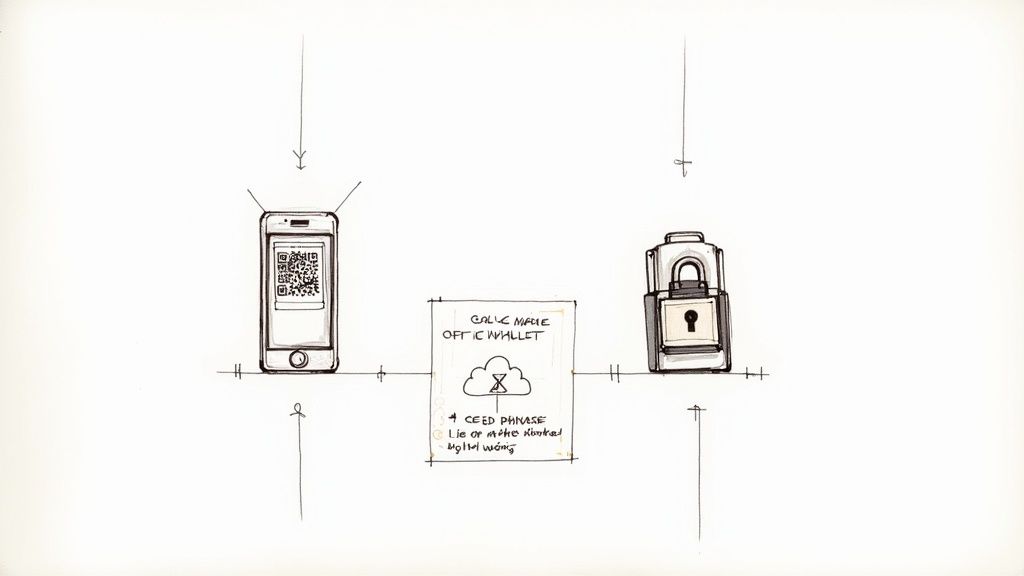
Right, so you've bought your first bit of crypto on an exchange. The big question now is, where do you keep it? Leaving it on the exchange is definitely the easiest option, but it's a bit like leaving your cash with the shopkeeper after you've paid. For real ownership and peace of mind, you’ll want to move your crypto into a personal digital wallet.
Think of it this way: the exchange is the marketplace, but the wallet is your own private, secure vault. This is a huge part of learning how to invest in cryptocurrency safely because it puts you in charge of your own assets. Let’s look at the main types of wallets you'll come across.
Hot Wallets: Your Everyday Spending Account
Most beginners start with a hot wallet, and for good reason. These are software programs that you run on your computer or phone, and they're always connected to the internet. You've probably heard of popular ones like Exodus or MetaMask.
Their biggest selling point is convenience. Because they're online, sending and receiving crypto is quick and easy. I like to think of a hot wallet as my everyday bank account—it's perfect for holding smaller amounts that I might need to use quickly. For instance, if you want to buy an NFT or try out a decentralised finance app, a hot wallet is exactly what you need.
Cold Wallets: Your High-Security Savings Vault
At the other end of the security spectrum are cold wallets. These are physical hardware devices—you'll see names like Ledger and Trezor mentioned a lot—that store your crypto completely offline. By staying disconnected from the internet, they're pretty much immune to online hacks and viruses.
A cold wallet is your savings vault. It’s built for the long-term storage of larger amounts of crypto that you don't plan on touching regularly. They're not as convenient for quick, daily transactions, but the security they offer is unbeatable. Honestly, holding a significant amount of crypto without a cold wallet is a risk most experienced investors just aren't willing to take.
The old saying in crypto is "not your keys, not your coins." Using a personal wallet means you control your private keys—the secret data that proves ownership—so only you can ever access your funds.
For a deeper dive to help you figure out which wallet suits your goals, check out our complete guide on choosing the right wallet for your needs.
Setting Up and Protecting Your First Wallet
Let’s quickly run through setting up a software (hot) wallet, as it’s the most common first step. The process itself is usually super simple, but there's one part that needs your absolute, undivided attention: looking after your seed phrase.
When you create a new wallet, it will give you a unique list of 12 or 24 random words. This is your seed phrase, sometimes called a recovery phrase. It's the master key to everything in your wallet. If you lose your phone or your laptop breaks, this phrase is the only way to get your crypto back on a new device.
Here is the single most important piece of advice I can give you:
- Write it down on paper. Do not, under any circumstances, store your seed phrase digitally.
- Never, ever take a screenshot of it. Don't save it in a text file, email it to yourself, or stick it in a cloud service like Google Drive.
- Store the physical copy somewhere incredibly safe and private. Some people use a fireproof safe, while others might split the phrase into two parts and keep them in different secret locations.
Anyone who gets hold of your seed phrase can take all of your crypto, and there's no customer support line to call. You are your own bank now. That responsibility begins and ends with protecting that phrase like it’s a priceless treasure.
Getting to Grips with Crypto Research
Stepping beyond the world of Bitcoin and Ethereum can feel a bit like heading into the wild west. With thousands of other cryptocurrencies—often called altcoins—out there, how do you find a project with real potential and avoid the ones built on pure hype? This is where you learn to do your own research, or DYOR as it's known in the crypto community.
It’s all about learning to look at a project with a critical eye, so you’re making decisions based on solid information, not just what’s trending on social media. The great thing is, you don’t need to be a financial whiz to do this well. By asking a few key questions and knowing where to find the answers, you can build the confidence to invest with your head, not just your gut.
Your First Port of Call: Free Research Tools
To start, you'll want to get familiar with a crypto data website like CoinMarketCap or CoinGecko. Think of these sites as a massive, free directory for the entire crypto market. They’re powerful and give you a vital snapshot of every coin.
Don't let the sheer amount of data overwhelm you. At this stage, you only need to focus on a couple of key numbers to get a feel for a project:
- Market Capitalisation (Market Cap): This is the total value of all of a project's coins currently out there. It's simply the current price multiplied by the number of coins available. A high market cap (in the billions of pounds) usually points to a more established, stable project like Bitcoin or Ethereum. A low market cap (millions or less) suggests a newer, riskier project that could be much more volatile.
- Circulating Supply: This figure tells you how many coins are actually available on the market. It’s also worth checking if there's a limit on the total number of coins that will ever exist. Bitcoin, for example, has a famous maximum supply of 21 million, which creates scarcity. A project with an infinite supply, on the other hand, could be prone to inflation down the line.
A good way to think about it is by comparing it to the stock market. A high market cap coin is like a huge, well-known company like Apple, while a low market cap coin is more like a small startup. Both can be great investments, but they carry very different levels of risk.
Getting Under the Hood: The Whitepaper
Once you've sized up the basic numbers, it’s time to find out what the project actually does. For this, you’ll need to look at its whitepaper. The whitepaper is basically the project's big plan—it lays out its mission, how the technology works, and its goals for the future.
Don’t worry, you don’t need to read it cover-to-cover or understand complex code. Your goal here is to skim through it to answer one crucial question:
What problem does this cryptocurrency solve? A solid project should have a clear, understandable purpose. For example, is it aiming to make international payments faster (like Ripple’s XRP)? Is it trying to build a new, decentralised internet (like Internet Computer's ICP)? If you can't easily figure out its real-world use, that should be a major warning sign.
The UK crypto market has seen 32% growth over the past year, and one of the most interesting trends is the move by everyday investors towards altcoins with specific uses in decentralised finance (DeFi). This shows that many UK investors are digging deeper and looking for projects with real functions, like lending or staking. If you’re curious about these trends, you can explore the full findings on European crypto adoption from Chainalysis to see how the market is maturing.
Checking Out the Team and Community
A project is only ever as good as the people building it. Take a look at the project's official website and find the team page. Are the founders and developers public figures with credible experience? For example, can you find their LinkedIn profiles? An anonymous team is almost always a sign to be cautious.
Finally, take the community's pulse. Is there an active, engaged group of supporters? Check out their social media channels like X (formerly Twitter) and join their Discord or Telegram channels. A healthy project has regular updates from the team, lively discussions, and a community willing to help newcomers. If all you see are posts hyping the price with rocket emojis, it might be all sizzle and no steak.
A transparent team and a buzzing community are often fantastic signs of a project’s long-term health. By pulling these simple research threads together, you can start to form your own informed opinion and make that first crypto investment a smart one.
Making Your First Crypto Purchase
Alright, you’ve picked your exchange, set up a secure wallet, and done your homework on a project that excites you. Now for the fun part: actually buying your first bit of crypto. This is where it all becomes real, and honestly, it’s much less scary than it sounds. Let's walk through it together, step-by-step.
First things first, you need to get some money onto the exchange. If you're in the UK, this is usually as simple as a bank transfer. Just look for a "Deposit" or "Add Funds" button on the platform. You'll be given an account number and sort code, and you can send your pounds (GBP) over using Faster Payments from your regular banking app. It's normally very quick.
Once your cash has landed in your account, you’re ready to go. Head over to the trading section and find the cryptocurrency you want to buy—let's say it's Bitcoin (BTC).
Placing Your First Order
When you click "Buy," you'll usually have two main choices. Getting your head around these is key for controlling how you enter the market.
- Market Order: Think of this as the "just get it done" option. It tells the exchange to buy your crypto immediately at whatever the current market price is. It’s fast, simple, and perfect for when you just want to get your foot in the door without any fuss.
- Limit Order: This option gives you more control. You set the exact price you're willing to pay. For example, if Bitcoin is currently trading at £52,000, you might think that's a bit high. You could set a limit order to buy only if the price drops to £50,000. Your order will just sit there and wait, and it will only be completed if the market hits your target price.
For a first-timer, a market order is often the easiest way to go. It takes the guesswork out and gets you invested right away.
What to Do After You Buy
Congratulations—you're officially a crypto owner! So, what’s next? The most important thing now is to have a plan. Staring at the price charts every five minutes is a recipe for stress. Most people who do well in this space adopt a clear, long-term strategy from the beginning.
Here are a couple of popular, beginner-friendly approaches to consider:
- HODLing (Holding On for Dear Life): This is the classic long-term strategy. The idea is simple: you buy a cryptocurrency you truly believe in and hold onto it for months or even years, ignoring the inevitable ups and downs along the way. Your focus is on the project's long-term potential, not the daily price swings.
- Dollar-Cost Averaging (DCA): This is a brilliant way to take emotion out of investing. You commit to buying a fixed amount of crypto at regular intervals—for example, £25 worth of Ethereum every Friday—no matter what the price is. This method smooths out the bumps; you automatically buy more coins when the price is low and fewer when it's high, giving you a better average cost over time.
Adopting a strategy like DCA fosters discipline and helps you build your position steadily. It’s an approach that reflects the growing maturity of the UK crypto market. In fact, by 2025, the UK became a world leader in crypto adoption, with nearly 24 million people—roughly 35% of the population—owning crypto. The average holding per user has also climbed past $2,286, which points to a strong belief in long-term investing. You can dive deeper into the UK's impressive growth in this crypto adoption report.
The infographic below neatly summarises the kind of research that should support any good buying and holding decision.
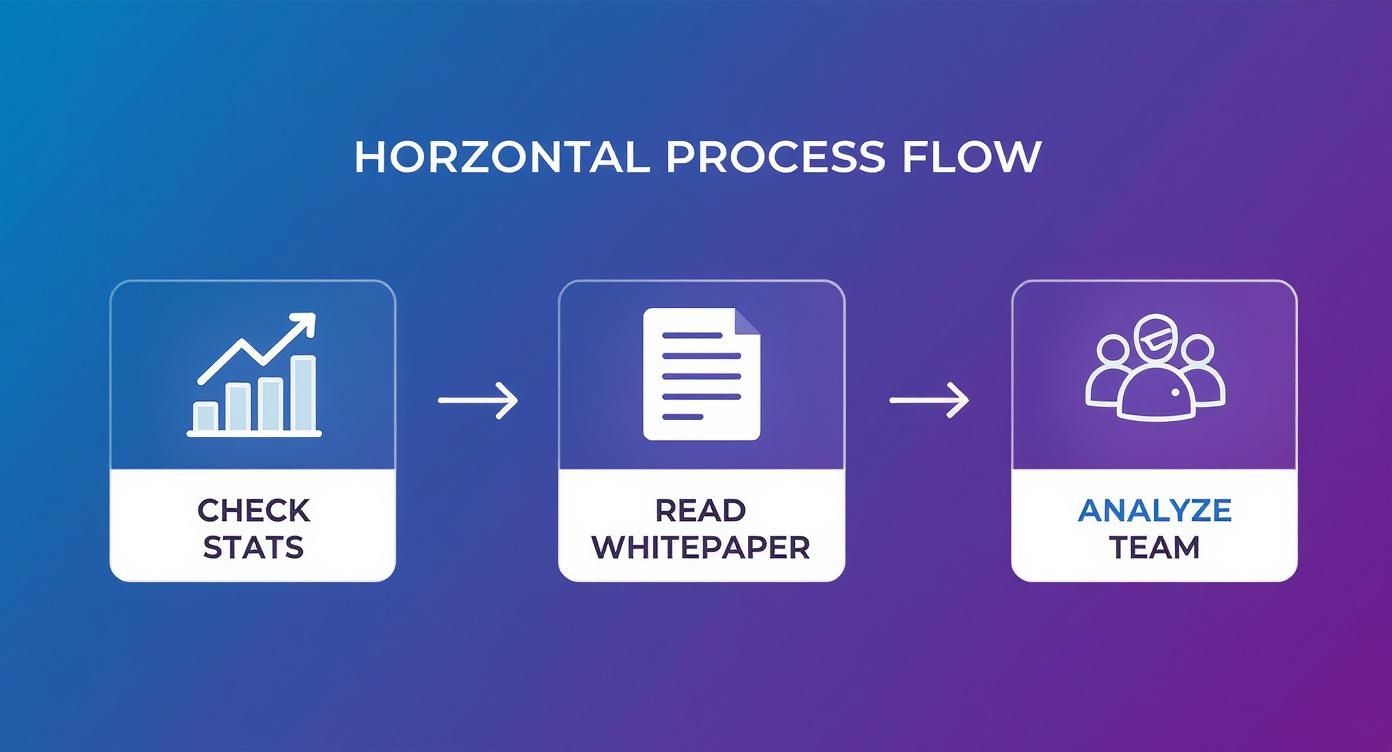
This process—checking the stats, reading the whitepaper, and sizing up the team—is the foundation of a solid investment, whether you decide to HODL for the long haul or build your stake gradually with DCA.
Managing Risks and UK Crypto Taxes
Alright, let's talk about the serious side of things. Putting your money into any investment means understanding the rules and the risks, and crypto is no different. The two biggest challenges you'll face at the start are the wild price swings (volatility) and getting your head around UK taxes. Nailing these from the beginning will make your crypto journey a whole lot smoother.
The crypto market is famous for its rollercoaster rides. Prices can shoot up one day and plummet the next, which can be pretty scary if you're not prepared for it. This brings us to the golden rule of investing: only put in what you can genuinely afford to lose. Seriously, this one principle will save you from making emotional, panicked decisions down the line.
Navigating Volatility and Common Scams
When the market eventually takes a dive—and trust me, it will—the absolute worst thing you can do is panic and sell everything at a loss. I've seen it happen time and time again. Experienced investors often see these downturns as buying opportunities, not the end of the world. A solid strategy, like dollar-cost averaging (investing a fixed amount regularly), helps you keep a level head and stick to your plan.
The other big danger out there is scams. Because crypto is still a relatively new space, it attracts a lot of shady people trying to trick newcomers. Be incredibly suspicious of anyone who slides into your DMs with a "guaranteed" investment opportunity or pops up pretending to be a support agent.
Here are a few of the most common scams I see people fall for:
- Fake Support Staff: You'll get a message on Discord or X (formerly Twitter) from someone claiming to be from your exchange or wallet provider. They'll say there's an "issue" with your account and ask for your private keys or seed phrase to "fix it." No legitimate company will ever ask you for this. Ever.
- Giveaway Scams: Scammers will create a fake social media profile of a famous person like Elon Musk and promise to double any crypto you send to their address. It's a classic trick that still catches people out. If an offer sounds too good to be true, it absolutely is.
- Phishing Emails: You might get an email that looks exactly like it's from your exchange, urging you to click a link to verify your account. That link will take you to a copycat of the real website, designed purely to steal your login details.
The bottom line is this: your security is your own responsibility. A healthy dose of scepticism and the habit of double-checking everything is your strongest defence against getting scammed.
Understanding Your UK Tax Obligations
Here in the UK, any profits you make from crypto are taxable, just like gains from stocks or other investments. It might sound intimidating, but it's manageable as long as you stay on top of it from your very first trade.
The main one you need to know about is Capital Gains Tax (CGT). This tax applies whenever you ‘dispose’ of a crypto asset. A disposal isn't just selling; it also happens when you:
- Sell your crypto for pounds (or any other fiat currency).
- Trade one type of crypto for another (for instance, swapping your Bitcoin for Ethereum).
- Use your crypto to buy something, like a coffee or a new laptop.
Every UK taxpayer gets an annual CGT allowance, which is a certain amount of profit you can make each tax year before any tax is due. If your gains go over that allowance, you have to report it all to HMRC.
If you take only one piece of advice from this section, let it be this: keep detailed records of every single transaction. I’m talking about the date, the crypto involved, its value in pounds at the time, and what you did with it. While this isn't official financial advice, believe me, having organised records from day one will save you a world of stress when tax season comes around.
Got Questions? Let's Get Them Answered
It's perfectly normal to have a few more questions before you jump in. In fact, it’s a good sign – it means you’re thinking critically. Let's walk through some of the most common things that new investors ask.
A big one is always, "How much money do I actually need to start?" The good news is, the barrier to entry is incredibly low. Most popular UK exchanges will let you get started with as little as £10 or £20. The real key is to begin with an amount you'd be genuinely okay with losing. This isn't about being negative; it's about giving yourself the freedom to learn the ropes without the stress.
Digging a Little Deeper
Once people get past the initial setup, a few other questions tend to pop up.
Is it too late to buy something like Bitcoin?
You see the headlines and the massive price growth over the years and it's easy to feel like you've missed the boat. But many people don't look at it as a get-rich-quick asset anymore. Instead, they see it as a long-term store of value, a bit like digital gold. Forget trying to perfectly time the market – it's a nearly impossible game. Focus on your own goals and remember you don't need to buy a whole coin; you can own a tiny piece to get started.
What's the absolute safest way to store my crypto?
If security is your top priority, nothing beats a hardware wallet. Think of it as a small, secure vault that keeps your private keys completely offline, far away from hackers. This is often called "cold storage" and it's the gold standard for a reason.
For smaller amounts or for crypto you plan to actively trade or use, a reputable software wallet (a "hot wallet") is a solid, convenient choice. Just remember, its security is only as strong as your own habits. Protect your device, and guard that seed phrase like it's the key to your house – because, in the digital world, it is.
Do I really have to worry about taxes?
In a word, yes. In the UK, any profits you make from your crypto activities could be subject to Capital Gains Tax. HMRC considers it a "disposal" when you:
- Sell your crypto for pounds (GBP)
- Swap one cryptocurrency for another
- Spend your crypto directly on goods or services
You do get an annual tax-free allowance, which is helpful. But the most important piece of advice I can give you is this: keep careful records of every single transaction from day one. It's not the most exciting part of investing, but it will save you a world of pain when it's time to file your taxes.
Ready to build on this knowledge and invest with real confidence? At The Coin Course, we've got expert-led articles and clear guides designed to help you master every step of your crypto journey. Start learning with The Coin Course today.