So, you want to get your hands on some free crypto through an airdrop? It all comes down to showing you're an active, early user of a new project. Usually, this means trying out a new decentralised application (dApp), holding a certain token, or getting involved with the community before a cut-off point known as the "snapshot" date. Get your wallet address on that list, and you're in line for a reward.
What Are Crypto Airdrops, and Are They Worth the Effort?
Imagine a new crypto project sending a surprise gift of free tokens straight to your digital wallet. That's pretty much what an airdrop is. It's a marketing move that new projects use to build a community, reward early supporters, and create a lot of buzz. Think of it as their way of saying "thanks" for getting involved before everyone else.
But is chasing these airdrops actually worth your time? If you're smart about it, absolutely. The potential reward can be huge. For instance, early users of the Uniswap decentralised exchange were gifted 400 UNI tokens, which later became worth thousands of pounds. More recently, the Arbitrum airdrop gave out ARB tokens to people who used its network, turning some simple interactions into a nice surprise for many.
These aren't just one-off lucky breaks. They prove an important point: hunting for airdrops is more than just a search for free money. It's a genuine chance to get involved with new, interesting projects and maybe get a piece of their future success.
Here's a quick look at the whole process.
A Quick Overview of How to Receive an Airdrop
Here is a simple summary of the key actions you need to take to successfully claim a crypto airdrop.
| Phase | What You Do | Why It's Important |
|---|---|---|
| Discovery | Actively search for new projects that haven't launched a token yet. | Getting in early is everything. You need to be active before the snapshot is taken. |
| Preparation | Set up a special crypto wallet (like MetaMask) and put some "gas" money in it (e.g., ETH). | You'll need this to pay for transaction fees as you interact with different dApps. |
| Interaction | Use the project's platform. This could mean swapping tokens, adding to liquidity pools, or testing out new features. | Projects reward real users. The more you engage, the bigger your potential reward. |
| Claiming | Once the airdrop is announced, connect your eligible wallet to the official claim page and follow the instructions. | This is the final step to get the tokens into your wallet. Always double-check the website address to avoid scams. |
Following these phases puts you in a great position to qualify for some of the most promising airdrops out there.
Why The Hype Is Real
Learning how to get airdrops is about more than just grabbing tokens. It's your way of becoming part of a new project's journey. When you take part, you're not just another user; you're an early adopter helping to test, secure, and grow a network from the start. This is exactly the kind of involvement projects are looking for, and they're happy to reward it.
This trend is only getting bigger as more people get into crypto. In the UK, for example, interest is growing fast. The number of UK adults holding crypto climbed to 24% as of April 2025, a massive jump from 18% just a year earlier. This growing crowd is the perfect audience for new projects to launch airdrops to. You can read more about these findings in the report on UK's crypto ownership trends on Cointelegraph.
Finding and Vetting Airdrop Opportunities

With so many projects starting up, the first big task is to sift through them all to find real opportunities. Knowing where to look is half the battle. Your goal is to find promising projects early, way before they become famous, as this is usually when you have the best chance to qualify.
Specialised websites are a great place to begin. Places like Airdrops.io and DappRadar are brilliant because they list current and upcoming airdrops. They usually explain the tasks you need to do, which makes it much simpler to keep track of everything.
Another fantastic source is social media. Following well-known crypto researchers and influencers on X (formerly Twitter) can give you a real advantage. They often share valuable information on projects that aren't widely known yet.
Becoming an Airdrop Detective
Finding a potential airdrop is just the first part. You absolutely have to learn how to check it properly to avoid scams and wasting your time. A real project will never ask for your wallet's private key or seed phrase. Think of these like the master keys to your entire crypto savings—they are for your eyes only. If anyone asks for them, it's a 100% scam. No question.
The main thing to remember is simple: a real project wants you to use their product, not give them your money or keys. Scammers try to create panic and ask for secret information. Genuine projects focus on building a real community around their technology.
To dig a bit deeper, it helps to have a quick investigation routine. Start with the project's official website and social media. Is there a genuine, active community on their Discord or Telegram? Look for real conversations and questions, not just a load of bot comments saying "great project!" A healthy community is a very good sign.
Your Quick Vetting Checklist
Before you spend any time on a new project, run through these quick checks. It’ll save you a lot of trouble later.
- Team Transparency: Are the team members public (doxxed)? An anonymous team isn't automatically bad in crypto, but a public team with a history of success definitely adds more trust.
- Project Goals: Read their whitepaper or documents. Are they solving a real problem, or just making a copy of something else? Take the music platform Audius, for example. Their airdrop was designed to reward the artists and playlist creators who helped build the platform—a clear, sensible goal.
- Tokenomics: Check out how the tokens are being shared. A huge amount set aside for the team that they can sell quickly could be a warning sign. It might mean they plan to cash out fast.
Getting into this detective mindset is key. It helps you focus your energy on projects that not only have the chance of a good airdrop but are also building something genuinely useful for the future.
Getting Your Crypto Wallet Ready for an Airdrop
Think of your crypto wallet as the most important tool in your airdrop-hunting kit. But not just any wallet will work. To actually receive airdropped tokens, you need what’s called a non-custodial wallet.
This is totally different from keeping your crypto on an exchange like Coinbase or Binance. With a non-custodial wallet, you—and only you—hold the keys. It’s your own personal digital vault, giving you full control over your funds.
Choosing and Setting Up Your Wallet
Getting started is surprisingly easy. For anything happening on Ethereum or related blockchains like Polygon, a wallet like MetaMask is the go-to choice. If you’re exploring the Solana world, Phantom is your best option. These usually come as simple browser extensions or mobile apps.
If you're new to this, we have a complete guide that walks you through setting up browser extension wallets like MetaMask.
The move towards personal wallets is a growing trend. In the UK alone, around 3.2 million people now own Bitcoin, a number that's shot up three times since 2021. This increase, especially among people aged 25-44, shows more and more are taking direct control of their crypto, which is exactly what a non-custodial wallet lets you do. You can read more about Bitcoin ownership trends in the UK on MEXC Blog.
Adding Networks and Funding for Gas
Once your wallet is installed, you aren't just stuck on one blockchain. Airdrops happen everywhere—on Solana, Polygon, Arbitrum, you name it. You'll need to set up your wallet to connect with these different networks. Luckily, adding a new network to MetaMask usually just takes a couple of clicks and opens up a whole new world of projects to try out.
This infographic breaks down the simple flow for prepping your wallet.
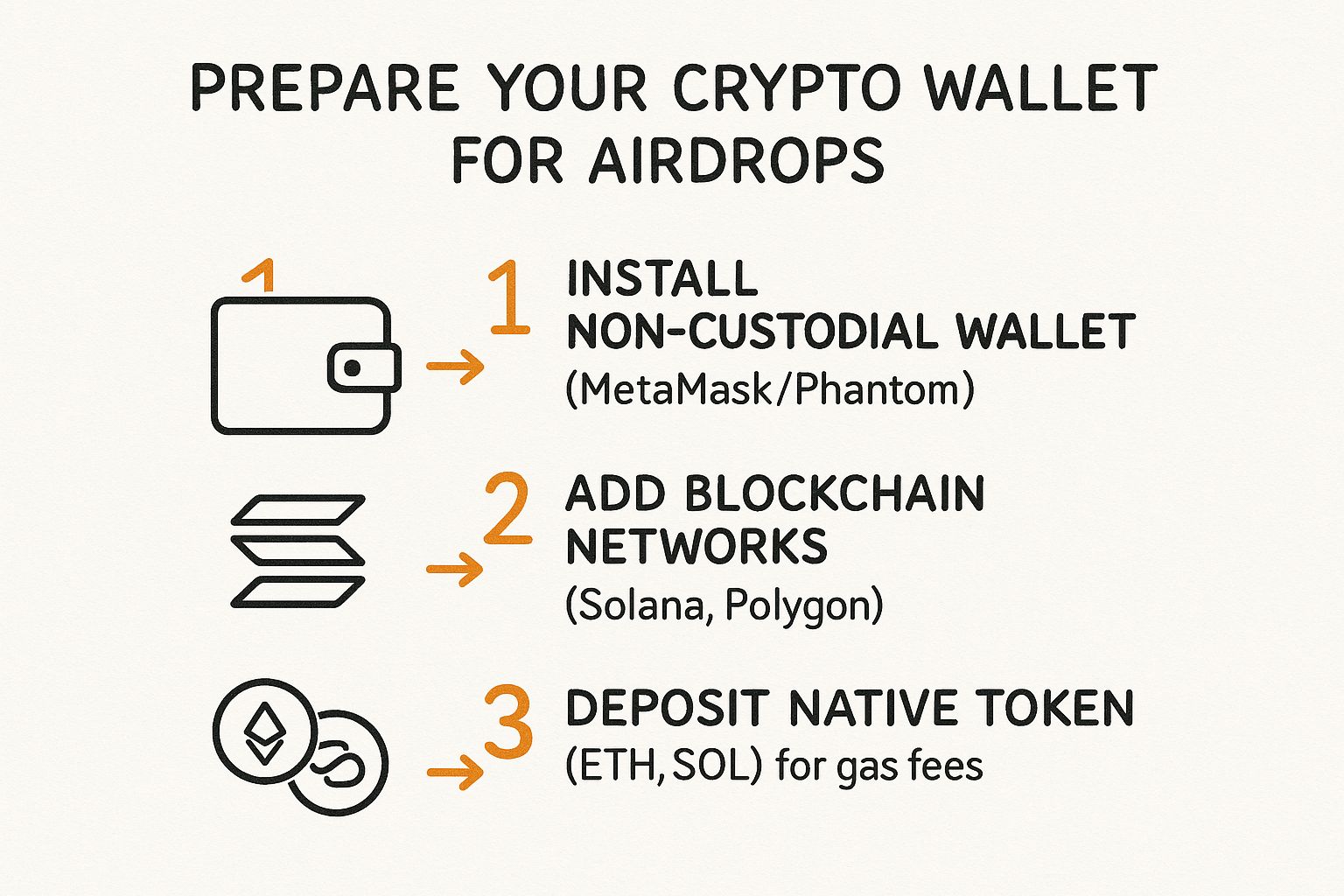
Getting these three things sorted—installing a wallet, adding the right networks, and funding it for gas—is the essential prep work for any serious airdrop hunter.
A small but crucial detail that often catches beginners is the need for "gas fees." Every single action on a blockchain, from a simple token swap to claiming an airdrop, requires a small fee. This is always paid in the network's main coin.
- On the Ethereum network, you'll need a little bit of ETH.
- For Solana, you’ll need some SOL.
My advice? Always keep a small amount of the main token in your wallet. It makes sure that when an airdrop goes live, you're ready to pay the fee and claim your tokens without any annoying delays.
Completing Tasks to Qualify for Airdrops
The biggest airdrops almost never just land in your wallet by magic. Let’s be honest, you usually have to earn them. Projects are looking for real users who are actively testing things out and helping their ecosystem grow, not just a bunch of wallet addresses waiting for free cash. This means you need to get involved and complete a few tasks.
At the end of the day, these tasks are all designed to prove one thing: your engagement. When you use a new decentralised application (dApp), you’re helping the team test its features, create activity on the blockchain, and build a real community before the token even exists. It's a classic win-win: your early help gets rewarded later on.
What Kind of Tasks Are We Talking About?
The exact things you'll need to do can be very different from one project to another, but they nearly always involve using the platform's main features. Basically, you're taking the dApp for a proper test run.
A common example is using a decentralised exchange (DEX). A new DEX on the Arbitrum network, for instance, might ask you to do a few things to get noticed:
- Swap tokens: A simple exchange of one crypto for another, like trading some ETH for USDC.
- Provide liquidity: This means depositing a pair of tokens (like ETH and USDC) into a liquidity pool, which helps other people make trades.
These kinds of actions create transactions and prove you know how to use the platform. We actually break down how to connect your wallet for these interactions in our guide on wallet integration with DeFi protocols.
Another frequent activity is playing around on a 'testnet'. Think of this as a practice version of the blockchain where you use fake, worthless tokens to try out the dApp. For instance, you might be asked to borrow and repay assets on a new lending app's testnet. It’s a completely risk-free way to show you're interested.
The whole point is to build a history of on-chain activity connected to your wallet address. When the project eventually takes its eligibility "snapshot," they'll look at the blockchain for wallets that have done these key actions. The more you’ve done, and the more often, the better your chances of getting a good amount of tokens.
Beyond Simple Swaps
It’s not always about trading, though. To filter out bots, projects are getting more clever in how they measure real engagement.
You might also find yourself needing to:
- Bridge Assets: This just means moving tokens from one blockchain to another. A common task is bridging ETH from the main Ethereum network over to a Layer 2 network like Base.
- Mint an NFT: Some projects offer a free (or very cheap) special NFT for their early supporters. Minting it is a simple transaction that creates a permanent record of your early involvement.
- Community Participation: Sometimes, it's less about what you do on the blockchain and more about being part of the community. This could be as simple as joining their Discord, voting on a proposal, or completing a few quests on platforms like Galxe or Zealy.
By ticking these boxes, you’re sending a clear message to the project that you’re an active, valuable community member. This is what really boosts your odds of receiving that airdrop you've been working for.
Safely Claiming and Managing Your New Tokens
So, you’ve qualified for an airdrop. That’s brilliant! This is the moment you've been waiting for, but it’s also when you need to be extra careful. Scammers are experts at making convincing fake websites—perfect copies of the real thing—designed to empty your wallet the second you connect.
Your number one priority is safety. Always, and I mean always, get the official claim link directly from the project's own channels. That means their official X (formerly Twitter) account, their announcements channel on Discord, or their official blog. Never click on links sent in private messages or found on random social media posts.
Once you’re sure you're on the real claim page, the process is usually simple: connect your wallet and sign a transaction to get your tokens.
After the Claim: What Now?
When the transaction goes through, the tokens are officially yours. But don't worry if they don't show up in your wallet right away. This is totally normal.
You'll probably need to manually add the token's contract address to your wallet. You can find this official address on a block explorer like Etherscan or by checking the project's official documents. Once added, your new balance should appear.
Now for the big decision: do you hold or sell? There's no single right answer here. Some airdrop hunters sell a bit straight away to lock in profits and cover their gas fees, while others hold on for the long run, believing in the project's future. Your choice should be based entirely on your own research and how much risk you're comfortable with.
A critical mistake is letting the excitement of the moment make you careless. Before you connect your wallet to any claim page, triple-check the website address. A single wrong letter or a different domain (like .net instead of .com) could be the sign of a scam site.
Keeping Safe from Airdrop Scams
Scammers love the hype around airdrops. They know people are keen to claim their tokens and use that excitement against them. Here’s a quick list of the most common tricks they use.
Table: Common Airdrop Scams and How to Spot Them
| Scam Tactic | How to Identify It | What to Do |
|---|---|---|
| Phishing Websites | The URL looks a bit off (e.g., "projcet-claim.com" instead of "project-claim.com"). The website design might have small mistakes. | Triple-check the URL against the official source. Never rush. Bookmark the real site once you find it. |
| "Surprise" Airdrops | You get random, unknown tokens in your wallet. The token name tells you to visit a website to "claim" more or "enable" them. | Ignore them completely. Do not go to the website or try to interact with the tokens. It's a trap to drain your wallet. |
| Fake Support DMs | A "support admin" messages you on Discord or Telegram offering to help you claim your airdrop or fix a problem. | Block and report them. Real project staff will never message you first or ask for your seed phrase. All support is done in public channels. |
| Malicious Transactions | A claim site asks you to sign a "Set Approval For All" transaction. | Reject the transaction immediately. This gives the contract permission to spend all of your tokens, not just the airdropped one. Real claims rarely need this. |
Knowing about these tactics is your best protection. Always be a little suspicious and trust official sources only.
Finally, let's talk about the less exciting but very important part: taxes. In the UK, receiving airdropped tokens can be a taxable event. If you got them for free without doing anything, they might not be taxed at first. However, if you completed tasks to get them, they're often treated as income, and you'll need to declare their value.
When you later sell those tokens for a profit, that gain will be subject to Capital Gains Tax. For a detailed guide, it's worth reading up on UK crypto airdrop taxes on Cointracking.
The need for safety doesn't end once the tokens are in your wallet. You can learn more about protecting your crypto by reading our guide on recognising and avoiding crypto scams. Stay safe out there.
Common Questions About Crypto Airdrops
Jumping into the world of airdrops can feel a bit confusing at first. Let's clear up some of the most frequent questions that people have when they're getting started.
Do I Need to Pay for an Airdrop?
This is a big one, and the answer is a definite no. You should never pay a project directly to get airdropped tokens. If someone asks you for money up front, it's almost certainly a scam.
However, you will need a small amount of the network's main crypto (like ETH on Ethereum) in your wallet. This is to cover the transaction cost, known as a "gas fee," which you pay to the network—not the project—when you officially claim your tokens.
How Long After a Snapshot Is the Airdrop?
The waiting can be the toughest part. A "snapshot" is just the moment a project records all the wallets that have qualified. After that, the actual airdrop claim might be available in a few days, a few weeks, or sometimes even months later.
There's no set timeline, so your best bet is to keep a close watch on the project's official channels. Follow their Twitter account or join their Discord server for the most reliable announcements.