
Before you even think about making your first crypto trade, it's vital to get the basics down. It all begins with learning the language and the core ideas that make this market tick. Picture it like building a house – without a solid foundation, everything you construct on top is at risk of falling apart.
Building Your Crypto Trading Foundation
So, you’re ready to jump into the world of crypto trading. That's great! But let’s tap the brakes for a second. Before you dash off to an exchange and start clicking buttons, we need to lay some groundwork. The crypto market is known for its wild price swings, and going in unprepared is one of the quickest ways to lose your money.
Think about it this way: you wouldn't try to sail a ship in a storm without first learning how to read a map and a compass. The same idea applies right here.
Grasping the Core Concepts
First up, let’s get comfortable with the lingo. You’ll see these terms pop up everywhere, so understanding what they mean isn't just helpful, it's essential.
Blockchain: This is the clever technology behind most cryptocurrencies. Imagine a digital notebook that is shared across thousands of computers. Every transaction is a permanent entry, and because no single person controls it, it's incredibly secure and hard to cheat. This is what gives crypto its strength.
Bitcoin (BTC) vs. Ethereum (ETH): While you’ve probably heard of both, they serve different purposes. Bitcoin was the first of its kind, created to be a digital form of money and a way to store value, a bit like digital gold. Ethereum, on the other hand, is more like a global supercomputer that lets developers build applications on its network. Its value comes from its usefulness.
Altcoins and Stablecoins: Any crypto that isn't Bitcoin is generally called an altcoin (short for 'alternative coin'). This covers a huge range, from major projects like Solana (SOL) and Cardano (ADA) to fun, community-driven tokens like Shiba Inu (SHIB). Stablecoins are a different kettle of fish. Coins such as Tether (USDT) or USD Coin (USDC) are linked to a stable asset, usually the US dollar, to keep their price steady.
Understanding these differences is key. Investing in a brand-new altcoin is a high-risk, high-reward game, while buying a well-known asset like Ethereum or using a stablecoin to hold value are completely different strategies.
The Two Pillars of Market Analysis
Okay, so you know what the assets are. Now, how do you figure out when to buy or sell? Traders usually lean on two main methods. You don't have to become an expert overnight, but you definitely need to know how they work.
Technical Analysis (TA)
This is the art of reading charts. People who use TA believe that a crypto's price history tells you everything you need to know. By looking at past price movements and trading volume, they search for patterns and use special tools called indicators to guess where the price might go next.
It's all about finding trends and important price levels. For instance, a technical trader might see that every time Bitcoin's price drops to $60,000, it bounces back up. They would call this a "support level" and might see it as a good time to buy, expecting another rebound. To get a better handle on this, check out our guide on the cryptocurrency trading basics for beginners.
Fundamental Analysis (FA)
If TA is about charts, FA is about being a detective for the project itself. This method involves digging into the details to figure out if a crypto has real, long-term value.
Someone using FA would ask important questions:
- What problem does this project actually solve? For example, is it making international payments faster or creating a new kind of gaming world?
- Who is the team behind it? Do they have a good track record?
- How large and active is the community? Has it landed any big partnerships?
For example, an analyst might study the whitepaper for a project like Chainlink (LINK), see its potential to connect blockchains with real-world data, and decide it's a good long-term investment, no matter what its price is doing today. It's a strategy focused on substance rather than short-term market hype.
Setting Up Your UK Trading Toolkit
Alright, you’ve got the theory down. Now it’s time for the practical part: getting the tools you need to actually trade. This is where we shift from learning to doing. Your first big step is picking a cryptocurrency exchange—this will be your marketplace, the spot where you'll buy, sell, and watch your assets.
The crypto scene in the UK has grown enormously over the last few years. It's now much easier to get involved, with more users and a ton of information available. In fact, nearly 24 million people in the UK, which is about 35% of the population, now own some form of cryptocurrency. The average amount held per person has also jumped to over $2,286, which shows that people are taking it more seriously.
Choosing Your UK Crypto Exchange
Not all exchanges are created equal, especially when you're just starting. You need a platform that is simple to use but doesn't cut corners on security or charge you a fortune in fees. For traders in the UK, a few names always come up as great places to begin.
Here’s a quick rundown of some popular options:
- Coinbase: Often the first stop for newcomers, and for good reason. Its app is incredibly clean and straightforward, making your first crypto purchase feel as easy as ordering a takeaway. The flip side is that its fees can be a bit higher than some competitors.
- Kraken: A fantastic all-rounder with a great reputation for being secure and having more reasonable trading fees. Its platform has more features, but it's still easy enough for a beginner to get the hang of. Plus, their customer support is known to be excellent.
- Binance: The biggest exchange in the world, offering a massive selection of cryptocurrencies and advanced tools. For a complete beginner, the sheer number of choices can feel a bit overwhelming, like trying to drink from a fire hose. It's a brilliant platform, but maybe one to move to once you have more experience.
To help you choose, here's a simple table.
Comparing Popular UK Crypto Exchanges for Beginners
Picking your first exchange can feel like a big decision, but the main thing is to find one that suits you right now. You can always open an account on another platform later. This table gives you a quick comparison of the top choices for UK beginners.
| Exchange | Best For | Beginner Friendliness | Typical Fees |
|---|---|---|---|
| Coinbase | Absolute Simplicity | ⭐⭐⭐⭐⭐ | 1.49% - 3.99% for card buys, 0.6% maker/taker |
| Kraken | Security & Lower Fees | ⭐⭐⭐⭐ | 0.16% maker / 0.26% taker (pro) |
| Binance | Huge Coin Selection | ⭐⭐⭐ | 0.1% spot trading fee, plus network fees |
Ultimately, the 'best' exchange is the one where you feel comfortable and confident enough to start without feeling lost.
The infographic below helps to show the journey you're about to start. It all begins with the blockchain technology, which is the foundation for the coins you'll trade, and leads to the market analysis you'll perform on these platforms.
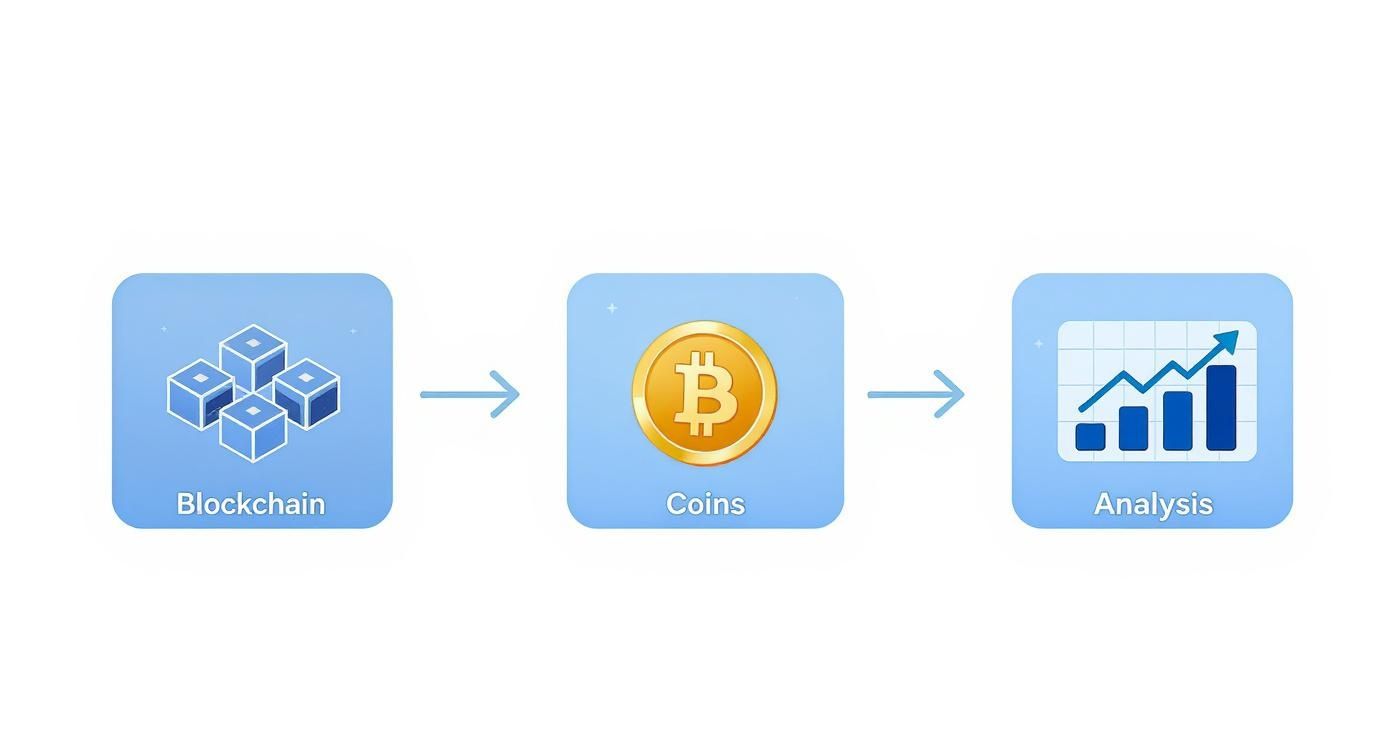
Think of it like this: you understand the engine (blockchain), you choose your car (the coin), and now you're learning to drive (analysis and trading).
Securing Your Account and Assets
Once you've chosen your exchange, your next task is the most crucial one: security. The crypto world can be a target for hackers, so protecting your account isn't just a good idea—it's absolutely vital.
First off, set up Two-Factor Authentication (2FA). This adds a strong second layer of protection. Instead of just needing your password, logging in will also require a special, time-sensitive code from an app on your phone, such as Google Authenticator. It’s a small step that makes a huge difference.
Next, you need to understand the different kinds of wallets.
- Hot Wallets: These are connected to the internet, like the wallet that comes with your exchange account. They are handy for active trading but are more open to online risks.
- Cold Wallets: These are offline hardware devices, like a Ledger or a Trezor. They store your crypto completely offline, offering the best security for investments you plan to hold for a long time.
When you're new, it's fine to keep a small amount for trading in an exchange's hot wallet. But as your portfolio gets bigger, you should really move the majority of your funds to a cold wallet. It’s the single best thing you can do for security.
If you want to dive deeper, our guide on choosing the right wallet for your needs explains everything with detailed comparisons to help you choose.
Making Your First Deposit
The final piece of the puzzle is putting money into your account. To do this with a UK-regulated exchange, you’ll need to complete a Know Your Customer (KYC) check. This usually involves uploading a photo of your ID (a driving licence or passport is perfect) and sometimes a recent bill to prove your address.
It might feel a bit like an intrusion, but KYC is a standard process that all legitimate platforms use to stop illegal activities. Once you're verified, you can link your UK bank account and deposit British Pounds (GBP), often using Faster Payments, which is quick and usually free. Then you're all set to make your first trade.
Learning to Read the Language of the Market
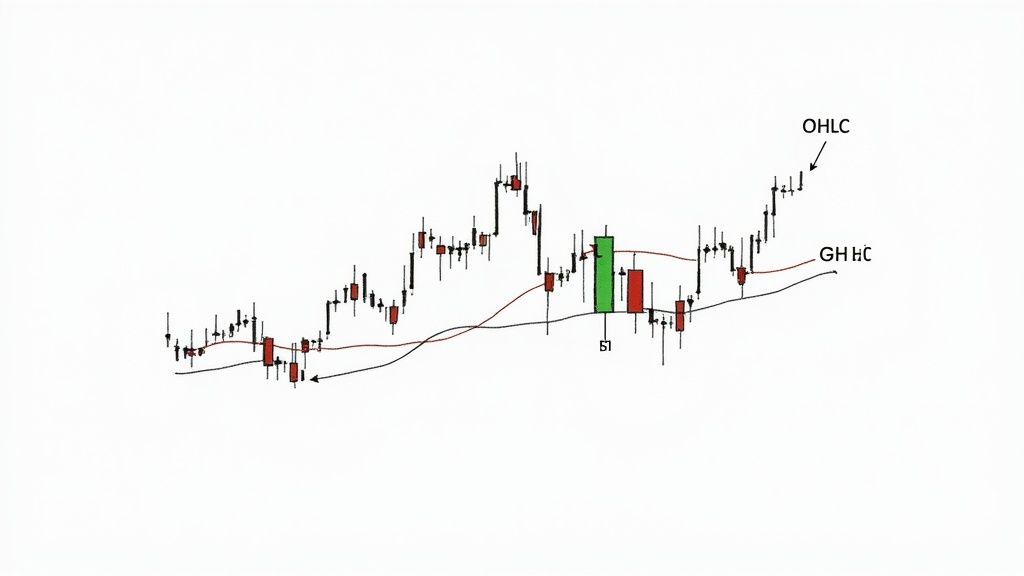
Opening a trading platform for the first time can feel like looking inside an aeroplane's cockpit—a confusing mix of flashing numbers, spiky lines, and blinking lights. It can be intimidating. But those charts aren't as complicated as they look.
Think of them as telling a story about the constant battle between buyers and sellers. Learning to read that story is your first big step towards trading with confidence. It's the difference between making a smart decision and simply gambling based on something you saw on social media.
Decoding Candlestick Charts
The first thing you'll almost always see is a candlestick chart. Each of those little "candles" gives you a picture of the price action over a certain time—whether it's one minute, an hour, or a day—and it packs a lot of information into a simple shape.
Let’s imagine you’re looking at a daily chart for Bitcoin. A single candle tells you the whole story of that day's trading.
- The Body: This is the thick, boxy part. If it's green, it means the price finished higher than it started (buyers were in control). If it's red, the price finished lower (sellers won the day).
- The Wicks: These are the thin lines sticking out from the top and bottom. The very top of the upper wick shows the highest price reached during that time, while the bottom of the lower wick shows the lowest price.
A series of these candles tells a bigger story. A line of long, solid green candles? That suggests strong buying. A string of red ones? The price is likely heading down.
Identifying Support and Resistance Levels
As you watch the charts, you'll begin to notice something curious. Prices don't just move up and down randomly; they often seem to bounce off invisible floors or hit invisible ceilings. In trading, we call these support and resistance levels.
Support is that price floor. It's a point where a downward trend often loses steam because buyers are likely to step in and start buying. For example, if you see Ethereum's price drop to £2,200 and then bounce back up several times, you've just spotted a key support level.
Resistance is the opposite—it's the price ceiling. This is where an upward trend often runs into trouble as sellers start to take their profits. If Bitcoin repeatedly climbs towards £55,000 but struggles to push past it, that level is acting as a major resistance.
Knowing where these levels are gives you a big advantage. When an asset is nearing a strong support level, it could be a good buying opportunity. Likewise, as it approaches a tough resistance, it might be a smart time to consider selling.
Using Simple Indicators to Gain an Edge
If charts tell the story, then technical indicators are like the narrators, giving you extra clues and context. You don't need to flood your screen with dozens of them. In fact, starting with just one or two can hugely improve your analysis.
Let's look at two of the most popular, beginner-friendly indicators out there.
Moving Averages (MA)
A Moving Average helps to smooth out the choppy price action to give you a clearer picture of the overall trend. It works by calculating the average price over a specific period, like the last 50 days.
- The 50-day MA: This is a popular tool for seeing the medium-term trend. If the price is trading above its 50-day MA, the general feeling is positive.
- The 200-day MA: This is the big one for the long-term trend. A price trading above its 200-day MA is a classic sign of a strong, long-term uptrend.
A powerful signal that many traders look for is the "Golden Cross"—this happens when the shorter-term 50-day MA crosses above the longer-term 200-day MA. It’s often seen as a very positive sign for the market.
Relative Strength Index (RSI)
The RSI is known as a momentum indicator. It measures how fast and how much an asset's price has changed, moving on a scale from 0 to 100. Its main job is to help you spot when something might be overbought or oversold.
- Overbought: An RSI reading above 70 is a warning light. It suggests an asset has been bought up very quickly and might be due for a price drop.
- Oversold: An RSI reading below 30 signals the opposite. The asset may have been sold off too much and could be ready for a comeback.
Imagine you see that Cardano (ADA) has an RSI of 25 just as its price hits a known support level. That combination could be a strong hint that a price reversal is on the horizon, potentially marking a great time to buy.
By combining these simple tools—candlesticks, support/resistance, and an indicator like the RSI—you’re no longer just guessing. You're starting to build a solid method for analysing any crypto chart you come across.
4. Developing Your First Crypto Trading Strategy
Okay, you've got a feel for reading charts. Now it's time to create your plan of action. Honestly, trading without a strategy is like going on a road trip without a map—you'll end up somewhere, but probably not where you intended. A good strategy changes pure guesswork into a structured method with clear rules for when to buy and when to sell.
The trick is to find a style that suits your personality, your daily routine, and how much time you can realistically set aside. There is no single "best" strategy; the right one for you is the one you can stick to consistently. Let’s explore a couple of popular approaches that are a great match for beginners.
Swing Trading: Capturing the Mid-Term Moves
Swing trading is a brilliant starting point for most newcomers because it doesn't require you to be glued to your screen all day. The whole idea is to catch the "swings" in price that happen over several days or even a few weeks. You aim to profit from one significant market move instead of lots of tiny ones.
This style is perfect for someone who has a day job and can check the markets once or twice a day. It uses a blend of technical analysis on daily charts to find good entry points, along with a bit of awareness of major news so you don't get caught out.
A swing trader’s best friend is patience. You might find the perfect setup but have to wait a couple of days for the price to reach your ideal entry point.
Day Trading: Riding the Daily Waves
Day trading, on the other hand, is a much more active and intense approach. As the name suggests, a day trader opens and closes all their trades within the same day. This means you never have money at risk in the market overnight. The aim is to make smaller, more frequent profits from the price movements that occur during the day.
This style demands a serious time commitment and an almost robotic level of discipline. Day traders spend their time on shorter-term charts—like the 15-minute or 1-hour charts—and often use indicators like Moving Averages and the RSI to make quick decisions.
Key Takeaway: Choosing between swing and day trading really depends on your schedule. If you can dedicate several focused hours to the market each day, day trading might appeal to you. If not, the slower rhythm of swing trading is a much more practical and less stressful option.
Putting a Strategy into Action: A Swing Trade Example
Theory is one thing, but let's walk through a real-world example. Imagine you're looking at the chart for an altcoin like Solana (SOL) and want to set up a swing trade.
Identify the Trend: First, you open the daily chart. You see that SOL has been in a steady uptrend for weeks, making higher highs and higher lows. This tells you the general momentum is positive, so it makes sense to only look for chances to buy.
Find a Key Level: As you study the chart, you spot that the price has recently pulled back and is getting close to a former resistance level around £120. This old ceiling could now become a new floor (support). At the same time, the RSI indicator is dipping below 30, suggesting that the selling might be running out of steam.
Define Your Entry and Exits: With this info, you can now create a clear plan:
- Entry: You place a buy order at £122, just above that key support level.
- Stop-Loss: To protect your money if you're wrong, you set a stop-loss order at £115. If the price falls to this level, your trade will automatically close for a small, controlled loss.
- Take-Profit: You look up the chart and find the next major resistance level is at £145, setting this as your target to take profits.
By setting these three points before you even enter the trade, you remove emotion from the process. Your only job now is to let the trade unfold according to the rules you've established.
It's also worth knowing that the crypto market in the UK offers more than just buying and selling coins directly. The UK’s crypto derivatives market has grown a lot, giving traders new ways to use more advanced strategies. Globally, derivatives make up about 76% of all crypto trading volume.
The daily trading volume for these products has hit an average of $24.6 billion, which shows just how busy this part of the market is. For UK traders, this means more opportunities to learn about futures and options on platforms like Binance UK and Kraken, which offer guides to help users understand these more complex tools. You can read more about these crypto derivatives market statistics to get the full picture.
Mastering Risk Management to Protect Your Capital
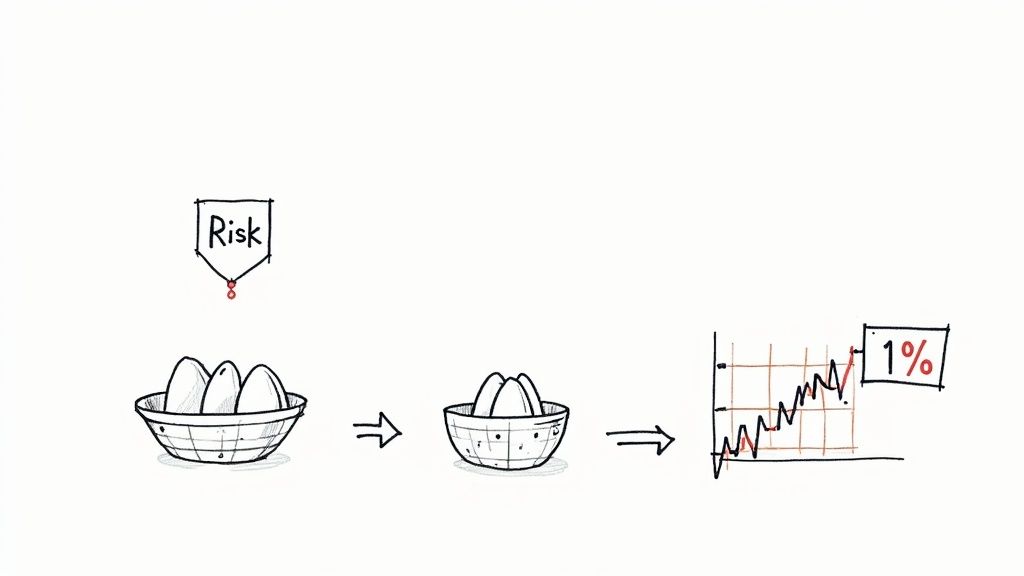
Let’s be direct: this is the most important section in this entire guide. Success in crypto trading isn't about winning every single trade. It’s about managing your losses so you can survive the bad days and still be in the game to profit from the good ones.
If you get this part wrong, even the most amazing strategy will eventually lead to an empty account.
The number one rule is beautifully simple: only risk money you can truly afford to lose. If losing the funds in your trading account would cause you real financial or emotional stress, then it’s too much. Start with a small amount and make protecting your capital your main priority.
The Power of the 1% Rule
One of the best mindsets any new trader can adopt is the 1% Rule. It’s a simple but incredibly effective principle that helps keep your emotions under control and prevents those huge losses that can knock people out of trading for good.
The rule is this: you should never risk more than 1% of your total trading funds on any single trade.
So, if you have a £1,000 trading account, the absolute most you should be willing to lose on one position is £10. This simple habit forces you to think clearly and ensures that a string of bad luck won't wipe out your account. It keeps you in the game long enough to learn and get better.
Using Stop-Loss and Take-Profit Orders
The 1% Rule is a great idea, but how do you actually put it into practice? The answer is by using automated orders that all good exchanges provide. Think of them as your unemotional trading assistants that carry out your plan without hesitation.
Stop-Loss Order: This is your safety net. It's an instruction you give the exchange to automatically sell your crypto if the price falls to a specific level you've chosen. It's how you enforce the 1% rule and put a strict limit on your potential loss. For example, if you buy Bitcoin at £50,000, you could set a stop-loss at £49,500 to limit your loss.
Take-Profit Order: This is the other side of the plan. It's an instruction to automatically sell your position once it reaches a certain profit target. This helps you secure your winnings and stops you from getting greedy and holding on for "just a bit more," only to see your profits vanish. For that same Bitcoin trade, you might set a take-profit order at £52,000.
By setting both a stop-loss and a take-profit order as soon as you enter a trade, you define your maximum risk and potential reward from the very beginning. This removes emotion from the equation and builds discipline—two of the most vital skills in trading.
Diversification and Avoiding Emotional Traps
Another key part of smart risk management is diversification. You've heard the old phrase, "Don't put all your eggs in one basket," and it's especially true in the unpredictable world of crypto. Spreading your money across a few different assets (like a mix of Bitcoin, Ethereum, and a promising altcoin) can soften the blow if one of them suddenly drops in price.
However, even with a diverse portfolio, your biggest enemy will often be your own feelings. Fear Of Missing Out (FOMO) is a powerful impulse that tempts traders to buy into an asset after its price has already shot up. This is usually the worst possible time to get in. To learn more about building a solid defence, you can check out our detailed guide on risk management in cryptocurrency trading.
The UK’s crypto market has grown up a lot, showing a strong 32% growth over the last year, even though it's no longer the biggest European market by volume. This growth is happening because traders are becoming more educated. Data shows UK retail traders are increasingly using decentralised exchanges (DEXs) for things like staking, which requires a much better understanding of risk and technology. Find out more about these trends and the state of European crypto adoption from Chainalysis. This change shows that to succeed now, you need a much more careful approach to managing your assets.
Common Crypto Trading Questions in the UK
As you get started with crypto trading, you're going to have questions. That's perfectly normal. The path from total beginner to experienced trader is full of curiosity and a little bit of healthy caution. This final part of the guide answers some of the most common questions we hear from new traders here in the UK.
Think of this as tying up any loose ends. Getting clear answers to these questions will give you the confidence to move forward, knowing you have a good handle on the practical stuff. From how much money you need to start, to the often-feared topic of taxes, let's get them sorted.
How Much Money Do I Need to Start Crypto Trading in the UK?
One of the biggest myths is that you need a large amount of money to start. The truth is quite different. Most UK-friendly exchanges will let you open an account and deposit as little as £10 or £20.
The real secret isn't how much you begin with, but how you manage it. The best advice is to start with an amount you would genuinely be okay with losing—perhaps £100. This isn't about being negative; it's about being smart.
Use that small starting fund as your practice money. Make a few trades, get used to setting a stop-loss, and watch how the market moves without the stress of risking your life savings. Your main goal in the first few months should be learning, not making a profit. Only when you've found a strategy that works and feel confident in your choices should you consider adding more money.
The most valuable thing you have as a new trader isn't your starting money; it's your desire to learn. A small, carefully managed account is a fantastic educational tool.
Is Crypto Trading Legal and How Is It Taxed in the UK?
Let's get this straight: yes, trading cryptocurrency is completely legal for individuals in the UK. But—and this is a big but—you must understand your tax responsibilities. This is something many new traders overlook until it becomes a problem.
HM Revenue & Customs (HMRC) treats crypto assets as property. This means you might have to pay Capital Gains Tax (CGT) whenever you ‘dispose’ of them.
A 'disposal' doesn't just mean selling your crypto for pounds. It also includes:
- Swapping one cryptocurrency for another (like trading your Bitcoin for Ethereum).
- Selling your crypto for any normal currency (GBP, USD, etc.).
- Using your crypto to buy things (yes, even a cup of coffee).
Every UK resident has an annual CGT allowance, which is the amount of profit you can make before any tax is due. You only pay tax on gains that are above this amount. For this reason, keeping detailed records of every single transaction is absolutely essential. If you're ever unsure, spending a little money on advice from a tax expert who understands digital assets is a very wise investment.
What Is the Biggest Mistake New Crypto Traders Make?
If I had to pick just one, it's this: letting emotions control your decisions. We call it 'emotional trading', and it’s the fastest way to empty a trading account.
It usually appears in two classic ways:
- FOMO (Fear Of Missing Out): You see a coin's price rocketing up, and everyone on social media is celebrating. The urge to jump on board is intense. So you buy at the very top, right before the price naturally pulls back, and you're left with a loss.
- Panic Selling: This is FOMO's evil twin. The market takes a dip, fear sets in, and you sell your assets at a loss to "stop the pain," often just before the price recovers.
Good trading is built on logic, discipline, and a clear plan. To avoid this common mistake, you must create a trading plan before you even think about clicking the 'buy' button. Your plan needs to have clear rules for your entry price, your profit target, and, most importantly, your stop-loss to cut a losing trade short. Sticking to that plan, no matter what the market hype or fear is shouting at you, is what separates consistent traders from gamblers.
At The Coin Course, we believe that a strong educational foundation is the key to navigating the crypto market with confidence. Our extensive library of expert articles is designed to guide you through every step of your journey, from understanding the basics to mastering advanced trading techniques. Start your learning path today at https://thecoincourse.com.