
So, you’re thinking about launching your own cryptocurrency. Before you dream up a cool name or a slick logo, you face a huge first question: are you building a coin or a token?
This isn't just nerdy talk. It’s a massive decision that shapes your entire project. It will define your budget, your timeline, and the kind of team you need to bring your idea to life.
Your First Big Decision: Coin vs. Token
Imagine it this way. Making a coin is like building a house from the ground up. You buy the land, pour the foundation, and design every single detail yourself—the layout, the materials, even the security system. It gives you total freedom, but it costs a fortune in time, money, and expert help. Bitcoin is the ultimate example; it operates on its very own blockchain, powered by a massive global network of computers called miners.
Creating a token, however, is more like renting a fancy, secure apartment in a brand-new building. You can furnish it however you want, but you’re using the building's existing structure—its security guards, plumbing, and electricity. This option is much faster and cheaper, and you get to lean on the proven security of a huge network. A great example is Pepe, an ERC-20 token that runs on the super-secure and widely used Ethereum blockchain.
Weighing Your Options
Building a coin gives you complete control. You can invent your own rules for how transactions are approved, set custom fees, and create features that are impossible on other platforms. But this power has a steep price. You'll need a team of top-tier blockchain developers, a large budget, and a smart plan to attract enough people to help secure your network. A network without enough support is weak and an easy target for attackers.
Taking the token route makes things much simpler. By launching on a platform like Ethereum, Solana, or BNB Smart Chain, you’re basically borrowing their multi-billion-dollar security system. The development is also easier because you use well-known templates for your code. If you're curious about these templates, you can learn more by understanding token standards like ERC-20 and ERC-721. This approach lets you focus on what makes your project special, instead of the giant task of building and maintaining a whole new blockchain.
The core difference isn't just technical—it's about your project's philosophy. Coins are like independent nations with their own economies, while tokens are like businesses that operate within a larger country's economy.
To make it even clearer, let's look at a simple comparison.
Creating a Coin vs Creating a Token
| Feature | Coin (New Blockchain) | Token (Existing Blockchain) |
|---|---|---|
| Complexity | Extremely high. Needs deep blockchain knowledge. | Relatively low. Uses ready-made infrastructure. |
| Development Time | Months to years. | Days to weeks. |
| Cost | Very high. Often costs hundreds of thousands. | Low. Can be done for a few thousand pounds. |
| Security | You have to build and protect it yourself. | Gets its security from the host blockchain. |
| Control | Full control over all rules and features. | Limited by the rules of the host blockchain. |
| Example | Bitcoin (BTC), Litecoin (LTC) | Shiba Inu (SHIB), Chainlink (LINK) |
At the end of the day, the choice depends on your project's goals, your budget, and what you want to achieve in the long run.
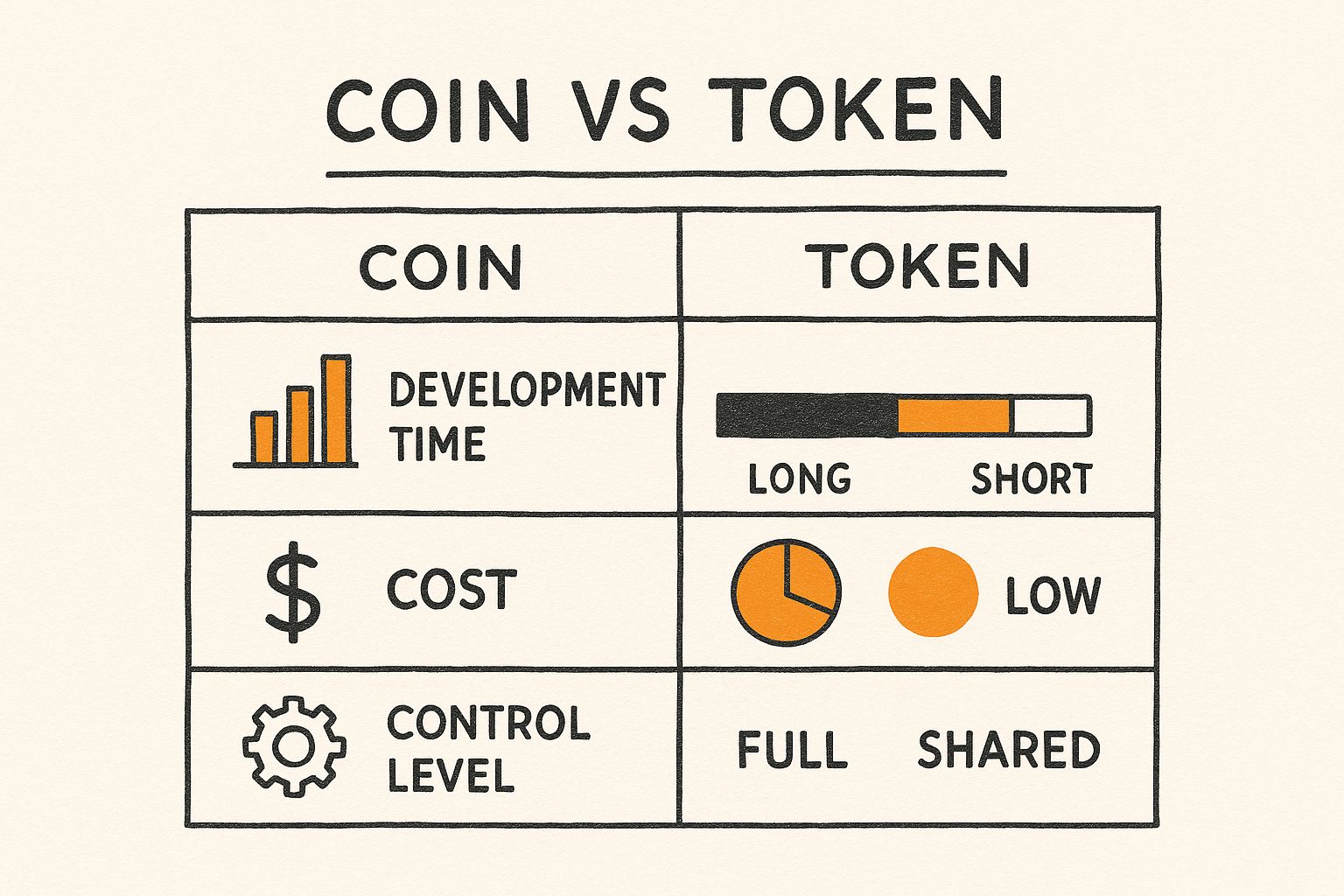
As you can see, making a coin gives you total power but requires a massive investment. In contrast, tokens offer a quicker, more affordable way in by using the strength of established networks. For almost every new project, creating a token is the smarter and more practical choice.
Designing Your Project's Economic Engine
After you’ve picked between a coin and a token, it’s time to design the heart of your project: its economy. This is what people call tokenomics, and it’s way more than just choosing a random number for your total supply. If you get it right, you can create an exciting, thriving ecosystem. But if you get it wrong, your project might fail before it even starts.
Picture yourself as the boss of a central bank for your own digital world. Every choice you make about supply, demand, and usefulness will guide how people behave, build trust, and ultimately decide if your creation has any real, lasting value.
What's Your Total Supply?
One of your first and most important decisions is the total number of coins or tokens that will ever be created. This isn't just a number; it sends a powerful message. You have two main paths you can take.
A fixed supply model, like Bitcoin’s famous 21 million coin limit, builds in scarcity from the very beginning. This built-in rarity can be a huge reason for its value to go up, especially if your project becomes popular. When people know for sure that no more tokens can ever be made, it gives them a real sense of security and confidence in its future.
Alternatively, you could choose an inflationary model, where new tokens are made over time. This is popular for projects that need to reward people for helping secure the network, like Ethereum does for its stakers. While you lose the appeal of a strict limit, it’s a great way to encourage people to participate and help cover ongoing costs. The trick is to manage the creation of new tokens carefully so you don't reduce the value of what your early supporters hold.
How Will You Allocate Your Tokens?
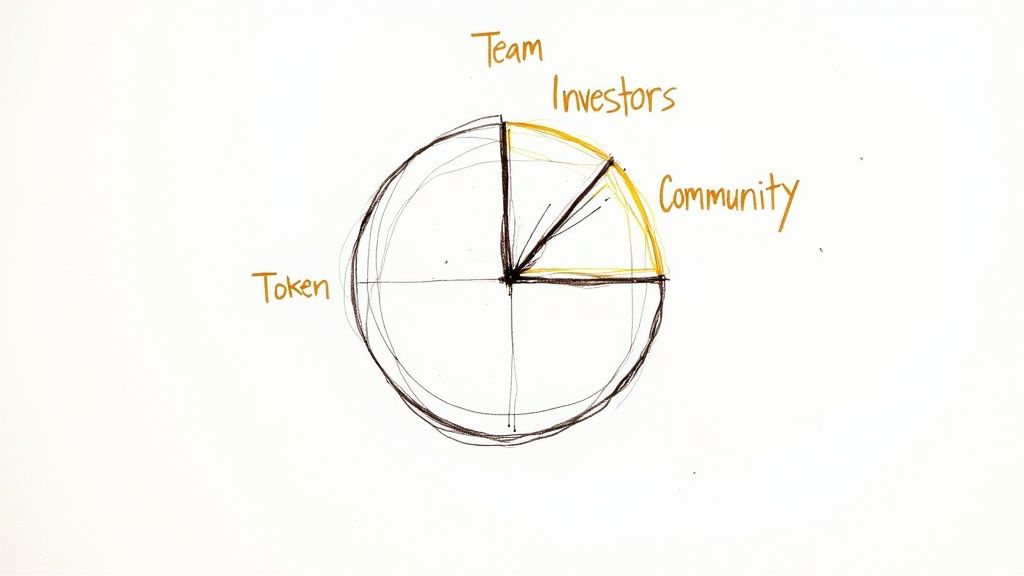
How you divide up the tokens is just as important as how many you create. Your token allocation is a public signal of what your project believes in, and having a fair, open plan is essential for building trust with your community. If it seems like the founders are keeping a huge slice for themselves, you’ll scare away the very people you need to help you grow.
A healthy, well-thought-out allocation might look like this:
- Community & Ecosystem (40-60%): This should always be the biggest portion. It’s used for giveaways (airdrops), grants for developers, and rewards for users to encourage growth.
- Founding Team & Advisors (10-20%): This is fair pay for their hard work, but it must come with a "vesting schedule." This means their tokens are unlocked slowly over a few years, showing everyone the team is committed for the long haul.
- Treasury/Foundation (10-15%): Think of this as a savings account for future development, marketing, and operational costs.
- Early Investors/Seed Sale (5-15%): This helps fund the project at the very start, but these investors should also have their tokens unlocked gradually to prevent them from selling everything at once and crashing the price.
- Public Sale (1-5%): A small chunk for the official launch, which helps set a fair price and get the token into more hands.
A project's token allocation is a public statement of its values. Giving the community the biggest share shows a commitment to decentralised growth over quick profits.
What's the Point of Your Token?
Let’s be honest: a token with no purpose is just a digital poker chip. For your project to last, your token needs real utility—a genuine reason for people to buy, hold, and use it. Utility is what transforms a piece of code into something valuable.
Here are some powerful ways to give your token a purpose:
- Governance: Let your token holders have a real say in the project's future by allowing them to vote on important decisions. The UNI token, which lets people vote on changes to the Uniswap exchange, is a perfect example.
- Network Fees: Your token can be the official currency for paying fees on your platform, just like how you need ETH to pay for "gas" to do anything on the Ethereum network.
- Access: Holding a certain amount of your token could unlock special features, give access to exclusive content, or provide discounts on your platform.
- Staking: Let users lock up their tokens to help secure the network or provide trading liquidity in exchange for rewards. For example, users can stake SOL on the Solana network to earn more SOL. This creates demand and also reduces the number of tokens being actively sold.
If you want to dive deeper into this topic, our guide on tokenomics and economic models explains exactly how successful projects are built.
Pulling It All Together in Your Whitepaper
Finally, all these big decisions—supply, allocation, utility—need to be clearly explained in a whitepaper. This document is your project’s blueprint. It’s more than just a technical guide; it’s your most important tool for marketing and fundraising.
A good whitepaper tells a clear and exciting story. It needs to define the problem you are solving, explain why your solution is better than others, and show how your token’s economic design will make the whole ecosystem work. It's often the first thing a serious investor or user will read, and a great one can make all the difference.
Bringing Your Token to Life with Smart Contracts
If your tokenomics is the economic soul of your project, the smart contract is its beating heart. This is where your ideas turn from plans into real, working code. The smart contract is a digital agreement that automatically enforces the rules. It manages your token’s supply, handles transfers, and makes sure everything works exactly as planned—all without needing a middleman to oversee it.
I like to think of a smart contract as a super-reliable vending machine. You put in the correct payment (a transaction fee), you press a button to make a choice (call a function), and the machine automatically gives you what you paid for (executes the code). It follows its programming perfectly every time, and the whole process is recorded on the blockchain for anyone to see and check.
Choosing Your Programming Language and Tools
For anyone serious about learning how to create a cryptocurrency on a platform like Ethereum, the main programming language to know is Solidity. It’s the king of smart contract languages. It might look a bit tricky at first, but it was designed specifically for this job, giving it the power to set the exact rules for your token.
You won't be writing this code in a basic program like Notepad, though. You’ll need a special tool to help you write, check, and fix your code. A fantastic place to start is Remix IDE. It’s a website-based tool that lets you start coding right away without any complicated setup. It's perfect for playing around with your first token in a safe environment.
Once you’re comfortable with the basics, you might want to move on to more powerful tools like Hardhat or Truffle. These are the tools the pros use for a reason; they offer more advanced features for testing and launching your project.
Following the ERC-20 Standard
Here’s a huge tip: don't try to reinvent the wheel. The crypto world has already created templates that make sure wallets, exchanges, and apps can instantly understand and work with your token. The most famous of these is the ERC-20 standard on Ethereum.
To be clear, following this standard isn't just a good idea; it’s basically a must-have for any serious token. It makes sure your token can work with the massive Ethereum ecosystem. At its core, an ERC-20 token needs to have a specific set of functions that define what it can do.
Your contract must include these key functions:
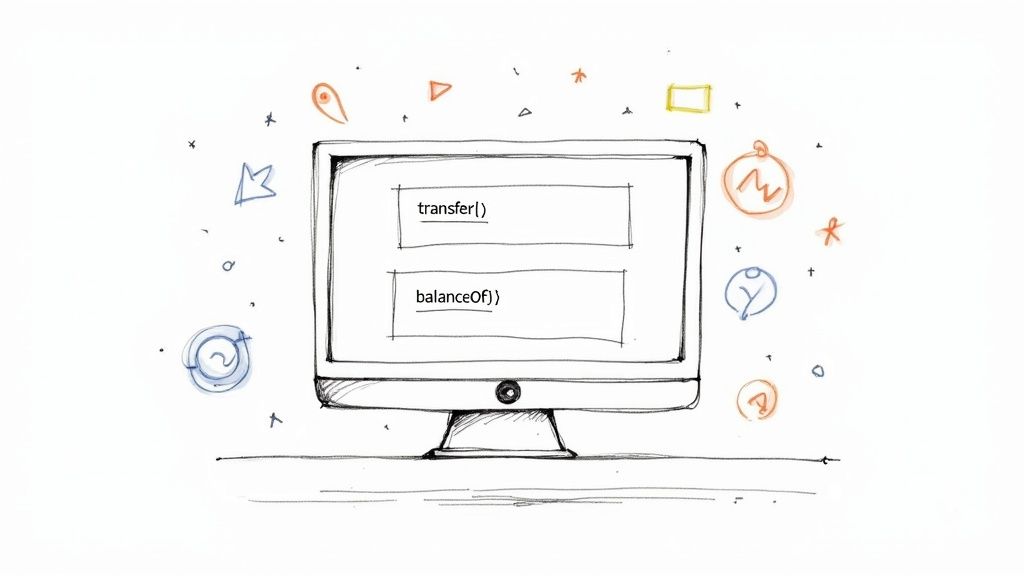
totalSupply(): Shows the total number of your tokens that exist.balanceOf(address account): Lets anyone check how many tokens are in a specific wallet.transfer(address recipient, uint256 amount): The main function that lets a user send tokens to someone else.approve(address spender, uint256 amount): Lets a user give permission to another app (like a decentralised exchange) to spend a certain amount of their tokens for them.allowance(address owner, address spender): Checks how much an app is still allowed to withdraw from a user’s wallet.transferFrom(address sender, address recipient, uint256 amount): The function the app uses to complete the transfer after getting permission viaapprove.
By including these functions, you make sure that services like MetaMask, Uniswap, and many others can work perfectly with your token from the start.
Think of ERC-20 as a universal language for tokens. By speaking this language, your project can instantly communicate with a global ecosystem of wallets, exchanges, and decentralised applications.
Writing Clean and Secure Code
Once you have the basic functions planned out, the real work begins. Writing a smart contract isn’t just about making it work; it’s about making it secure. Once you launch your contract, its code is permanent—you can't change it. One tiny mistake could lead to millions of pounds being lost.
This is why clean, efficient, and well-explained code is absolutely necessary. Use clear names for your variables, add comments to explain what your code is doing, and follow well-known best practices. For example, always use security libraries that have already been tested by experts, like those from OpenZeppelin. Their ready-made contracts provide super-secure versions of standards like ERC-20, saving you from writing everything yourself and protecting you from common hacker tricks.
Your code is the foundation of your whole project. Any weakness here will ruin everything else. That’s why understanding the basics of smart contract security and audits isn't just a nice-to-have—it’s a vital part of the process that protects you and your users. Get familiar with this before you even dream of launching.
Testing Your Code Before You Risk It All
In the normal financial world, a small software mistake might cause a temporary problem. In crypto, one little error in your smart contract can lead to a permanent, multi-million-pound disaster. This isn’t an overstatement. Once your code is live on the blockchain, it’s there for good. That’s why testing it thoroughly isn’t just a good idea—it’s absolutely vital.
Think of it like the final rehearsal before a big show. It’s your chance to find and fix every possible issue in a safe space where mistakes don't cost anything. Skipping this step is like trying to launch a spaceship without running any tests; you’re not being brave, you’re just being careless.
Your Private Sandbox: The Testnet
Before you even consider launching your token on the main network (the mainnet), you need to practice on a testnet. A testnet is basically a copy of a real blockchain, like Ethereum, but with one key difference: the money on it has no real-world value.
This creates the perfect playground for developers. You can get free testnet money from websites called "faucets," which lets you launch your smart contract, send tokens between test wallets, and test all its features—all without risking a single penny. For example, if you're building on Ethereum, you might use a testnet called Sepolia to see how your token works in different situations.
This is where you should try to break your own code on purpose. What happens if someone tries to send more tokens than they have? Does your contract handle very large numbers correctly? The testnet is your chance to find out safely.
Running Specific Unit Tests
While a testnet is great for trying things out by hand, professional projects take it a step further with automated unit tests. This involves writing little scripts that automatically check every single function of your smart contract to make sure it works exactly as it should.
Tools like Hardhat or Truffle are designed for this. You can write tests that automatically perform actions and then check if the results are correct. For instance, a basic set of tests might:
- Launch your contract in a local test environment.
- Check that the
totalSupply()function shows the correct starting amount. - Pretend to send tokens from one wallet to another.
- Confirm that the sender’s balance went down and the receiver’s balance went up by the exact right amount.
By running dozens of these focused tests, you create a safety net that catches mistakes early, long before they can become a serious problem.
A smart contract is only as strong as its weakest link. A full set of tests acts as your quality check, making sure every part works perfectly before you let the public and their money near it.
Bringing in the Professionals: A Security Audit
Even with the best internal testing, you can still miss things. We all have blind spots. That's why the final and most important step before you launch is a third-party security audit. This means hiring a special company of blockchain security experts to go through your smart contract line by line, looking for any weaknesses you might have missed.
These auditors are basically "good guy" hackers. They will try their best to break your code, searching for common tricks that real hackers use, like re-entrancy bugs or integer overflows—the same kind of flaws that have led to huge hacks in the past.
When you're picking an auditor, look for firms with a strong reputation and public reports of their past work. Companies like CertiK or ConsenSys Diligence are highly respected in the field. They will give you a detailed report of any problems they find, ranked by how serious they are. Your team will then be expected to fix these issues before the firm gives its final approval.
An audit isn’t just a technical check; it’s a powerful way to build trust with your community and investors. It shows you’ve done your homework and taken security seriously, which gives everyone the confidence they need for a successful launch.
Launching and Building a Community in the UK

You did it. After countless hours of coding, testing, and checking, your smart contract is finally ready. It’s a huge achievement, but honestly, this is where the real work starts. Your job now changes from being a developer to being a community builder, and the project's future success depends on what you do next.
Putting your contract on the mainnet is the technical starting line—it makes your token official and usable. But a token without a community is just a bunch of code. The biggest challenge now is to bring together a group of supporters, users, and fans who believe in your vision.
From Mainnet to Market
Your first technical step is to launch the smart contract onto your chosen blockchain, like Ethereum. This is usually done with a development tool like Hardhat or Remix, by connecting to the mainnet with a wallet like MetaMask, and paying a "gas fee" to record your code on the blockchain forever. Once that transaction is complete, your token officially exists.
The next step is to make it available to people. For most new projects, this journey begins on a Decentralised Exchange (DEX), such as Uniswap or PancakeSwap.
Listing on a DEX involves creating a liquidity pool. This is basically another smart contract that holds a supply of your token and another asset—often a stablecoin like USDC or the blockchain’s main coin like ETH. This pool allows people to trade your token instantly without needing permission.
- Create the Pool: You'll need to deposit an equal value of your token and the other asset. For instance, you could put in £50,000 worth of your new token and £50,000 of ETH.
- Set the Initial Price: The ratio of the two assets you deposit sets the starting price for everyone else.
- Lock the Liquidity: It is a standard and very good practice to lock the "liquidity provider" (LP) tokens you receive. This is a strong signal to the community that you can’t just run away with the money (a "rug pull"), which is a huge step in building trust.
Cultivating Your Core Community
In the crypto world, your project's success is tied to its community. This is especially true in the UK, which has a very active and smart crypto audience. In fact, some studies predict that by 2025, almost 24 million people in the UK could own cryptocurrencies, which is about 35% of the population. This exciting environment is very open to new projects that can build a real connection. You can learn more about the UK's rising crypto popularity and what it means for new projects.
Your community will probably start on platforms like Discord and Telegram. Think of these not just as chat rooms, but as the central hub for your entire project.
Building a community isn't about shouting marketing slogans at people. It's about creating a space where people feel like they belong and have a stake in the project, turning them from casual observers into passionate fans.
To make that happen, you need to focus on giving them real value. Share content that helps them understand what you're trying to achieve. Hold regular "Ask Me Anything" (AMA) sessions with the founders to be transparent.
Fostering Engagement and Growth
Just starting a Discord server and then ignoring it is a surefire way to create a digital ghost town. Keeping a community alive and growing requires constant effort and a clear plan.
Here are a few simple tricks I’ve seen work again and again:
- Create Clear Channels: A well-organised server is a happy server. Make separate channels for announcements, general chat, technical help, and even just for fun.
- Incentivise Participation: Make people feel important. Reward helpful community members with special roles, early access to new features, or small token prizes.
- Actually Listen to Feedback: Your first users are your best source of information. Actively ask for their thoughts and show them you’re listening by actually making changes based on their suggestions.
- Share the Journey Openly: Keep everyone updated on your progress, new partnerships, and even the problems you're facing. Being honest builds amazing loyalty, especially when things aren’t perfect.
By using these strategies, you'll go beyond just launching a token and start building a lively, growing ecosystem. Your community will become your project's most important asset, helping it grow in the UK and around the world.
Connecting with Your UK Crypto Audience
Before you write a single line of code, you need to know exactly who you're building for. This isn't just a pointless task; understanding your audience will influence everything, from your project's name and logo to how your app works. In the UK, the crypto community is quite unique, and if you can connect with it, you'll have a big advantage.
The typical UK crypto fan is young, comfortable with technology, and grew up on the internet. We're not just guessing—the numbers prove it. The Financial Conduct Authority (FCA) found that around 12% of UK adults now own cryptoassets, and this growth is almost all from people under 45. It's a huge and active market. For more detail, Chainalysis offers great insights into Europe's crypto adoption, highlighting the UK's leading position.
Tailoring Your Project for the UK Market
So, what does this mean for your plan? It means that every marketing message, community event, and design choice needs to appeal directly to this younger, digital-first audience.
- Design First: Make sure your app is mobile-friendly, clean, and easy to use. A clunky, confusing app will be instantly rejected by users who are used to the best apps on the market.
- Talk Their Language: Forget boring corporate-speak. Your communication should be real and honest. Be active where they are—on Discord, Telegram, and X (formerly Twitter).
- Build Real Utility: Your token needs to do something useful. Focus on features that solve real problems for a generation interested in decentralised finance (DeFi), web3 gaming, and digital collectibles.
A project that truly understands its target audience has a massive advantage. Generic, one-size-fits-all ideas just get ignored. But a solution built for a specific community can inspire incredible loyalty.
Knowing that the UK is a leader in crypto adoption in Europe gives you a fantastic head start. By designing your project around the habits and tastes of this key group, you’re not just launching another token—you’re building something that truly connects with the people most likely to support it.
Burning Questions About Creating a Cryptocurrency
Jumping into the world of crypto creation brings up a lot of questions. It’s a complicated field that mixes technology, finance, and law, so it’s perfectly normal to be unsure about a few things. Let’s go over some of the most common questions I get from people starting out.
What's the Real-World Cost?
This is the big one, and the simple answer is: it really depends on what you're trying to create.
If you're just launching a simple token on a well-known blockchain like Ethereum, the cost to get started is surprisingly low. You could be looking at a cost of a few hundred to a few thousand pounds. Most of that money will go towards hiring a developer to write the smart contract and, crucially, getting a full security audit.
On the other hand, if you dream of building a completely new blockchain from the ground up (what we'd call a coin), you're in a completely different ballpark. This is a huge project that needs a full-time team, many hours of development, and ongoing maintenance. The costs here can easily climb into the hundreds of thousands, or even millions, of pounds.
Is It Legal to Create a Cryptocurrency in the UK?
Yes, it is perfectly legal to create a cryptocurrency in the UK. However, it's not a free-for-all. The rules are always changing, and the Financial Conduct Authority (FCA) is paying more attention. Their main goal is to stop financial crime and protect people from scams.
It is extremely important to get your project classified correctly from the start. Is it a utility token (which gives access to a service), or does it act more like a security (an investment)? You must know the answer. Talking to a legal expert who specialises in UK crypto rules isn't just a suggestion—it's a vital first step to avoid big trouble later on.
Do I Actually Need to Be a Coder?
Technically no, but you will definitely need strong coding skills on your team. There are "no-code" platforms that can create a basic token for you, but they are very limited. They don’t allow for much customisation and often have big security risks.
For any serious project—one that you want people to trust with their money—you cannot cut corners on technical skills. If you’re not a developer yourself, you will need to hire experienced blockchain developers. They will be in charge of your smart contract from start to finish: writing the code, testing it over and over, and protecting it from hackers.
Ready to turn your idea into a reality? At The Coin Course, we cut through the noise with clear, expert-led guides that cover every corner of the crypto world. Whether you're building the next big thing or just starting your journey, we've got the resources to help you succeed. Start your learning journey with us today.