To buy cryptocurrency safely, you only need to follow three key steps: use a well-known, regulated exchange, turn on two-factor authentication for your account, and move your crypto to a personal digital wallet for long-term safekeeping. This straightforward process puts you in control and protects you from the most common dangers.
Your Essential First Steps to Safe Crypto Buying
Diving into the world of cryptocurrency doesn’t have to feel like guesswork. Your journey starts with a few basic steps, all designed to build your confidence and protect your investment right from the beginning. Think of this as your simple roadmap—a clear path from setting up an account to securing your digital coins.
The first, and probably most important, choice you'll make is your trading platform. This is the place where you'll swap your pounds for assets like Bitcoin or Ethereum. After that, you'll need a secure spot to keep them, which is where digital wallets come in.
Understanding the Process
A digital wallet is vital because it gives you real ownership of your crypto. Leaving your coins on an exchange might seem easy, but it means you're trusting someone else with your money. For instance, if the exchange gets hacked, your funds could be at risk. Moving them to a personal wallet puts you in complete charge. Our goal here is to replace any confusion with a clear, actionable plan.
This simple infographic breaks down the core three-step process for buying crypto securely.
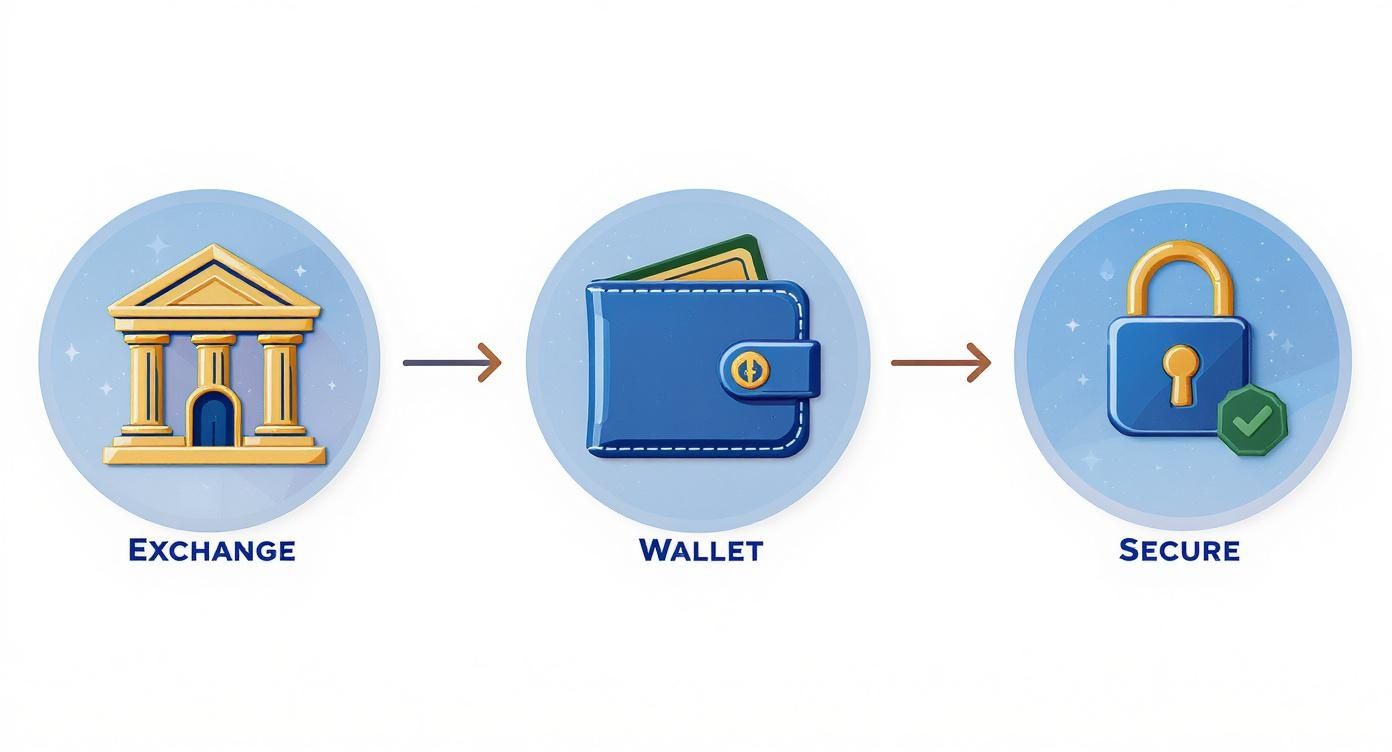
As you can see, the journey flows logically from choosing a secure exchange, to setting up a personal wallet, and finally, locking down your assets for safekeeping.
Why UK Regulations Matter
In the UK, buying cryptocurrency safely means knowing both the market opportunities and the rules designed to protect you. The UK's crypto market is pretty big, hitting around USD 301.2 billion in 2024 and is expected to grow a lot more.
A key thing making your purchases safer is the Financial Conduct Authority (FCA), which makes crypto firms register and follow strict anti-money laundering rules. This simple check helps you spot legitimate companies and stay away from unregulated ones where the risks are much higher.
A secure start in crypto isn't about having complicated tech skills. It's about making smart choices: picking a regulated platform, using strong account security, and taking control of your own assets.
Your safety really comes down to the tools you choose and the habits you build. Before you even think about which coin to buy, focus on the how.
Here's a quick-start checklist to keep you on the right path. Think of these as the basic safety pillars to put in place before you make your first purchase.
Quick-Start Safety Checklist
| Safety Pillar | Why It's Critical | Your First Action |
|---|---|---|
| Regulated Exchange | Ensures the platform meets UK anti-money laundering standards, adding a layer of trust and accountability. | Choose an exchange that is officially registered with the FCA. |
| Personal Wallet | Gives you total control over your private keys, meaning only you can access your funds. It’s like holding cash versus having an IOU. | Look into and set up a non-custodial wallet (like a hardware or software one) that you're comfortable with. |
| Account Security | Protects your exchange account from unwanted access, even if your password is stolen. | Enable Two-Factor Authentication (2FA) using an authenticator app, not just a text message. |
This table doesn't cover everything, but getting these three things right from the start puts you in a much safer position.
Ultimately, these first steps are your first line of defence. They prepare you for a much more secure experience as you begin to explore the world of digital assets.
- Platform Choice: Pick an exchange registered with the FCA. This is a non-negotiable first step.
- Wallet Setup: Decide on a wallet type that fits your needs. For a deeper look, our guide on choosing the right wallet for your needs is a great resource.
- Security Habits: Always use strong, unique passwords and, most importantly, enable two-factor authentication.
How to Choose a Secure Crypto Exchange
Picking the right cryptocurrency exchange is your first and most important move. It’s easy to get distracted by flashy ads promising low fees, but when it comes to crypto, your top priority should always be security. A solid, trustworthy platform is the foundation of your entire investment journey.
Think of it like this: the exchange you choose is the bridge that turns your hard-earned pounds into digital assets. You wouldn't cross a shaky, uninspected bridge, would you? Let's look past the marketing hype and focus on what really keeps your money safe.
The FCA Registration: Your First Line of Defence
Here in the UK, there's one check that's an absolute must: make sure the exchange is registered with the Financial Conduct Authority (FCA).
Don't even consider creating an account until you've checked this. It’s not just a nice bonus; it's a crucial safety net. FCA-registered firms are legally required to follow strict anti-money laundering (AML) and counter-terrorist financing (CTF) rules. While this won't protect you from a bad investment decision, it does filter out many dodgy operators and provides a layer of accountability. You can, and should, check the official FCA register online to confirm an exchange's status.
Centralised vs. Decentralised: What's the Difference?
Next up, you need to decide what kind of exchange you feel comfortable using. They usually come in two types: centralised (CEXs) and decentralised (DEXs). Each one handles security in a different way, and understanding the pros and cons is key.
Centralised Exchanges (CEXs): These are the big names you've probably heard of, like Coinbase or Kraken. They operate a bit like a regular bank, acting as a trusted middleman. They hold your crypto for you, run the trading platform, and offer customer support. For most beginners, this is the easiest starting point.
Decentralised Exchanges (DEXs): Platforms such as Uniswap work without a central company in charge. Instead, trades happen directly between users' wallets, using something called smart contracts. This means you hold your own funds at all times, which is great for control, but it also means security is completely up to you.
The UK crypto scene is lively, with a 32% growth in the market over the past year. While many experienced investors are using DEXs to find smaller, niche coins, a regulated CEX is still the smartest and safest launchpad for anyone new to crypto.
Centralised vs Decentralised Exchanges Key Differences
Choosing between a CEX and a DEX really comes down to a classic trade-off: ease of use versus control. For anyone just starting, a regulated, user-friendly centralised exchange is almost always the smarter, safer choice. Here’s a quick breakdown to help you decide.
| Feature | Centralised Exchanges (CEXs) | Decentralised Exchanges (DEXs) |
|---|---|---|
| Ease of Use | Usually very user-friendly with simple interfaces and customer support. For example, buying Bitcoin on Coinbase is similar to an online shopping experience. | Can be more complicated and require a good understanding of crypto wallets. Using Uniswap for the first time can feel a bit technical. |
| Custody of Funds | The exchange holds your funds. It's convenient, but you're trusting them with your assets. | You always keep your funds in your own personal wallet. |
| Security Responsibility | The exchange is responsible for protecting the platform from hackers. | You are 100% responsible for securing your own wallet and private keys. |
| Regulation | Can be registered with bodies like the FCA, providing some official oversight. | Usually operate outside of traditional government rules. |
The choice between a CEX and a DEX comes down to a trade-off: convenience versus control. For newcomers learning how to buy cryptocurrency safely, a regulated CEX is almost always the more prudent option.
Digging Deeper: What to Look For
Once you've settled on an exchange type and confirmed its FCA status, there are a few more things to check out. These details give you a clearer idea of how seriously a platform takes your security.
Insurance Funds Some of the top exchanges, like Binance, keep a special insurance fund to pay back users if a major hack happens. Look for terms like "SAFU" (Secure Asset Fund for Users). It's not a complete guarantee, but it’s a big sign of confidence that shows they’re ready for the worst.
User Reviews Don't just look at the star rating on a site like Trustpilot. Read the actual reviews. Are people often complaining about locked funds, bad customer service, or security problems? A pattern of unresolved issues is a huge red flag you can't afford to ignore.
Customer Support When something goes wrong with your money, you need to know you can get help—fast. Before you sign up, check what kind of support they offer. Is there a live chat? A phone number? A quick email response? An exchange with non-existent support can leave you completely stuck when you need them most.
Taking the time to look into these areas will pay off. For a more detailed look at the tools at your disposal, have a read of our guide on how to protect your assets on an exchange. A little research now gives you the peace of mind that you've chosen a platform built to last.
Locking Down Your Account and Identity
Okay, so you've picked your exchange. Before you even think about putting in a single pound, we need to turn that new account into a digital fortress. This isn't just a boring task; it's your first active line of defence in protecting your identity and your future investments.
The first thing you’ll be asked to do is complete a process called ‘Know Your Customer’, or KYC. I know, it can seem like a bit of a hassle, but believe me, it’s a critical security step.
Getting Through the KYC Process
KYC is how regulated exchanges check that you are who you say you are. It’s no different from a bank asking for your ID when you open an account. For any FCA-registered firm in the UK, it’s a legal must-do, and honestly, it’s a massive red flag if an exchange doesn't ask for it.
To get this done, you’ll usually need a few things ready:
- Proof of Identity: A clear photo of a government-issued ID, such as your passport or driving licence, is standard.
- Proof of Address: A recent utility bill or bank statement with your name and address will work.
- A "Liveness Check": This sounds high-tech, but it’s often just a quick selfie or a short video of you turning your head to prove you’re a real person and not just a picture.
This process is about more than just following the rules. It actively helps stop fraud and money laundering, which protects the entire platform and every user on it, including you. It makes it extremely hard for someone else to open an account in your name.
Two-Factor Authentication Is Non-Negotiable
If you only do one thing to secure your account, make it this. Two-Factor Authentication (2FA) adds a crucial second layer of security. Even if a hacker somehow gets your password, they are stopped in their tracks. To get in, they'd need both your password and physical access to your phone.
When you go to set up 2FA, you’ll usually see two options:
- SMS (Text Message) Codes: This is the weaker choice. Hackers can use a trick called a "SIM-swap" attack, where they trick your mobile provider into moving your number to a new SIM they control. From there, they get your codes.
- Authenticator App Codes: This is the one you want. Apps like Google Authenticator or Authy create a new six-digit code on your phone every 30 seconds. Because it’s not linked to your phone number, it’s much more secure.
Setting up 2FA with an authenticator app is one of the simplest yet most powerful things you can do to secure your crypto account. It effectively neutralises the single biggest threat: a stolen password.
Always, always choose an authenticator app over SMS. It might take an extra two minutes to set up, but it could save you from a financial nightmare. The difference in security is huge.
Creating a Password That's Actually Secure
We’ve all heard the advice about strong passwords, but for crypto, you need to be extra careful. A simple word with a number and a symbol just isn't enough. Your crypto exchange password needs to be completely unique—never used on another site—and genuinely complex.
A really strong password has a few key features:
- Length: Don't settle for less than 12 characters. Honestly, longer is always better.
- Complexity: It needs a good mix of uppercase letters, lowercase letters, numbers, and symbols.
- Randomness: It absolutely cannot be a real word or a predictable pattern like "Password123!".
For instance, Bitcoin2024! is a weak password. A much better one looks something like this: q8$#zP!nK*v7@e.
So, how do you remember something like that? You don't. Use a reputable password manager like LastPass or 1Password. These tools create and securely store unique, complex passwords for all your accounts. You just have to remember one single master password.
Finally, be paranoid about phishing emails. Scammers make fake emails that look exactly like those from your exchange, often with urgent warnings like "suspicious login detected" or "verify your account." The links inside go to fake login pages designed to steal your details. Make it a habit to always log in by typing the exchange’s official web address directly into your browser, never by clicking a link in an email.
Why You Should Move Your Crypto Off an Exchange
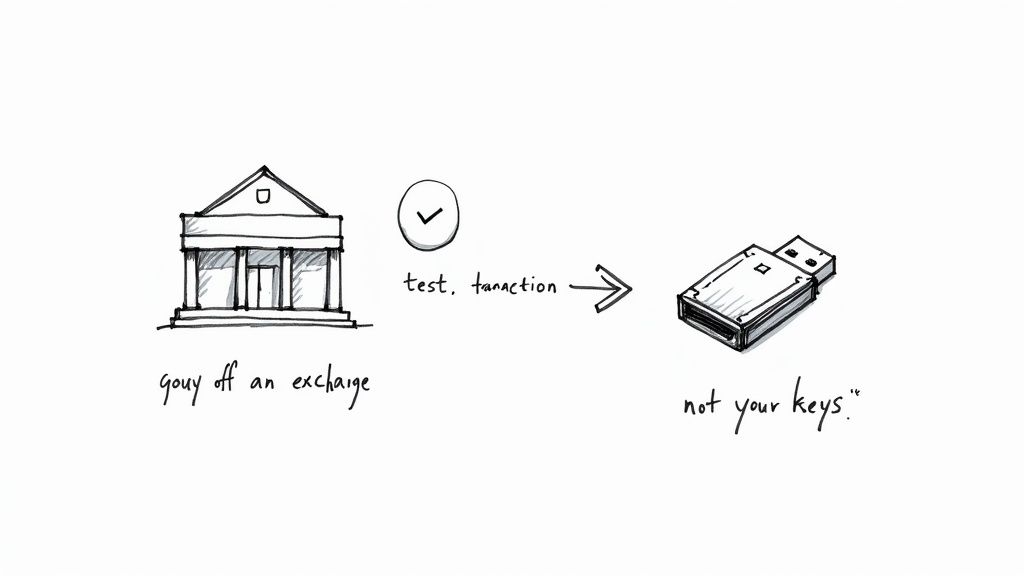
You’ll hear this phrase a lot in crypto: "not your keys, not your coins." Buying on an exchange is the first step for almost everyone, but leaving your assets there long-term is like storing your cash in a public locker where someone else has the master key. It's easy, sure, but you're putting all your trust in the exchange's security team.
When your crypto is on an exchange, you don't actually hold the private keys—the special codes that prove you own the assets. The exchange holds them for you. This means you’re relying on them to stop hackers, prevent employee theft, and stay in business.
Taking control of your own keys, known as self-custody, is the most important security step you can take. It’s a core part of learning how to buy cryptocurrency safely, and it's the real difference between owning a digital IOU and holding the actual asset yourself.
Getting to Grips with Wallet Types
Once you're ready to take control, the next step is choosing the right wallet. They generally come in two types: software wallets (hot) and hardware wallets (cold). Each has its own purpose, and the best one for you depends on what you're doing and how much you’re storing.
Software Wallets (Hot Wallets)
These are simply apps you install on your phone or computer. Think of them like your everyday spending wallet—great for quick access and holding small amounts. Because they’re connected to the internet, they’re called "hot."
- Common Examples: You'll come across names like MetaMask (popular for Ethereum and related tokens) or Trust Wallet.
- The Good: They’re almost always free, fairly easy to use, and make sending and receiving crypto simple.
- The Bad: Being constantly online makes them more open to viruses, phishing attacks, and other digital dangers.
Hardware Wallets (Cold Wallets)
A hardware wallet is a small physical device, often resembling a USB stick, that keeps your private keys completely offline. This "cold" storage is, by a huge margin, the most secure way to protect any serious amount of crypto.
- Common Examples: The two biggest names in this space are Ledger and Trezor.
- The Good: Your keys never touch the internet, which makes them almost impossible to hack online.
- The Bad: They cost money (usually £50-£150) and add an extra step to transactions, making them less ideal for frequent, small payments.
In the end, it’s a simple choice between convenience and security. A software wallet is fine for a bit of spending money. For your life savings or long-term investments, a hardware wallet is a must. It's the gold standard.
How to Make Your First Secure Transfer
Moving crypto for the first time can feel nerve-wracking, but if you’re careful, it's perfectly safe. The golden rule? Always, always send a small test amount first.
Let's walk through a real-world example: moving some Bitcoin from an exchange to a new Ledger hardware wallet.
- Get Your Receiving Address: After setting up your Ledger, open its app (Ledger Live) and ask it to generate a new Bitcoin receiving address. This will be a long, unique string of letters and numbers.
- Copy the Address with Extreme Care: Double-check it. Then check it again. One wrong letter or number and your funds could be sent into a digital void, gone forever.
- Initiate a Test Withdrawal: Go to the withdrawal section on your exchange. Paste the address you just copied and send a tiny amount—for instance, £5 worth of Bitcoin.
- Confirm and Be Patient: You’ll need to approve the transaction through email and your two-factor authenticator app. Then, just wait for it to be confirmed on the blockchain, which can take a few minutes.
- Check It Arrived: Once that £5 test amount shows up safely in your Ledger wallet, you know the address is correct. Now you can confidently repeat the process and send the rest.
This small test transfer isn’t just good practice; it's a vital safety habit that gets rid of the "what if" worry before you move a large amount.
Securing Your Recovery Phrase: The Master Key
When you create any personal wallet—software or hardware—you'll be given a recovery phrase (also called a seed phrase). This is a list of 12 or 24 random words.
Treat this phrase as the most important secret you own. It's the master key to your entire crypto portfolio. If your hardware wallet gets lost, stolen, or broken, this phrase is the only thing that will let you get your funds back on a new device.
Here’s exactly how to protect it:
- Write It Down. On Paper. Never, ever store your recovery phrase on a computer or phone. Not in a text file, not in your notes app, not as a photo, and definitely not in a password manager. Anything connected to the internet can be hacked.
- Make a Couple of Copies. Create two or three physical, handwritten copies.
- Store Them in Different, Safe Places. Think like a spy. Keep one copy in a fireproof safe at home and another in a secure place elsewhere, like with a trusted family member or in a bank's safety deposit box.
And one last, crucial point: never share these words with anyone. No real company, support person, or developer will ever ask for your recovery phrase. Anyone who does is a scammer, plain and simple. Your financial freedom depends on keeping this phrase secret and safe.
How to Spot and Avoid Common Crypto Scams
Where there’s money, there are scammers. It’s an unfortunate truth, and the crypto world is no different. It's an exciting area, but it also attracts people looking to take your money. The best way to keep your investments safe is to understand their tricks.
Think of this as your personal security guide. I’m going to show you exactly what to look for, with real examples of the scams I see every day. The number one rule is simple but powerful: if an offer sounds too good to be true, it absolutely is. Scammers play on the fear of missing out (FOMO) and the promise of easy riches. Your knowledge is your best defence.
Phishing Emails and Fake Websites
One of the most frequent threats you'll face is phishing. This is where a scammer tries to trick you into giving up your login details or private keys by pretending to be a company you trust, like Coinbase or Kraken. They almost always create a sense of panic to make you act before you have time to think.
For instance, you might get an email that looks like it came straight from your exchange. It'll have a scary subject line like, "URGENT Security Alert on Your Account!" The email will claim there's been a suspicious login and tell you to click a link immediately to secure your account.
That link, however, takes you to a fake login page—a perfect copy of the real one. The second you enter your username and password, the scammer has them. Always, always double-check the website address (URL) before you log in. Even better, get into the habit of only logging in by typing the exchange’s official web address directly into your browser yourself.
The Lure of Unrealistic Returns
Another massive red flag is anyone guaranteeing huge, risk-free profits. Real investing involves risk, and anyone promising you a sure thing is lying. These scams often appear as professional-looking websites or social media ads.
Here's a snapshot from the Financial Conduct Authority's ScamSmart page, which perfectly shows the kind of promises you need to run from.
As the FCA points out, promises of "high-return investments" are a classic warning sign. Scammers will use slick marketing materials to make their fake platforms seem real, but the offer is always the same: easy money with no risk.
If an "investment advisor" sends you a direct message promising to double your Bitcoin in a week, it’s not an opportunity—it’s a trap. Block them immediately.
They might even show you a fake dashboard where your "investment" looks like it's growing. But the moment you try to take your money out, you'll be hit with endless excuses or demands for more cash to cover fake "taxes" or "fees." By then, your original investment is long gone. For a much deeper look, we've put together a full guide on recognising and avoiding crypto scams.
Social Media Giveaways and Pump and Dumps
Social media is a minefield for crypto scams. One of the most popular tricks involves scammers hijacking or creating fake accounts of famous people, like tech billionaires or crypto influencers, to promote fake giveaways.
The setup is disturbingly simple and effective:
- They'll post from a fake "celebrity" account announcing a huge crypto giveaway to their followers.
- The post will say something like, "To show my thanks, I'm giving back! Send 0.1 BTC to this address, and I’ll send you 0.2 BTC back instantly!"
- To make it look real, they use automated accounts (bots) to flood the replies with fake comments saying, "It worked! I just got my Bitcoin back!"
Of course, any crypto you send is gone forever. No real person or project will ever ask you to send them money first to get something in return.
Another scheme you'll see is the "pump and dump." A group of scammers will pick a little-known, low-value coin and use platforms like Telegram or Discord to hype it up with false news. They create a buying frenzy, encouraging everyone to buy in and "get ready for the moon!" As new buyers pile in, the price shoots up—that's the "pump." As soon as the price hits a peak, the original scammers sell all of their coins at once—the "dump"—which causes the price to crash, leaving everyone else with worthless tokens. Be very careful of any group promising coordinated buying for guaranteed profits.
Dipping Your Toes in With Regulated Investments
If the idea of managing private keys and hardware wallets sounds a bit intimidating, you're not alone. The good news is, you don't have to be a tech expert to get involved in crypto. There are simpler, regulated ways that offer exposure to the market without the steep learning curve. These are perfect for anyone who prefers a more traditional investment experience with an extra layer of security.
One of the most straightforward options is a crypto Exchange Traded Note (ETN). You can buy these on a regular stock exchange, just like you would a share in a company like Apple or BP. The main difference is that instead of tracking a business, its value follows the price of a cryptocurrency, such as Bitcoin.
The real attraction here is the official oversight. These products come from established financial companies that have to follow the rules. This provides a safety net that you just don't get when you buy and hold crypto directly, making it a much more comfortable starting point for many investors.
The Growing Demand for a Simpler Way In
We're seeing a real change in the UK market. People are increasingly looking for safer, regulated ways to add crypto to their portfolios. While direct crypto ownership was around 12% of UK adults in early 2025, the situation is changing with the arrival of regulated crypto ETNs.
In fact, after the Financial Conduct Authority (FCA) gave these products the green light, research from IG Group found that up to 30% of UK adults are now interested in investing this way. The interest is especially high among younger people, with an amazing 50% of 18-24 year olds keen to invest through ETNs. You can look at the numbers yourself by reading the full research on UK crypto market trends.
For many, the appeal of crypto ETNs is simple: they offer a way to invest in the asset class through a familiar brokerage account, without the direct responsibility of securing the underlying coins.
So, what's causing this interest? It really comes down to two main things:
- A Sense of Safety: For 32% of potential investors, the fact that these products are regulated is the biggest attraction.
- Tax-Smart Investing: Another 19% were drawn in by the possibility of holding these assets in tax-friendly accounts like ISAs or SIPPs.
Your Questions Answered
Got a few more questions? You're not the only one. Here are some quick, straightforward answers to the things most newcomers ask when they're starting out with crypto in the UK.
Is It Actually Safe to Buy Cryptocurrency in the UK?
Yes, as long as you take the right precautions. The most important step is to stick with a crypto exchange that's officially registered with the Financial Conduct Authority (FCA). This registration means the platform has to meet certain standards, especially around anti-money laundering, which adds a vital layer of accountability.
Besides choosing the right platform, your personal security is key. Always enable Two-Factor Authentication (2FA) on your account from day one. For any crypto you plan to hold for the long term, I'd strongly suggest moving it off the exchange and into a personal hardware wallet. This puts you in complete control and protects your assets from any exchange-specific problems like hacks or business failures.
Do I Need to Tell HMRC About My Crypto Purchases?
Simply buying crypto with your pounds doesn't need to be reported to HMRC. However, the moment you 'dispose' of your crypto, they will be interested, and you might have to pay Capital Gains Tax.
A 'disposal' can be any of these things:
- Selling your crypto for pounds sterling (for example, selling £500 of Bitcoin back to your bank account).
- Trading one type of crypto for another (e.g., swapping your Bitcoin for Ethereum).
- Spending your crypto directly on things like a coffee or a new laptop.
Because of this, it’s really important to keep detailed records of every single transaction: what you bought, when you bought it, its value in pounds at the time, and the same details for when you sell or trade it. If it starts getting complicated, it's always smart to talk to a tax advisor who understands digital assets.
The single most important security measure is to protect your recovery phrase. It is the master key to your funds, and no legitimate company will ever ask for it.
What Is the Single Most Important Security Tip for a Beginner?
This one is simple but an absolute must: never, ever share your wallet's private keys or its ‘seed phrase’ (often called a recovery phrase). Think of this phrase as the master key to your entire crypto collection. Anyone who has it has complete access to your funds.
Be extremely careful, as scammers are always trying to trick people into revealing it. No real support agent, company representative, or developer will ever ask for your seed phrase. Anyone who does is trying to rob you. The best thing to do is write it down on a piece of paper (or something more durable like a metal plate) and store it in a secure, offline place that only you know about.
At The Coin Course, our mission is to provide clear, reliable knowledge to help you navigate the world of crypto with confidence. To continue learning, explore our full range of expert articles and guides at https://thecoincourse.com.