Buying bitcoin safely boils down to four key stages: picking a trustworthy crypto exchange, getting your identity verified, making the actual purchase, and finally, moving your new coins into your own private wallet. If you stick to this path, you're setting yourself up for a much safer journey right from the start.
Your Quick Guide to Safely Buying Bitcoin
Jumping into the world of Bitcoin for the first time can feel like a big step, but it doesn't have to be complicated. I've designed this guide to walk you through everything, step-by-step, giving you a solid footing before you even think about spending your first pound. Consider this your friendly roadmap for navigating the UK's crypto scene with confidence.
You're certainly not alone in this. The Financial Conduct Authority (FCA) recently found that around 10% of UK adults now own some form of crypto, a figure that has more than doubled in recent years. With awareness now topping 90 percent, it's clear that understanding how to buy Bitcoin safely is more important than ever. Newcomers are often the most vulnerable to simple mistakes, so getting it right from the beginning is your best defence. You can dive deeper into the latest data on crypto ownership in the UK directly on the FCA's site.
The Essential Steps to Secure Your First Bitcoin
Let's break the whole thing down into four manageable actions. This process shows you the full journey, from picking a platform right through to locking down your investment.
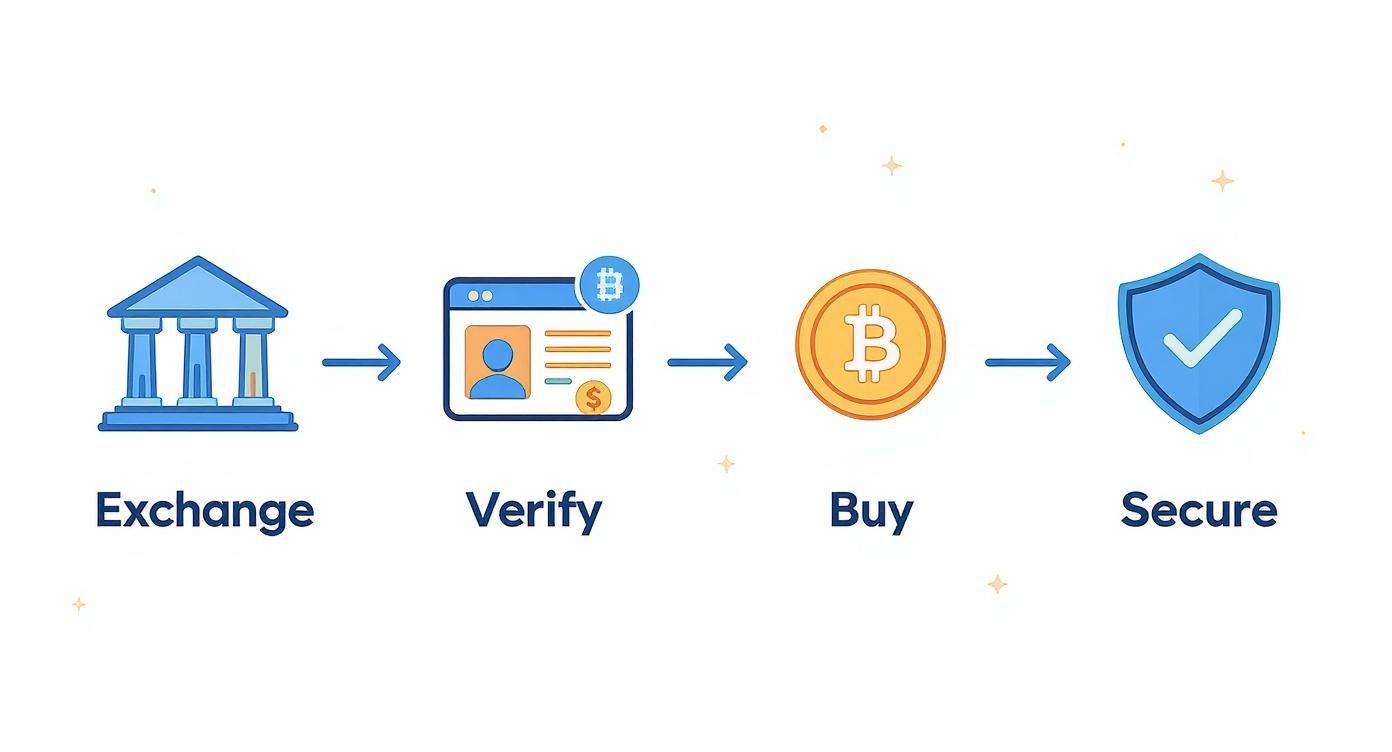
As you can see, buying Bitcoin isn't just a one-click affair. It’s a structured process where each step is built on the last, all designed to keep you and your money safe.
To give you a clearer picture, I've put together a quick summary of what each of these stages involves. Think of these as the four pillars of a secure Bitcoin purchase. Understanding them will help you stay focused and sidestep common pitfalls.
The Four Pillars of Buying Bitcoin Safely
| Stage | What It Means | Your Main Goal |
|---|---|---|
| Choose an Exchange | This is about selecting a regulated and reputable online platform where you can buy and sell crypto. For instance, a well-known name like Kraken or Coinbase. | To find a trustworthy, FCA-registered platform with solid security features and transparent fees. |
| Verify Your Identity | You'll need to complete the 'Know Your Customer' (KYC) process by providing personal ID documents, like a driver's licence. | To comply with UK regulations and help the exchange protect your account from fraud. |
| Make the Purchase | Using a payment method, like a UK bank transfer or debit card, to finally buy your Bitcoin on the exchange. | To complete the transaction with a secure, low-cost payment method. Always start with a small amount. |
| Secure Your Bitcoin | Moving the Bitcoin you've bought from the exchange into a personal wallet that only you control, such as a hardware device from Ledger. | To take full, independent ownership of your coins and shield them from online risks like exchange hacks. |
Nailing these four stages is the foundation of every secure crypto purchase. Each one plays a crucial role in protecting your investment for the long term.
Choosing a Secure UK Crypto Exchange
Your first step into Bitcoin is a big one, and it all starts with a single, crucial decision: where you choose to buy it. Think of it like choosing a bank. You wouldn't deposit your savings into an institution with a shaky reputation, and the same logic applies here.
The platform you pick is where you'll connect your bank account and verify your identity, so it's absolutely vital to choose one that takes your security seriously from the get-go.
Centralised vs Decentralised Exchanges
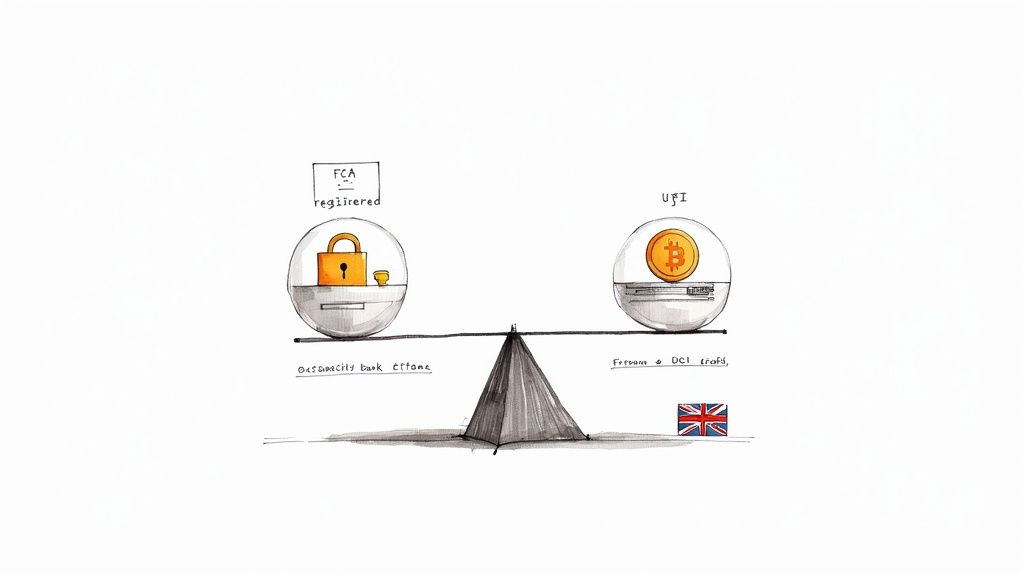
Right away, you'll encounter two main types of platforms: centralised exchanges (CEXs) and decentralised exchanges (DEXs). Honestly, for anyone just starting out in the UK, a CEX is the only realistic place to begin.
Centralised Exchanges (CEXs): These are companies like Coinbase or Kraken. They operate much like a traditional stockbroker, providing a user-friendly platform, customer support, and easy ways to turn your pounds into Bitcoin via bank transfer or card.
Decentralised Exchanges (DEXs): These platforms, such as Uniswap, run on automated code and allow users to trade directly with each other without a middleman. While they offer more user control, they are far more complex and definitely not the place for your first purchase.
For now, let's stick with centralised exchanges. They provide the familiar security and regulatory oversight that’s essential when you're learning the ropes.
The Most Important Factor: FCA Registration
For any UK-based investor, one thing matters more than anything else: regulation. The UK’s crypto rules are constantly evolving, and the Financial Conduct Authority (FCA) now requires all crypto firms operating here to be officially registered.
This registration isn't just a piece of paper. It means the exchange must comply with the UK's strict Money Laundering, Terrorist Financing and Transfer of Funds Regulations. It’s a critical stamp of approval, showing the platform meets high operational and legal standards.
Key Takeaway: My number one piece of advice is this: never, ever use a crypto exchange that isn't registered with the FCA. It's the single best way to shield yourself from scams and poorly run operations in the UK.
Thankfully, checking a platform's status is dead simple. The FCA keeps a public list of every single approved crypto firm. Just head to the FCA register, type in the name of the exchange, and see if it's listed. If it is, you're good to go.
A Quick Comparison to Help You Decide
Here's a straightforward breakdown to help you see why a CEX is the right starting point. This table compares the key differences and should make it clear which type of exchange fits your current needs.
Centralised vs Decentralised Exchanges: A Quick Comparison
| Feature | Centralised Exchanges (CEXs) | Decentralised Exchanges (DEXs) |
|---|---|---|
| Ease of Use | Very beginner-friendly with simple, intuitive interfaces, like the Coinbase app. | Often complex, requiring good knowledge of crypto wallets and networks. |
| Payment Methods | Supports UK bank transfers (Faster Payments) and debit/credit cards. | Requires you to already own crypto; no direct fiat-to-crypto purchases. |
| Regulation | Can be registered with the FCA and must follow UK regulations. | Generally unregulated, operating as autonomous global platforms. |
| Custody of Funds | The exchange holds your crypto for you until you move it elsewhere. | You always maintain 100% control of your funds in your personal wallet. |
| Security | Managed by the company, but they can be a target for large-scale hacks. | Security is your sole responsibility; no central point of failure. |
As you can see, CEXs are built for convenience and security, which is exactly what you need for your first transaction.
Comparing Key Features of Secure Exchanges
Once you’ve got a shortlist of FCA-registered exchanges, it’s time to dig into the practical details. What’s perfect for one person might not be for another, so consider what’s most important to you. For a much deeper look at this, our guide on how to assess exchange security and protect your assets is a great resource.
When it comes to funding your account, a CEX that supports UK Faster Payments is usually the sweet spot between speed and low fees. While paying by debit card is instant, you often get hit with higher transaction fees, sometimes as much as 3-4%. Imagine spending £100 and immediately losing £4 to fees. A bank transfer might take an hour or two to show up, but it's nearly always cheaper.
My advice? Always check an exchange's fee schedule before you commit. A few minutes of research can save you a surprising amount of money.
Setting Up and Securing Your Account
Right, so you’ve picked a reputable, FCA-registered exchange. The next step is all about getting your account created and, more importantly, making it a digital fortress. This isn't just about choosing a username; it's about laying a secure foundation for your investments.
Getting the basics sorted now will save you a world of pain later. Think of it like opening a new bank account. The exchange has a legal duty to verify who you are, which brings us to the 'Know Your Customer' process, or KYC.
Navigating the Know Your Customer (KYC) Process
To operate legally in the UK, every legitimate exchange will ask you to prove you are who you say you are. There's no getting around this—it's a critical measure to prevent fraud and money laundering. You'll usually need a couple of documents to hand.
- Proof of Identity: A clear photo of a government-issued ID is standard. Your passport or a UK driving licence will do the trick.
- Proof of Address: You'll likely need to upload a recent utility bill or a bank statement that clearly shows your name and current address. For example, your latest council tax bill or a PDF of your Halifax bank statement.
Don't be surprised if they also ask for a quick selfie of you holding your ID. I know it can feel a bit much, but it’s actually a brilliant sign that you’re dealing with a compliant and secure platform. It's a green flag, not a red one.
Your First Line of Defence: A Strong Password
This sounds obvious, but you’d be surprised how many people get it wrong. Creating a strong password is one of the simplest yet most effective ways to protect your account. The biggest mistake? Reusing a password from another website. It’s incredibly risky. If another service you use gets hacked, criminals will immediately try that same email and password combination on crypto exchanges.
Instead, create a completely unique password just for this one account. It needs to be long and complex, mixing upper and lower-case letters, numbers, and symbols. A good example might look something like Tr0ub4dor&3. A password manager is your best friend here. It can generate and store impossibly complex passwords for you, leaving you to remember just one master password.
Adding an Extra Lock with Two-Factor Authentication (2FA)
If a strong password is the main lock on your door, think of Two-Factor Authentication (2FA) as the heavy-duty deadbolt. It adds a second layer of security by demanding a second piece of proof when you log in, making it incredibly difficult for anyone to get into your account, even if they manage to steal your password.
You generally have three options for setting this up:
- SMS-Based 2FA: The exchange sends a code to your phone via text. While it’s better than nothing, this is the least secure method. It's vulnerable to "SIM-swap" attacks, where a fraudster convinces your mobile provider to switch your number to their device.
- Authenticator App: This is a much safer bet. Apps like Google Authenticator or Authy generate a new six-digit code on your phone every 30 seconds. Because the code is created on your device, it can't be intercepted like a text message.
- Hardware Security Key: For the truly security-conscious, this is the gold standard. A physical device, like a YubiKey, plugs into your computer's USB port. You can only log in when the key is inserted and you tap it, making a remote attack virtually impossible.
If you’re serious about protecting your crypto, using an authenticator app is the absolute minimum you should be doing. It’s a huge security upgrade over SMS for very little effort.
Setting up 2FA is a one-off job that massively bolsters your account’s defences. If you want to get into the nitty-gritty, our guide on using two-factor authentication for crypto accounts breaks down exactly how each method works and how to get it running. Take these steps now, and you can be confident that when you're ready to buy Bitcoin, your account is already locked down tight.
Making Your First Bitcoin Purchase
Alright, you’ve done the groundwork and your exchange account is ready to go. Now for the exciting bit: buying your first slice of Bitcoin. It’s a great feeling, but let’s make sure we do it right. The aim here is to get your first transaction done smoothly, safely, and without paying more than you have to.
The first hurdle is getting your pounds from your bank account onto the exchange. If you’re in the UK, you’ll see a few familiar options. Each one strikes a different balance between speed and cost, and knowing the trade-offs is key.
Choosing the Right Payment Method in the UK
How you fund your account will directly affect your overall costs and how quickly you can get in on the action. Most reputable UK exchanges give you a few ways to pay, but it usually boils down to bank transfers or card payments.
Here’s a quick rundown of what you’ll typically find:
- UK Faster Payments: Honestly, this is your best bet for a first-timer. A direct bank transfer is often free, or at worst, has a tiny fee. The money usually lands in your exchange account within a couple of hours.
- Debit and Credit Cards: This is the hare in the race – it’s the quickest way to buy, with the transaction being almost instant. That convenience comes at a price, though. Card fees can be surprisingly high, sometimes anywhere from 2.5% to 4% of your total purchase.
- PayPal: Some platforms have started integrating PayPal, which is a nice touch for those who like the familiarity. The fees usually sit somewhere in the middle, a bit more than a bank transfer but less than a card.
For most people, using Faster Payments is the most sensible option. A short wait is a small price to pay for saving a decent chunk on fees, especially as you start investing more over time.
Why You Should Start With a Small Amount
If I could give just one piece of advice to someone new, it would be this: start small. Seriously. For your very first purchase, just buy £20 or £50 worth of Bitcoin. This isn't about making a quick profit; it’s about going through the motions in a low-risk way.
Think of it as a test run. A small initial purchase lets you see the whole process from start to finish. You’ll find out how long your deposit really takes, get comfortable placing an order, and—most importantly—practise withdrawing the Bitcoin to your own secure wallet later on. Nailing this trial run will give you the confidence you need before you commit any serious money.
My Personal Tip: Treat your first Bitcoin purchase like a dress rehearsal. The goal isn't to perfectly time the market, but to prove to yourself that you can navigate the platform safely. A successful small buy is a massive win.
Understanding Market Orders and Limit Orders
When you’re on the "buy" screen, you'll probably see two main choices: market orders and limit orders. It might sound like jargon, but this choice simply gives you control over the price you pay, which is a pretty big deal in a market that moves as fast as Bitcoin.
A market order is the simple, no-fuss option. You're basically telling the exchange, "Buy me Bitcoin right now at the best price you can find." It’s quick and your order is guaranteed to go through, but you don't get a say in the exact price. It might be a tiny bit higher or lower than what you saw a second ago.
A limit order, on the other hand, puts you in the driver's seat. You set the exact price you’re willing to pay for Bitcoin. For example, if Bitcoin is trading at £50,000, you could set a limit order to buy at £49,500. Your order will only get filled if the market price drops to your target level (or lower). If the price never hits your number, the order just sits there, unfilled. This is a brilliant tool for avoiding buying during a sudden price spike and helps you stick to a plan.
For your very first purchase with a small amount, a market order is absolutely fine. As you get more experienced, you’ll find that using limit orders is a much smarter way to manage how you enter the market.
Moving Your Bitcoin to a Secure Wallet
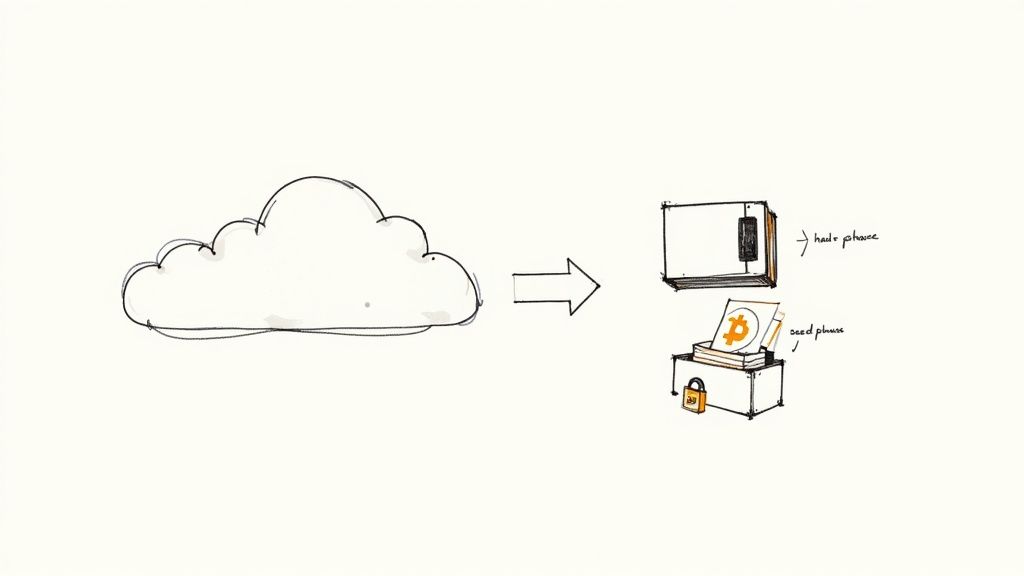
Right, you've navigated the exchange and bought your first Bitcoin. Brilliant! But don't pop the champagne just yet. Buying it is only half the job; the real test is keeping it safe for the long haul.
Leaving your Bitcoin sitting on an exchange is easy, but it comes with a major catch: it's not truly yours. It’s like leaving a pile of cash with a stranger who promises to look after it. Sure, they might have security, but you're still relying on them. This is where crypto wallets change the game.
Why You Need to Take Control
Taking personal control of your Bitcoin—a concept called self-custody—is the single most important thing you can do to protect your investment. When your coins are in your own wallet, you and only you hold the keys. This insulates you from all sorts of chaos, from exchange hacks to a company suddenly deciding to freeze your account.
This is especially true here in the UK. A recent global report found that 24% of Brits have now invested in crypto, with younger folks really driving the trend. But as ownership grows, so does fraud. Many of these losses stem from simple mistakes with private keys or poor wallet security. These numbers really drive home why a secure, personal wallet isn't just a nice-to-have; it's an essential part of any sensible Bitcoin strategy. You can see the full 2025 crypto report findings here to get a better sense of how the landscape is changing.
Hot Wallets vs. Cold Wallets
Crypto wallets generally come in two flavours: hot and cold. The difference sounds simple, but it has huge security implications.
Hot Wallets: These are software apps on your phone (like Trust Wallet) or browser extensions (like MetaMask) that are always connected to the internet. They’re incredibly convenient for everyday transactions, but that constant online connection leaves them open to digital threats.
Cold Wallets: These are physical, offline devices. Think of them as a tiny vault for your crypto. Because they stay disconnected from the internet, they're practically immune to remote hacking. They represent the highest level of security you can get and are the go-to for serious, long-term holding.
For anyone planning to hold Bitcoin for more than a couple of weeks, a cold wallet isn't a luxury—it's a necessity. The peace of mind alone is worth every penny.
We've put together a full breakdown to help you decide what's best for you in our guide on choosing the right wallet for your needs.
The Gold Standard: Hardware Wallets
When people talk about cold storage, they're almost always talking about hardware wallets. These are small, purpose-built devices designed to do one thing and one thing only: keep your private keys completely isolated from online risks. The most trusted names in the game are Ledger and Trezor.
These gadgets often resemble a USB stick and feature a small screen and physical buttons. To authorise any transaction, you must physically press a button on the device itself. This is a brilliant security feature. It means that even if your computer is compromised with a virus, a hacker is powerless to move your funds without having the device in their hands.
The One Thing You Must Protect: Your Seed Phrase
When you first set up any wallet worth its salt—hot or cold—it will generate a seed phrase (also called a recovery phrase). This is a unique list of 12 or 24 random words. For example, it might be something like: apple table happy chair river silent diamond ... and so on.
This phrase is the master key to your Bitcoin.
If your wallet is ever lost, stolen, or smashed to bits, you can enter these words into a new device and regain complete access to your funds. But here’s the crucial bit: anyone who finds your seed phrase can do the same.
Follow these rules religiously:
- DO write the words down on paper or, even better, stamp them into metal.
- DO store it somewhere incredibly safe and private where no one else will find it (like a home safe).
- NEVER type it into a computer or phone.
- NEVER take a picture of it.
- NEVER save it in a password manager, email, or cloud storage.
Treat your seed phrase as if it were a bearer bond for the full value of your crypto. Its security is 100% your responsibility.
Moving Your Funds From the Exchange
Okay, let's bring it all together. Getting your Bitcoin off the exchange and into your shiny new wallet is actually quite simple.
- Get Your Receiving Address: Fire up your hardware wallet and its companion software (like Ledger Live for a Ledger device). Find and click the "Receive" button. The software will generate a unique address for you—a long string of characters.
- Verify on Your Device: This is critical. The same address shown on your computer screen should appear on your hardware wallet's little screen. You must physically check that they match, character for character. This is your defence against clipboard-hijacking malware.
- Start the Withdrawal: Log in to your exchange, head to your Bitcoin wallet, and hit the "Withdraw" button.
- Paste and Check (Then Check Again): Carefully paste your receiving address into the destination field on the exchange. I can't stress this enough: double and triple-check that it's correct. One wrong character, and your funds could be lost forever.
- Confirm and Send: Enter the amount you want to withdraw, complete any security steps like 2FA, and click send.
In about 10–30 minutes, you should see the transaction confirm. Your Bitcoin is now safe in your personal wallet, under your exclusive control. You've officially achieved self-custody.
Answering Your Top Questions About Buying Bitcoin Safely
Even with the best instructions, it's completely normal to have a few questions buzzing around your head when you're first figuring out how to buy Bitcoin safely. Most newcomers in the UK bump into the same handful of worries, so let’s get them cleared up right now. Having solid answers is the best way to build the confidence you need to get started.
Is It Actually Safe to Buy Bitcoin in the UK?
Yes, it certainly can be, but your safety really comes down to the choices you make. The first and most crucial step is to exclusively use a crypto exchange that is registered with the Financial Conduct Authority (FCA). This is non-negotiable, as it ensures the platform is playing by UK rules designed to combat financial crime.
After you've chosen a registered exchange, security is largely in your hands.
- Lock Down Your Account: Always use a strong, unique password and, most importantly, set up app-based Two-Factor Authentication (2FA) with something like Google Authenticator.
- Embrace Self-Custody: The single most powerful thing you can do for your security is to move your Bitcoin off the exchange and into a hardware wallet you control, like a Ledger or Trezor.
Frankly, the biggest dangers in crypto almost always stem from simple user mistakes, falling for scams, or just having sloppy security habits—not from a flaw in Bitcoin itself.
How Much Money Should I Start With?
This is a brilliant question, and the answer is refreshingly simple: only put in an amount you would be genuinely okay with losing. Bitcoin's price is notoriously volatile, so you should never, ever invest money that you need for rent, bills, or any kind of emergency fund.
For your very first go, starting small with something like £20 or £50 is a perfect way to dip your toes in.
Your first buy isn't about getting rich; it's about learning the ropes. A small purchase lets you experience the entire process—from funding your account to sending the bitcoin to your own wallet—without the anxiety of having a significant amount of money at stake. Once you feel comfortable with the mechanics, you can then decide if you want to invest more based on your own financial goals.
What Happens If I Lose My Wallet Password?
This is a critical concept to grasp when you take control of your own crypto. If you forget your wallet's PIN or password, all is not lost. You can recover everything using your seed phrase (sometimes called a recovery phrase).
This is the list of 12 or 24 words your wallet gave you during setup. It's the ultimate master key to your funds.
However—and this is a big one—if you lose both your password and your seed phrase, your Bitcoin is almost certainly gone for good. There's no customer service desk to call. This is the trade-off for true ownership. That’s why it is absolutely vital to write your seed phrase down and store it in a safe, secure, and completely offline location.
Do I Have to Pay Tax on Bitcoin Profits in the UK?
In a word, yes. In the UK, Her Majesty's Revenue and Customs (HMRC) views Bitcoin and other cryptoassets as property. That means if you realise a profit, you might be on the hook for Capital Gains Tax.
This tax becomes relevant when you "dispose" of your Bitcoin, which can mean several things:
- Selling it for pounds (or any other fiat currency).
- Swapping it for another cryptocurrency. For example, trading Bitcoin for Ethereum.
- Spending it directly on goods or services.
Every individual in the UK has an annual tax-free allowance for capital gains, so you only owe tax on any profits that push you over that threshold for the year. Keeping meticulous records is essential—note down the date, amount, and value in GBP for every single transaction. If your situation gets complex, speaking to a qualified tax professional is the smartest move you can make.
At The Coin Course, our mission is to provide clear, reliable education that helps you navigate the world of cryptocurrency with confidence. To find more in-depth guides and expert articles, feel free to explore our full library at https://thecoincourse.com.