£629.3 million was lost to fraud and payment scams in the UK in the first half of 2025 alone, and reported incidents rose by 17% compared with the same period a year earlier, according to BBC reporting on UK Finance data. That number changes the conversation. Scams aren't a fringe problem affecting only careless people. They're now part of ordinary online life.
If you spend any time online, use mobile banking, shop on marketplaces, hold crypto, trade NFTs, or even just answer your phone, you're in the target pool. The awkward truth is that modern scams often don't look obviously fake. They look polished, familiar, and well-timed.
That's why learning how to avoid scams has less to do with being naturally suspicious and more to do with building a repeatable habit. Good security isn't about genius. It's about slowing down at the right moments, checking the right details, and making it harder for a criminal to rush you into a bad decision.
Why Scams Are More Common and Clever Than Ever
Scams scale now in a way they did not a few years ago. Cheap tools, stolen branding, AI-written copy, and ready-made phishing kits let criminals produce messages that look polished enough to pass a quick glance. In crypto, that can mean a fake wallet warning, a spoofed airdrop page, or a support account that copies a real exchange's tone almost perfectly. The quality bar for scams has gone up, while the cost of producing them has dropped.
The other change is distribution. Fraud usually starts in places people already trust with their attention: text messages, search results, social apps, dating platforms, online marketplaces, Discord servers, Telegram groups, and inboxes. The first contact often feels routine. The loss comes later, after a rushed click, a copied seed phrase, or a transaction approved without reading it carefully.
A scam does not need to convince everyone. It needs to catch one distracted person at the wrong moment.
That is why smart users still get hit. I see this constantly in security work. The weak point is rarely raw intelligence. It is context. Someone is waiting for a parcel, worried about a bank alert, trying to recover an exchange account, or chasing a fast-moving mint while half-reading prompts on a phone.
Crypto adds another layer of risk. Traditional bank fraud sometimes gives you a chance to reverse a payment. A wallet drain usually does not. Once assets move on-chain, speed works in the criminal's favor. The same pressure that makes general scams effective also shows up in crypto-specific forms, which is why learning how to spot and avoid phishing scams in crypto is no longer a niche skill.
Better fakes, less obvious mistakes
Old advice trained people to look for terrible spelling, strange formatting, and clumsy logos. Those clues still show up, but they are no longer reliable filters. Modern scam pages often look clean. Fake support emails can copy real templates almost exactly. Search ads can place a fraudulent site above the genuine one. Even basic technical details can be dressed up well enough to fool someone who is rushing, which is why a little understanding email deliverability helps when you are checking whether a message really came from who it claims to be.
This shift explains why simple suspicion is not enough. Good defense comes from habits that survive tiredness and information overload. Open the banking app yourself. Use the bookmark you already trust for your exchange. Type the known web address instead of tapping the message link. In crypto, read the wallet approval screen like it is a contract, because it often is.
There is also a human problem that does not get talked about enough. Scam fatigue is real. After months of hearing "be careful" about every text, email, call, token launch, giveaway, and support request, people get numb. They stop checking with care and start making fast judgment calls. Criminals benefit from that fatigue. They only need one moment where caution slips and routine takes over.
The safest approach is boring on purpose. Slow down when a message wants speed. Verify through a second channel. Treat unexpected contact as untrusted until you confirm it yourself. Boring habits are what keep money in your account and assets in your wallet.
How to Spot the Universal Red Flags of a Scam
The strongest scam detection skill is simple. Separate the message from the claim. A text might mention your bank. An email might use your exchange's logo. A call might show a familiar number. None of that proves the communication is genuine.
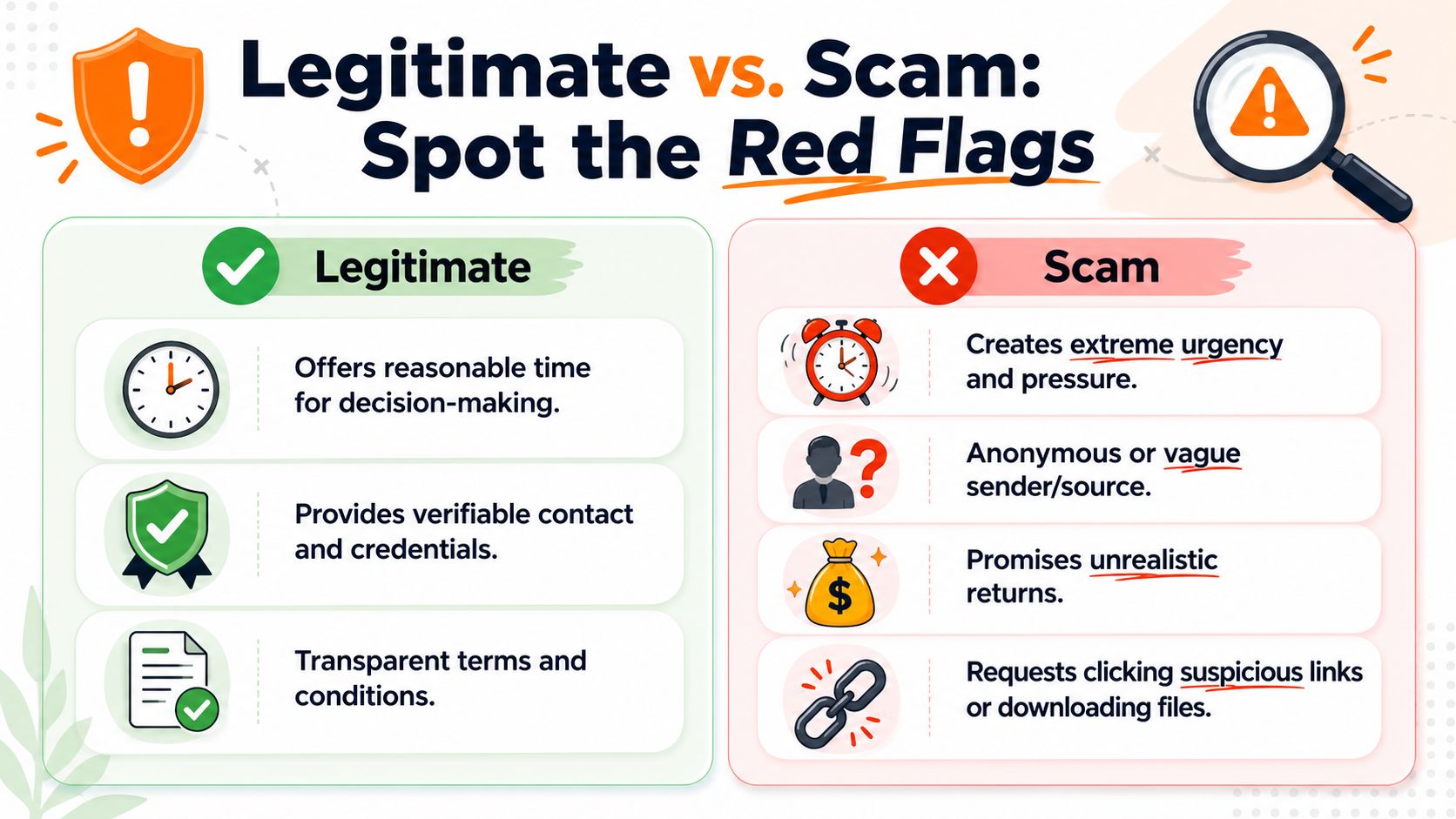
Four warning signs that show up everywhere
The delivery scam, fake support ticket, romance approach, and crypto airdrop all tend to share the same bones.
- Urgency first: “Act now”, “your account will be frozen”, “limited mint window”, “withdraw immediately”. Pressure is the point. If they can make you rush, they reduce the chance you'll verify.
- Authority without proof: The sender claims to be from your bank, HMRC, a wallet provider, OpenSea support, or a trading platform, but pushes you to use their link, their number, or their chat.
- A shortcut that bypasses your normal routine: Instead of opening your banking app the way you always do, they want you to tap a link in a message. Instead of logging into your exchange through your saved bookmark, they want you to use a fresh URL.
- A reward that overpowers judgement: Guaranteed returns, free tokens, surprise refunds, account recovery, whitelist access, “secret” pre-sale access.
A quick compare-and-contrast check
Here's a simple way to think about it before you click anything.
| Situation | More likely legitimate | More likely a scam |
|---|---|---|
| Bank message | Tells you to log in through your usual app or website | Tells you to click a link immediately |
| Crypto exchange email | References routine account activity and uses normal support channels | Claims an urgent security problem and sends you to a lookalike page |
| NFT mint announcement | Comes from the official project channels you already follow | Arrives via random DM with a countdown and “guaranteed mint” |
| Support contact | You initiated the ticket | They contacted you first |
The UK government warns that phishing is the most common way criminals initiate attacks, and that AI and phishing-as-a-service kits make fake websites and messages more convincing. So don't rely on appearance alone.
The sender name means less than you think
One detail I tell people to check is the path the message took, not just the display name. If you're trying to get better at spotting spoofed or manipulated emails, a basic guide to understanding email deliverability helps you see why a polished sender name can still be misleading.
For crypto users, the same principle applies across every channel. Discord username, Telegram badge, X profile picture, and website branding all create borrowed trust. None of them should be enough on their own. If you want more crypto-specific examples, this guide on how to spot and avoid phishing scams in crypto is worth reading.
If a message tells you not to verify it independently, you already have your answer.
A small pause catches most bad decisions
When people ask me how to avoid scams without becoming paranoid, I usually suggest one habit. Pause before action, not after.
Ask these questions:
- Did I expect this message?
- Is the sender asking me to leave my usual login path?
- Are they creating time pressure?
- Can I verify this through the official app, website, or number I found myself?
If you answer “no” to verification or “yes” to pressure, stop there.
Building Your Personal Security Fortress
You don't need elite technical skills to stay safer online. You need a handful of habits that work together. Think of them like locks on a front door. One good lock helps. Several layers help far more.
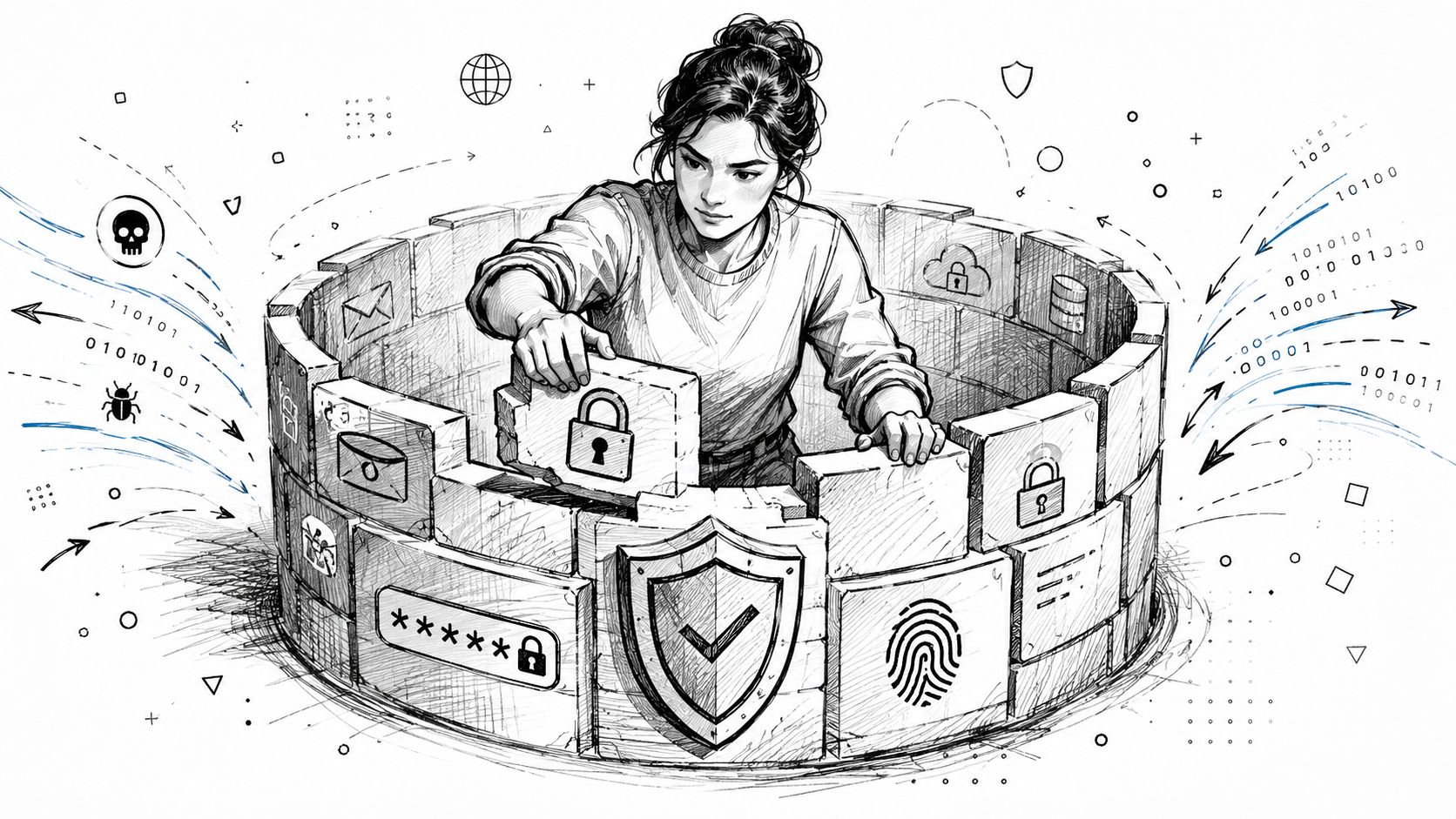
The most important layer protects your email account. If someone controls your email, they can often reset passwords elsewhere, intercept alerts, and take over accounts one by one. The Office for National Statistics notes that the simplest and most effective security measures are using strong, unique passwords, such as three random words, for your email and enabling 2-step verification wherever available.
Start with the two habits that matter most
A strong password strategy sounds annoying until you use a password manager. Then it becomes normal.
- Use unique passwords: Reusing one password across multiple sites turns one leak into a chain reaction.
- Protect your email first: Your email is often the recovery key for everything else.
- Turn on 2-step verification: That extra prompt blocks a lot of account takeover attempts.
- Store credentials properly: A browser password manager is better than a notes app, screenshot album, or reused password list.
If you hold crypto, your wallet setup matters even more. Use a separate wallet for everyday interaction and keep long-term holdings in a more locked-down setup. A hardware wallet is the closest thing crypto has to a home safe. It won't save you from every bad signature, but it gives you a stronger boundary than leaving everything in a hot wallet connected to every new site.
Privacy is part of security
People often think of privacy as a separate issue. It isn't. Oversharing gives scammers material.
A public post about your new phone, holiday plans, exchange account issue, or recent profit can become fuel for impersonation. A scammer who knows where you bank, which wallet you use, and which projects you follow can write a message that feels personal enough to get a click.
That applies offline too. If you handle ID scans, statements, tax papers, or wallet records, keeping them out of casual reach matters. For sensitive files that shouldn't sit exposed on a shared device, these offline document privacy solutions are a sensible reference point.
Field note: The best security setup is the one you'll still use on a rushed Tuesday morning.
That's why I don't recommend complicated routines that collapse under real life. Better to use a strong password manager, 2SV, bookmarks for important sites, and a clean wallet setup every day than build a perfect system you abandon in a week.
A practical stack for ordinary users
Here's a sensible baseline:
- Email account: Unique password, 2SV enabled, recovery options checked.
- Banking and exchange access: No login through message links. Use your app or bookmark.
- Crypto wallets: Separate spending wallet from storage wallet.
- Device habits: Update your phone and computer. Old software gives attackers easier openings.
- Important accounts: Review connected devices and active sessions now and then.
If you want a crypto-specific walkthrough of account protection, this explainer on how two-factor authentication protects your assets covers the mechanics in plain English.
Navigating Common Crypto and NFT Scams
Fraudsters do not need complex code to steal from you. They often need one tired decision, one rushed signature, or one moment where scam fatigue wins and you stop checking because every warning starts to sound the same.
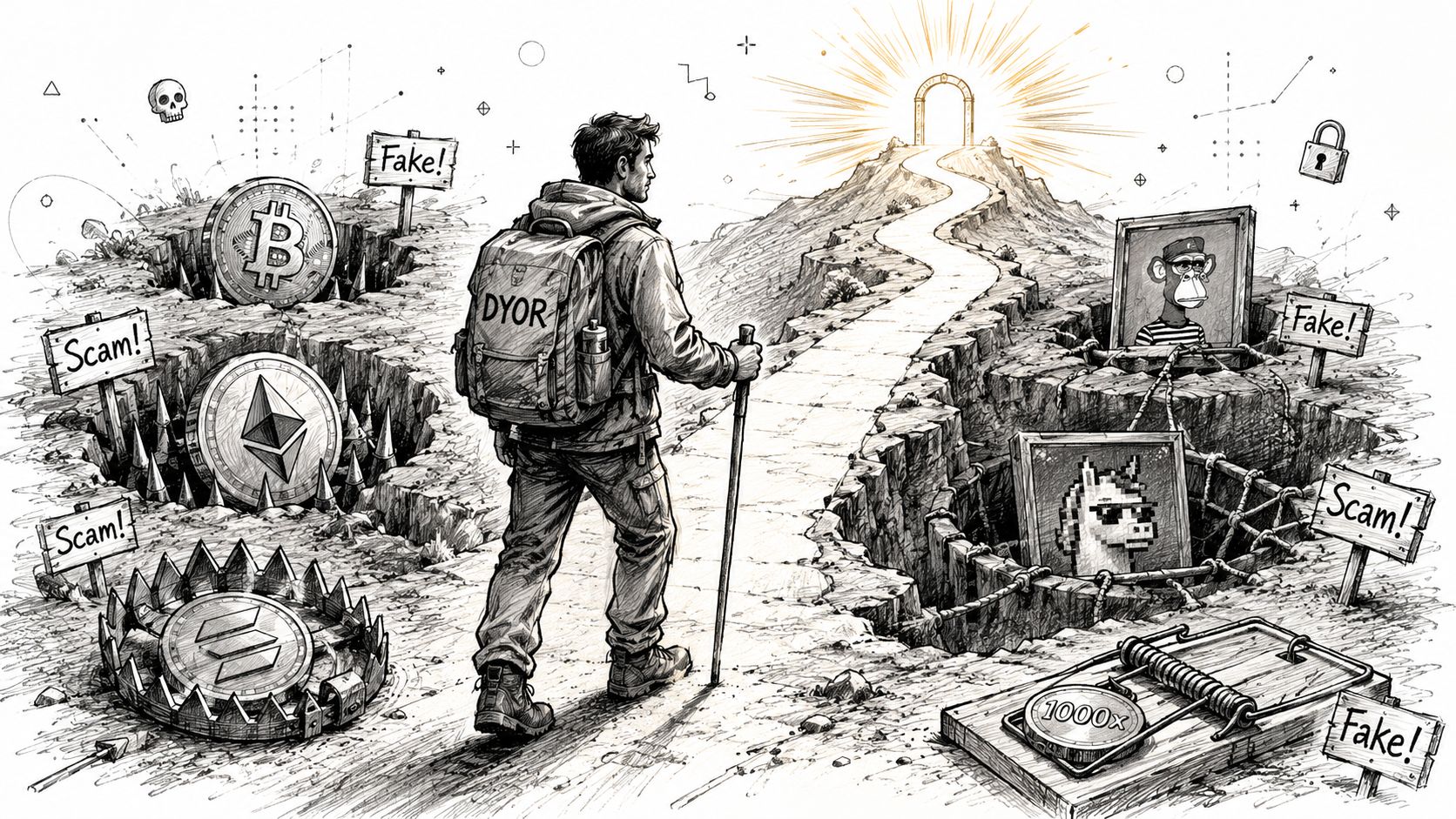
The Financial Conduct Authority says crypto-related fraud losses have risen 42% in the UK, and many younger victims report scam fatigue, feeling overwhelmed by standard warnings and trusting online communities more than regulators. That pattern tracks with what I see in practice. People are not always tricked because they know nothing. They get worn down by constant alerts, then trust the one message that feels familiar, urgent, or socially endorsed.
The fake airdrop and fake mint
This scam usually starts with a believable story. A project is rewarding early supporters. A collection is reopening a mint. A marketplace issue needs a quick wallet check. The page looks close enough to the original that your brain fills in the gaps.
The dangerous moment is not always the first click. It is the wallet prompt.
Some fake sites ask for your seed phrase outright. Others are smarter. They ask you to sign a message or approve a transaction that grants broad access to tokens or NFTs in that wallet. If you are moving fast, the request can look routine. It is the crypto version of signing a blank form because the logo at the top looked familiar.
NFT traders get hit by cloned mint pages, fake whitelist claims, copied collection listings, and spoofed support accounts. If NFTs are part of your routine, this guide on how to identify and avoid common NFT scams breaks down the usual setups clearly.
The scam that feels like a relationship
Some of the most expensive crypto scams move slowly. A stranger starts a friendly conversation on Instagram, Telegram, WhatsApp, X, or a dating app. Nothing feels strange at first. Then the topic shifts to investing, trading, or a platform they claim helped them make easy money.
That mix of emotional trust and financial pressure is what makes these scams effective. The victim is not just evaluating an investment. They are trying not to disappoint someone they now talk to every day.
Guaranteed returns, private signals, invite-only groups, and pressure to act before an opportunity disappears are all warning signs. So is any platform that seems polished but cannot be verified independently outside the conversation that introduced it.
Nobody legitimate needs romance, secrecy, or flattery to explain an investment.
A less dramatic scam can still be expensive. address poisoning scams work by planting lookalike wallet addresses into your transaction history, hoping you copy the wrong one later. No fake support agent. No urgent phone call. Just a small lapse in attention.
A short visual refresher helps because these patterns are easier to remember when you can watch them play out.
Rules that hold up in real life
Generic advice fades fast. Clear operating rules are easier to follow when you are busy, curious, or distracted.
- Treat every airdrop, mint, or support message as untrusted until proven otherwise: Go to the project through your own saved link, not the link that found you.
- Read the wallet prompt, not just the page behind it: The site can lie. The signature request tells you what you are approving.
- Use a separate wallet for experiments: Keep your main holdings away from new mints, unknown dApps, and hype-driven trading.
- Assume screenshots and social proof can be faked: A busy Discord, a verified-looking profile, or a thread full of excited replies is not proof.
- Slow down when a message tries to speed you up: Urgency is part of the attack, especially in crypto where people are trained to fear missing out.
Crypto rewards curiosity. Safe users add one habit before they act. They pause long enough to verify what they are being asked to trust.
The First Steps to Take If You Are Scammed
Fraud gets a second chance when people panic. I see the same pattern over and over. Someone loses money once, then loses more by replying to the scammer, trusting a fake recovery expert, or clicking one more “help” link while they are stressed and tired.
That spiral is common because scam fatigue is real. After days of fake delivery texts, cloned login pages, wallet pop-ups, and support impersonators, even careful people get worn down. The job now is not to replay the mistake in your head. The job is to contain the damage fast.
Do these things immediately
Cut contact
Stop replying on every channel. Do not argue, threaten, negotiate, or send a small payment to “release” the larger one. Recovery scams often start within hours of the first theft.Secure the account that was touched
Change the password from a device you trust. Sign out of other sessions. Reset or enable 2-step verification. If the attacker may have access to your email, secure that first because email is often the master key to everything else.Contact the bank or payment provider
If money left your bank account or card, contact the provider immediately through the number on the back of your card, the official banking app, or the UK's 159 service for suspected bank fraud. For wider reporting in the UK, use Action Fraud.Preserve evidence before it disappears
Save screenshots, wallet addresses, transaction IDs, usernames, email headers, chat logs, dates, and amounts. Copy the exact website address you used. Scammers delete accounts, edit messages, and rotate domains quickly.
Crypto-specific damage control
Crypto incidents need a slightly different response because there is often no chargeback and no support desk that can reverse a signed transaction. Speed matters, but accuracy matters too. Rushing from one wallet prompt to another is how people turn a bad loss into a total loss.
Use the response that matches what happened:
| What happened | Immediate response |
|---|---|
| You entered a seed phrase on a fake site | Move remaining assets to a new wallet you control as fast as possible. Treat the old wallet as permanently compromised |
| You connected a wallet and signed something suspicious | Stop using that wallet. Review token approvals and move valuable assets to a fresh wallet if needed |
| Exchange account accessed | Change password, secure email, reset 2FA, review withdrawal history, and contact exchange support through the official site or app |
| Bank transfer sent | Contact the bank immediately and ask what fraud response options are still open |
A practical rule from the crypto world helps here. If your seed phrase was exposed, the wallet is done. If you only signed a bad approval, the answer depends on what permission you gave and whether assets are still at risk. People often blur those two situations and waste time on the wrong fix.
Important: Anyone who contacts you after the theft and promises tracing, reversal, or guaranteed recovery for an upfront fee is very likely running a second scam.
Report it in the places that can create a record
Reporting rarely feels satisfying in the moment. Do it anyway. A bank may need a reference number. A platform may freeze an account that is still targeting other people. Your notes may also help if the same scam hits you again through a different channel.
Report the incident to the bank, exchange, wallet provider, marketplace, social platform, or messaging app involved. If the scam used a fake website, report the domain through the browser's safe browsing tools or the hosting provider if you can identify it. Keep your report plain and factual. What happened, when it happened, what account was used, what was taken.
Shame keeps people quiet. Scammers count on that. The faster you switch from embarrassment to containment, the better your odds of limiting the damage.
Your Reusable Scam-Proofing Checklist
The easiest way to stay safe is to make scam checking small enough that you'll do it. Not a huge security ritual. Just a quick pre-flight check before you click, connect, pay, sign, or share.
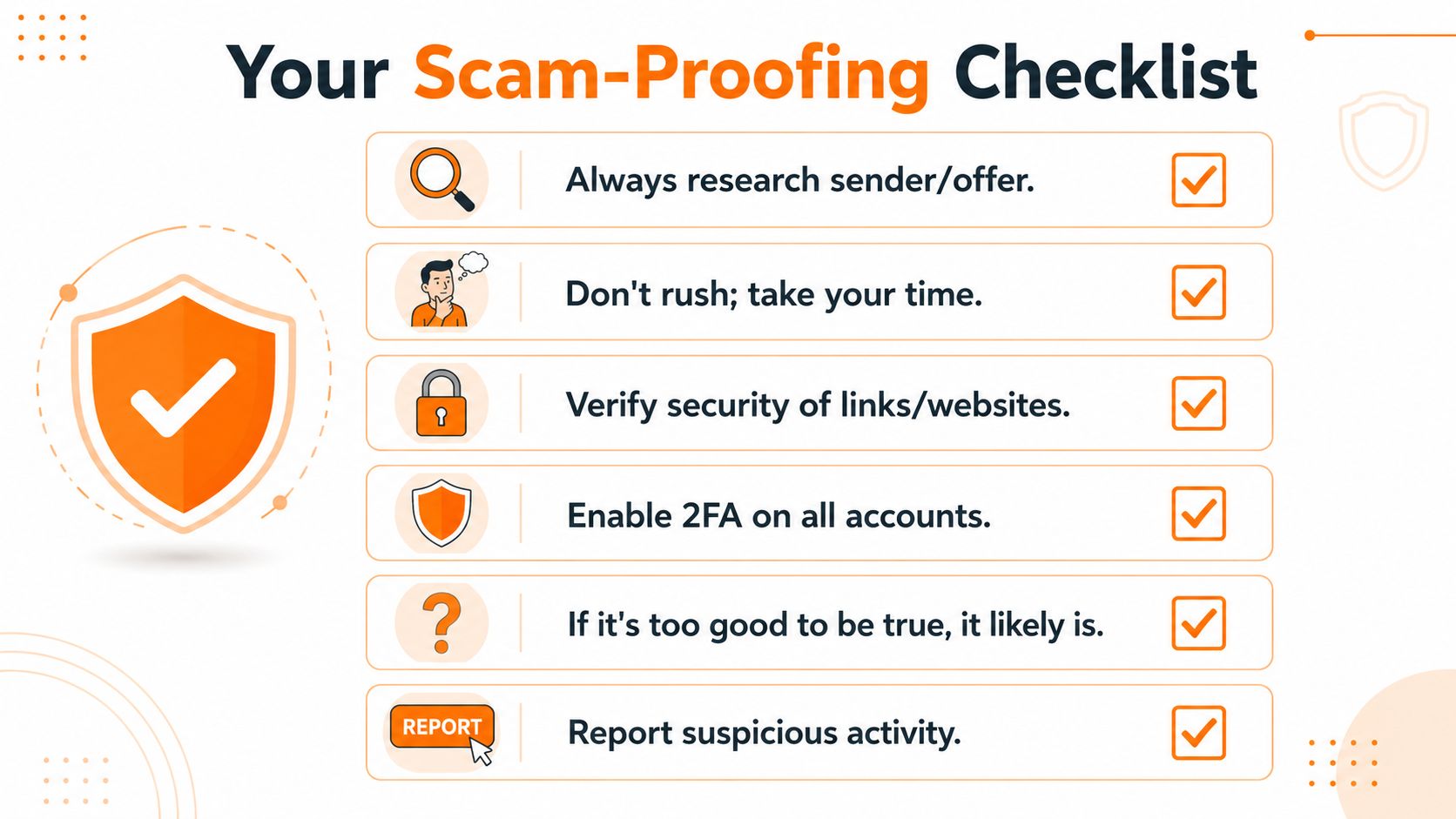
The six-question check
Do I know who initiated this?
Expected messages are safer than surprise ones. Random urgency deserves extra suspicion.Am I being rushed?
Pressure is one of the oldest scam tools because it works.Have I verified through a separate route?
Use the official app, a saved bookmark, or contact details you found yourself.Am I about to reveal something powerful?
Seed phrases, one-time codes, passwords, and identity documents can all lead to further damage.Does the offer rely on emotion?
Fear, greed, romance, relief, and exclusivity all weaken judgement.If this went wrong, what would I lose?
That single question often slows people down enough to spot the trap.
Use the checklist differently depending on the situation
For ordinary life, this might mean checking whether a delivery text is real before tapping a link. For crypto, it might mean reading a wallet signature twice and using a low-value wallet for first contact. For investing, it means being very cautious with “guaranteed” returns, secret opportunities, or strangers who want to move you into a private chat.
The Government Counter Fraud Profession's fraud prevention standard argues for a continuous, proportionate, data-driven control approach built around commitment, risk assessment, procedures, due diligence, training, and review. That same idea works at personal level too. Don't treat security as a one-off setting. Treat it as maintenance.
Good scam prevention isn't about spotting every lie instantly. It's about refusing to make important decisions at a scammer's speed.
If you remember one thing, remember this. Most scams fall apart when you slow the process down and verify outside the channel that contacted you.
If you want clear, practical crypto education without the hype, The Coin Course is a strong place to keep learning. It covers wallets, security, NFTs, DeFi, trading, and core blockchain concepts in a way that helps you protect your assets while you build real understanding.