
So, you’re thinking about running a crypto airdrop. Smart move. When done right, an airdrop is one of the most powerful tools in a Web3 project's arsenal for building a community, rewarding your earliest believers, and getting your token into the hands of people who will actually care.
This isn’t just about theory. We’re going to walk through the practical, actionable steps you need to take. Forget the fluff—we'll cover everything from defining your goals and picking a distribution model to the nitty-gritty of the tech and talking to your community. The goal is simple: launch an airdrop that does more than just give away free tokens. It should build the very foundation of your project.
Think of a well-planned airdrop less as a giveaway and more as a clever marketing campaign. You’re essentially planting seeds—giving a piece of your project to the very people most likely to help it grow. This is how you turn passive followers into active, invested participants.
Take a look at the Uniswap airdrop back in 2020. They gave UNI tokens to anyone who had used their platform early on. It was a brilliant move. It wasn't just a simple "thank you"; it instantly created a massive, decentralised governing body. Suddenly, thousands of users had a real stake in the protocol's future. That single event rewrote the playbook on building a loyal community from day one.
Why Are Airdrops Gaining So Much Traction?
The excitement around airdrops has exploded as crypto becomes more popular. In the United Kingdom alone, the change has been significant. Crypto ownership jumped from 18% to 24% in just one year—that's a 33% surge in the user base. This growing audience represents a huge pool of potential community members for your project. You can find more of these crypto user statistics over at SQ Magazine.
This growth is precisely why mastering the art of the airdrop is so important for project teams today. A single, well-executed campaign can help you achieve several key goals at once:
- Generate Buzz: Airdrops get people talking. They create genuine excitement on social media and often get featured by crypto news outlets.
- Decentralise Your Token: By spreading tokens to lots of people, you avoid the risk of a few wallets holding all the power.
- Reward Your Day Ones: It’s a powerful way to thank the people who supported your vision from the very beginning, building a core of long-term loyalty.
To help you picture the entire process, here’s a quick breakdown of what goes into a successful airdrop from start to finish.
Airdrop Strategy at a Glance
| Phase | Key Objective | Critical Action |
|---|---|---|
| 1. Planning & Strategy | Define clear goals for the airdrop. | Set targets, define the target audience, and choose the airdrop model (e.g., standard, bounty, holder). |
| 2. Eligibility & Snapshot | Identify and lock in the recipient list. | Decide on criteria (like wallet activity or Discord roles) and take a blockchain snapshot at a specific block number. |
| 3. Technical Execution | Build the distribution mechanism. | Develop and test the smart contract, create a Merkle tree for efficient claims, and build a secure front-end website. |
| 4. Communication & Launch | Announce and manage the airdrop. | Create a clear communication plan, publish official announcements, and provide support through community channels. |
| 5. Post-Airdrop | Analyse results and engage the new community. | Track claim rates, watch token activity, and create initiatives to keep new token holders involved. |
Each phase requires careful thought and execution to make sure the airdrop not only runs smoothly but also achieves its strategic goals.
A successful airdrop isn’t measured by how many tokens you give away. It’s measured by the quality and engagement of the community you create. The real win is attracting long-term contributors, not short-term flippers.
To get there, every single decision you make is important. From defining who gets a token to making sure the claim process is secure and easy, careful planning is a must. This guide will give you a clear roadmap to navigate each step, avoid common mistakes, and truly maximise your airdrop’s impact.
Pinpointing Your Airdrop’s Purpose and Audience
Before you even think about the technical side of things, the success of your airdrop comes down to a single, vital question: why are you doing this? The answer to that question will guide every single decision you make, from who gets tokens to how they claim them.
Airdrops are far more than just free token giveaways. When done right, they are precise tools for hitting specific project goals. Without a clear objective, you’re just throwing tokens into the wind, hoping some of it lands in the right hands. That's a recipe for rewarding the wrong people and wasting a huge opportunity.
What’s the Goal? Setting Clear Objectives
Your main objective is the foundation of the entire campaign. Are you trying to build a community from scratch, thank your earliest believers, or maybe even attract users from a competitor? Each of these goals needs a completely different approach.
Let’s break down some common reasons:
- Rewarding Early Supporters: This is all about recognizing the people who took a chance on you from day one. The aim here isn't just a thank you; it's about cementing a base of long-term holders and true fans of your project. A great example is when the NFT project Pudgy Penguins airdropped lil pudgys to their original holders as a thank you.
- Decentralising Governance: For any project moving towards a DAO (Decentralised Autonomous Organisation) structure, getting voting power into as many hands as possible is essential. This stops any small group from having too much influence over the protocol's future.
- Attracting New Users: Sometimes, the goal is simply aggressive growth. You might be trying to pull users away from a rival platform or draw in participants from a related ecosystem.
- Sparking Network Activity: An airdrop can be a fantastic way to encourage specific, valuable actions. This could be anything from asking users to provide liquidity, mint an NFT, or test out a brand-new feature.
A classic example of this in action was the Ethereum Name Service (ENS) airdrop. They gave $ENS tokens to everyone who had ever registered a .eth name. Their mission was twofold: reward their earliest users and, most importantly, hand over governance of the protocol to that very community. It was a masterclass in using an airdrop to achieve real decentralisation.
Defining Who Gets a Slice of the Pie
Once you’ve figured out your "why," you can get to the "who." Your eligibility criteria should be a direct result of your main goal. If you're trying to reward loyalty, you need to find a way to identify what that looks like on-chain. This is where you move from big-picture strategy to detailed data analysis.
Simply giving tokens to every wallet that ever interacted with your protocol is almost always a mistake. This approach is a magnet for "airdrop farmers"—users who perform minimal actions across hundreds of projects just to qualify, with no plan to stick around. The data is clear on this: airdrops with loose, easily-gamed criteria almost always face a massive token dump right after the claim goes live.
To avoid that fate, you have to get specific.
A thoughtfully designed airdrop is a filter for genuine community members, not mercenaries. Focus on the quality of your future token holders, not just the raw number. The best way to attract the right people is to reward proven commitment.
Think about the on-chain actions that signal real, meaningful engagement. A user who has made 10+ transactions, holds a governance token from a key partner project, or has provided liquidity for over three months is far more valuable than someone who just did a single swap and vanished.
Using On-Chain Data to Find Your People
Let's look at how some well-known projects handled this.
- Uniswap: In what became a legendary move, Uniswap rewarded anyone who had ever used the protocol, even if their transaction failed. It was a very broad approach, but it worked wonders at a time when airdrops weren't yet a common part of the crypto playbook.
- Optimism: For its first airdrop, Optimism took a much more detailed, multi-layered approach. They didn't just reward their own users; they also included active Ethereum users, DAO voters, and multi-sig signers, strategically targeting engaged participants from the wider ecosystem.
- Blur: The NFT marketplace, Blur, tied its airdrop directly to the behaviour it wanted to encourage. Rewards were based on trading volume and a "loyalty score," which strongly incentivised the on-platform activity that helped it grow so quickly.
This whole process leads up to the snapshot. A snapshot is basically a photograph of the blockchain at a specific block height. It creates a permanent, unchangeable record of all the wallet addresses that met your criteria at that exact moment in time.
Deciding on and announcing your snapshot is a key strategic move. In most cases, a retroactive snapshot—one that was taken at some point in the past without any prior announcement—is the best way to go. Why? Because it guarantees the list of recipients is based on genuine, natural activity. It completely stops people from trying to game the system at the last minute just to get a payout.
Choosing Your Distribution Model
Once you've decided who qualifies for your airdrop, you’re faced with a big technical challenge: how do you actually get the tokens into their wallets? This isn't just a simple choice; it has huge effects on your budget, your users' experience, and even security. Broadly, you have two paths you can take.
The first is the ‘push’ model, where you are the one sending tokens directly to every eligible wallet. The second, and by far the more popular option today, is the ‘pull’ model, where users have to visit a website to actively claim their tokens. Let's break down the real-world pros and cons of each.
The Direct Push Airdrop
At first glance, the push model seems very simple. You've got your list of addresses, you load up a wallet with tokens, and you start sending them out, paying the gas fee for each transaction. From the user's perspective, it’s a dream – they just wake up one day and find new tokens have magically appeared in their wallet. For instance, the Starknet airdrop in early 2024 sent tokens directly to certain Ethereum solo-stakers without them needing to do anything.
But that convenience comes at a very high price. You, the project, pay for every single transaction. If your airdrop has thousands, or even tens of thousands, of recipients, this can get incredibly expensive. We’re talking about a potential cost of hundreds of thousands of pounds in gas fees, especially on a busy network like Ethereum.
This diagram shows the basic workflow that gets you to this important decision point.
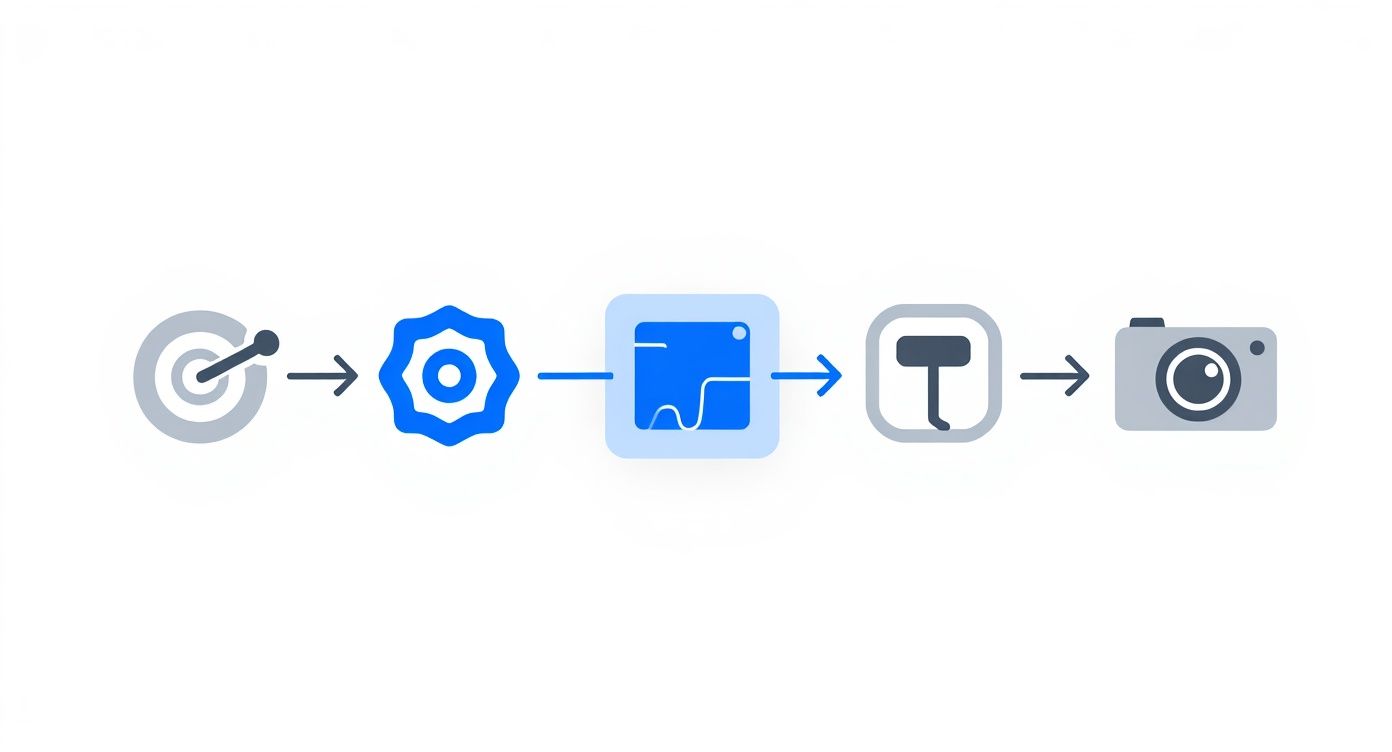
As you can see, figuring out your goals, eligibility, and snapshot method comes first. These early decisions directly affect the scale of your distribution and help determine which model makes sense.
The Modern Pull or Claim Model
This is where the pull model, often called a claim-based airdrop, really shines. Instead of you pushing the tokens out, eligible users come to a special website to pull them in. In this setup, the user connects their wallet, signs a transaction, and pays the gas fee themselves to get their tokens.
This approach completely changes the cost situation. The project's gas spending shrinks to just one or two transactions needed to set up the airdrop smart contract. For a project working with a tight budget, this is a huge advantage and the main reason why over 95% of major airdrops now use this method.
The 'pull' model does more than just save on gas fees; it acts as a filter. Users who take the time to visit your site and claim their tokens are showing a higher level of interest and are more likely to become engaged community members.
This method also gives you incredibly valuable data. You can watch claim rates in real-time and see exactly how many of your airdropped tokens have actually entered circulation. This information is gold for understanding your initial token distribution and how engaged your community really is. Getting the distribution method right is a key part of your project's financial strategy, a topic we cover in our guide to tokenomics and economic models.
The Magic of Merkle Trees for Efficiency
So, how does a smart contract know if a user connecting to your website is on the list without storing thousands of addresses on-chain? Trying to store that much data directly in a smart contract would be ridiculously expensive. The smart solution the industry has settled on is the Merkle Tree.
Think of a Merkle Tree as a clever way to create a single, cryptographic fingerprint (the Merkle Root) from a huge list of data. Here’s a simple way to picture it:
- Start with your full list of eligible wallet addresses and the number of tokens they get.
- Cryptographically "hash" each of these address-and-amount pairs individually.
- Take pairs of those resulting hashes and hash them together, creating a new, smaller layer of hashes.
- Keep repeating this process—pairing and hashing—until you’re left with just one single hash. That's your Merkle Root.
You only need to store this one Merkle Root in your smart contract, which is very cheap. When someone wants to claim, their browser gives the contract their address, their token amount, and a "Merkle Proof"—the specific chain of hashes needed to connect their individual data all the way back up to the root. The contract can then instantly check if their proof correctly rebuilds the root it has stored. If it matches, the claim goes through.
This technique is the backbone of almost every modern airdrop you’ve heard of, from Arbitrum to Jupiter. It lets them verify eligibility for millions of users with very low on-chain cost. It’s a brilliant piece of cryptographic engineering that makes large-scale, cost-effective airdrops possible.
Bringing Your Airdrop to Life: Execution and Communication
Alright, you’ve done the heavy lifting. The strategy is set, the contracts are ready, and you know how you're getting tokens to your community. Now comes the moment of truth: execution. This is where planning meets reality, and a smooth launch comes down to two things: rock-solid security and crystal-clear communication. Get this right, and you've got a community-building success; get it wrong, and you're looking at a trust-shattering mess.
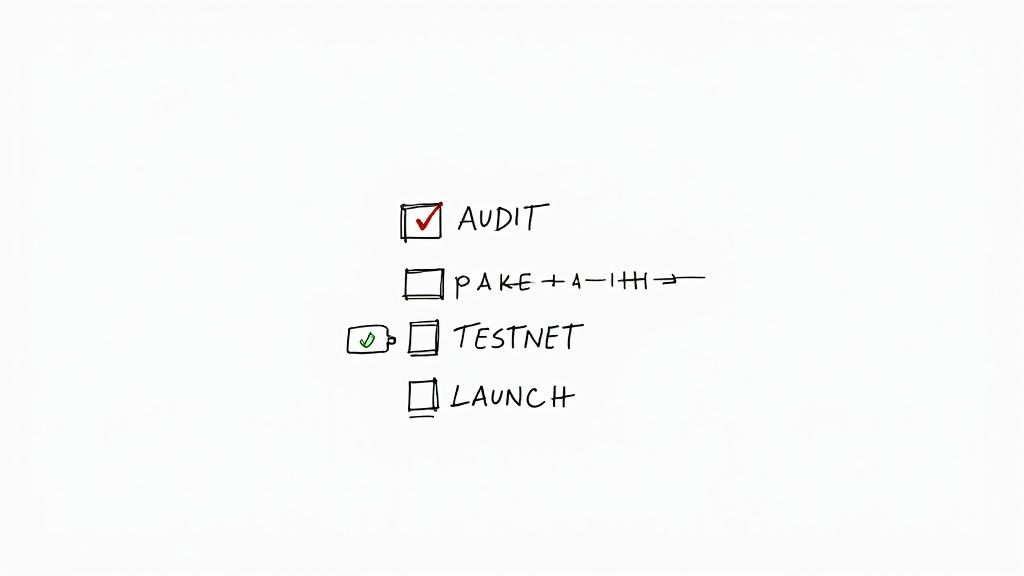
Before a single token goes out, you need to run through a pre-launch checklist that you absolutely cannot skip. Don't even think about cutting corners here.
Run the Pre-Launch Security Gauntlet
First up, and most importantly, is a professional security audit. Launching an unaudited smart contract is like leaving a bank vault wide open with a "help yourself" sign. A single flaw could see your entire airdrop allocation drained, destroying your reputation before you've even started. You absolutely must hire a reputable third-party auditing firm to check your code for any weaknesses.
A security audit isn't just a box-ticking exercise; it's your project's insurance policy against a catastrophic failure. The cost of a good audit is a drop in the ocean compared to the potential loss from an exploit.
Once your code comes back with a clean bill of health, it's time for a full testnet deployment. Think of this as your dress rehearsal. You'll want to simulate the entire airdrop on a network like Sepolia, from the initial snapshot to the final claim. This is your chance to fix any bugs in the claiming process, check that the website talks to the contract properly, and generally make sure the user experience is perfect. It’s here that you catch the small issues that become massive headaches on launch day.
To get a deeper understanding of this crucial process, have a look at our detailed guide on smart contract security and audits.
Master Your Launch Day Comms
When airdrop day arrives, your communication plan is your single most important tool. Your goal is to create one official source of truth to cut through the inevitable chaos and scam attempts that will flood your community's private messages. Coordinate your announcement to go live across all your channels at the same time—Twitter (X), Discord, Telegram, and your blog.
Keep your messaging simple and direct. Provide a clear, step-by-step guide on how to claim, and—this is vital for security—share one official link to the claiming portal. Really hammer this point home.
- Be Proactive: Constantly remind your community to never, ever click on links from unofficial sources or respond to anyone offering "help" in their DMs. Scammers will be out in full force.
- Set Expectations: Be clear about the claim window. Do users have 30 days, 90 days, or a year to get their tokens? Make it obvious. For example, the Arbitrum airdrop gave users six months to claim their tokens.
- Handle Gas: Let people know which network the claim is on and remind them to have enough native currency (like ETH) ready for gas fees.
A well-managed communication strategy doesn't just guide users; it builds a huge amount of trust when they need it most.
The Work Isn't Over After Launch
The job isn't done just because the claim page is live. The post-launch phase is your chance to turn a technical distribution into a real community-building moment. You'll want to start by actively watching key metrics. Keep an eye on the claim rate and the number of unique wallets claiming. This data gives you instant feedback on the airdrop's reach and how engaged people are right away.
This is also the perfect time to roll out the welcome mat for new token holders. Use the excitement to kickstart community activity. You could host an "Ask Me Anything" (AMA) with the founders, launch the first governance proposals for new holders to vote on, or create special Discord roles just for airdrop participants.
The financial upside of a well-planned airdrop can be huge. An analysis of 11 major airdrops revealed a total distribution of roughly $7.16 billion across 1.9 million users. The median claim value sat around $4,600 per address, showing the powerful economic incentive driving people to take part.
By actively engaging with your new token holders from day one, you start the all-important process of turning them from passive recipients into active, long-term contributors who believe in your project's future.
Understanding UK Tax and Regulatory Rules
If your project has a UK presence or is targeting users there, getting to grips with the local rules isn't just a formality—it’s key to building trust. A solid understanding of how His Majesty's Revenue and Customs (HMRC) treats crypto airdrops means you can communicate clearly and responsibly with an important part of your community.
The rules aren't as scary as they might seem, but they all depend on one crucial difference. Knowing this allows you to set clear expectations and save your users from a big tax headache later on.
https://www.youtube.com/embed/5wxcgSgjI4o
The Core Principle: Action vs. No Action
In the eyes of HMRC, the tax treatment of an airdrop comes down to a simple question for the person receiving it: did they have to do anything to get the tokens? This one factor decides whether the airdrop is treated as miscellaneous income right when they get it.
Let's take a "holder airdrop." Imagine you're rewarding everyone who held a specific NFT or token at the snapshot time. These users didn't perform any new action; they were just passive holders. In this situation, the value of the airdropped tokens is not typically considered income at the point of receipt. A good example is the ENS airdrop, where users received tokens just for having owned a .eth domain name in the past.
But the moment you require users to perform a task, the game changes completely. This is often called a "bounty airdrop."
- Examples of Taxable Actions: Asking users to share a post on social media, join a Telegram group, or actively test a new feature.
- The Tax Hit: If a specific task is required, the fair market value of the tokens at the time they're received is considered miscellaneous income and must be reported to HMRC.
As the CoinTracking guide to UK crypto taxes explains, it’s all about whether the tokens were earned through work. If they just appear in a wallet without any effort, they’re generally tax-free on arrival. If someone had to complete a task to get them, they're taxed as income.
Capital Gains Tax: The Second Piece of the Puzzle
Receiving the tokens is only the first part of the story. For UK residents, the tax obligations don't stop there, no matter how the airdrop was received. When a user eventually sells, swaps, or spends those tokens, any profit they make is subject to Capital Gains Tax (CGT).
This applies to every single airdrop recipient. The important part is figuring out the "cost basis" of the tokens to calculate the taxable gain.
For an airdrop that was treated as income, the cost basis is its market value on the day it was received. For a passive airdrop that wasn't income, the cost basis is £0. This means the entire value upon sale is treated as a capital gain.
Communicating Responsibly with Your UK Community
So, what does all this mean for you, the project lead? You can't offer financial advice, of course, but you absolutely can—and should—be transparent about how your airdrop works. This transparency helps your UK community members stay on the right side of the rules and builds incredible goodwill.
Be upfront about the terms. If users need to complete tasks, a simple heads-up to consider the potential tax implications in their country goes a long way. This small act of responsible communication shows you really care about your community's long-term success.
Staying on top of tax obligations is a vital part of being a crypto investor. For a more detailed breakdown of this topic, have a look at our guide on navigating crypto trading taxes and what every investor should know. A proactive approach here protects both your project and the people who believe in it.
Common Questions About Crypto Airdrops
Even with the most detailed plan, a crypto airdrop always has a few surprises. Project teams tend to run into the same old problems, whether it's battling bots or just managing the community's sky-high expectations. Here, we'll walk through some of the questions that come up time and time again, so you can handle these challenges with a bit more confidence.
How Do We Stop Bots from Farming Our Airdrop?
Look, there’s no magic solution for stopping airdrop farmers. The best you can do is build a multi-layered defence. If you rely on a single metric, you’re just asking for trouble from clever bots, what we call "Sybil" attackers. The real goal is to create eligibility criteria that reward genuine, long-term believers over someone who just automates a few clicks.
A solid starting point is to make rules that reward activity over time. Forget single transactions; look for a history of consistent participation over several months. For example, did a wallet interact with your protocol multiple times across different weeks? That simple check alone will filter out a huge number of low-effort bots.
From there, you can start digging into the on-chain data for anything that seems suspicious.
- Funding Source Analysis: Do hundreds of wallets all get their initial ETH from a single source? That’s a massive red flag and classic Sybil farm behaviour. The LayerZero team famously did this to disqualify thousands of wallets.
- Identical Behaviour: If you see a cluster of wallets performing the exact same sequence of actions at almost the same time, you can bet they're connected.
- Wallet Age: Setting a minimum wallet age (e.g., must have been created before a specific date) is a simple but effective way to remove brand-new accounts created just to farm your airdrop.
Some projects also bring in identity-related tools like Gitcoin Passport or BrightID to add another layer of human verification. By using these methods together—rewarding long-term use, analysing on-chain footprints, and adding verification steps—you build a much tougher system, making it far more likely your tokens land in the hands of real community members.
What Are the Biggest Security Risks with an Airdrop?
Two nightmares should keep every project team up at night: smart contract bugs and phishing scams. A tiny mistake in your airdrop contract could be exploited to drain the entire token allocation or let ineligible users claim, completely destroying your project's credibility. This is exactly why a third-party security audit isn’t a nice-to-have; it's absolutely essential.
The second huge threat is phishing. The second you announce your airdrop, the scammers will crawl out of the woodwork. They'll create fake websites, make convincing social media profiles, and send private messages to your users, all trying to trick people into connecting their wallets to a malicious site.
Your communication strategy is your primary defence against phishing. You must establish one official, undeniable source of truth—ideally a big, obvious link on your main website—and relentlessly repeat that message.
Constantly remind your community to double-check URLs, bookmark the official claim page, and ignore any private messages offering "help" or "special access." Your job is to be the loudest, clearest voice in the room, drowning out the noise from the bad actors.
How Many Tokens Should We Airdrop?
Figuring out the size of your airdrop is a delicate balancing act that is tied directly to your project's overall tokenomics. There's no magic number here, but we often see airdrops fall somewhere between 5% and 20% of the total token supply. For instance, the popular project Arbitrum airdropped 12.75% of its total supply.
A bigger allocation can create more excitement and get your token into more hands, but it also carries the risk of a massive sell-off right after launch, which could hurt your token’s price. You have to carefully weigh the desire to reward your early community against the need to maintain a healthy market.
Claim rates are another big variable. We’ve seen airdrops with claim rates as low as 30% and others that soared past 90%. It all depends on the project's hype, the perceived value of the airdrop, and how easy you make the claiming process.
It’s also very important to have a clear plan for what happens to any tokens that go unclaimed. A popular and responsible move is to sweep these unclaimed tokens into the community treasury. From there, they can be put to good use for future growth, such as:
- Grant Programmes: Funding developers to build new tools and features.
- Liquidity Incentives: Rewarding users for providing liquidity on decentralised exchanges.
- Future Community Rewards: Saving them for another round of targeted incentives later on.
This approach ensures every token ultimately serves the project's long-term health, even if it wasn't picked up in the initial airdrop.
At The Coin Course, we're dedicated to providing clear, practical, and expert-led education to help you master every aspect of the crypto world. From foundational principles to advanced strategies, our resources are designed to build your confidence and skill. Start your learning journey today at https://thecoincourse.com.