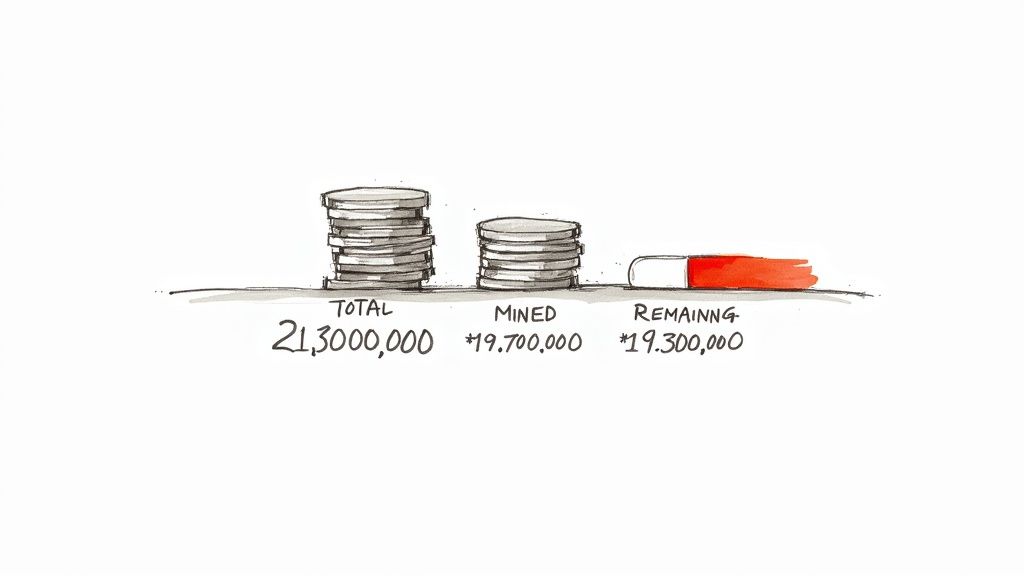
Let's cut straight to the chase. Of the 21 million bitcoins that will ever exist, a staggering 19.7 million have already been mined as of early 2024. That leaves just over 1.3 million bitcoins left to be discovered. This hard limit is one of the most important parts of Bitcoin's design.
The Current State of Bitcoin's Supply
Imagine it like a digital gold rush, but everyone knows exactly how much gold is in the mountain. The vast majority has already been dug up, and the last few bits are being pulled out at a slow and steady pace. This built-in rarity is what makes Bitcoin different from regular money, which governments can print whenever they want.
New coins come into the world through a process called mining. Basically, miners use powerful computers to solve tricky math puzzles. For instance, a mining farm in Iceland might have thousands of computers running at once, all competing to find the answer. The first one to crack the puzzle gets to approve a new batch of transactions and is rewarded with some brand-new bitcoin.
This reward, however, doesn't stay the same forever. It gets cut in half roughly every four years in an event called the “halving”. This system is set up to slow down the creation of new coins over time, making sure the final bitcoin won’t be mined until somewhere around the year 2140.
To see the numbers clearly, here's a quick breakdown of where we stand today.
Bitcoin Supply At a Glance
| Metric | Amount |
|---|---|
| Maximum Total Supply | 21,000,000 |
| Circulating Supply (approx.) | 19,700,000 |
| Remaining to be Mined | 1,300,000 |
This table shows a simple fact: the chance to mine new bitcoin is slowly disappearing.
While the UK's direct contribution to global mining is small, the growing scarcity of Bitcoin is a big deal for British investors and money experts. If you want to dive deeper into the nuts and bolts, you can find more information about the Bitcoin mining process and how it works.
The key takeaway is simple: Bitcoin is designed to be scarce. With over 93% of the total supply already in circulation, the competition for the remaining coins will only get more intense.
Why Is Bitcoin Capped at 21 Million?
Ever wonder about that magic number, 21 million? It’s not just a random figure. This was a very careful choice by Bitcoin's creator, Satoshi Nakamoto, who wanted to make a digital asset that acted more like a precious metal, such as gold, than a typical currency.
Unlike the money in our bank accounts, which central banks can create more of whenever they decide, Bitcoin’s supply is totally fixed and predictable. This is a vital part of its design. When a government prints more money, the value of every pound or dollar already out there tends to fall. We call this inflation. Bitcoin was built to be different.
Think of it like a limited-edition sneaker. If the company guarantees they will only ever make 500 pairs, each one becomes incredibly valuable because it's rare. Bitcoin uses that same idea of scarcity in the digital world. The 21 million limit is written right into its core code, which means no single person or group can just decide to make more and lower the value for everyone else.
The 'Digital Gold' Analogy
This scarcity is why you'll often hear people call Bitcoin "digital gold." We know there’s only a certain amount of gold on Earth. As it gets harder and more expensive to dig up, its value tends to hold steady or even go up. Bitcoin was designed to copy this exact feature.
By setting a finite supply, Satoshi engineered Bitcoin to be a disinflationary asset. This just means that the rate of new coin creation slows down over time, helping to protect its long-term value from being worn down by inflation.
This key design choice is essential for understanding what gives Bitcoin its value. As more people start using it and the supply of new coins gets smaller, simple economics suggests this built-in rarity could become a major reason its price goes up. For a deeper look into how it all started, our guide on Bitcoin as the first cryptocurrency covers the full backstory.
How the Bitcoin Halving Controls Supply
The release of new bitcoins isn't a free-for-all; it’s controlled by a clever, built-in event called the halving. You can think of it as an automatic supply switch baked directly into Bitcoin’s code, making sure new coins become harder to get over time. This process is the secret sauce behind Bitcoin's rarity.
Here's how it works: for every 210,000 blocks added to the blockchain—which takes roughly four years—the reward paid out to the role of miners in cryptocurrency networks gets chopped in half. It’s a bit like a gold rush where, after a few years of digging, the amount of gold you could find each day was suddenly and permanently cut by 50%. The gold left in the ground would naturally feel more precious.
This predictable "supply shock" is a key part of Bitcoin's economic design. It deliberately slows down the creation of new coins, making it a disinflationary asset.
The Halving Schedule and Its Impact
We've already had several halvings, and each one has dramatically changed how fast new Bitcoin is created. Let's look at the journey:
- 2009: When Bitcoin first launched, miners earned a generous 50 BTC for every block they solved.
- 2012 Halving: The reward was cut down to 25 BTC.
- 2016 Halving: It was chopped in half again, this time to 12.5 BTC.
- 2020 Halving: The reward dropped to 6.25 BTC per block.
- 2024 Halving: Most recently, it was slashed to just 3.125 BTC.
As you can see, the pace at which new bitcoins are made is always slowing down. The great thing about this system is its predictability; anyone can check the code and see exactly how the supply will play out for decades to come.
By slashing the reward, the halving directly reduces the flow of new supply entering the market. This mechanism is so effective that it guarantees the very last bitcoin won’t be mined until somewhere around the year 2140.
This predictable tightening of supply is a key feature that attracts many investors. In the past, each halving has sparked new interest in the market, as people are reminded of just how rare Bitcoin is becoming.
When Will the Last Bitcoin Be Mined?
When you hear that over 93% of all possible Bitcoin is already out there, it’s easy to think we're almost at the end. But the truth is quite different. Thanks to a clever system built into Bitcoin's code, the final coin isn't expected to be mined until around the year 2140.
That’s more than a century from now. So, how does that work?
It all comes down to the ‘halving’. Roughly every four years, the reward for mining a new block of transactions gets cut in half. Think of it like a treasure hunt where the clues get progressively harder to solve. The reward dropped from 6.25 BTC to 3.125 BTC in 2024, and around 2028, it’ll fall again to just 1.5625 BTC.
This steady reduction means that even though millions of bitcoins were made in the early days, the last few will appear incredibly slowly. It's a key design choice that stops a sudden flood of new coins and strengthens Bitcoin’s long-term scarcity.
The Long Road to 21 Million
This halving schedule lays out a long and predictable path towards the final supply limit.
The infographic below really brings this timeline to life, showing how each halving event carefully slows down the flow of new Bitcoin.
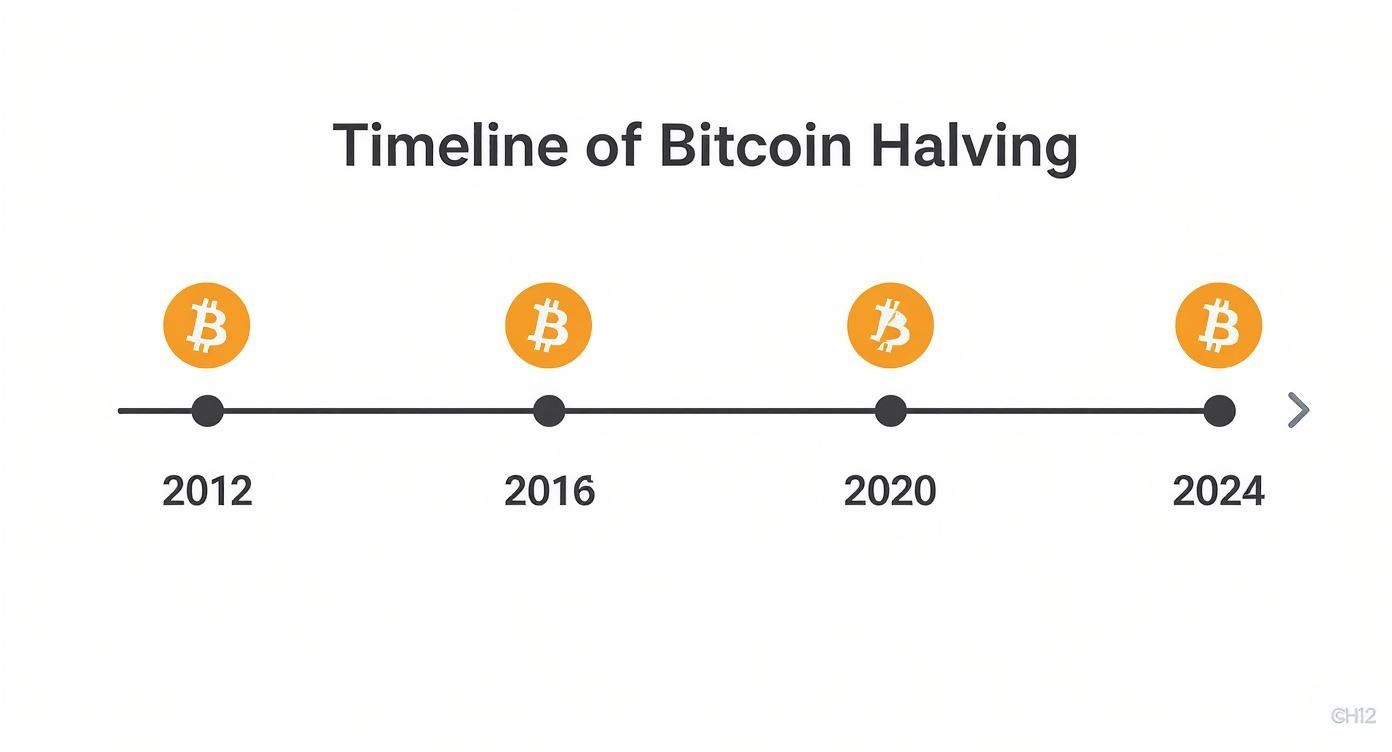
As you can see, each four-year cycle makes a big cut to the mining reward. This makes sure the journey to 21 million is a marathon, not a sprint.
The key takeaway is that Bitcoin’s supply schedule is deliberately designed to last a long time. It busts the common myth that we’re about to run out of new bitcoins; in fact, mining the last 1% will take nearly a hundred years.
This drawn-out forecast creates a stable and predictable model for how the remaining supply will be released, giving the whole network plenty of time to adapt as the business of mining continues to change.
The Reality of Bitcoin Mining in the UK

While the race to mine the last bitcoins is a global one, what happens on the ground locally makes a huge difference. For anyone thinking about mining Bitcoin in the United Kingdom, one massive roadblock stands out: the shocking cost of electricity.
This one thing makes the UK a very tough place to run a profitable mining farm, especially when you compare it to other places in the world where power is cheap and abundant. Think of electricity as the main fuel for a miner. When that fuel is expensive, your profits can disappear quickly.
This economic fact forces British miners to be smarter and more efficient. To have any chance of succeeding, they must invest in the newest mining hardware – specifically, ASICs (Application-Specific Integrated Circuits). These are special-purpose machines built for only one task: to solve Bitcoin’s tricky puzzles using as little energy as possible.
Overcoming the Energy Challenge
Just having the best equipment isn't always enough. To stay in business, UK miners are getting creative with how they get their power.
- Using Renewables: A growing number of miners are powering their computers with solar or wind. For example, a small operation in Scotland might use wind turbines to lower its electricity bill. This approach helps cut costs and also answers some of the tough questions about mining's carbon footprint. We explore the environmental impact of cryptocurrency in another guide.
- Finding Cheaper Deals: Some miners manage to get special rates from energy companies, finding electricity deals that give their business a fighting chance.
The Bitcoin network uses a huge amount of energy. In a high-cost country like the UK, staying profitable is like walking a tightrope. Trying to mine with electricity prices above £0.20 per kWh, for instance, is often a losing game unless your setup is extremely efficient.
This situation proves that where you mine is just as important as how you mine. The local cost of power directly shapes the plans and success of those chasing the final bitcoins from UK soil.
The key takeaway is that local factors, especially energy prices, create a unique set of challenges and opportunities for UK miners pursuing the last remaining bitcoins.
What Happens When the Last Bitcoin is Mined?
With the final bitcoin not due until around the year 2140, it's a long way away. Still, it’s a good question to ask what happens next. If the block reward—that prize of new bitcoin for miners—disappears, why would anyone keep the network running?
The clever part of Bitcoin's design is that it was built for this exact moment. The system is set up to slowly and smoothly change how miners get paid. Their income will simply switch from being paid in brand-new coins to being paid entirely through transaction fees.
The Big Switch to Transaction Fees
Think of it like this: every time you send a bitcoin transaction, you can add a small fee. This fee is like a tip, encouraging miners to pick your transaction first and include it in the next block. For example, if you're in a hurry to send money, you might add a slightly bigger fee to make sure it goes through faster.
After 2140, these fees will become the only way miners earn money.
This ensures there’s still a strong financial reason for miners to keep their computers running, securing the network long after the last coin has been found.
Miners will effectively become the paid guards of the network. Their job—checking transactions and keeping the blockchain honest—will be funded directly by the people using it, all through these small fees.
You could compare it to a toll road. Once the road is built (all bitcoins are mined), drivers still pay a small toll to cover maintenance and security. In the same way, transaction fees will keep the Bitcoin network healthy and secure for years to come.
A Few Lingering Questions
It's natural to still have a few questions. Let's look at some of the most common ones people ask about Bitcoin's supply and mining schedule.
What About All the Lost Bitcoin?
It’s a tough fact to accept, but an estimated 3 to 4 million bitcoins are thought to be lost forever. This usually happens when someone loses the private keys to their wallet. For example, someone might have stored their keys on an old laptop that they threw away years ago. That's like losing the only key to a digital vault.
While these coins are still technically part of the total supply, they can never be accessed again. They can't be spent or moved, which makes the actual amount of usable bitcoin even smaller. It's like treasure that has sunk to the bottom of the ocean; we know it's there, but it's permanently out of reach.
Could the 21 Million Limit Ever Be Changed?
The short answer is: not really. While it's technically possible to change the code, doing so would need almost everyone—the vast majority of miners and users across the whole network—to agree.
Bitcoin's hard limit is one of its most important and valued features. It’s the foundation of its scarcity. Convincing the global community to agree to a change that would almost certainly lower the value of their own coins is nearly impossible. The limit is a core part of Bitcoin's promise.
The fixed supply is a foundational promise of the Bitcoin network. Changing it would break the very trust that gives Bitcoin its value, making any such change a self-defeating effort.
How Does the Mining Schedule Stay So Consistent?
Bitcoin has a brilliant, built-in system called the difficulty adjustment. About every two weeks (or 2,016 blocks), the network automatically checks how fast blocks are being mined.
- If miners are finding blocks too quickly (for instance, every 8 minutes instead of the 10-minute target), the puzzle's difficulty goes up.
- If they're finding them too slowly (say, every 12 minutes), the difficulty goes down.
This clever solution ensures the block creation time stays right on track, keeping the halvings—and that final mining date of 2140—amazingly predictable.
Ready to dive deeper and build your crypto knowledge from the ground up? At The Coin Course, we offer expert-led articles and guides to help you master everything from blockchain basics to advanced trading strategies. Start your learning journey with confidence today at https://thecoincourse.com.