At its heart, blockchain is a way of keeping a secure, shared digital record of transactions. This record isn't stored in one place; it's spread across many computers, which makes it incredibly difficult to cheat or hack.
Imagine it like a special digital notebook. Once you write something in it, the ink is permanent. It can't be erased or scribbled over. For example, if you note down that "Sarah paid Tom £5," that entry is there for good.
What Is Blockchain in Simple Terms
Let's set aside the technical jargon for a moment. The simplest way to get your head around how blockchain works is to picture a digital notebook shared between a group of friends.
Every time someone adds a new entry—let's say, noting who paid for lunch—everyone in the group gets an instant update. Once a page in this notebook is full, it's sealed with a unique, unbreakable stamp. This newly sealed page is then cryptographically linked to the previous one, creating a chain of records that can’t be broken.
And that's where the name comes from: a chain of blocks.
The Three Core Ideas of Blockchain
This digital notebook analogy neatly breaks down the three big ideas that give blockchain its power. Grasping these is the key to understanding its real-world potential.
Blocks as Pages: Think of each "block" as a single page in our shared notebook. It holds a list of recently confirmed transactions. A block on the Bitcoin network, for instance, might contain details of a few thousand recent payments.
The Chain as Binding: The blocks are connected in chronological order using advanced cryptography, which forms the "chain". Each new block contains a cryptographic fingerprint of the one before it, cementing the entire history of transactions and making it impossible to alter.
Decentralisation as Shared Copies: Instead of one person controlling the notebook, everyone on the network has their own identical copy. This is decentralisation. If anyone tries to secretly change their version, it will no longer match everyone else's, and the network will immediately reject it as invalid. This builds a system based on group consensus, not trust in a single entity like a bank.
For a deeper look at these fundamentals, you can explore our guide that offers a more detailed blockchain explained overview of core concepts and how it works.
This clever structure of linked, shared records is what gives blockchain its trademark security and transparency.
In essence, a blockchain is a distributed, immutable ledger. "Distributed" means it’s shared and synchronised across many computers, and "immutable" means that once data is recorded, it cannot be altered.
To bring this all together, here’s a quick summary of these core ideas.
Core Blockchain Concepts at a Glance
| Concept | Simple Analogy | What It Does |
|---|---|---|
| Block | A page in a notebook | Records a batch of transactions securely. |
| Chain | The spine of the notebook | Links blocks together in a permanent, chronological order. |
| Decentralisation | Everyone has a copy of the notebook | Ensures no single person can control or alter the records. |
| Cryptography | A unique, complex seal | Secures the data within each block and links it to the next. |
By weaving these elements together, blockchain delivers a trustworthy system for recording information without needing a central middleman to oversee things. This shared, unchangeable record is completely rethinking how we approach digital trust.
Following a Single Blockchain Transaction
To really get your head around how a blockchain works, it helps to forget the abstract theory for a moment and just follow the money. Let’s walk through what happens when you send some digital currency to a friend, say, Alex. This whole thing unfolds securely and out in the open, without a bank or any other middleman taking a cut or calling the shots.
It all begins in your digital wallet. When you tap 'send', you're not just flinging coins into the void; you're creating a small, secure packet of data. This packet holds the essential details: Alex's public address (think of it like his bank account number), the amount you're sending, and crucially, your digital signature.
This signature isn't your name scrawled on a screen. It's a unique cryptographic code produced by your private key—a secret password that only you should ever have access to. It's the digital equivalent of a wax seal on a royal decree, proving to the entire network that you, and only you, authorised this payment.
From Your Wallet to the Network
Once signed, your wallet broadcasts this transaction packet out to the network of computers, which we call nodes. Imagine shouting your instructions into a vast, crowded hall where everyone is meticulously taking notes.
Thousands of these nodes, scattered across the globe, hear your broadcast. They immediately get to work, independently checking if your transaction is legitimate by running it against a strict set of rules.
- Signature Check: First, they verify your digital signature. Is it really you? The maths will prove it.
- Funds Check: Next, they scan the entire history of the blockchain to make sure you actually have the funds to send. This is what stops people from spending the same money twice or creating it out of thin air.
If your transaction passes these checks, it's moved into a sort of digital waiting room called the mempool (short for memory pool). Here, it sits alongside thousands of other validated transactions from all over the world, waiting for the next step.
A transaction is essentially a digitally signed instruction to the network. It says, "I, the owner of these funds, authorise the transfer of X amount to this specific address." The network’s job is to validate this instruction and make it a permanent part of the public record.
The diagram below helps visualise this core idea, showing how individual blocks, full of transactions, are chained together across the network.
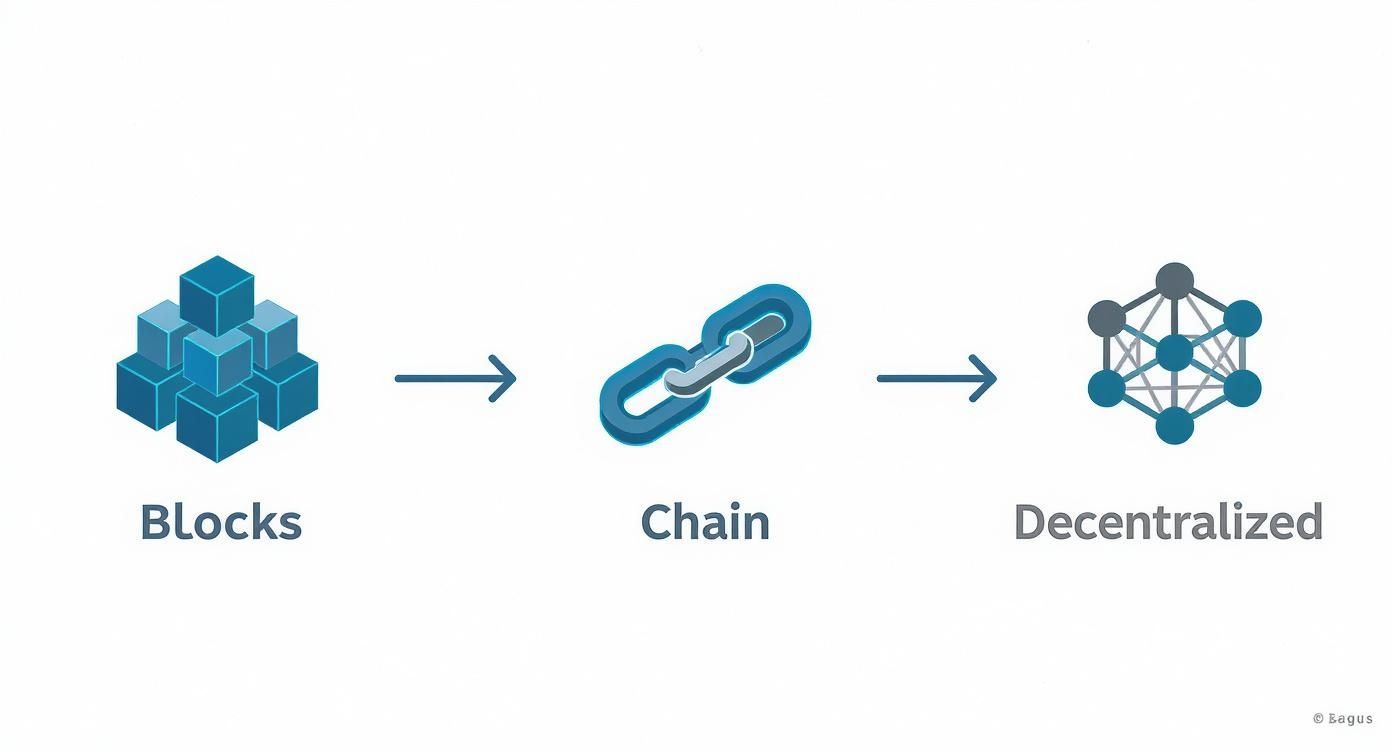
This illustrates the fundamental logic: transactions are gathered into blocks, the blocks are cryptographically linked together, and the entire chain is distributed, creating a shared, secure ledger that everyone can trust.
Bundling Transactions into a New Block
Now, a special group of nodes known as miners (or validators in other systems) steps up. Their job is to grab a batch of pending transactions from the mempool and bundle them into a new block. But to earn the right to add their block to the chain, they have to solve an incredibly difficult mathematical puzzle first.
This competitive process, called mining, demands a huge amount of computational power. The first miner to crack the puzzle gets the prize: they get to add their block—which includes your payment to Alex—to the official blockchain. As soon as that happens, your transaction is confirmed and permanently etched into the public ledger, where it can never be altered or removed.
This drive for secure, transparent systems is fuelling incredible growth. In fact, the blockchain market in the UK is projected to explode from USD 0.66 billion to USD 54.63 billion by 2033. That's a huge leap, showing just how vital this technology is becoming in finance, supply chains, and many other fields. You can explore more data on the UK blockchain market to see how things are shaping up.
After a few more blocks are stacked on top of the one containing your transaction, it's considered fully settled and irreversible. The money is now safely in Alex's wallet.
How Blocks Are Secured and Chained Together
We've covered how transactions get bundled into blocks. But what stops someone from slipping a fake transaction in or, even worse, going back and changing an old record? This is where the real magic of blockchain happens, all thanks to something called cryptographic hashing.
Think of a hash as a unique digital fingerprint for data. It’s created by a special mathematical function that can take any amount of information—a single word or a huge list of transactions—and condense it into a fixed-length string of characters. For example, if you hash the word "Hello," you get a long code. If you hash "hello" (with a small 'h'), you get a completely different code.
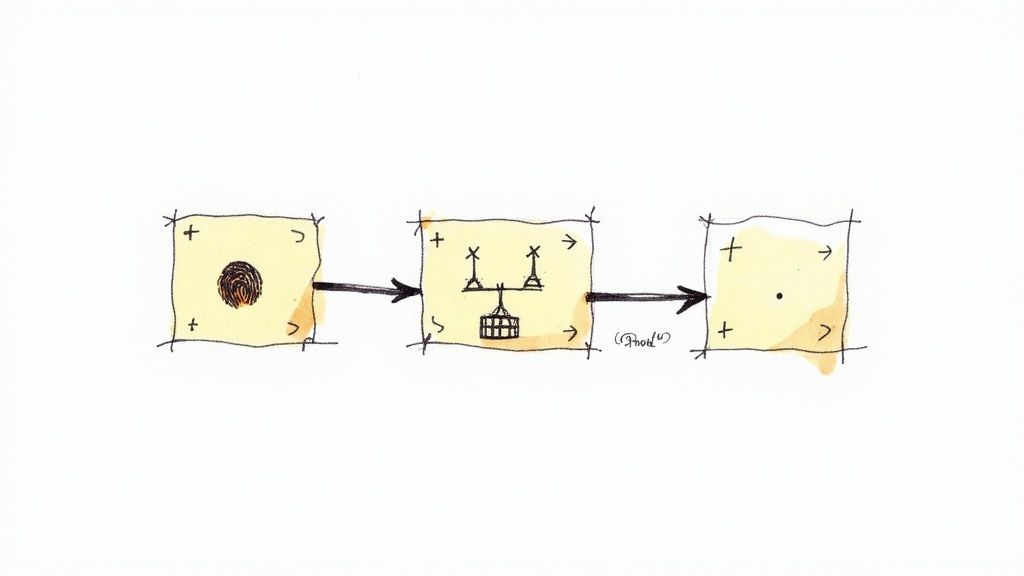
This digital fingerprint is powerful for two key reasons. First, it’s completely unique. Change just one tiny detail in the original data—even a comma—and the resulting hash will look totally different. Second, it's a one-way street. You can easily create a hash from your data, but you can't reverse-engineer the original data just by looking at the hash. This makes it the perfect digital seal.
Forging an Unbreakable Chain
So, how does this fingerprinting system create the 'chain' in blockchain? It’s surprisingly simple. When a new block is built, it doesn't just hold the latest transactions. It also includes the unique hash—that digital fingerprint—of the block that came right before it.
This simple act of referencing the previous block's hash creates a powerful, interlocking chain. Each block is cryptographically tethered to its predecessor, forming a continuous line all the way back to the very first block ever created, which is known as the Genesis Block.
This chaining mechanism is what makes a blockchain immutable, or unchangeable. To alter an old transaction, a fraudster wouldn't just need to edit one block. They’d have to recalculate the hash for that block and every single block that has come after it. On a large network, this would require an astronomical and practically impossible amount of computing power.
Imagine someone tries to alter a transaction in Block 500. The moment they do, the hash of Block 500 changes. This new, fraudulent hash no longer matches the one recorded in Block 501, instantly breaking the chain. The entire network would immediately spot the inconsistency and reject the tampered block.
Summarising Transactions Efficiently with Merkle Trees
A single block can contain thousands of transactions. Hashing them all one-by-one to check the block’s integrity would be incredibly slow. To get around this, blockchains use a very clever data structure called a Merkle Tree.
A Merkle Tree works by organising transactions in pairs and creating a hash for each pair. It then takes those new hashes, pairs them up, and hashes them again. This continues all the way up the tree until only one single hash remains at the top. This final hash is called the Merkle Root.
Let's break it down:
- Individual Hashes: First, a unique hash is created for every single transaction in the block.
- Paired Hashes: These individual hashes are then grouped into pairs, and a new hash is generated for each pair.
- Repeat to the Top: This pairing and hashing process repeats until just one hash is left—the Merkle Root.
This final Merkle Root is like a super-summary, a single fingerprint that represents all the transactions in that block. It gets placed in the block's header, right next to the hash of the previous block.
This system makes verification unbelievably efficient. If you want to confirm that your specific transaction is in a block, you don't need to download and search through thousands of others. You only need a small sliver of the tree's data—a few hashes—to prove it's there.
It's this layered security—the linking of blocks with hashes and the neat summarisation of transactions with Merkle Trees—that turns a simple ledger into a fortress of data integrity. Every piece is designed to make the history of transactions transparent, permanent, and virtually impossible to manipulate without the whole world noticing.
How the Network Agrees on the Truth
https://www.youtube.com/embed/M3EFi_POhps
So far, we've pieced together how transactions get bundled into blocks and chained together. But that leaves one massive question unanswered. In a system with no central authority like a bank, who gets to add the next block? How do thousands of computers scattered across the globe agree on a single, shared history of transactions?
This is where a consensus mechanism comes into play. Think of it as the rulebook that forces everyone on the network to cooperate and agree on one version of the truth. It's the democratic engine of the blockchain, preventing any single person or group from taking control.
There are a few different ways to achieve this, but two have come to dominate the conversation: Proof of Work and Proof of Stake. They both solve the problem of trust, but they go about it in completely different ways.
Proof of Work: The Great Digital Race
Proof of Work (PoW) is the original consensus model, the one that powers Bitcoin. The easiest way to picture it is as a relentless global race. In this system, powerful computers called miners are all competing at the same time to solve an incredibly difficult mathematical puzzle.
This isn't a puzzle that requires clever thinking; it’s all about raw computational power. The miners are effectively guessing trillions of numbers every second, hoping to be the first to stumble upon the correct answer. When a miner finds the solution, they win the "race."
For all that effort (and electricity), the winner gets the right to add the next block to the chain. They’re also rewarded with brand-new cryptocurrency, which is how coins like Bitcoin are created and enter circulation. This whole process makes cheating the system astronomically expensive and difficult.
Proof of Work’s security comes from making bad behaviour incredibly costly. To successfully add a fake block, an attacker would need to control over half of the entire network’s computing power—a feat so expensive it's practically impossible.
Proof of Stake: The Shareholder Vote
Proof of Stake (PoS) is a newer, more energy-efficient alternative that major blockchains like Ethereum now use. Instead of a high-energy race, PoS works more like a company’s shareholder vote.
Here, participants known as validators lock up, or “stake,” a certain amount of their own cryptocurrency as collateral. The network then runs a sort of lottery to choose one of these validators to create the next block. The more crypto a validator stakes, the higher their chance of being picked. For instance, someone staking 100 coins is ten times more likely to be chosen than someone staking just 10.
If a validator is chosen and they add a valid block, they get rewarded with the transaction fees from that block. But here's the clever part: if they try to cheat by validating a fraudulent transaction, they get penalised by losing some, or even all, of their staked crypto. This financial risk is a powerful incentive to keep everyone honest.
Comparing the Two Approaches
Both PoW and PoS get the network to agree on a single source of truth, but their methods, energy costs, and who can participate are worlds apart. Grasping these differences is fundamental to understanding why different blockchains behave the way they do.
To make this clearer, let's break down the key distinctions.
Proof of Work (PoW) vs Proof of Stake (PoS)
| Feature | Proof of Work (e.g., Bitcoin) | Proof of Stake (e.g., Ethereum) |
|---|---|---|
| How It Works | Miners compete to solve a complex puzzle using computational power. | Validators are chosen to create blocks based on the amount of crypto they "stake." |
| Energy Use | Extremely high, as it requires massive amounts of electricity for computations. | Very low, as it doesn't involve intensive puzzle-solving. Can be over 99% more efficient. |
| Security Model | Secured by the high cost of energy and computing hardware. | Secured by the value of the staked crypto that validators risk losing. |
| Who Participates | Anyone with powerful, specialised mining hardware. | Anyone who owns and is willing to stake the network's cryptocurrency. |
| Centralisation Risk | Can lead to centralisation as mining operations consolidate into large pools. | Can lead to centralisation if a few wealthy entities hold a majority of the stake. |
As you can see, these two methods represent a core debate in the crypto world about the best way to keep a network both secure and decentralised. Each has its own strengths and trade-offs, which directly shape the performance, security, and even the environmental footprint of a blockchain.
To dig even deeper into how these systems work, you can explore our detailed guide on understanding consensus mechanisms.
Blockchain Technology in the Real World
It's one thing to talk about consensus mechanisms and cryptographic chains in theory, but where the rubber really meets the road is in how this technology is used to solve actual problems. Let's move past the diagrams and see how blockchain is making an impact.
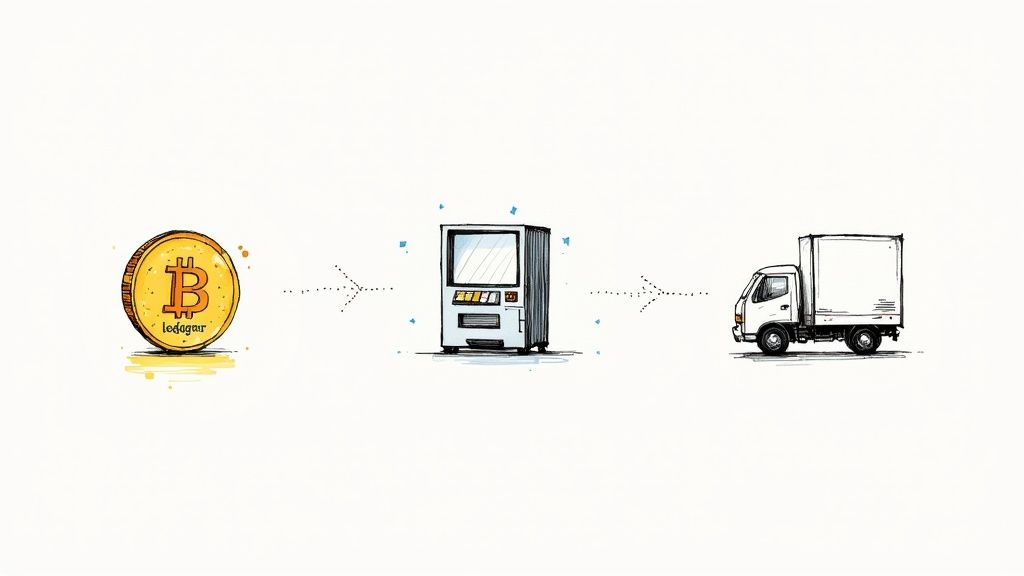
The story, of course, starts with Bitcoin. It was the first, and it’s still the most famous application of blockchain. At its heart, Bitcoin was designed as a peer-to-peer electronic cash system. The big idea was to let people send money directly to each other, anywhere on the planet, without a bank getting in the way. Every single Bitcoin transaction is carved into its public ledger, creating an open and secure payment history for all to see.
Ethereum and the Dawn of Smart Contracts
While Bitcoin proved that blockchain was perfect for sending value, Ethereum came along and asked, "What if we could do more?" It introduced a truly game-changing idea: smart contracts.
Think of a smart contract as a bit of code that lives on the blockchain. It's like a super-powered vending machine; you put in the right input, and it’s programmed to automatically execute a set of instructions without any human meddling.
Imagine buying a digital concert ticket. A smart contract could be written to hold your payment, and the very moment it confirms the funds have arrived, it automatically sends the ticket to your digital wallet. If the payment fails for any reason, the money is instantly returned to you. No ticketing agency, no waiting, and no chance of someone changing the rules halfway through. This self-executing logic blew the doors wide open for what was possible.
A smart contract is an agreement written in code that automatically enforces its own terms. Because it runs on a decentralised network, its execution is guaranteed to be tamper-proof and unstoppable once deployed.
This very innovation paved the way for decentralised finance (DeFi), where people can now lend, borrow, and trade assets without the need for traditional banks or brokers.
Beyond Cryptocurrency and Finance
Finance might have been blockchain's first big stage, but its potential now stretches far into other industries. The technology's core ability to create a secure, shared, and unchangeable record is proving invaluable for solving long-standing problems of trust and transparency.
Here are just a few powerful examples:
- Supply Chain Management: Companies are using blockchain to trace products from farm to fork. A coffee company, for instance, could log every part of a bean’s journey on a blockchain—from the moment it’s picked, to the roaster, and onto the shipping container. This creates an auditable trail that lets consumers verify a product's origin and helps businesses pinpoint problems in their supply chain.
- Digital Identity: Instead of having your personal data spread across countless company databases, blockchain can enable self-sovereign identity. This puts you back in control of your own information, letting you prove things—like being over 18—without having to reveal your exact date of birth. It’s a secure and verifiable way to manage who sees what.
- Healthcare Records: Imagine if your entire medical history was stored securely on a blockchain, owned and controlled by you. You could grant temporary access to a new doctor or a hospital when needed, ensuring your sensitive data stays private and isn't scattered across different systems.
We're already seeing this technology move from the fringes to the mainstream. In the UK, for instance, nearly one in four people now own or use some form of cryptocurrency. This isn't just a niche interest anymore; it reflects a much broader acceptance of digital assets. You can find more insights on the UK's fast growth in crypto adoption and see just how quickly things are changing.
Why Is Blockchain So Secure?
So, we've followed a transaction all the way from a digital wallet to its final, permanent home on the ledger. We’ve seen how blocks are linked together with clever cryptography and how a global network manages to agree on a single source of truth.
Now, let's pull all these threads together to answer the big question: what actually makes this system so incredibly secure?
Blockchain's legendary security isn't the result of a single silver bullet. Instead, it's built on three core principles that work together to create a digital fortress. Once you understand how these layers reinforce each other, you'll see why so many people trust it.
The Power of Decentralisation
First up, and arguably the most important, is decentralisation. Think about how traditional systems work. Your money, your data, your photos—it's all stored on a central server owned by a bank or a tech company. This creates a massive single point of failure. If that one server gets hacked, goes down, or is tampered with, everything is at risk.
Blockchain throws that model out the window. The ledger isn't kept in one place; it’s copied and distributed across thousands of computers (nodes) all over the world. There’s no central target for an attacker to aim at. To corrupt the network, a hacker would have to simultaneously attack and alter the records on the majority of these computers, a feat that is practically impossible.
The strength of a decentralised network lies in its distribution. By eliminating a central point of control, it removes the single greatest vulnerability that plagues traditional digital systems.
This distributed design also means the network is incredibly resilient. Even if a bunch of nodes go offline, the blockchain keeps running. It creates a system that's not only robust but also resistant to censorship, as no single person or organisation can unilaterally change the rules or wipe the history.
The Unbreakable Cryptographic Chain
The second pillar of security is the cryptographic chain itself. As we touched on earlier, every block contains the unique hash—like a digital fingerprint—of the block that came before it. This creates a mathematical and chronological chain that locks the entire ledger together.
This structure is what makes the blockchain effectively immutable, or unchangeable. Imagine someone tries to sneakily alter a transaction in an old block. The moment they do, the hash of that block would completely change. This would instantly break the cryptographic link to the next block, causing a domino effect that invalidates the rest of the chain. The network would immediately spot the discrepancy and reject the fraudulent version.
The visual below helps to picture how this chain reaction works.
As the image shows, any attempt to tamper with one block breaks the chain for all subsequent blocks, making it immediately obvious to everyone on the network.
The Strength of Consensus
Finally, the third pillar is the consensus mechanism. A new block can't just be added to the chain willy-nilly. The network first has to agree that it's valid.
Mechanisms like Proof of Work (PoW) and Proof of Stake (PoS) are essentially rulebooks that ensure everyone is on the same page. For a malicious block to get accepted, an attacker would need to control a huge amount of the network's resources to fool everyone else into accepting their version of reality. This collective agreement is the final piece of the puzzle that protects the ledger's integrity.
If you're keen to dive deeper into the nuts and bolts, our guide on how hash functions power blockchain technology is a great next step.
It’s this combination—decentralisation, cryptography, and consensus—that creates a powerful, multi-layered defence, making blockchain one of the most secure systems ever devised for recording information.
Frequently Asked Questions About Blockchain
Even with a good grasp of the basics, a few questions tend to crop up again and again. Let's tackle some of the most common ones to help lock in your understanding.
Think of this as tying up the loose ends.
Is Blockchain the Same as Bitcoin?
That's a common point of confusion, but no, they're not the same. It helps to think of it like this: blockchain is the operating system (like iOS), while Bitcoin is just one app that runs on it (like your banking app).
Blockchain is the underlying technology that makes Bitcoin possible. But its uses go far beyond a single cryptocurrency. Countless other projects, from Ethereum's smart contracts to systems tracking goods across the globe, are all built on different versions of blockchain technology.
Can a Blockchain Be Hacked or Changed?
For a big, public network, it's incredibly difficult—bordering on impossible. Imagine someone wanted to change a transaction that happened yesterday. First, they’d have to alter the data in that specific block, which would instantly change its unique digital fingerprint, its hash.
Because every block is cryptographically chained to the one before it, changing one block creates a domino effect. The attacker would have to re-mine not just that block, but every single block that has been added to the chain since.
To pull off this kind of heist on a network like Bitcoin, an attacker would need to control over 50% of the entire network's computational power. The sheer cost and coordination required for that is astronomical, making it practically infeasible. The rest of the network would simply see the fraudulent chain and reject it.
This built-in, distributed defence is what gives blockchain its renowned security.
Does Blockchain Use a Lot of Energy?
This one is a "yes and no" answer, and it all comes down to the blockchain's design. The system that Bitcoin uses, known as Proof of Work (PoW), is notoriously power-hungry. It forces computer "miners" to compete in a constant race to solve complex maths problems, which consumes a vast amount of electricity.
However, the industry recognised this problem years ago. Many modern blockchains now use a far more efficient alternative called Proof of Stake (PoS). Instead of raw computing power, PoS relies on an economic stake in the network to secure it. This approach can be over 99% more energy-efficient, effectively solving one of the biggest criticisms levelled at the technology.
Ready to build a solid foundation in digital assets? At The Coin Course, we provide clear, expert-led guides to help you understand everything from the basics of blockchain to advanced investment strategies. Start your learning journey today at https://thecoincourse.com.